Unit 5 Languages Around the World 单元基础练 -2026-2027学年高中英语人教版必修第一册
2026-09-20
|
2份
|
9页
|
5人阅读
|
0人下载
摘要:
**基本信息**
聚焦Unit 5语言主题,通过语法、短语、句子及语篇四层递进训练,系统巩固定语从句、非谓语等核心语法及固定搭配,提升语言应用与知识整合能力。
**专项设计**
|模块|题量/典例|题型特征|知识逻辑|
|----|-----------|----------|----------|
|单句语法填空|9题(如定语从句连接词)|聚焦语法点单题考查|基础语法点(定语从句、非谓语等)直接应用|
|短语填空|8题(如date back to)|固定搭配辨析与运用|核心短语在语境中的准确选用|
|完成句子|5题(如汉译英结合语法)|语法与短语结合的句子翻译|语法规则与短语搭配的综合应用|
|语法填空|10题(语篇填空)|语篇层面综合语法考查|从单句到语篇的知识整合与逻辑运用|
内容正文:
高一( )班 姓名__________________ 座号________ 第( )组
高一英语单元基础训练
Book 1 Unit 5 Languages Around the World(一)
Ⅰ. 单句语法填空
1. People often refer to Chinese characters ________________ symbols that carry culture and history.
2. Despite ________________ (face) many changes, the Chinese writing system has continued into modern times.
3. The tradition ________________ (date) back hundreds of years and is still practised today.
4. There is a great ________________ (vary) of languages spoken around the world.
5. Writing is an important ________________ (mean) of communication.
6. I still remember the year ________________ I first became interested in learning Chinese.
7. The language club is a place ________________ students can practise speaking with one another.
8. This is the reason ________________ many learners keep a vocabulary notebook.
9. I would greatly appreciate ________________ if you could give me some advice on pronunciation.
Ⅱ. 短语填空
refer to; date back to; be based on; ups and downs; no matter where; relate to; point of view; play a key role in
1. When you meet an unfamiliar expression, you may ______________________________ a dictionary or your notes.
2. The history of these written symbols can ______________________________ ancient times.
3. Good language learning should ______________________________ regular practice rather than short-term memory.
4. Every language experiences ______________________________ as society changes.
5. ______________________________ Chinese learners live, they can communicate through the same writing system.
6. Many differences in language ______________________________ history, culture and ways of life.
7. From my ______________________________, making mistakes is a natural part of learning a language.
8. The Chinese writing system has ______________________________ connecting the past with the present.
高一( )班 姓名__________________ 座号________ 第( )组
Book 1 Unit 5(一)
Ⅲ. 完成句子
1. 这种书写传统可以追溯到古代。(date back to)
This writing tradition ________________ ________________ ________________ ancient times.
2. 这项研究以真实的语言学习经历为基础。(be based on)
The study ________________ ________________ ________________ real language-learning experiences.
3. 无论中国人住在哪里,他们都可以用汉字交流。(no matter where)
________________ ________________ ________________ Chinese people live, they can communicate in writing.
4. 我仍然记得我第一次在课堂上用英语发言的那一天。(when)
I still remember the day ________________ I first spoke English in class.
5. 如果你能给我一些实用的学习建议,我将不胜感激。(appreciate)
I would ________________ ________________ ________________ you could give me some practical advice on learning.
Ⅳ. 语法填空
The Chinese writing system is one of the main factors that have helped Chinese civilisation continue into modern times. Written Chinese began as a picture-based language. It 1. ________________ (date) back several thousand years to symbols carved on animal bones and shells. By the Shang Dynasty, the symbols had developed into a 2. ________________ (full) formed writing system.
Later, geographical division led to different dialects and forms of characters. This was a period 3. ________________ communication between regions could be difficult. After Emperor Qinshihuang united the seven major states, the writing system began to develop in one direction, 4. ________________ (allow) people from different areas to communicate more easily. It also became an important means 5. ________________ which Chinese culture was passed down. Even today, no matter 6. ________________ Chinese people live, they can still communicate in writing. The system connects the present 7. ________________ the past and enables people to read ancient works. Chinese calligraphy, 8. ________________ is also an art form, remains an important part of Chinese culture. As China plays a greater role in global affairs, an increasing number of international students 9. ________________ (begin) to appreciate Chinese culture through the language. This is one reason 10. ________________ written Chinese continues to attract learners around the world.
1. ____________ 2. ____________ 3. ____________ 4. ____________ 5. ____________
6. ____________ 7. ____________ 8. ____________ 9. ____________ 10. ____________
高一( )班 姓名__________________ 座号________ 第( )组
高一英语单元基础训练
Book 1 Unit 5 Languages Around the World(二)
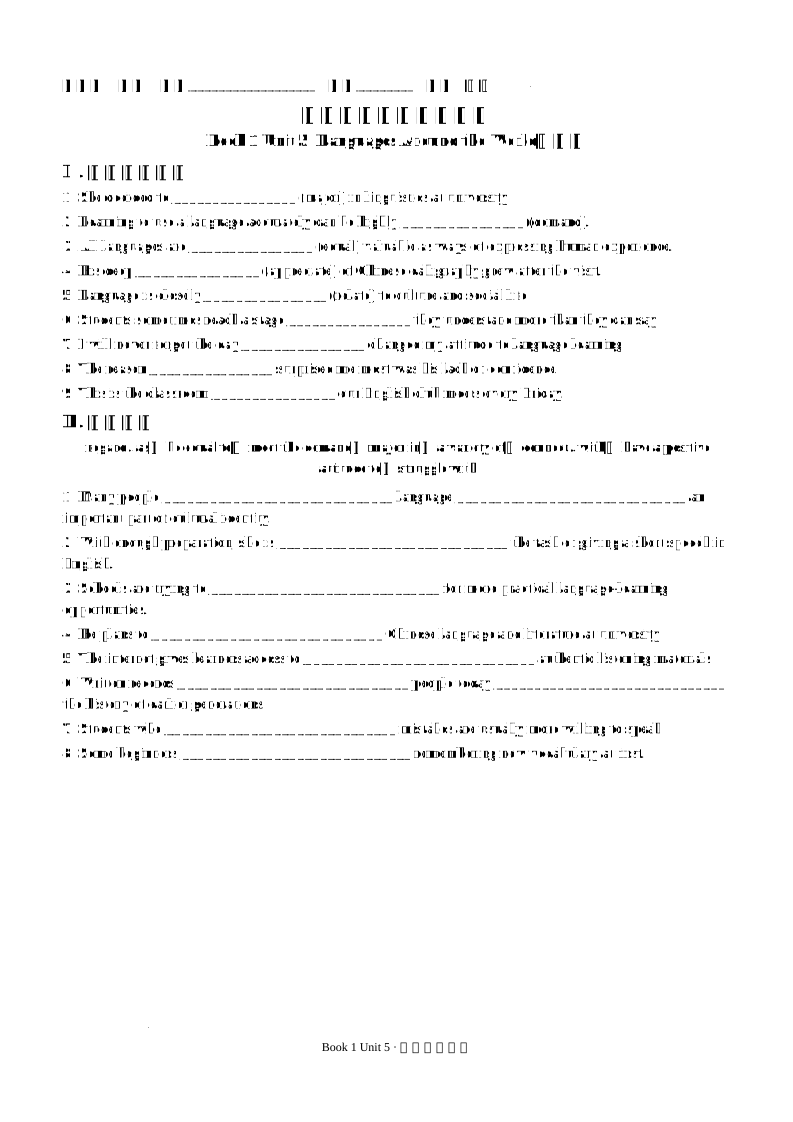
Ⅰ. 单句语法填空
1. She decided to ________________ (major) in linguistics at university.
2. Learning to use a language accurately can be highly ________________ (demand).
3. All languages are ________________ (equal) valuable as ways of expressing human experience.
4. His deep ________________ (appreciate) of Chinese calligraphy grew after the visit.
5. Language is closely ________________ (relate) to culture and social life.
6. Students sometimes reach a stage ________________ they understand more than they can say.
7. I will never forget the day ________________ changed my attitude to language learning.
8. The reason ________________ surprised me most was his lack of confidence.
9. This is the classroom ________________ our English club meets every Friday.
Ⅱ. 短语填空
regard...as; be equal to; meet the demand; major in; a variety of; connect...with; have a positive attitude to; struggle with
1. Many people ______________________________ language ______________________________ an important part of cultural identity.
2. With enough preparation, she is ______________________________ the task of giving a short speech in English.
3. Schools are trying to ______________________________ for more practical language-learning opportunities.
4. He plans to ______________________________ Chinese language and literature at university.
5. The internet gives learners access to ______________________________ authentic listening materials.
6. Written records ______________________________ people today ______________________________ the history of earlier generations.
7. Students who ______________________________ mistakes are usually more willing to speak.
8. Some beginners ______________________________ remembering new vocabulary at first.
高一( )班 姓名__________________ 座号________ 第( )组
Book 1 Unit 5(二)
Ⅲ. 完成句子
1. 在我看来,理解文化有助于我们更好地学习语言。(point of view)
From my ________________ ________________ ________________, understanding culture helps us learn a language better.
2. 她大学主修英语语言文学。(major in)
She ________________ ________________ English language and literature at university.
3. 语言与文化和历史密切相关。(be related to)
Language ________________ closely ________________ ________________ culture and history.
4. 这就是我开始每天朗读英语的原因。(why)
This is the reason ________________ I began to read English aloud every day.
5. 学习者常常会到达一个需要更多真实交流的阶段。(where)
Learners often reach a stage ________________ they need more real communication.
Ⅳ. 语法填空
Many students can remember a time 1. ________________ learning a foreign language seemed especially difficult. Some struggle with vocabulary, while others find listening or speaking more 2. ________________ (demand). The important thing is to understand the reason 3. ________________ a problem occurs and then choose a suitable way to deal with it.
A language-learning blog can be a useful place 4. ________________ students share problems and practical advice. One learner may explain the method 5. ________________ helped her remember new words; another may describe the situation 6. ________________ he finally became confident enough to speak. Learners should also have a positive attitude 7. ________________ mistakes, because mistakes are a normal part of progress. Regular reading can enlarge a learner's 8. ________________ (vocabulary), while listening and speaking practice help connect knowledge 9. ________________ real communication. Above all, students should remember that no single method is 10. ________________ (equal) effective for all learners.
1. ____________ 2. ____________ 3. ____________ 4. ____________ 5. ____________
6. ____________ 7. ____________ 8. ____________ 9. ____________ 10. ____________
高一( )班 姓名__________________ 座号________ 第( )组
高一英语单元基础训练
Book 1 Unit 5 Languages Around the World(三)
Ⅰ. 单句语法填空
1. Many modern language-learning methods are ________________ (base) on repeated exposure and use.
2. Beginners often struggle ________________ (understand) fast natural speech.
3. A learner’s attitude ________________ mistakes can strongly affect progress.
4. There is a growing demand ________________ people who can communicate across cultures.
5. The word “native” may refer ________________ a person who was born in a particular place.
6. The cultural centre is a place ________________ people from different backgrounds meet and communicate.
7. There are times ________________ a learner needs to slow down and review what has been learned.
8. The reason ________________ language changes over time is closely related to society and culture.
9. The school has created a situation ________________ students can use English beyond the classroom.
Ⅱ. 短语填空
despite all difficulties; struggle for; appreciate the value of; meet the demand; have a positive attitude to; be related to; refer to...as; no matter what
1. ______________________________, the student kept practising English every day.
2. People in many parts of the world have long ______________________________ equal access to education.
3. Learning another language can help us ______________________________ different cultures and ways of thinking.
4. More practical courses are being offered to ______________________________ for real-life English practice.
5. Successful learners usually ______________________________ challenges and mistakes.
6. The meaning of a word may ______________________________ the history and culture of the community that uses it.
7. People sometimes ______________________________ English ______________________________ a global language because of its wide use.
8. ______________________________ language you choose to learn, regular practice is necessary.
高一( )班 姓名__________________ 座号________ 第( )组
Book 1 Unit 5(三)
Ⅲ. 完成句子
1. 汉字书写体系在连接中国的过去与现在方面发挥着重要作用。(play a key role in)
The Chinese writing system ________________ ________________ ________________ ________________ connecting China’s past with its present.
2. 越来越多的国际学生开始学习汉语。(an increasing number of)
________________ ________________ ________________ ________________ international students are beginning to learn Chinese.
3. 保护语言多样性对于理解人类文化非常重要。(of great importance)
Protecting language diversity ________________ ________________ ________________ ________________ for understanding human culture.
4. 我永远不会忘记我第一次独立完成英文演讲的那一刻。(when)
I will never forget the moment ________________ I completed an English speech on my own for the first time.
5. 使他改变学习计划的原因是时间不足。(that/which)
The reason ________________ made him change his study plan was a lack of time.
Ⅳ. 语法填空
Languages change because the communities that use them also change. Every language develops in a social and cultural environment 1. ________________ people communicate, work and live together. There are times 2. ________________ contact between different groups brings new words and expressions into a language. This is one reason 3. ________________ languages often contain words borrowed from others.
Language is also a means 4. ________________ expressing identity and culture. People may struggle 5. ________________ (protect) a local language when fewer young people use it, because losing a language can mean losing part of a community's history. At the same time, global communication creates a growing demand 6. ________________ people who can use more than one language. Learning another language can help us relate 7. ________________ people from different backgrounds and appreciate the 8. ________________ (vary) of human experience. No matter 9. ________________ language we learn, it is useful to keep an open attitude and practise regularly. A language becomes meaningful when it is used in situations 10. ________________ real communication takes place.
1. ____________ 2. ____________ 3. ____________ 4. ____________ 5. ____________
6. ____________ 7. ____________ 8. ____________ 9. ____________ 10. ____________
Book 1 Unit 5 · 单元基础训练
学科网(北京)股份有限公司
$
高一英语单元基础训练·教师答案
Book 1 Unit 5 Languages Around the World(一)
Ⅰ. 单句语法填空
1. as
2. facing
3. dates
4. variety
5. means
6. when
7. where
8. why
9. it
Ⅱ. 短语填空
1. refer to
2. date back to
3. be based on
4. ups and downs
5. No matter where
6. relate to
7. point of view
8. played a key role in
Ⅲ. 完成句子
1. dates back to
2. is based on
3. No matter where
4. when
5. appreciate it if
Ⅳ. 语法填空
1. dates date back to 在这里描述历史事实,主语 It 为第三人称单数。
2. fully 副词 fully 修饰 formed。
3. when 先行词 a period 表时间,从句成分完整,when 作时间状语。
4. allowing 现在分词作结果状语。
5. by by means of / a means by which 表示“通过……方式”。
6. where no matter where 引导让步状语从句。
7. with connect A with B 为固定搭配。
8. which 非限制性定语从句修饰 Chinese calligraphy,用 which。
9. are beginning 语境说明当前正在出现的趋势,主语 students 为复数。
10. why 先行词 reason,从句主干完整,why 作原因状语。
高一英语单元基础训练·教师答案
Book 1 Unit 5 Languages Around the World(二)
Ⅰ. 单句语法填空
1. major
2. demanding
3. equally
4. appreciation
5. related
6. where
7. that/which
8. that/which
9. where
Ⅱ. 短语填空
1. regard; as
2. equal to
3. meet the demand
4. major in
5. a variety of
6. connect; with
7. have a positive attitude to
8. struggle with
Ⅲ. 完成句子
1. point of view
2. majored in
3. is; related to
4. why
5. where
Ⅳ. 语法填空
1. when 先行词 a time 表时间,从句完整,when 作时间状语。
2. demanding find + 宾语 + 形容词宾语补足语;demanding 表示“费力的、要求高的”。
3. why 先行词 reason,从句完整,why 作原因状语。
4. where 先行词 place,从句完整,where 作地点状语。
5. that/which 先行词 method 在从句中作主语,用关系代词。
6. where 先行词 situation 为抽象地点,从句完整,where 作状语。
7. to/towards have a positive attitude to/towards...。
8. vocabulary vocabulary 作“词汇量”时可作不可数名词。
9. with connect A with B。
10. equally 副词 equally 修饰形容词 effective。
高一英语单元基础训练·教师答案
Book 1 Unit 5 Languages Around the World(三)
Ⅰ. 单句语法填空
1. based
2. to understand
3. to/towards
4. for
5. to
6. where
7. when
8. why
9. where
Ⅱ. 短语填空
1. Despite all difficulties
2. struggled for
3. appreciate the value of
4. meet the demand
5. have a positive attitude to
6. be related to
7. refer to; as
8. No matter what
Ⅲ. 完成句子
1. plays a key role in
2. An increasing number of
3. is of great importance
4. when
5. that/which
Ⅳ. 语法填空
1. where 先行词 environment 表环境/情境,从句完整,where 作地点状语。
2. when 先行词 times 表时间,从句完整,when 作时间状语。
3. why 先行词 reason,从句完整,why 作原因状语。
4. of a means of doing sth 表示“做某事的一种方式”。
5. to protect struggle to do sth 表示“努力做某事”。
6. for a demand for... 表示“对……的需求”。
7. to relate to...。
8. variety the variety of... 表示“……的多样性”。
9. what no matter what + 名词,引导让步状语从句。
10. where 先行词 situations 为抽象地点,从句完整,where 作状语。
Book 1 Unit 5 · 教师答案
学科网(北京)股份有限公司
$
资源预览图

1

2
3

相关资源
示范课
高中英语人教版(2019)必修一 Unit5 Languages Around the World
立即播放 高中英语人教版(2019)必修一 Unit5 Languages Around the World
立即播放由于学科网是一个信息分享及获取的平台,不确保部分用户上传资料的 来源及知识产权归属。如您发现相关资料侵犯您的合法权益,请联系学科网,我们核实后将及时进行处理。