Unit 6 A Rising Self课时2 Function & Pronunciation 部分课时练习 2026-2027学年仁爱科普版九年级英语上册
2026-08-06
|
6页
|
94人阅读
|
0人下载
摘要:
**基本信息**
初中英语新授课同步练,以“词汇-句型-语篇”分层递进设计,强化语言能力与思维品质,适配课时目标实现基础巩固与综合应用衔接。
**分层设计**
|层次|知识覆盖|设计特色|
|----|----------|----------|
|基础层|音标、单词(如音标写单词、单词写音标)|通过音形互转夯实词汇基础,培养语言能力|
|进阶层|句型补全、词形变化(如完成句子、用所给词适当形式填空)|结合主题语境强化语法应用,提升思维逻辑性|
|综合层|语篇填空、阅读(如短文填空、阅读还原、阅读理解)|以Nan Rendong和Marie Curie事迹为载体,融合信息提取与文化意识,深化综合语言运用能力|
内容正文:
2026-2027学年仁爱版九年级上 Unit 6 A Rising Self
课时2 Function & Pronunciation 部分课时练习
一、根据音标写单词(写出对应的英文单词)
1. /ˈɪnstɪtjuːt/ __________
2. /əbˈzɜːv/ __________
3. /ˈsɪɡnəl/ __________
4. /əˈwɔːd/ __________
5. /eks reɪ/ __________
6. /ədˈmaɪə/ __________
7. /ˈwɪnə/ __________
8. /dɪˈvəʊtɪd/ __________
二、根据单词写音标(写出对应的音标,注意音标格式)
1. observe /__________/
2. signal /__________/
3. award /__________/
4. institute /__________/
5. admire /__________/
6. winner /__________/
7. physics /__________/
8. missile /__________/
三、完成句子(根据中文提示补全英文句子,每空一词)
1. 南仁东被称为FAST之父。
Nan Rendong is called "The ______ of FAST".
2. FAST被用来观测宇宙。
FAST is used to ______ the universe.
3. 它可以接收来自100亿光年外的恒星信号。
It can receive ______ from stars that are 10 ______ light years away.
4. 玛丽·居里是第一位获得诺贝尔奖的女性。
Marie Curie was the ______ woman to win the Nobel Prize.
5. 她曾在两个不同领域两次获得该奖项。
She won the ______ twice in two ______ fields.
四、用括号内所给词的适当形式填空
1. Nan Rendong spent about 22 years on this project ______ (make) it what it is today.
2. She ______ (award) the 1903 Nobel Prize for Physics.
3. Her research helped with the ______ (develop) of X-ray machines.
4. With those machines, doctors could examine patients ______ (easy).
5. She was one of the ______ (great) scientists in human history.
6. It is used to observe the universe and can receive signals from stars that are 10 billion light years ______ (away).
五、阅读短文,在空白处填入一个适当的词或用括号内所给词的正确形式填空
Nan Rendong was a Chinese scientist (1) ______ is called the Father of FAST. FAST is the world's largest telescope and it is also (2) ______ (know) as China's Sky Eye. It is used (3) ______ (observe) the universe and can receive signals from stars that are 10 billion light years away. Nan Rendong spent about 22 years (4) ______ this project to make it what it is today. He worked very hard and was (5) ______ (devote) to his research.
Marie Curie was the first woman to win the Nobel Prize. She was (6) ______ (award) the 1903 Nobel Prize for Physics and the 1911 Nobel Prize for Chemistry. Her research (7) ______ (help) with the development of X-ray machines. (8) ______ those machines, doctors could examine patients easily and saved many (9) ______ (life) during World War II. She was (10) ______ (true) one of the greatest scientists in human history.
六、阅读还原(从A-E五个选项中选出恰当的一项填入短文空缺处,使短文完整流畅)
Great People We Admire
There are many great people in history who have made significant contributions to the world. (1) ______ They inspire us with their achievements and spirits.
Nan Rendong is one of them. He is called the Father of FAST. (2) ______ He spent 22 years on this project. His hard work made it possible to observe the universe in a new way.
Marie Curie is another great scientist. (3) ______ She won the Nobel Prize twice in two different fields. Her research helped improve X‑ray machines and saved many lives.
Both Nan Rendong and Marie Curie devoted their lives to their work. (4) ______ They never gave up, even when faced with difficulties. Their stories remind us that with hard work and dedication, we can achieve great things.
(5) ______ We should learn from their example and try to make a difference in our own lives.
A. Her discoveries greatly pushed forward the development of science.
B. They set good role models for young people.
C. He led the building of China’s FAST telescope.
D. Lots of young people look up to these heroes.
E. It takes plenty of time and effort to achieve big goals.
(1) ________ (2) ________ (3) ________ (4) ________ (5) ________
七、阅读理解(A篇为说明文,B篇为记叙文,每题仅有一个最佳选项)
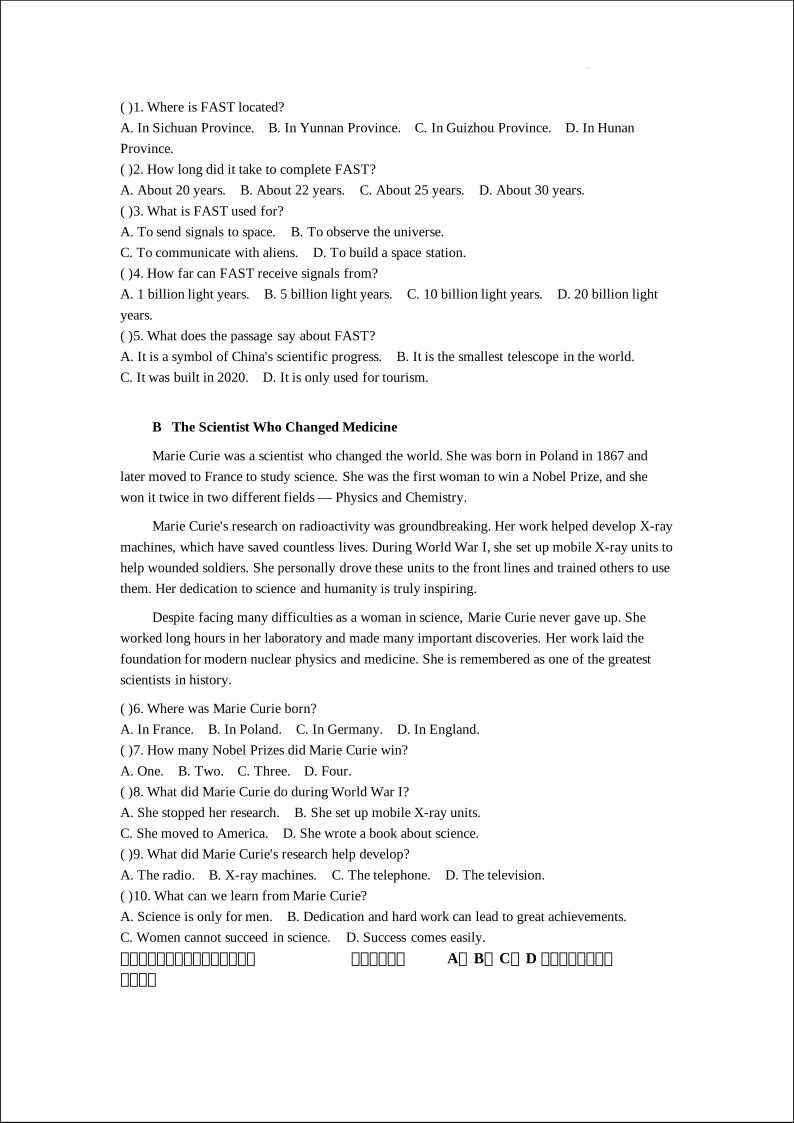
A FAST — China's Sky Eye
FAST, also known as China's Sky Eye, is the world's largest and most sensitive radio telescope. It is located in a natural basin in Guizhou Province, China. The telescope is 500 meters in diameter, which is about the size of 30 football fields.
FAST was designed by Chinese scientist Nan Rendong and his team. It took about 22 years to complete the project. The telescope is used to observe the universe and search for signals from distant stars and galaxies. It can receive signals from 10 billion light years away. This makes it a powerful tool for exploring the mysteries of the universe.
Since it began operating, FAST has made many important discoveries. It has found new pulsars and helped scientists learn more about the universe. FAST has also become a symbol of China's scientific and technological progress. It attracts many tourists and scientists from around the world.
( )1. Where is FAST located?
A. In Sichuan Province. B. In Yunnan Province. C. In Guizhou Province. D. In Hunan Province.
( )2. How long did it take to complete FAST?
A. About 20 years. B. About 22 years. C. About 25 years. D. About 30 years.
( )3. What is FAST used for?
A. To send signals to space. B. To observe the universe.
C. To communicate with aliens. D. To build a space station.
( )4. How far can FAST receive signals from?
A. 1 billion light years. B. 5 billion light years. C. 10 billion light years. D. 20 billion light years.
( )5. What does the passage say about FAST?
A. It is a symbol of China's scientific progress. B. It is the smallest telescope in the world.
C. It was built in 2020. D. It is only used for tourism.
B The Scientist Who Changed Medicine
Marie Curie was a scientist who changed the world. She was born in Poland in 1867 and later moved to France to study science. She was the first woman to win a Nobel Prize, and she won it twice in two different fields — Physics and Chemistry.
Marie Curie's research on radioactivity was groundbreaking. Her work helped develop X-ray machines, which have saved countless lives. During World War I, she set up mobile X-ray units to help wounded soldiers. She personally drove these units to the front lines and trained others to use them. Her dedication to science and humanity is truly inspiring.
Despite facing many difficulties as a woman in science, Marie Curie never gave up. She worked long hours in her laboratory and made many important discoveries. Her work laid the foundation for modern nuclear physics and medicine. She is remembered as one of the greatest scientists in history.
( )6. Where was Marie Curie born?
A. In France. B. In Poland. C. In Germany. D. In England.
( )7. How many Nobel Prizes did Marie Curie win?
A. One. B. Two. C. Three. D. Four.
( )8. What did Marie Curie do during World War I?
A. She stopped her research. B. She set up mobile X-ray units.
C. She moved to America. D. She wrote a book about science.
( )9. What did Marie Curie's research help develop?
A. The radio. B. X-ray machines. C. The telephone. D. The television.
( )10. What can we learn from Marie Curie?
A. Science is only for men. B. Dedication and hard work can lead to great achievements.
C. Women cannot succeed in science. D. Success comes easily.
八、完形填空(阅读下面的短文,从每题所给的A、B、C、D四个选项中选出最佳选项)
Nan Rendong was a great Chinese (1) ______. He is known as the Father of FAST. He spent about 22 years (2) ______ this project. The telescope is (3) ______ to observe the universe. It can receive signals from stars that are 10 billion light years away. He worked very hard and was (4) ______ to his work. His dedication (5) ______ us that with hard work, we can achieve great things.
Marie Curie was (6) ______ first woman to win the Nobel Prize. She won the award (7) ______ in Physics and Chemistry. Her research helped with the development of X-ray machines. (8) ______ machines saved many lives during World War II. She is remembered as one of the (9) ______ scientists in history. We should all (10) ______ these great people and learn from their example.
( )1. A. engineer B. scientist C. doctor D. explorer
( )2. A. in B. on C. at D. for
( )3. A. used B. made C. designed D. produced
( )4. A. devoted B. bored C. tired D. excited
( )5. A. teaches B. speaks C. talks D. says
( )6. A. a B. an C. the D. /
( )7. A. once B. twice C. three times D. four times
( )8. A. These B. Those C. This D. That
( )9. A. great B. greater C. greatest D. more great
( )10. A. admire B. forget C. ignore D. dislike
九、阅读回答(阅读下面的音标知识短文,根据短文内容回答下列问题,每题答案不超过6个单词)
Weak Forms and Stresses in English
In spoken English, not all words are pronounced with the same strength. Some words are stressed, while others are weak. This is called "weak form" and "stress."
Content words like nouns, verbs, adjectives, and adverbs are usually stressed. They are pronounced clearly and with more force. Function words like articles, prepositions, and pronouns are often weak. They are pronounced more quickly and with less force. For example, in the sentence "She is a teacher," the words "She" and "teacher" are stressed, while "is" and "a" are weak.
Using weak forms and stresses correctly makes your English sound more natural and fluent. It also helps listeners understand you better. You can practice by listening to native speakers and noticing which words they stress. With practice, you can improve your pronunciation and become a better speaker.
1. What are content words?
2. What are function words?
3. Give one example of a content word from the text.
4. Why should we use weak forms and stresses?
5. How can we practice weak forms and stresses?
参考答案
一、根据音标写单词
1. institute 2. observe 3. signal 4. award
5. X-ray 6. admire 7. winner 8. devoted
二、根据单词写音标
1. /əbˈzɜːv/ 2. /ˈsɪɡnəl/ 3. /əˈwɔːd/ 4. /ˈɪnstɪtjuːt/
5. /ədˈmaɪə/ 6. /ˈwɪnə/ 7. /ˈfɪzɪks/ 8. /ˈmɪsaɪl/
三、完成句子
1. Father 2. observe 3. signals; billion 4. first 5. award; different
四、用括号内所给词的适当形式填空
1. to make 2. was awarded 3. development 4. easily 5. greatest 6. away
五、短文填空
1. who 2. known 3. to observe 4. on 5. devoted
6. awarded 7. helped 8. With 9. lives 10. truly
六、阅读还原
1.D 2.C 3.A 4.E 5.B
七、阅读理解
A篇:1. C 2. B 3. B 4. C 5. A
B篇:6. B 7. B 8. B 9. B 10. B
八、完形填空
1. B 2. B 3. A 4. A 5. A
6. C 7. B 8. A 9. C 10. A
九、阅读回答
1. Nouns, verbs, adjectives, adverbs.
2. Articles, prepositions, pronouns.
She / teacher / etc.
Sound more natural.
Listen to native speakers.
学科网(北京)股份有限公司
$
资源预览图

1

2
3
相关资源
示范课
由于学科网是一个信息分享及获取的平台,不确保部分用户上传资料的 来源及知识产权归属。如您发现相关资料侵犯您的合法权益,请联系学科网,我们核实后将及时进行处理。