Unit 1 People of Achievement Reading and Thinking 课件-2026-2027学年高二英语人教版选择性必修第一册
2026-07-25
|
2份
|
14页
|
5162人阅读
|
14人下载
普通
摘要:
该高中英语课件围绕“Unit 1 People of Achievement”展开,核心聚焦屠呦呦事迹,通过词汇学习、文本分析等活动培养人物品质描述与语篇理解能力。课堂导入先呈现diligent、persistent等伟人品质词汇激活认知,再播放屠呦呦短视频建立联系,通过段落主旨匹配、细节扫读搭建从词汇到语篇的学习支架。
其亮点在于融合语言能力、文化意识与思维品质培养。语言能力上,通过圈画数字(如200 million疟疾患者)分析药效,填空练习巩固语法;文化意识上,链接传统中医文本与现代科研,体现家国情怀;思维品质通过实验步骤排序(测试干青蒿、煮沸、低温提取等)培养逻辑分析。采用任务型教学,流程图梳理发现过程,学生提升语用能力与文化认同,教师可直接使用结构化活动提高教学效率。
内容正文:
Unit 1
People of achievement
Reading and Thinking
What are the qualities of these great people?
Can you use some descriptive words to describe them?
diligent
talented
selfless
persistent
devoted
courageous
kind-hearted
considerate
A person of great value
A short video about Tu Youyou
Where would you most likely find this passage?
title
date
The illustrations
The passage
In a newspaper
News story
= was awarded
(more concise and brief )
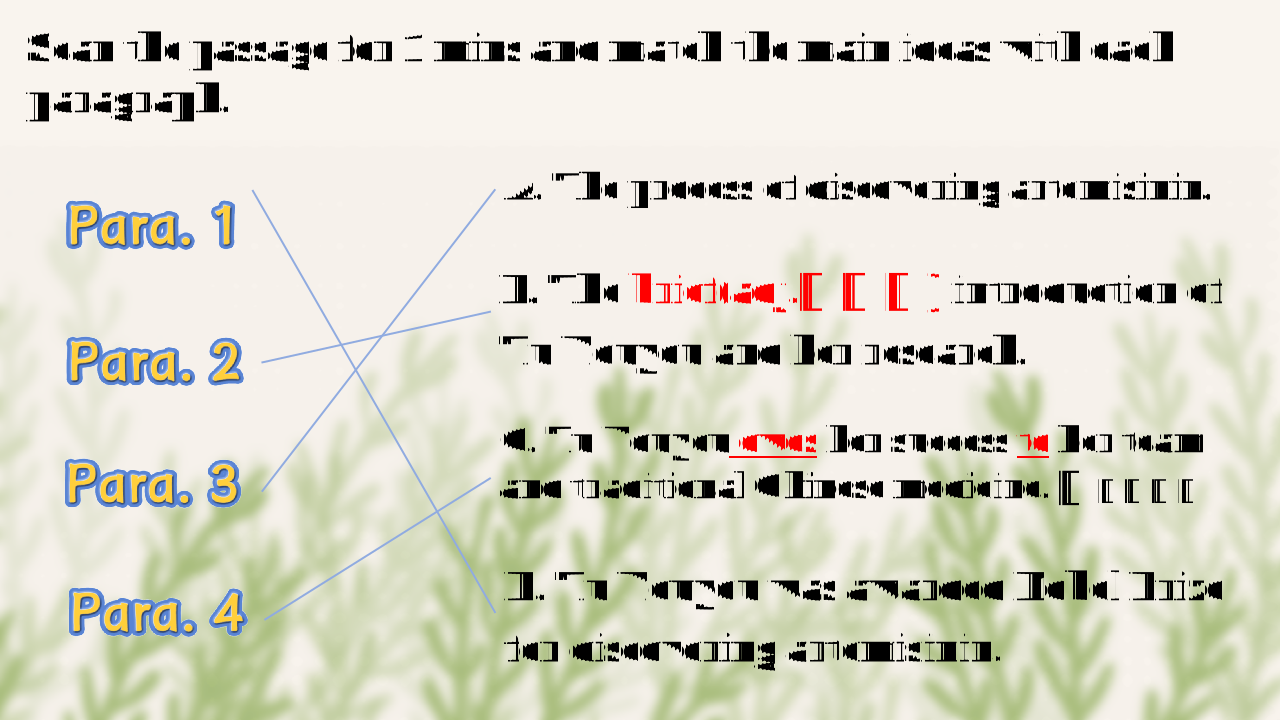
Scan the passage for 1 mins and match the main ideas with each paragraph.
D. Tu Youyou was awarded Nobel Prize for discovering artemisinin.
B. The brief(adj.简短的) introduction of Tu Youyou and her research.
A. The process of discovering artemisinin.
C. Tu Youyou owes her success to her team and traditional Chinese medicine. 【归功于】
[Read for 1 min to finish the tasks below]
1. Circle all the numbers; 2. What do the numbers indicate?
1.The second and the fourth sentence show how effective artemisinin is in medical treatment.
2.The third sentence shows terrible circumstances caused by malaria.
Careful Reading Para. 1
Careful Reading Para. 2
birthplace
education
occupation
personality
mission
P2: Tu Youyou's personal profile & her study
Tu Youyou's personal profile
Birthplace
Birthdate
Education
Occupation
Personality
Her Mission
Ningbo, China
30 December 1930
graduated from Peking University Medical School
worked at the China Academy of Traditional Chinese Medicine in Beijing
committed and patient
To discover a new treatment for malaria
Her study
went to Hainan to study malaria patients
examined over 2, 000 ancient Chinese medical texts
evaluated 280, 000 plants
discovered and tested 380 distinct ancient Chinese medical treatments
Fieldwork
Literature review
Proof test
Careful Reading Para. 3
P3: Tu Youyou & her team's experiment
tested dried wormwood leaves
tried boiling fresh wormwood
Used a lower temperature to draw out the extract
failed more than 190 times
finally succeeded
tested the medicine on themselves
Tu Youyou's team examined _1_, and evaluated _2_.
They found a medical text suggesting _3_.
They tested _4_.
They tried _5_, but _6_.
They used a _7_ the sweet wormwood extract.
They tested the medicine _8_ to see if safe.
They tested the medicine on _9_.
The medicine became _10_ for malaria.
How was artemisinin discovered?
Answers:
1. old medical texts
2. 280,000 plants
3. using the extract from sweet
wormwood to treat a fever
4. dried wormwood leaves
5. boiling fresh wormwood and using the liquid
6. this did not work either
7. lower temperature to draw out
8. on themselves
9. malaria patients
10. a standard treatment
Careful Reading Para. 4
P4: What's Tu Youyou's attitude towards the Nobel Prize?
The honour is not just mine. There is a team behind me, and all the people of my country. This success proves the great value of traditional Chinese medicine. It is indeed an honour for China’s scientific research and Chinese medicine to be spread around the world.
Fill in the following blanks.
Tu Youyou, a famous 1.__________(scientific), was born in Ningbo, Zhejiang Province on 30 December 1930. In 1951, she was 2._________(admit) to Beijing University, majoring 3.______ making medicine and graduated in 1955. After 4._________(graduate), she worked at the China Academy of Traditional Chinese Medicine in Beijing. In 1969, she became 5.________head of the project and performed numerous tests. In 1971, Tu’s team succeeded in 6._________(discover) and developing artemisinin to cure those patients suffering from malaria in different places of the world, for 7._________she won many big awards. To our excitement and delight, she 8.____________(award) the Nobel Prize in Medicine on October 5th, 2015, becoming the first Chinese woman 9._________(win) the Nobel Prize. We are called on to learn from her and committed 10.___________(we) to scientific research.
scientist
admitted
in
graduation
the
discovering
which
was awarded
to win
ourselves
Lavf59.27.100
Packed by Bilibili XCoder v2.0.2
$1930年,一位女婴在浙江宁波咕咕落地,他的父亲从诗经中找了一首诗作为他的名字,悠悠攸攸鹿鸣,食野之蒿。这句古诗命运般的将女孩与他一生的事业联系起来。多年后,女孩悠悠发现了青蒿素,终结了死亡率居高不下的疟疾,并成为中国第一个诺贝尔医学奖的获得者。祝贺屠呦呦获得五好队员称号。1969年7月,39岁的屠呦呦虽然拿了奖,却并不开心。此行,他是带着自己研究了半年的样品胡椒提取物,到海南疟疾疫区进行临床疗效观察,然而结果并不理想。这两个样品只能改善病人的症状,但不能彻底消灭疟原虫。疟疾在20世纪60年代末成为全球难题。在越南战场上,引发疟疾的疟原虫突然出现强大的抗药性,原有的治疗药物失效,大量士兵还未登上战场便死于疟疾。1967年,中国开启5二三项目,研发抗疟药。年轻的屠呦呦在两年后以中药研究员的身份加入5二三项目。他要从传统的中医角度寻找治疗疟疾的新药。三个月时间的打磨,他翻遍前人记载,从两千多个药方中精心筛查出640余个,再用两个多月做出五十多个样品,最终筛选出胡椒提取物。但是,临床试验的失败却敲响了他这条路走不通。抗疟工作只能上不能下,我们可以失望,但不能失败。筛选、提取、试验相同的流程,屠呦呦干了两年,一共失败190次。青蒿一握,水二升,渍绞取汁,尽服之。绞取汁就是低温提取,难道千百年来高温提取青蒿搞错了,采用低温或许会一战成功。要低温提取青蒿素,需要使用沸点只有34.6摄氏度的乙醚代替水或酒精,但乙醚毒性极大。在不通风的实验室里,同事们纷纷鼻子出血、皮肤过敏,屠呦呦也得了中毒性肝炎。悠悠,你怎么了?月季这种传染病有季节性,过了这两个月,今年就没法在临床观察,我不能再等一年。1971年10月,在第191次实验时,屠呦呦和同事们发现,青蒿乙醚中性提取物对疟原虫的抑制率达到了百分之百。就在同事们沉浸在兴奋之中时,屠呦呦却冷静地宣布,他要亲自试药。只有对人体无害,才能最终确认七号的价值。我有信心,我来带头。有人报名吗?1972年7月,屠呦呦和两位同事住进了东直门医院,七天的试服结果证明,提取物对人体并无毒副作用。不久,这一单体提取物被推广到全国,并被命名为青蒿素。十年磨一剑,在屠呦呦的带领下,全国数十家机构,数百名科研人员共同努力,齐心协力攻关,出色的完成了5二三项目,研制出了抗疟新药青蒿素,为全球上亿人的健康带来了希望。2015年,屠呦呦获得诺贝尔生理学或医学奖,这是中国医学界迄今为止获得的最高奖项。屠呦呦说,青蒿素是中国传统文化献给世界的一份礼物。我这一辈子就干了一件事,就是研究青蒿素和它的衍生品。能把中国。的优势,传统的东西与现代科学结合起来,做出创新性贡献,这是我的愿望。
资源预览图

1

2

3

4

5
6
相关资源
示范课
由于学科网是一个信息分享及获取的平台,不确保部分用户上传资料的 来源及知识产权归属。如您发现相关资料侵犯您的合法权益,请联系学科网,我们核实后将及时进行处理。