2026-2027学年高一初升高英语衔接-第11讲 阅读理解过渡一 细节定位与主旨归纳
2026-07-22
|
2份
|
12页
|
1042人阅读
|
16人下载
普通
内容正文:
初升高英语暑假衔接学习手册
Day 11 · 第 11 讲 阅读理解过渡一:细节定位与主旨归纳
项目
内容
版本
学生版
建议用时
30-40 分钟
学习程式
情境观察 → 规律发现 → 知识梳理 → 分层练习 → 语篇应用 → 学习打卡
学习目标 能用定位词寻找细节;能识别常见同义改写;能区分段落细节与全文主旨;能为短文选择范围恰当的标题。
一、情境导入:30秒找到活动信息
新生手册中有四条校园活动信息。阅读问题,圈出关键词,再从信息中找到答案。
Robotics Club: Room 305, Tuesday, 4:30 p.m. | School Choir: Music Hall, Wednesday, 5:00 p.m. | Reading Circle: Library, Thursday, 4:20 p.m. | Basketball Team: Sports Field, Friday, 5:10 p.m.
问题A:Where should Leo go if he wants to build machines? ____________________
问题B:Which activity begins earliest in the afternoon? ____________________
问题C:When can a student who enjoys singing join an activity? ____________________
问题D:Which activity is held outdoors? ____________________
阅读动作 细节题不要求记住全文。先把问题中的人物、时间、地点或活动圈出来,再回到材料中寻找相同信息或同义表达。
二、细节题:用“三步定位法”寻找证据
第一步,提取定位词。优先圈出人名、地点、数字、时间和较特别的名词,因为它们在原文中容易辨认。
第二步,回原文扫描。视线快速寻找定位词,不必从头逐词翻译。找到后阅读它所在的完整句子。
第三步,核对同义改写。正确选项常常换一种说法表达原文信息,而不是原句照搬。
位置
信息
判断
问题
What did Mia do before choosing the course?
before choosing; Mia
原文
Mia talked with her adviser and then made her choice.
先咨询,后选择
正确答案
She asked her adviser for advice.
talked with = asked...for advice
证据边界 答案必须由原文直接支持。生活常识即使合理,只要原文没有说明,就不能作为细节题答案。
三、同义改写:正确答案为什么“长得不一样”
改写方式
原文表达
选项表达
原词替换
popular
liked by many people
词性转换
succeeded
was successful
上下义转换
table tennis
a sport
主动被动转换
Experts trained the students.
The students received training from experts.
概括具体信息
read, dance and practise calligraphy
take part in cultural activities
观察:The museum offers two free tours each day.
1. Which statement agrees with the sentence?
A. Visitors must pay for both tours.
B. Visitors can join a tour without paying.
C. The museum opens only twice a day.
D. Each visitor can take only two tours.
你的选择:________ 原文证据:________________________________________
四、主旨题:把“许多细节”装进一个中心句
主旨不是某一个醒目的细节,而是能够覆盖文章主要内容的中心意思。阅读时可以依次完成以下判断。
看首尾:记叙文的结尾常点明经历的意义;说明文的首段或尾段常概括主题。
看复现:反复出现的人物、事物或概念通常是文章核心。
看篇幅:如果大部分段落都围绕同一活动的过程和意义展开,主旨应同时覆盖“做了什么”和“产生了什么影响”。
做减法:排除只概括一个段落的选项、范围过大的选项和原文没有表达的观点。
主旨公式 合适的主旨通常可以写成“核心对象 + 主要事件或特点 + 重要意义”。标题题则要在准确的基础上做到简洁、醒目。
五、干扰项:识别“看起来很像”的错误选项
干扰方式
常见表现
排除动作
原词复现
重复原文词,却改变人物、时间或范围
逐项核对对象、动作和限定词
无中生有
选项符合常识,但原文没有说明
要求自己画出直接证据
以偏概全
用一个醒目细节代替全文主旨
检查是否覆盖多数段落
范围过大
标题能够包含文章,却远大于实际主题
比较标题与文章的对象和边界
正误混合
前半句符合原文,后半句偷换信息
核对选项中的每个信息点
三项核对 选择前依次问:原文有证据吗?对象和范围一致吗?该选项能回答题干真正的问题吗?
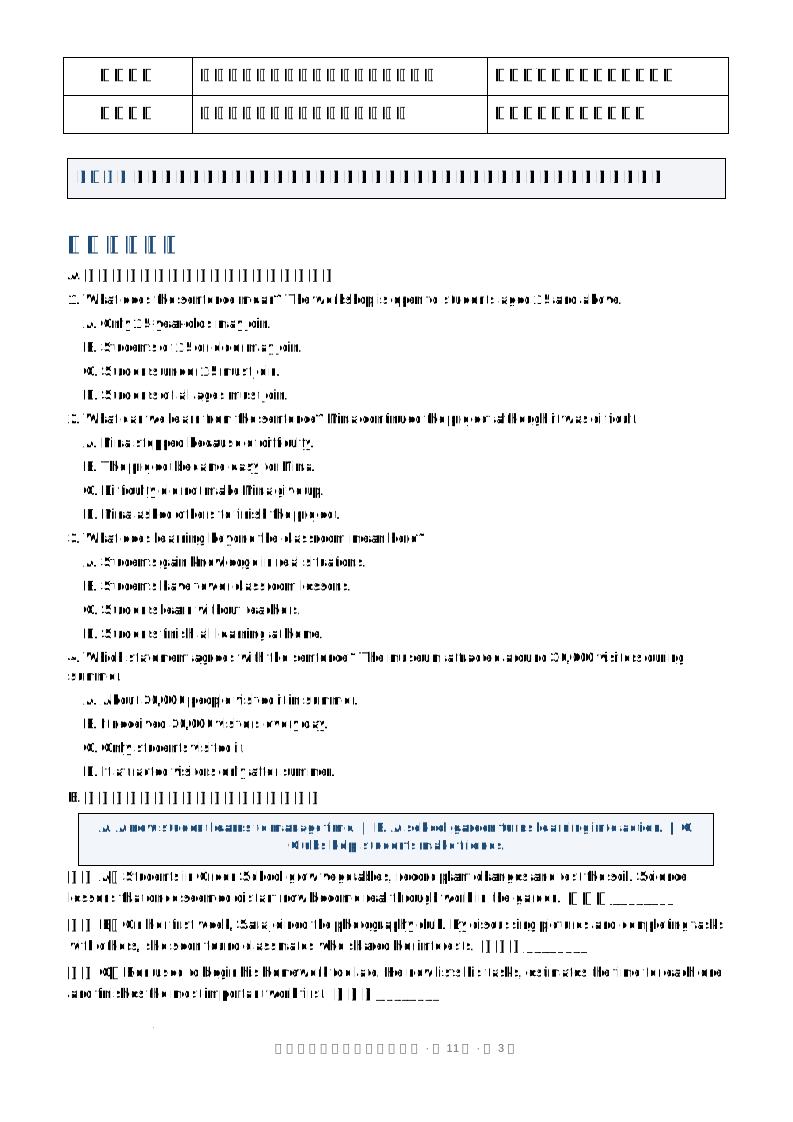
六、即时练习
A. 阅读原句,选择与原文意思相同的一项。
1. What does the sentence mean? The workshop is open to students aged 15 and above.
A. Only 15-year-olds may join.
B. Students of 15 or older may join.
C. Students under 15 must join.
D. Students of all ages must join.
2. What can we learn from the sentence? Nina continued the project although it was difficult.
A. Nina stopped because of difficulty.
B. The project became easy for Nina.
C. Difficulty did not make Nina give up.
D. Nina asked others to finish the project.
3. What does learning beyond the classroom mean here?
A. Students gain knowledge in real situations.
B. Students have fewer classroom lessons.
C. Students learn without teachers.
D. Students finish all learning at home.
4. Which statement agrees with the sentence? The museum attracted around 30,000 visitors during summer.
A. About 30,000 people visited it in summer.
B. It received 30,000 visitors every day.
C. Only students visited it.
D. It attracted visitors only after summer.
B. 阅读段落,为每段选择最合适的主旨。
A. A new student learns to manage time. | B. A school garden turns learning into action. | C. Clubs help students make friends.
段落A:Students in Green School grow vegetables, record plant changes and test the soil. Science lessons that once seemed distant now become real through work in the garden. 主旨:________
段落B:On her first week, Sara joined the photography club. By discussing pictures and completing tasks with others, she soon found classmates who shared her interests. 主旨:________
段落C:Ben used to begin his homework too late. He now lists his tasks, estimates the time for each one and finishes the most important work first. 主旨:________
七、微阅读:从定位到概括
When Chen Yu entered senior high school, he worried that the library would be difficult to use. During orientation week, a student volunteer showed his group around. She explained how to search for books online and introduced quiet rooms for group study. Chen later returned with two classmates to prepare a science report. They found useful books, but the discussion rooms were full. Instead of leaving, they asked a librarian for help and used an open reading area. By the end of the afternoon, they had completed their plan. Chen realised that the library was not simply a place to borrow books. It was also a space where students could solve problems together.
6. What worried Chen Yu at first?
A. Finding classmates.
B. Using the library.
C. Preparing a report.
D. Borrowing a computer.
7. Why did Chen return to the library?
A. To attend orientation.
B. To search for a volunteer.
C. To prepare a science report.
D. To book a quiet room.
8. What did the group do when the rooms were full?
A. They went home.
B. They changed the report.
C. They waited outside.
D. They asked for help.
9. What is the main idea of the passage?
A. Libraries need more discussion rooms.
B. Volunteers should work every afternoon.
C. A school library supports both study and teamwork.
D. Online searches are the best way to find books.
八、语篇应用一:多彩暑期学习活动(根据新华社2026年7月6日报道原创改编)
For many Chinese children, summer vacation is a time to rest, but it is also a chance to discover new interests. In different cities, young people are choosing activities that combine learning with fun. Some read in bookstores, while others practise dancing, calligraphy or table tennis at youth centres.
Museums are also becoming popular learning spaces. In Jinhua, a child explored science equipment, and in Luoyang, children tried restoring cultural relics. These activities are different, yet they share one feature: children learn by doing. Instead of only reading about science, art or history, they use their hands, ask questions and work with others.
A well-planned vacation, therefore, does not need to be filled with extra schoolwork. It can give children time to develop skills, enjoy culture and better understand the world around them.
10. What did children do in Luoyang?
A. They restored cultural relics.
B. They operated science equipment.
C. They played table tennis.
D. They sold books.
11. What common feature do the activities have?
A. They all take place outdoors.
B. Children learn through action.
C. Parents design every task.
D. They focus on school subjects.
12. What does the writer think of a well-planned vacation?
A. It should include more tests.
B. It should avoid cultural activities.
C. It can support learning in different ways.
D. It is mainly a time for complete rest.
13. What is the best title for the passage?
A. Why Children Need More Homework
B. Learning Beyond the Classroom in Summer
C. The Most Popular Sport in China
D. How Museums Restore Cultural Relics
九、语篇应用二:澳门青少年太空科学项目(根据新华社2026年7月11日报道原创改编)
A space science education programme in Macao recently celebrated the work of young learners. The 2026 Macao Space Dream Project, launched in May, included a space-experiment design competition for secondary school students and an aerospace camp for younger pupils.
Before the competition, experts trained participants in space experiments and introduced real project examples. The training did not remove every difficulty. One award-winning team met many problems while developing its design, but the students kept improving it instead of giving up.
A team member said the experience helped her understand the aerospace field and gain knowledge beyond the classroom. The organisers hope such programmes will improve scientific literacy and encourage innovation among young people. The project shows that science education becomes more powerful when students are given a real goal, useful guidance and enough room to test their own ideas.
14. Who joined the space-experiment design competition?
A. University teachers.
B. Secondary school students.
C. Younger pupils only.
D. Aerospace experts.
15. What did experts do before the competition?
A. They chose the winners.
B. They built designs for students.
C. They provided training.
D. They removed difficult tasks.
16. What can we learn about the award-winning team?
A. It completed the work without difficulty.
B. It improved the design despite problems.
C. It learned only from classroom textbooks.
D. It gave up its first design immediately.
17. What is the main purpose of the passage?
A. To explain how rockets are built.
B. To compare primary and secondary schools.
C. To introduce a programme that develops young people's interest and skills in space science.
D. To show that competitions are more important than classes.
十、阅读证据记录表
题号
题型
原文证据
同义改写
1
________
________________________
________________
2
________
________________________
________________
3
________
________________________
________________
4
________
________________________
________________
5
________
________________________
________________
十一、任务输出:三句话概括一次学习活动
选择本讲一篇文章,用三句话分别写出“活动内容”“参与者行动”和“活动意义”。
活动内容:____________________________________________________________
参与者行动:__________________________________________________________
活动意义:____________________________________________________________
十二、学习打卡
我能回原文定位细节:□ □ □ □ □ 我能识别同义改写:□ □ □ □ □
我能排除片面主旨:□ □ □ □ □ 今日错题数:________
初升高英语暑假衔接学习手册 · 第11讲 · 第 1 页
学科网(北京)股份有限公司
$
初升高英语暑假衔接学习手册
Day 11 · 第 11 讲 阅读理解过渡一:细节定位与主旨归纳
项目
内容
版本
答案解析版
建议用时
30-40 分钟
学习程式
情境观察 → 规律发现 → 知识梳理 → 分层练习 → 语篇应用 → 学习打卡
使用建议 答案解析按照“题型—定位词—原文证据—选项判断”展开。订正时不要只记录选项字母,要补写支持答案的原文信息。
一、情境导入答案
【答案】问题A. Room 305 问题B. Reading Circle 问题C. Wednesday at 5:00 p.m. 问题D. Basketball Team
【解析】
【问题A题详解】
细节理解题。build machines 对应 Robotics Club,地点是 Room 305。 故选Room 305。
【问题B题详解】
细节理解题。四个时间中 4:20 p.m. 最早。 故选Reading Circle。
【问题C题详解】
细节理解题。singing 对应 School Choir。 故选Wednesday at 5:00 p.m.。
【问题D题详解】
细节理解题。Sports Field 是户外场地。 故选Basketball Team。
三、同义改写观察答案
【答案】1. B
【解析】
【1题详解】
细节理解题。free 与 without paying 同义;two tours 不等于每天只开放两次。 故选B。
六、即时练习A答案
【答案】1. B 2. C 3. A 4. A
【解析】
【1题详解】
细节理解题。aged 15 and above 等于15岁及以上。 故选B。
【2题详解】
推理判断题。although 表明困难没有使 Nina 放弃。 故选C。
【3题详解】
词义猜测题。beyond the classroom 在此指把学习拓展到真实情境。 故选A。
【4题详解】
细节理解题。around 30,000 等于 about 30,000,且时间范围是 summer。 故选A。
六、即时练习B答案
【答案】段落A. B 段落B. C 段落C. A
【解析】
【段落A题详解】
主旨大意题。全段围绕学校花园如何让科学学习变得真实。 故选B。
【段落B题详解】
主旨大意题。摄影只是活动形式,重点是通过社团结识兴趣相同的同学。 故选C。
【段落C题详解】
主旨大意题。列任务、估时间和先做重要任务都属于时间管理。 故选A。
七、微阅读答案与解析
【答案】6. B 7. C 8. D 9. C
【解析】
【导语】本文是一篇记叙文。文章讲述陈宇从担心不会使用高中图书馆,到在志愿者和馆员帮助下与同学完成科学报告计划,最终认识到图书馆兼具学习与合作功能。
【6题详解】
细节理解题。根据首句“he worried that the library would be difficult to use”可知,陈宇最初担心的是不会使用图书馆,B项是原文同义表达。A项“结识同学”、C项“准备报告”及D项“借电脑”都不是首句所写的担忧。 故选B。
【7题详解】
细节理解题。根据“Chen later returned with two classmates to prepare a science report”可知,他再次来到图书馆是为了准备科学报告。A项orientation发生在此前;B项寻找志愿者和D项预订房间均非返回目的。 故选C。
【8题详解】
细节理解题。根据“the discussion rooms were full. Instead of leaving, they asked a librarian for help”可知,房间已满后,他们向馆员求助。A项与Instead of leaving相反;B、C两项原文均未提及。 故选D。
【9题详解】
主旨大意题。根据全文经历及结尾“not simply a place to borrow books...a space where students could solve problems together”可知,文章强调图书馆同时支持学习与合作。A项只抓住房间不足这一细节;B、D项把志愿者或网络检索夸大为全文中心。 故选C。
八、语篇应用一答案与解析
【答案】10. A 11. B 12. C 13. B
【解析】
【导语】本文是一篇说明文。文章介绍中国青少年在暑假参加阅读、艺术、体育、科学和文化体验等活动,说明有计划的假期可以让学生在课堂之外通过实践发展技能、理解世界。
【10题详解】
细节理解题。根据第二段“in Luoyang, children tried restoring cultural relics”可知,洛阳的孩子体验了修复文物。B项是金华活动;C项属于青年中心活动;D项没有原文依据。 故选A。
【11题详解】
细节理解题。根据“These activities are different, yet they share one feature: children learn by doing”可知,共同点是孩子通过行动学习,learn by doing与learn through action同义。A、C、D三项都把部分情境错误扩大为全部活动。 故选B。
【12题详解】
推理判断题。根据末段“It can give children time to develop skills, enjoy culture and better understand the world”可知,作者认为合理安排的假期能以多种方式促进学习。A项“更多测试”、B项“避免文化活动”与原文相反;D项“完全休息”忽略全文重点。 故选C。
【13题详解】
主旨大意题。全文先列举书店、青年中心和博物馆活动,再总结孩子在假期通过实践发展技能,因此B项“暑期课堂外学习”覆盖全文。A项与作者观点相反;C、D项只涉及体育或文物修复的局部细节。 故选B。
九、语篇应用二答案与解析
【答案】14. B 15. C 16. B 17. C
【解析】
【导语】本文是一篇说明文。文章介绍澳门太空科学教育项目的活动对象、赛前培训、学生克服困难的经历,以及项目对培养科学素养和创新能力的意义。
【14题详解】
细节理解题。根据第一段“a space-experiment design competition for secondary school students”可知,设计竞赛面向中学生。C项younger pupils参加的是aerospace camp;A、D项是教师或专家,并非参赛者。 故选B。
【15题详解】
细节理解题。根据第二段“experts trained participants...and introduced real project examples”可知,专家在赛前提供培训,trained participants与provided training同义。A项评选获奖者、B项代做设计、D项消除困难均与原文不符。 故选C。
【16题详解】
推理判断题。根据“met many problems...but the students kept improving it instead of giving up”可知,获奖团队虽遇到问题仍持续改进设计。A项“毫无困难”和D项“立即放弃”与原文相反;C项“只从教材学习”不符合赛前培训和实践过程。 故选B。
【17题详解】
主旨大意题。文章依次介绍项目内容、专家指导、学生坚持改进及培养科学素养与创新能力的目标,因此C项完整概括全文。A项只谈火箭建造;B项误把参赛对象差异当作中心;D项把竞赛与课堂作无依据比较。 故选C。
十一、任务输出参考答案
活动内容:The Macao Space Dream Project offered a design competition and an aerospace camp for young learners.
参与者行动:Students received expert training, faced difficulties and kept improving their designs.
活动意义:The project helped young people gain space knowledge, scientific skills and confidence beyond the classroom.
概括说明 三句话分别覆盖项目内容、学生行动和活动意义,没有加入原文之外的信息,也没有停留在单一细节。
初升高英语暑假衔接学习手册 · 第11讲 · 第 1 页
学科网(北京)股份有限公司
$
资源预览图

1

2
3

相关资源
示范课
由于学科网是一个信息分享及获取的平台,不确保部分用户上传资料的 来源及知识产权归属。如您发现相关资料侵犯您的合法权益,请联系学科网,我们核实后将及时进行处理。