暑假作业Grade8to9(综合训练)2026-2027学年沪教版英语九年级上册 30Days (23)
2026-07-12
|
6页
|
84人阅读
|
3人下载
摘要:
**基本信息**
以话题为载体整合词汇、语法与语用,通过三段式进阶训练构建“复习-诊断-滚动”体系,突出情态动词等核心语法的系统提炼与跨情境应用,提升语言能力与文化意识。
**综合设计**
|模块|题量/典例|方法提炼|知识逻辑|
|----|-----------|----------|----------|
|Grammar Focus|1语法总结+10题练习|情态动词“基本用法-推测-被动语态”系统归纳|从基础规则到复杂语境的递进推导|
|Vocabulary|3类词性汉译英|核心词分层记忆(标★重点词)|按话题构建“历史-地理”语义网络|
|Writing|1篇话题写作|提示词与语法融合表达|语言知识从输入到综合输出的转化|
内容正文:
Grade 8→9 Summer Homework | Day 23
八年级升初三 · 英语暑假作业
适配:深圳 · 沪教版教材 · 毕业班衔接
每天2页A4 · 题型对标深圳中考
三段式:8B单元复习(8天) → 深圳中考套题(2天) → 课标词话题滚动(20天)
阶段
天数
核心目标
第一阶段:8B单元复习
Day 1-8
每天1单元:默写→语法巩固→作文句型默写→阅读题型搭配
第二阶段:深圳中考套题
Day 9-10
2套75分深圳中考模拟卷(真题题型+分值)
第三阶段:课标词话题滚动
Day 11-30
20话题课标词:词表→中翻英→造句→词转填空→翻译→小作文
Day 23 历史与地理 · 情态动词综合
Part 1 Vocabulary 话题课标词汉译英(Chinese → English)
▸ 名词 Nouns
中文
答案区
中文
答案区
历史
★ 时代;年代
★ 皇帝
朝代
战争
和平
★ 死亡
事件
世纪
改变
地理
国家;乡村
首都;大写字母
人口
面积;地区
★ 气候
★ 沙漠
山
河流
海洋
岛屿
森林
北方
南方
东方
西方
★ 公民;市民
文化
象征
地标
国家
宫殿
位置
★ 特征;特点
边界
▸ 动词 Verbs
中文
答案区
中文
答案区
发明
发现
★ 建立;创立
发展
★ 证明
★ 出版;发表
保护
保存;保护
▸ 形容词 Adjectives
中文
答案区
中文
答案区
古代的
现代的
传统的
重要的
著名的
富有的
深的
Part 2 Key Grammar Points 重点考点练习
一、词形转换(10题)
1. The ancient city has a long and ______ (history) of over 3,000 years.
2. China is a ______ (develop) country with a rich culture.
3. The Great Wall is one of the most ______ (fame) landmarks in the world.
4. Many ancient ______ (invent) changed the world.
5. The emperor ______ (found) a new dynasty in 1368.
6. These traditional customs should be ______ (protect).
7. She ______ (publish) her first book about Chinese history last year.
8. The ______ (important) of learning history cannot be overstated.
9. The desert has a very dry ______ (climate).
10. The citizens ______ (encourage) to protect the ancient buildings.
二、虚词填空(5题,不给提示)
11. The book must ______ finished by Friday.
12. You ______ not swim in the river — it's dangerous!
13. The ancient palace may ______ built during the Ming Dynasty.
14. She can ______ be at home. I just saw her at the library.
15. All citizens should ______ proud of their country's history.
Part 3 Translation 句子翻译(Chinese → English)
1. 长城一定是在古代建造的。 (must have been, build, ancient)
________________________________________________________________________
2. 这本书不可能是李白写的。 (can't be, write)
________________________________________________________________________
3. 所有公民都应该保护传统文化。 (citizens, should, protect, traditional culture)
________________________________________________________________________
4. 那个地区可能曾经是一片森林。 (area, may have been, forest)
________________________________________________________________________
5. 这项发明改变了世界历史的进程。 (invention, change, course of history)
________________________________________________________________________
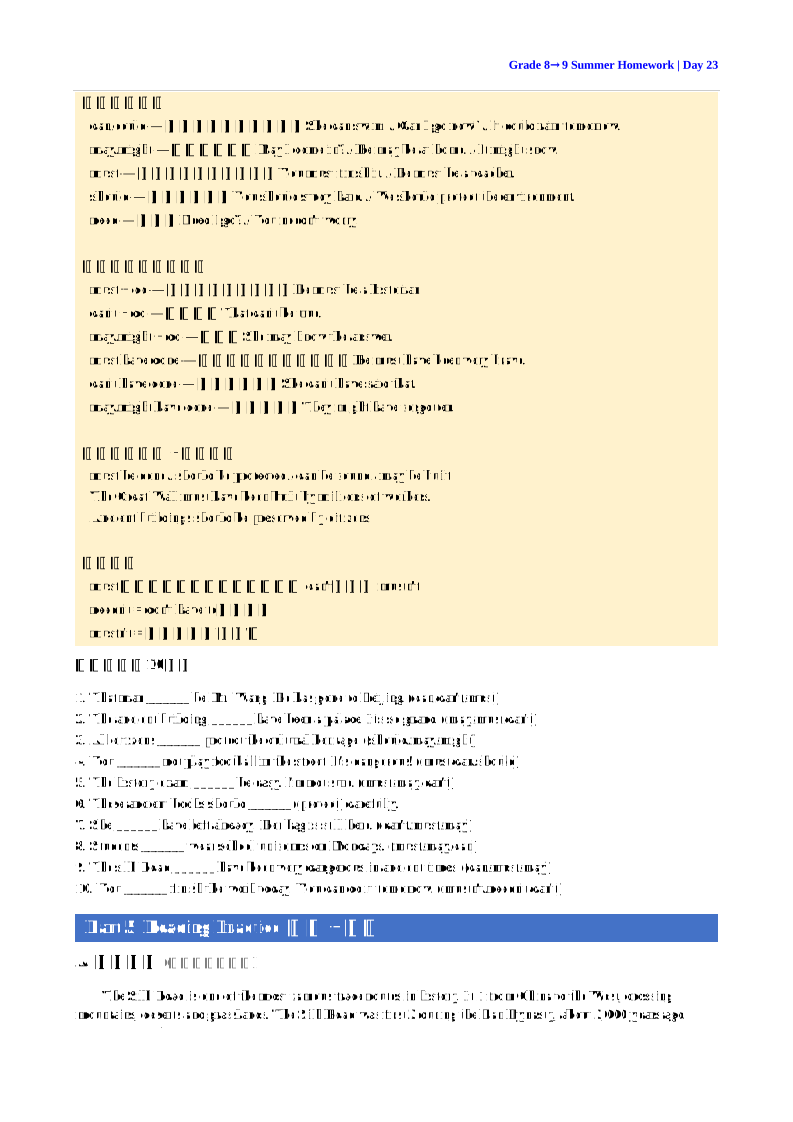
Part 4 Grammar Focus 语法点总结 + 配套练习
情态动词综合
一、基本用法
can/could — 能力、许可、可能性:She can swim. / Can I go now? / It could rain tomorrow.
may/might — 许可、推测:May I come in? / He may be at home. / It might snow.
must — 必须、推测(一定):You must finish it. / He must be a teacher.
should — 应该、建议:You should study hard. / We should protect the environment.
need — 需要:Need I go? / You needn't worry.
二、情态动词表推测
must + do — 一定(肯定推测):He must be a historian.
can't + do — 不可能:That can't be true.
may/might + do — 可能:She may know the answer.
must have done — 一定做过(过去推测):He must have been very brave.
can't have done — 不可能做过:She can't have said that.
may/might have done — 可能做过:They might have forgotten.
三、情态动词 + 被动语态
must be done / should be protected / can be found / may be built
The Great Wall must have been built by millions of workers.
Ancient buildings should be preserved by citizens.
四、注意
must表推测只用于肯定句;否定用can't,不用mustn't
needn't = don't have to(不必)
mustn't = 禁止(不是'不必')
配套练习(10题)
1. That man ______ be Mr. Wang. He has gone to Beijing. (can/can't/must)
2. The ancient building ______ have been a palace. It's so grand. (may/must/can't)
3. All citizens ______ protect the cultural heritage. (should/may/might)
4. You ______ not play football in the street. It's dangerous! (must/can/should)
5. The history exam ______ be easy. I'm not sure. (must/may/can't)
6. These ancient books should ______ (protect) carefully.
7. She ______ have left already. Her bag is still here. (can't/must/may)
8. Students ______ wear school uniforms on Mondays. (must/may/can)
9. The silk Road ______ have been very dangerous in ancient times. (can/must/may)
10. You ______ finish the work today. You can do it tomorrow. (mustn't/needn't/can't)
Part 5 Reading Practice 完形 + 阅读
A. 完形填空 (改编自历史文献)
The Silk Road is one of the most famous trade routes in history. It 1 from China to the West, crossing mountains, deserts and grasslands. The Silk Road was first 2 during the Han Dynasty, about 2,000 years ago.
The ancient Chinese 3 silk, tea and porcelain to the West, and 4 back glass, spices and new ideas. The Silk Road must have been very 5 — travellers had to face sandstorms, wild animals and extreme weather.
One of the most important 6 on the Silk Road was Zhang Qian. The emperor 7 him to travel to the West to find allies. He was going to complete the task, but he was captured and 8 for many years. However, he never 9 up. His journey proved that communication between different cultures was 10 .
Today, the spirit of the Silk Road lives on. China's "Belt and Road" initiative continues to connect countries and build a peaceful future.
(1) A. ran B. walked C. flew D. drove
(2) A. discovered B. invented C. opened D. found
(3) A. bought B. sold C. took D. exported
(4) A. brought B. took C. carried D. gave
(5) A. comfortable B. safe C. dangerous D. easy
(6) A. explorers B. tourists C. citizens D. passengers
(7) A. forced B. sent C. invited D. allowed
(8) A. held B. kept C. stayed D. protected
(9) A. gave B. took C. made D. put
(10) A. impossible B. possible C. difficult D. terrible
B. Reading Comprehension (改编自国家地理)
Egypt is a country in the northeast of Africa. It has one of the oldest civilisations in the world, with a history of over 5,000 years. The River Nile, which is the longest river in Africa, flows through the country from south to north. Most of Egypt's population lives along the Nile, because the land near the river is fertile while the rest of the country is mainly desert.
The climate in Egypt is hot and dry. In summer, the temperature can reach over 40°C. However, the weather near the Mediterranean coast is more comfortable.
Egypt is famous for its ancient landmarks. The Pyramids of Giza, which were built about 4,500 years ago, are one of the Seven Wonders of the Ancient World. The Great Sphinx, with the body of a lion and the head of a human, stands near the pyramids. These ancient buildings must have taken thousands of workers many years to build.
The ancient Egyptians invented many things that we still use today, such as paper, ink and the 365-day calendar. They also developed a system of writing called hieroglyphics (象形文字).
Today, Egypt is a modern nation with a population of over 100 million. The citizens are proud of their rich culture and long history. Millions of tourists visit Egypt every year to see its amazing landmarks and learn about its ancient civilisation. As one Egyptian guide said, "Our history is not just about the past — it shapes who we are today."
1. Where is Egypt located?
A. In the southeast of Africa. B. In the northeast of Africa. C. In the northwest of Africa. D. In the southwest of Asia.
2. Why do most people in Egypt live along the Nile?
A. Because the climate is cooler there. B. Because the land near the river is fertile. C. Because the pyramids are there. D. Because it's close to the desert.
3. What does "must have taken" in Paragraph 3 mean?
A. The pyramids certainly took a long time to build. B. The pyramids might have taken a long time. C. The pyramids can't have taken a long time. D. People should take more time to build pyramids.
4. Which of the following was NOT invented by ancient Egyptians according to the passage?
A. Paper. B. Ink. C. The wheel. D. The 365-day calendar.
5. What is the main idea of the passage?
A. The River Nile is very long. B. Egypt has a rich history and important cultural heritage. C. The pyramids are the only famous landmarks. D. Egypt is a small country.
Part 6 Writing 话题写作
A Great Person in History
请根据以下提示,写一篇80-100词的英语短文。
Write about a great person in history. You should include:
1. Who the person was and when he/she lived;
2. What he/she did and achieved;
3. Why you admire him/her and what you can learn from him/her.
提示词:ancient, emperor, dynasty, found, important, famous, must have been
________________________________________________________________________
________________________________________________________________________
________________________________________________________________________
________________________________________________________________________
________________________________________________________________________
________________________________________________________________________
________________________________________________________________________
________________________________________________________________________
【参考答案】
Part 1 话题课标词
history, ancient, modern, era, emperor, dynasty, war, peace, death, event, century, invent, discover, found, develop, change, geography, country, capital, population, area, climate, desert, mountain, river, ocean, island, forest, north, south, east, west, citizen, prove, publish, protect, preserve, traditional, culture, symbol, landmark, nation, palace, location, characteristic, border, important, famous, rich, deep
Part 2 重点考点练习
1. history 2. developing 3. famous 4. inventions 5. founded 6. protected 7. published 8. importance 9. climate 10. are encouraged
11. be 12. must 13. have been 14. can't 15. be
Part 3 句子翻译
1. The Great Wall must have been built in ancient times.
2. This book can't have been written by Li Bai.
3. All citizens should protect traditional culture.
4. That area may have been a forest.
5. This invention changed the course of world history.
Part 4 语法练习
1. can't 2. must 3. should 4. must 5. may 6. be protected 7. can't 8. must 9. must 10. needn't
Part 5 阅读
A (完形): 1-5 ACDBC 6-10 ABABB
B (阅读): 1-5 BBACB
Part 6 写作(参考范文)
A Great Person in History
The great person I admire most is Zheng He, a famous explorer in the Ming Dynasty. He was born in 1371 and lived during an important era in Chinese history.
Zheng He led seven great ocean voyages between 1405 and 1433. He travelled to over 30 countries across the Indian Ocean with the largest fleet in the world at that time. His journeys proved that China was a powerful and peaceful nation. He must have been a very brave and determined man to face the dangerous ocean.
I admire Zheng He because he showed the world the greatness of Chinese civilisation. He didn't go to start wars — he went to build friendship. From him, I learn that courage and peace can change the world. As citizens, we should carry on his spirit of exploration and friendship.
学科网(北京)股份有限公司
$
资源预览图

1

2
3

相关资源
示范课
由于学科网是一个信息分享及获取的平台,不确保部分用户上传资料的 来源及知识产权归属。如您发现相关资料侵犯您的合法权益,请联系学科网,我们核实后将及时进行处理。