素养阅读+写作训练2025-2026学年人教版英语七年级下册
2026-06-18
|
6页
|
298人阅读
|
5人下载
摘要:
**基本信息**
以传统文化与社会规则为主题,整合完形填空、阅读理解、词语运用及书面表达模块,系统培养语言能力与文化意识,实现知识应用与素养提升的统一。
**专项设计**
|模块|题量/典例|题型特征|知识逻辑|
|----|-----------|----------|----------|
|完形填空|2篇(神话/规则)|考查上下文语境理解与词汇辨析|通过故事发展链串联词汇运用,强化语境感知能力|
|阅读理解|3篇(《山海经》/安全讲座/公共标识)|细节理解、主旨归纳与推理判断|从文化典籍到现实规则,构建"文化认知-规则理解"逻辑链条|
|词语运用|2篇(语法填空)|动词时态、词性转换及固定搭配|以主题语境为载体,实现语法知识与语用能力的融合|
|书面表达|2篇(神话故事/校园规则)|主题写作与应用写作|从输入(阅读)到输出(写作),形成"理解-内化-表达"完整闭环|
内容正文:
2025-2026学年七年级下册英语素养阅读+写作训练
训练一
一、完形填空
Alice fell into a pool of salt water. "I'm now in the sea," she thought. But soon she 1____ out the fact. She was in the pool of her tears. "I cried 2____," she said when she swam about.
Just then, she heard 3 ____splashing around (戏水) in the pool a little way off. She swam 4____ to find what it was. It was a mouse and it fell into the pool 5____ her.
"Oh, Mouse, do you know the 6 ____out of the pool?" Alice asked. It said nothing. "Maybe it doesn't know English," thought Alice. "It's a mouse from 7____." So she said the word "cat" in French. The mouse suddenly jumped out of the water when it heard the word. It trembled (颤抖) all over with fright (惊吓). "I'm sorry," said Alice. "I 8____ you didn't like cats."
"Our family always hate cats!" cried the mouse. "Don't let me hear the name again!"
"I won't," said Alice. "Do you like 9____? A farmer near my house has a nice little dog. He says it's useful and it kills all the rats and… Oh, dear!" cried Alice. "The mouse is 10____," she thought, for it swam away at once. She was alone again, looking for the way out.
( )1. A. took B. put C. found D. knew
( )2. A. too many B. too much C. much too D. many too
( )3. A. something B. anything C. everything D. nothing
( )4. A. less B. more C. farther D. nearer
( )5. A. with B. like C. below D. along
( )6. A. trip B. key C. plan D. way
( )7. A. Russia B. England C. France D. Canada
( )8. A. said B. heard C. forgot D. thought
( )9. A. dogs B. cats C. mice D. rats
( )10. A. brave B. careless C. excited D. angry
二、阅读理解
In the South China Sea, there is a group of Jiaoren, or Chinese mermaids (美人鱼), whose tears become pearls (珍珠) after they fall. To the north of Kunlun Mountains, there is a monster called Xiangliu which has nine heads with human faces but a body of a snake. These magic creatures (生物) are from the old book Shan Hai Jing.
Shan Hai Jing, also known as The Classic of Mountains and Seas, is said to be at least 2,200 years old. It is about Chinese geography, history, myth and so on in ancient times. It has about 31,000 words and eighteen parts, describing about 550 mountains and 300 seas. It also tells many interesting stories and talks about lots of magic creatures.
A famous story in the book is about Zhu Rong, the God of Fire. When he had a big fight with Gong Gong, the God of Water, Zhu Rong won. But after the fight, the human world came into complete darkness. Then he brought fire from heaven to the world and taught humans how to use it.
Although it's not clear who wrote it, Shan Hai Jing is seen as an important old book and a treasure of Chinese culture. The stories in the book are now being passed down in China. The book inspired (赋予灵感) many people like Lu Xun and J.K. Rowling. There are also many books, films, games and art works based on it.
( )11. How does the writer start the passage?
A. By comparing (比较) two facts. B. By telling a story.
C. By raising a question. D. By giving two examples.
( )12. According to the passage, what can we learn about Shan Hai Jing?
A. It is about Chinese geography, history, myth and so on in ancient times.
B. It was written by Lu Xun.
C. It has 500 mountains and 200 seas.
D. It mainly describes modern Chinese cities.
( )13. What does the underlined word "it" in Paragraph 3 refer to?
A. The book. B. The body. C. The fire. D. The water.
( )14. What is the main purpose of this passage?
A. To spread Chinese and Western cultures.
B. To introduce the content and cultural value of an old book.
C. To explain how pearls are formed in nature.
D. To teach readers how to read Shan Hai Jing.
三、词语运用
阅读下面短文,在空白处填入一个适当的单词或括号内单词的正确形式。
Do you love stories? There are many 15____ (interest) myths in China. It is believed that the story of the Monkey King is not new to Chinese children.
The Monkey King or Sun Wukong is one of the main characters 16____ the Chinese novel Journey to the West.
The Monkey King sometimes does not even look like a monkey! This is because he can make seventy-two 17 ____(change) to his shape and size. But unless (除非) he can hide his tail, he can't turn himself into a person. To fight bad people, the Monkey King 18_____ (use) a magic stick. Sometimes he can make the stick so small 19 ____he can keep it in his ear.
The Monkey King has excited Chinese children for many years. And as soon as the TV programme 20____ (come) out more than thirty years ago, almost all the children became interested in this story and it brought lots of happiness to 21___ (they). The clever Monkey King keeps 22 ____(fight) to help the weak and never gives up. 23____ (final), he wins the hearts of many young people.
If you want to know more about the Monkey King, you'd better read 24___ book when you're free. I'm sure you will love it.
四、书面表达
神话故事 (myth) 作为中国传统文化的一部分,对青少年了解民族文化及历史具有一定意义。请你以“A Story I Know”为题,介绍一则神话故事及其给你带来的影响和启发。
要求:
1. 条理清晰,内容完整,语句通顺,书写工整;
2. 文中不得出现真实姓名和校名;
3. 不少于80词(开头已给出,不计入总词数)。
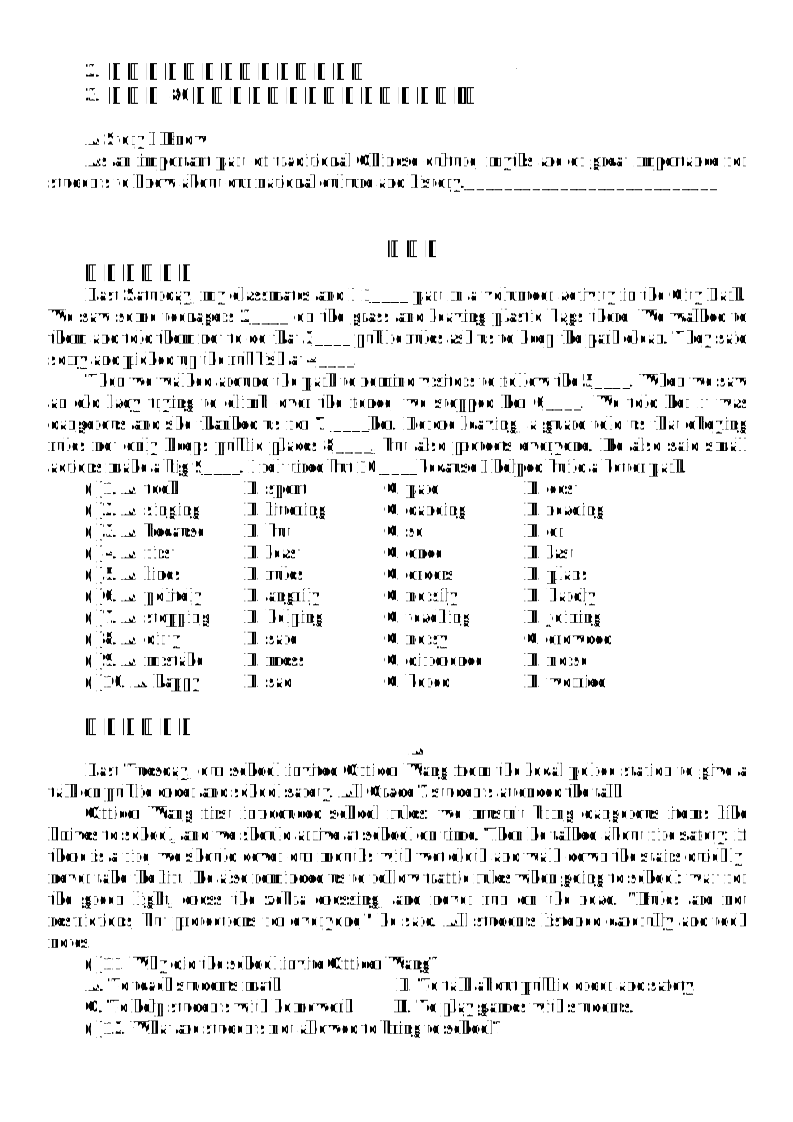
A Story I Know
As an important part of traditional Chinese culture, myths are of great importance for students to know about our national culture and history.___________________________
训练二
一、完形填空
Last Saturday, my classmates and I 1____ part in a volunteer activity in the City Park. We saw some teenagers 2____ on the grass and leaving plastic bags there. We walked to them and told them not to do that 3____ public rules ask us to keep the park clean. They said sorry and picked up the rubbish at 4____.
Then we walked around the park to remind visitors to follow the 5____. When we saw an old lady trying to climb over the fence, we stopped her 6____. We told her it was dangerous and she thanked us for 7 ____her. Before leaving, a guard told us that obeying rules not only keeps public places 8____, but also protects everyone. He also said small actions make a big 9____. I felt tired but 10 ____because I helped build a better park.
( )1. A. took B. spent C. paid D. cost
( )2. A. singing B. littering C. dancing D. reading
( )3. A. because B. but C. so D. or
( )4. A. first B. least C. once D. last
( )5. A. lines B. rules C. orders D. plans
( )6. A. politely B. angrily C. noisily D. hardly
( )7. A. stopping B. helping C. teaching D. joining
( )8. A. dirty B. safe C. noisy C. crowded
( )9. A. mistake B. mess C. difference D. noise
( )10. A. happy B. sad C. bored D. worried
二、阅读理解
A
Last Tuesday, our school invited Officer Wang from the local police station to give a talk on public order and school safety. All Grade 7 students attended the talk.
Officer Wang first introduced school rules: we mustn't bring dangerous items like knives to school, and we should arrive at school on time. Then he talked about fire safety: if there is a fire, we should cover our mouths with wet cloth and walk down the stairs quickly, never take the lift. He also reminded us to follow traffic rules when going to school: wait for the green light, cross the zebra crossing, and never run on the road. "Rules are not restrictions, but protections for everyone," he said. All students listened carefully and took notes.
( )11. Why did the school invite Officer Wang?
A. To teach students math. B. To talk about public order and safety.
C. To help students with homework. D. To play games with students.
( )12. What are students not allowed to bring to school?
A. Notebooks. B. Pencils. C. Knives. D. Water bottles.
( )13. What should you do if there is a fire at school?
A. Take the lift to escape. B. Run out of the building at once.
C. Cover your mouth with wet cloth and use stairs. D. Hide under the desk and wait.
( )14. Which of the following is TRUE according to the passage?
A. Students can bring knives to school for crafts.
B. We should run on the road to save time.
C. Taking the lift is safe during a fire.
D. Rules are meant to protect us.
( )15. What is the best title for the passage?
A. A Useful Safety Talk B. How to Be a Police Officer
C. School Rules Are Boring D. Fire Is Dangerous
B
When we go to public places like subways, libraries and parks, we can always see different signs. These signs are important public rules that everyone should follow. Here are some common ones:
● No Smoking: You can't smoke in places like hospitals, libraries or cinemas. Smoking not only hurts your health but also bothers others.
● No Littering: This sign is usually seen in parks and streets. Throwing rubbish everywhere makes the environment dirty and unpleasant.
● Wait in Line: You can see this sign at subway stations, bus stops and dining halls. Waiting in line keeps order and avoids chaos.
● Keep Quiet: This sign is common in libraries, museums and classrooms. Keeping quiet helps everyone focus on reading or learning.
If we all follow these signs, public places will be more comfortable for everyone.
( )16. Where can you usually see the "No Smoking" sign?
A. In cinemas and libraries. B. In dining halls and playgrounds.
C. On buses and bikes. D. In classrooms and labs.
( )17. What does the "No Littering" sign tell us?
A. Don't eat in public places. B. Don't throw rubbish everywhere.
C. Don't talk loudly in parks. D. Don't run on the street.
( )18. When do we need to "Wait in Line"?
A. When we read books in the library. B. When we buy food in the dining hall.
C. When we watch movies in the cinema. D. When we do homework at home.
( )19. What will happen if we don't follow public signs?
A. Public places will become more comfortable. B. Everyone will be happy and safe.
C. Order will be broken and the environment will get dirty.
D. We will get praise from others.
( )20. What is the main idea of the passage?
A. How to make public signs. B. The importance of following public signs.
C. Why smoking is bad for health. D. How to keep quiet in the library.
三、词语运用
阅读下面短文,在空白处填入一个适当的单词或括号内单词的正确形式。
We follow rules every day to keep our life 21____ (order) and safe. At school, we must obey school 22 ____ (rule): we shouldn't run in the hallways, and we need to wear uniforms on weekdays. On the road, traffic rules help us cross the street 23____ (safe). We must wait for the green light and never play on the road. In public places, we should avoid 24____ (make) loud noises and littering. It's also important 25 ____ (wait) in line when we buy food or get on the bus. If we break the rules, we may get 26____ (punish), like getting a fine or criticism. Rules may seem strict sometimes, 27 ____ they are necessary for everyone. When we all follow the rules, our society will become a 28____ (good) place to live in. Let's develop a good habit of 29____ (obey) rules from now on. Small actions can make a big 30 ____ (different)!
四、书面表达
假如你是李华,你们学校上周开展了“Obey Rules, Build a Civilized Campus”(遵守规则,共建文明校园)主题活动。请你给学校英语报投稿,分享你的经历和感受。
提示:1. 活动中学到的两条校园规则;2. 你平时遵守规则的做法;3. 你的感受。
要求:1. 须包含所有提示内容,可适当发挥;2. 语句通顺,书写规范;3. 不少于80词(开头已给出,不计入总词数)。
Dear Editor,
Last week, our school held an activity called "Obey Rules, Build a Civilized Campus".
________________________________________________________________
I hope everyone can follow the rules and make our campus better.
Yours,
Li Hua
训练一参考答案
一、完形填空
1. C 2. B 3. A 4. D 5. B
6. D 7. C 8. D 9. A 10. D
二、阅读理解
11. D 12. A 13. C 14. B
三、词语运用
15. interesting 16. in / of 17. changes 18. uses 19. that
20. came 21. them 22. fighting 23. Finally 24. the
四、书面表达(参考范文)
A Story I Know
As an important part of traditional Chinese culture, myths are of great importance for students to know about our national culture and history. The story that impresses me most is Hou Yi Shoots the Suns.
Once upon a time, there were ten suns in the sky, which made the earth too hot to live on. People suffered a lot. Hou Yi, a brave archer, decided to save them. He climbed to the top of a mountain and shot down nine suns with his bow and arrows. Finally, only one sun remained, and the earth became peaceful and warm again.
This story inspires me deeply. It tells me that no matter how difficult the situation is, we should be brave and never give up. We should use our abilities to help others and make the world a better place.
训练二参考答案
一、完形填空
1. A 2. B 3. A 4. C 5. B
6. A 7. B 8. B 9. C 10. A
二、阅读理解
11. B 12. C 13. C 14. D 15. A
16. A 17. B 18. B 19. C 20. B
三、词语运用
21. orderly 22. rules 23. safely 24. making 25. to wait
26. punished 27. but 28. better 29. obeying 30. difference
四、书面表达(参考范文)
Dear Editor,
Last week, our school held an activity called "Obey Rules, Build a Civilized Campus". Through the activity, I learned two important rules: we mustn't run in the hallways, and we should never litter on campus.
In daily life, I always follow these rules strictly. I arrive at school on time every day, queue up for lunch quietly, and put rubbish into the bins. I also remind my classmates to keep the classroom tidy.
I feel proud to be part of building a civilized campus. Following rules not only makes our school more beautiful, but also helps us develop good habits.
I hope everyone can follow the rules and make our campus better.
Yours,
Li Hua
学科网(北京)股份有限公司
$
资源预览图

1

2
3

相关资源
示范课
由于学科网是一个信息分享及获取的平台,不确保部分用户上传资料的 来源及知识产权归属。如您发现相关资料侵犯您的合法权益,请联系学科网,我们核实后将及时进行处理。