精品解析:2026年重庆一中初2026届初三下期第二次模拟测试英语试题卷
 切换试卷
切换试卷
2026-05-24
|
2份
|
40页
|
1544人阅读
|
26人下载
资源信息
| 学段 | 初中 |
|---|---|
| 学科 | 英语 |
| 教材版本 | - |
| 年级 | 九年级 |
| 章节 | - |
| 类型 | 试卷 |
| 知识点 | - |
| 使用场景 | 中考复习-二模 |
| 学年 | 2026-2027 |
| 地区(省份) | 重庆市 |
| 地区(市) | - |
| 地区(区县) | - |
| 文件格式 | ZIP |
| 文件大小 | 2.96 MB |
| 发布时间 | 2026-05-24 |
| 更新时间 | 2026-05-24 |
| 作者 | 匿名 |
| 品牌系列 | - |
| 审核时间 | 2026-05-24 |
| 下载链接 | https://m.zxxk.com/soft/58019831.html |
| 价格 | 5.00储值(1储值=1元) |
| 来源 | 学科网 |
内容正文:
【机密】2026年5月23日11:00前
2026年重庆一中初2026届初三下期第二次模拟测试
英语试题卷
(全卷共九个大题,满分:150分,考试时间:120分钟)
第Ⅰ卷(共100分)
Ⅰ. 听力测试。(共35分)
第一节(每小题1分,共6分)
听两遍。根据你所听到的句子,从A、B、C三个选项中选出最恰当的答语,并把答题卡上对应题目的答案标号涂黑。
1. A. Pretty good. B. Not at all. C. You, too.
2. A. Sorry, I won’t. B. OK, I will. C. Here you are.
3. A. Of course not. B. Yes, I do. C. That sounds great.
4. A. Saturday. B. May, 23rd. C. Sunny.
5. A. What a pity! B. Have a good time. C. Good luck.
6. A. I don’t think so. B. It’s cool. C. They’re perfect.
第二节(每小题1. 5分,共9分)
听两遍。根据你所听到的对话和问题,从A、B、C三个选项中选出正确答案,并把答题卡上对应题目的答案标号涂黑。
7. A. /ə'bʌv/. B. /ə'brɔ:d/. C. /ə'raɪv/.
8. A. Go to the school concert.
B. Stay at home and review.
C. Go out with friends.
9. A. A comedy. B. A war film. C. A scary movie.
10. A. Teacher and student. B. Brother and sister. C. Mother and son.
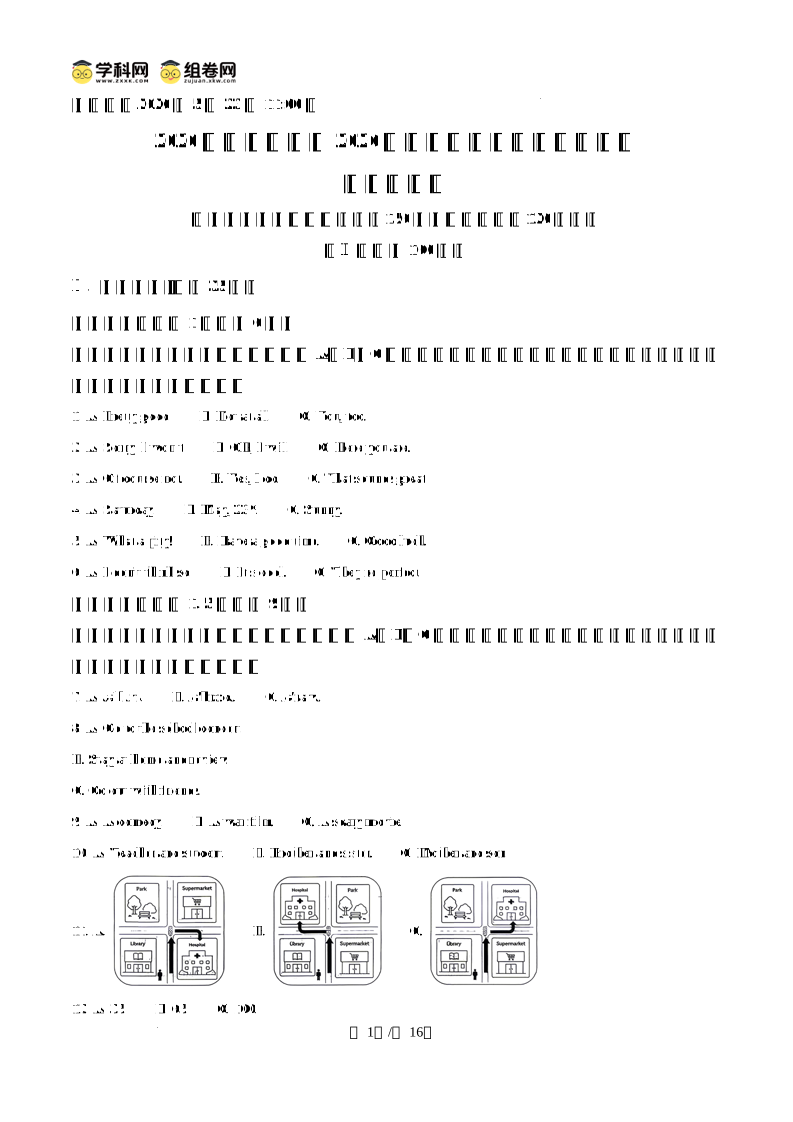
11. A. B. C.
12. A. 35. B. 65. C. 100.
第三节(每小题1. 5分,共6分)
听两遍。根据你所听到的长对话,从A、B、C三个选项中选出正确答案,并把答题卡上对应题目的答案标号涂黑。
听第一段材料,回答第13和14小题。
13. What is wrong with the boy’s earphones?
A. They don’t work. B. They are too old. C. They are too expensive.
14. What will the boy probably do next?
A. Get the earphones repaired.
B. Buy a new pair.
C. Ask his friend for help.
听第二段材料,回答第15和16小题。
15. What time will the bus leave?
A. At 7:30. B. At 7:50. C. At 8:00.
16. Who will probably be late for the school trip?
A. Tom. B. Ben. C. Peter.
第四节(每小题1.5分,共6分)
听两遍。根据你所听到的短文内容,从A、B、C三个选项中选出正确答案,并把答题卡上对应题目的答案标号涂黑。
17. What did the driver do again and again?
A. He gave speeches. B. He listened to the speech. C. He wrote speeches.
18. Where did Einstein sit during the speech?
A. On the stage. B. At home. C. In the crowd.
19. How did people feel after Einstein answered the question?
A. Shocked. B. Happy. C. Angry.
20. Why didn’t the driver answer the question himself?
A. Because the question was too difficult for him.
B. Because he didn’t hear the question clearly.
C. Because he thought the student was impolite.
第五节(每小题2分,共8分)
听两遍。根据你所听到的广播内容,在横线处补全笔记,每空一词,并把答案填写在答题卡上对应的位置。
Ⅱ. 语法选择。(每小题1分,共10分)
根据短文内容,从A、B、C三个选项中选出一个语法正确的答案,并把答题卡上对应题目的答案标号涂黑。
I never meant to get a cat. She simply entered my world one day and stayed.
For years, she lived quietly at the end of my bed, ____1____ me from her place near the wall. She wasn’t the kind of cat who listened to orders. She had her habits, and I had ____2____. She never spoke, but I learned to understand her silence.
Our life together was built on small moments — shared lifestyles, ____3____ surprises, and quiet company (陪伴). There was the time she scared the neighbor, the time she sat in my arms ____4____ I cried, and the nights when her soft steps crossed the room just before sleep.
Then came the end. She was old and ill. I sat ____5____ her as the animal doctor prepared the final injection (注射). I had practiced ____6____ I would say, but the words disappeared when it happened. I held her gently, the way I always did. Her body was still warm when her eyes closed for ____7____ last time.
Now the room ____8____ too quiet. At night, I still turn to the place where she used to sleep. I know she won’t be there, but part of me still waits. I wonder how many ____9____ end this way — not with loud goodbyes, but with a soft space left behind.
She knew she was safe. She knew she ____10____. And that, I think, is enough.
1. A. watch B. watching C. watches
2. A. mine B. my C. myself
3. A. strange B. stranger C. strangest
4. A. as B. so C. though
5. A. through B. beside C. on
6. A. which B. what C. whether
7. A. an B. a C. the
8. A. felt B. feel C. feels
9. A. story B. stories C. story’s
10. A. loves B. is loved C. was loved
Ⅲ. 完形填空。(每小题1.5分,共15分)
根据短文内容,从A、B、C、D四个选项中选出一个能填入相应空格的最佳答案,并把答题卡上对应题目的答案标号涂黑。
The elevator was broken. So even though it was a cool autumn afternoon, I was sweating (出汗) all over after I climbed up to my seventh-floor apartment. As soon as I got inside, I headed straight for the fridge and took out a bottle of iced ____11____.
Just then, Mom came out of the bedroom. “It’s not that hot today!” she said. “Don’t drink something too cold. Let me pour you some hot water.”
“But I’m sweating all over!” I argued.
“You ____12____ sweat! I’m afraid your liver (肝) fire is too high.”
Mom’s opinion — “high liver fire” — reminded me of a popular video. The mother in the video always pushed her son to drink sponge gourd (丝瓜) soup ____13____ she thought it was good for his health. When the son refused, she complained that his liver fire must be too high. She finally asked her son to have some sponge gourd soup to help ____14____ the heat.
Unsurprisingly, the video quickly drew much attention. After all, who hasn’t ____15____ these “for your own good” lines such as “Drink more hot water”, “Wear your warm coats”, and “Use your phone ____16____?
But as other people point out, these words stand for our parents’ love for us. Many of them hope to take good care of us, but often find ____17____ unable to understand our daily habits. My mom, for example, once ____18____ my weight-loss diet for eating almost nothing.
Perhaps we should try to be ____19____ for our parents’ “liver-fire” love. But when my “liver fire” runs high, I’d still rather drink some iced juice. Next time, though, I’ll make sure to enjoy it ____20____.
11. A. soup B. milk C. juice D. tea
12. A. never B. always C. hardly D. sometimes
13. A. if B. though C. unless D. because
14. A. reduce B. increase C. win D. leave
15. A. heard from B. looked after C. heard of D. looked through
16. A. less B. more C. harder D. faster
17. A. ourselves B. themselves C. herself D. yourself
18. A. changed B. called C. decided D. mistook
19. A. ready B. thankful C. fit D. sorry
20. A. in excitement B. in surprise C. in secret D. in public
Ⅳ. 阅读理解。(每小题2分,共30分)
阅读下列材料,从A、B、C、D四个选项中选出最佳答案,并把答题卡上对应题目的答案标号涂黑。
A
Before flying a drone, read these instructions carefully. Follow each step and choose a safe place. This will help you use it correctly and avoid danger.
Follow these steps before flying:
① Turn on the controller.
② Connect the controller to the drone.
③ Check the battery level. Make sure it is full.
④ Choose an open place.
⑤ Press the button to take off.
⑥ Use the control sticks carefully to move the drone.
Page 1
√ in a park with few people
√ in an open field
√ in the countryside
√ on a big playground
√ …
× near people or crowds
× on busy streets
× near tall buildings
× in windy areas
× in rainy areas
× …
Always check the place and the weather before flying. Use your drone carefully and put safety first.
Page 2
21. Which of the following is the third step before flying a drone?
A. Turn on the controller. B. Connect the controller to the drone.
C. Check the battery level. D. Choose an open place.
22. Where can people fly a drone safely?
A. B. C. D.
23. What is the writer’s main purpose of writing the passage?
A. To introduce different kinds of drones. B. To tell people how to use drones safely.
C. To invite people to join a drone club. D. To explain why people like flying drones.
B
Have you ever seen this? The rotating (旋转的) lantern, known as Zou Ma Deng, is a traditional Chinese invention. It gets the name from the moving shadows (影子) of the horses on it. But how can they move? Some interesting physical rules lie behind this.
However, this simple but clever design is not just a lantern: it pushes technology forward. Gas turbines (涡轮机), for example, work in the same way: heat drives air, and then it produces electricity to power modern machines. Just like this, the wisdom of the ancient people has traveled through time and space, and quietly changed the modern world.
From Zou Ma Deng to gas turbines, from fireworks to space rockets, and from compasses to e-maps…, these folk inventions have grown into forces to drive our world. And human creativity, like Zou Ma Deng, is a light that will never go out.
24. What is the correct order of how the rotating lantern works?
① The candle warms the air. ② The paper cut-outs move around.
③ The central axis turns around. ④ Hot air pushes the fan wheel.
A. ①→④→③→② B. ②→①→④→③
C. ①→③→②→④ D. ④→①→③→②
25. Which sentence uses “mount” the same meaning as the underlined word?
mount /maʊnt/ v. ①骑上 ②组织;发起 ③安装;固定 ④增加;上
A. The noise outside kept mounting as more people arrived.
B. A show was mounted for the Ancient Chinese Art Festival.
C. The girl mounted her horse and rode away before sunrise.
D. Wendy’s family photo was mounted on the bedroom wall.
26. What do the rotating lantern and the gas turbine have in common?
A. They were both invented in ancient China. B. They both depend on the moving air.
C. They are both used to drive modern machines. D. They both use candles to create heat.
27. What is the best title for the passage?
A. Modern Science: The Development of Gas Turbines
B. Physical Rules: The Secret Behind Hot Air and Lantern
C. Human Wisdom: From Old Inventions to Modern Technology
D. A Great Invention: Special Ways to Make a Zou Ma Deng
C
(Victor, a young scientist with a big dream, was crazy about creating life. His hope was exciting, but soon led to regret and a sad ending...)
Chapter One
At university, I shut my door against the world. Letters from home lay unanswered. Friends knocked and finally stopped. Days became nights.
To make a living creature (生物), I had chosen body parts that I thought beautiful, and I imagined life would rise like sunshine: clean, golden, and bright. In this way I began my dream work that would finally shape my painful life.
Then, on a dark and stormy night, its breath started. A hand lifted, fingers moving as if testing the air. Its eyes opened, ugly and yellow, the lips dark, and the parts I had chosen for beauty turned out to be awful.
My blood froze. I stepped back, unable to breathe.
It was a monster(怪物), made from death! Without any hesitation (犹豫), I left it in darkness. But what I didn’t expect was that I left myself in an even darker place.
(…)
Chapter Nine
I do not remember much about the beginning of my life. I saw, felt, heard and smelt all at the same time. But I do remember the moment Victor fled (逃离) from me, leaving me with my first lesson: I was alone.
I got out of that university and just walked through the forest. The cold cut through my skin, and hunger clawed (抓) at my stomach. I tried to go near humans like a lost child, but only to get cries and hatred (厌恶).
“Go away! Ugly monster!”
“I will kill you if you dare to come closer!”
“…”
I tried to give a hand to the people in need. I tried to be kind and gentle.
But stones and sticks met me before a hand of welcome ever did. Even when I did help a child once, ▲
Day after day, I stopped trying to be understood and chose to make my pain seen. In time, I killed, and each death made my sadness deeper and my hatred harder. Something good and clean inside me disappeared, and I had learned the final lesson: when the world only sees you as a monster, it makes you one.
— Adapted from Frankenstein
Here is the information form of the two chapters. Which can be put in No.1 and No.2?
Chapter One
Chapter Nine
The Narrative (叙事角度)
Victor
________
Details & Emotions
① Letters from ... became nights. → Focused
② I imagined life… bright. → Hopeful
③ I stepped back, unable to breathe. → ________
① But I do remember … alone. → Lone
② I tried to go near ... hatred. → Hurt
③ I killed ... my hatred deeper. → Hate
28. A. Victor B. The child C. The creature D. A friend
29. A. Angry B. Excited C. Scared D. Proud
30. Which of the following is the best to put in ▲ ?
A. I killed the child because he strongly refused my help.
B. he smiled at me and invited me to have dinner together.
C. his parents looked at me and thanked me with flowers.
D. thankfulness disappeared the moment he saw my face.
31. What can we learn from the two chapters?
A. Humans shouldn’t get too close to monsters. B. People’s coldness may change one’s nature.
C. We can never depend too much on science. D. Monsters or bad people are born, not made.
D
① Sitting through a family dinner, your uncle suddenly starts talking about different topics like an expert. But everything he knows is from TikTok. After exams, one classmate is sure to do well. But he ends up with far lower marks than expected. Sounds familiar? This kind of behavior is called the Dunning-Kruger effect.
② In 1995, a man named Wheeler robbed a bank with lemon juice on his face. He believed it would make him not be seen. This story inspired two psychologists (心理学家) David Dunning and Justin Kruger to do some experiments. They asked people to tell how well they did in certain tasks. The results showed people with poor skills often thought they did much better than they actually did. They failed to see their own shortcomings, which made them too confident.
③ Later, people used a simple graph (图表) to show this effect. It clearly tells us the link between our actual knowledge and our self-confidence. When we know very little about something, our confidence rises to quite a high point. We may even believe we know everything. Digging deeper, we begin to realize how difficult the topic truly is, and our confidence drops. At this point, we start questioning ourselves. Only when we keep learning can our ability and confidence rise in a healthy way.
④ This is not just a psychological phenomenon (现象) for strangers or uncles at dinner — it is a mistake that everyone may easily fall into. Have you ever laughed at your classmates’ mistakes without realizing your own? Have you ever turned a deaf ear to others’ advice because you thought you knew better? Have you ever felt fully prepared, only to be shocked by the final result? If so, you are having it too.
⑤ Dear graduates of 2026, as you are stepping into senior high and then a wider world, remember that real growth lies in the courage to be modest (谦虚). Always remember to learn, feel, and listen, and you will surely shine brighter in the years ahead.
32. Which sentence might be said by the uncle in Paragraph ①?
A. “I’m not sure. You’d better go and ask a teacher about this.”
B. “Oranges are good for the skin? Let’s check more articles.”
C. “This accident has many causes. I may not know the truth.”
D. “This war would end fast if they just listened to me.”
33. What do the experiments by Dunning and Kruger show?
A. Most people can see their shortcomings, more or less.
B. Less skilled people often think highly of themselves.
C. A person can tell how well he or she finishes a task.
D. Lemon juice doesn’t work for hiding people’s bodies.
34. Who is most likely to be at Point D in the graph?
A. A student who is beating self-doubt step by step with hard work.
B. A person who feels super confident after taking the first driving lesson.
C. A math teacher who feels very lost in the beginning of his teaching.
D. An experienced doctor who keeps learning for many years at work.
35. Which of the following can be put in the third box of the structure?
A. Listing more results. B. Sharing scientific facts.
C. Connecting with readers. D. Discussing different ideas.
Ⅴ. 口语运用。(每小题2分,共10分)
阅读下面对话,从7个选项中选择5个恰当的句子完成此对话,并把答题卡上对应题目的答案标号涂黑。
(A reporter is interviewing a student about the law on the return of cultural relics《文物归还法案》.)
R: Hello. I’m from the school newspaper. We’re doing a report on cultural relics. ____36____
S: Yes. France has made a new rule about returning them.
R: ____37____
S: Because many cultural relics were taken away during wars.
R: I see. But returning them may not be easy.
S: You’re right. ____38____
R: So, it may take a long time.
S: Yes. And it is not only about bringing things home.
R: ____39____
S: I mean, each relic carries history and culture.
R: I agree. ____40____
S: We can learn to respect history and protect cultural things.
A. It sounds interesting.
B. What do you mean by that?
C. Have you heard about the new rule in France?
D. When did the rule start?
E. It may be hard to find out where they came from.
F. What do you think we can learn from this?
G. Why does France want to do that?
第Ⅱ卷(共50分)
Ⅵ. 任务型阅读。(65-66小题,每小题2分,67-68小题,每小题3分,共10分)
阅读下文并回答问题。
When AI brings unprecedented (前所未有的) convenience, what makes humanity valuable? A Chinese teacher collected 54 answers from her students, posing a single question in class: “Prove (证明) you’re not an AI with one word. What would you choose?” .The following are three of their responses.
Lacey: My dad had been ill for weeks. Some of those days I was overcome with fear, and some with worrying thoughts. Yet I still held his hand and kept believing that tomorrow might be better because the love of family never gives up easily. Experiences like this make me understand: AI can offer answers to almost everything, but everything I felt in my hope stays only in humans like me.
Winslet: Since primary school, I always considered my classmates smarter than me. I remember the slow and painful progress. But those experiences taught me to accept my “stupidity” and turn it into a push to try harder. AI can work quickly, but it will never understand the struggle (挣扎), the joy, the upset and the quiet pride of growing from my own “stupidity”.
Chris: On my walk home, I always slow down for sunsets, flowers, and stray (流浪) cats. I still remember the nervousness while waiting for the exam result, and the feeling of being excited and worried when waiting for the girl I care about. AI can have all the data (数据) on earth but not those real moments of life. And all the ups and downs I had in my heart always remind me of the beauty of being a human.
Soon, this class went popular online and received many different answers, each of which was surprising and heartfelt. And those answers together show us the differences between humans and AI.
41. Did Lacey’s family members give up on her dad easily?
______________________________________________________________________
42. How does Chris feel about waiting for the girl he cares about?
______________________________________________________________________
43. According to the answers, what are the differences between humans and AI?
______________________________________________________________________
44. Which word would you choose to prove you are not AI? Share your answer like the three above.(about 30 words)
______________________________________________________________________
Ⅶ. 完成句子。(69-71小题,73小题每空1分,72小题2分,共10分)
阅读短文,根据方框中的内容和各小题的提示,完成句子。
▶ The road is smooth.
▶ The rider will often meet many problems on the way.
▶ 即使你摔下车,你也要爬起来继续前行。
▶ make, hard, strong, you, confident, roads, and
▶ You should face the challenges bravely.
Check out the two pictures above. Many people think their “plan” is a smooth road to success. However, the road ____45____ ____46____. (否定句) In fact, “God’s plan” is full of ups and downs. ____47____ ____48____ the rider often meet on the way? (对划线部分提问) Many problems, of course. It’s because life is filled with unexpected changes. So remember, even though you ____49____ ____50____ the bike, you should get back up and keep going. (完成译句) Because you will find out that ____51____. (连词成句) ____52____ ____53____ face the challenges bravely? (一般疑问句) I think you have the answer now.
Ⅷ. 概要补全。(74和76小题,每小题2分;75和77小题,每小题3分,共10分)
阅读文章,用恰当的短语或句子补全概要。补全部分总词数不超过30词,不能照抄原文连续超过3个词。
When you read comic (漫画) books, have you noticed that villains (反派) often share two clear things in common? For one thing, they hurt others or break laws to get what they want. For another, they are painted green or purple by comic artists, like the classic bad characters Joker and Loki. These colors help readers tell heroes and villains apart right away. So what influenced the choice of the two colors?
Let’s look into the history and culture first. In Shakespeare’s play Othello, envy (嫉妒) is famously described as a “green-eyed monster”, and this is where the common expression “green with envy” comes from. Even earlier, people connected green with sickness. Ancient Greeks believed too much bile (胆汁) could make a sick person look green. This idea makes green perfect for a villain who is sick in mind. We can also find green used in many other similar situations to show villains’ bad personalities. Gradually, it has developed deeper meanings more than just a simple color.
Purple sends a different message. For centuries, purple coloring was very hard to produce, which makes it unusual and expensive. Only powerful people could afford it. In ancient Rome, purple was worn by rulers. In England, Queen Elizabeth I only let close relatives wear purple. So when villains wear purple, it suggests that they want to be powerful and respected.
Next, let’s look at color theory (理论). Red, yellow and blue are primary colors. When two of them are mixed, they make secondary colors like green and purple. Most superheroes wear bright primary colors. Comic artists use green and purple for villains, making these characters seem “secondary”. This way, readers can easily tell heroes from villains just by their colors.
In short, the use of green and purple for comic book villains is not by accident. These colors help show villains’ bad personalities and power, making characters clearer and the stories easier to read.
Different colors separate comic characters. Comic artists _______54_______. These two colors help readers tell the difference between heroes and them. Green _______55_______ which are often seen in villains. Villains wear purple to show their wish for _______56_______. Primary and secondary colors create clear differences for easier reading. In short, the choice of the two colors is influenced by _______57_______.
Ⅸ. 书面表达。(满分20分)
58. 下个月,来自加拿大的访学团将来到我校。他们将了解中国学生的校园生活,近距离感受中国传统文化的魅力。作为学生代表,你将在交流活动中进行发言。请你从以下三种中国传统手工艺品中选择一种来制作,并写一篇英文演讲稿。
写作要点:
①阐述该工艺品的制作过程;
②描述该工艺品的设计(形状、图案等)和寓意;
③表达对访学团同学的欢迎或祝福。
要求:
1. 80-120词,开头已给出,不计入总词数;
2. 文中不能出现自己的姓名和所在学校的名称。
Hello everyone! I’m really glad to introduce this traditional Chinese handicraft to you.
____________________________________________________________________________________________________________________________________________________________________________________________________________________________________________________________________________________
Thank you for listening. I sincerely hope we will be good friends from now on.
第1页/共1页
学科网(北京)股份有限公司
$
【机密】2026年5月23日11:00前
2026年重庆一中初2026届初三下期第二次模拟测试
英语试题卷
(全卷共九个大题,满分:150分,考试时间:120分钟)
第Ⅰ卷(共100分)
Ⅰ. 听力测试。(共35分)
第一节(每小题1分,共6分)
听两遍。根据你所听到的句子,从A、B、C三个选项中选出最恰当的答语,并把答题卡上对应题目的答案标号涂黑。
1. A. Pretty good. B. Not at all. C. You, too.
2. A. Sorry, I won’t. B. OK, I will. C. Here you are.
3. A. Of course not. B. Yes, I do. C. That sounds great.
4. A. Saturday. B. May, 23rd. C. Sunny.
5. A. What a pity! B. Have a good time. C. Good luck.
6. A. I don’t think so. B. It’s cool. C. They’re perfect.
第二节(每小题1. 5分,共9分)
听两遍。根据你所听到的对话和问题,从A、B、C三个选项中选出正确答案,并把答题卡上对应题目的答案标号涂黑。
7. A. /ə'bʌv/. B. /ə'brɔ:d/. C. /ə'raɪv/.
8. A. Go to the school concert.
B. Stay at home and review.
C. Go out with friends.
9. A. A comedy. B. A war film. C. A scary movie.
10. A. Teacher and student. B. Brother and sister. C. Mother and son.
11. A. B. C.
12. A. 35. B. 65. C. 100.
第三节(每小题1. 5分,共6分)
听两遍。根据你所听到的长对话,从A、B、C三个选项中选出正确答案,并把答题卡上对应题目的答案标号涂黑。
听第一段材料,回答第13和14小题。
13. What is wrong with the boy’s earphones?
A. They don’t work. B. They are too old. C. They are too expensive.
14. What will the boy probably do next?
A. Get the earphones repaired.
B. Buy a new pair.
C. Ask his friend for help.
听第二段材料,回答第15和16小题。
15. What time will the bus leave?
A. At 7:30. B. At 7:50. C. At 8:00.
16. Who will probably be late for the school trip?
A. Tom. B. Ben. C. Peter.
第四节(每小题1.5分,共6分)
听两遍。根据你所听到的短文内容,从A、B、C三个选项中选出正确答案,并把答题卡上对应题目的答案标号涂黑。
17. What did the driver do again and again?
A. He gave speeches. B. He listened to the speech. C. He wrote speeches.
18. Where did Einstein sit during the speech?
A. On the stage. B. At home. C. In the crowd.
19. How did people feel after Einstein answered the question?
A. Shocked. B. Happy. C. Angry.
20. Why didn’t the driver answer the question himself?
A. Because the question was too difficult for him.
B. Because he didn’t hear the question clearly.
C. Because he thought the student was impolite.
第五节(每小题2分,共8分)
听两遍。根据你所听到的广播内容,在横线处补全笔记,每空一词,并把答案填写在答题卡上对应的位置。
Ⅱ. 语法选择。(每小题1分,共10分)
根据短文内容,从A、B、C三个选项中选出一个语法正确的答案,并把答题卡上对应题目的答案标号涂黑。
I never meant to get a cat. She simply entered my world one day and stayed.
For years, she lived quietly at the end of my bed, ____1____ me from her place near the wall. She wasn’t the kind of cat who listened to orders. She had her habits, and I had ____2____. She never spoke, but I learned to understand her silence.
Our life together was built on small moments — shared lifestyles, ____3____ surprises, and quiet company (陪伴). There was the time she scared the neighbor, the time she sat in my arms ____4____ I cried, and the nights when her soft steps crossed the room just before sleep.
Then came the end. She was old and ill. I sat ____5____ her as the animal doctor prepared the final injection (注射). I had practiced ____6____ I would say, but the words disappeared when it happened. I held her gently, the way I always did. Her body was still warm when her eyes closed for ____7____ last time.
Now the room ____8____ too quiet. At night, I still turn to the place where she used to sleep. I know she won’t be there, but part of me still waits. I wonder how many ____9____ end this way — not with loud goodbyes, but with a soft space left behind.
She knew she was safe. She knew she ____10____. And that, I think, is enough.
1. A. watch B. watching C. watches
2. A. mine B. my C. myself
3. A. strange B. stranger C. strangest
4. A. as B. so C. though
5. A. through B. beside C. on
6. A. which B. what C. whether
7. A. an B. a C. the
8. A. felt B. feel C. feels
9. A. story B. stories C. story’s
10. A. loves B. is loved C. was loved
【答案】1. B 2. A 3. A 4. A 5. B 6. B 7. C 8. C 9. B 10. C
【解析】
【导语】文章讲述作者与猫相伴的生活,从相遇到相处,再到猫年老离世。表达了作者对猫的深厚感情及离别后的思念与感悟。
【1题详解】
句意:多年来,她安静地睡在我床尾,看着我从她靠墙的位置。
空处所在的句子结构为“lived quietly... watching me...”,表示伴随动作,应用现在分词形式。“watching”符合语法。“watch”是动词原形;“watches”是第三人称单数形式,均不符合语境。
【2题详解】
句意:她有她的习惯,我有我的习惯。
空处需要一个名词性物主代词指代“my habits”。“mine”符合语法。“my”是形容词性物主代词;“myself”是反身代词,均不符合语境。
【3题详解】
句意:我们的生活建立在小小的瞬间上——共享的生活方式、奇怪的惊喜和安静的陪伴。
空处需要一个形容词修饰“surprises”。“strange”符合语法。“stranger”是名词或比较级;“strangest”是最高级,均不符合语境。
【4题详解】
句意:有一次她吓到了邻居,有一次当我哭泣的时候她坐在我怀里。
空处需要一个连词引导时间状语从句。“as”符合语法。“so”表示结果;“though”表示让步,均不符合语境。
【5题详解】
句意:我挨着她坐着,动物医生准备最后的注射。
空处需要一个介词表示位置。“beside”符合语法。“through”表示穿过;“on”表示在上面,均不符合语境。
【6题详解】
句意:我练习了我将要说的话,但当那一刻发生时,话语消失了。
空处需要一个连接代词引导宾语从句。“what”符合语法。“which”表示哪一个;“whether”表示是否,均不符合语境。
【7题详解】
句意:她的身体还温暖着,当她的眼睛最后一次闭上。
空处需要一个定冠词表示特指。“the”符合语法。“an”和“a”是不定冠词,均不符合语境。
【8题详解】
句意:现在房间感觉太安静了。
空处所在的句子描述现在的感受,应用一般现在时。“feels”是第三人称单数形式符合语法。“feel”是动词原形;“felt”是过去式,均不符合语境。
【9题详解】
句意:我想知道有多少故事以这种方式结束——不是以大声的告别,而是以留下的柔和空间。
空处需要一个名词复数形式与“how many”搭配。“stories”符合语法。“story”是单数;“story’s”是所有格,均不符合语境。
【10题详解】
句意:她知道她被爱着。
空处所在的句子描述过去的状态,应用一般过去时的被动语态。“was loved”符合语法。“loves”是第三人称单数形式;“is loved”是现在时的被动语态,均不符合语境。
Ⅲ. 完形填空。(每小题1.5分,共15分)
根据短文内容,从A、B、C、D四个选项中选出一个能填入相应空格的最佳答案,并把答题卡上对应题目的答案标号涂黑。
The elevator was broken. So even though it was a cool autumn afternoon, I was sweating (出汗) all over after I climbed up to my seventh-floor apartment. As soon as I got inside, I headed straight for the fridge and took out a bottle of iced ____11____.
Just then, Mom came out of the bedroom. “It’s not that hot today!” she said. “Don’t drink something too cold. Let me pour you some hot water.”
“But I’m sweating all over!” I argued.
“You ____12____ sweat! I’m afraid your liver (肝) fire is too high.”
Mom’s opinion — “high liver fire” — reminded me of a popular video. The mother in the video always pushed her son to drink sponge gourd (丝瓜) soup ____13____ she thought it was good for his health. When the son refused, she complained that his liver fire must be too high. She finally asked her son to have some sponge gourd soup to help ____14____ the heat.
Unsurprisingly, the video quickly drew much attention. After all, who hasn’t ____15____ these “for your own good” lines such as “Drink more hot water”, “Wear your warm coats”, and “Use your phone ____16____?
But as other people point out, these words stand for our parents’ love for us. Many of them hope to take good care of us, but often find ____17____ unable to understand our daily habits. My mom, for example, once ____18____ my weight-loss diet for eating almost nothing.
Perhaps we should try to be ____19____ for our parents’ “liver-fire” love. But when my “liver fire” runs high, I’d still rather drink some iced juice. Next time, though, I’ll make sure to enjoy it ____20____.
11. A. soup B. milk C. juice D. tea
12. A. never B. always C. hardly D. sometimes
13. A. if B. though C. unless D. because
14. A. reduce B. increase C. win D. leave
15. A. heard from B. looked after C. heard of D. looked through
16. A. less B. more C. harder D. faster
17. A. ourselves B. themselves C. herself D. yourself
18. A. changed B. called C. decided D. mistook
19. A. ready B. thankful C. fit D. sorry
20. A. in excitement B. in surprise C. in secret D. in public
【答案】11. C 12. B 13. D 14. A 15. C 16. A 17. B 18. D 19. B 20. C
【解析】
【导语】本文讲述了“我”爬完楼梯满头大汗想喝冰饮,却被妈妈以“肝火太旺”为由制止,由此联想到网络上类似的亲子对话,探讨了父母以“为你好”为名的关爱与年轻人生活习惯之间的小摩擦,传递了对这份爱的理解与包容。
【11题详解】
句意:一进家门,我就径直走向冰箱,拿出了一瓶冰果汁。
根据下文“我还是宁愿喝些冰果汁”可知,此处指“我”想喝冰果汁,juice符合语境;soup汤、milk牛奶、tea茶,均与后文呼应不符,均不符合。
【12题详解】
句意:“你总是出汗!恐怕你肝火太旺了。”
根据上下文,妈妈认为“我”出汗多是因为肝火太旺,always符合语境;never从不、hardly几乎不、sometimes有时,均与妈妈的说法矛盾,均不符合。
【13题详解】
句意:视频里的妈妈总是催儿子喝丝瓜汤,因为她认为这对他的健康有好处。
根据上下文,妈妈催儿子喝丝瓜汤的原因是她觉得这对健康好,此处表因果关系,because符合语境;if如果、though虽然、unless除非,均逻辑不符,均不符合。
【14题详解】
句意:她最后让儿子喝些丝瓜汤来帮助降火。
根据上下文,丝瓜汤被认为是用来降火的,此处表达“减少、降低”火气的意思,reduce符合语境;increase增加、win赢得、leave离开,均与“降火”的语境不符,均不符合。
【15题详解】
句意:毕竟,谁没听过这些“为你好”的话呢?比如“多喝热水”“穿暖和点”。
根据上下文,此处指每个人都听过父母说这类话,heard of意为“听说过”,符合语境;heard from收到……来信、looked after照顾、looked through浏览,均与语境无关,均不符合。
【16题详解】
句意:……“少玩手机”?
根据上下文,此处是父母常见的叮嘱,结合生活常识,父母常说的是“少玩手机”,less符合语境;more更多、harder更努力、faster更快,均不符合父母的叮嘱逻辑,均不符合。
【17题详解】
句意:他们中很多人都想好好照顾我们,但常常发现他们自己无法理解我们的日常习惯。
根据上下文,此处指代“他们(父母)自己”,主语是Many of them,反身代词用themselves,符合语境;ourselves我们自己、herself她自己、yourself你自己,均与主语不一致,均不符合。
【18题详解】
句意:比如我的妈妈,曾经误解我的减肥餐,说我几乎什么都不吃。
根据上下文,妈妈不理解“我”的减肥餐,误以为“我”几乎什么都不吃,mistook符合语境;changed改变、called称呼、decided决定,均与“误解”的语境不符,均不符合。
【19题详解】
句意:也许我们应该试着对父母这份“肝火式”的爱心存感激。
根据上下文,此处表达对父母的爱要心怀感激,thankful符合语境;ready准备好的、fit合适的、sorry抱歉的,均与语境不符,均不符合。
【20题详解】
句意:不过下次,我一定会偷偷享用它.
根据上下文,“我”还是想喝冰果汁,但为了不让妈妈说,会偷偷喝,in secret意为“秘密地、偷偷地”,符合语境;in excitement兴奋地、in surprise惊讶地、in public公开地,均与语境不符,均不符合。
Ⅳ. 阅读理解。(每小题2分,共30分)
阅读下列材料,从A、B、C、D四个选项中选出最佳答案,并把答题卡上对应题目的答案标号涂黑。
A
Before flying a drone, read these instructions carefully. Follow each step and choose a safe place. This will help you use it correctly and avoid danger.
Follow these steps before flying:
① Turn on the controller.
② Connect the controller to the drone.
③ Check the battery level. Make sure it is full.
④ Choose an open place.
⑤ Press the button to take off.
⑥ Use the control sticks carefully to move the drone.
Page 1
√ in a park with few people
√ in an open field
√ in the countryside
√ on a big playground
√ …
× near people or crowds
× on busy streets
× near tall buildings
× in windy areas
× in rainy areas
× …
Always check the place and the weather before flying. Use your drone carefully and put safety first.
Page 2
21. Which of the following is the third step before flying a drone?
A. Turn on the controller. B. Connect the controller to the drone.
C. Check the battery level. D. Choose an open place.
22. Where can people fly a drone safely?
A. B. C. D.
23. What is the writer’s main purpose of writing the passage?
A. To introduce different kinds of drones. B. To tell people how to use drones safely.
C. To invite people to join a drone club. D. To explain why people like flying drones.
【答案】21. C 22. C 23. B
【解析】
【导语】本文是一篇说明文,主要讲述了无人机安全飞行的操作规范与注意事项,并强调了无人机飞行需严格遵循规范、规避危险、将安全放在首位。
【21题详解】
文章第一页部分“Follow these steps before flying”提到第③步是“Check the battery level”。
【22题详解】
文章第二页关于安全区域的部分提到“…in an open field…”,说明了“在开阔的田野里”是安全的,C项展示的是开阔无人的野外,符合安全飞行的条件。
【23题详解】
文章首段明确指出阅读这些说明能“help you use it correctly and avoid danger”,可知全文的核心目的是指导人们如何安全地操作和使用无人机。
B
Have you ever seen this? The rotating (旋转的) lantern, known as Zou Ma Deng, is a traditional Chinese invention. It gets the name from the moving shadows (影子) of the horses on it. But how can they move? Some interesting physical rules lie behind this.
However, this simple but clever design is not just a lantern: it pushes technology forward. Gas turbines (涡轮机), for example, work in the same way: heat drives air, and then it produces electricity to power modern machines. Just like this, the wisdom of the ancient people has traveled through time and space, and quietly changed the modern world.
From Zou Ma Deng to gas turbines, from fireworks to space rockets, and from compasses to e-maps…, these folk inventions have grown into forces to drive our world. And human creativity, like Zou Ma Deng, is a light that will never go out.
24. What is the correct order of how the rotating lantern works?
① The candle warms the air. ② The paper cut-outs move around.
③ The central axis turns around. ④ Hot air pushes the fan wheel.
A. ①→④→③→② B. ②→①→④→③
C. ①→③→②→④ D. ④→①→③→②
25. Which sentence uses “mount” the same meaning as the underlined word?
mount /maʊnt/ v. ①骑上 ②组织;发起 ③安装;固定 ④增加;上
A. The noise outside kept mounting as more people arrived.
B. A show was mounted for the Ancient Chinese Art Festival.
C. The girl mounted her horse and rode away before sunrise.
D. Wendy’s family photo was mounted on the bedroom wall.
26. What do the rotating lantern and the gas turbine have in common?
A. They were both invented in ancient China. B. They both depend on the moving air.
C. They are both used to drive modern machines. D. They both use candles to create heat.
27. What is the best title for the passage?
A. Modern Science: The Development of Gas Turbines
B. Physical Rules: The Secret Behind Hot Air and Lantern
C. Human Wisdom: From Old Inventions to Modern Technology
D. A Great Invention: Special Ways to Make a Zou Ma Deng
【答案】24. A 25. D 26. B 27. C
【解析】
【导语】本文是一篇说明文,主要介绍了中国传统民间灯笼——走马灯,包括其构造、工作原理,以及它与现代燃气轮机的原理关联,展现了古代发明对后世科技的启发。
【24题详解】
文中图表中提到“As a candle heats the air, the hot air rises and cool air flows in. The movement pushes the fan, causing the central axis to rotate. This way, the shadows move around and appear to come alive”说明走马灯的工作顺序是:蜡烛加热空气(①)→ 热空气推动风扇叶轮(④)→ 中心轴转动(③)→ 剪纸图案随之移动(②),对应选项A。
【25题详解】
文中“A small fan wheel is mounted above the axis”中,mounted意为 “安装;固定”。选项D“Wendy's family photo was mounted on the bedroom wall”中的 mounted同样表示“(照片)被安装/固定在墙上”,与原文含义一致。
【26题详解】
文中第二段提到“Gas turbines, for example, work in the same way: heat drives air, and then it produces electricity to power modern machines”,说明走马灯和燃气轮机的共同点是都依赖流动的空气来驱动,对应选项B。
【27题详解】
文章由走马灯说起,延伸到燃气轮机等现代科技,最后升华到人类创造力的价值,强调古代智慧对现代科技的影响,“Human Wisdom: From Old Inventions to Modern Technology”最能概括全文主旨。
C
(Victor, a young scientist with a big dream, was crazy about creating life. His hope was exciting, but soon led to regret and a sad ending...)
Chapter One
At university, I shut my door against the world. Letters from home lay unanswered. Friends knocked and finally stopped. Days became nights.
To make a living creature (生物), I had chosen body parts that I thought beautiful, and I imagined life would rise like sunshine: clean, golden, and bright. In this way I began my dream work that would finally shape my painful life.
Then, on a dark and stormy night, its breath started. A hand lifted, fingers moving as if testing the air. Its eyes opened, ugly and yellow, the lips dark, and the parts I had chosen for beauty turned out to be awful.
My blood froze. I stepped back, unable to breathe.
It was a monster(怪物), made from death! Without any hesitation (犹豫), I left it in darkness. But what I didn’t expect was that I left myself in an even darker place.
(…)
Chapter Nine
I do not remember much about the beginning of my life. I saw, felt, heard and smelt all at the same time. But I do remember the moment Victor fled (逃离) from me, leaving me with my first lesson: I was alone.
I got out of that university and just walked through the forest. The cold cut through my skin, and hunger clawed (抓) at my stomach. I tried to go near humans like a lost child, but only to get cries and hatred (厌恶).
“Go away! Ugly monster!”
“I will kill you if you dare to come closer!”
“…”
I tried to give a hand to the people in need. I tried to be kind and gentle.
But stones and sticks met me before a hand of welcome ever did. Even when I did help a child once, ▲
Day after day, I stopped trying to be understood and chose to make my pain seen. In time, I killed, and each death made my sadness deeper and my hatred harder. Something good and clean inside me disappeared, and I had learned the final lesson: when the world only sees you as a monster, it makes you one.
— Adapted from Frankenstein
Here is the information form of the two chapters. Which can be put in No.1 and No.2?
Chapter One
Chapter Nine
The Narrative (叙事角度)
Victor
________
Details & Emotions
① Letters from ... became nights. → Focused
② I imagined life… bright. → Hopeful
③ I stepped back, unable to breathe. → ________
① But I do remember … alone. → Lone
② I tried to go near ... hatred. → Hurt
③ I killed ... my hatred deeper. → Hate
28. A. Victor B. The child C. The creature D. A friend
29. A. Angry B. Excited C. Scared D. Proud
30. Which of the following is the best to put in ▲ ?
A. I killed the child because he strongly refused my help.
B. he smiled at me and invited me to have dinner together.
C. his parents looked at me and thanked me with flowers.
D. thankfulness disappeared the moment he saw my face.
31. What can we learn from the two chapters?
A. Humans shouldn’t get too close to monsters. B. People’s coldness may change one’s nature.
C. We can never depend too much on science. D. Monsters or bad people are born, not made.
【答案】28. C 29. C 30. D 31. B
【解析】
【导语】本文改编自《弗兰肯斯坦》,分别从科学家维克多和他创造的怪物两个视角讲述了故事,展现了怪物从渴望善意到因人类的冷漠而变得充满仇恨的过程。
【28题详解】
“Chapter Nine”部分的第一人称叙述“I do not remember much about the beginning of my life. I saw, felt, heard and smelt all at the same time. But I do remember the moment Victor fled from me…”,这一章是从怪物的视角进行叙述的。
【29题详解】
“Chapter One”中维克多看到自己创造的生物后的反应“My blood froze. I stepped back, unable to breathe.”,此时他的情绪是害怕的。
【30题详解】
怪物试图帮助他人,却总是遭到排斥和厌恶。前文提到“Even when I did help a child once”,后文又说怪物最终变得充满仇恨。因此此处应体现他的善意被再次拒绝。选项D“他一看到我的脸,感激之情就消失了”最符合上下文逻辑,表现了怪物的善意被误解和拒绝。
【31题详解】
文章结尾指出“Something good and clean inside me disappeared, and I had learned the final lesson: when the world only sees you as a monster, it makes you one.”,怪物本心存善意,却因人类持续的冷漠、排斥与恐惧,最终变成了自己曾经被认为的“怪物”。这说明人们的冷漠可能会改变一个人的本性。
D
① Sitting through a family dinner, your uncle suddenly starts talking about different topics like an expert. But everything he knows is from TikTok. After exams, one classmate is sure to do well. But he ends up with far lower marks than expected. Sounds familiar? This kind of behavior is called the Dunning-Kruger effect.
② In 1995, a man named Wheeler robbed a bank with lemon juice on his face. He believed it would make him not be seen. This story inspired two psychologists (心理学家) David Dunning and Justin Kruger to do some experiments. They asked people to tell how well they did in certain tasks. The results showed people with poor skills often thought they did much better than they actually did. They failed to see their own shortcomings, which made them too confident.
③ Later, people used a simple graph (图表) to show this effect. It clearly tells us the link between our actual knowledge and our self-confidence. When we know very little about something, our confidence rises to quite a high point. We may even believe we know everything. Digging deeper, we begin to realize how difficult the topic truly is, and our confidence drops. At this point, we start questioning ourselves. Only when we keep learning can our ability and confidence rise in a healthy way.
④ This is not just a psychological phenomenon (现象) for strangers or uncles at dinner — it is a mistake that everyone may easily fall into. Have you ever laughed at your classmates’ mistakes without realizing your own? Have you ever turned a deaf ear to others’ advice because you thought you knew better? Have you ever felt fully prepared, only to be shocked by the final result? If so, you are having it too.
⑤ Dear graduates of 2026, as you are stepping into senior high and then a wider world, remember that real growth lies in the courage to be modest (谦虚). Always remember to learn, feel, and listen, and you will surely shine brighter in the years ahead.
32. Which sentence might be said by the uncle in Paragraph ①?
A. “I’m not sure. You’d better go and ask a teacher about this.”
B. “Oranges are good for the skin? Let’s check more articles.”
C. “This accident has many causes. I may not know the truth.”
D. “This war would end fast if they just listened to me.”
33. What do the experiments by Dunning and Kruger show?
A. Most people can see their shortcomings, more or less.
B. Less skilled people often think highly of themselves.
C. A person can tell how well he or she finishes a task.
D. Lemon juice doesn’t work for hiding people’s bodies.
34. Who is most likely to be at Point D in the graph?
A. A student who is beating self-doubt step by step with hard work.
B. A person who feels super confident after taking the first driving lesson.
C. A math teacher who feels very lost in the beginning of his teaching.
D. An experienced doctor who keeps learning for many years at work.
35. Which of the following can be put in the third box of the structure?
A. Listing more results. B. Sharing scientific facts.
C. Connecting with readers. D. Discussing different ideas.
【答案】32. D 33. B 34. D 35. C
【解析】
【导语】本文是一篇说明文,介绍了心理学中的“达克效应”。文章通过生活中的例子引出该效应,阐述了其发现过程、表现形式,并指出这是普遍存在的现象,最后给即将步入高中和更广阔世界的毕业生提出建议:真正的成长在于保持谦虚的勇气,要持续学习、感受和倾听。
【32题详解】
根据第一段“your uncle suddenly starts talking about different topics like an expert. But everything he knows is from TikTok”可知,这位叔叔会像专家一样谈论各种话题,且知识来源单一,表现出过度自信、高估自己认知的特点。
【33题详解】
根据第二段“The results showed people with poor skills often thought they did much better than they actually did. They failed to see their own shortcomings, which made them too confident.”可知,Dunning和Kruger的实验表明,技能差的人往往高估自己的表现,看不到自身不足,过于自信。
【34题详解】
根据第三段对图表的解释“Only when we keep learning can our ability and confidence rise in a healthy way.”以及图表中D点的位置可知,D点代表的是通过持续学习,能力和自信都健康提升的人。
【35题详解】
文章的结构为:①展示例子;②③解释效应;④联想到读者;⑤给出建议。所以第三部分的作用是联系读者,让读者产生共鸣,意识到这种现象的普遍性。
Ⅴ. 口语运用。(每小题2分,共10分)
阅读下面对话,从7个选项中选择5个恰当的句子完成此对话,并把答题卡上对应题目的答案标号涂黑。
(A reporter is interviewing a student about the law on the return of cultural relics《文物归还法案》.)
R: Hello. I’m from the school newspaper. We’re doing a report on cultural relics. ____36____
S: Yes. France has made a new rule about returning them.
R: ____37____
S: Because many cultural relics were taken away during wars.
R: I see. But returning them may not be easy.
S: You’re right. ____38____
R: So, it may take a long time.
S: Yes. And it is not only about bringing things home.
R: ____39____
S: I mean, each relic carries history and culture.
R: I agree. ____40____
S: We can learn to respect history and protect cultural things.
A. It sounds interesting.
B. What do you mean by that?
C. Have you heard about the new rule in France?
D. When did the rule start?
E. It may be hard to find out where they came from.
F. What do you think we can learn from this?
G. Why does France want to do that?
【答案】36. C 37. G 38. E 39. B 40. F
【解析】
【导语】本文是一篇关于《文物归还法案》的采访对话,记者就法国归还文物新规与学生展开交流,讨论了新规的背景、执行难点和文物的文化意义。
【36题详解】
根据下文学生的回答“Yes. France has made a new rule about returning them.”可知,此处是记者询问对方是否听说了法国的新规。选项C“Have you heard about the new rule in France?”符合语境。
【37题详解】
根据下文学生的回答“Because many cultural relics were taken away during wars.”可知,此处是记者询问法国出台新规的原因。选项G“Why does France want to do that?”是询问原因的特殊疑问句,符合逻辑。
【38题详解】
根据上文记者说的“But returning them may not be easy.”和下文“So, it may take a long time.”可知,此处是学生说明归还文物的困难。选项E“It may be hard to find out where they came from.”解释了困难的原因,承上启下。
【39题详解】
根据下文学生的回答“I mean, each relic carries history and culture.”可知,此处是记者请对方解释“不只是把东西带回家”这句话的含义。选项B“What do you mean by that?”符合语境。
【40题详解】
根据下文学生的回答“We can learn to respect history and protect cultural things.”可知,此处是记者询问我们能从这件事中学到什么。选项F“What do you think we can learn from this?”与答语完美对应。
第Ⅱ卷(共50分)
Ⅵ. 任务型阅读。(65-66小题,每小题2分,67-68小题,每小题3分,共10分)
阅读下文并回答问题。
When AI brings unprecedented (前所未有的) convenience, what makes humanity valuable? A Chinese teacher collected 54 answers from her students, posing a single question in class: “Prove (证明) you’re not an AI with one word. What would you choose?” .The following are three of their responses.
Lacey: My dad had been ill for weeks. Some of those days I was overcome with fear, and some with worrying thoughts. Yet I still held his hand and kept believing that tomorrow might be better because the love of family never gives up easily. Experiences like this make me understand: AI can offer answers to almost everything, but everything I felt in my hope stays only in humans like me.
Winslet: Since primary school, I always considered my classmates smarter than me. I remember the slow and painful progress. But those experiences taught me to accept my “stupidity” and turn it into a push to try harder. AI can work quickly, but it will never understand the struggle (挣扎), the joy, the upset and the quiet pride of growing from my own “stupidity”.
Chris: On my walk home, I always slow down for sunsets, flowers, and stray (流浪) cats. I still remember the nervousness while waiting for the exam result, and the feeling of being excited and worried when waiting for the girl I care about. AI can have all the data (数据) on earth but not those real moments of life. And all the ups and downs I had in my heart always remind me of the beauty of being a human.
Soon, this class went popular online and received many different answers, each of which was surprising and heartfelt. And those answers together show us the differences between humans and AI.
41. Did Lacey’s family members give up on her dad easily?
______________________________________________________________________
42. How does Chris feel about waiting for the girl he cares about?
______________________________________________________________________
43. According to the answers, what are the differences between humans and AI?
______________________________________________________________________
44. Which word would you choose to prove you are not AI? Share your answer like the three above.(about 30 words)
______________________________________________________________________
【答案】41.
No, they didn’t.
42.
He feels excited and worried.
43.
AI can offer answers, work quickly and have all the data, but humans have real feelings and real moments of life.
44.
I would choose “Mistake”. AI is programmed to be perfect and accurate. However, as a human, I make mistakes, learn from them, and grow better. Mistakes make my life real.
【解析】
【导语】本文是一篇记叙文。文章主要讲述了一位老师在课堂上让学生用一个词证明自己不是AI,并分享了三位学生各自选择的词语及背后蕴含的人类独有情感和真实体验的故事。
【41题详解】
根据表格第一行Lacey的回答“...because the love of family never gives up easily.”可推知,Lacey的家人没有轻易放弃她的父亲。
【42题详解】
根据表格第三行Chris的回答“...and the feeling of being excited and worried when waiting for the girl I care about.”可推知,Chris在等待他在乎的女孩时感到激动和担忧。
【43题详解】
根据表格中Lacey的回答“AI can offer answers to almost everything, but everything I felt in my hope stays only in humans like me.”、Winslet的回答“AI can work quickly, but it will never understand the struggle, the joy, the upset and the quiet pride...”以及Chris的回答“AI can have all the data on earth but not those real moments of life.”可推知,AI能快速提供答案并拥有数据,但人类拥有真实的情感和生命体验。
【44题详解】
本题为开放性问题,要求选择一个词证明自己不是AI并给出理由,字数在30词左右。可以结合自身经历,选择如“Love(爱)”、“Mistake(错)”等词,表达人类独有的情感或成长经历。
Ⅶ. 完成句子。(69-71小题,73小题每空1分,72小题2分,共10分)
阅读短文,根据方框中的内容和各小题的提示,完成句子。
▶ The road is smooth.
▶ The rider will often meet many problems on the way.
▶ 即使你摔下车,你也要爬起来继续前行。
▶ make, hard, strong, you, confident, roads, and
▶ You should face the challenges bravely.
Check out the two pictures above. Many people think their “plan” is a smooth road to success. However, the road ____45____ ____46____. (否定句) In fact, “God’s plan” is full of ups and downs. ____47____ ____48____ the rider often meet on the way? (对划线部分提问) Many problems, of course. It’s because life is filled with unexpected changes. So remember, even though you ____49____ ____50____ the bike, you should get back up and keep going. (完成译句) Because you will find out that ____51____. (连词成句) ____52____ ____53____ face the challenges bravely? (一般疑问句) I think you have the answer now.
【答案】45.
isn’t 46.
smooth 47.
What 48.
will 49.
fall 50.
off 51.
hard roads make you strong and confident##hard roads make you confident and strong
52.
Should 53.
you
【解析】
【导语】本文通过两幅图对比,讲述了人生道路并非一帆风顺,而是充满起伏与挑战,鼓励人们勇敢面对困难。
【45题详解】
句意:然而,这条路并不平坦。原句为“The road is smooth.”,改为否定句,在be动词is后加not,故填isn’t。
【46题详解】
句意:然而,这条路并不平坦。原句为“The road is smooth.”,改为否定句,在be动词is后加not,smooth保持不变。
【47题详解】
句意:骑手在路上会遇到什么?原句“The rider will often meet many problems on the way.” 中含有助动词will,对划线部分提问时,将will提前, 故填What提问。
【48题详解】
句意:骑手在路上会遇到什么?原句“The rider will often meet many problems on the way.” 中含有助动词will,对划线部分提问时,故填will。
【49题详解】
句意:所以记住,即使你摔下自行车,你也应该爬起来继续前行。“摔下”的英文表达为fall off,句子用一般现在时,主语是you,用动词原形,故填fall。
【50题详解】
句意:所以记住,即使你摔下自行车,你也应该爬起来继续前行。“摔下”的英文表达为fall off,句子用一般现在时,主语是you,用动词原形,故填off。
【51题详解】
句意:因为你会发现艰难的道路会让你变得坚强和自信。连词成句,主语是hard roads,谓语是make,宾语是you,宾语补足语是strong and confident,故填hard roads make you strong and confident或 hard roads make you confident and strong。
【52题详解】
句意:你应该勇敢地面对挑战吗?原句为“You should face the challenges bravely.”,改为一般疑问句,将情态动词should提前,句首首字母大写。
【53题详解】
句意:你应该勇敢地面对挑战吗?原句为“You should face the challenges bravely.”,改为一般疑问句,将情态动词should提前,主语you放在其后。
Ⅷ. 概要补全。(74和76小题,每小题2分;75和77小题,每小题3分,共10分)
阅读文章,用恰当的短语或句子补全概要。补全部分总词数不超过30词,不能照抄原文连续超过3个词。
When you read comic (漫画) books, have you noticed that villains (反派) often share two clear things in common? For one thing, they hurt others or break laws to get what they want. For another, they are painted green or purple by comic artists, like the classic bad characters Joker and Loki. These colors help readers tell heroes and villains apart right away. So what influenced the choice of the two colors?
Let’s look into the history and culture first. In Shakespeare’s play Othello, envy (嫉妒) is famously described as a “green-eyed monster”, and this is where the common expression “green with envy” comes from. Even earlier, people connected green with sickness. Ancient Greeks believed too much bile (胆汁) could make a sick person look green. This idea makes green perfect for a villain who is sick in mind. We can also find green used in many other similar situations to show villains’ bad personalities. Gradually, it has developed deeper meanings more than just a simple color.
Purple sends a different message. For centuries, purple coloring was very hard to produce, which makes it unusual and expensive. Only powerful people could afford it. In ancient Rome, purple was worn by rulers. In England, Queen Elizabeth I only let close relatives wear purple. So when villains wear purple, it suggests that they want to be powerful and respected.
Next, let’s look at color theory (理论). Red, yellow and blue are primary colors. When two of them are mixed, they make secondary colors like green and purple. Most superheroes wear bright primary colors. Comic artists use green and purple for villains, making these characters seem “secondary”. This way, readers can easily tell heroes from villains just by their colors.
In short, the use of green and purple for comic book villains is not by accident. These colors help show villains’ bad personalities and power, making characters clearer and the stories easier to read.
Different colors separate comic characters. Comic artists _______54_______. These two colors help readers tell the difference between heroes and them. Green _______55_______ which are often seen in villains. Villains wear purple to show their wish for _______56_______. Primary and secondary colors create clear differences for easier reading. In short, the choice of the two colors is influenced by _______57_______.
【答案】54. use green or purple for villains
55. is connected with envy and sickness
56. power and respect
57. history, culture and color theory
【解析】
【导语】本文介绍了漫画反派常被赋予绿色和紫色的原因:绿色与嫉妒、疾病相关;紫色象征权力与尊重,色彩理论也帮助区分英雄与反派。
【54题详解】
根据第一段“they are painted green or purple by comic artists,...”,反派通常被画成绿色或紫色。空处照抄句子中的“green or purple”,然后用“use sth. for sb. (把某物用于某人身上)”来替换。
【55题详解】
根据第二段“...and this is...‘green with envy’ comes from.”和“Even earlier, people connected green with sickness.”以及“...green used...to show villains’ bad personalities.”,绿色和嫉妒和心理扭曲这样的不良性格有关。be connected with“与……有关”,介词with后接名词“envy和sickness”。
【56题详解】
根据第三段最后一句“So when villains wear purple, it suggests that they want to be powerful and respected.”,反派穿紫色是为了显示他们对“权力和尊重”的渴望。文中“powerful”和“respected”均为形容词,空处for为介词,后接名词,其对应的名词为power和respect。
【57题详解】
根据第一段最后一句“So what influenced the choice of the two colors?”,第二段首句“Let’s look into the history and culture first.”和第四段“let’s look at color theory (理论).”,这两种颜色的选择受到“历史、文化和色彩理论”的影响。空处照抄句子中的color theory,然后再结合其他两个影响因素回答。
Ⅸ. 书面表达。(满分20分)
58. 下个月,来自加拿大的访学团将来到我校。他们将了解中国学生的校园生活,近距离感受中国传统文化的魅力。作为学生代表,你将在交流活动中进行发言。请你从以下三种中国传统手工艺品中选择一种来制作,并写一篇英文演讲稿。
写作要点:
①阐述该工艺品的制作过程;
②描述该工艺品的设计(形状、图案等)和寓意;
③表达对访学团同学的欢迎或祝福。
要求:
1. 80-120词,开头已给出,不计入总词数;
2. 文中不能出现自己的姓名和所在学校的名称。
Hello everyone! I’m really glad to introduce this traditional Chinese handicraft to you.
____________________________________________________________________________________________________________________________________________________________________________________________________________________________________________________________________________________
Thank you for listening. I sincerely hope we will be good friends from now on.
【答案】
Hello everyone! I’m really glad to introduce this traditional Chinese handicraft to you.
I choose to make paper-cutting. It is very easy to make. First, fold a piece of red paper. Second, draw a beautiful picture on it with a pencil. Next, cut the paper carefully with scissors. Finally, unfold it, and a nice paper-cutting is finished.
My paper-cutting is round and it has a pattern of flowers. In Chinese culture, the round shape means family gathering, and flowers stand for good luck and a happy life.
Welcome to our school! I hope you can enjoy the beauty of Chinese traditional culture and have a great time here.
Thank you for listening. I sincerely hope we will be good friends from now on.
【解析】
【详解】写作步骤
[第一步:审题立意]
确定文体:英文演讲稿类应用文,用一般现在时为主
明确要点:剪纸的制作过程、剪纸的设计与文化寓意、对加拿大访学团的欢迎与祝福。
确定人称:第一人称(I/my)
注意事项:不得透露真实姓名与学校名称;严格遵循演讲稿的格式要求
[第二步:构思布局]
采用“开篇引入-主体说明-结尾祝福”的演讲稿经典结构:
开头段:使用题目给定的开篇句,直接切入“介绍中国传统手工艺品”的主题
主体段 1:介绍剪纸的制作步骤。
主体段 2:描述剪纸的外观设计,结合中国文化背景解读寓意
结尾段:表达对访学团的欢迎与祝福
[第三步:要点展开]
要点一:剪纸的制作过程
制作步骤:First, fold a piece of red paper. Second, draw a beautiful picture on it with a pencil. Next, cut the paper carefully with scissors. Finally, unfold and open it, and a nice paper-cutting is finished./The process is simple: start with.../then.../after that.../in the end...
要点二:剪纸的设计与寓意
剪纸的设计:My paper-cutting is round and it has a pattern of flowers/round shape/traditional pattern./It is designed in a... shape with... patterns.
文化寓意:In Chinese culture, the round shape means family gathering, and flowers stand for good luck and a happy life./In traditional Chinese culture, this shape/pattern symbolizes...
要点三:欢迎与祝福
欢迎表达:Welcome to our school!/a warm welcome to.../feel at home/On behalf of my school, I’d like to give you a warm welcome.
祝福表达:I hope you can enjoy the beauty of Chinese traditional culture and have a great time here/have a wonderful stay/experience the charm of.../make new friends./I sincerely hope you can...
第1页/共1页
学科网(北京)股份有限公司
$
资源预览图
1
2
3
相关资源
由于学科网是一个信息分享及获取的平台,不确保部分用户上传资料的 来源及知识产权归属。如您发现相关资料侵犯您的合法权益,请联系学科网,我们核实后将及时进行处理。