跟着课文背单词+词组+句型+语法丨人教社新版英语九年级(上册+下册)
2026-05-22
|
51页
|
499人阅读
|
1人下载
教辅
内容正文:
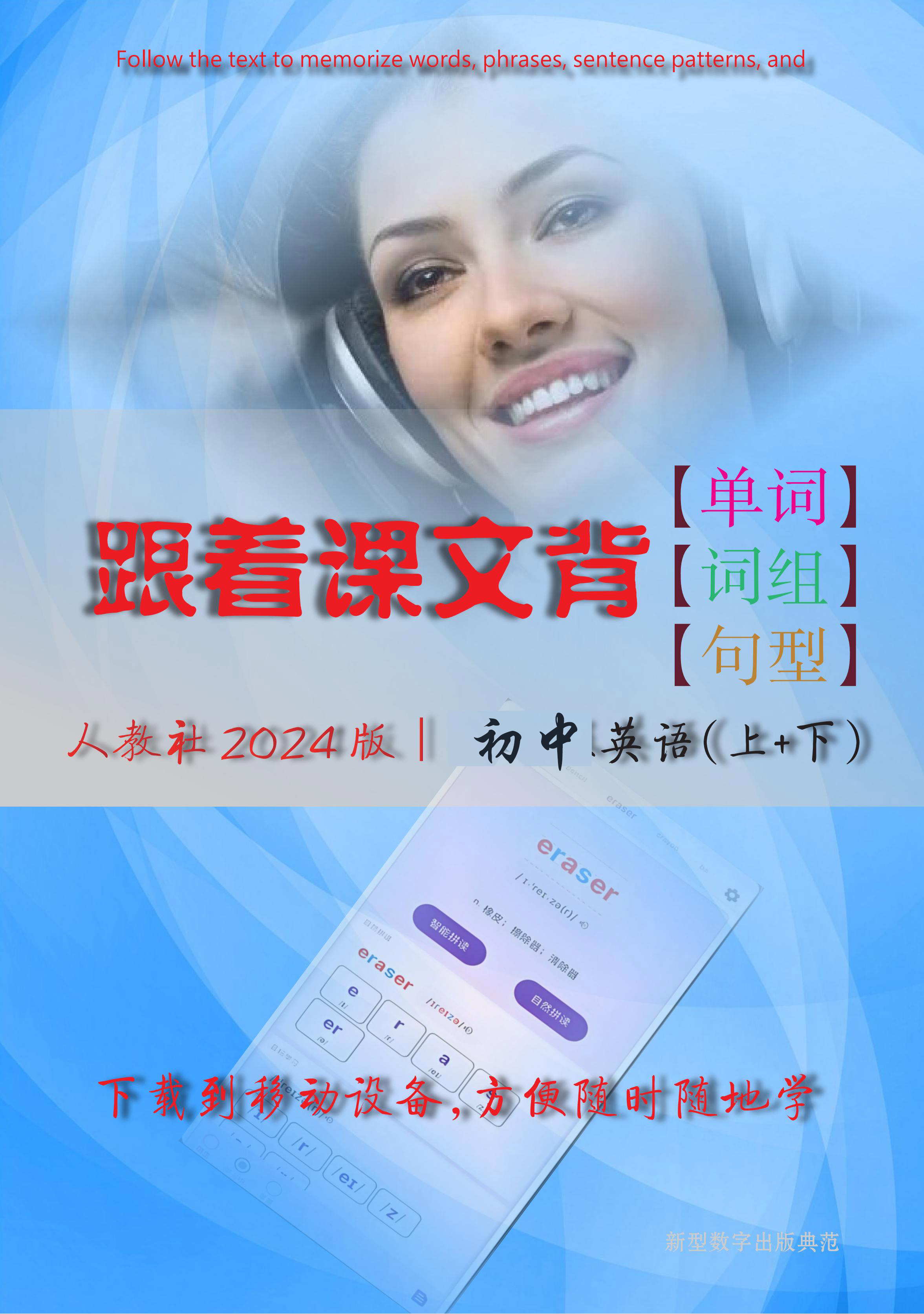
Follow the text to memorize words,phrases,sentence patterns,and grammar
【单词】
跟着误文背
【词组】
【句型】
【语法】
人教社新版|初中英语九年级(全一册)》
eraser
11-701-z0()
智能拼读
eraser
橡被:擦除器,清除疆
er
Hre1zole
然拼读
下载到形动设备,方便随时随地学
erl /z/
新型数字出版典范
跟着课文背|单词+词组+句型+语法
人教新版九年级英语全一册
说明
本书配套人民教育出版社新版九年级英语课本全一册,按单元整
理核心单词、重点词组、核心句型,课内语法点,贴合教材编排顺序,
适配九年级学生背诵使用。
1
2
Unit 1 How can we become good learners?
【单词】
textbook
['tekstbuk]
n.教科书;课本
conversation
[kpnve'seIfn]
n.交谈;谈话
aloud
[e'laudl
adv.大声地;出声地
pronunciation
[pre,nAnsi'eIfn]
n.发音;读音
sentence
['sentens]
n.句子
patient
[peIfnt]
adj.有耐心的n.病人
expression
[Ik'sprefn]
n.表达(方式);表示
discover
[dI'skAve(r)]
v.发现;发觉
secret
['si:kret]
n.秘密adj.秘密的
grammar
['g raeme(r]
n.语法
repeat
[rI pi:t]
v.重复;重做
note
[neut]
n.笔记;记录v.留意
pal
[pael]
n.朋友;伙伴
pattern
['paetn]
n.模式;方式
physics
['f红zIks]
n物理;物理学
chemistry
['kemIstri]
n.化学
人教2024版九年级英语|全-册
跟着课文背|单词+词组+句型+语法
partner
['pa:tne(r)]
n.搭档;同伴
pronounce
[pre'nauns]
v.发音
increase
[In'kri:s]
v.增加;增长
speed
[spi:d]
n.速度v.加速
ability
[e bIlatil
n.能力;才能
brain
[breIn]
n.大脑
active
['aektIv]
adj.活跃的;积极的
attention
[e'ten'n]
n.注意;关注
connect
[ke'nekt]
v.连接;与…有联系
overnight
eUve'naIt]
adv.一夜之间;突然
【重点词组】
l.fall in love with爱上;与…相爱
2.take notes记笔记
3.pay attention to注意;关注
4.connect.with..把…和…联系起来
5.ask for help求助
6.read aloud大声朗读
7.make mistakes犯错误
8.learn from向…学习
3
4
【核心句型】
1.特殊疑问句+方式介词用法
-How do you learn English?
-I learn by studying with a group.
一你是怎样学习英语的?
我通过小组合作学习。
2.t作形式主语,不定式作真正主语
It's too hard to understand spoken English.
听懂英语口语太难了。
3.比较级叠加句型:he+比较级…,the+比较级…
The more you read,the faster you'll be.
你读得越多,阅读速度就越快。
4.疑问词+不定式作宾语
I don't know how to increase my reading speed.
我不知道如何提高我的阅读速度。
【课内语法点】
1.方式介词by的用法
by后接动名词(doing),表示“通过某种方式、手段”,贴合本
单元“学习方法”话题。例:by reading aloud(通过大声朗读)、by
working hard(通过努力学习);注意区分by(通过…方式)与with
(用某种工具)、in(用某种语言)。
2.it作形式主语句型
人教2024版九年级英语|全-册
跟着课文背|单词+词组+句型+语法
基本结构为t’s+形容词+to do sth.,其中it是形式主语,真正
的主语是后面的不定式(todo),用于避免句子头重脚轻。例:It’s
important to practice English every day.(每天练习英语很重要)。
3.“the+比较级…,the+比较级…”句型
表示“越…,就越…”,前后两个比较级需对应,时态保持一致
(主句常用一般将来时,从句用一般现在时)。
4.疑问词+不定式(how/what/when to do)
可作宾语,置于动词(know,leam,decide等)后,相当于一个宾
语从句。例:Idon't know what to do..=Idon’t know what I should do.
(我不知道该做什么)。
5
6
Unit 2 I think that mooncakes are delicious!
【单词】
mooncake
['mu:nkeIk]
n.月饼
lantern
['laentan]
n.灯笼
stranger
['streInd3e(r)]
n.陌生人
relative
['reletIv]
n.亲属;亲戚
pound
[paUnd]
n.磅;英镑
folk
[feuk]
adj.民间的;民俗的
goddess
['g pdes]
n.女神
steal
[sti:I]
v.偷;窃取
lay
[leI]
v.放置;安放;产(卵)
dessert
[dI z3:t]
n.甜,点;甜食
garden
['g a:dn]
n.花园;园子
tradition
[tre'dIfn]
n.传统
admire
[ed'maIe(r)]
v.欣赏;仰慕
tie
[taI]
n.领带v.捆;束
haunted
['ho:ntId]
adj.有鬼魂出没的
ghost
g eust]
n.鬼;鬼魂
trick
[trIk]
n.花招;把戏
treat
[tri:t]
v.招待;款待n.款待
【重点词组】
人教2024版九年级英语|全一册
跟着课文背|单词+词组+句型+语法
1.put on增加(体重);发胖
2.lay out摆开;布置
3.dress up盛装打扮;乔装打扮
4.play a trick on sb.捉弄某人
5.admire the moon赏月
6.share sth.with sb.和某人分享某物
【核心句型】
1.that引导宾语从句
IⅡthink that mooncakes are delicious.我觉得月饼很好吃。
2.特殊疑问句
What do you like best about the Dragon Boat Festival?
你最喜欢端午节的什么?
3.f引导宾语从句(表是否)
I wonder if it's similar to the Water Festival of the Dai people.我想知
道它是否和傣族的泼水节相似。
4.How型感叹句
How exciting the races are!这些比赛多么令人激动啊!
【课内语法点】
1.that引导的宾语从句
hat无实际意义,可省略,从句用陈述语序(主语+谓语,主句
为一般现在时,从句时态根据句意而定。例:She says(that)she likes
7
8
the Mid-Autumn Festival..(她说她喜欢中秋节);若主句为过去时,从
句需用相应过去时态。
2.f引导的宾语从句(表“是否”,核心)
if可替换为whether,从句用陈述语序,不可用疑问语序。例:I
don't know if/whether he will come..(我不知道他是否会来);注意与if
引导的条件状语从句区分(表“如果”时,遵循“主将从现”)。
3.How型感叹句
基本结构为How+形容词/副词+主语+谓语!,用于表达强烈的
情感,注意与What型感叹句区分(What+alan+形容词+可数名词
单数+主语+谓语!)。
4.不规则动词辨析(拓展)
本单元重点掌握steal(偷)、lay(放置)的过去式和过去分词,
避免拼写错误:steal→stole→stolen;lay→laid→laid。
人教2024版九年级英语|全一册
跟着课文背|单词+词组+句型+语法
Unit 3 Could you please tell me where the restrooms are?
【单词】
restroom
['restru:m]
n.洗手间;公共厕所
stamp
[staemp]
n.邮票;印章
bookstore
['buksto:
]
n.书店
beside
[bI'saId]
prep.在…旁边
postcard
['peustk a d]
n.明信片
pardon
['pa:dn]
interj.请再说一遍;抱歉
washroom
['wpfru:m]
n.洗手间;厕所
bathroom
['ba:0 ru:m]
n.浴室;洗手间
rush
[
v.仓促;匆忙
suggest
[se d3est]
v.建议;提议
staff
[st a f]
n.员工;全体职员
central
[sentrel]
adj.中心的;中央的
mail
[meIl]
v.邮寄n.邮件
east
[i:st]
n.东;东方adj.东方的
fascinating
['faesIneItIn]
adj.迷人的
convenient
[ken'vi:nient]
adj.便利的;方便的
mall
[m:1]
n.商场;购物中心
clerk
[kla:k]
n.职员;店员
corner
['ko:ne(r)]
n.拐角;角落
9
10
polite
[pe'laIt]
ad.礼貌的;客气的
request
[rI'kwest]
n.&v.要求;请求
direction
[de'rekJn]
n.方向;方位
correct
[ke'rekt]
adj.正确的;恰当的
politeness
[pe'laItnes]
n.礼貌;客气
direct
[de'rekt]
adj.直接的;直率的
impolite
[,Impe'laIt]
adj.不礼貌的
address
[e'dres]
n.住址;地址
underground
['Ande g raund]
adj.地下的n.地铁
【重点词组】
1.pardon me抱歉;打扰一下
2.turn left/right向左/右转
3.go along沿着…走
4.pass by路过;经过
5.parking lot停车场
6.ask for help politely礼貌求助
【核心句型】
1.委婉请求句型+whee引导宾语从句(陈述语序)
Could you please tell me where the restrooms are?
你能告诉我洗手间在哪里吗?
2.where引导宾语从句
Excuse me,do you know where I can get some stamps?
人教2024版九年级英语|全-册
跟着课文背|单词+词组+句型+语法
打扰一下,你知道我在哪里可以买到邮票吗?
3.t作形式主语,不定式作真正主语
It's convenient to take the underground train.
乘坐地铁很方便。
4.t作形式主语+疑问词+不定式
It's important to learn how to use proper language.
学会使用得体的语言很重要。
【课内语法点】
1.宾语从句的陈述语序
无论主句是疑问句还是陈述句,宾语从句必须用“主语+谓语”
的陈述语序,不可用疑问语序。例:Could you tell me where he is?
(V);Could you tell me where is he?(x )
2.委婉请求句型
Could you please do sth.?表示“你能做某事吗?”,语气礼貌委
婉,用于向他人求助或提出请求,否定形式为Could you please not do
sth.?(你能不做某事吗?)。
3.疑问词+不定式作真正主语
基本结构为t’s+形容词+to do sth.,其中todo可替换为“疑
问词+不定式”,例:t’s hard to decide what to buy.(很难决定买什
么)
4.suggest的用法(拓展)
11
12
suggest作“建议”讲时,后接动名词(doing)或that从句(从
句用should+动词原形,should可省略),不可接不定式(todo)。例:
He suggests going to the bookstore.(他建议去书店)。
人教2024版九年级英语|全一册
跟着课文背|单词+词组+句型+语法
Unit 4 I used to be afraid of the dark.
【单词】
humorous
['hju:meres]
adj.有幽默感的
silent
['saIlent]
adj.沉默的;寂静的
helpful
[helpfl]
adj.有用的;有帮助的
outgoing
[aut g auIn]
adj.外向的;爱交际的
brave
[breIv]
adj.勇敢的;无畏的
background
['bae g kraund]
n.背景
interview
['Intevju:
v.&n.采访;面试
Asian
['eIfn]
adj.亚洲的n.亚洲人
dare
[dee(r)]
v.敢于;胆敢
private
[praIvet]
adj.私人的;私密的
guard
[g a:d]
n.警卫v.守卫;保卫
require
[rI'kwaIe(r)]
v.需要;要求
European
[jvere'pi:en]
ad.欧洲的n.欧洲人
African
['aefrIken]
adj.非洲的n.非洲人
British
['briu]
adj.英国的;英国人的
speech
[spi:]
n.演讲;发言
public
[pAblik]
adj.公众的;公共的
ant
[aent]
n.蚂蚁
insect
['Insekt]
n.昆虫
13
14
influence
['Influens
v.影响;对…起作用
seldom
['seldem]
adv.很少;不常
proud
[prad]
adj.自豪的;骄傲的
absent
['aebsent]
adj.缺席的;不在的
fail
[feIl]
v.失败;未能(做到)》
Examination
[I g,zaemI'neIfn]
n.考试;审查
decision
[dI'sI3n]
n.决定;抉择
pride
[praId]
n.自豪;骄傲
【重点词组】
1.from time to time时常;有时
2.deal with应对;处理
3.in public公开地;当众
4.be proud of=take pride in为…感到自豪
5.be absent from缺席;不在
6.make a decision做决定
7.in person亲自;亲身
【核心句型】
1.used to句型(过去常常)
I used to be afraid of the dark.
我过去常常害怕黑暗。
2.used to一般疑问句
人教2024版九年级英语|全-册
跟着课文背|单词+词组+句型+语法
Did you use to play the piano?
你过去常常弹钢琴吗?
3.一般现在时+频度固定短语
She still plays the piano from time to time.
她仍然时常弹钢琴。
4动名词作介词宾语
Many times I thought about giving up,but I fought on.
很多次我都想放弃,但我坚持了下来。
【课内语法点】
L.used to do sth.句型
表示“过去常常做某事”,强调过去的习惯或状态,现在已不再
如此,否定形式为didn’t use to do sth.,一般疑问句为Did..use to do
sth.?例:He didn’t use to smoke..(他过去不抽烟);注意与be used to
doing sth.(习惯于做某事)区分。
2.dare的用法
dare可作情态动词(后接动词原形,多用于否定句、疑问句),
也可作实义动词(后接todo,有人称和时态变化)。例:He dare not
speak in public..(情态动词);He doesn't dare to speak in public..(实义
动词)。
3.动名词作介词宾语
15
16
介词(about,of,in等)后接动词时,需用动名词(doing)形式,
本单元重点掌握think about doing sth..(考虑做某事)、be afraid of doing
sth.(害怕做某事)。
4.频度副词的用法(拓展)
seldom(很少)、sometimes(有时)、often(经常)等频度副词,
置于be动词、情态动词之后,实义动词之前。例:She is seldom late.
(她很少迟到);He often plays basketball.(他经常打篮球)。
人教2024版九年级英语|全一册
跟着课文背|单词+词组+句型+语法
Unit 5 What are the shirts made of?
【单词】
material
[ma't讧eriel
n.材料;原料
cotton
['kptn]
n.棉花;棉线
wood
[wud]
n.木材;木头
glass
[gla:s]
n.玻璃;玻璃杯
steel
[sti:I]
n.钢;钢铁
silver
['sIlve(r)]
n.银adj.银色的
gold
g euld]
n.金adj.金色的
leaf
[i:
n.叶子(pl.leaves)
produce
[pre'dju:s]
v.生产;制造
widely
['waIdli]
adv.广泛地;普遍地
process
[preuses]
v.加工;处理n.过程
local
['leukl]
adj.当地的;本地的
brand
[braend]
n.品牌;商标
avoid
[e'vord]
v.避免;回避
handbag
['haendbae g
n.手提包
everyday
['evrideI]
adj.每天的;日常的
boss
[bps]
n.老板;上司
Germany
['d33:menil
n.德国
surface
['s3:fIs]
n.表面;表层
17
18
postman
['paustmen]
n.邮递员
cap
[kaep]
n.帽子;便帽
glove
[g IAv]
n.手套
【重点词组】
1.be made of由…制成(看得出原材料)
2.be made from由…制成(看不出原材料)
3.be made in在…制造
4.be known for因…而闻名
5.be famous for以…著名
6.avoid doing sth.避免做某事
【核心句型】
1.一般现在时被动语态
-What are the shirts made of?-They're made of cotton.
一这些衬衫是由什么制成的?一它们是棉质的。
2.It seems that宾语从句+被动语态
It seems that many products are made in China.
似乎很多商品都是中国制造的。
3.一般现在时被动语态
Chinese tea is drunk all over the world.
中国茶风靡全世界。
4.avoid+动名词作宾语
He avoids making the same mistake again.
人教2024版九年级英语|全-册
跟着课文背引单词+词组+句型+语法
他避免再犯同样的错误。
【课内语法点】
1.一般现在时被动语态
基本结构为“主语+am/is/ae+过去分词”,强调动作的承受者,
贴合本单元“物品制作”话题。例:The desk is made of wood.(这张
桌子是木头做的);否定形式为am/is/are+not+过去分词,疑问句为
Am/Is/Are+主语+过去分词?
2.be made of与be made from的区别
两者均表示“由…制成”,be made of看得出原材料(物理变
化),be made from看不出原材料(化学变化)。例:Paper is made from
wood.(纸是由木头制成的,看不出原材料)。
3.avoid的用法
avoid后接动名词(doing),不可接不定式(todo),表示“避免
做某事”,例:Avoid eating too much sugar.(避免吃太多糖)。
4.副词widely的用法(拓展)》
widely表示“广泛地、普遍地”,置于动词之后,修饰动词,
例:English is widely used in the world.(英语在世界上被广泛使用)a
19
20
Unit 6 When was it invented?
【单词】
invent
[In'vent]
v.发明;创造
invention
[In'ven'n]
n.发明;创造
inventor
[In'vente(r)]
n.发明家
heel
[hi:I]
n.鞋跟;足跟
scoop
[sku:p]
n.勺;铲子
electric
[I'lektrIk]
adj.电的;带电的
slipper
['slIpe(r)]
n.拖鞋
battery
['baetri]
n.电池;电瓶
style
[staIl]
n.样式;款式
project
['prpd3ekt]
n.项目;工程
pleasure
ple3e(r)]
n.高兴;愉快
zipper
['zIpe(r)]
n.拉链;拉锁
daily
['derli]
adj.每日的;日常的
website
[websaIt]
n.网站
pioneer
[paIe nIe(r)]
n.先锋;先驱
list
[lIst]
n.名单;清单v.列出
mention
[menfn]
v.提到;说到
nearly
[nIeli]
adv.几乎;差不多
boil
[boIl]
v.煮沸;烧开
人教2024版九年级英语|全一册
跟着课文背|单词+词组+句型+语法
remain
[rI'meIn]
v.保持;仍然是
national
['naefnel]
adj.民族的;国家的
trade
[treId]
n.贸易;交易
popularity
[pppju laereti]
n.受欢迎;普及
doubt
[daut]
n.&v.疑惑;怀疑
low
lau]
adj.低的;矮的
instrument
['Instrement]
n.仪器;工具;乐器
【重点词组】
1.by accident偶然;意外地
2.by mistake错误地;无意中
3.without doubt毫无疑问;的确
4.take place发生;出现
5.spread to传播到…
6.be used for被用来做
【核心句型】
1.一般过去时被动语态
-When was the telephone invented?
-It was invented in 1876.
电话是什么时候发明的?
它发明于1876年。
2.固定句型It is said that据说…
21
22
It is said that tea was invented by accident.
据说茶叶是偶然被发明的。
3.最高级句型one of+最高级+名词复数
Tea has become one of the most popular drinks in the world.
茶叶已经成为世界上最受欢迎的饮品之一。
4.whether引导宾语从句
We doubt whether he can finish the work on time.
我们怀疑他能否按时完成这项工作。
【课内语法点】
1.一般过去时被动语态
基本结构为“主语+was/were+过去分词”,用于描述过去发生的
被动动作,贴合本单元“发明创造”话题。例:The light bulb was
invented by Edison..(电灯泡是爱迪生发明的);否定形式为was/were+
not+过去分词,疑问句为Was/Were+主语+过去分词?
2.It is said that..句型
表示“据说…”,that引导宾语从句,从句时态根据句意而定,
可转换为“主语+is said to do sth.”结构。例:It is said that he is a
great inventor.=He is said to be a great inventor..(据说他是一位伟大的
发明家)。
3.one of+最高级+名词复数
表示“最…之一”,后面的名词必须用复数形式,谓语动词用单
数。例:Beijing is one of the biggest cities in China.(北京是中国最大的
城市之一)。
人教2024版九年级英语|全一册
跟着课文背|单词+词组+句型+语法
4.whether引导的宾语从句
whether表“是否”,可与f互换,但在句首、介词后或与or not
连用时,只能用whether。.例:Idon't know whether he will come or not..
(我不知道他是否会来)
23
24
Unit 7 Teenagers should be allowed to choose their own
clothes.
【单词】
allow
[e'lau]
v.允许;准许
license
['laIsns]
n.证件;许可证
safety
['seIftil
n.安全;安全性
smoke
[smeuk]
v.吸烟n.烟
part-time
[p a:t'taIm]
adj.兼职的
earring
['IerIn]
n.耳环
pierce
[pIes]
v.刺穿;刺破
flash
[flae]
v.闪光n.闪光灯
hug
[hg
v.&n.拥抱
lift
f
v.举起;抬起n.电梯
awful
[':f
adj.糟糕的;极坏的
teenager
['ti:neId3e(r)]
n.青少年
regret
[rI'g ret]
v.&n.后悔;懊悔
poem
[peuIm]
n.诗;韵文
community
[ke'mju:neti]
n.社区;社群
chance
[tf a ns]
n.机会;机遇
educate
['ed3ukeIt]
v.教育;教导
manage
['maenId3]
v.管理;设法做到
人教2024版九年级英语|全一册
跟着课文背|单词+词组+句型+语法
society
[se sareti]
n.社会
peace
[pi:s]
n.和平;安宁
【重点词组】
1.be allowed to do sth.被允许做某事
2.allow sb.to do sth.允许某人做某事
3.talk back回嘴;顶嘴
4.keep away from远离
5.make one’s own decision自己做决定
6.get in the way of妨碍;挡…的路
【核心句型】
1.情态动词被动语态
Teenagers should be allowed to choose their own clothes.
青少年应该被允许选择自己的衣服。
2.宾语从句+否定前移+情态动词被动
I don't think sixteen-year-olds should be allowed to drive.
我认为十六岁的青少年不应该被允许开车。
3.regret+动名词作宾语
He regrets talking back to his parents..他后悔和父母顶嘴。
4.情态动词+被动语态+不定式
We should be educated to take care of ourselves.
我们应该被教会照顾自己。
25
26
【课内语法点】
1.情态动词被动语态
基本结构为“主语+情态动词(should,.can,must等)+be+过去
分词”,表示“应该/能够必须被做某事”,贴合本单元“青少年权利
与规则”话题。例:Children must be taken good care of.(孩子们必须
被好好照顾)。
2.否定前移
当主句主语为第一人称(Iwe),谓语动词为think,believe,
suppose等时,否定词not要前移到主句中,从句用肯定形式。例:I
don't believe he is right..(我认为他不对),而非I believe he is not
right.o
3.regret的用法
regret后接动名词(doing),表示“后悔做过某事”(事情已发
生):后接不定式(todo),表示“遗憾要做某事”(事情未发生)。
例:I regret missing the bus..(我后悔错过了公交车);I regret to tell you
the bad news.(我遗憾地告诉你这个坏消息)。
4.alow的用法
allow sb.to do sth.(允许某人做某事),其被动形式为sb.be
allowed to do sth.(某人被允许做某事),不可说allow to do sth.o
人教2024版九年级英语|全一册
跟着课文背|单词+词组+句型+语法
Unit 8 It must belong to Carla.
【单词】
truck
[trAk]
n.卡车;货车
rabbit
['raebIt]
n.兔;野兔
whose
[hu:z]
adj.&pron.谁的
attend
[e'tend]
v.出席;参加
valuable
['vaeljuebl]
adj.很有用的;宝贵的
pink
[pInk]
adj.粉红色的n.粉红色
picnic
[pIknIk]
n.野餐
noise
[n3Iz]
n.声音;噪音
policeman
[pe'li:smen]
n.男警察
wolf
[wulf]
n.狼
laboratory
le'bpretri]
n.实验室
sleepy
['sli:pi]
adj.困倦的;瞌睡的
pocket
['ppkIt]
n.衣袋;口袋
alien
['eIlien]
n.外星人
suit
[su:t]
n.西服;套装
express
[Ik'spres]
v.表示;表达
circle
['s3:kl]
n.圆圈v.圈出
receive
[rI'si:v]
v.接受;收到
leader
['li:de(r)]
n.领导;领袖
27
28
medical
['medIkl]
ad.医疗的;医学的
purpose
[p3:pes]
n.目的;目标
prevent
[prI'vent]
v.阻止;阻挠
energy
['ened3i]
n.精力;力量
position
[pe'zIn]
n.位置;地方
ancestor
['aenseste(r)]
n.祖先;祖宗
【重点词组】
1.belong to属于
2.attend a concert参加音乐会
3.pick up捡起;拾起
4.un away逃跑;逃走
5.not only..but also.不但…而且.
6.prevent..from doing sth.阻止某人做某事
【核心句型】
1.情态动词must表肯定推测
It must belong to Carla.
它一定属于卡拉。
2.情态动词表归属推测
-Whose book is this?
-It must be Mary's.It has her name on it.
一这是谁的书?
定是玛丽的,上面有她的名字。
人教2024版九年级英语|全-册
跟着课文背|单词+词组+句型+语法
3.情态动词could表可能性推测
It could be a boy's room.
这可能是一个男孩的房间。
4.情态动词can’t表否定推测
The light can't be a UFO.
那道光不可能是不明飞行物。
【课内语法点】
1.情态动词表推测
本单元重点掌握must,could,can’t表推测的用法:①must表
“一定、肯定”,用于肯定句,可能性最高;②coud表“可能、也
许”,用于肯定句或否定句,可能性较低;③can’t表“不可能”,用
于否定句,可能性为0。例:He must be at home.(他一定在家);He
could be late.(他可能会迟到):He can't be ill.(他不可能生病)。
2.belong to的用法
belong to后接人或名词所有格,表示“属于某人”,无被动语
态,也不用于进行时。例:This book belongs to me.(这本书属于我),
不可说This book is belonged to me.o
3.not only..but also.句型
表示“不但…而且…”,连接两个并列成分(主语、谓语、宾语
等),遵循“就近原则”(谓语动词的单复数由靠近它的主语决定)。
例:Not only he but also I am good at English..(不但他,我也擅长英
语)。
4.prevent...from doing sth.
29
30
表示“阻止某人/某物做某事”,fom可省略,也可替换为
stop..from doing sth.、keep.from doing sth.(keep后的from不可省
略)。
人教2024版九年级英语|全一册
跟着课文背|单词+词组+句型+语法
Unit 9 I like music that I can dance to.
【单词】
prefer
[prI'f3:(]
v.更喜欢;偏爱
lyric
['lIrIk]
n.歌词
Australian
[p'streIlien]
adj.澳大利亚的
n.澳大利亚人
electronic
[I lek'tronIk]
adj.电子的
smooth
[smu:6]
adj.平滑的;悦耳的
spare
[spea(r)]
adj.空闲的;多余的
director
[de rekte(r)]
n.导演;负责人
war
[w:(]
n.战争;冲突
drama
['dr a:mel
n.戏剧;剧本
Documentary
[dpkju'mentri]
n.纪录片
ending
['endIn]
n.结局;结尾
moving
['mu:vIn]
adj.感人的
comedy
['kDmedi]
n.喜剧;喜剧片
plenty
plenti]
pron.大量;充足
stuck
[stAk]
adj.卡住的;无法移动的
dialogue
['darelp g
n.对话;对白
intelligent
[In'telId3ent]
adj.聪明的;有才智的
sense
[sens]
n.感觉;意识v.感觉到
31
32
【重点词组】
l.dance to跟着…跳舞
2.sing along with跟着…一起唱
3.spare time空闲时间
4.plenty of大量;充足
5.stick to坚持;固守
6.make sense有道理;合乎情理
【核心句型】
1.that引导定语从句(修饰物)
I like music that I can dance to.
我喜欢可以跟着跳舞的音乐。
2.定语从句+prefer偏爱句型
I prefer music that has great lyrics.
我更喜欢歌词优美的音乐。
3.特殊疑问句
What kind of movies do you like?
你喜欢什么类型的电影?
4.which引导定语从句(修饰物)
I love movies which are funny.
我喜欢搞笑类的电影。
【课内语法点】
1.that/which引导的定语从句
人教2024版九年级英语|全-册
跟着课文背|单词+词组+句型+语法
两者均可修饰可数名词单数或复数(指物),hat可省略,which
不可省略;在从句中作主语或宾语,若作宾语,可省略。例:Ike
the book(hat/which)he bought yesterday.(我喜欢他昨天买的那本书):
注意:当先行词被最高级、序数词修饰时,只能用that,不可用
whicho
2.prefer的用法
prefer sth..(更喜欢某物)、prefer doing sth.(更喜欢做某事)、
prefer A to B(比起B,更喜欢A),例:I prefer tea to coffee.(比起咖
啡,我更喜欢茶);prefer to do sth.rather than do sth.(宁愿做某事,也
不愿做某事)。
3.stick to的用法
stick to后接名词或动名词(doing),表示“坚持某事/做某事”,
不可接不定式,例:He sticks to reading English every morning.(他坚持
每天早上读英语)。
4.plenty of的用法(拓展)
plenty of可修饰可数名词复数或不可数名词,表示“大量、充
足”,多用于肯定句,例:There is plenty of water in the bottle..(瓶子里
有很多水);There are plenty of books on the shelf..(书架上有很多书)a
33
34
Unit 10 Youre supposed to shake hands.
【单词】
custom
['kAstem]
n.风俗;习俗
bow
[bau]
v.&n.鞠躬;弯腰
kiss
[kIs]
v.&n.亲吻;接吻
greet
[g ri:t]
v.问候;打招呼
relaxed
[rI'laekst]
adj.放松的;自在的
value
[vaelju:
v.重视;珍视n.价值
chopstick
['tfopstIk]
n.筷子
fork
[f:k]
n.餐叉;叉子
knife
[naIf]
n.刀(pl.knives)
spoon
[spu:n]
n.勺子;调羹
rude
[ru:d]
adj.粗鲁的;无礼的
point
[poInt]
v.指;指向n.要点
empty
['empti的
adj.空的;空洞的
exchange
[Iks'tfeInd3]
v.&n.交换;互换
uncomfortable[An kAmftebl]
adj.不舒服的;不安的
gradually
g raed3ueli]
adv.逐渐地;逐步地
improve
[Im pru:v]
v.改进;改善
【重点词组】
I.be supposed to do sth.应该做某事
人教2024版九年级英语|全一册
跟着课文背|单词+词组+句型+语法
2.shake hands握手
3.for the first time第一次
4.make an effort努力;尽力
5.on time准时
6.be used to doing sth..习惯于做某事
【核心句型】
1.固定句型be supposed to do应该做…
You're supposed to shake hands.
你应该握手。
2.时间状语从句+固定礼仪句型
What are you supposed to do when you meet someone for the first time?
当你第一次与人见面时,应该做什么?
3.t作形式主语,不定式作真正主语
It's polite to bow in Japan.
在日本,鞠躬是有礼貌的行为。
4.be/get used to doing习惯于做某事
I gradually get used to living here.
我渐渐习惯了这里的生活。
【课内语法点】
1.be supposed to do sth.句型
表示“应该做某事”,相当于should do sth.,强调根据习俗、规则
或他人期望“理应做某事”,否定形式为be not supposed to do sth.(不
35
36
应该做某事)。例:You are not supposed to smoke here.(你不应该在这
里抽烟)。
2.be/get used to doing sth.
表示“习惯于做某事”,to是介词,后接动名词(doing),注意与
used to do sth.(过去常常做某事)区分。例:She is used to drinking
milk in the morning..(她习惯早上喝牛奶)。
3.for the first time的用法
作时间状语,位于句末或句首,强调“第一次做某事”,不可接
从句;而the first time可引导时间状语从句,例:I fell in love with her
for the first time..(我第一次见到她就爱上了她);The first time I saw her,.
I fell in love with her.(我第一次见到她时,就爱上了她)。
4.时间状语从句(拓展)
when引导的时间状语从句,主句用一般现在时,从句也用一般
现在时,表示客观事实或习惯性动作,例:When you meet a Japanese,
you’re supposed to bow.(当你遇到日本人时,你应该鞠躬)。
人教2024版九年级英语|全一册
跟着课文背|单词+词组+句型+语法
Unit 11 Sad movies make me cry.
【单词】
drive
[draIv]
v.迫使;驱使;驾驶
crazy
['kreIzi]
adj.疯狂的;狂热的
loud
[laud]
adj.大声的;响亮的
soft
[spft]
adj.柔软的;轻柔的
friendship
['frendfIp]
n.友谊;友情
king
[kIn]
n.国王;君主
queen
[kwi:n]
n.女王;王后
palace
[paeles]
n.宫殿;豪华大厦
wealth
[wel 0]
n.财富;财产
power
['pave(r)]
n.权力;力量
Disappointed
[.dIse'poIntId]
adj.失望的;沮丧的
embarrassed
[Im'baerest]
ad.尴尬的;窘迫的
【重点词组】
1.make sb.do sth.让某人做某事
2.would rather do sth.宁愿做某事
3.drive sb.crazy使某人发疯
4.be friends with sb..和某人成为朋友
5.leave out忽略;冷落;不提及
【核心句型】
37
38
L.使役动词make+宾语+省to不定式作宾补
Sad movies make me cry.
悲伤的电影让我落泪。
2.固定句型would rather do…than do…宁愿…也不愿…
I'd rather stay at home than go out.
我宁愿待在家里,也不愿出门。
5.make+宾语+形容词作宾补
The loud music makes me nervous.
喧闹的音乐让我感到紧张。
6.过去分词短语作表语
He feels left out because he has no friends here.
他因为在这里没有朋友而感到受冷落。
【课内语法点】
1.使役动词make的用法
①make sb.do sth.(让某人做某事),被动形式为sb.be made to do
sth.(某人被让做某事),to不可省略;②make sb.+形容词(让某人
处于某种状态),例:The news made her happy..(这个消息让她很高
兴)。
2.would rather do..than do…句型
表示“宁愿做某事,也不愿做某事”,han后接动词原形,前后
两个动作并列,语气坚定。例:He would rather work hard than give up.
(他宁愿努力工作,也不愿放弃)。
3.过去分词作表语
人教2024版九年级英语|全-册
跟着课文背|单词+词组+句型+语法
过去分词(如left out,disappointed,.embarrassed)作表语,用于描
述主语的感受或状态,相当于形容词。例:She is disappointed with the
result.(她对结果感到失望)。
4.drive的用法(拓展)
drive sb.crazy/mad表示“使某人发疯/发狂”,drive还可表示“驱
使、迫使”,后接不定式(todo),例:Poverty drove him to steal..(贫穷
迫使他偷窃)。
39
40
Unit 12 Life is full of the unexpected.
【单词】
unexpected
AnIk'spektId]
adj.出乎意料的
backpack
['baekpaek]
n.背包;双肩包
oversleep
[euve'sli:p]
v.睡过头;睡得太久
miss
[mIs]
v.错过;未赶上;想念
alarm
[e'la:m]
n.闹钟;警报
rush
[
v.冲;奔;匆
lock
[1pk]
v.锁;锁住n.锁
realize
['ri:elaIz]
v.意识到;领会
disaster
[dI'z a:ste(r]
n.灾难;灾祸
earthquake
['3:0 kwerk]
n.地震
【重点词组】
l.by the time在…以前
2.go off(闹钟)发出响声
3.wake up醒来
4.rush out冲出去
5.show up露面;出现
6.play tricks on sb.捉弄某人
【核心句型】
1.句型类别:主系表结构
人教2024版九年级英语|全一册
跟着课文背|单词+词组+句型+语法
Life is full of the unexpected.
生活充满了意想不到的事情。
2.时间状语从句+过去完成时
By the time I got up,my brother had already gotten in the shower.
当我起床时,我哥哥已经在洗澡了。
3.宾语从句+过去完成时
I realized I had left my keys at home.
我意识到我把钥匙忘在家里了。
4.时间状语从句+过去完成时
Many people had fled the city before the earthquake came.
地震来临之前,许多人已经逃离了这座城市。
【课内语法点】
1.过去完成时
基本结构为“主语+had+过去分词”,表示“在过去某个动作之
前已经完成的动作”,即“过去的过去”,常与by the time,before,when
等引导的时间状语从句连用,贴合本单元“意外事件”话题。例:By
the time we arrived,the meeting had already started.(我们到达时,会议
已经开始了)。
2.by the time的用法
by the time引导时间状语从句,从句用一般过去时,主句用过去
完成时;若从句用一般现在时,主句用一般将来时。例:By the time
he comes,.we will have finished our homework.(等他来的时候,我们将
会完成作业)
41
42
3.动词短语goof的用法
g0off可表示“(闹钟)发出响声”,还可表示“爆炸、熄灭”,结
合本单元场景,重点掌握“闹钟响”的用法,例:My alarm didn’tgo
off this morning,so I overslept.(今天早上我的闹钟没响,所以我睡过头
了)
4.过去分词作定语(拓展)
本单元出现多个过去分词作定语的用法,修饰名词,表被动或完
成,例:the unexpected(意想不到的事情)、a locked door(一扇锁着
的门),其中unexpected为过去分词转化的形容词,作定语修饰名
词。
人教2024版九年级英语|全一册
跟着课文背|单词+词组+句型+语法
Unit 13 Were trying to save the earth!
【单词】litter
['lIte(r)]
n.垃圾;废弃物v.乱
扔垃圾
bottom
['bptam]
n.底部;末端
fisherman
['fIfemen]
n.渔民;钓鱼的人
coal
[keul]
n.煤;煤炭
ugly
['Agli]
ad山j.丑陋的;难看的
advantage
[ed'y a:ntId3]
n.优点;有利条件
cost
[kpst]
v.花费;价钱为
n.花费;成本
wooden
['wudn]
adj.木制的;木头的
plastic
['plaestIk]
adj.塑料的
n.塑料;塑料制品
takeaway
['teIkeweI]
n.外卖食物
bin
[bIn]
n.垃圾桶
pollute
[pe'lu:t]
v.污染;弄脏
pollution
[pe lu:fn]
n.污染
recycle
[.ri:'saIkl]
v.回收利用;再利用
reusable
[ri:'ju:zebl]
adj.可重复使用的
harmful
['h a:mfl]
adj.有害的
binoculars
[bI npkjelerz]
n.双筒望远镜
43
44
industry
['Indestril
n.工业;产业
law
[l:]
n.法律;法规
reusable
[,ri:'ju:zebl]
adj.可重复使用的
cloth
[klp 0]
n.布;布料
towel
['ta心al]
n.毛巾
reduce
[rI'dju:s]
v.减少;降低
reuse
[ri:ju:z]
v.再次使用;重复利用
repair
[rI'pee(r)]
v.修理;修补
instead
[In'sted]
adv.代替;作为替代
【重点词组】
1.at the bottom of在…底部
2.throw away扔掉;丢弃
3.put sth.to good use好好利用某物
4.pull down拆除;摧毁
5.set up建立;设立
6.cut down砍倒;削减
7.play a part in参与;在中发挥作用
8.instead of代替;而不是
【核心句型】
1.现在进行时表动作正在进行
We're trying to save the earth!
我们正在努力拯救地球!
人教2024版九年级英语|全-册
跟着课文背|单词+词组+句型+语法
2.被动语态(一般现在时)
Rivers are polluted by waste water from factories.
河流被工厂排出的废水污染了。
3.情态动词can表建议
We can use cloth bags instead of plastic bags.
我们可以用布袋代替塑料袋。
4.疑问词+不定式作宾语
I don't know how to reduce pollution.
我不知道如何减少污染。
5.现在完成时表动作影响
People have polluted the environment for many years.
人们污染环境已经很多年了。
【课内语法点】
1.现在进行时表现阶段动作
基本结构为“主语+am/is/ae+现在分词”,本单元用于表示现阶
段正在进行的动作或努力,不一定此时此刻正在做。例:She is
learning to recycle paper..(她正在学习回收纸张,不一定此刻正在
做)。
2.一般现在时被动语态(拓展)
结合本单元“环境污染与保护”话题,重点掌握被动语态在描述
客观事实、普遍现象时的用法,基本结构“主语+am/is/ae+过去分
词”,强调动作承受者。例:Plastic is widely used in our daily life.(塑
料在我们的日常生活中被广泛使用)。
45
46
3.instead与instead of的区别
instead是副词,置于句末,表“代替”;instead of是介词短语,
后接名词、代词或动名词,表“代替某物/做某事”。例:He didn’t
go to school;he stayed at home instead..(他没去上学,而是待在了家
里);He stayed at home instead of going to school..(他待在家里,而不是
去上学)。
4.情态动词can表建议
can用于提出建议,语气委婉,意为“可以、能够”,后接动词原
形。例:We can plant more trees to improve the environment.(我们可以
种更多的树来改善环境)。
人教2024版九年级英语|全一册
跟着课文背|单词+词组+句型+语法
Unit 14 I remember meeting all of you in Grade 7.
【单词】
survey
['s3:veI]
n.调查;测量
standard
['staended]
n.标准;水平adj.标准的
row
[reu]
n.一排;一行;列v.划船
keyboard
['ki:bo:d]
n.键盘
method
['me 0 ed]
n.方法;办法
instruction
[In'strAkfn]
n.指示;命令
double
[dAbl]
v.加倍;是…的两倍
adj.两倍的;双的
overcome
euve'kAm]
v克服;战胜
difficulty
['difrkelti]
n.困难;难题
graduate
g raed3ueIt]
.毕业n.毕业生
congratulate
[ken'g raetfeleIt]
v.祝贺
ceremony
['seremeni]
n.典礼;仪式
celebrate
['selIbreIt]
v.庆祝;庆贺
degree
[dI'g ri:
n.学位;度数;程度
thankful
[0 aenkfl]
adj.感激的;感谢的
lastly
['la:stli]
adv.最后
task
[t a sk]
n.任务;工作
ahead
[e'hed]
adv.向前;在前面
47
48
responsible
[rI'sppnsebl]
ad.有责任的;负责的
separate
['sepret]
adj.单独的;分离的
['sepereIt]
v.分离;分开
【重点词组】
1.look back at回顾;回忆
2.in arow连续几次地
3.overcome difficulties克服困难
4.graduate from从…毕业
5.congratulate sb.on sth.因某事祝贺某人
6.be thankful to sb.对某人心存感激
7.ahead of在…前面;提前
8.take responsibility承担责任
9.separate from与…分离;分开
【核心句型】
I.remember doing sth.记得做过某事
I remember meeting all of you in Grade 7.
我记得在七年级见过你们所有人。
2.现在完成时表经历
We have learned a lot over the past three years.
在过去的三年里,我们学到了很多东西。
3.情态动词could表过去的能力
I could not speak English well when I was in Grade 7.
人教2024版九年级英语|全-册
跟着课文背|单词+词组+句型+语法
我上七年级时英语说得不好。
4.祈使句表建议/祝福
Let's celebrate our graduation!
让我们庆祝我们的毕业吧!
5.宾语从句(that可省略)
Our teacher told us that we should be responsible for our actions.
我们的老师告诉我们,我们应该对自己的行为负责。
【课内语法点】
1.remember doing sth.与remember to do sth.的区别
remember doing sth.表示“记得做过某事”(事情已发生):
remember to do sth.表示“记得要做某事”(事情未发生)。例:I
remember closing the door..(我记得关了门,门已经关了):Remember
to close the door.(记得关门,门还没关)。
2.现在完成时表经历
基本结构“主语+have/has+过去分词”,常与over the past three
years,since,for等时间状语连用,强调从过去持续到现在的经历或变
化。例:He has lived in this city for three years..(他已经在这个城市住
了三年了)。
3.情态动词could表过去的能力
could用于表示过去具备的能力,现在可能不再具备,区别于can
(表现在的能力)。例:She could swim when she was five.(她五岁时就
会游泳了)。
4.congratulate的用法
49
50
congratulate sb.on sth.表示“因某事祝贺某人”,不可直接接
sth.,需加介词on;其名词形式为congratulation,常用复数形式
congratulations:We congratulated him on winning the competition.
(我们祝贺他赢得了比赛)。
人教2024版九年级英语|全-册
资源预览图

1

2

3

4
相关资源
示范课
由于学科网是一个信息分享及获取的平台,不确保部分用户上传资料的 来源及知识产权归属。如您发现相关资料侵犯您的合法权益,请联系学科网,我们核实后将及时进行处理。