Unit 6 Hitting the road Developing ideas(Listening) 课件 2025-2026学年外研版英语七年级下册
2026-05-21
|
29页
|
668人阅读
|
3人下载
普通
资源信息
| 学段 | 初中 |
|---|---|
| 学科 | 英语 |
| 教材版本 | 初中英语外研版七年级下册 |
| 年级 | 七年级 |
| 章节 | Listening and speaking,Developing ideas,Unit 6 Hitting the road |
| 类型 | 课件 |
| 知识点 | - |
| 使用场景 | 同步教学-新授课 |
| 学年 | 2026-2027 |
| 地区(省份) | 全国 |
| 地区(市) | - |
| 地区(区县) | - |
| 文件格式 | PPTX |
| 文件大小 | 28.05 MB |
| 发布时间 | 2026-05-21 |
| 更新时间 | 2026-05-21 |
| 作者 | 匿名 |
| 品牌系列 | - |
| 审核时间 | 2026-05-21 |
| 下载链接 | https://m.zxxk.com/soft/57981376.html |
| 价格 | 2.00储值(1储值=1元) |
| 来源 | 学科网 |
摘要:
该初中英语课件围绕Unit 6“Hitting the road”的听说模块展开,核心涵盖/ʃ/、/ʒ/、/tʃ/、/dʒ/发音训练,accept/receive词汇辨析及help用法等语法知识。课堂以“你喜欢看旅行vlog吗”导入,结合vlog定义讲解搭建兴趣支架,通过听力选择情境、完成个人主页到填充思维地图,逐步提升信息提取能力。
其亮点在于以旅行vlog为真实情境载体,融合语言能力(听说获取关键信息)、思维品质(用思维地图分析伯尔尼人游泳上班的原因与方式)和文化意识(了解不同文化的出行方式)。采用“听-说-练”递进教学,如发音训练结合例词重复,结对分享旅行经历提升合作学习能力,助力学生在语境中提升语言运用与逻辑思维,教师可借结构化活动高效教学。
内容正文:
Unit 6 Hitting the road
Developing ideas (Listening)
教学目标
思维品质
学习能力
文化意识
学生能够用本课时的核心词汇和句型进行对话;掌握/ʃ/、/ʒ/、/dʒ/、/tʃ/的发音。
引导学生对信息进行分析,培养学生归纳总结、推理判断的思维能力,学会从听力材料中提炼要点。
学生能够运用预测、抓关键词等听力技巧,提高听力理解效率;通过模仿跟读、角色扮演等方式,提升口语表达能力。
激发学生对文化和旅行的探索兴趣,树立尊重和欣赏不同文化的态度,增强文化自信。
语言能力
√
√
√
√
★教学重难点
学生在听说环节中能够获取并梳理关键信息,掌握/ʃ/、/ʒ/、/dʒ/、/tʃ/的发音。
通过活动的展开,学生能够描述特殊形式的旅行,能够分析、谈论自己旅行的经历和其中的意义。
Warming up
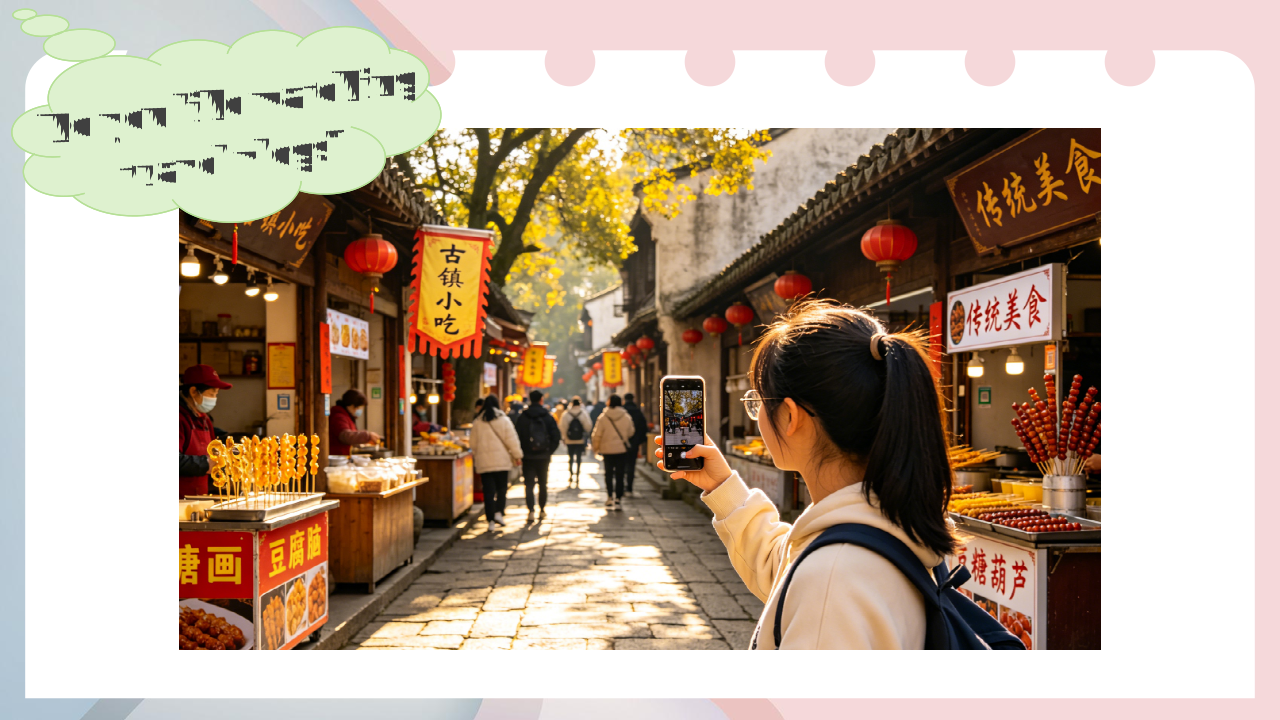
Do you like watching travel vlogs?
What is the woman doing?
A vlog is a blog in the form of a video. It's a popular way of sharing information and experiences. People sharing vlogs online are called vloggers.
Did you know
Listening
Listen to the speech and choose the correct situation.
a The speaker is accepting an award on the stage.
b The speaker is making a travel vlog in the street.
c The speaker is talking to local people in a restaurant.
Pronunciation:
/ʃ/ share should
/ʒ/ usually decision
/tʃ/ watch much
/dʒ/ Jack just
Listen and repeat.
/ʃ/ British finish shop sure
/ʒ/ television pleasure treasure usual
/dʒ/ enjoy judge job bridge
/tʃ/ Chinese teacher each catch
Listen again and complete the personal homepage.
Award: Best ___________ Vlogger
How I travel:
During my travels, I don’t just go to the _______________.
Travel
famous places
Name: ____________
Jack
Listen again and complete the personal homepage.
How I travel:
I ____________ talking to local people.
It helps me learn about their __________ and understand their __________.
enjoy
lives
culture
The latest vlog:
Listen to the vlog and complete the thinking map.
Jack
Where am I?
I'm in Bern, a beautiful place with _________________.
What do I find?
I see someone __________ the river. There are lots of people in the water. I talk to a lady and find she is going to _________________.
a long history
in
work by swimming
Listen to the vlog and complete the thinking map.
Jack
Why do people do this?
There are no traffic jams or noise. People can __________ on their way to work. It's a ___________ way to get around Bern in summer. It's very "cool".
How do people do it?
People put their _________________ in a waterproof bag.
chat
popular
clothes and things
Expressing surprise If you hear something positive, you can use expressions such as Really? or Amazing! If you hear something negative, you can use expressions such as Oh dear! or How awful!
Learning to learn
Listen again. Then talk about how Jack expresses surprise.
Listen again.
Jack: Hi, everybody. I'm Jack. Thank you for giving me the award for Best Travel Vlogger.
This year's award is about “Different experiences", so I'd like to share my thoughts
on that.
During my travels, I don't just go to the famous places. I enjoy talking to local people. That's more interesting to me. It helps me learn about their lives and understand their culture. For example, I recently visited a city and I noticed something very surprising. Many people there swim to work! Where is this place? Well, you'll have to watch my latest vlog to find out! Thanks again for the award.
Jack: Hello, everyone. I'm in Bern, Switzerland. It's a beautiful place with a long history.
Behind me, you can see the famous Clock Tower. Oh! Did someone just jump in the
river? Wow, there are lots of people in the river! Let me go and ask that lady. Excuse
me, what are you doing?
Woman: I'm going to work.
Jack:I'm sorry? You swim to work?
Woman: That's right. There are no traffic jams or noise. I often chat to people on my way to
work.
Listen again.
Jack: But what do you do with your clothes and your things?
Woman: Oh, I put them in a waterproof bag. They won't get wet.
Jack: Is this a popular way to get around Bern?
Woman: In summer, yes. Why don't you jump in the river, too? You can get a waterproof
bag and have a look at the city down the river.
Jack: Amazing! I'll try that later. Enjoy your swim!
Woman: Bye!
Listen again.
Work in pairs.
Talk about your favourite kind of travelling and share what you can learn from it.
Grammer
accept
▶accept:v. 接受;收下;认可(主观愿意)
常用搭配:
•accept sth from sb:从某人那里接受某物
例:She accepted advice from her teacher.
她接受了老师的建议。
I accepted a gift from my friend.
我从朋友那里收下了礼物。
accept / receive
▶accept:主观接受,心里愿意
receive:客观收到,只表示动作,不代表是否接受
常用搭配:
•receive sth (from sb):从某人处收到某物
例:I received a letter from my friend yesterday.
我昨天收到了朋友的一封信(只说明收到了,没说是否愿意)。
help sb (to) do sth
•help sb (to) do sth:v帮助某人做某事
例:My best friend often helps me (to) practice my English.(我最好的朋友经常
帮我练习英语。)
•help sb with sth 在某事上帮助某人(后接名词 / 代词)
例:Could you help me with my math homework?(你能帮我做数学作业吗?)
help do sth 帮忙做某事(无宾语)
例:Let’s help clean the classroom after school.(放学后我们一起帮忙打扫教室吧。)
help oneself to… 请随便吃 / 用……(固定礼貌用语)
例:Help yourselves to some cakes, children.(孩子们,请随便吃蛋糕。)
Exercise
用括号内单词的适当形式填空
1. We are proud of Jack because he won an ___________ (奖品) in the competition.
2. She puts them in a _________________ (防水的) bag.
3. She feels sorry that she isn’t able to _______________ (接受) her friend’s kind invitation (邀请).
4. This is a _____________ (有用的) suggestion. Please keep it in your mind.
award
waterproof
accept
useful
根据中文句意补全句子
1. 多亏了你的帮助,我成功通过了考试。
__________________ your help, I passed the exam successfully.
2. 吃完早饭后,我们决定早点儿出发了。
After having breakfast, we decided to ___________________ early.
3. 如果你以提问的方式请求帮助,你会显得更有礼貌。
If you ask for help _______________________ a question, you’ll sound much more polite.
Thanks for
set out/off
in the form of
Homework
Homework
1. Review the keywords and sentence structures in today’s lesson.
2. Preview the next lesson.
Other
69394.695
Lavf57.71.100
Codec by Bilibili XCode Worker v4.8.35(fixed_gap:False)
Other
186486.75
$
资源预览图
1
2
3

4
5

6
相关资源
由于学科网是一个信息分享及获取的平台,不确保部分用户上传资料的 来源及知识产权归属。如您发现相关资料侵犯您的合法权益,请联系学科网,我们核实后将及时进行处理。