河南省三门峡市 2026 年中招第二次模拟考试英语试题卷
 切换试卷
切换试卷
2026-05-20
|
10页
|
52人阅读
|
1人下载
资源信息
| 学段 | 初中 |
|---|---|
| 学科 | 英语 |
| 教材版本 | - |
| 年级 | 九年级 |
| 章节 | - |
| 类型 | 试卷 |
| 知识点 | - |
| 使用场景 | 中考复习-二模 |
| 学年 | 2026-2027 |
| 地区(省份) | 河南省 |
| 地区(市) | 三门峡市 |
| 地区(区县) | - |
| 文件格式 | DOCX |
| 文件大小 | 922 KB |
| 发布时间 | 2026-05-20 |
| 更新时间 | 2026-05-20 |
| 作者 | 匿名 |
| 品牌系列 | - |
| 审核时间 | 2026-05-20 |
| 下载链接 | https://m.zxxk.com/soft/57946515.html |
| 价格 | 1.00储值(1储值=1元) |
| 来源 | 学科网 |
内容正文:
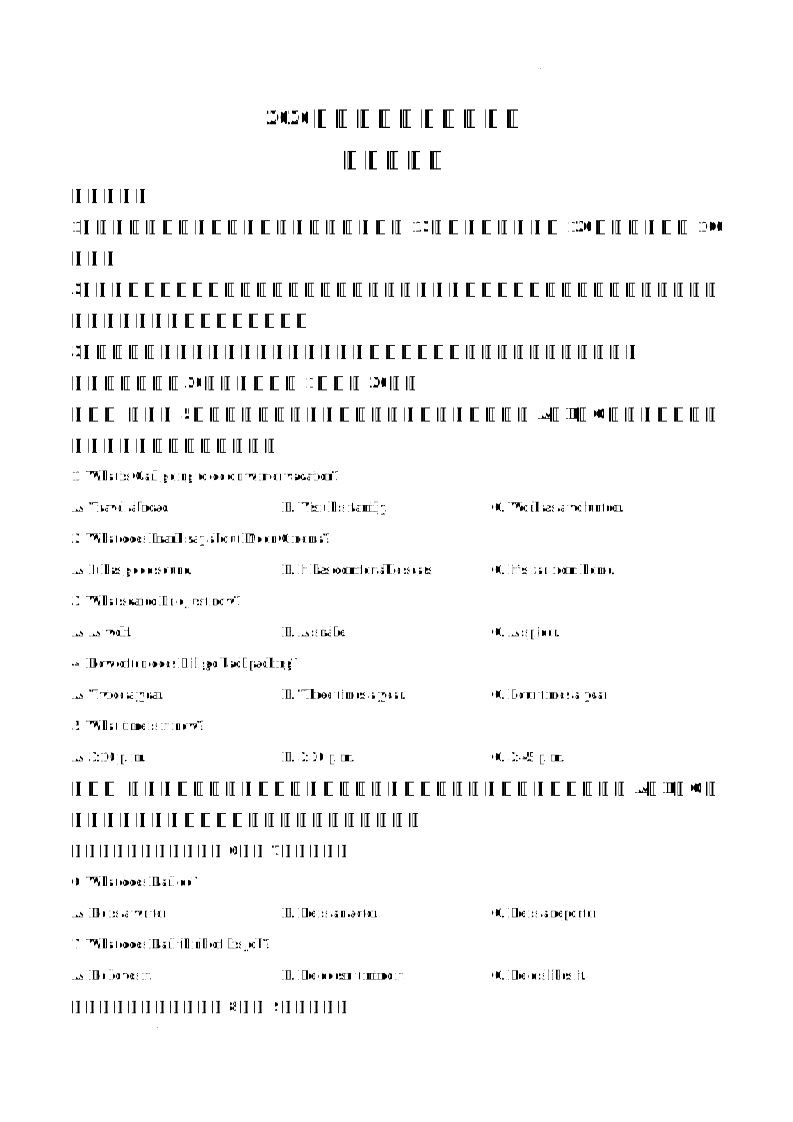
2026年中招第二次模拟考试
英语试题卷
注意事项:
1.本试卷分试题卷和答题卡两部分。试题卷共12页,六大题,满分120分,考试时间100分钟。
2.答题前,同学们务必先将自己的学校、班级、姓名、考场号、座号,以及准考证号写在试题卷和答题卡第一面的指定位置。
3.答题时,同学们一定要按要求把答案写在答题卡上,答案写在试题卷上无效。
一、听力理解(20小题,每小题1分,共20分)
第一节 听下面5段对话。每段对话后有一个小题,从题中所给的A、B、C三个选项中选出最佳答案。每段对话读两遍。
1. What is Carl going to do on winter vacation?
A. Travel abroad. B. Visit his family. C. Work as a volunteer.
2. What does Frank say about Moon Cinema?
A. It has good sound. B. It has comfortable seats. C. It’s far from home.
3. What scared Eric just now?
A. A wolf. B. A snake. C. A spider.
4. How often does Bill go backpacking?
A. Twice a year. B. Three times a year. C. Four times a year.
5. What time is it now?
A. 3:10 p. m. B. 3:30 p. m. C. 3:45 p. m.
第二节 听下面几段对话或独白。每段对话或独白后有几个小题,从题中所给的A、B、C三个选项中选出最佳答案。每段对话或独白读两遍。
听下面一段对话,回答第6至第7两个小题。
6. What does Karl do?
A. He is a writer. B. He is an actor. C. He is a reporter.
7. What does Karl think of his job?
A. He loves it. B. He doesn’t mind it. C. He dislikes it.
听下面一段对话,回答第8至第9两个小题。
8. What sport was David supposed to play after school?
A. Baseball. B. Tennis. C. Ping-pong.
9. How did David get home?
A. By bus. B. By subway. C. On foot.
听下面一段独白,回答第10至第12三个小题。
10. Where did Edward go today?
A. To the beach. B. To the farm. C. To the forest.
11. What sport did Jimmy do before swimming?
A. He played badminton. B. He played baseball. C. He played soccer.
12. What kind of movie does Jimmy want to watch with Edward?
A. An action movie. B. A scary movie. C. A comedy.
听下面一段对话,回答第13至第15三个小题。
13. How did Eric feel as he set off?
A. Nervous. B. Relaxed. C. Interested.
14. What was the best part of the trip?
A. Talking with local people. B. Feeling the sun on the face. C. Trying local food.
15. Across which country does Eric plan to have a bike trip some day?
A. Canada. B. New Zealand. C. Australia.
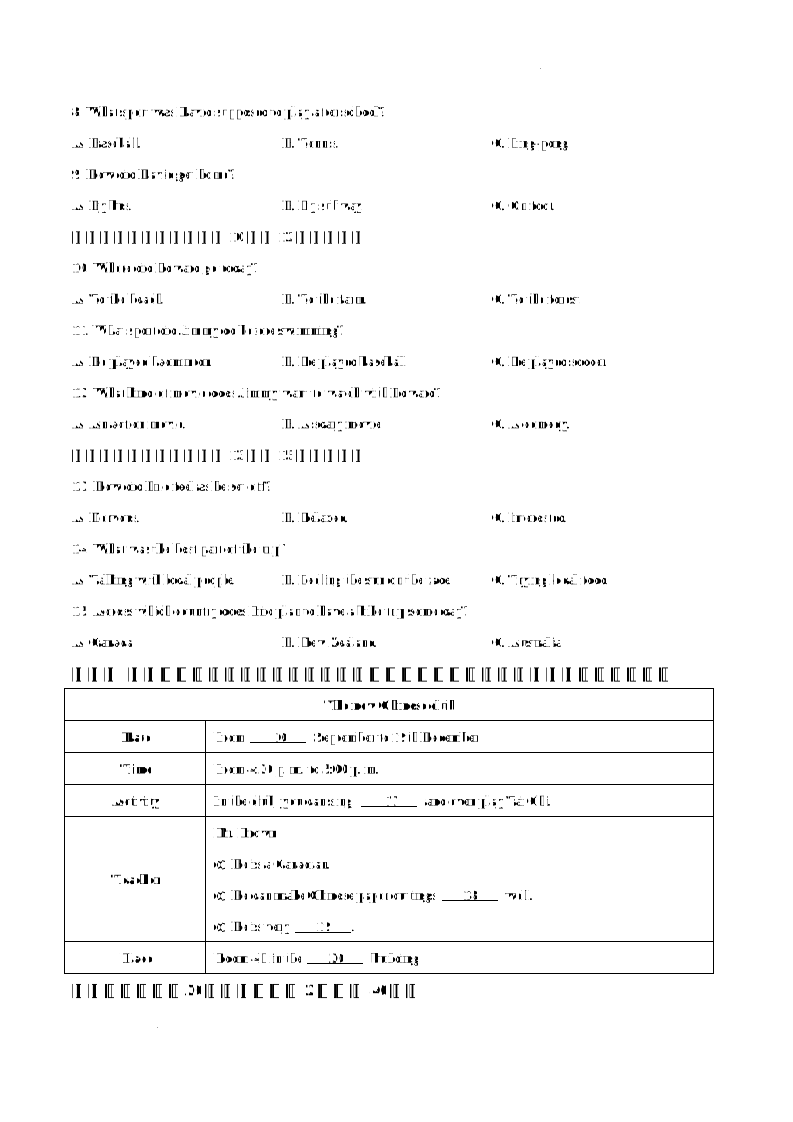
第三节 听短文,根据所听到的短文内容,完成下面表格,每空填一词。短文读两遍。
The new Chinese club
Date
From 16 September to 19th December
Time
From 4:20 p. m. to 5:00 p. m.
Activity
In the club, you can sing, 17 and even play Tai Chi.
Teacher
Mr. Brown
◎ He is a Canadian.
◎ He can make Chinese paper cuttings 18 well.
◎ He is very 19 .
Place
Room 4F in the 20 building
二、阅读理解(20小题,每小题2分,共40分)
阅读下面四篇语言材料,然后按文后要求做题。
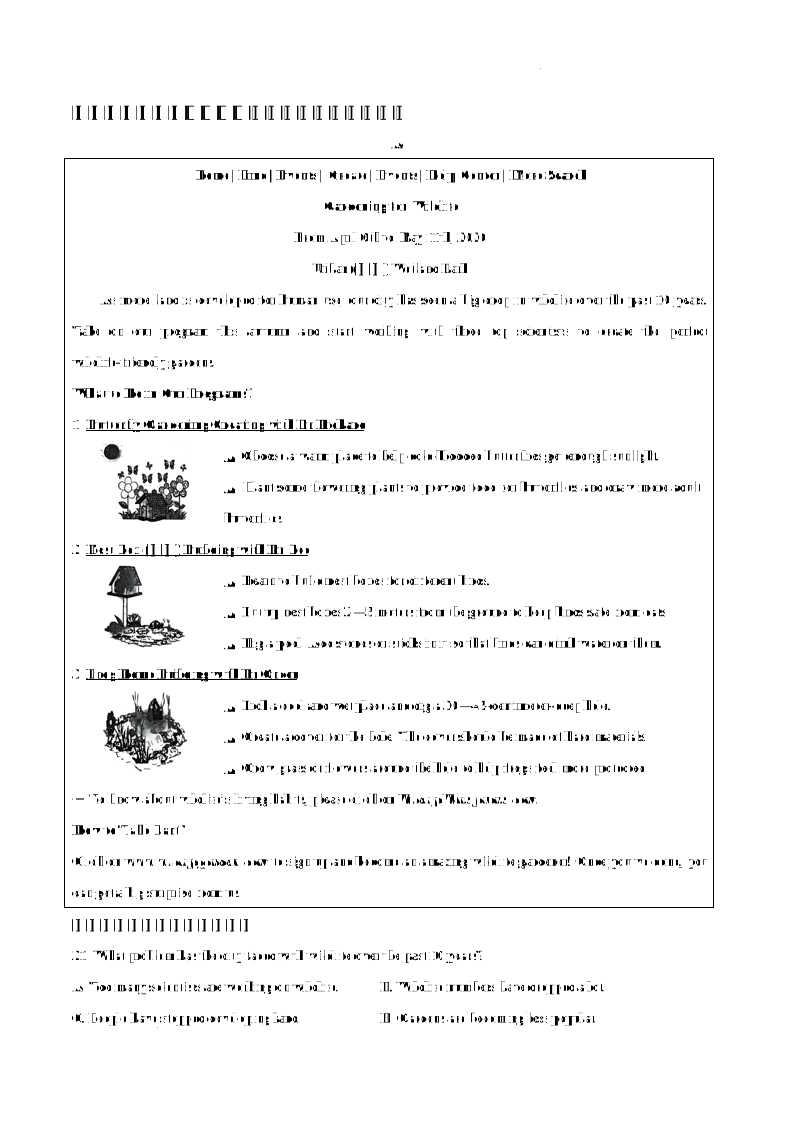
A
Home | Find | Events | Create | Events | Help Center | More Search
Gardening for Wildlife
From April 6th to May 11th, 2026
Urban (城市) Wetland Park
As more land is developed for human use, our city has seen a big drop in wildlife over the past 10 years. Take on our program this autumn and start working with three top scientists to create the perfect wildlife-friendly gardens.
What to Do in Our Programs?
1. Butterfly Gardening Creating with Dr Richard
▲ Choose a warm place to help cold-blooded butterflies get enough sunlight.
▲ Plant some flowering plants to provide food for butterflies and draw more adult butterflies.
2. Nest Box (巢箱) Building with Dr Lee
▲ Learn to build nest boxes for different birds.
▲ Put up nest boxes 2—5 meters from the ground to keep birds safe from cats.
▲ Dig a pool. Add stones or sticks in it so that birds can drink water on them.
3. Frog Home Building with Dr Green
▲ Pick a cool and wet place and dig a 30—45-centimeter-deep hole.
▲ Create a cover for the hole. The cover should be made of hard materials.
▲ Grow grass or flowers around the hole to help frogs feel more protected.
→ To know about wildlife’s living habits, please click on WildlifeWhisperers. com.
How to Take Part?
Click on www.wildlifegarden. com to sign up and become an amazing wildlife gardener! Once you’ve done, you can get a big surprise from us.
根据材料内容选择最佳答案。
21. What problem has the city faced with wildlife over the past 10 years?
A. Too many scientists are working on wildlife. B. Wildlife numbers have dropped a lot.
C. People have stopped developing land. D. Gardens are becoming less popular.
22. Why do people plant flowering plants in the butterfly gardening activity?
A. To provide a resting place. B. To provide food for young butterflies.
C. To make butterflies come for food. D. To help butterflies feel protected.
23. What should people do to help birds drink water in the activity?
A. By placing stones or sticks in the pool. B. By hanging water boxes in trees.
C. By planting trees near the pool. D. By changing the water in the pool.
24. How can Tommy, a bird lover, take part in the program?
A. By writing a letter to the park. B. By calling the scientists.
C. By signing up on a website. D. By coming to the park directly.
25. What is the text?
A. A news report. B. An invitation letter.
C. A science story. D. A program poster.
B
Fiona was a very popular girl at school. From an early age, she made an effort to be kind and friendly to everyone. She invited the whole class to her birthday party and sometimes gave presents to everybody.
However, everything changed on International Day of Friendship. In class that day, everyone had to make three presents to give to their three best friends. Fiona enjoyed the task of choosing three from all her classmates. But when all the presents had been made and shared out, she was the only one that didn’t receive a present! Fiona hadn’t expected this and felt terrible, crying for hours. Everyone came to comfort her, but each stayed only a short time before leaving — just as she had done to others so many times.
She realized she was a good companion, but she hadn’t been a true friend to anyone. Although she had tried to be close to everyone, she found that wasn’t enough to create true friendships.
That night, Fiona told her mother about everything. Her mother said, “My dear, you cannot buy friends with a smile or a few good words. If you want true friends, you must give them time and real care. For a true friend, you must always be there in good times and bad.”
Hearing this, Fiona decided to change her ways to finally have some true friends. As she lay in bed that night, she thought about how to achieve this. She thought about her mother, who was always ready to help her, put up with her bad behaviour, encouraged her and loved her dearly. That was what made a true friend!
Fiona smiled happily, realizing she already had the best friend anyone could ever want.
根据材料内容选择最佳答案。
26. What did Fiona do to make herself kind before International Day of Friendship?
A. She had a few very close friends and shared secrets with them.
B. She often invited the whole class to parties and gave out gifts.
C. She only played with classmates who gave her presents.
D. She was good at making presents for all her classmates.
27. How did Fiona’s feelings change in the text?
A. Proud → Surprised → Grateful B. Confident → Angry → Proud
C. Proud → Lonely → Angry D. Confident → Sad → happy
28. What can we learn from the text?
A. It’s important to be popular among all classmates.
B. A true friend is someone who gives us expensive presents.
C. Friendship should be based on time, care and real support.
D. Mothers always know more about friendship than daughters.
29. After the story, Fiona might most probably do the following EXCEPT ________.
A. try to give gifts to everyone more often B. focus more on building deeper friendships
C. spend more quality time with her mother D. build close friendships with fewer but real people
30. What’s the best title for the text?
A. The International Day of Friendship B. How to Hold a Perfect Birthday Party
C. Fiona’s Search for True Friendship D. The Story of a Popular Girl
C
The Northern Lights are bright, moving lights in the night sky. The scientific name for the Northern Lights is the aurora borealis (极光). It is named after Aurora, the Roman goddess of dawn (黎明), and Boreas, the Greek god of the north wind.
The Northern Lights appear when charged particles (带电粒子) from the Sun hit Earth’s upper atmosphere (高层大气) at high speeds. As Earth’s magnetic field (磁场) pulls these particles towards the poles — there are the Southern Lights too. When these particles meet some gases in the sky, they create colorful lights across the sky.
The Northern Lights vary in color from green to purple and blue. But have you ever wondered why they have different colors? Different gases produce different colors.
For many of us, this might be a very special and unusual event. But it has become more common in the last few years. That’s because the Sun is reaching a “maximum” in its 11-year cycle. During this maximum, the Sun sends out very large clouds of particles. You can think of this as a big sneeze (喷嚏) by the Sun!
Thanks to increasing solar activity, the Northern Lights can appear further south and more often than usual. However, the best places to see them are near the North Pole, such as northern Norway, Finland, Iceland and Greenland.
根据材料内容选择最佳答案。
31. How does the writer lead into the topic in Paragraph 1?
A. By giving a definition. B. By telling a short story.
C. By listing numbers. D. By comparing two things.
32. What causes the colors of the Northern Lights according to the text?
A. The speed of charged particles. B. The magnetic field of the Earth.
C. Different gases in the sky. D. The 11-year cycle of the Sun.
33. What does the word “maximum” mean in Paragraph 4?
A. The lowest point of the Sun’s cycle.
B. The time when Earth is farthest from the Sun.
C. The moment when the Northern Lights disappear.
D. The highest level of solar activity in an 11-year cycle.
34. Why does the writer compare the solar particles to a “big sneeze” in Paragraph 4?
A. To show how small the particle clouds are.
B. To explain how the Sun produces energy for us.
C. To show that the Sun is unhealthy and bad for us.
D. To help readers imagine the huge amount of particles.
35. What is the main idea of the text?
A. The best places to watch the Northern Lights.
B. The story behind the names of the Northern Lights.
C. The introduction of the Northern Lights and features.
D. How solar activity harms the Earth’s atmosphere.
D
Middle school life can be overwhelming (难以抗拒的). For example, exams, friendships, and busy schedules can all cause stress. 36. ________. However, learning simple life skills to manage your mood can really help.
One easy way is the “5-4-3-2-1 grounding method”. When you feel anxious, try this — find 5 things you see, 4 things you feel, 3 things you hear, 2 things you smell, and 1 thing you taste. 37. ________. It pulls your mind away from worries and into the present moment.
Another good way is to set small, clear goals. Instead of “study for English”, write “learn at least 5 new words”. Breaking big tasks into small steps makes them easier to start. Finishing small tasks gives you a sense of progress. 38. ________.
Focusing on gratitude (感恩) is also a great way to boost your mood. Notes of gratitude can help you focus on the positive side of life. 39. ________. Even on hard days, there is always something small to be thankful for, like a sunny morning or a friend’s text.
Finally, don’t forget to say “no” when you need to. You don’t have to join every activity or agree to every request. When you save some time for yourself, you can do better in the things that truly matter. 40. ________.
Learning these skills takes practice, but they can truly make a difference. Try them and see how you feel!
根据材料内容,从下面五个选项中选出能填入文中空缺处的最佳选项,使文章意思通顺、内容完整。
A. This method works quickly to calm your mind.
B. Valuing your own time helps you stay more relaxed.
C. It’s completely normal for teens to have stress now and then.
D. They help you notice the good things that sometimes go unnoticed.
E. This small win can encourage you to keep going.
三、完形填空(15小题,每小题1分,共15分)
先通读短文,掌握其大意,然后从A、B、C、D四个选项中选出一个可以填入相应空白处的最佳答案。
Elena lived in a small fishing village by the sea. While other children watched the boats come and go, Elena kept her eyes on the 41 , not the water. She dreamed of flying. The children laughed at her, “Fish can’t fly, and neither can you.” Elena didn’t 42 , instead she just went home and started building.
Her first “wings” were made of old fishing nets and bamboo. She climbed onto the 43 of her house, took a deep breath, and jumped. She fell straight into a pile of hay (干草堆). It didn’t work, but she didn’t 44 . She tried several times, each time, she climbed higher and fell 45 . Her mother worried. “Why can’t you just be normal like other girls?” she asked. “Heaven helps those who help 46 ,” Elena replied with a smile.
On her twelfth try, Elena built something different. She bought a large piece of silk to make wings. She studied 47 birds moved their wings and designed a simple machine to help control them. The morning of the test, the whole village came to watch. Elena stood at the top of the highest cliff (悬崖) near the village. The wind was 48 for flying. She closed her eyes, said a small prayer (祈祷) to her-self, and jumped. For a moment, she fell. The crowd held their breath. Then the wind 49 her silk wings. She didn’t fly like a bird — she glided (滑翔) like a kite. She stayed in the air for nearly a minute 50 landing safely on the beach below. The village was 51 . No one laughed anymore. Elena stood up, her heart beating with joy. She didn’t 52 flew, but she came closer than anyone ever had.
Years later, Elena became an engineer who 53 airplane parts. She never forgot the day she jumped off the cliff. That day taught her that 54 is not the opposite of success — it is the start of it.
The villagers still tell the story of the girl who tried to fly. And every child who hears it learns the same 55 : the only way to fail is to stop trying.
41. A. sea B. sky C. boat D. sand
42. A. argue B. agree C. cry D. leave
43. A. wall B. door C. floor D. roof
44. A. give up B. get up C. stand up D. wake up
45. A. slower B. higher C. harder D. stronger
46. A. themselves B. herself C. ourselves D. yourselves
47. A. why B. how C. when D. where
48. A. weak B. cold C. perfect D. warm
49. A. touched B. pulled C. wore D. caught
50. A. after B. before C. while D. as
51. A. noisy B. silent C. happy D. worried
52. A. hardly B. simply C. only D. truly
53. A. discovered B. wrote C. designed D. sold
54. A. failure B. success C. effort D. progress
55. A. story B. lesson C. problem D. rule
四、语篇填空(15小题,每小题1分,共15分)
第一节 阅读短文,从方框中选择适当的词并用其正确形式填空,使短文通顺、意思完整。每空限填一词,每词限用一次。
movie because what different opinion spend happy amaze share of
Living with a host family is a unique experience. Although being away from my family for a long time can be challenging, it allows me to see things from a 56 view.
I grew up near the Pacific Ocean. My family loved 57 time at the beach, but I often felt bored when we went there. When I moved to Germany and 58 my beach stories with my host siblings (兄弟姐妹), they were very surprised. They said they would never pass up a chance to visit the ocean, which they saw as a magical place they had only seen in 59 or read about in books.
Once, we were trying to decide what to do on a Saturday morning. My host dad suggested visiting the ruins (遗迹) 60 a nearby castle (城堡). The kids groaned (呻吟) and said, “Oh no, not another castle!” I was surprised 61 I had never seen a real castle before. In my country, castles are rare (少见的), so the idea of visiting one was exciting to me.
That Saturday, we went to the castle, and it was 62 . The castle was ancient, with tall stone walls and towers. I imagined 63 it was like to live there hundreds of years ago. My host siblings showed me around, and we 64 explored the castle together.
From this experience, I learned that both the ocean and old castles can be fun places to visit — if you have the right 65 . Living with my host family taught me to appreciate new experiences and to see the beauty in things I might have overlooked (忽视) before.
第二节 阅读短文,根据语篇要求填空,使短文通顺、意思完整。每空限填一词。
Wenchang Chicken is a famous local food from Hainan, China. It has a long history of over 2,000 years. In 2009, it became 66 special intangible (无形的) cultural heritage (遗产) for Hainan province.
Why is Wenchang Chicken so special? It has thin skin and tender fresh meat. The best way 67 eat it is to boil it in clean water and serve it with simple but delicious sauce. Long ago, a man from Wenchang presented the chicken to the emperor, who loved it very much.
Today, this dish is more than just food. 68 is famous around the world. We can enjoy it in Hainan and many other countries as “Hainan chicken rice”. For Chinese living far 69 home, tasting the dish is just like returning home. It is a part of Chinese culture 70 carries deep meaning for Chinese people. People are trying their best to pass down this traditional recipe to future generations.
五、补全对话(5小题,每小题2分,共10分)
根据下面的对话情景,在每个空白处填上一个适当的句子,使对话的意思连贯、完整。
A: Hi, Li Hua! I heard you visited Henan Museum last weekend. 71. ________?
B: It is wonderful! The museum has so many amazing old things, especially the Yubing Iron Sword (玉柄铁剑).
A: The Yubing Iron Sword? 72. ________?
B: Yes, of course. It’s known as the “First Sword of China”. And guess what? It was found in our hometown, Sanmenxia!
A: Wow, that’s amazing! 73 ________?
B: I went there with my parents. We took many photos there.
A: So cool! 74. ________.
B: It is really worth visiting and you can learn a lot about Chinese history there. Hope you’ll have a good time!
A: Thank you very much.
B: 75. ________.
六、书面表达(20分)
假定你是李华,上周末学校举办了一场特色运动会,活动丰富且充满意义,你与同学们积极参与,收获良多。请根据写作要点,给你的英国笔友Peter写一封电子邮件,介绍此次特色运动会的经历。
写作要点:
1.介绍运动会并描述本次运动会的特色项目(含传统运动项目);
2.分享参与后的收获与感悟;
3.邀请Peter来校观看或参与特色运动会。
写作要求:
1.词数100词左右(开头、结尾不计入总词数);
2.不得出现真实人名、校名。
提示词:
fun relay race(趣味接力赛),rope skipping(跳绳),shuttlecock kicking(踢毽子),hoop rolling(滚铁环)
Dear Peter,
I’m writing to share an interesting experience with you — ____________________________________________________________________________________________________________________________________________________________________________________________________________________________
I’m looking forward to your reply.
Yours,
Li Hua
学科网(北京)股份有限公司
$
资源预览图
1
2
3

相关资源
由于学科网是一个信息分享及获取的平台,不确保部分用户上传资料的 来源及知识产权归属。如您发现相关资料侵犯您的合法权益,请联系学科网,我们核实后将及时进行处理。