Unit 4 The art of having fun综合测评一 2025-2026学年外研版英语七年级下册
2026-05-17
|
11页
|
147人阅读
|
1人下载
资源信息
| 学段 | 初中 |
|---|---|
| 学科 | 英语 |
| 教材版本 | 初中英语外研版七年级下册 |
| 年级 | 七年级 |
| 章节 | Unit 4 The art of having fun |
| 类型 | 作业-单元卷 |
| 知识点 | - |
| 使用场景 | 同步教学-单元练习 |
| 学年 | 2026-2027 |
| 地区(省份) | 全国 |
| 地区(市) | - |
| 地区(区县) | - |
| 文件格式 | DOCX |
| 文件大小 | 432 KB |
| 发布时间 | 2026-05-17 |
| 更新时间 | 2026-05-17 |
| 作者 | 匿名 |
| 品牌系列 | - |
| 审核时间 | 2026-05-17 |
| 下载链接 | https://m.zxxk.com/soft/57903301.html |
| 价格 | 0.50储值(1储值=1元) |
| 来源 | 学科网 |
摘要:
**基本信息**
本单元卷以“ The art of having fun”为主题,通过听力、阅读、语言运用及书面表达多维度考查,融合文化传承与生活实践,适配初中英语单元复习,有效提升语言能力与文化意识。
**题型特征**
|题型|题量/分值|知识覆盖|命题特色|
|----|-----------|----------|----------|
|听力理解|15题/20分|日常活动、时间、兴趣爱好|情境真实,从短对话到独白梯度分明,考查信息抓取能力|
|阅读理解|20题/40分|家庭活动、文化场所、艺术故事|素材鲜活,如树刺绣艺术、陈夏书房,渗透环保与文化传承,提升文化意识|
|语言运用|40题/40分|语法(时态、连词)、词汇(fun的多元表达)|语境化考查,完形填空以时间管理为线,语法填空聚焦“kidults”现象,贴近生活|
|书面表达|1题/20分|观点表达与逻辑组织|围绕“having fun的重要性”写发言稿,综合语言输出,提升思维品质与表达能力|
内容正文:
Unit4 The art of having fun综合测评一
第1部分 听力理解(共三节,满分20分)
第一节:听小对话,从A、B、C三个选项中选出正确的选项,回答问 题。每段对话读一遍。(共5小题;每小题1分,共5分)
( ) 1. Who taught Bob to play the piano?
A. His aunt. B. His mother. C. His sister.
( ) 2. When is the school open day?
A. On April 13th. B. On April 14th. C. On April 15th.
( ) 3. What club will the boy join?
A. The reading club. B. The nature club. C. The skating club.
( ) 4. When will Tom's birthday party begin?
A. At 4:00 pm. B. At 5:00 pm. C. At 6:00 pm.
( ) 5. How many girls are there on the surfing team?
A. 6. B. 12. C. 18.
第二节:听长对话,从A、B、C三个选项中选出正确的选项,回答问题。每段对话读两遍。(共5小题; 每小题1.5分, 共7.5分)
听下面一段较长的对话,回答第6~7小题。
( ) 6. Who did Nancy go to the park with yesterday?
A. Her cousin. B. Her grandma. C. Her brother.
( ) 7. What did they do in the park?
A. They rode bikes. B. They flew kites. C. They jogged.
听下面一段较长的对话,回答第8~10小题。
( ) 8. What is the cooking club going to make?
A. Fruit sandwiches. B. Fruit cakes. C. Fruit salads.
( ) 9. How many apples do they need?
A. One kilo. B. Two kilos. C. Three kilos.
( )10. Where is the fruit store?
A. Behind the school. B. Behind the hospital. C. Behind the park.
第三节:听独白,从A、B、C三个选项中选择最佳选项,回答问题。独白读两遍。(共5小题; 每小题1.5分, 共7.5分)
( )11. How old is Helen?
A. Twelve. B. Thirteen. C. Fourteen.
( )12. Who gave Helen a camera for her birthday?
A. Her father. B. Her mother. C. Her uncle.
( )13. What does Helen's favourite photo show?
A. A school. B. A flower. C. A dog.
( )14. When did Helen take her favourite photo?
A. Last Monday. B. Last Wednesday. C. Last Friday.
( )15. What does Helen think of her hobby?
A. Difficult. B. Interesting. C. Dangerous.
第2部分 阅读理解 (共两节, 满分 40 分)
第1节 阅读理解(共15小题,每小题2分,满分30分)
阅读下面材料,从每题所给的A、B、C、D四个选项中选出最佳选项。
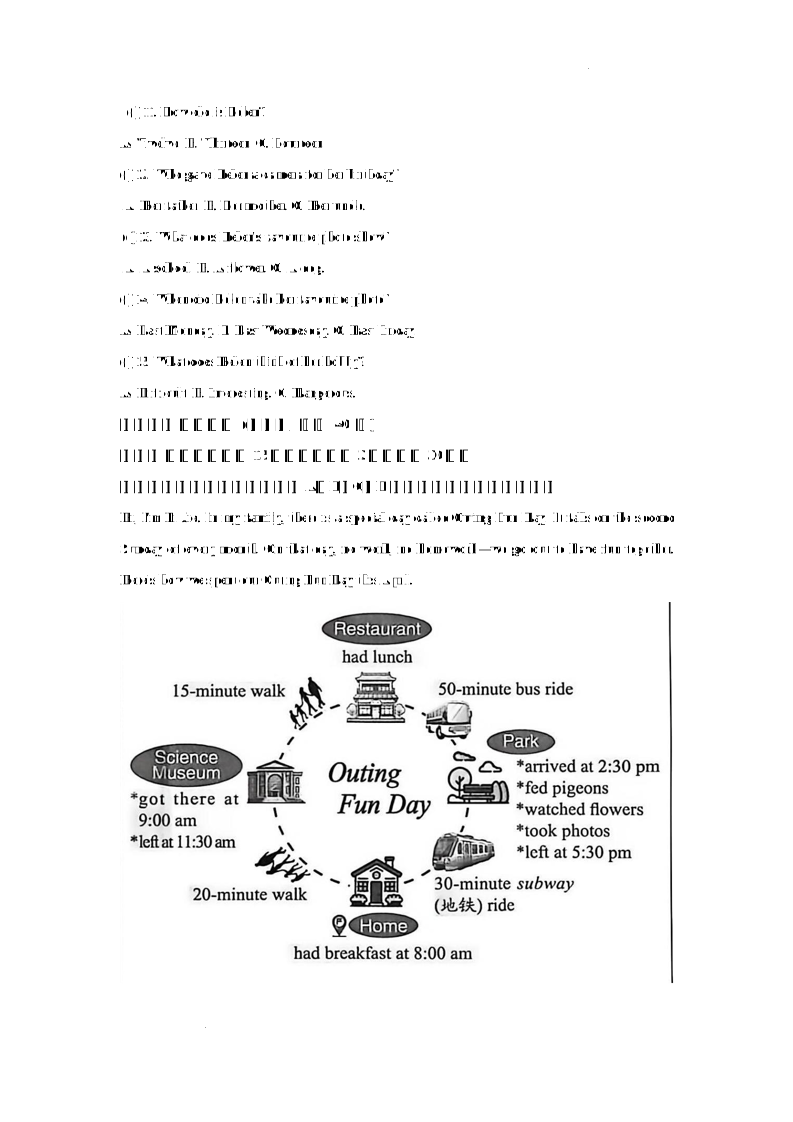
Hi, I'm Li Jie. In my family, there is a special day called Outing Fun Day. It falls on the second Sunday of every month. On that day, no work, no homework—we go out to have fun together. Here's how we spent our Outing Fun Day this April.
( )16. When did Li Jie's family have their Outing Fun Day in April?
A. On the 5th. B. On the 11th. C. On the 12th. D. On the 19th.
( )17. How long did Li Jie's family stay in the science museum?
A. For 1.5 hours. B. For 2 hours. C. For 2.5 hours. D. For 3 hours.
( )18. Where was Li Jie's family at 2:00 pm?
A. On the bus. B. On the subway. C. In the park. D. In the restaurant.
( )19. What did Li Jie's family do in the park?
1 They took a boat. ② They took photos. ③ They fed pigeons. ④ They watched flowers.
A. ①②③ B. ①②④ C. ①③④ D. ②③④
( )20. Which of the following is TRUE?
A. Li Lie's family got home at 6:30 pm.
B. Li Lie's family went to the restaurant on foot.
C. Li Lie's family stayed in the park for two hours.
D. Li Lie's family left for the museum at 8:30 am.
B
A new study (书房) is now open at the Capital Library. It is the Chen-Xia Study. The books in the study are from Chen Pingyuan and Xia Xiaohong. Chen is Xia's husband, and they are both teachers at Peking University.
Now, the study has about 13,000 books. Some are the books by Chen and Xia. Some are gifts from their friends. The study also shows their artworks. All of these help tell the story of their lives and work.
Chen says, "We are interested in books. It's great to have our books here for everyone to read and learn from." The study looks just like their home, so people can visit to see how they work. Most books here are easy to read and enjoy. What's more, people can borrow (借) them and read at home.
"It's not easy to say goodbye to our books," Chen says. "But books are for reading and sharing." Chen and Xia will keep choosing more books for the study. They hope more people will enjoy paper books.
To make reading a happy daily habit, the library will have fun reading activities in it. In this way, more and more people will discover a love for reading.
( )21. What do we know about the Chen-Xia Study?
A. It is an old study.
B. It is at Peking University.
C. It is Chen and Xia's workplace.
D. It has more than 10,000 books now.
( )22. What can we find in the Chen-Xia Study?
1 Books by Chen and Xia. ② Chen and Xia's artworks.
2 Books from their friends. ④ Books from their students.
A. ①②③ B. ①②④ C. ①③④ D. ②③④
( )23. What are the books in the study like?
A. They are all very new books.
B. Most are easy to understand.
C. They are not interesting enough.
D. Most are difficult for students.
( )24. Why will the library have fun reading activities?
A. To make the study more beautiful.
B. To encourage more people to read.
C. To make people learn from Chen and Xia.
D. To help more people learn about the study.
( )25. What does the passage mainly talk about?
A. The future of paper books.
B. Famous teachers at Peking University.
C. A special study at the Capital Library.
D. The importance of sharing books.
C
We can always find amazing art in our daily life, on paper, cloth or walls. Today, we will learn about another special kind of art-embroidery (刺绣) on trees.
Diana was born in 1995. She is an artist from Ukraine. She loved embroidery as a child. In late 2018, she started to do embroidery on trees and her works soon became popular online.
Diana got the idea of the special art by chance. One day, when she took a walk near her home, she saw some scars (疤痕) on the trees. The scars were grey and looked sad, and she wanted to do something to cover (掩盖) them up. Then she thought of embroidery.
Diana measured (测量) the size of the tree scars first and then thought about some right embroidery designs (设计) for them. Next, she embroidered the designs on the cloth. Finally, she cut out the embroidery and covered the scars with it.
Diana's embroidery works include colourful flowers, human eyes and hearts. They not only give life back to the tree scars, but also carry a deeper meaning. "Humans, animals and plants are all part of nature," Diana said. "I hope my embroidery works can remind people to care about and protect life around us."
( )26. What can we know about Diana from paragraph 2?
①How old she is. ②Where she comes from.
③Why she loves embroidery. ④When she started to do embroidery on trees.
A. ①②③ B. ①②④ C. ①③④ D. ②③④
( )27. Why did Diana want to cover up the tree scars?
A. To have some fun.
B. To help the trees get well.
C. To create a new kind of art.
D. To make the trees look nice.
( )28. What is paragraph 4 mainly about?
A. Why Diana chose to do embroidery on trees.
B. How Diana got the ideas for her embroidery designs.
C. How Diana made embroidery works on trees.
D. What people think of Diana's works on trees.
( )29. What is Diana's hope?
A. People can live a peaceful life.
B. People can be kind to all living things.
C. People can try this special kind of art.
D. People can enjoy her embroidery works.
( )30. What is the best title for the passage?
A. A special artist
B. The beauty of tree scars
C. The embroidery art on trees
D. Let's do some embroidery
第2节 任务型阅读(共5小题,每小题2分,满分10分)
阅读下面材料,从方框中所给的A-E五个选项中选择正确选项 (其中一项是多余选项), 将其序号填入第31-34题, 并回答第35小题。
Free time is important for us students. (31)___ Making good use of it can help us feel happy and stay healthy. We asked three classmates about their favourite free-time activities. Let's see what they said!
Zhao Ying: (32)___ I love getting lost in a good book. My favourite place is the school library and I can always find interesting books and magazines there. I often forget about time when I sit there with a favourite book in my hands.
He Li: I spend a lot of my free time cooking. I love to try new recipes and create new dishes. I always have a strong sense of achievement (成就) when I see my family and friends enjoy my dishes. (33)___
Sun Wei: For me, parkour (跑酷) is the best way to spend my free time. (34)___ It is full of challenges and needs a lot of skills (技巧). Doing this sport makes me stronger and braver.
A. It's easy but exciting.
B. It's also a good way to connect with them.
C. My favourite free-time activity is reading.
D. It's more than just running, climbing and jumping.
E. It's a time to relax, have fun and explore hobbies.
35. What is your favourite free-time activity? Why do you like it? (不超过 15词)
__________________________________________________________________________
第3部分 语言运用(共三节,满分40分)
第1节 完形填空 (共15小题, 每小题1分, 满分15分 )
阅读下面短文,掌握其大意,然后从每题所给的A、B、C、D四个选项中选出最佳选项。
Peter was always worried about not having enough time. He had many things to do every day, 36__ he couldn't always finish them. "Why are there 37__2 4 hours in a day?" he often thought.
One day, Peter found a magic box. "Hello, I'm Tim, the Time Keeper," a _ 38_ suddenly came from it, and then an old man appeared. "I see you are always 39 ____time, so I come to help you."
Then Tim 40___ an hourglass (沙漏) to Peter. It showed Peter's day: he 41___ washed up after getting up, played during breakfast, and watched TV while doing homework...
"See?" Tim said. "You don't have 42___ time not because there's too little of it, but because you don't _43_it well."
Peter nodded and 44___ what he should do. Tim said, "First, plan what you 45___ to do every morning. Remember, do important things first. Second, stay focused. When you do one thing, give all your 46___ to it. Third, balance study and rest. For example, have a five-minute 47___ each time after studying for 25minutes .
" Peter decided to follow the 48___ . After a week, when Tim appeared again, he found Peter's life had changed a lot. 49___ finished homework faster and had more time to play.
"It's 50____ !" Peter said to Tim. "I now have enough time for everything!"
"Well done!" Tim smiled and said. "Remember, time is the most precious (珍贵的) thing in the world and you must cherish (珍惜) it."
( )36. A. or B. and C. but D. because
( )37. A. only B. even C. also D. still
( )38. A. cry B. voice C. sound D. laugh
( )39. A. good at B. bored with C. strict with D. worried about
( )40. A. sent B. gave C. treated D. introduced
( )41. A. slowly B. quietly C. suddenly D. carefully
( )42. A. free B. hard C. happy D. enough
( )43. A. use B. store C. choose D. collect
( )44. A. learned B. imagined C. wondered D. remembered
( )45. A. love B. need C. forget D. refuse
( )46. A. feeling B. courage C. attention D. spirit
( )47. A. meal B. break C. match D. dream
( )48. A. example B. advice C. tradition D. record
( )49. A. He B. She C. They D. You
( )50. A. scary B. funny C. difficult D. amazing
第2节 词汇运用(共15小题,每小题1分,满分15分)
A. 将方框中所给词语的适当形式填入短文中,每词仅用一次。
feel might youthful imagine connect a number of
What is fun? Fun comes in (51)___forms (形式). Fun can be challenging and full of (52)___ spirit. (53)___ you are surfing the waves. How exciting that would be! Fun can also be quiet and deep (深刻的). When you read a book, you can (54)___ with people from a different world through words. Different people (55)____ love different forms of fun, but there is one thing in common (相同): fun brings them a happy (56)___.
B. 阅读下面短文,根据括号内所给汉语注释写出单词的正确形式 (每空一词)。
There was a boy named Andy in a town. He loved playing football. When he felt (57)___(烦闷的), he would play football in the yard. That could always (58)___ (使……更快乐) his spirits. For him, football was an important part of his (59)___ (日常的) life.
However, Andy always played football (60)___ (独自). The other boys in his neighbourhood never played it with him because they thought he was too small. But Andy didn't mind it. He (61)___ (选择) to practise hard to improve his football skills. He wanted to prove to them that he was (62)___(有能力做……的) to play football well.
One day, the big boys were playing football and their ball rolled (in 滚) to Andy's feet. At that (63)___(时刻), Andy saw his chance. He dribbled (带球) the ball and ran towards the goal. His small size and quick movements made it hard for the other boys to catch him and he scored a beautiful goal. The big boys were amazed by his skills and decided to (64)___(邀请) him to play with them from that day on.
Andy continued to practise and improve his football skills. He made the (65)___(名单) of the best players in the town, and later in his city. He showed that size doesn't matter and that anyone can achieve their dreams as long as they work hard and never give up.
第3节 语法填空 (共10小题, 每小题1分, 满分10分)
阅读下面短文,在空白处填入一个适当的词,或填入括号中所给单词的正确形式。
Most adults buy toys for kids in their families. But some adults buy toys for themselves. We call these people "kidults". The word (66)___ (come) from "kid" and "adult". Kidults are adults who love children's toys.
(67) ___ (actual), toys for kidults are very popular. The sales (销售额) of these toys make up nearly 28% of all toy sales around the world. And the number (68)___(be) still growing.
So (69)___ do adults love these toys? For one reason, it's interesting (70)___ (play) with the toys. (71)___ example, building a big Lego castle (乐高城堡) can make them feel so happy and proud. For another reason, some toys can bring back happy (72)___(memory) from when they were children.
Kristy Jones is (73)___ big fan of kidult toys. She says, "Life shouldn't be all work and no play. Playing with toys is a great way to relax. (74)___, I don't like the word 'kidult'. This word makes it seem like toys are only for kids. Everyone can play, no matter how old you are!"
So next time you see an adult playing with a toy, don't be (75)___ (surprise) - they are just having fun!
第4部分 书面表达 (共1小题, 满分20分)
76. 假如你是七年级三班的学生李华, 这周你们英文班会的主题是 "The importance of having fun", 请你根据下面的提示完成发言稿。
要求:
1. 包括所给提示内容, 可适当增加细节;
2. 条理清楚, 意思连贯, 语句通顺, 语法正确;
3. 70词左右(发言稿的开头和结尾已给出,不计人总词数)。
Dear classmates,
Junior high school life is busy. However, all work and no play makes Jack a dull boy.___________________________________________________________________________________________________________________________________________________________________________________________________________________________________________________________________________________________________________________________________________________________________________________________________________________________________________________________________________________________________________________________________________________________________________________________________________________________________________________ Thank you for listening.
答案:
学科网(北京)股份有限公司
$
资源预览图
1
2
3
相关资源
由于学科网是一个信息分享及获取的平台,不确保部分用户上传资料的 来源及知识产权归属。如您发现相关资料侵犯您的合法权益,请联系学科网,我们核实后将及时进行处理。