重庆市鲁能巴蜀中学2025-2026学年下学期八年级阶段学情自测英语
 切换试卷
切换试卷
2026-05-17
|
15页
|
168人阅读
|
5人下载
资源信息
| 学段 | 初中 |
|---|---|
| 学科 | 英语 |
| 教材版本 | 初中英语人教版八年级下册 |
| 年级 | 八年级 |
| 章节 | - |
| 类型 | 试卷 |
| 知识点 | - |
| 使用场景 | 同步教学-期中 |
| 学年 | 2026-2027 |
| 地区(省份) | 重庆市 |
| 地区(市) | - |
| 地区(区县) | - |
| 文件格式 | DOCX |
| 文件大小 | 523 KB |
| 发布时间 | 2026-05-17 |
| 更新时间 | 2026-05-17 |
| 作者 | 匿名 |
| 品牌系列 | - |
| 审核时间 | 2026-05-17 |
| 下载链接 | https://m.zxxk.com/soft/57899522.html |
| 价格 | 0.50储值(1储值=1元) |
| 来源 | 学科网 |
内容正文:
英 语
第Ⅰ卷(共90分)
Ⅰ. 听力测试。(共38分)
第一节(每小题1.5分,共9分)
听一遍,根据你所听到的句子,从A、B、C三个选项中选出最恰当的答语,并把答题卡上对应题目的答案标号涂黑。
1. A. All right. B. Thank you. C. Never mind.
2. A. Sure. B. I’m OK. C. No, thanks.
3. A. Sounds terrible. B. No, I don’t. C. Sorry, I won’t.
4. A. I’m fine. B. Good idea. C. Yes, I would.
5. A. I’m sorry to hear that. B. Have a good time. C. Help yourself.
6. A. I agree with you. B. 9 million km2. C. That’s all right.
第二节(每小题1.5分,共9分)
听一遍。根据你所听到的对话和问题,从A、B、C三个选项中选出正确答案,并把答题卡上对应题目的答案标号涂黑。
7. A. /bliːd/ B. /bled/ C. /blʌd/
8. A. Make a phone call. B. Have a talk. C. Write a letter.
9. A. The Yangtze River. B. The Nile. C. The Yellow River.
10. A. She had a toothache. B. She broke her leg. C. She had a flu.
11. A. Run at once. B. Hide under the desk. C. Protect her head.
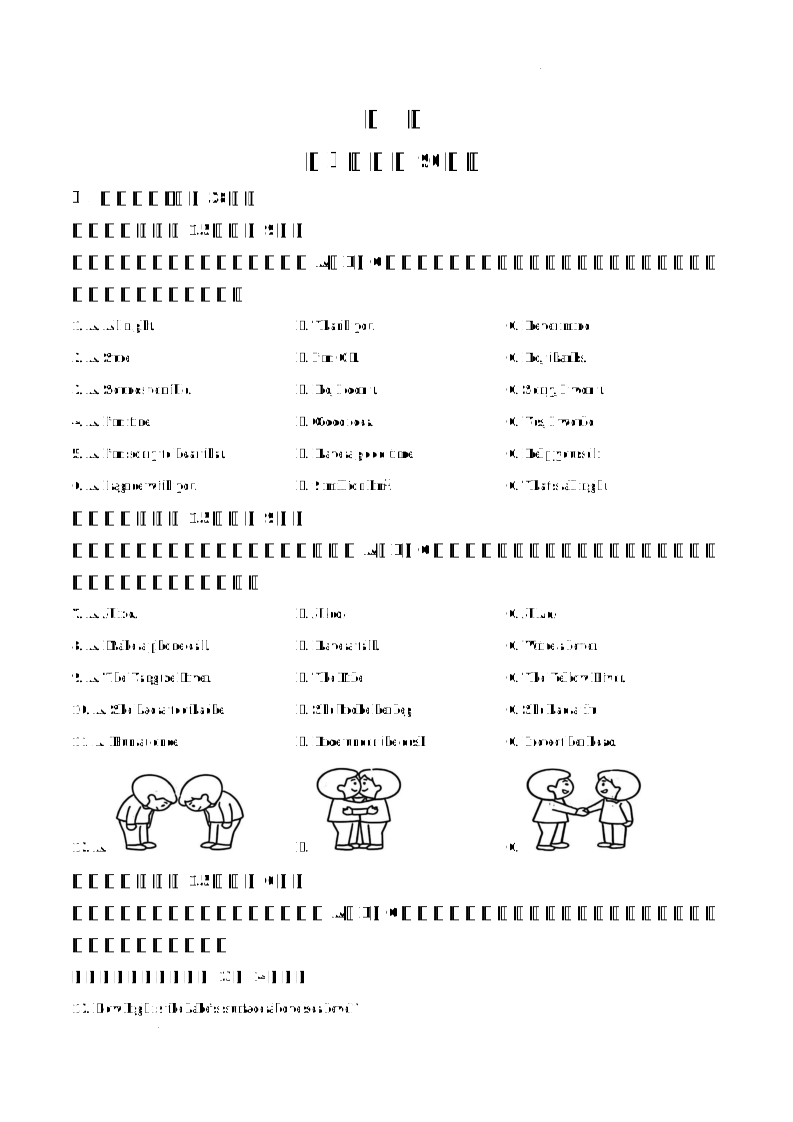
12. A. B. C.
第三节(每小题1.5分,共6分)
听两遍。根据你所听到的长对话,从A、B、C三个选项中选出正确答案,并把答题卡上对应题目的答案标号涂黑。
听第一段材料,回答第13和14小题。
13. How high is the lake’s surface above sea level?
A. It’s 1620.5 metres. B. It’s 1702.5 metres. C. It’s 1722.5 metres.
14. Which of the following activity is NOT mentioned (提及) in the conversation?
A. Riding bikes. B. Climbing the mountains. C. Taking photos.
听第二段材料,回答第15和16小题.
15. What should Li Hua use for the main course (主菜)?
A. The big fork. B. The small fork. C. The spoon.
16. Where should Li Hua place the knife and fork when she finishes eating?
A. In her hands. B. On the table. C. On the plate.
第四节(每小题1.5分,共6分)
听两遍,根据你所听到的短文内容,从A、B、C三个选项中选出正确答案,并把答题卡上对应题目的答案标号涂黑。
17. What was Chen Jie doing at 7:00 p.m. last Saturday evening?
A. She was fixing the windows.
B. She was checking the flashlights and candles.
C. She was helping her mother move flowers and plants.
18. Who was listening to the weather report on the radio at that time?
A. Chen Jie’s father. B. Chen Jie’s grandmother. C. Chen Jie’s brother.
19. When did they buy food and water in the supermarket?
A. After the storm. B. Before the storm. C. During the storm.
20. Why did the family stay safe during the storm?
A. Because the storm was not terrible.
B. Because they listened to the weather report.
C. Because they prepared well before the storm.
第五节(每小题2分,共8分)
听两遍,根据你所听到的演讲内容,在横线处补全笔记。每空1词,并把答案填写在答题卡上对应位置。
Mountain Climbing
Facts:
Benefits:
Safety Tips:
√ An 21 outdoor activity.
√ Keep 22 .
√ Wear proper shoes.
√ Gets more popular.
√ Learn about nature.
√ Never 23. .
√ Build a strong mind.
√ Check the weather.
24. The speaker encourages us to go mountain climbing because it’s good for both our and .
Ⅱ. 语法选择。(每小题1分,共10分)
根据短文内容,从A、B、C三个选项中选出一个语法正确的答案,并把答题卡上对应题目的答案标号涂黑。
Chongqing is 25 modern city with clear rivers and green hills. As middle school students, we should try 26 our hometown. Last week, my classmates and I took part in a city clean-up.
We met at the school gate at 8:00 last Friday. Our teacher warned us to be careful 27 broken glass on the road. Some students picked up rubbish, while 28 cleaned the small advertisements off the walls. I found a lot of rubbish along the river. I picked it up and put it into different bins. Many people 29 by and smiled at us. After two hours of hard work, we finished the cleaning. Our teacher gave us some water and told us that keeping the city clean needs 30 effort.
Now, I always remind everybody around me 31 rubbish everywhere. If everyone plays a role, our city will be much cleaner. I hope there will be more volunteer 32 in the future. I am looking forward to doing more useful things for Chongqing.
The volunteer work is not only meaningful but also helps us learn 33 to work with others. With our efforts, I believe our city will become more and more 34 .
25. A. a B. an C. the
26. A. protect B. to protect C. protecting
27. A. for B. at C. with
28. A. other B. others C. another
29. A. past B. pass C. passed
30. A. someone B. everyone C. everyone’s
31. A. not throw B. not to throw C. don’t throw
32. A. activity B. activitys C. activities
33. A. what B. how C. where
34. A. beauty B. beautiful C. beautifully
Ⅲ. 完形填空。(每小题1分,共10分)
根据短文内容,从A、B、C、D四个选项中选出一个能填入相应空格内的最佳答案,并把答题卡上对应题目的答案标号涂黑。
Look! A man is riding an 820RR-RS motorcycle, holding a Chinese flag. This motorcycle is the newest type made by ZXMOTO. The founder (创始人) of this company is Zhang Xue.
Born in a poor village in Hunan Province in 1987, Zhang had a 35 start. He left school after junior high and became a motorcycle repair apprentice (学徒) at the age of 14. Zhang’s love for motorcycles began 36 . In 2006, the 19-year-old Zhang rode over 100 kilometers in heavy rain just to catch a TV team, because he hoped to have a chance to join a racing team. However, it was not easy to make it, 37 he couldn’t become a real racer because of money problems, he turned 38 interest into a business. In 2013, he went to Chongqing, China’s “Motorcycle City”, with only 20,000 yuan and started to fix motorcycles. In 2017, Zhang started KOVOMOTO with others. But he had to leave the company in 2024, because his partners didn’t agree 39 him on making powerful engines. In the same year, he set up his own brand, ZXMOTO. On March 28, 2026, ZXMOTO surprised the world by 40 two championships at the World Superbike Championship. It was the first time a Chinese brand got these rewards. The whole nation 41 him, because the winning motorcycle uses a self-made engine and 100% Chinese parts.
Zhang’s story teaches us a good lesson: A difficult start does not mean a failed ending—never 42 our dreams. As he said, “ 43 you do what you like when you are young, you will feel sorry when you are old.” From a village boy to a world-famous founder, Zhang Xue overcame many difficulties on his way to success. His story tells us that with love and courage, anyone can 44 his dream.
35. A. simple B. normal C. difficult D. wonderful
36. A. early B. suddenly C. importantly D. lastly
37. A. But B. And C. So D. Although
38. A. her B. his C. our D. their
39. A. with B. at C. to D. for
40. A. winning B. losing C. watching D. starting
41. A. took action in B. took up in C. took part in D. took pride in
42. A. stick to B. lose to C. believe in D. give up
43. A. Unless B. As soon as C. As long as D. If
44. A. realize B. forget C. lose D. change
Ⅳ. 阅读理解。(第一篇共3题,每题1分,其余每篇4题,每小题2分,共27分)
阅读下列材料,从A、B、C、D四个选项中选出最佳答案,并把答题卡上对应题目的答案标号涂黑。
A
The ocean can be divided into different zones based on depth. Let’s read the information below to learn about each zone.
Sunlight Zone
● Up to (最深达到) 200m below sea level
● Sunlight
● Warm water
● Most ocean animals, such as sharks, and plants
Twilight Zone
● Up to 1000m below sea level
● Very little sunlight
● Animals with big eyes
Midnight Zone
● Up to 4000m below sea level
● No sunlight
● Animals that create their own light, like lanternfish (灯笼鱼)
Abyss
● Up to 6000m below sea level
● No sunlight
● Freezing water
● Only a few animals, such as sea stars
Trench
● Up to 11,000m below sea level
● No sunlight
● The Deepest point: Mariana Trench
45. Which animals can you find in the Sunlight Zone?
A. Sharks. B. Sea stars. C. Lanternfish. D. Animals with big eyes.
46. Which zone lies between 1000m and 4000m below sea level?
A. The Sunlight Zone. B. The Twilight Zone.
C. The Midnight Zone. D. The Abyss Zone.
47. What is the water temperature like in the Abyss?
A. hot B. warm C. comfortable D. cold
B
Family is important to everyone. In both the East and the West, there are special holidays just for getting together with loved ones. Two great examples are the Mid-Autumn Festival in China and Thanksgiving in the United States.
The Mid-Autumn Festival falls on the 15th day of the 8th lunar month. Long ago, it was a time to celebrate the harvest (丰收). After farmers finished working in the fields, they would return home and enjoy a big dinner together. Today, people still follow this tradition. After the family dinner, people like to go outside, look up at the round and bright moon and eat the traditional food—mooncakes with some tea or wine (酒). For Chinese people, this full moon is a symbol of family reunion (团圆).
Thanksgiving is on the fourth Thursday of November. Its origin (起源) dates back to 1620, when about 100 English settlers came to America on a ship called the Mayflower. The winter was very cold, but local people helped them. To show thanks, they had a big meal together for three days. Today, Americans still observe this holiday by getting together with their family. They go back home, have a big dinner and give thanks for what they have. On the table, there are many tasty dishes, like pumpkin pies, corn, and most importantly, a large turkey. After eating, people often play a fun game with the turkey’s wishbone (鸡叉骨). Two people pull on each end of the V-shaped bone and make a wish. If a person gets the larger part, he will have good luck.
Both holidays remind people to value their families and the good things in their lives.
48. Which of the following is TRUE according to the passage?
A. The full moon is a symbol of long life for Chinese people.
B. People usually eat pumpkin pies on the Mid-Autumn Festival.
C. People pull a V-shaped bone to see who is lucky on Thanksgiving.
D. People enjoy the moon and say thanks to others on the Mid-Autumn Festival.
49. Which sentence uses “observe” with the same meaning as the underlined word in Para.3?
observe /əbˈzɜːv/ v. ①观察 ②遵守 ③庆祝 ④评论
A. The scientist spent years observing different birds.
B. “The test wasn’t that bad,” he observed with a smile.
C. Please observe the school rules while you are in class.
D. We observed the opening of a library with a small party.
50. What do the two festivals have in common according to the passage?
①Each festival has its own traditional foods.
②They both last for three days with fun games.
③Each is a great time to give thanks for people’s lives.
④People return home and get together with loved ones.
A. ①③ B. ①④ C. ②③ D. ③④
51. What is the best title of the passage?
A. Special Foods in Two Countries B. History Behind Autumn Holidays
C. Being Together: Two Family Festivals D. Different Traditions Around the World
C
Nils loved playing tricks on others, so nobody liked him. One day, he caught an elf (精灵) and played a trick (捉弄) on him. The angry elf turned Nils into a very weak (弱小的) little man. The animals wouldn’t tell him where the elf went, because he tricked them too. Nils felt very sad.
At this moment, some wild geese went by. They called the home geese, “Come along! Off to Lapland!” Morten, a young goose, was about to follow them. Nils tried to stop him but was carried into the sky! High in the air, Nils held on tightly. He was afraid. Later, Morten became tired. Nils gave him some water and food. Morten caught him a fish. “It’s so good to have a friend,” Nils thought.
Late that night, everyone was resting. A fox quietly took a goose and ran fast to the forest. At that moment, Nils’ heart was beating fast, and he didn’t know what to do. After taking a deep breath, he didn’t hesitate (犹豫). He ran after the fox and grabbed (抓住) its tail tightly right away. The fox tried to shake him off, but Nils held on tighter. The fox had to drop the goose. The goose flew away and Nils climbed up a tree. “You can’t stay there forever,” the fox cried. Then a goose flew low. The fox jumped, but the goose flew up. Another goose came, then another. The fox jumped and jumped, catching nothing. Suddenly, he remembered Nils. But Nils ran away! Nils was filled with joy, because he and the geese helped each other and became good friends.
Then Nils went to the small animals. But they didn’t trust him. One day, Nils heard that a farmer had taken Mrs. Squirrel away. Nils found Mrs. Squirrel in a cage. But he was too small to open it. Nils brought her hungry babies to her. Seeing this, the farmer’s wife set Mrs. Squirrel free. After that, the small animals began to like Nils.
One day, the fox said to Akka, the leader of the geese, “If you give Nils to me, I will not hunt you anymore.” But Akka said, “No! We will give our lives for him!” Hearing the words, Nils felt deeply warm.
——Adapted from The Wonderful Adventures of Nils
52. How did Nils’ feelings change after the fox took the goose in Scene Three?
A. surprised → worried → happy B. scared → fearless → happy
C. scared → happy → nervous D. surprised → calm → warm
53. Each picture below matches one Scene. Which Scene is missing?
A. Scene One. B. Scene Two. C. Scene Three. D. Scene Four.
54. What can we infer from the underlined sentences in the last paragraph?
A. Nils finally became the leader of the geese.
B. The geese weren’t afraid of the fox anymore.
C. Akka wanted Nils to give his life for the geese.
D. Nils won the geese’s trust through his kind actions.
55. What can we learn from Nils’ story?
A. Helping others can bring you true friendship.
B. Playing tricks on others can make you popular.
C. Becoming weak can help others understand you.
D. Facing danger on your own is better than asking for help.
D
①Did you look out of the window and see the sky turn yellow or orange? The color is often caused by a sandstorm (沙尘暴). A sandstorm is a strong wind that picks up sand and dust (灰尘) from the ground. Do you know how powerful it can be? A single sandstorm can carry over 40 million tons of dust.
②To understand why sandstorms happen, we need to look at the factors (因素) that cause them. A large area of dry, loose sand is necessary. Without enough rain, the ground becomes very dry and breaks into tiny pieces. Strong winds are also required to lift the sand into the air. In spring, cold northern air often meets warm southern air, creating powerful winds. Moreover, if an area doesn’t have enough trees or plants, nothing can hold the soil (土壤) down. Without them, the wind can easily sweep the soil away.
③Sandstorms are dangerous weather events that harm people and the environment. When a sandstorm hits, the air fills with tiny dust, making breathing hard and causing sore eyes or throats. People with asthma or other breathing problems face greater risks. Sandstorms also lead to traffic accidents and flight delays. They damage crops, cover buildings with dust, and spread germs quickly. Over time, sandstorms speed up soil loss and turn land into desert.
④To reduce the damage, we should plant more trees and take good care of the soil. Since the 1970s, millions of trees have been planted across northern China. Take the Taklamakan Desert as an example, the new forests there not only stop sand but also take in CO2.
⑤However, China’s efforts can’t stop all sandstorms. Many of them don’t start in China at all. For example, dust from Mongolia’s Gobi Desert (蒙古的戈壁沙漠) can blow into China and even reach Japan. The dry land there has become a major source (来源) of sandstorms in East Asia. To truly solve the problem, planting trees only in China is not enough.
⑥Fighting against sandstorms takes time and patience, but every tree we plant counts. Each new tree holds the soil, reduces dust, and brings us one step closer to a cleaner world. By doing this, we are not only protecting ourselves today but also building a safer, brighter tomorrow for generations.
56. Which of the following shows the factors that cause sandstorms?
A. Desert, strong winds, and breathing problems.
B. Enough rain, dry loose sand and strong winds.
C. Cold northern air, warm southern air and many trees.
D. Dry loose sand, strong winds and few plants or trees.
57. Why does the author write “every tree we plant counts” in the last paragraph?
A. To prove that counting trees is important to hold the soil.
B. To suggest that planting trees is enough to stop sandstorms.
C. To explain why it takes a long time to fight against sandstorms.
D. To show that each small action plays an important role for the future.
58. Which of the following best shows the structure of the passage?
Structure: Introduction→Causes & Effects→Solutions→Hope
A. ①→②③→④→⑤⑥ B. ①→②③→④⑤→⑥
C. ①②→③→④⑤→⑥ D. ①②→③④→⑤→⑥
59. The government wants to fight against the sandstorms. According to the passage, which plan would be the most effective (有效的)?
A. Planting a large number of trees in the countryside.
B. Working with neighboring countries to plant trees together.
C. Providing free masks and air cleaners for people in the city.
D. Building a 50-meter-high wall along the desert to stop sandstorms.
Ⅴ. 口语运用(每小题1分,共5分)
阅读下面对话,从方框内7个选项中选择5个恰当的句子完成此对话,并把答题卡上对应题目的答案标号涂黑。
A: Hi, Nancy. Long time no see! You look so weak and pale (苍白) today. 60
B: Oh, I’m not feeling well. I have a terrible cold, a sore throat and a bad cough.
A: I’m sorry to hear that. You need to take good care of yourself. 61
B: For 3 days. And I can’t sleep well because of the cough.
A: 62
B: Yes, I did. My temperature is OK. I don’t have a fever.
A: You must take it seriously. 63 If it’s worse, You should go to the doctor.
B: OK, I will. Thank you so much for your kind advice.
A: 64 I hope you will get better soon.
A. You’re welcome.
B. What’s the matter with you?
C. Did you take your temperature?
D. Where did you go yesterday?
E. How long have you been like this?
F. What are you going to do?
G. You should drink more hot water and have a good rest.
第Ⅱ卷(共60分)
Ⅵ. 任务型阅读。(65-66小题,每小题2分;67-68小题,每小题3分;共10分)
阅读下文并回答问题。
Last week, our school magazine interviewed some students about their good habits and how these habits change them. Let me share one of them with you. Here is the interview.
Reporter: Hello, Wang Hui. What good habits have you developed?
Wang Hui: Well, now I do housework for 30 minutes every day. I sweep the floor, wash the dishes, and tidy my room.
Reporter: That sounds great.
Wang Hui: But to be honest, I never helped my parents with housework before. I thought studying was the only thing I should do. My parents said I was lazy, and they often got angry.
Reporter: So what made you change your mind and start doing housework?
Wang Hui: One day my mom was ill in bed, so I had to do chores and realized that every family member should share the housework. Later I decided to keep doing it every day.
Reporter: Was it hard at the beginning?
Wang Hui: Yes, it was a little difficult for me at first. But I told myself that I couldn’t give up.
Reporter: Have you noticed any changes in yourself?
Wang Hui: Yes. I find myself more responsible than before. I’m not that lazy kid anymore.
Reporter: That’s nice. Is your relationship with your parents better than before?
Wang Hui: Of course. Doing housework helps me understand their hard work better. I know they really cared about me and did so much for me.
Reporter: Great! Does this habit also help you with your study?
Wang Hui: Actually, yes. After finishing housework, I can sit down and study with a clearer mind. It helps me focus.
Reporter: Anything else?
Wang Hui: I also learn to be independent. I don’t need my parents to do everything for me now.
Reporter: Thank you, Wang Hui. You’ve set a good example for us.
Wang Hui keeps improving herself through a small daily habit. Her story shows that true growth (成长) comes from patience and persistence (坚持). Small steps lead to big changes.
— LNBS Campus Times
65. Did Wang Hui use to be lazy?
66. How long does Wang Hui do housework every day?
67. How does Wang Hui’s good habit help her according to the passage?
68. According to your understanding of the underlined sentences, what will you do in your daily life? (about 30 words)
Ⅶ. 根据首字母或用所给单词的适当形式填空。(每空1分,共10分)
69. Mary (shake) the bottle before she drank the juice.
70. Don’t forget to make good (prepare) before you start.
71. The teacher told us a (surprise) story about her trip to Africa.
72. The firemen saved the people in the burning buildings (success).
73. The main p of the speech is to teach the students some basic life skills.
74. Tom and his parents (sleep) when the earthquake happened at night.
75. Climbing Qomolangma is always difficult because of the (change) weather.
76. When they smelt something (usual), they realized that there might be a fire.
77. Our teacher always tells us k not only comes from books but also from practice.
78. I refused (go) camping with Lucy, because I need to study for the English exam.
Ⅷ. 完成句子。(79-82小题,每空1分;83小题2分;共10分)
阅读语篇,根据方框里的内容和相应括号里的提示,完成句子.
79. The school nurse taught us how to deal with injuries and emergencies.
80. He got badly hurt.
81. Lucy called 120 quickly because her grandma fell down.
82. 我们为在急救课上学到的知识感到自豪。
83. can, a, life, knowing, first, aid, save
Last week, we had a first aid class at school. The school nurse taught us something useful. 79. ___________ did the school nurse ___________ us in the lesson? (对划线部分提问) It’s about how to deal with injuries and emergencies. Everyone listened carefully and learned a lot. For example, Ben hurt his leg during the soccer game. Thanks to the first aid class, he knew what to do with his injury. 80. He ___________________ badly hurt. (改为否定句) Lucy’s grandma fell down at home. 81. ___________ Lucy ___________ 120 quickly? (变一般疑问句) Yes, because she knew that calling for help right away could save her grandma’s life. 82. We were ___________ ___________ what we learned in the first aid class. (完成译句) 83. And we will always remember: _________________________________________. (连词成句)
Ⅸ. 原文填空,根据课文内容填空,一空一词。(每小题1分,共5分)
Last Friday started 84 . First, my 85 clock didn’t go off, so I woke up late and had to rush to the bus stop. I had a test that morning, so I was 86 my notes while I was waiting for my bus. All of a 87 , thunder rolled across the sky. Then it started to pour. The wind was too 88 for me to use my umbrella!
84. 85. 86. 87. 88.
Ⅹ. 概要补全。(89和91小题,每小题3分;90和92小题,每小题2分;共10分)
阅读文章,用恰当的短语或句子补全概要。补全部分总词数不超过30词,不能照抄原文连续超过3个词。
Giving gifts is a common way to show kindness, respect and care. It also helps us to improve relationships with others. However, if you don’t know the customs, you will make some mistakes.
In China, when we choose gifts, we should avoid many things. For example, we never choose clocks as gifts because the word “clock” sounds like “zhong” in Chinese, which means death. Giving shoes is also a bad idea because in Chinese shoes sound like “xie”, which means something bad or unlucky. Things are similar in Western countries. They never choose handkerchiefs (手帕), because people use them to wipe tears. They mean sadness. Also, sharp objects like knives or scissors are not good choices, as they mean cutting off the relationship. Knowing these can help us avoid embarrassment.
What’s more, when receiving gifts, Chinese people may refuse a gift two or three times before accepting it to show politeness. Also, they usually do not open a gift in front of the giver. They do it after the giver leaves. However, Western people like Americans or Englishmen open gifts immediately in front of the giver to show respect and politeness. And refusing a gift is considered impolite in the West.
All in all, knowing the customs well is of great importance. The more you know about them, the fewer embarrassments and misunderstandings you will have. So next time you want to give a gift to others, don’t forget what you have read today. Hope it can help you.
Giving gifts is common in our life. The passage mainly talks about 89 . Both in China and Western countries, we should avoid choosing many things for gifts because of 90 . What’s more, 91 . For example, how to accept a gift and when to open it vary (有区别) from culture to culture. All in all, 92 , you will be embarrassed and cause misunderstandings.
Ⅺ. 书面表达。(满分15分)
上周六我校举办了“中美学生文化交流日”活动,上午美国学生体验了剪纸、书法和包饺子等活动,下午中美学生一起打篮球、参观美术馆、画画等,晚上邀请美国学生品尝了重庆火锅……作为这次活动的一名志愿者,请你以“Cultural Exchange Day”为题,记录本次文化交流日的各种活动,并谈谈这次交流日的意义以及你的感受与收获。
要求:
1. 80-120词左右;
2. 包含所给提示信息,并适当发挥;
3. 文中不能出现自己的姓名和所在学校名称。
Word bank
do paper-cutting; do calligraphy; dumplings; art room; Hot pot; know more about China; build friendship; have cultural confidence…
学科网(北京)股份有限公司
$
资源预览图
1
2
3
相关资源
由于学科网是一个信息分享及获取的平台,不确保部分用户上传资料的 来源及知识产权归属。如您发现相关资料侵犯您的合法权益,请联系学科网,我们核实后将及时进行处理。