2026年重庆一中初 2027届初二下期半期考试英语试题卷
 切换试卷
切换试卷
2026-05-16
|
16页
|
447人阅读
|
16人下载
资源信息
| 学段 | 初中 |
|---|---|
| 学科 | 英语 |
| 教材版本 | 初中英语人教版八年级下册 |
| 年级 | 八年级 |
| 章节 | - |
| 类型 | 试卷 |
| 知识点 | - |
| 使用场景 | 同步教学-期中 |
| 学年 | 2026-2027 |
| 地区(省份) | 重庆市 |
| 地区(市) | 重庆市 |
| 地区(区县) | 沙坪坝区 |
| 文件格式 | DOCX |
| 文件大小 | 1.14 MB |
| 发布时间 | 2026-05-16 |
| 更新时间 | 2026-05-16 |
| 作者 | 匿名 |
| 品牌系列 | - |
| 审核时间 | 2026-05-16 |
| 下载链接 | https://m.zxxk.com/soft/57891150.html |
| 价格 | 1.00储值(1储值=1元) |
| 来源 | 学科网 |
内容正文:
绝密★启用前【考试时间:2026年5月15日16:30前绝密】
2026年重庆一中初2027届初二下期半期考试
英语试题卷
(全卷共十一个大题,满分:150分 考试时间:120分钟)
注意事项:
1.答卷前,考生务必将自己的姓名、准考证号码填写在答题卡上。
2.作答时,务必将答案写在答题卡上。写在本试卷及草稿纸上无效。
3.考试结束后,将答题卡交回。
第I卷(共90分)
Ⅰ. 听力测试。(共35分)
第一节(每小题1分,共6分)
听一遍。根据你所听到的句子,从A、B、C三个选项中选出最恰当的答语,并把答题卡上对应题目的答案标号涂黑。
1. A. Just so so. B. You’re welcome. C. It doesn’t matter.
2. A. It’s Qomolangma. B. I went there last summer. C. I visited there with my parents.
3. A. OK, I will. B. Yes, I won’t. C. That sounds fun.
4. A. It’s 6,300 kilometers long. B. It’s 6,300 kilometers deep. C. It’s 6,300 kilometers high.
5. A. They shake hands. B. They eat with chopsticks. C. They wave goodbye.
6. A. Not much. B. Never mind. C. I’m sorry to hear that.
第二节(每小题1.5分,共9分)
听一遍。根据你所听到的对话和问题,从A、B、C三个选项中选出正确答案,并把答题卡上对应题目的答案标号涂黑。
7. A. /blʌd/. B. /flʌd/. C. /flu:t/.
8. A. She was watching TV. B. She was playing outside. C. She was doing homework.
9. A. About 1,420. B. About 15,200. C. About 14,200.
10. A. Because she got home late. B. Because she failed a test. C. Because she broke something.
11. A. In South America. B. In Asia. C. In Africa.
12. A. She’s very helpful. B. She’s really polite. C. She’s quite honest.
第三节(每小题1.5分,共6分)
听两遍。根据你所听到的长对话,从A、B、C三个选项中选出正确答案,并把答题卡上对应题目的答案标号涂黑。
听第一段材料,回答第13和14小题。
13. Where does the conversation probably take place?
A. On the street. B. On the phone. C. In someone’s house.
14. What did the man do before the typhoon?
A. He opened all the windows. B. He prepared plenty of food. C. He offered some advice.
听第二段材料,回答第15和16小题。
15. What’s the matter with Jane?
A. She has a headache. B. She has a toothache. C. She has a stomachache.
16. How often should Jane take the medicine?
A. Three times a week. B. Three times a day. C. Twice a day.
第四节(每小题1.5分,共6分)
听两遍。根据你所听到的短文内容,从A、B、C三个选项中选出正确答案,并把答题卡上对应题目的答案标号涂黑。
17. What kind of passage is this?
A. A report. B. An ad. C. A diary.
18. What CAN’T we see near the lake?
A. Wild geese. B. Large eagles. C. White swans.
19. What activity can we do there?
A. Take a boat. B. Go swimming. C. Go fishing.
20. What is the best time to visit there?
A. Late winter. B. Early spring. C. Summer time.
第五节(每小题2分,共8分)
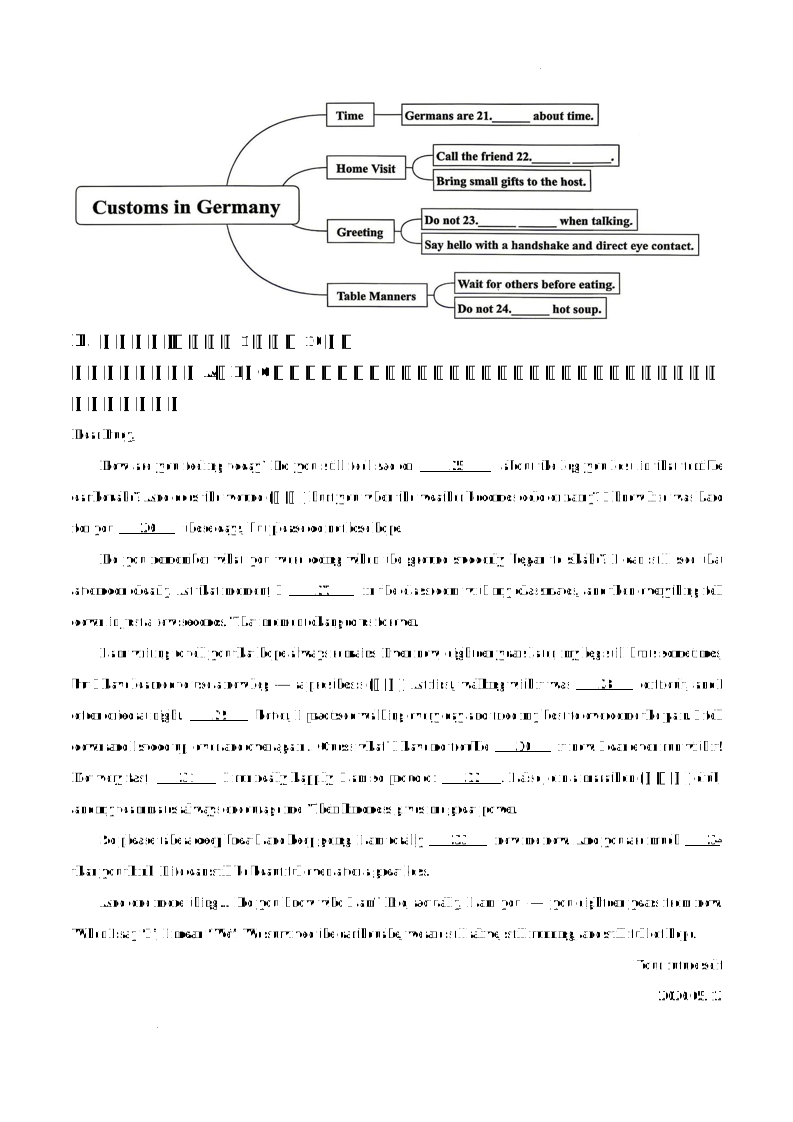
听两遍,根据你所听到的短文内容,在21-24题的空格处填入最恰当的词(每空1词),并将答案写在答题卡上对应的位置。
Ⅱ. 语法选择。(每小题1分,共10分)
根据短文内容,从A、B、C三个选项中选出一个语法正确的答案,并把答题卡上对应题目的答案标号涂黑。
Dear Lucy,
How are you feeling today? Do you still feel sad or 25 about the leg you lost in that terrible earthquake? And does the wound (伤口) hurt you when the weather becomes cold or rainy? I know life was hard for you 26 these days, but please do not lose hope.
Do you remember what you were doing when the ground suddenly began to shake? I can still see that afternoon clearly. At that moment, I 27 in the classroom with my classmates, and then everything fell down in just a few seconds. That moment changed us forever.
I am writing to tell you that hope always remains. Even now, eighteen years later, my leg still hurts sometimes, but I have learned to use a new leg — a prosthesis (假肢). At first, walking with it was 28 difficult, and I often cried at night. 29 better, I practised walking every day and tried my best to overcome the pain. I fell down and I stood up, over and over again... Guess what? I have no trouble 30 it now. I can even run with it! Not very fast, 31 I run really happily. I am so proud of 32 . I also join a marathon (马拉松) club, and my teammates always encourage me. Their kindness gives me great power.
So please take a deep breath and keep going. I am totally 33 new me now. And you are much 34 than you think. Life can still be beautiful even after a great loss.
And one more thing… Do you know who I am? Kid, actually, I am you — you eighteen years from now. When I say “I”, I mean “We”. We survived the earthquake, we are still alive, still running, and still full of hope.
Your future self
2026.05.12
25. A. worries B. worried C. worrying
26. A. during B. to C. with
27. A. sat B. sitting C. was sitting
28. A. terrible B. more terrible C. terribly
29. A. Get B. To get C. Getting
30. A. wear B. wore C. wearing
31. A. but B. and C. also
32. A. I B. me C. myself
33. A. a B. an C. /
34. A. strong B. stronger C. strongest
Ⅲ. 完形填空。(每小题1分,共10分)
根据短文内容,从A、B、C、D四个选项中选出一个能填入相应空格内的最佳答案,并把答题卡上对应题目的答案标号涂黑。
Long ago, a tall oak tree (橡树) grew by the river. It was strong and 35 , with thick branches and deep roots (根). Around it grew many 36 reeds (芦苇). The oak often laughed at them. “You are too weak to survive any storm,” it said. The reeds remained quiet and did not answer.
One day, a terrible 37 came. The wind beat against the earth and the rain fell thick and fast. The oak stood straight and fought the storm with all its power. “Although I am alone, I am stronger than any wind!” it shouted. Around it, the reeds behaved 38 . They just bent (弯腰) down and let the wind pass over them. The oak laughed at them. “You don’t even 39 to face the storm!”
Suddenly, the storm turned much worse, the oak could not hold on anymore. Its roots were pulled out bit by bit and it finally fell into the river. The flood carried it away. The reeds, however, survived the storm safely. When the wind stopped, they 40 again, unhurt.
A few minutes later, the broken oak floated (漂浮) 41 the reeds. It was confused and asked around, “I am so strong, yet I fell. You are so weak, yet you survived. Why?” The reeds smiled gently and answered, “In this situation, we will break 42 we learn to bend. Even though we look weak, we know when to lower our heads. True wisdom is not about being the strongest, but just about knowing how to 43 according to the situation.”
The oak said 44 more and floated away. It finally understood: being too proud and refusing changes can bring bad results, but being humble (谦虚的) and wise keeps you safe.
35. A. curious B. happy C. proud D. friendly
36. A. strong B. thin C. heavy D. deep
37. A. drought B. snowstorm C. earthquake D. typhoon
38. A. similarly B. soundly C. differently D. terribly
39. A. dare B. stop C. volunteer D. forget
40. A. bent down B. went along C. woke up D. rose up
41. A. below B. above C. among D. between
42. A. whether B. unless C. if D. as long as
43. A. learn B. think C. change D. hide
44. A. everything B. anything C. something D. nothing
Ⅳ. 阅读理解。(每小题2分,共30分)
阅读下列材料,从A、B、C、D四个选项中选出最佳答案,并把答题卡上对应题目的答案标号涂黑。
A
Yellowstone Visitors’ Guide
45. How much do you need to pay for a 7-Day tour by car?
A. 30 dollars. B. 35 dollars. C. 65 dollars. D. 70 dollars.
46. If you want to explore the Thermal Spring first, which entrance (入口) is the closest?
A. East Entrance. B. Southeast Entrance. C. Northeast Entrance. D. North Entrance.
47. What number should you call at when you need rescue?
A. 119. B. 911. C. 307-344-7381. D. 110.
B
From China Daily, April 2026
This April, the Water-Splashing Festival (泼水节) in China’s Yunnan Province attracted many people. The local Dai people traditionally use water for gentle sprinkling (喷水) with small bowls or leaves, which means washing away bad luck and offering good wishes.
However, several bad events overshadowed this year’s celebrations, causing wide discussion online. In Xishuangbanna, a family from Liaoning experienced a scary moment. While they were driving, a group of tourists pulled open their car doors, pouring plenty of water inside. The cars’ electrical (电力) system broke and began to smoke, putting people inside in great danger. Another video shows two women on a bike. Even when they waved their hands to say “stop,” people kept sprinkling them with high-pressure water guns.
Local governments gave out “Civilized Water-Splashing Suggestion” before the holidays, telling visitors to stay away from high-pressure tools, respect the elderly and sick, and not to influence traffic.
A local culture expert said, “The water should be a gentle gift, but in this event, it is more like a war against strangers. War is never good for anything. It only brings sadness and mess. To stop this crazy ‘war’, we need to focus on its true meaning — good wishes for others and a fresh start for ourselves.”
As videos of smoking cars and scared families became popular online, both government and visitors tried to protect the spirit of this ancient festival. A true blessing (祝福) does not come from a powerful water gun; it comes from a respectful smile. As one local person put it, “We don’t throw water to cause trouble; we throw water to share joy.”
48. What is the traditional way to splash water during the festival?
A. Using high-pressure water guns on the street.
B. Gently sprinkling water with leaves or small bowls.
C. Pulling open car doors and filling them with water.
D. Influencing the traffic and throwing water balloons.
49. Which sentence uses “overshadow” with the same meaning as the underlined word?
overshadow /ˌəʊvəˈʃædəʊ/ v.①遮盖;遮蔽 ②使…蒙上阴影;使…扫兴③使…逊色
A. The new building overshadowed the school, so it was hard to see it from the street.
B. The serious injury of their best player overshadowed the team’s victory in the last minute.
C. The big apple tree stood alone, overshadowing the small house in the backyard.
D. The tall man overshadowed his brother in every family photo, making him look tiny.
50. How did the local expert show his opinion?
A. By describing a past event. B. By listing the festival rules.
C. By telling a sad story. D. By comparing the event to a war.
51. What is the writer’s main purpose in writing this passage?
A. To encourage more tourists to join the festival next year.
B. To introduce the history of the Water-Splashing Festival.
C. To remind people to celebrate the festival with respect.
D. To compare different ways of people celebrating the festival.
C
The message arrived at 3:17 in the morning.
Leo was alone on Station Aegis. His job was to listen to space. Most days, he heard nothing. But this time, a voice came through — a man’s voice.
“This is Commander (指挥官) Vance of the ship Odyssey. We are lost. Please — we need help.”
Leo froze. The Odyssey got lost sixty-three years ago. She never reached her destination (目的地). Search teams found nothing.
“Tell me your place,” Leo said.
He replied, “We’ve been drifting (飘移) for three days.”
“What is today’s date on your ship?”
“August 12, 2089.”
Leo’s hands went cold.
“Commander,” he said slowly. “You have been gone for sixty-three years.”
Silence. Then, he said, “That’s impossible.”
“Time can change. Tell me what happened.” Leo said.
“We passed through a dust cloud. Then everything went wrong. And the stars looked… wrong.”
Leo said, “That dust cloud you passed through might have bent time (扭曲时间). For you, only three days passed. But out here, it’s been sixty-three years.”
“Oh my god. Please help me back.”
“Look outside. Do you see anything else?”
A short break. Then, “There’s a ship behind us. It’s black — blacker than space. No lights. No names or signs.”
“Was it there before the dust cloud?”
“I don’t think so.”
“Check your machines. Look at the information from before you hit the cloud.”
Leo waited. When the voice returned, it was shaking.
“It was there. Our machines saw it three minutes before the cloud. But no one noticed. Why did no one see it?”
Leo didn’t answer. He already understood. The black ship wasn’t following them. It had been waiting for them. For sixty-three years.
“Follow the way I’m sending to you. Do not look back.”
The conversation ended. Leo sat in the dark. Ten minutes passed.
Then a new message appeared. Not from the Odyssey. From somewhere close. Three words: DON’T TRUST HER.
The message came from the same frequency (无线电波信号) as the black ship.
Leo looked out at the dark stars. Then he realized the black ship wasn’t following the Odyssey. It had been waiting for the Odyssey to call someone. Now it had learned the station’s frequency.
Next target (目标): Station Aegis. Alone.
— Inspired by Stanislaw Lem Return from the Star
52. What does “She” refer to in the sentence “She never reached her destination.”?
A. Station Aegis. B. The ship Odyssey. C. The search team. D. Commander Vance.
53. According to the passage, what year was it on Station Aegis?
A. 2089. B. 2092. C. 2152. D. 2026.
54. From the sentence “Leo’s hands went cold”, what can we know?
A. The temperature in the station dropped suddenly.
B. Leo was physically ill from working alone.
C. Leo realized something shocking.
D. Leo was angry at Commander Vance for lying.
55. What’s the correct order of the following events?
① Leo realized Station Aegis was the next target.
② Search teams tried to look for the ship Odyssey but failed.
③ Leo told Vance the ship Odyssey had been gone for sixty-three years.
④ Leo received a message from the same frequency as the black ship.
⑤ Vance checked the machines and found the black ship was there before the cloud.
A. ②③⑤①④ B. ②⑤③④① C. ②③⑤④① D. ③②⑤④①
D
①Every year, millions of birds migrate (迁徙) along the same paths (路径) to rest and find food. One of the busiest paths goes from the Arctic to New Zealand and Australia. A shorebird called the godwit holds the record — it can fly over 12,000 kilometers in just eight days without a stop.
②To protect these long-distance travelers, scientists built an online map called the MBHA. The map uses information from satellite trackers (卫星追踪), bird bands (鸟环), and people watching on the ground. It has 20 years of tracking data (数据) on 98 kinds of birds. It shows where they rest, lay eggs, and stay in winter.
③The MBHA needs teamwork between countries. It connects over 1,500 wetlands (湿地) across 22 countries. Birds have no idea about countries. They follow coastlines (海岸线), avoid mountains and large areas of ocean, and choose paths with enough wetlands to rest and eat. So, a bird that lays eggs in Russia may rest in South Korea, stop in China, and spend winter in Australia. ▲
④Take the spoon-billed sandpiper (勺嘴鹬) as an example. It lays its eggs in northeastern Russia. During its trip, it needs wetlands in China and South Korea. Finally, it will enjoy sunshine in Australia. To help the birds, the MBHA connects the countries along the path closely.
⑤China and Australia take actions first. The wetlands at the Yellow River Delta in China and Roebuck Bay in Australia are both important rest stops. They share information and protect these areas together.
⑥However, birds face new problems. A 2024 report found that climate changes are already changing bird travel times. Some birds now arrive at rest stops after the best food is gone.
⑦Another problem is that MBHA is not finished yet. The team says the map covers less than 40% of all known traveling bird kinds on this path. “What we have mapped is only a small part of the whole picture,” says the lead scientist. More work is needed to protect the birds before it is too late.
56. Why does the writer take a shorebird called “godwit” as an example in Paragraph 1?
A. To show that godwits can fly to New Zealand.
B. To tell that godwits do not need wetlands to rest.
C. To give an example of a bird that uses the MBHA.
D. To lead in the importance of building the MBHA.
57. Which of the following sentences can be put in ▲ ?
A. If China protects its wetlands, the birds will be safe.
B. Birds can find another way if a key wetland is destroyed.
C. If one country destroys a key wetland, the whole bird path is in danger.
D. Only the country where birds lay eggs needs to protect wetlands.
58. Which of the following pictures shows the right migration path of the spoon-billed sandpiper?
A. B.
C. D.
59. Which of the following best shows the structure of the passage?
A. B.
C. D.
Ⅴ. 口语应用。(每小题1分,共5分)
阅读下面对话,从方框内7个选项中选择5个恰当的句子完成此对话,并把答题卡上对应题目的答案标号涂黑。
A: Hi, Jasper. I’m preparing a report on Chinese culture. Could you tell me something about table manners back in the old days?
B: Sure. They were very important in daily life.
A: 60. __________
B: Of course! The first example is that young people should not start eating before the elders.
A: 61. __________ It says respecting the elders is always important in China.
B: Exactly. What else do you want to know?
A: How about the use of the chopsticks?
B: OK. 62. __________
A: Why was that a problem?
B: 63. __________
A: I see. Anything else?
B: Yes. Searching food with chopsticks means impoliteness.
A: 64. __________
B: Just look, pick a piece on the top, and take it.
A: That’s so interesting. Thank you so much.
A. Could you give me some examples?
B. Because people believed it would bring bad luck.
C. Do you need some advice?
D. I read about it in a book.
E. Why is this a right way?
F. People shouldn’t stick chopsticks into a bowl of rice.
G. So what is the right way?
第Ⅱ卷(共60分)
Ⅵ. 任务型阅读。(65-66小题,每小题2分,67-68小题,每小题3分,共10分)
阅读并回答问题。
“Ni hao, we’re all Chinese now.” This is what many foreign young people are saying on TikTok today. A new trend (趋势) called “China maxxing” (精神中国人) has become very popular in the West. Millions of foreigners are sharing videos and posting online about Chinese lifestyles (生活方式).
Tom 26-5-11 15:30 sent in London, UK
Living like a Chinese feels really good! I used to start my day with iced coffee, but now I have warm ginger (姜) tea or apple-boiled water. My stomach doesn’t hurt anymore, and I feel much more comfortable in the mornings. I also started to eat rice instead of just bread every day — it keeps me full of energy all day. At home, I always wear soft indoor slippers (拖鞋) to avoid “han qi” from the floor. Before sleeping, I never forget my hot foot bath to sleep better. My Chinese neighbor told me this is called “Yang Sheng”.
#YangSheng #China maxxing
Host: Today, we talk about “China maxing.” We invite a college student Bob. Bob, where you are from?
Bob: I’m from New York.
Host: How does “China maxing” change your life?
Bob: Oh, Chinese apps are everywhere in my life now!
Host: Any example?
Bob: Meituan, Xiaohongshu, TikTok. They are so helpful. They help me order food, find travel tips, and learn new things.
Host: Sounds amazing!
Bob: Now I want to live like a Chinese person, because Chinese people have these helpful apps.
Host: Do your friends notice that?
Bob: Yes. They also use these apps every day.
Host: That’s the power of “China maxing”. Besides affecting daily lives, do you think it has any deeper meaning?
Bob: Yes. I think “China maxing” is also a bridge between China and other countries because ______________.
Host: I totally agree. So let’s continue to…
65. Does Tom still drink iced coffee every morning?
____________________________________________________________________________________________
66. What time do people in China Maxxing Group practice Tai Chi (太极) every morning?
____________________________________________________________________________________________
67. Why do foreign young people want to live like Chinese?
________________________________________________________________________________________________________________________________________________________________________________________
68. Finish the missing part in the interview. (at least 20 words)
“China maxxing” is a bridge… because______________________________________________________________________________________________________________________________________________________
Ⅶ. 根据括号内所给词的适当形式填空。(每空1分,共5分)
69. All the ___________ (prepare) for the coming flood were completed by the whole family together.
70. Live ___________ (simple), dream deeply, stay true to yourself, and you will shine all the way.
71. Our team refused ___________ (beat) the other team in a dishonest way.
72. Working in a team can make you much ___________ (success) than working alone.
73. She ___________ (hide) her test paper at the bottom of her schoolbag because she got low grades.
Ⅷ. 完成句子。(74-77小题每空1分,78小题2分,共10分)
阅读短文,根据方框中的内容和各小题的提示,完成句子。74-77每空一词,含缩略词,78小题请将完整的句子写在答题卡上相应位置。
74. It is wise to jump into the water directly.
75. Many brave people did this correctly.
76. You can reach them safely by using a long stick.
77. 一旦他们醒来并开始咳嗽,帮他们坐起来并马上送医。
78. calm, to, saving, before, stay, remember, others
Do you know how to help someone who is drowning (溺水)? First, remain calm so that you can think straight. This is important because fear makes everything worse.
When you see a person in the water, shout for help loudly. 74. ________ ________ wise to jump into the water directly? (改为一般疑问句) No. Although you may swim well, don’t jump in blindly! In the past, many brave people 75. ________ ________ this correctly. (改为否定句) And they got into trouble too. 76. ________ ________ you reach them safely? (对划线部分提问) You can reach them safely by using a long stick. Stay on land and pull them up.
After that, you must act fast. Clear their mouth to make water come out. Then, push on their chest (胸口) to make their heart beat again. As soon as they 77. ________ ________ and start coughing, help them sit up and send them to hospital right away. (完成译句)
78. _____________________________________________________. (连词成句)
Ⅸ. 原文默写。(每小题1分,共5分。)
(Unit 4) Climbing Qomolangma is dangerous… Why do people still 79. _________________ to climb the highest mountain in the world? It is because 80. _________________ and ambition cannot be stopped.
(Unit 5) Back at the hotel,… It meant that a tsunami was possible! He 81. _________________ right away and rushed to get people off the beach… People were screaming and running 82. ___________________________________ when they saw a huge wall of water coming from the sea.
Tilly was right… but thankfully, 83. ____________________________________ just as the water hit the hotel.
Ⅹ. 概要补全。(84和87小题,每小题3分;85和86小题,每小题2分,共10分。)
阅读文章,用恰当的短语或句子补全概要,不能照抄原文连续超过3个词,补全总词数不超过30词。
A basketball game is almost over. The score is close and players are running and jumping nervously. Suddenly, a player crashes into someone from the other team. Someone shouts loudly, “That was a foul (犯规)!” A small argument breaks out on the court (球场). It seems like nothing serious — just a few angry words. But that night, someone posts it online. Then another person comments (评论). Soon, the whole school is watching, sharing, and arguing. Angry words fly everywhere. A small push on the court has turned into a huge mess online. Why does this happen so easily?
One main reason is something called the Online Disinhibition Effect (ODE,网络去抑制效应). It means when we cannot see the other person’s face in the real life, it’s easier to express the thoughts that may hurt others online. Another reason is that some unchecked posts are shared online so fast that nobody can control it. Soon, many join the argument even though they weren’t at the game and didn’t really know what happened.
However, once it is online, we cannot take it back. The fight grows bigger and bigger. Friends take sides and relationships get hurt. Some students might even feel afraid to come to school.
So what should we do instead of posting angry messages online? First, when we are in anger, posting our fights online may only make things worse. Put our phones down. Walk away from the screen. Count to ten slowly and take deep breaths. Second, if we still feel upset about what happened, find the person we argue with and have a conversation with him. Only in this way can we deal with the problem. If talking feels too hard, we can look around and see if anybody can help us. Maybe someone is always there to listen. Third, if we see those unreasonable posts online, do not join them. Instead, ignore (无视) them.
In a word, fights start small, but online anger can make them big. Next time when something makes you mad, remember: don’t let the small become big online.
A small push in a basketball game soon becomes a big online fight. This is mainly because of ODE. When this effect happens, people may 84. __________________ online than in real life. Another reason is that people join the fight blindly. Because of 85. __________________, the writer gives some advice: calm down first, have a face-to-face talk, ask others for help and ignore these angry posts 86. __________________. By learning from the whole passage, 87. __________________.
Ⅺ. 书面表达。(20分)
那年夏天,一场持续的高温让重庆电力供应越来越紧张,终于在一个闷热的午后,全城市民接到通知:晚上八点到十一点将迎来大停电(a power cut)。请根据下图写一篇作文,讲述在这个特别的夜晚,你和家人是如何度过的以及你的感受。
要求:
1.80-120词,开头与结尾已给出,不计入总词数;
2.文中不出现自己的真实姓名与所在学校名称。
One hot summer afternoon, we surprisingly received a notice: there would be a big power cut from 8 p.m. to 11 p.m._____________________________________________________________________________________________________________________________________________________________________________________________________________________________________________________________________________________________________________________________________________________________________________
学科网(北京)股份有限公司
$
资源预览图
1
2
3
相关资源
由于学科网是一个信息分享及获取的平台,不确保部分用户上传资料的 来源及知识产权归属。如您发现相关资料侵犯您的合法权益,请联系学科网,我们核实后将及时进行处理。