Unit 7 A Good Read单元测试(浙江专用)-2025-2026学年人教版英语八年级下册
2026-05-14
|
2份
|
28页
|
74人阅读
|
1人下载

资源信息
| 学段 | 初中 |
|---|---|
| 学科 | 英语 |
| 教材版本 | 初中英语人教版八年级下册 |
| 年级 | 八年级 |
| 章节 | Unit 7 A Good Read |
| 类型 | 作业-单元卷 |
| 知识点 | - |
| 使用场景 | 同步教学-单元练习 |
| 学年 | 2026-2027 |
| 地区(省份) | 浙江省 |
| 地区(市) | - |
| 地区(区县) | - |
| 文件格式 | ZIP |
| 文件大小 | 211 KB |
| 发布时间 | 2026-05-14 |
| 更新时间 | 2026-05-15 |
| 作者 | 栗子老师精品英语 |
| 品牌系列 | - |
| 审核时间 | 2026-05-14 |
| 下载链接 | https://m.zxxk.com/soft/57869469.html |
| 价格 | 3.00储值(1储值=1元) |
| 来源 | 学科网 |
内容正文:
Unit 7 A Good Read单元测试
(浙江专用)
学校:___________姓名:___________班级:___________考号:___________
第一部分 听力理解(共三节,满分20分)
(略)
第二部分 阅读理解(共两节,满分40分)
第一节 阅读理解(共15小题,每小题2分,满分30分)
阅读下面短文,从每题所给的A、B、C、D四个选项中选出最佳选项。
A
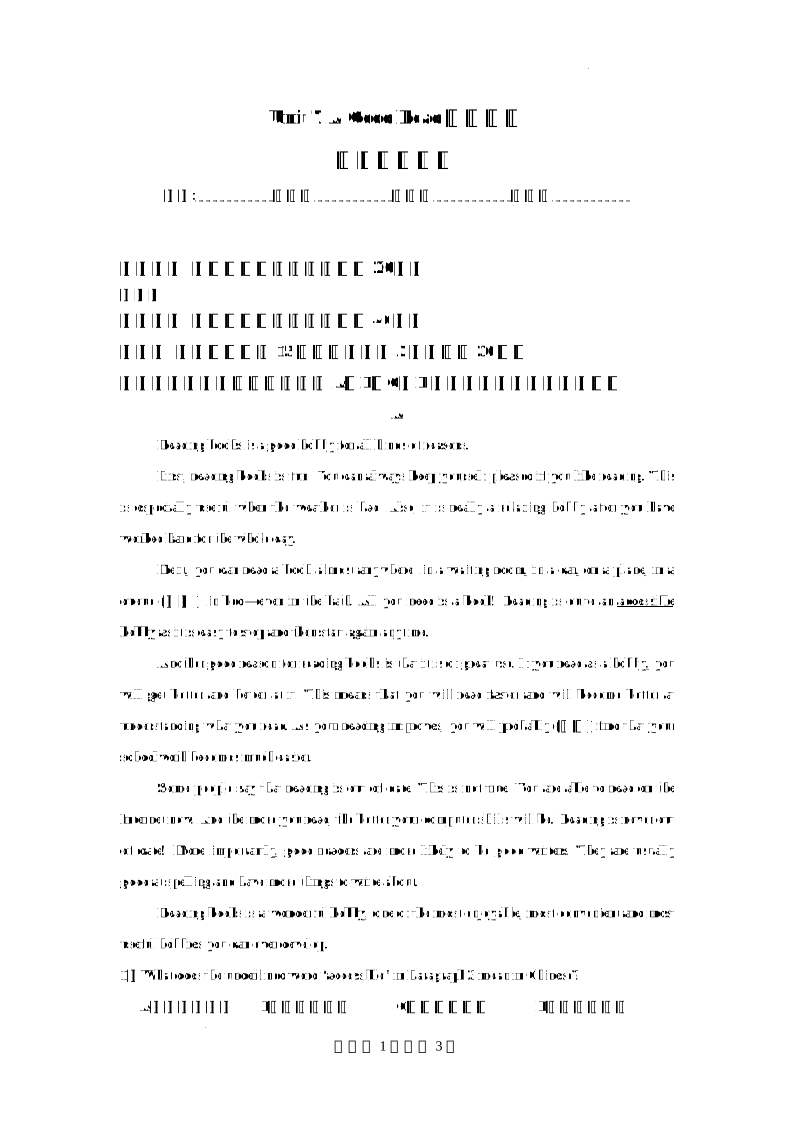
Reading books is a good hobby for all kinds of reasons.
First, reading books is fun. You can always keep yourself pleased if you like reading. This is especially useful when the weather is bad. Also, it is really a relaxing hobby after you have worked hard for the whole day.
Next, you can read a book almost anywhere: in a waiting room, in a car, on a plane, in a queue (队列), in bed—even in the bath. All you need is a book! Reading is quite an accessible hobby as it is easy to stop and then start again anytime.
Another good reason for reading books is that it is of great use. If you read as a hobby, you will get better and better at it. This means that you will read faster and will become better at understanding what you read. As your reading improves, you will probably (可能) find that your schoolwork becomes much easier.
Some people say that reading is out of date. This is not true. You are able to read on the Internet now. And the more you read, the better your computer skills will be. Reading is never out of date! More importantly, good readers are more likely to be good writers. They are usually good at spelling and have more things to write about.
Reading books is a wonderful hobby, one of the most enjoyable, most convenient and most useful hobbies you can ever develop.
1.What does the underlined word “accessible” in Paragraph 3 mean in Chinese?
A.物美价廉的 B.难以相处的 C.触手可及的 D.清楚易懂的
2.What’s the writer’s attitude to the view that reading is out of date?
A.He agrees. B.He disagrees. C.He is not sure. D.He doesn’t care.
3.What is the best title for the text?
A.How to develop a reading habit B.Where you should read books
C.How to improve reading speed D.Why reading books is a good hobby
B
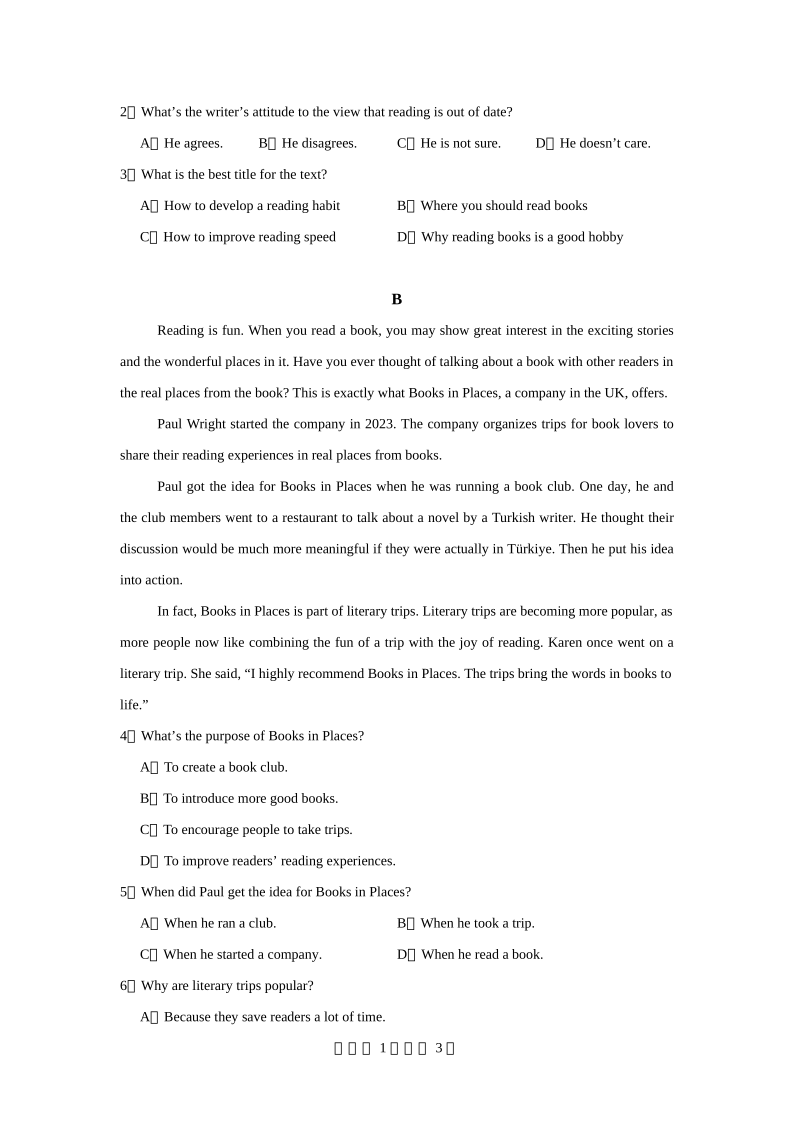
Reading is fun. When you read a book, you may show great interest in the exciting stories and the wonderful places in it. Have you ever thought of talking about a book with other readers in the real places from the book? This is exactly what Books in Places, a company in the UK, offers.
Paul Wright started the company in 2023. The company organizes trips for book lovers to share their reading experiences in real places from books.
Paul got the idea for Books in Places when he was running a book club. One day, he and the club members went to a restaurant to talk about a novel by a Turkish writer. He thought their discussion would be much more meaningful if they were actually in Türkiye. Then he put his idea into action.
In fact, Books in Places is part of literary trips. Literary trips are becoming more popular, as more people now like combining the fun of a trip with the joy of reading. Karen once went on a literary trip. She said, “I highly recommend Books in Places. The trips bring the words in books to life.”
4.What’s the purpose of Books in Places?
A.To create a book club.
B.To introduce more good books.
C.To encourage people to take trips.
D.To improve readers’ reading experiences.
5.When did Paul get the idea for Books in Places?
A.When he ran a club. B.When he took a trip.
C.When he started a company. D.When he read a book.
6.Why are literary trips popular?
A.Because they save readers a lot of time.
B.Because they save travellers plenty of money.
C.Because they combine the fun of travel with the joy of reading.
D.Because they allow readers to get to know more book clubs.
7.In which part of a newspaper can we probably read this passage?
A.The natural world. B.Travel and literature.
C.Being a smart learner. D.Exploring different cultures.
C
One day in autumn Squire Gordon went on a long journey. John went with him and I pulled the cart (马车). The weather was rainy and windy, cold raindrops getting my thin coat wet and strong wind making a noise past my ears, but we travelled happily until we came to the old wooden bridge.
The man at the tollgate (收费处) told us the river was rising fast. “There is going to be a bad storm tonight,” he said.
We arrived in the town, but Squire Gordon’s business took a long time. We didn’t leave until late afternoon. The wind was blowing, making a terrible sound, moving through the tree tops and sending dead leaves flying all around us.
Suddenly we heard a crack (爆裂声), and a huge tree fell across the road in front of us. I stopped still. I was shaking with fear, but I did not turn round or run away.
“We must go back to the crossroad,” said John, “and drive six miles to the wooden bridge.”
When we got there it was nearly dark. There was water on the middle of the bridge, but the Squire did not stop. As soon as my feet touched the bridge I knew that something was wrong. I stopped dead. “Go on, Beauty,” said the Squire.
“There’s something wrong, sir,” said John. He got out and tried to lead me forward. “Come on, Beauty,” he said. But I knew that the bridge was not safe.
Just then the man saw us. “Hey there! Stop!” he cried.
“What is it?” shouted the Squire.
“The bridge is broken in the middle,” he answered. “If you go on to it, you are all going to drown in the river.”
“Thank God!” said the Squire. “Thank you, Beauty!” said John. We turned around and went along the road by the river. For a long time no one said anything. Then John said, “Black Beauty saved our lives. He knew that the bridge was dangerous.” When we returned home, the Squire told Mrs Gordon, “We are all safe, thanks to Black Beauty!”
That night I had good food to eat and a comfortable straw (稻草) bed. I was happy because I was very tired.
—Adapted from Black Beauty
8.What’s the right order of the story?
① A big tree fell down on the road. ② Black Beauty stopped on the broken bridge.
③ They went to the town for business. ④ The man told them the bridge was broken.
⑤ It rained and blew hard on their way.
A.⑤③①②④ B.③⑤①②④ C.③⑤①④② D.③⑤④②①
9.Why did Black Beauty stop dead when he stepped on the bridge?
A.Because he was too tired to walk further.
B.Because he was afraid of the darkness.
C.Because he knew the bridge was unsafe.
D.Because he didn’t like to cross the river.
10.What can we infer from the underlined sentence in the last paragraph?
A.Black Beauty enjoyed being busy all day long.
B.Black Beauty felt safe and relaxed after danger.
C.Black Beauty was too tired to feel anything.
D.Black Beauty felt happy to have a straw bed.
11.What is the best title for the passage?
A.A Heavy Storm in Autumn B.A Broken Wooden Bridge
C.A Clever and Careful Horse D.An Unlucky Journey Home
D
Ernest Hemingway: A Legendary American Writer
Ernest Hemingway (1899—1961) was a famous American writer, awarded the Nobel Prize in Literature. Known for his writing style and life, he developed 20th-century literature with his short and clear sentences.
Early Life and War Experiences
Born in Illinois, Hemingway grew up loving nature, especially summers in Michigan. After high school, he worked as a reporter. During World War I, he joined the Red Cross as an ambulance driver. In 1918, he was wounded in Italy, where he fell in love with a nurse who later left him. These experiences deeply influenced his writing.
Becoming a Writer
Moving to Paris in the 1920s, Hemingway met other famous writers like F. Scott Fitzgerald. His first big success came with The Sun Also Rises (1926), about hopeless young people after the war—called the Lost Generation, though Hemingway disliked these words. In 1929, A Farewell to Arms mixed a war story with a sad love matter, making him a major writer.
Spain and War Stories
Hemingway loved Spain’s bullfights and wrote Death in the Afternoon (1932) about them. During the Spanish Civil War, he wrote For Whom the Bell Tolls (1940), his popular novel about an American taking part in the war efforts in Spain. The story shows both the cruelty (残酷的) of war and the friendships between soldiers.
Later Life and Legacy
In World War II, Hemingway reported from the front lines. His short novel The Old Man and the Sea (1952), about a fisherman’s fight with a huge fish, won the Pulitzer Prize and helped him get the Nobel Prize in 1954. Later, Hemingway lived in Cuba and Africa and died in Idaho at 61. His works, full of courage and loss, are timeless.
12.What is Ernest Hemingway famous for?
A.His long and difficult sentences. B.His colorful life and writing style.
C.His paintings and stories. D.His work as a Red Cross nurse.
13.Where did Hemingway get hurt during World War I?
A.In Illinois. B.In Michigan. C.In Italy. D.In Spain.
14.Which book made Hemingway a major writer?
A.The Sun Also Rises B.A Farewell to Arms
C.Death in the Afternoon D.For Whom the Bell Tolls
15.What can we infer from the passage?
A.Hemingway won the Nobel Prize before the Pulitzer Prize.
B.Hemingway’s experiences in war have greatly influenced his books.
C.Hemingway only wrote about happy endings.
D.Hemingway disliked living in Cuba.
第二节 任务型阅读(共5题,每小题2分,满分10分)
阅读下面材料,从方框中所给的A-E五个选项中选择正确的选项(其中一项是多余选项),并完成最后小题。
If your children are learning to read, it’s wonderful! Whatever they’re reading, they’re probably super-excited readers! But the fact is that reading is a skill.
Create a comfortable reading space.
Choose a special place with the right furnishings (家具陈设), blankets and pillows for your children and put a bookcase for your children’s books. If your children feel like they have their own special place for reading, they will probably spend time in their little space with all their new favorite books.
Set aside time to read together.
If you want your children to learn to love reading, set aside a few minutes every day to read together, no matter how busy you are. Plan to go to bed a few minutes earlier each night so your children have the time to choose a book to read. Besides, reading aloud to your children can make them more willing to read on their own.
Make the library and bookstore a special treat.
They may be excited about new clothes and toys, but not books! Try to use that excitement to help your children love to read. Making a special treat of spending some time at the library or bookstore can be the perfect way to get your children excited about reading. Let them have fun around there and they can choose whatever excites them
A.Reading together is the perfect way to relax before bedtime.
B.Whether (无论) your kids are big readers or not, they are only children.
C.Let your children read alone.
D.The special place may push your children to start to love reading.
E.Here are some useful ways to help make your children love reading!
16.
17.
18.
19.
20.Which of these ways do you think is the best? Why? (No more than 20 words.)
第三部分 语言运用(共三节,满分40分)
第一节 完形填空(共15小题,每小题1分,满分15分)
One afternoon, I realized a serious problem: my son completely lost himself in screens. He spent 21 on phones and video games every day. I was afraid that his love for 22 was fading (消逝) fast. I knew I had to take action at once.
The next 23 , I picked up a book, the one that I had read many times. I shared the story with my son instead of asking him to read 24 . I noticed his eyes lighting up. He laughed at the funny plot. We read till lunchtime that day and he forgot about his 25 games for the first time in months. It was a really good 26 .
“I remember when I was your age,” I said, my voice 27 and encouraging. “I used to love reading. It took me to the world I could only 28 . Maybe you can find a world like that too.” A look of doubt crossed his face. “But 29 can I do if I can’t understand it?” he asked, his voice just above a whisper (近乎耳语).
“I’ll be here to help you,” I said, 30 a hand on his shoulder. “We can read it together, I’ll explain anything that you find hard to 31 .”
Then our reading time became a(n) 32 part of our daily life. Slowly but surely, his confidence grew. He began to enjoy the stories, and his vocabulary became 33 with each new book.
One evening, he stopped and looked up at me 34 as we were reading a challenging book. “Mum, I understand it now,” he said. And his eyes shone. A new-found joy and understanding filled 35 . “It’s like the words are coming to life.”
I smiled, with tears in my eyes. “I knew you could do it,” I said, with a mix of pride and joy in my voice.
21.A.seconds B.minutes C.hours D.days
22.A.phones B.screens C.games D.books
23.A.morning B.afternoon C.evening D.night
24.A.together B.alone C.carefully D.aloud
25.A.ball B.card C.board D.video
26.A.present B.past C.start D.end
27.A.deep B.proud C.nervous D.soft
28.A.create B.imagine C.change D.visit
29.A.what B.when C.where D.how
30.A.showing B.pulling C.putting D.carrying
31.A.write B.understand C.make D.discuss
32.A.difficult B.easy C.terrible D.wonderful
33.A.smaller B.bigger C.shorter D.longer
34.A.excitedly B.sadly C.noisily D.angrily
35.A.us B.me C.them D.it
第二节 词汇运用(共15小题,每小题1分,满分15分)
用方框中所给单词的适当形式填空,每词仅用一次。
weak defeat consider inspire enemy
When I choose a book, I always 36 the main character carefully. Last month, I read a story about a boy who was 37 at first. He had strong 38 , but he never gave up. Finally, he 39 them through hard work. This story has really 40 me a lot since then. I have become more confident in my studies. I believe reading will continue to inspire me in the future.
请从方框内选择适当的词并用其正确形式填空,使文章完整连贯。每词限用一次。
Canada, against, at last, read, recommend, wake up, I, one, crazy, communicate
Today is Saturday. The rain is still beating 41 the window outside. When I 42 this morning, it was raining heavily. I had breakfast 43 and then I chose my favourite classical Chinese novel to read in the study. To tell you the truth, I especially enjoy losing 44 in reading on rainy days. I have a 45 friend called Mary. We have the same hobby—reading books.
Mary is much 46 about reading books than me. And I think we can make our 47 much easier by reading. Last year, I strongly 48 Journey to the West to her. It’s one of the most famous novels in China. The writer created a number of colourful characters like Tang Seng, Sun Wukong, Zhu Bajie and Sha Wujing. 49 , they managed to get the true Buddhist scriptures after they went through 81 difficulties. Mary finds it very exciting. She says it’s the best book she 50 so far.
第三节 语法填空(共10小题,每小题1分,满分10分)
阅读文章,用括号中所给词的正确形式填空,每空不超过两词。
Hobbies play an important role in our daily life. Last year, I got into 51 (read) English novels to improve my language skills. At first, it was not easy, but after months of hard practice, I finally managed 52 (finish) my first English story. Winning first prize in the school reading competition was a great 53 (achieve) for me.
When we learn new things, we should avoid 54 (make) the same mistakes again and again. It’s 55 (harm) to give up easily when we face difficulties. I was really surprised at my own 56 (decide) to keep reading for at least half an hour every day.
I have also learned a lot about nature. I know the blue whale is one of the 57 (big) animals in the world. Every year, millions of 58 (travel) from all over the world come to visit amazing natural wonders. This hobby not only fills my free time 59 also teaches me to face challenges bravely. I will keep my hobby and never give up 60 the future.
第四部分 书面表达(共1小题,满分20分)
61.良好的阅读理解能力是打开知识宝库的钥匙,也是与古今智者对话的桥梁。提升阅读理解能力能让我们在纷繁世界中辨明真伪,让我们的精神世界愈发辽阔丰盈。学校英语报社正在征集关于如何提高阅读理解能力的稿件。请你根据提示信息,以“How to Improve Our Reading Ability”为题,用英语写一篇短文。
提示信息:
写作要求:
1. 至少包含两项提示信息,可适当发挥;
2. 文中不得出现真实姓名、校名和地名;
3. 词数:80—100,开头和结尾已给出,不计入总词数。
How to Improve Our Reading Ability
Reading ability is the key to a colorful world that is full of knowledge and valuable experiences. It’s not hard to improve if you try these simple steps.
__________________________________________________________________________________________________________________________________________________________________________________________________________________________________________________________________________________________________________________________________________________________________________________________________________________________________________________________________________________________________________________________________
Believe in yourself! With practice, your reading comprehension will get better and better.
试卷第1页,共3页
试卷第1页,共3页
学科网(北京)股份有限公司
$
Unit 7 A Good Read单元测试
(浙江专用)
学校:___________姓名:___________班级:___________考号:___________
第一部分 听力理解(共三节,满分20分)
(略)
第二部分 阅读理解(共两节,满分40分)
第一节 阅读理解(共15小题,每小题2分,满分30分)
阅读下面短文,从每题所给的A、B、C、D四个选项中选出最佳选项。
A
Reading books is a good hobby for all kinds of reasons.
First, reading books is fun. You can always keep yourself pleased if you like reading. This is especially useful when the weather is bad. Also, it is really a relaxing hobby after you have worked hard for the whole day.
Next, you can read a book almost anywhere: in a waiting room, in a car, on a plane, in a queue (队列), in bed—even in the bath. All you need is a book! Reading is quite an accessible hobby as it is easy to stop and then start again anytime.
Another good reason for reading books is that it is of great use. If you read as a hobby, you will get better and better at it. This means that you will read faster and will become better at understanding what you read. As your reading improves, you will probably (可能) find that your schoolwork becomes much easier.
Some people say that reading is out of date. This is not true. You are able to read on the Internet now. And the more you read, the better your computer skills will be. Reading is never out of date! More importantly, good readers are more likely to be good writers. They are usually good at spelling and have more things to write about.
Reading books is a wonderful hobby, one of the most enjoyable, most convenient and most useful hobbies you can ever develop.
1.What does the underlined word “accessible” in Paragraph 3 mean in Chinese?
A.物美价廉的 B.难以相处的 C.触手可及的 D.清楚易懂的
2.What’s the writer’s attitude to the view that reading is out of date?
A.He agrees. B.He disagrees. C.He is not sure. D.He doesn’t care.
3.What is the best title for the text?
A.How to develop a reading habit B.Where you should read books
C.How to improve reading speed D.Why reading books is a good hobby
【答案】1.C 2.B 3.D
【导语】本文是一篇议论文,从有趣、方便、实用、写作能力提升等多个角度论证了阅读是一个好爱好的原因。
1.第三段提到“you can read a book almost anywhere... it is easy to stop and then start again anytime”,说明阅读不受地点、时间限制,随时可以开始或暂停,所以划线词意为“触手可及的”。
2.第五段提到“Some people say that reading is out of date. This is not true.”,说明作者不同意阅读过时的观点。
3.全文围绕“阅读是一个好爱好”展开,列举了多个原因,因此最佳标题是“为什么读书是一个好爱好”。
B
Reading is fun. When you read a book, you may show great interest in the exciting stories and the wonderful places in it. Have you ever thought of talking about a book with other readers in the real places from the book? This is exactly what Books in Places, a company in the UK, offers.
Paul Wright started the company in 2023. The company organizes trips for book lovers to share their reading experiences in real places from books.
Paul got the idea for Books in Places when he was running a book club. One day, he and the club members went to a restaurant to talk about a novel by a Turkish writer. He thought their discussion would be much more meaningful if they were actually in Türkiye. Then he put his idea into action.
In fact, Books in Places is part of literary trips. Literary trips are becoming more popular, as more people now like combining the fun of a trip with the joy of reading. Karen once went on a literary trip. She said, “I highly recommend Books in Places. The trips bring the words in books to life.”
4.What’s the purpose of Books in Places?
A.To create a book club.
B.To introduce more good books.
C.To encourage people to take trips.
D.To improve readers’ reading experiences.
5.When did Paul get the idea for Books in Places?
A.When he ran a club. B.When he took a trip.
C.When he started a company. D.When he read a book.
6.Why are literary trips popular?
A.Because they save readers a lot of time.
B.Because they save travellers plenty of money.
C.Because they combine the fun of travel with the joy of reading.
D.Because they allow readers to get to know more book clubs.
7.In which part of a newspaper can we probably read this passage?
A.The natural world. B.Travel and literature.
C.Being a smart learner. D.Exploring different cultures.
【答案】4.D 5.A 6.C 7.B
【导语】本文介绍了英国一家名为Books in Places的公司,它组织读者前往书中的真实地点分享阅读体验,这类文学旅行正越来越受欢迎。
4.根据第二段“The company organizes trips for book lovers to share their reading experiences in real places from books.”可知,公司的目的是让读者在书中的真实地点分享阅读体验,以此提升读者的阅读体验。
5.根据第三段“Paul got the idea for Books in Places when he was running a book club.”可知,他是在运营读书俱乐部时产生了这个想法。
6.根据第四段“Literary trips are becoming more popular, as more people now like combining the fun of a trip with the joy of reading.”可知,原因是它结合了旅行的乐趣和阅读的快乐。
7.文章围绕文学主题的旅行展开,内容同时涉及“旅行”与“文学阅读”,因此最可能出现在“旅行与文学”版块。
C
One day in autumn Squire Gordon went on a long journey. John went with him and I pulled the cart (马车). The weather was rainy and windy, cold raindrops getting my thin coat wet and strong wind making a noise past my ears, but we travelled happily until we came to the old wooden bridge.
The man at the tollgate (收费处) told us the river was rising fast. “There is going to be a bad storm tonight,” he said.
We arrived in the town, but Squire Gordon’s business took a long time. We didn’t leave until late afternoon. The wind was blowing, making a terrible sound, moving through the tree tops and sending dead leaves flying all around us.
Suddenly we heard a crack (爆裂声), and a huge tree fell across the road in front of us. I stopped still. I was shaking with fear, but I did not turn round or run away.
“We must go back to the crossroad,” said John, “and drive six miles to the wooden bridge.”
When we got there it was nearly dark. There was water on the middle of the bridge, but the Squire did not stop. As soon as my feet touched the bridge I knew that something was wrong. I stopped dead. “Go on, Beauty,” said the Squire.
“There’s something wrong, sir,” said John. He got out and tried to lead me forward. “Come on, Beauty,” he said. But I knew that the bridge was not safe.
Just then the man saw us. “Hey there! Stop!” he cried.
“What is it?” shouted the Squire.
“The bridge is broken in the middle,” he answered. “If you go on to it, you are all going to drown in the river.”
“Thank God!” said the Squire. “Thank you, Beauty!” said John. We turned around and went along the road by the river. For a long time no one said anything. Then John said, “Black Beauty saved our lives. He knew that the bridge was dangerous.” When we returned home, the Squire told Mrs Gordon, “We are all safe, thanks to Black Beauty!”
That night I had good food to eat and a comfortable straw (稻草) bed. I was happy because I was very tired.
—Adapted from Black Beauty
8.What’s the right order of the story?
① A big tree fell down on the road. ② Black Beauty stopped on the broken bridge.
③ They went to the town for business. ④ The man told them the bridge was broken.
⑤ It rained and blew hard on their way.
A.⑤③①②④ B.③⑤①②④ C.③⑤①④② D.③⑤④②①
9.Why did Black Beauty stop dead when he stepped on the bridge?
A.Because he was too tired to walk further.
B.Because he was afraid of the darkness.
C.Because he knew the bridge was unsafe.
D.Because he didn’t like to cross the river.
10.What can we infer from the underlined sentence in the last paragraph?
A.Black Beauty enjoyed being busy all day long.
B.Black Beauty felt safe and relaxed after danger.
C.Black Beauty was too tired to feel anything.
D.Black Beauty felt happy to have a straw bed.
11.What is the best title for the passage?
A.A Heavy Storm in Autumn B.A Broken Wooden Bridge
C.A Clever and Careful Horse D.An Unlucky Journey Home
【答案】8.A 9.C 10.B 11.C
【导语】本文是小说《黑骏马》的节选,讲述了黑骏马凭借冷静的判断,拯救了自己及主人的性命。
8.根据原文叙事顺序,事件发生顺序为:出行途中遇到狂风暴雨(⑤)→到达城镇办事情(③)→返程时大树倒在路上拦路(①)→绕路到木桥,黑骏马一踩桥就停下(②)→收费员赶来告知桥已经断裂(④),对应顺序为⑤③①②④。
9.根据第六段中“As soon as my feet touched the bridge I knew that something was wrong. I stopped dead.”以及后文黑骏马知道桥危险等相关内容可知,黑骏马突然停下是因为它知道桥不安全。
10.结合全文内容可知,黑骏马一行人刚刚经历了桥断裂的生命危险,安全回家后享用美食、睡舒适的草床,由此可推断出,黑骏马脱险后感到安全又放松。
11.文章主要讲述了黑骏马在旅途中凭借自己的感知避免了大家陷入危险,突出了黑骏马的聪明和细心,C选项“一匹聪明细心的马”最能概括文章主旨。
D
Ernest Hemingway: A Legendary American Writer
Ernest Hemingway (1899—1961) was a famous American writer, awarded the Nobel Prize in Literature. Known for his writing style and life, he developed 20th-century literature with his short and clear sentences.
Early Life and War Experiences
Born in Illinois, Hemingway grew up loving nature, especially summers in Michigan. After high school, he worked as a reporter. During World War I, he joined the Red Cross as an ambulance driver. In 1918, he was wounded in Italy, where he fell in love with a nurse who later left him. These experiences deeply influenced his writing.
Becoming a Writer
Moving to Paris in the 1920s, Hemingway met other famous writers like F. Scott Fitzgerald. His first big success came with The Sun Also Rises (1926), about hopeless young people after the war—called the Lost Generation, though Hemingway disliked these words. In 1929, A Farewell to Arms mixed a war story with a sad love matter, making him a major writer.
Spain and War Stories
Hemingway loved Spain’s bullfights and wrote Death in the Afternoon (1932) about them. During the Spanish Civil War, he wrote For Whom the Bell Tolls (1940), his popular novel about an American taking part in the war efforts in Spain. The story shows both the cruelty (残酷的) of war and the friendships between soldiers.
Later Life and Legacy
In World War II, Hemingway reported from the front lines. His short novel The Old Man and the Sea (1952), about a fisherman’s fight with a huge fish, won the Pulitzer Prize and helped him get the Nobel Prize in 1954. Later, Hemingway lived in Cuba and Africa and died in Idaho at 61. His works, full of courage and loss, are timeless.
12.What is Ernest Hemingway famous for?
A.His long and difficult sentences. B.His colorful life and writing style.
C.His paintings and stories. D.His work as a Red Cross nurse.
13.Where did Hemingway get hurt during World War I?
A.In Illinois. B.In Michigan. C.In Italy. D.In Spain.
14.Which book made Hemingway a major writer?
A.The Sun Also Rises B.A Farewell to Arms
C.Death in the Afternoon D.For Whom the Bell Tolls
15.What can we infer from the passage?
A.Hemingway won the Nobel Prize before the Pulitzer Prize.
B.Hemingway’s experiences in war have greatly influenced his books.
C.Hemingway only wrote about happy endings.
D.Hemingway disliked living in Cuba.
【答案】12.B 13.C 14.B 15.B
【导语】本文是一篇记叙文,主要介绍了美国著名作家欧内斯特·海明威的生平经历、重要作品以及文学成就,展现了他的写作风格与人生传奇。
12.第一段指出海明威的知名之处:“Known for his writing style and life, he developed 20th-century literature with his short and clear sentences”,说明他以独特的写作风格和丰富的人生经历而闻名。
13.第二段说明海明威一战中的受伤地点:“In 1918, he was wounded in Italy”,明确他在意大利受伤。
14.第三段说明让海明威成为重要作家的作品:“In 1929, A Farewell to Arms mixed a war story with a sad love matter, making him a major writer”,指出《永别了,武器》这部作品奠定了他在文坛的重要地位。
15.全文多处体现海明威的战争经历对作品的影响:第二段提到“These experiences deeply influenced his writing”,第四段写西班牙内战相关作品《丧钟为谁而鸣》,第五段提及二战前线报道经历,综合可推断出他的战争经历极大影响了其著作。
第二节 任务型阅读(共5题,每小题2分,满分10分)
阅读下面材料,从方框中所给的A-E五个选项中选择正确的选项(其中一项是多余选项),并完成最后小题。
If your children are learning to read, it’s wonderful! Whatever they’re reading, they’re probably super-excited readers! But the fact is that reading is a skill.
Create a comfortable reading space.
Choose a special place with the right furnishings (家具陈设), blankets and pillows for your children and put a bookcase for your children’s books. If your children feel like they have their own special place for reading, they will probably spend time in their little space with all their new favorite books.
Set aside time to read together.
If you want your children to learn to love reading, set aside a few minutes every day to read together, no matter how busy you are. Plan to go to bed a few minutes earlier each night so your children have the time to choose a book to read. Besides, reading aloud to your children can make them more willing to read on their own.
Make the library and bookstore a special treat.
They may be excited about new clothes and toys, but not books! Try to use that excitement to help your children love to read. Making a special treat of spending some time at the library or bookstore can be the perfect way to get your children excited about reading. Let them have fun around there and they can choose whatever excites them
A.Reading together is the perfect way to relax before bedtime.
B.Whether (无论) your kids are big readers or not, they are only children.
C.Let your children read alone.
D.The special place may push your children to start to love reading.
E.Here are some useful ways to help make your children love reading!
16.
17.
18.
19.
20.Which of these ways do you think is the best? Why? (No more than 20 words.)
【答案】16.E 17.D 18.A 19.B 20. I think the second way. It makes kids feel warm and interested.
【导语】本文是一篇关于培养孩子阅读习惯的说明文,提出了三个实用建议:创造舒适的阅读空间、每天留出时间一起阅读、把图书馆和书店变成特殊待遇。
16.第一段说“阅读是一项技能”,空白处应引出下文的具体建议。选项E“Here are some useful ways to help make your children love reading!”(这里有一些有用的方法可以帮助你的孩子爱上阅读!)起到承上启下的作用,自然总领后文。
17.第二段讲创造舒适的阅读空间,空白处后说“如果孩子觉得他们有自己专属的阅读空间,他们可能会花时间在那里”。因此空白处应说明这个特殊空间的作用。选项D“The special place may push your children to start to love reading.”(这个特别的地方可能会促使你的孩子开始喜欢阅读)符合逻辑,与后文形成因果关系。
18.第三段讲每天留出时间一起阅读,空白处后说“每晚早睡几分钟,让孩子有时间选书”。因此空白处应说明睡前一起阅读是放松的好方式。选项A“Reading together is the perfect way to relax before bedtime.”(一起阅读是睡前放松的最佳方式)符合逻辑,与后文“早睡”“选书”衔接。
19.第四段讲把图书馆和书店变成特殊待遇,空白处后说“孩子可能对新衣服和玩具兴奋,而不是书”。因此空白处应说明无论孩子是不是爱读书,他们终究是孩子。选项B“Whether your kids are big readers or not, they are only children.”(无论你的孩子是不是爱读书,他们终究只是孩子)符合逻辑,与后文形成转折关系。
20.开放性试题,任选一种方法,理由合理、不超20词即可。
第三部分 语言运用(共三节,满分40分)
第一节 完形填空(共15小题,每小题1分,满分15分)
One afternoon, I realized a serious problem: my son completely lost himself in screens. He spent 21 on phones and video games every day. I was afraid that his love for 22 was fading (消逝) fast. I knew I had to take action at once.
The next 23 , I picked up a book, the one that I had read many times. I shared the story with my son instead of asking him to read 24 . I noticed his eyes lighting up. He laughed at the funny plot. We read till lunchtime that day and he forgot about his 25 games for the first time in months. It was a really good 26 .
“I remember when I was your age,” I said, my voice 27 and encouraging. “I used to love reading. It took me to the world I could only 28 . Maybe you can find a world like that too.” A look of doubt crossed his face. “But 29 can I do if I can’t understand it?” he asked, his voice just above a whisper (近乎耳语).
“I’ll be here to help you,” I said, 30 a hand on his shoulder. “We can read it together, I’ll explain anything that you find hard to 31 .”
Then our reading time became a(n) 32 part of our daily life. Slowly but surely, his confidence grew. He began to enjoy the stories, and his vocabulary became 33 with each new book.
One evening, he stopped and looked up at me 34 as we were reading a challenging book. “Mum, I understand it now,” he said. And his eyes shone. A new-found joy and understanding filled 35 . “It’s like the words are coming to life.”
I smiled, with tears in my eyes. “I knew you could do it,” I said, with a mix of pride and joy in my voice.
21.A.seconds B.minutes C.hours D.days
22.A.phones B.screens C.games D.books
23.A.morning B.afternoon C.evening D.night
24.A.together B.alone C.carefully D.aloud
25.A.ball B.card C.board D.video
26.A.present B.past C.start D.end
27.A.deep B.proud C.nervous D.soft
28.A.create B.imagine C.change D.visit
29.A.what B.when C.where D.how
30.A.showing B.pulling C.putting D.carrying
31.A.write B.understand C.make D.discuss
32.A.difficult B.easy C.terrible D.wonderful
33.A.smaller B.bigger C.shorter D.longer
34.A.excitedly B.sadly C.noisily D.angrily
35.A.us B.me C.them D.it
【答案】
21.C 22.D 23.A 24.B 25.D 26.C 27.D 28.B 29.A 30.C 31.B 32.D 33.B 34.A 35.C
【导语】本文讲述母亲通过亲子共读,帮沉迷电子屏幕的儿子重拾阅读兴趣、建立自信的故事。
21.句意:他每天花好几个小时在手机和电子游戏上。
前文提到“他儿子沉迷于各类电子产品”,后文又提到“每一天”,说明他每天都花几个“小时”玩手机或游戏,最能体现他的沉迷。应用hours。
22.句意:我担心他对书的热爱正在快速消逝。
前文提到“他儿子沉迷手机和游戏”,第二段提到“妈妈拿起一本书读给儿子听”,说明妈妈担心的是他对“书”的热爱正在消逝。应用books。
23.句意:第二天早上,我拿起一本书,一本我已经读过很多遍的书。
下文提到本段第五句提到“我们一直读到午餐时间”,说明是第二天“早上”开始读书的。应用morning。
24.句意:我和儿子一起分享这个故事,而不是让他自己独自阅读。
本句前半部分说“分享”,再根据“instead of”可知,不是让他“独自”读。应用alone。
25.句意:那天我们一直读到午饭时间,而他几个月来第一次忘记了他的电子游戏。
第一段提到“他每天花几个小时在手机和电子游戏上”,经过和妈妈一起阅读让他忘记了他的“电子游戏”。应用video。
26.句意:这真是一个很好的开端。
前文提到“几个月来第一次忘记游戏”,下文继续讲养成读书习惯,说明这是一个好的“开端”。应用start。
27.句意:“我记得在我像你这么大的时候,”我说道,声音温柔而充满鼓励。“我曾经非常喜欢阅读。它带我走进了一个我只能在想象中见到的世界。也许你也能找到那样的一个世界。”
本句是母亲在鼓励儿子,说明声音是“轻柔”而鼓励的。应用soft。
28.句意:“我记得在我像你这么大的时候,”我说道,声音温柔而充满鼓励。“我曾经非常喜欢阅读。它带我走进了一个我只能在想象中见到的世界。也许你也能找到那样的一个世界。”
前半句提到“读书带我去往的世界”,说明那是一个只能“想象”的世界。应用imagine。
29.句意:“但如果我读不懂,我能做什么呢?”他问道,声音近乎耳语。
儿子问“如果我读不懂”,说明他想问的是“我能做什么”。应用what。how“怎样”,一般作状语,本句do后缺宾语,不符合语境。应用what。
30.句意:“我会在这儿帮助你,”我说道,把手放在他肩膀上。“我们可以一起读,我会解释任何你觉得难以理解的内容。”
根据“手”和“肩上”可知,应是把手“放”在肩上。应用putting。
31.句意:“我会在这儿帮助你,”我说道,把手放在他肩膀上。“我们可以一起读,我会解释任何你觉得难以理解的内容。”
上文儿子问“if I can’t understand it”,后文母亲说会解释,说明解释他难以“理解”的内容。应用understand。
32.句意:我们的阅读时间成为日常生活中美好的一部分。
前文开始一起读书,后文儿子信心增长、词汇量变大,说明读书成了“美好的”日常生活一部分。应用wonderful。
33.句意:他开始享受这些故事,他的词汇量也随着每一本新书而变得更大。
前半部分提到“词汇”,后半部分提到“随着每一本新书”,说明他的词汇量也随着每一本新书而变得更“大”。应用bigger。
34.句意:一天晚上,我们在读一本有挑战性的书时,他停下来,兴奋地抬头看着我。
后文说读一本有挑战性的书,并且读懂了,说明他很开心,很“激动”。应用excitedly。
35.句意:一种全新的喜悦和理解填满了他的双眼。
本句承接前一句的“his eyes shone”,空处需用them指代“his eyes”,说明他读懂了这本具有挑战性的书的喜悦与领悟填满了他的双眼,即“them”。
第二节 词汇运用(共15小题,每小题1分,满分15分)
用方框中所给单词的适当形式填空,每词仅用一次。
weak defeat consider inspire enemy
When I choose a book, I always 36 the main character carefully. Last month, I read a story about a boy who was 37 at first. He had strong 38 , but he never gave up. Finally, he 39 them through hard work. This story has really 40 me a lot since then. I have become more confident in my studies. I believe reading will continue to inspire me in the future.
【答案】36.consider 37.weak 38.enemies 39.defeated 40.inspired
【导语】本文讲述了作者选书时的习惯,并分享了一个故事中男孩克服困难的经历,表达了阅读给自己带来的积极影响。
36.句意:当我选书时,我总是会仔细考虑主角。根据语境和备选词,此处表达“考虑”的含义,主语为I,时态为一般现在时,需用动词原形,因此填consider。
37.句意:上个月,我读了一个关于一个起初很虚弱的男孩的故事。根据后文“but he never gave up”(但他从未放弃)可推知,男孩一开始的状态是“虚弱的/软弱的”,因此填weak。
38.句意:他有强大的对手,但他从未放弃。根据后文“them”指代此处的名词,结合语境,此处指他面对的“敌人/对手”,且“enemy”为可数名词,需用复数形式表示多个困难或对手,因此填enemies。
39.句意:最后,他通过努力战胜了它们。根据语境,此处表达“击败、战胜”的含义,时态为一般过去时,需用动词过去式,因此填defeated。
40.句意:从那以后,这个故事真的激励了我很多。根据后文“I have become more confident in my studies”可知,故事对“我”产生了激励作用,时态为现在完成时,需用过去分词形式,因此填inspired。
请从方框内选择适当的词并用其正确形式填空,使文章完整连贯。每词限用一次。
Canada, against, at last, read, recommend, wake up, I, one, crazy, communicate
Today is Saturday. The rain is still beating 41 the window outside. When I 42 this morning, it was raining heavily. I had breakfast 43 and then I chose my favourite classical Chinese novel to read in the study. To tell you the truth, I especially enjoy losing 44 in reading on rainy days. I have a 45 friend called Mary. We have the same hobby—reading books.
Mary is much 46 about reading books than me. And I think we can make our 47 much easier by reading. Last year, I strongly 48 Journey to the West to her. It’s one of the most famous novels in China. The writer created a number of colourful characters like Tang Seng, Sun Wukong, Zhu Bajie and Sha Wujing. 49 , they managed to get the true Buddhist scriptures after they went through 81 difficulties. Mary finds it very exciting. She says it’s the best book she 50 so far.
【答案】
41.against 42.woke up 43.first 44.myself 45.Canadian 46.crazier 47.communication 48.recommended 49.At last 50.has read
【导语】本文是一篇记叙文。文章讲述了作者在周六雨天的阅读经历,包括自己阅读中国古典小说的感受,以及向同样热爱阅读的朋友玛丽推荐《西游记》并得到玛丽高度评价的故事。
41.句意:外面的雨还在敲打着窗户。根据“beating...the window”可知,此处表示雨敲打在窗户上,beat against为固定搭配,意为“敲打”。
42.句意:当我今天早上醒来时,雨下得很大。根据“When I...this morning”可知,此处表示早上醒来,wake up为固定搭配,意为“醒来”,由“was”可知,句子时态为一般过去时,动词用过去式,所以填woke up。
43.句意:我先吃了早餐,然后我选了我最喜欢的中国古典小说在书房里读。根据“I had breakfast...and then I chose my favourite classical Chinese novel to read in the study.”可知,此处表示先吃早餐,然后读书,one的序数词first意为“首先”。
44.句意:说实话,我特别喜欢在雨天沉浸在阅读中。lose oneself in为固定搭配,意为“沉浸于”,主语为“I”,此处应用I的反身代词myself。
45.句意:我有一个加拿大朋友叫玛丽。根据“friend called Mary”可知,此处需要一个形容词修饰名词friend,Canada的形容词Canadian意为“加拿大的”。
46.句意:玛丽比我更热衷于读书。根据“than”可知,此处应用形容词crazy的比较级crazier,表示“更热衷的”。
47.句意:我认为我们可以通过阅读使我们的交流更容易。根据“by reading”可知,此处表示通过阅读使交流更容易,communicate的名词communication意为“交流”。
48.句意:去年,我强烈向她推荐《西游记》。根据“Journey to the West to her”可知,此处表示向她推荐《西游记》,recommend为动词,意为“推荐”,由“Last year”可知,句子时态为一般过去时,动词用过去式recommended。
49.句意:最后,他们在经历了81个困难后成功地得到了真正的佛经。根据“they managed to get the true Buddhist scriptures after they went through 81 difficulties”可知,此处表示最后成功得到佛经,at last为固定搭配,意为“最后”,句首注意首字母大写。
50.句意:她说这是她到现在为止读过的最好的书。根据“so far”可知,句子时态为现在完成时,其结构为have/has+动词的过去分词,主语为“she”,助动词用has,read的过去分词为read。
第三节 语法填空(共10小题,每小题1分,满分10分)
阅读文章,用括号中所给词的正确形式填空,每空不超过两词。
Hobbies play an important role in our daily life. Last year, I got into 51 (read) English novels to improve my language skills. At first, it was not easy, but after months of hard practice, I finally managed 52 (finish) my first English story. Winning first prize in the school reading competition was a great 53 (achieve) for me.
When we learn new things, we should avoid 54 (make) the same mistakes again and again. It’s 55 (harm) to give up easily when we face difficulties. I was really surprised at my own 56 (decide) to keep reading for at least half an hour every day.
I have also learned a lot about nature. I know the blue whale is one of the 57 (big) animals in the world. Every year, millions of 58 (travel) from all over the world come to visit amazing natural wonders. This hobby not only fills my free time 59 also teaches me to face challenges bravely. I will keep my hobby and never give up 60 the future.
【答案】
51.reading 52.to finish 53.achievement 54.making 55.harmful 56.decision 57.biggest 58.travellers 59.but 60.in
【导语】本文讲述了作者通过阅读英语小说提升语言能力的经历,介绍了阅读爱好带来的成长与收获,同时强调了面对困难不轻易放弃的重要性。
51.句意:去年,我开始养成阅读英文小说的习惯,以此来提升自己的语言能力。固定搭配“get into doing sth.”表示“开始做某事/养成做某事的习惯”,介词into后需接动名词形式reading。
52.句意:一开始这并不容易,但经过几个月的刻苦练习,我终于设法完成了我的第一篇英文故事。固定搭配“manage to do sth.”表示“设法做成某事”,后需接动词不定式形式to finish。
53.句意:在学校阅读比赛中获得一等奖对我来说是一项巨大的成就。固定搭配“a great + 名词”表示“一项巨大的……”,动词achieve需变为名词形式achievement。
54.句意:当我们学习新事物时,应该避免反复犯同样的错误。固定搭配 “avoid doing sth.”表示“避免做某事”,后需接动名词形式making。
55.句意:当我们面对困难时,轻易放弃是有害的。固定句型“It’s + 形容词 + to do sth.”表示“做某事是……的”,名词/动词harm需变为形容词形式harmful。
56.句意:我对自己每天坚持阅读至少半小时的决定感到非常惊讶。固定搭配“one’s own + 名词”表示“某人自己的……”,动词decide需变为名词形式decision。
57.句意:我知道蓝鲸是世界上最大的动物之一。固定结构“one of the + 形容词最高级 + 复数名词”表示“最……之一”,形容词big需变为最高级形式biggest。
58.句意:每年,数百万来自世界各地的游客前来参观令人惊叹的自然奇观。根据空格后“come to visit amazing natural wonders”可知,此处主语应是“人”(游客),而非“旅行”。固定搭配“millions of + 复数名词”表示“数百万的……”,动词travel需变为表示“游客”的名词复数形式travellers。
59.句意:这个爱好不仅充实了我的空闲时间,还教会我勇敢面对挑战。固定搭配“not only...but also...”表示“不仅……而且……”,需填入连词but。
60.句意:我会坚持我的爱好,在未来永不放弃。固定搭配“in the future”表示“在将来”,需填入介词in。
第四部分 书面表达(共1小题,满分20分)
61.良好的阅读理解能力是打开知识宝库的钥匙,也是与古今智者对话的桥梁。提升阅读理解能力能让我们在纷繁世界中辨明真伪,让我们的精神世界愈发辽阔丰盈。学校英语报社正在征集关于如何提高阅读理解能力的稿件。请你根据提示信息,以“How to Improve Our Reading Ability”为题,用英语写一篇短文。
提示信息:
写作要求:
1. 至少包含两项提示信息,可适当发挥;
2. 文中不得出现真实姓名、校名和地名;
3. 词数:80—100,开头和结尾已给出,不计入总词数。
How to Improve Our Reading Ability
Reading ability is the key to a colorful world that is full of knowledge and valuable experiences. It’s not hard to improve if you try these simple steps.
__________________________________________________________________________________________________________________________________________________________________________________________________________________________________________________________________________________________________________________________________________________________________________________________________________________________________________________________________________________________________________________________________
Believe in yourself! With practice, your reading comprehension will get better and better.
【答案】例文
How to Improve Our Reading Ability
Reading ability is the key to a colorful world that is full of knowledge and valuable experiences. It’s not hard to improve if you try these simple steps.
First, read regularly. Read about 20 minutes a day and be sure to choose your favorite book. That can make reading fun, not a chore. Second, ask questions. For example, “Why does the character act like that?” This can help you understand the story better. Third, look up new words. Write down new words and try to guess their meaning. Then look them up in a dictionary after finishing that part. Mastering more words makes reading easier over time. Finally, tell your friends about the book in a few sentences. This shows you really understand the story.
Believe in yourself! With practice, your reading ability will get better and better.
【详解】写作步骤
[第一步:审题立意]
确定文体:说明文,时态用一般现在时为主
明确要点:以“How to Improve Our Reading Ability”为题,介绍提升阅读理解能力的方法,至少包含两项提示信息
确定人称:第二人称/第一人称
注意事项:词数80—100;文中不得出现真实姓名、校名和地名;开头和结尾已给出,不计入总词数;可适当发挥
[第二步:构思布局]
三段式结构:
开头段:承接题目给出的开头,点明提升阅读能力不难,引出下文方法
主体段:介绍提升阅读能力的具体方法
结尾段:呼应题目给出的结尾,鼓励读者坚持练习
[第三步:要点展开]
要点一:坚持日常阅读
阅读安排:read about 20 minutes a day/set a fixed reading time every day/stick to a daily reading schedule等
读物选择:choose your favorite book/pick different genres of books/start with short, easy passages等
要点二:带着问题阅读
思考方式:ask questions/think about why the character acts like that/predict what will happen next/make inferences based on the text等
阅读作用:this can help you understand the story better/improve your ability to analyze and think critically等
要点三:科学处理生词
处理步骤:look up new words/write down new words and try to guess their meaning/look them up in a dictionary after finishing that part/use context clues to guess word meanings first等
长期效果:mastering more words makes reading easier over time/expand your vocabulary gradually/read more smoothly without stopping等
要点四:读后分享与巩固
分享方式:tell your friends about the book in a few sentences/discuss the book with classmates/write a short summary of what you read等
巩固作用:this shows you really understand the story/deepen your understanding of the text/remember the content more clearly等
试卷第1页,共3页
试卷第1页,共3页
学科网(北京)股份有限公司
$
资源预览图
1
2

3

相关资源
由于学科网是一个信息分享及获取的平台,不确保部分用户上传资料的 来源及知识产权归属。如您发现相关资料侵犯您的合法权益,请联系学科网,我们核实后将及时进行处理。