Unit 8 课时2 Lesson 2 (分层作业) 英语新教材冀教版八年级下册
2026-04-22
|
3份
|
18页
|
275人阅读
|
0人下载
内容正文:
Unit 8 Natural disasters
课时2 Lesson 2 Staying safe in an earthquake分层作业
核心知识速记
01基础达标
02能力提升
03拓展培优
04思维进阶
词汇
occur /əˈkɜː(r)/v. 发生;出现
anytime /ˈenɪtaɪm/adv. 在任何时候
rapidly /ˈræpɪdli/adv. 迅速地
survival /səˈvaɪvl/n. 生存;幸存
patent /ˈpeɪtnt/n. 专利;专利证书 /ˈpeɪtnt/adj. 有专利的
transfer /ˈtrænsfɜː(r)/n. 转让;转移
female /ˈfiːmeɪl/adj. 女性的;雌的
paratrooper /ˈpærətruːpə(r)/n. 空降兵
husband /ˈhʌzbənd/n. 丈夫
medical /ˈmedɪkl/adj. 医学的;医疗的
prescription /prɪˈskrɪpʃn/n. 处方;药方
military /ˈmɪlətri/adj. 军事的;军队的
uniform /ˈjuːnɪfɔːm/n. 制服;统一服装 adj. 一致的
句型
1. What can you do to stay safe in this situation?——在这种情况下,你可以采取哪些措施来确保自身安全?
2.Never get into a lift during an earthquake.——地震发生时切勿进入电梯。
3.It is not easy, but it can save your life.——这并不容易,但能挽救你的生命。
一、单词默写。
1 / 6
学科网(北京)股份有限公司
1.____________/əˈkɜː(r)/v. 发生;出现
2.____________/ˈenɪtaɪm/adv. 在任何时候
3.____________/ˈræpɪdli/adv. 迅速地
4.____________/səˈvaɪvl/n. 生存;幸存
二、词组默写。
1.毫无预兆;突然:________________________
2.保护自己:________________________
3.保持冷静:________________________
4.开始摇晃:________________________
5.躲到桌子下面:________________________
6.坚固的某物:________________________
7.保护某人免受……:________________________
8.远离;不要靠近:________________________
9.进入;陷入:________________________
10.在地震期间:________________________
11.尽可能快地:________________________
12.远离:________________________
13.(车辆)靠边停车:_______________________
14.靠近;离…… 近:________________________
15.尽可能……:________________________
16.大量;许多:________________________
17.留意;警惕;小心提防:___________________
18.落在…… 上;砸向:_______________________
19.太多(修饰可数名词复数):_______________
20.摧毁;放倒;使倒塌:_____________________
1 / 6
学科网(北京)股份有限公司
三、根据要求完成句子。
1.我们需要一些坚固的东西来保护自己。
We need ________ ________ to protect ourselves.
2.请尽可能快地跑到安全的地方。
Please run to the safe place ________ ________ ________ ________.
3.地震时我们要远离危险的建筑物。
We should ________ ________ ________ dangerous buildings in an earthquake.
4.司机看到危险必须靠边停车。
The driver must ________ ________ when he sees danger.
5.大风会摧毁那些破旧的房屋。
Strong wind will ________ ________ the old houses.
四、用适当的介词填空。
1.We should protect ourselves ________ getting hurt in natural disasters.
2.You’d better stay away ________ dangerous places outside.
3.Don’t be close ________ the broken walls during the storm.
4.There is plenty ________ clean water in the mountain village.
5.Please keep an eye out ________ falling stones when walking in the mountains.
五、语法填空。
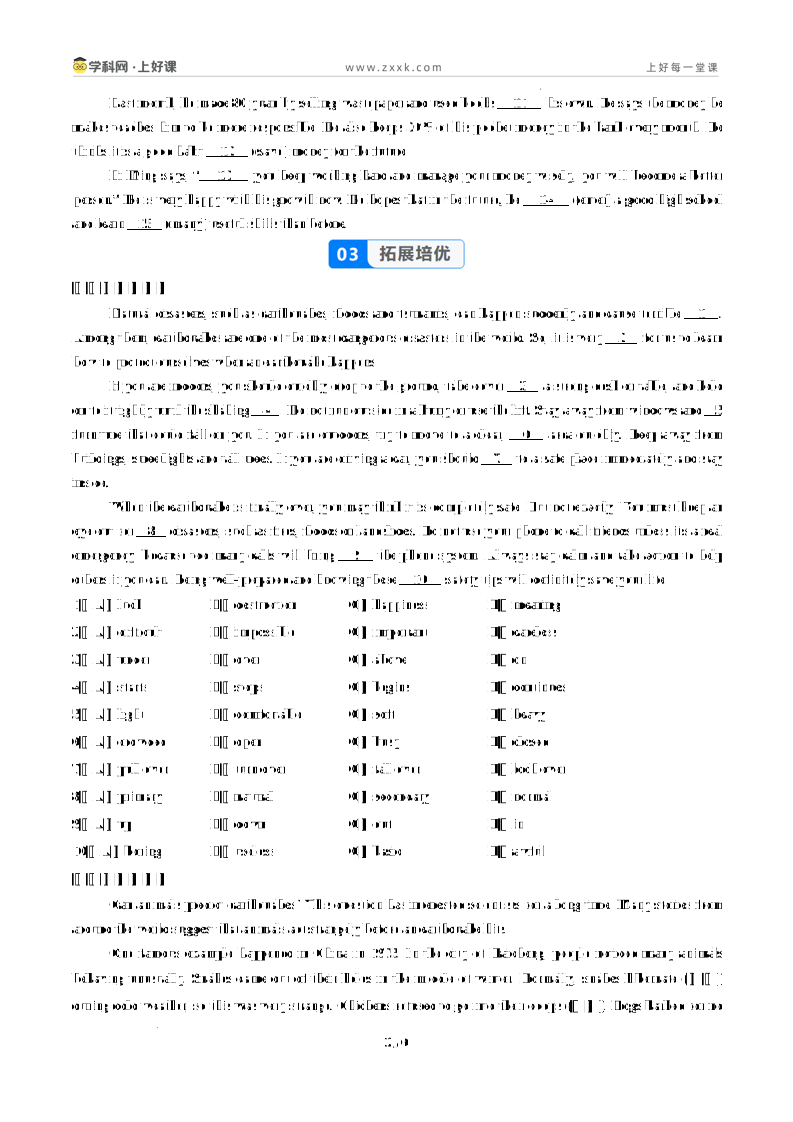
Li Ming is a Grade 8 student. He is working hard to be a better learner and also learn to manage his pocket money 1 (wise).
At the moment, he 2 (make) a study plan and a monthly budget for his pocket money in his room. Last term, he had a hard time with his English. He 3 (can) hardly remember new words and was afraid of speaking in public. One day, while he 4 (worry) about his study in the classroom, his English teacher Ms. Wang came over.
Ms. Wang gave him lots of useful 5 (suggest) on English learning. She advised him to write down new words in a notebook and go over them twice 6 week. She also told him to practice speaking with his classmates as often as possible. With Ms. Wang’s help, Li Ming has made great progress. He becomes more confident and knows the 7 (true) that hard work leads to success.
For his pocket money, he gets 200 yuan every month from 8 (he) parents. He never spends money on unnecessary things. He always makes a shopping list 9 going to the store. 10 he saves enough money, he will buy a new dictionary which is helpful for his study.
Last month, he made 80 yuan by selling wastepaper and used books 11 his own. He says the money he makes teaches him to be more responsible. He also keeps 30% of his pocket money in the bank every month. He thinks it is a good habit 12 (save) money for the future.
Li Ming says, “ 13 you keep working hard and manage your money wisely, you will become a better person.” He is very happy with his growth now. He hopes that in the future, he 14 (enter) a good high school and learn 15 (many) useful skills than before.
六、完形填空。
Natural disasters, such as earthquakes, floods and tsunamis, can happen suddenly and cause terrible 1 . Among them, earthquakes are one of the most dangerous disasters in the world. So, it is very 2 for us to learn how to protect ourselves when an earthquake happens.
If you are indoors, you should quickly drop to the ground, take cover 3 a strong desk or table, and hold on to it tightly until the shaking 4 . Do not run outside in a hurry or use the lift. Stay away from windows and 5 furniture that could fall on you. If you are outdoors, try to move to a clear, 6 area quickly. Keep away from buildings, streetlights and tall trees. If you are driving a car, you should 7 to a safe place immediately and stay inside.
When the earthquake is finally over, you may think it is completely safe. But not exactly. You must keep an eye out for 8 disasters, such as fires, floods or landslides. Do not use your phone to call friends unless it's a real emergency, because too many calls will bring 9 the phone system. Always stay calm and take action to help others if you can. Being well-prepared and knowing these 10 safety tips will definitely save your life.
1.A.luck B.destruction C.happiness D.meaning
2.A.difficult B.impossible C.important D.careless
3.A.under B.over C.above D.on
4.A.starts B.stops C.begins D.continues
5.A.light B.comfortable C.soft D.heavy
6.A.crowded B.open C.busy D.closed
7.A.pull over B.turn over C.fall over D.look over
8.A.primary B.natural C.secondary D.normal
9.A.up B.down C.out D.in
10.A.boring B.useless C.basic D.awful
七、阅读理解。
Can animals predict earthquakes? This question has interested scientists for a long time. Many stories from around the world suggest that animals act strangely before an earthquake hits.
One famous example happened in China in 1975. In the city of Haicheng, people noticed many animals behaving unusually. Snakes came out of their holes in the middle of winter. Normally, snakes hibernate (冬眠) during cold weather, so this was very strange. Chickens refused to go into their coops (鸡笼). Dogs barked for no reason. Cows and horses seemed nervous and tried to break free from their fences.
Because of these signs, the government ordered people to leave their homes. Just hours later, a huge earthquake struck the city. Many buildings fell down, but most people were safe because they had already moved outside. This event made people believe that animals really can sense when a disaster is coming.
Scientists have several ideas about how animals might do this. Some think animals can feel small shaking in the ground that humans cannot feel. Others believe animals can sense changes in the air or in gases that come out of the ground before an earthquake. Animals also have much better hearing than humans, so they might hear sounds that we cannot hear.
However, not all scientists agree that animals can predict earthquakes. They say that animals act strangely for many different reasons. Sometimes what looks like a warning sign is just normal animal behavior. More research is needed to understand this mystery.
1.What is the right order of what happened in Haicheng in 1975?
a. A huge earthquake struck the city.
b. People noticed animals behaving strangely.
c. The government ordered people to leave their homes.
A.a-b-c B.b-c-a C.c-a-b D.b-a-c
2.Why do some scientists think animals can sense earthquakes?
A.Animals are smarter than humans.
B.Animals can feel small shaking or sense changes in gases.
C.Animals always act strangely for no reason.
D.Animals have lived on Earth for a long time.
3.How does the writer support the main idea of paragraph 4?
A.By telling a story. B.By giving numbers.
C.By explaining reasons. D.By asking questions.
4.In which part of a newspaper can you probably read the text?
A.Sports News. B.Science & Nature. C.Health & Life. D.Travel & Culture.
5.What can be the best title for the text?
A.The Haicheng Earthquake B.How to Protect Yourself in an Earthquake
C.Can Animals Predict Earthquakes? D.Strange Animal Behavior
八、阅读表达。
Protecting Ourselves in the Earthquake
Earthquakes happen all the time around the world. Sometimes they are just too small for people to feel. But when a serious earthquake happens, it can be very sudden and dangerous. Luckily, here are some safety tips for you to follow.
To begin with, you must know where to hide. If you are indoors, hide under a strong desk and hang on to its legs. Or you can sit in the corner of the rooms. If you are outdoors, find an open area and stay away from trees and power lines. In this way, you can keep off danger more easily.
Besides, always prepare an emergency kit at home. In the kit, you should keep enough food and water, a flashlight, a knife, a strong rope, and other useful things. Being prepared may help save your life.
Most importantly, as students, you need to take part in the safety training at school. It can help you put your knowledge into practice. For example, when the strong shaking stops, you should not move around right away. Sometimes, there will be some aftershocks, and they can be quite dangerous, too.
No one expects to experience an earthquake, but no one knows whether they will have the bad luck. So, to increase our chance of surviving the natural disaster, we must always be prepared.
1.What should you do if you are indoors during an earthquake?
_________________________________________________________
2.What should you do if you are outdoors during an earthquake?
_________________________________________________________
3.What should you keep in an emergency kit?
______________________________________________________
4.Why is it important to take part in safety training?
_________________________________________________________
5.What should you remember when the strong shaking stops?
_________________________________________________________
九、阅读下面短文,完成相关任务。
Last month, a powerful earthquake struck a small town. It was the strongest earthquake in the area’s history. The ground shook violently, and many buildings fell down. People ran out of their houses as fast as they could. The government sent rescue workers immediately. They worked harder than anyone to save people. Some survivors said they felt several aftershocks after the main quake. One of them said, “The first earthquake was terrible, but the aftershocks were even scarier because we didn’t know when they would stop.” Now, people are rebuilding their homes. They are building them stronger than before to prepare for future earthquakes.Task 1: 回答问题。
1.What happened in the small town last month?
_________________________________________________________
2.How did the ground shake during the earthquake?
_________________________________________________________
3.What did the rescue workers do?
_________________________________________________________
Task 2: 用括号内所给词的适当形式填空。
4.The earthquake was the (strong) in the area’s history.
5.People ran out (fast) than they could imagine.
6.The aftershocks were even (scary) than the first earthquake.
7.They are building houses (strong) than before.
8.The rescue workers worked (hard) than anyone.
Task 3: 写作训练。
9.根据短文内容及你的了解,写一段关于“如何应对地震”的短文。要求:
1. 不少于6句话;
2. 至少运用2个复合词(如 earthquake, aftershock, flashlight 等)和2个副词比较级或最高级;
3. 运用本课时所学语法和句型。
__________________________________________________________________________________________
__________________________________________________________________________________________
__________________________________________________________________________________________
__________________________________________________________________________________________
__________________________________________________________________________________________
__________________________________________________________________________________________
__________________________________________________________________________________________
__________________________________________________________________________________________
$
Unit 8 Natural disasters
课时2 Lesson 2 Staying safe in an earthquake分层作业
参考答案
一、单词默写。
occur;anytime;rapidly;survival
二、词组默写。
1.without warning 2.protect oneself 3.stay calm4.begin to shake 5.get under a table 6.something strong
7.protect somebody from doing 8.stay out of 9.get into 10.during an earthquake 11.as fast as you can
12.stay away from 13.pull over 14.be close to 15.as…as possible 16.plenty of 17.keep an eye out for
18.fall on 19.too many 20.bring down
三、完成句子。
1.something strong 2.as fast as you can 3.stay away from 4.pull over 5.bring down
四 、用适当的介词填空。
1.from 2.from 3.to 4.of 5.for
五、语法填空。
1.wisely 2.is making 3.could 4.was worrying 5.suggestions 6.a 7.truth 8.his 9.before 10.If 11.on 12.to save 13.If 14.will enter 15.more
六、完形填空。
1.B 2.C 3.A 4.B 5.D 6.B 7.A 8.C 9.B 10.C
七、阅读理解。
1.B 2.B 3.C 4.B 5.C
八、阅读表达。
1.Hide under a strong desk and hang on to its legs, or sit in the corner of the rooms. 2.Find an open area and stay away from trees and power lines. 3.Enough food and water, a flashlight, a knife, a strong rope, and other useful things. 4.It can help you put your knowledge into practice. 5.Do not move around right away because there may be aftershocks.
九、阅读综合。
1.A powerful earthquake struck the small town. 2.The ground shook violently. 3.They worked hard to save people. 4.strongest 5.faster 6.scarier 7.stronger 8.harder 9.例文
Earthquakes are one of the most terrible natural disasters. When an earthquake happens, we should stay calm and act quickly. First, we must hide under a strong table or desk. We should protect our head with our hands. After the main shock, be careful of aftershocks because they can be even more dangerous. It is also important to prepare a flashlight and some food at home. We can keep them in a bag so that we can find them faster. In the rescue, people who act more bravely can help others better. Learning how to stay safe is the best way to face an earthquake.
1 / 6
学科网(北京)股份有限公司
$Unit 8 Natural disasters
课时2 Lesson 2 Staying safe in an earthquake分层作业
核心知识速记
01基础达标
02能力提升
03拓展培优
04思维进阶
词汇
occur /əˈkɜː(r)/v. 发生;出现
anytime /ˈenɪtaɪm/adv. 在任何时候
rapidly /ˈræpɪdli/adv. 迅速地
survival /səˈvaɪvl/n. 生存;幸存
patent /ˈpeɪtnt/n. 专利;专利证书 /ˈpeɪtnt/adj. 有专利的
transfer /ˈtrænsfɜː(r)/n. 转让;转移
female /ˈfiːmeɪl/adj. 女性的;雌的
paratrooper /ˈpærətruːpə(r)/n. 空降兵
husband /ˈhʌzbənd/n. 丈夫
medical /ˈmedɪkl/adj. 医学的;医疗的
prescription /prɪˈskrɪpʃn/n. 处方;药方
military /ˈmɪlətri/adj. 军事的;军队的
uniform /ˈjuːnɪfɔːm/n. 制服;统一服装 adj. 一致的
句型
1. What can you do to stay safe in this situation?——在这种情况下,你可以采取哪些措施来确保自身安全?
2.Never get into a lift during an earthquake.——地震发生时切勿进入电梯。
3.It is not easy, but it can save your life.——这并不容易,但能挽救你的生命。
一、单词默写。
1 / 6
学科网(北京)股份有限公司
1.____________/əˈkɜː(r)/v. 发生;出现
2.____________/ˈenɪtaɪm/adv. 在任何时候
3.____________/ˈræpɪdli/adv. 迅速地
4.____________/səˈvaɪvl/n. 生存;幸存
【答案】occur;anytime;rapidly;survival
二、词组默写。
1.毫无预兆;突然:________________________
2.保护自己:________________________
3.保持冷静:________________________
4.开始摇晃:________________________
5.躲到桌子下面:________________________
6.坚固的某物:________________________
7.保护某人免受……:________________________
8.远离;不要靠近:________________________
9.进入;陷入:________________________
10.在地震期间:________________________
11.尽可能快地:________________________
12.远离:________________________
13.(车辆)靠边停车:_______________________
14.靠近;离…… 近:________________________
15.尽可能……:________________________
16.大量;许多:________________________
17.留意;警惕;小心提防:___________________
18.落在…… 上;砸向:_______________________
19.太多(修饰可数名词复数):_______________
20.摧毁;放倒;使倒塌:_____________________
1 / 6
学科网(北京)股份有限公司
【答案】
1.without warning 2.protect oneself 3.stay calm4.begin to shake 5.get under a table 6.something strong
7.protect somebody from doing 8.stay out of 9.get into 10.during an earthquake 11.as fast as you can
12.stay away from 13.pull over 14.be close to 15.as…as possible 16.plenty of 17.keep an eye out for
18.fall on 19.too many 20.bring down
三、根据要求完成句子。
1.我们需要一些坚固的东西来保护自己。
We need ________ ________ to protect ourselves.
2.请尽可能快地跑到安全的地方。
Please run to the safe place ________ ________ ________ ________.
3.地震时我们要远离危险的建筑物。
We should ________ ________ ________ dangerous buildings in an earthquake.
4.司机看到危险必须靠边停车。
The driver must ________ ________ when he sees danger.
5.大风会摧毁那些破旧的房屋。
Strong wind will ________ ________ the old houses.
【答案】1.something strong 2.as fast as you can 3.stay away from 4.pull over 5.bring down
四、用适当的介词填空。
1.We should protect ourselves ________ getting hurt in natural disasters.
2.You’d better stay away ________ dangerous places outside.
3.Don’t be close ________ the broken walls during the storm.
4.There is plenty ________ clean water in the mountain village.
5.Please keep an eye out ________ falling stones when walking in the mountains.
【答案】1.from 2.from 3.to 4.of 5.for
1.解析:固定搭配 protect sb. from doing sth. 保护某人免受…… 伤害,介词固定用 from。
2.解析:固定搭配 stay away from 远离……,介词固定用 from。
3.解析:固定搭配 be close to 靠近……;离…… 近,介词固定用 to。
4.解析:固定搭配 plenty of 大量;许多,介词固定用 of。
5.解析:固定搭配 keep an eye out for 留意;小心提防……,介词固定用 for。
五、语法填空。
Li Ming is a Grade 8 student. He is working hard to be a better learner and also learn to manage his pocket money 1 (wise).
At the moment, he 2 (make) a study plan and a monthly budget for his pocket money in his room. Last term, he had a hard time with his English. He 3 (can) hardly remember new words and was afraid of speaking in public. One day, while he 4 (worry) about his study in the classroom, his English teacher Ms. Wang came over.
Ms. Wang gave him lots of useful 5 (suggest) on English learning. She advised him to write down new words in a notebook and go over them twice 6 week. She also told him to practice speaking with his classmates as often as possible. With Ms. Wang’s help, Li Ming has made great progress. He becomes more confident and knows the 7 (true) that hard work leads to success.
For his pocket money, he gets 200 yuan every month from 8 (he) parents. He never spends money on unnecessary things. He always makes a shopping list 9 going to the store. 10 he saves enough money, he will buy a new dictionary which is helpful for his study.
Last month, he made 80 yuan by selling wastepaper and used books 11 his own. He says the money he makes teaches him to be more responsible. He also keeps 30% of his pocket money in the bank every month. He thinks it is a good habit 12 (save) money for the future.
Li Ming says, “ 13 you keep working hard and manage your money wisely, you will become a better person.” He is very happy with his growth now. He hopes that in the future, he 14 (enter) a good high school and learn 15 (many) useful skills than before.
【答案】
1.wisely 2.is making 3.could 4.was worrying 5.suggestions 6.a 7.truth 8.his 9.before 10.If 11.on 12.to save 13.If 14.will enter 15.more
【导语】本文主要介绍了八年级学生李明在英语学习和零花钱管理两方面的成长与进步。
1.句意:他正在努力成为一名更好的学习者,同时也学着理智地管理自己的零花钱。此处修饰动词 manage,需要用副词形式,wise 的副词是 wisely“理智地;明智地”。
2.句意:此刻,他正在自己的房间里制定学习计划和月度零花钱预算。根据时间标志“At the moment ”可知,句子用现在进行时,结构为am/is/are + 动词现在分词,主语he是第三人称单数,be动词用is,make的现在分词是making。
3.句意:他几乎记不住新单词,还害怕在公共场合发言。根据前文“Last term”可知,句子描述过去的情况,用一般过去时,can的过去式是could,表示 “能够”。
4.句意:一天,当他正在教室里为学习发愁时,他的英语老师王老师走了过来。while引导时间状语从句,强调主句动作发生时,从句动作正在进行,主句为一般过去时,从句用过去进行时,结构为was/were + 动词现在分词,主语 he是第三人称单数,be动词用was,worry的现在分词是worrying。
5.句意:王老师给了他很多关于英语学习的有用建议。lots of后接可数名词复数或不可数名词,suggest是动词,其名词形式suggestion表示 “建议”,是可数名词,复数形式为suggestions。
6.句意:她建议他把新单词写在笔记本上,一周复习两次。twice a week是固定搭配,表示 “一周两次”,此处用不定冠词a。
7.句意:他变得更加自信,也明白了努力造就成功的真理。定冠词the后接名词,true是形容词,其名词形式truth表示 “真理;事实”,是不可数名词。
8.句意:至于零花钱,他每个月从父母那里得到 200 元。此处修饰名词parents,用形容词性物主代词,主语是he,对应的形容词性物主代词是his“他的”。
9.句意:他总是在去商店之前列好购物清单。根据语境和空后的动名词going可知,此处填时间介词before,表示 “在……之前”。
10.句意:如果他存够了钱,他会买一本对他学习有帮助的新词典。本句是 if 引导的条件状语从句,遵循 “主将从现” 的时态规则,if 表示 “如果”,句首首字母大写。
11.句意:上个月,他靠自己卖废纸和旧书赚了 80 元。on one’s own 是固定短语,表示“独自;靠自己”。
12.句意:他认为为未来存钱是一个好习惯。此处用 it 作形式主语,真正的主语是后面的不定式to+动词原形。
13.句意:如果你持续努力,并且理智地管理你的钱财,你会成为一个更优秀的人。本句是if引导的条件状语从句,遵循 “主将从现” 规则,if表示 “如果”,句首首字母大写。
14.句意:他希望未来能进入一所好的高中,学到比以前更多有用的技能。根据时间标志in the future可知,句子用一般将来时,结构为will + 动词原形。
15.句意:他希望未来能进入一所好的高中,学到比以前更多有用的技能。根据句中的than可知,此处用形容词比较级,many的比较级是more,表示“更多的”。
六、完形填空。
Natural disasters, such as earthquakes, floods and tsunamis, can happen suddenly and cause terrible 1 . Among them, earthquakes are one of the most dangerous disasters in the world. So, it is very 2 for us to learn how to protect ourselves when an earthquake happens.
If you are indoors, you should quickly drop to the ground, take cover 3 a strong desk or table, and hold on to it tightly until the shaking 4 . Do not run outside in a hurry or use the lift. Stay away from windows and 5 furniture that could fall on you. If you are outdoors, try to move to a clear, 6 area quickly. Keep away from buildings, streetlights and tall trees. If you are driving a car, you should 7 to a safe place immediately and stay inside.
When the earthquake is finally over, you may think it is completely safe. But not exactly. You must keep an eye out for 8 disasters, such as fires, floods or landslides. Do not use your phone to call friends unless it's a real emergency, because too many calls will bring 9 the phone system. Always stay calm and take action to help others if you can. Being well-prepared and knowing these 10 safety tips will definitely save your life.
1.A.luck B.destruction C.happiness D.meaning
2.A.difficult B.impossible C.important D.careless
3.A.under B.over C.above D.on
4.A.starts B.stops C.begins D.continues
5.A.light B.comfortable C.soft D.heavy
6.A.crowded B.open C.busy D.closed
7.A.pull over B.turn over C.fall over D.look over
8.A.primary B.natural C.secondary D.normal
9.A.up B.down C.out D.in
10.A.boring B.useless C.basic D.awful
【答案】
1.B 2.C 3.A 4.B 5.D 6.B 7.A 8.C 9.B 10.C
【导语】本文介绍了地震等自然灾害的突发性与危害性,详细讲解了地震发生时在室内、室外、开车等不同场景下的自救方法,以及地震结束后的注意事项。
1.句意:自然灾害,比如地震、洪水和海啸,可能突然发生并造成严重的破坏。
根据自然灾害的特点,会带来破坏,应选用destruction,表示“破坏”,符合灾害带来的后果。luck表示“运气”,happiness表示“幸福”,meaning表示“意义”,均与语境不符。
2.句意:所以,学习地震发生时如何保护自己对我们来说非常重要。
因为地震很危险,所以学习自保很重要,应选用important,表示“重要的”,符合文意。difficult表示“困难的”,impossible表示“不可能的”,careless表示“粗心的”,均与语境不符。
3.句意:如果你在室内,你应该迅速趴在地上,躲在坚固的书桌或桌子下面。
地震时躲在桌子下方能躲避坠落物,应选用under,表示“在……下面”,符合避险常识。over表示“在……正上方”,above表示“在……上方”,on表示“在……上面”,均不符合。
4.句意:紧紧抓住它直到摇晃停止。
地震时要躲到震动结束,应选用stops,表示“停止”,符合避震要求。starts表示“开始”,begins表示“开始”,continues表示“继续”,均与语境不符。
5.句意:远离窗户和可能砸到你的重家具。
重家具倒塌会伤人,应选用heavy,表示“重的”,符合危险物品特征。light表示“轻的”,comfortable表示“舒服的”,soft表示“软的”,均不符合。
6.句意:如果你在室外,迅速跑到开阔、空旷的地方。
室外避震要去开阔区域,应选用open,表示“开阔的”,符合安全要求。crowded表示“拥挤的”,busy表示“忙碌的”,closed表示“关闭的”,均不符合。
7.句意:如果你正在开车,应立即把车停在安全的地方并待在车内。
开车时遇到地震要靠边停车,应选用pull over,表示“靠边停车”,符合交通避险规则。turn over表示“翻转”,fall over表示“摔倒”,look over表示“检查”,均不符合。
8.句意:你必须留意次生灾害,比如火灾、洪水或滑坡。
地震后引发的灾害是次生灾害,应选用secondary,表示“次生的”,符合灾害类型。primary表示“主要的”,natural表示“自然的”,normal表示“正常的”,均不符合。
9.句意:除非真正紧急,否则不要打电话给朋友,因为太多电话会使电话系统瘫痪。
根据常识,震后大量通话会导致通信网络拥堵甚至瘫痪,因此应选用down,bring down意为“使垮台、使崩溃”,符合语境。bring up意为“抚养、提出”,bring out意为“出版、使显现”,bring in意为“引入”,均不符合“压垮系统”的意思。
10.句意:做好充分准备并了解这些基本安全技巧一定能拯救你的生命。
文中讲的是基础自救知识,应选用basic,表示“基本的”,符合文意。boring表示“无聊的”,useless表示“无用的”,awful表示“可怕的”,均不符合。
七、阅读理解。
Can animals predict earthquakes? This question has interested scientists for a long time. Many stories from around the world suggest that animals act strangely before an earthquake hits.
One famous example happened in China in 1975. In the city of Haicheng, people noticed many animals behaving unusually. Snakes came out of their holes in the middle of winter. Normally, snakes hibernate (冬眠) during cold weather, so this was very strange. Chickens refused to go into their coops (鸡笼). Dogs barked for no reason. Cows and horses seemed nervous and tried to break free from their fences.
Because of these signs, the government ordered people to leave their homes. Just hours later, a huge earthquake struck the city. Many buildings fell down, but most people were safe because they had already moved outside. This event made people believe that animals really can sense when a disaster is coming.
Scientists have several ideas about how animals might do this. Some think animals can feel small shaking in the ground that humans cannot feel. Others believe animals can sense changes in the air or in gases that come out of the ground before an earthquake. Animals also have much better hearing than humans, so they might hear sounds that we cannot hear.
However, not all scientists agree that animals can predict earthquakes. They say that animals act strangely for many different reasons. Sometimes what looks like a warning sign is just normal animal behavior. More research is needed to understand this mystery.
1.What is the right order of what happened in Haicheng in 1975?
a. A huge earthquake struck the city.
b. People noticed animals behaving strangely.
c. The government ordered people to leave their homes.
A.a-b-c B.b-c-a C.c-a-b D.b-a-c
2.Why do some scientists think animals can sense earthquakes?
A.Animals are smarter than humans.
B.Animals can feel small shaking or sense changes in gases.
C.Animals always act strangely for no reason.
D.Animals have lived on Earth for a long time.
3.How does the writer support the main idea of paragraph 4?
A.By telling a story. B.By giving numbers.
C.By explaining reasons. D.By asking questions.
4.In which part of a newspaper can you probably read the text?
A.Sports News. B.Science & Nature. C.Health & Life. D.Travel & Culture.
5.What can be the best title for the text?
A.The Haicheng Earthquake B.How to Protect Yourself in an Earthquake
C.Can Animals Predict Earthquakes? D.Strange Animal Behavior
【答案】1.B 2.B 3.C 4.B 5.C
【导语】本文是一篇说明文,探讨了动物是否能预测地震的问题,以1975年中国海城地震前动物异常行为为例,并介绍了科学家的不同观点。
1.根据原文第二、三段,事件顺序为:①“Snakes came out... chickens refused...”人们注意到动物行为异常;②“the government ordered people to leave”政府命令居民撤离;③“a huge earthquake struck”地震发生。正确顺序为b-c-a,故选B。
2.第四段“Some think animals can feel small shaking in the ground that humans cannot feel. Others believe animals can sense changes in the air or in gases…”可知一些科学家认为动物可能感觉到人无法察觉的微小震动,另一些科学家则认为它们可以感知空气及地面释放的气体变化。故选B。
3.第四段“…feel small shaking…sense changes in gases…have better hearing”主要列举了科学家关于动物如何感知地震的几种解释,属于解释原因。故选C。
4.文章主题是动物行为与地震预测的科学探讨,属于科学与自然范畴。故选B。
5.文章首句提出问题“Can animals predict earthquakes?”并全文围绕此展开,既包含案例又包含科学解释,故该疑问句最能概括主旨。故选C。
八、阅读表达。
Protecting Ourselves in the Earthquake
Earthquakes happen all the time around the world. Sometimes they are just too small for people to feel. But when a serious earthquake happens, it can be very sudden and dangerous. Luckily, here are some safety tips for you to follow.
To begin with, you must know where to hide. If you are indoors, hide under a strong desk and hang on to its legs. Or you can sit in the corner of the rooms. If you are outdoors, find an open area and stay away from trees and power lines. In this way, you can keep off danger more easily.
Besides, always prepare an emergency kit at home. In the kit, you should keep enough food and water, a flashlight, a knife, a strong rope, and other useful things. Being prepared may help save your life.
Most importantly, as students, you need to take part in the safety training at school. It can help you put your knowledge into practice. For example, when the strong shaking stops, you should not move around right away. Sometimes, there will be some aftershocks, and they can be quite dangerous, too.
No one expects to experience an earthquake, but no one knows whether they will have the bad luck. So, to increase our chance of surviving the natural disaster, we must always be prepared.
1.What should you do if you are indoors during an earthquake?
_________________________________________________________
2.What should you do if you are outdoors during an earthquake?
_________________________________________________________
3.What should you keep in an emergency kit?
______________________________________________________
4.Why is it important to take part in safety training?
_________________________________________________________
5.What should you remember when the strong shaking stops?
_________________________________________________________
【答案】1.Hide under a strong desk and hang on to its legs, or sit in the corner of the rooms. 2.Find an open area and stay away from trees and power lines. 3.Enough food and water, a flashlight, a knife, a strong rope, and other useful things. 4.It can help you put your knowledge into practice. 5.Do not move around right away because there may be aftershocks.
【导语】本文主要介绍了在地震中保护自己的方法,包括室内和室外应对措施、准备应急包、参加安全培训以及地震停止后的注意事项等。
1.文中第二段明确提到“If you are indoors, hide under a strong desk and hang on to its legs. Or you can sit in the corner of the rooms.”,所以如果地震时在室内,应该躲在结实的桌子下面并抓住桌腿,或者坐在墙角,答案直接从原文提取。
2.根据第二段“If you are outdoors, find an open area and stay away from trees and power lines.”可知,如果地震时在室外,要找一个开阔的地方并远离树木和电线,这是原文直接给出的信息。
3.第三段指出“In the kit, you should keep enough food and water, a flashlight, a knife, a strong rope, and other useful things.”,即应急包里应该放足够的食物和水、手电筒、刀、结实的绳子和其他有用的东西,答案源于原文具体表述。
4.第四段提到“as students, you need to take part in the safety training at school. It can help you put your knowledge into practice.”,说明参加安全培训很重要是因为它能帮助把知识运用到实践中,这是原文直接阐述的内容。
5.第四段提到“when the strong shaking stops, you should not move around right away. Sometimes, there will be some aftershocks, and they can be quite dangerous, too.”,表明地震强烈摇晃停止后不要立刻四处走动,因为可能会有余震,答案从原文合理提取。
九、阅读下面短文,完成相关任务。
Last month, a powerful earthquake struck a small town. It was the strongest earthquake in the area’s history. The ground shook violently, and many buildings fell down. People ran out of their houses as fast as they could. The government sent rescue workers immediately. They worked harder than anyone to save people. Some survivors said they felt several aftershocks after the main quake. One of them said, “The first earthquake was terrible, but the aftershocks were even scarier because we didn’t know when they would stop.” Now, people are rebuilding their homes. They are building them stronger than before to prepare for future earthquakes.Task 1: 回答问题。
1.What happened in the small town last month?
_________________________________________________________
2.How did the ground shake during the earthquake?
_________________________________________________________
3.What did the rescue workers do?
_________________________________________________________
Task 2: 用括号内所给词的适当形式填空。
4.The earthquake was the (strong) in the area’s history.
5.People ran out (fast) than they could imagine.
6.The aftershocks were even (scary) than the first earthquake.
7.They are building houses (strong) than before.
8.The rescue workers worked (hard) than anyone.
Task 3: 写作训练。
9.根据短文内容及你的了解,写一段关于“如何应对地震”的短文。要求:
1. 不少于6句话;
2. 至少运用2个复合词(如 earthquake, aftershock, flashlight 等)和2个副词比较级或最高级;
3. 运用本课时所学语法和句型。
__________________________________________________________________________________________
__________________________________________________________________________________________
__________________________________________________________________________________________
__________________________________________________________________________________________
__________________________________________________________________________________________
__________________________________________________________________________________________
__________________________________________________________________________________________
__________________________________________________________________________________________
【答案】1.A powerful earthquake struck the small town. 2.The ground shook violently. 3.They worked hard to save people. 4.strongest 5.faster 6.scarier 7.stronger 8.harder 9.例文
Earthquakes are one of the most terrible natural disasters. When an earthquake happens, we should stay calm and act quickly. First, we must hide under a strong table or desk. We should protect our head with our hands. After the main shock, be careful of aftershocks because they can be even more dangerous. It is also important to prepare a flashlight and some food at home. We can keep them in a bag so that we can find them faster. In the rescue, people who act more bravely can help others better. Learning how to stay safe is the best way to face an earthquake.
【导语】本文讲述了上个月一个小镇遭遇强震的事件,包括地震的破坏情况、救援行动、余震影响以及人们重建家园的举措。
1.原文首句提到“Last month, a powerful earthquake struck a small town.”,直接提取事件信息。
2.原文提到“The ground shook violently”,直接描述震动的程度。直接提取原文信息。
3.原文提到“They worked harder than anyone to save people.”,直接提取救援人员的行动。
4.句意:这次地震是该地区历史上最强烈的。“in the area’s history”表示三者及以上的范围,需用形容词最高级,“strong”的最高级是strongest。
5.句意:人们跑得比他们能想象的还要快。“than”提示用比较级,“fast”的比较级是faster。
6.句意:余震比第一次地震更可怕。“than”提示用比较级,多音节形容词“scary”的比较级是scarier。
7.句意:他们正在建造比以前更坚固的房子。“than”提示用比较级,“strong”的比较级是stronger。
8.句意:救援人员比任何人都更努力地工作。“than”提示用比较级,“hard”的比较级是harder。
9.[第一步:审题立意]
确定文体:说明文,用一般现在时为主
明确要点:介绍应对地震的方法,满足不少于6句话、至少2个复合词、2个副词比较级/最高级的要求
确定人称:第二人称(you) 注意事项:运用本课时所学语法和句型,内容清晰连贯
[第二步:构思布局]
四段式结构:
开头段:点明地震发生时要保持冷静
主体段1:介绍室内应对方法(躲在坚固家具旁、远离窗户)
主体段2:介绍室外应对方法(到开阔地带、避开建筑)
结尾段:提醒余震注意事项,准备应急物品,总结安全要点
[第三步:要点展开]
要点一:核心复合词 选择:earthquake(地震)、aftershock(余震)、flashlight(手电筒)
要点二:副词比较级/最高级 选择:more carefully(更小心地)、most importantly(最重要的是)
要点三:应对方法,室内:stay under a strong desk(躲在坚固桌子下)、keep away from windows(远离窗户);室外:go to an open area(到开阔地带)、stay far from tall buildings(远离高楼);震后:prepare a flashlight(准备手电筒)、watch out for aftershocks(注意余震)
$
资源预览图

1

2
3
相关资源
示范课
由于学科网是一个信息分享及获取的平台,不确保部分用户上传资料的 来源及知识产权归属。如您发现相关资料侵犯您的合法权益,请联系学科网,我们核实后将及时进行处理。