Unit 9 Section 3 “Active Learning”的新知学习环节-【新课程学案】2025-2026学年高中英语必修第三册教师用书word(北师大版)
2026-04-23
|
10页
|
23人阅读
|
0人下载
教辅

资源信息
| 学段 | 高中 |
|---|---|
| 学科 | 英语 |
| 教材版本 | 高中英语北师大版必修第三册 |
| 年级 | 高一 |
| 章节 | Lesson 1 Active Learning |
| 类型 | 教案-讲义 |
| 知识点 | - |
| 使用场景 | 同步教学-新授课 |
| 学年 | 2026-2027 |
| 地区(省份) | 全国 |
| 地区(市) | - |
| 地区(区县) | - |
| 文件格式 | DOCX |
| 文件大小 | 143 KB |
| 发布时间 | 2026-04-23 |
| 更新时间 | 2026-04-23 |
| 作者 | 山东一帆融媒教育科技有限公司 |
| 品牌系列 | 新课程学案·高中同步导学 |
| 审核时间 | 2026-03-31 |
| 下载链接 | https://m.zxxk.com/soft/57113478.html |
| 价格 | 2.00储值(1储值=1元) |
| 来源 | 学科网 |
摘要:
本讲义围绕“Active Learning”主题,构建从基础词汇到句式应用的学习支架。先通过阅读单词、重点单词、构词规律(如“un-”前缀、“v.+ion”名词转化)及高级词块夯实基础,再聚焦assume、reflect等核心词汇的用法解析(含用法感知、归纳点拨、应用练习),最后结合while对比句式、It is true that...主语从句等句式学习,通过课文缩写语法填空实现知识巩固。
该资料以语言能力培养为核心,通过构词规律串记(如unlikely关联unhappy等)帮助学生系统积累词汇,结合“用法感知+归纳点拨+应用融会”模式(如argue的搭配及句型转换)提升思维品质。课中助力教师分层教学,课后通过单句语法填空、句式仿写等练习,帮助学生查漏补缺,培养自主学习能力,实现从知识输入到语言输出的有效转化。
内容正文:
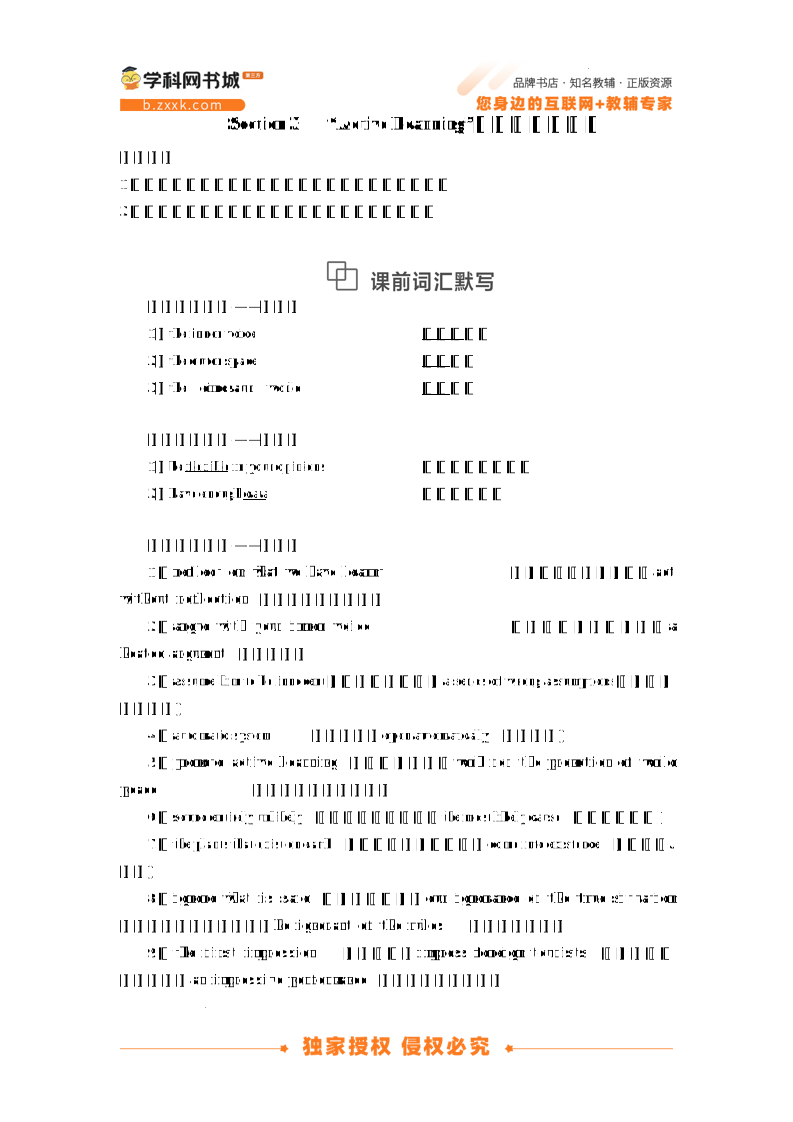
Section 3 “Active Learning”的新知学习环节
课时目标
1.熟记与学习有关的话题词汇及句式,并掌握其用法。
2.能够运用所学知识,讨论自己对学习的一些建议。
一、阅读单词——知其义
1.the inner voice 内心的声音
2.the outer space 外层空间
3.the dinosaur world 恐龙世界
二、重点单词——写其形
1.be flexible in your opinions 灵活处理你的意见
2.have enough data 有足够的数据
三、活用单词——悉其变
1.
2.
3.
4.
5.
6.
7.
8.
9.
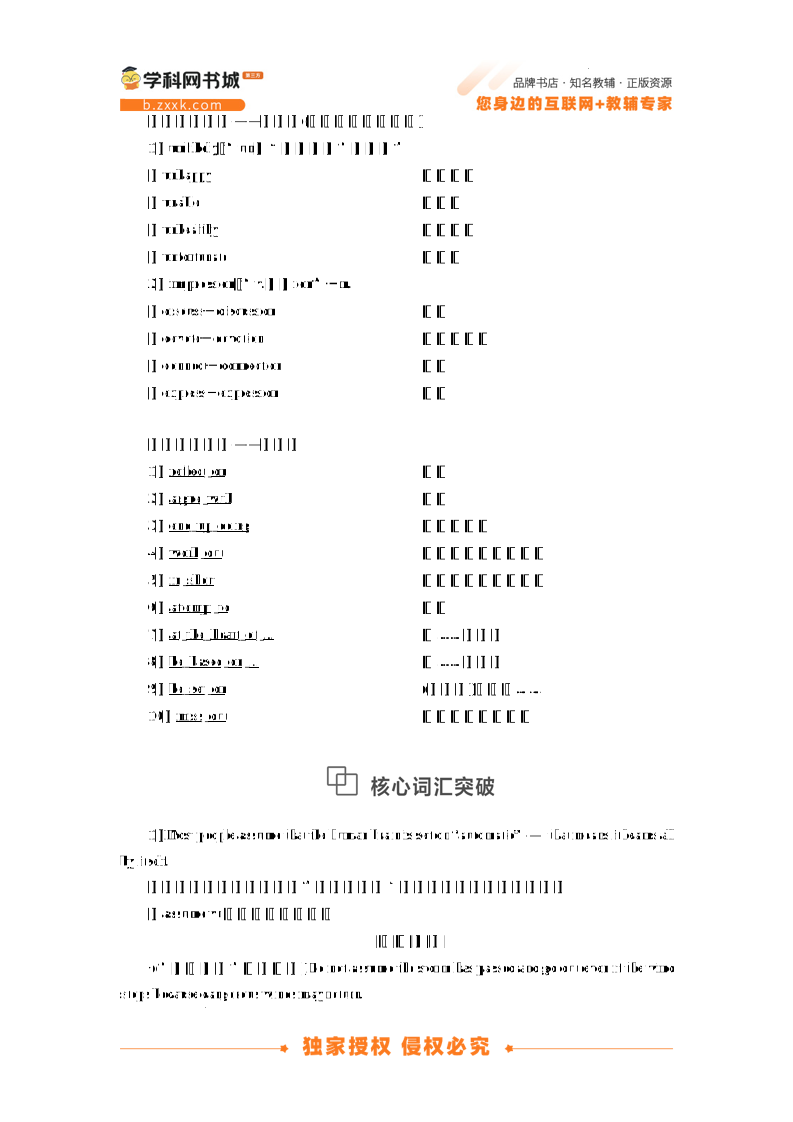
四、拓展构词——明其规(依据规律串记单词)
1.unlikely:“un-”前缀表示“不,无”
①unhappy 不开心的
②unable 不能的
③unhealthy 不健康的
④unfortunate 不幸的
2.impression:“v.+-ion”→n.
①discuss→discussion 讨论
②devote→devotion 献身,热爱
③connect→connection 连接
④express→expression 表达
五、高级词块——通其用
1.reflect_on 思考
2.argue_with 争吵
3.end_up_doing 最后;最终
4.work_out 弄懂某事物;计算出
5.in_short 总而言之;简单地说
6.attempt_to 尝试
7.at_the_heart_of_... 在……的中心
8.be_based_on_... 以……为根据
9.be_set_on (机器等)设置为……
10.miss_out 错过;遗漏;省略
1.Most people assume that the human brain is set on “automatic” — that means it learns all by itself.
很多人认为人类的大脑是“自动运行的”,这是说大脑能自动学习。
★assume vt.认为;假定,假设
|用|法|感|知|
·(“灾害防范”主题佳句)Do not assume the storm has passed and go out even if the wind stops because dangerous winds may return.
即使风停了,也不要以为风暴已经过去而外出,因为危险的风可能会再来。
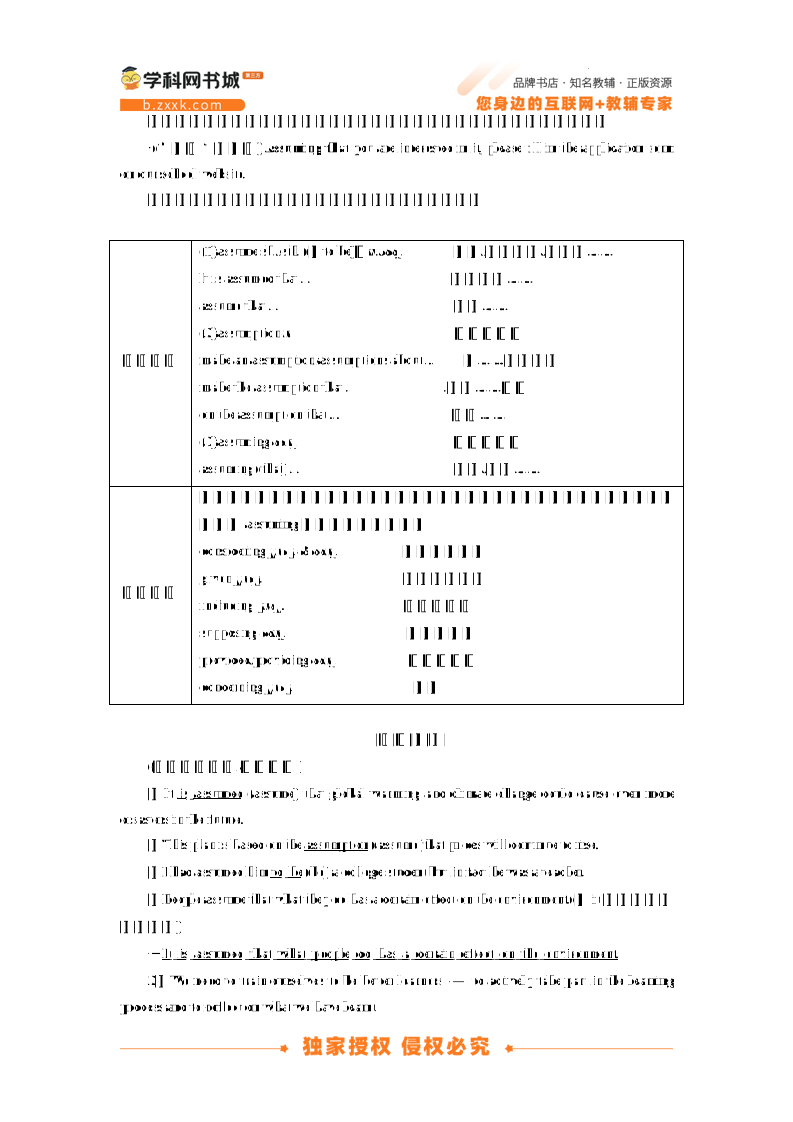
·(“通知”类佳句)Assuming that you are interested in it, please fill in the application form on our school website.
假如你对此感兴趣,请在我们学校网站上填写申请表。
归纳点拨
(1)assume sb./sth. (+to be)+n./adj. 假定/假设某人/某物是……
It is assumed that ... 人们认为……
assume that ... 认为……
(2)assumption n. 假定,假设
make an assumption/assumptions about ... 对……做出假设
make the assumption that .. .做出……假设
on the assumption that ... 假设……
(3)assuming conj. 假如,假设
assuming (that) ... 假设/假定……
名师点津
在英语中,有些看上去是现在分词或过去分词的词,实际上却常用作介词或连词。与assuming用法类似的词还有:
considering prep.& conj. 鉴于,考虑到
given prep. 鉴于,考虑到
including prep. 包括,包含
supposing conj. 假设,假如
provided/providing conj. 假如,如果
concerning prep. 关于
|应|用|融|会|
(单句语法填空/句型转换)
①It is_assumed (assume) that global warming and climate change could cause even more disasters in the future.
②This plan is based on the assumption (assume)that prices will continue to rise.
③I had assumed him to_be (be) a college student but in fact he was a teacher.
④People assume that what they do has a certain effect on the environment.(用it作形式主语改写句子)
→It_is_assumed_that_what_people_do_has_a_certain_effect_on_the_environment.
2.We need to train ourselves to be better learners — to actively take part in the learning process and to reflect on what we have learnt.
我们需要训练自己成为更好的学习者——积极参与学习过程并反思学到的东西。
★reflect vi.& vt.仔细思考;反思;表达(意见);反映; (指镜子等)映出……的影像
|用|法|感|知|
·(“建议”类佳句)First, you should reflect on your own behaviour and remember not to say too much when you're angry.
首先,你应该反思自己的行为,记住生气的时候不要说太多。
·(“动作描写”佳句)She looked at her face reflected in the mirror, applied some cream and walked out.
她照着镜子看了看脸,涂抹了一些面霜,然后出去了。
[归纳点拨]
(1)reflect ... in ... 在……中映出……的影像
be reflected in 倒映在;反映在
reflect on/upon sth. 思考/反省某事
(2)reflection n. 反射;反映;映像
on reflection 经再三考虑,仔细考虑
|应|用|融|会|
(单句语法填空/完成句子)
①He sets aside some time to reflect on/upon his successes and failures every week.
②The trees reflected (reflect) in the lake look attractive.
③This film is a real reflection (reflect) of the living conditions of people in the western region.
④People's lifestyles are_reflected_in_languages.
人们的生活方式反映在语言上。
3.If you find your inner voice difficult to control, you can argue with it as most active learners do.
如果你发现内心的声音难以控制,可以像大多数主动学习者那样和它争论。
★argue vi.争论,争吵
|用|法|感|知|
·(“建议”类佳句)The best way to solve the problem is not to argue with your parents but to tell them your views peacefully and honestly.
解决问题的最好办法不是和你的父母争论,而是平静且诚实地告诉他们你的想法。
·(“人际关系”主题佳句)I'm sorry to hear that you had an argument with your basketball teammate when discussing your training time.
我很遗憾听说你和你的篮球队友在讨论训练时间的时候发生了争执。
[归纳点拨]
(1)argue with sb. about/over sth. 就某事与某人争论
argue that ... 主张/认为……
argue for/against ... 为赞成/反对……而辩论
argue sb.into doing sth. 说服某人做某事
argue sb.out of doing sth. 说服某人不做某事
(2)argument n. 争论,辩论;论据,论点,理由
have an argument
beyond argument 无可争辩
|应|用|融|会|
(单句语法填空/完成句子)
①They were arguing over/about which film to go to see.
②When this happens, the important thing is to try not to let a calm discussion turn into a heated argument (argue).
③He was unhappy because many people argued_against_his_plan.
他不高兴,因为许多人反对他的计划。
④We tried many ways to_argue_him_into_accepting_our_advice,_ but in vain.
我们想方设法劝说他接受我们的建议,但都是徒劳。
4.Be flexible in your opinions and you might end up agreeing with the speaker/writer after all.
灵活处理你的意见,最终,你也许会同意说话人或是作者的观点。
★end up doing 最后;最终
|用|法|感|知|
·(“细节描写”佳句)I showed the burnt eggs to my mother and sadly explained what happened.To my surprise, she tasted them and said they weren't bad.In fact we ended up laughing and ate them all.
我把煎焦的鸡蛋拿给妈妈看,伤心地解释了事情的经过。让我吃惊的是,她尝了尝,说还不错。事实上,我们最后笑着把它们都吃了。
·(“学习生活”主题佳句)If you review your notes regularly, you will end up with a deeper understanding of the knowledge, which leads to better grades.如果你定期复习笔记,你最终会获得对知识更深刻的理解,从而取得更好的成绩。
·(“人物介绍”主题佳句)He was so diligent that he ended up as a fresher in Tsinghua University three years later.他非常勤奋,三年后考入了清华大学,成为一名大一新生。
[归纳点拨]
(1)end up 以……结束/告终
end up with/in ... 以……而结束
end up as ... 结果成为……(职位)
(2)come to an end=put/bring an end to
=bring sth. to an end 结束
at the end of 在……尽头;在……末端
by the end of 到……结束时;到……时候为止(常与完成时态连用)
in the end 最后;终于
at an end 结束,终止
make both ends meet 收支相抵
|应|用|融|会|
(单句语法填空/完成句子)
①If you don't know what you want, you might end up getting (get) something you don't want.
②His brother got rapid promotion and ended up as a manager in a company.
③Anyone who swims in the polluted river ended up with a terrible stomach upset.
④If he carries on driving like that, he'll end_up_dead.如果他继续那样开车,总有一天会把命丢掉。
⑤If you go on like this, you'll end_up_in_prison.
如果你继续这样,早晚得进监狱。
5.They attempt to find the truth at the heart of each idea.
他们努力从每个观点最核心的地方寻找真相。
★attempt to尝试
|用|法|感|知|
·(“建议”类佳句)It's also a good idea to attempt to write some short stories or poems in Chinese, which is beneficial to experience the beauty of Chinese culture.尝试用中文写一些短篇小说或诗歌也是一个好主意,这有利于体验中国文化之美。
·(“语言学习”主题佳句)As time went by, I made an attempt to read foreign fiction, through which my English improved greatly.
随着时间的推移,我尝试阅读外国小说,通过阅读小说我的英语有了很大的提高。
归纳点拨
(1)attempt vt.&n. 尝试;试图
make an attempt to do sth. 试图做某事
in an attempt at sth./to do sth. 试图做某事
at the first attempt 第一次尝试
(2)attempted adj. 未遂的
名师点津
attempt to do sth.相当于try to do sth.,意为“尝试做某事”,但不一定成功;而succeed in doing sth./manage to do sth.意为“成功地做某事”。
|应|用|融|会|
(1)单句语法填空
①She passed her driving test at the first attempt.
②The lonely man made an attempt to be sociable and make some friends.
(2)一句多译
他试图从窗户逃走,但失败了。
③He attempted_to_escape through a window but failed.(attempt v.)
④He made_an_attempt_to_escape through a window but failed.(attempt n.)
6.Active learners do not judge people based on first impressions or personal feelings.
主动学习者不会根据第一印象或个人感受来判断人。
★impression n.印象;感想
|用|法|感|知|
·(“学校生活”主题佳句) Some of the students recited beautiful sentences, which left a deep impression on teachers.
一些学生背诵了优美的句子,给老师留下了深刻的印象。
·(“学校生活”主题佳句)As a high school student, I came across a lot of challenges, one of which impressed me most.作为一名高中生,我遇到了很多挑战,其中一个给我印象最深。
[归纳点拨]
(1)leave/make a(n) ... impression on sb. 给某人留下……的印象
(2)impress vt. 给……留下深刻印象
vi. 给人印象
impress sb.with sth. 某事给某人留下深刻印象
impress sth.on/upon sb. 使某人铭记/意识到某事
be impressed with/by ... 对……有深刻印象
be impressed on one's mind/memory 被印在脑海/记忆里
(3)impressive adj. 令人印象深刻的;感人的
|应|用|融|会|
(1)单句语法填空/完成句子
①When it comes to finding a partner, first impressions (impress) do count.
②She was very impressive (impress) in the interview, which made it possible for her to get the job.
③The teacher impressed_on/upon_me the importance of immediate action.
老师使我意识到立刻行动的重要性。
(2)句式升级
Those beautiful paper-cutting works will surely impress you.
④You_will_surely_be_impressed_with those beautiful paper-cutting works.(be impressed with)
⑤Those beautiful paper-cutting works will_surely_make/leave_an_impression_on_you.(impression)
1.Your inner voice expresses your personal opinions, while the outer voice tells you about opinions from what you hear or read.
内心声音表达你的个人意见,而外部的声音告诉你关于听到或者读到的观点。
(1)此处while是并列连词,意为“然而”,用来连接两个并列分句,强调前后对比,常位于句中。
(2)while作从属连词,意为“当……的时候”时,引导时间状语从句。
(3)while作从属连词,意为“虽然”时,引导让步状语从句,常位于句首。
(4)while作名词时,意为“一会儿;一段时间”。
“两层级”学通用活句式
(1)通过“句式变换”弄明句式结构
①Tom is outgoing and confident.However, Katy is shy and quiet.
→Tom is outgoing and confident while_Katy_is_shy_and_quiet.
②Though I fully understand your point of view, I am in favor of Michael's.
→While_I_fully_understand_your_point_of_view,_I am in favor of Michael's.
(2)通过“句式仿写”做到熟练运用
③汤姆非常擅长数学,而他的弟弟却在历史方面表现很好。
Tom is very good at maths while_his_brother_does_well_in_history.
④尽管学生们来自不同的国家,但是他们在夏令营中相处得很好。
While_the_students_came_from_different_countries,_they got along quite well in the summer camp.
⑤当我们练习对话时,英语老师总会在教室里走动,提出改善建议。
Our English teacher always walks around the classroom while_we_are_practicing_dialogues,_offering suggestions for improvement.
2.It is true that we cannot help disliking some people — this is human nature, after all.
确实,我们难免会讨厌某些人——毕竟这是人的本性。
本句中使用了“It is+adj.+that从句”句型。
(1)在“It is true that ...”句型中,it作形式主语,真正的主语是that引导的主语从句。
(2)常见的it作形式主语替代that引导的主语从句的句型有:
①It is+形容词(clear、 obvious、 true、 possible、 necessary、 natural、 important ...)+that从句
②It is+名词(a pity、 a shame、 one's duty、 no wonder ...)+that从句
③It is+过去分词(said、 reported、 known、 believed、 announced、 suggested、 required ...)+that从句(注意:当过去分词是表示“建议、要求、命令”等动词时,从句谓语用“should+动词原形”,should可以省略)
“两层级”学通用活句式
(1)通过“句式变换”弄明句式结构
①That Lucy and Mark are getting married is true.
→It_is_true_that Lucy and Mark are getting married.
②We all know that China enjoys a long history and rich culture.
→It_is_known_to_all_that China enjoys a long history and rich culture.
(2)通过“句式仿写”做到熟练运用
③有人建议政府要改善人们的居住环境。
It is suggested that the government should improve people's living conditions.
④很遗憾,星期五下午我不能和你一起去书店了。
It_is_a_pity_that I cannot go to the bookstore with you on Friday afternoon.
⑤显而易见,为了提高工作效率,你应该有充足的睡眠。
It_is_obvious_that you should have enough sleep to improve your work efficiency.
课文缩写语法填空
根据课文内容,在空白处填入1个适当的单词或括号内单词的正确形式。
The human brain does not always work ①automatically (automatic) so we need to train ②ourselves (our) to be active learners.There are many things we can do ③to_become (become) active learners.We all have two voices — our inner voice and outer voice.Our inner voice tells us ④personal(person) opinions and our outer voice deals with opinions and things we have heard or read.If you listen to your inner voice too much, it can stop you ⑤from learning.If your inner voice is difficult to control, you can ⑥disagree (agree) with it.One of the easiest ⑦ways (way) to promote active learning is to ask questions,⑧which helps you gain more knowledge about a topic.In a word, you should never stop ⑨being (be) curious.Active learners also try to question the world around them and understand the truth deep within every idea.Finally,as active learners, we should never form opinions about people on ⑩the basis of first impressions or personal feelings.
学科网(北京)股份有限公司
$
资源预览图
1
2
3

相关资源
由于学科网是一个信息分享及获取的平台,不确保部分用户上传资料的 来源及知识产权归属。如您发现相关资料侵犯您的合法权益,请联系学科网,我们核实后将及时进行处理。