高三下学期3月份单元质量检测英语试题
 切换试卷
切换试卷
2026-03-30
|
2份
|
12页
|
113人阅读
|
0人下载
资源信息
| 学段 | 高中 |
|---|---|
| 学科 | 英语 |
| 教材版本 | - |
| 年级 | 高三 |
| 章节 | - |
| 类型 | 试卷 |
| 知识点 | - |
| 使用场景 | 同步教学-阶段检测 |
| 学年 | 2026-2027 |
| 地区(省份) | 山东省 |
| 地区(市) | 日照市 |
| 地区(区县) | - |
| 文件格式 | ZIP |
| 文件大小 | 137 KB |
| 发布时间 | 2026-03-30 |
| 更新时间 | 2026-03-30 |
| 作者 | 匿名 |
| 品牌系列 | - |
| 审核时间 | 2026-03-30 |
| 下载链接 | https://m.zxxk.com/soft/57091788.html |
| 价格 | 3.00储值(1储值=1元) |
| 来源 | 学科网 |
内容正文:
高三下学期3月份单元质量检测英语试题
英语试题
出题:西校高三英语组 审核:西校高三英语组
第一部分 阅读理解(共两节,满分60分)
第一节(共15小题;每小题3分,满分45分)
阅读下列短文,从题中所给的A、B、C和D四个选项中,选出最佳选项。
A
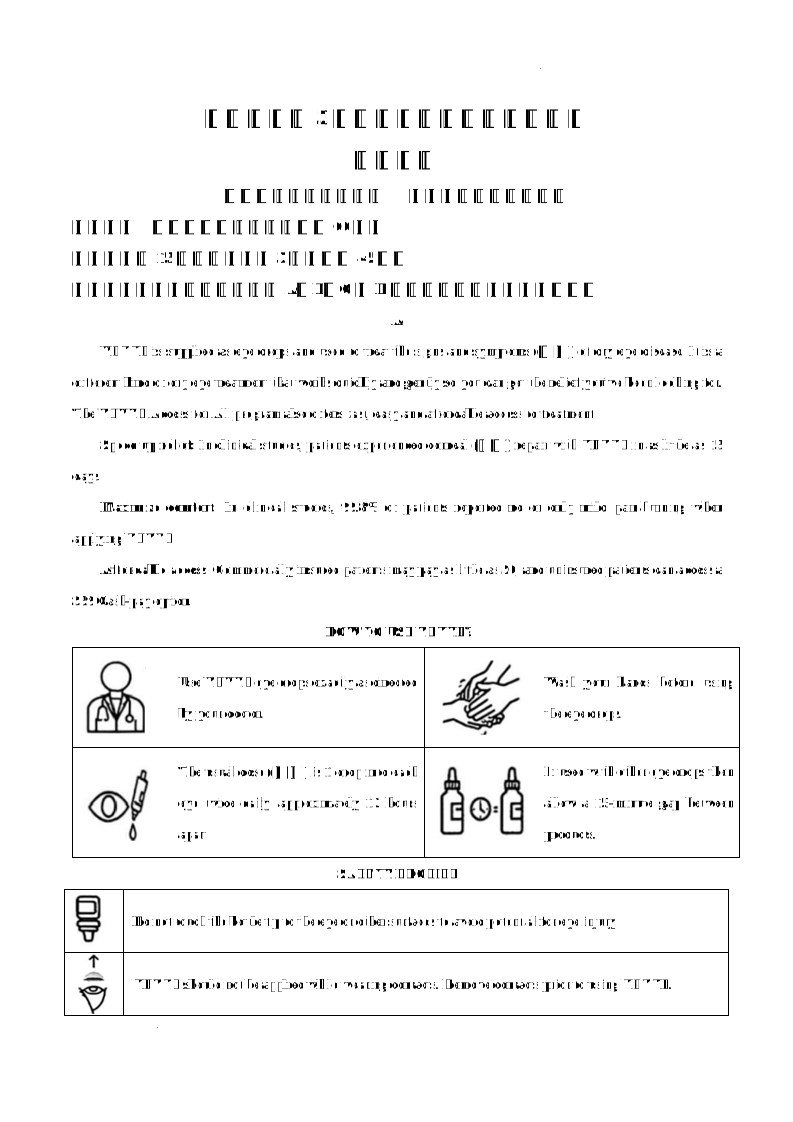
VEVYE is supplied as eye drops and used to treat the signs and symptoms (症状) of dry eye disease. It is a different kind of dry eye treatment that works quickly and gently so you can get the relief you’ve been looking for. The VEVYE Access for All program also offers fast, easy and affordable access to treatment.
Speed up relief: In clinical studies, patients experienced corneal (角膜) repair with VEVYE in as little as 15 days.
Maximize comfort: In clinical studies, 99.8% of patients reported no or only mild pain/burning when applying VEVYE
Affordable access: Commercially insured patients may pay as little as $0, and uninsured patients can access a $59 Cash-pay option.
HOW TO USE VEVYE?
Use VEVYE eye drops exactly as directed by your doctor.
Wash your hands before using the eye drops.
The usual dose (剂量) is 1 drop into each eye twice daily, approximately 12 hours apart.
If used with other eye drops then allow a 15-minute gap between products.
SAFETY PROFILE
Do not touch the bottle tip to the eye or other surfaces to avoid potential for eye injury.
VEVYE should not be applied while wearing contacts. Remove contacts prior to using VEVYE.
After applying VEVYE to the eyes, wait 15 minutes before putting contacts back in.
Side effect: The most common side effects include eye pain (8%) and temporary blurred vision (3%).
Safety and effectiveness: Safety and effectiveness in patients below the age of 18 years have not been established. No overall difference in safety or effectiveness has been observed between elderly and younger patients.
To report SUSPECTED ADVERSE REACTIONS, contact Harrow at 1-833-442-7769 or FDA at 1-800-FDA-1088 or www.fda.gov/medwatch.
1. What can patients expect when using VEVYE?
A. Mental relief. B. Fast recovery. C. Free insurance. D. Improved vision.
2. How should patients use VEVYE properly?
A. Stop using contacts. B. Wash eyes before using it.
C. Keep the tip away from eyes. D. Wait 15 minutes after the first drop.
3. Where is the text probably from?
A. A website of a drug company. B. A patient review platform.
C. An advertisement of a drugstore. D. A medical journal.
B
My dad is a crossword-lover. When I was a little girl, Dad would read his crossword puzzles to me from a magazine. I can still remember how he turned his pencil excitedly as he discovered a new phrase. If my attention weakened, he would say, “Feeling sleepy? Never mind, I’ll keep reading. Some of the words may crawl into your mind.” Bit by bit, Dad introduced me to the power of words and guided my life’s calling, a purpose I never questioned or bothered to pursue.
Years passing, I grew into a professional writer. I found that he never asked me to suggest a word or help him with a puzzle when I was working. For him, my words were precious; each held value. But it did not matter much to me how much I got paid for writing. I wrote because I loved word-craft and making up stories that brought ideas to life.
Recently when an editor surprised me with a lower rate of pay for a piece of essay that they chose to publish online rather than in print, I was kind of hurt! But I comforted myself by looking at the bright side—so many people read the piece and shared joyful emotions and praise on social media. Although some worldly-wise friends told me that I was paid peanuts, I myself felt well rewarded.
While I was content, a certain anxiety would secretly emerge: would the thought of earnings cheapen the dignity of my work? Dad’s solution was: “Why not both? Money isn’t everything, but isn’t it good to have enough to help yourself and those close to you? And for your talents and efforts to be valued?” Dad believed not only that more wealth did not mean greater happiness, but also that no effort should be undervalued.
Today, when doubts cloud my mind, I think of Dad’s pencil: its purpose may be to solve a crossword puzzle, but it was also there for anyone writing down a life-changing number in a lottery ticket (彩票). So couldn’t my words help complete my life purpose and earn a better living too? Now I take up assignments — some that pay well, some that don’t — and they both fill me with joy.
4. Dad didn’t turn to the author to solve puzzles probably because he ______.
A. didn’t know the fun of sharing games
B. failed to see her willingness to help
C. didn’t want to interrupt her literary creation
D. trusted his own ability to solve puzzles
5. “I was paid peanuts” in paragraph 3 indicates that ______.
A. my writing deserved a better pay B. I got some nuts from my writing
C. my writing ability was overrated D. I earned more than I should have
6. What does the author mainly convey in the last paragraph?
A. Dad uses a pencil to balance his life wisely.
B. Her life purpose is realized through writing.
C. She sees both her words’ material and spiritual value.
D. Multiple roles of a pencil may help change one’s life.
7. What can we learn about Dad and the author?
A. Dad developed her attention by reading.
B. Dad advised her to be a professional writer.
C. Dad improved her ability to solve word puzzles.
D. Dad helped shape her view on writing for a living.
C
Nature words like river, moss and blossom have appeared less frequently in books over the past years. This decline, according to a study by professor Miles Richardson from the University of Derby, mirrors a broader change he has traced through 220 years of records on urbanisation, the loss of wildlife in neighbourhoods, and parents no longer passing on engagement with nature to their children.
The computer modelling in the study also predicts an “extinction of experience”, with future generations continuing to lose an awareness of nature because it is not present in increasingly built-up neighbourhoods, while parents no longer pass on an “orientation (倾向)” towards the natural world. This is consistent with findings from other studies, which identify adult nature connectedness as the strongest predictor of whether a child will become close to nature.
Richardson said that when he tested policy and urban environmental changes in the model he was surprised at the scale of the changes required to restore the connection to nature. Increasing biodiverse green spaces in a city by 30% might look like significant positive progress for wildlife and people but Richardson said his study suggests a city might need to be 10 times greener to turn around declines in nature connection.
Efforts to simply encourage adults to engage with nature are often insufficient for lasting change. More effective are measures that build nature connection from an early age, such as forest schools for young children. Research indicates that government initiatives reshaping early education and urban design must be consistently applied over the next 25 years. Once established, this connection can become self-sustaining.
Richardson said the scale of societal change required might not be as challenging as it appeared. A study on people in Sheffield found that they spent just 4 minutes and 36 seconds on average in natural spaces each day. “Increase that by ten, and people are spending 40 minutes outside every day—that may be enough,” he said. “The key is to make these gains last across generations,” he added.
8. What change has Richardson traced in his study?
A. Nature words have disappeared from books.
B. People have less direct contact with nature.
C. Urbanisation has damaged wildlife habitats.
D. Parents spend more time outdoors with kids.
9. What might cause future generations to have “extinction of experience” in the model?
A. They are raised away from nature.
B. They can’t adapt to changes in nature.
C. High-rise buildings fill neighbourhoods.
D. Schools offer few nature science lessons.
10. What is a most effective solution to the issue according to the text?
A. Advancing long-term policies.
B. Launching eco-friendly campaigns.
C. Focusing on raising adults’ awareness.
D. Enlarging green space in certain areas.
11. Richardson mentioned the study on people in Sheffield to show ________.
A. nature contact varies from city to city
B. people’s living habits are hard to change
C. a new way to measure nature time is needed
D. small efforts help improve contact with nature
D
We’ve all seen this happen in a science-fiction movie: The super heroes jump into a shaky spaceship and escape the bad guys by flying through the asteroid (小行星) belt, where huge rocks fall and spin so close that the crew has to duck and dive to avoid being broken into pieces. It’s exciting, but it’s wrong: In our solar system, the odds are pretty good that you could stand on the surface of an asteroid and not even be able to see another.
Yet they do interact if given enough time. Even in the main asteroid belt between the orbits of Mars and Jupiter, crashes are ineluctable. And when two space rocks go “crash” in the main belt, big impacts blow lots of asteroid fragments (碎片) out into space.
In many cases, these fragments stay on much the same orbital path as the parent asteroid, although they gradually separate from it because of slight speed differences. After thousands of years, some fragments might be clear across the Sun, but their distance from the Sun and the shape and direction of their orbits remain similar. Such conserved features are collectively called an asteroid’s orbital elements. The groupings sharing orbital elements are identified as “families”, which are named after the largest asteroid in the group.
Studying asteroids by focusing on their families can help us make a good guess about what properties a newly-found one has if it belongs to a better-studied family. Care must be taken, though. Some very large asteroids have differentiated materials in the center and on the surface, so confirming those guesses usually requires taking spectra, the time-consuming process of breaking an object’s incoming light into individual colors to reveal its composition.
It’s more than a mere academic exercise to find this particular branch of an asteroid family tree: Some asteroids are potentially risky, meaning they could crash with Earth some time in the distant future. If we know how they find their way to the inner solar system from the main belt to pose threats in the first place, we can defend our planet from future worrisome asteroids.
12. What is the author’s view on the scene in the sci-fi movie?
A. It goes against the established facts.
B. It overstates the super heroes’ role.
C. It downplays the special visual effects.
D. It fuels people’s interest in the asteroid.
13. Which is closest in meaning to the underlined word “ineluctable” in paragraph 2?
A. Unavoidable. B. Uncommon. C. Incredible. D. Invisible.
14. What is paragraph 3 mainly about?
A. The definition of orbital elements. B. The formation of asteroid families.
C. The naming rule of asteroid groups. D. The moving pattern of asteroid fragments.
15. What can be inferred about the study of asteroid family?
A. It is a high-risk practice. B. It is built on assumptions.
C. Its value can’t be overstated. D. Its coverage needs to be expanded.
第二节(共5小题;每小题3分,满分15分)
阅读下面短文,从短文后的选项中选出能填入空白处的最佳选项。选项中有两项为多余选项。
Do you believe that setting goals is an important part of success? Having free time to relax and just accepting whatever happens can be nice on occasion. 16 And that involves goals and planning.
Successful people start with a goal. They know that without one, they have no direction or focus with which to achieve anything. 17 And your goal determines all of the steps you take towards it. Regardless of what type of goal you have, it’s important to be clear about it.
When starting any plans to reach a goal, successful people know that it can help to map out the route to reach your destination. For example, what steps would you take? By having a plan, it gives you a clearer picture of where to start, and what milestones you can expect along the way. Goals allow you to experience success along the way. 18
Successful people know that having a goal is the motivator that drives you forward with confidence. When you know where you’re going, it can be exciting to see your progress as you move closer to the goal. 19 For example, with the road trip scenario, every time you get to the next town, you know you are making progress. And feeling successful can give you the confidence to do more.
20 By committing to the task or process involved in reaching a goal, you are telling yourself you intend to do it. Giving up or not putting enough effort into creating your step-by-step plan is not going to help you reach your goal.
A. It’s the very basis of their success.
B. Successful people achieve goals with commitment.
C. They can make sure you get the training and experience they need.
D. From time to time you need to see how much you have committed to your goal.
E. Knowing what to expect around the next corner might make you feels less stressed.
F. Having things planned out ahead of time can help you to reach your goal more smoothly.
G. However, most of the time if you want to reach your dreams, you have to make an effort.
第二部分 语言知识运用(共两节,满分50分)
第一节(共15小题;每小题2分,满分30分)
阅读下面短文,从题中所给的A、B、C和D四个选项中,选出可以填入空白处的最佳选项。
I’m up to my ankles in clay in southern Germany. It’s 21 and I’m completely wet. It’s not exactly what I pictured when I emailed paleontologist (古生物学者) Madelaine from my 22 Toronto bedroom last February. Having just finished her book Ancientbones, I asked if I could join her excavation (发掘古物). I wanted to be where the action was.
A week later, her 23 came; I was very welcome. That’s why I found myself in the Hammerschmiede clay pit, my socks 24 with mud. For a moment, I wondered if I had made a 25 . But then we 26 excavating, and the fossils appeared. It was a dream come true to witness the 27 of ancient life.
Each morning, I climbed the 20-meter slope to the dig site. We moved the excavated clay-sand mixture into an opening, and high-pressure water 28 the sediment (沉淀物), leaving only stones, bones and shells. I 29 them for hours, sorting the bones by size and type. After a few days, I could 30 many of the 140 vertebrate species common to the site.
In the evenings, all the volunteers — mostly locals — gathered to talk about that day’s 31 . At times, it was a challenge not being 32 in German, but the practice paid off. By the end of the week, I was 33 conversational.
It may be a strange way to vacation, but I was in my sweet 34 . For me, this is the 35 way to travel: learning new skills, practicing a different language and truly getting to know a place.
21. A. pouring B. running C. flowing D. flooding
22. A. messy B. private C. tidy D. spacious
23. A. response B. letter C. recommendation D. turn
24. A. decorated B. coated C. marked D. occupied
25. A. joke B. fortune C. difference D. mistake
26. A. went on B. took over C. ended up D. set about
27. A. signals B. remains C. ruins D. leftovers
28. A. washed away B. picked up C. carried off D. wiped out
29. A. admired B. piled C. reflected D. screened
30. A. treasure B. illustrate C. encounter D. identify
31. A. adventures B. discoveries C. decisions D. trips
32. A. weak B. abundant C. fluent D. immersed
33. A. secretly B. suddenly C. nearly D. temporarily
34. A. fantasy B. spot C. leisure D. childhood
35. A. ideal B. possible C. safe D. long
第二节(共10小题;每小题2分,满分20分)
阅读下面短文,在空白处填入1个适当的单词或括号内单词的正确形式。
The multifunctionality of bamboo is recognized in China, where the giant woody grass has been widely employed since the 11th century BC. 36. ______ (bless) with a wealth of bamboo forests, China is the world’s largest producer of bamboo products and this resource secures its dominant position in the global market.
Evolving into an eco-friendly replacement, bamboo 37. ______ (celebrate) for its superior green nature. Its edge lies not only in toughness and strength 38. ______ in rapid growth and renewability. As opposed to trees (such as oak or teak), 39. ______ can take over a decade to mature, it reaches a harvest-ready stage in just four to six years, thus 40. ______ (permit) repeated harvests without replanting.
In Anji, a county in northwestern Zhejiang Province, bamboo 41. ______ (replace) plastic in various products in recent years. With 666 square kilometers of bamboo forests covering an area about 80 percent of 42. ______ size of New York City and a long-standing history of bamboo use, Anji serves as a model in advancing bamboo as an alternative 43. ______ plastic. On the farm, bamboo-based film (薄膜) replaces plastic film in the 44. ______ (preserve) of heat and water. The industrial development of bamboo benefits local communities as well, 45. ______ (economic) revitalizing (使复兴) rural areas through bamboo harvesting.
Scenes of harmony between humankind and nature are emerging in Anji, where bamboo-driven development is promoted to initiate dialogues with nature and champion a greener future.
第三部分 写作(满分40分)
第一节(满分15分)
假定你是李华,现在一所英国高中做交换生。因宿舍生活存在困扰,计划向宿管老师申请调换宿舍。请你写一封邮件,内容包括:
1. 申请原因;
2. 表达感谢与期待。
注意:
1. 写作词数应为80个左右;
2. 请按如下格式在答题卡的相应位置作答。
Dear Sir/ Madam,
____________________________________________________________________________________________________________________________________________________________________________________________________________________________________________________________________________________
Yours,
Li Hua
第二节(满分25分)
阅读下面材料,根据其内容和所给段落开头语续写两段,使之构成一篇完整的短文。
Jane had a deep affection for birds. Every morning, she scattered (抛撒) seeds in her backyard and whispered, “Good morning, my little friends!” To her, their songs sounded like cheerful laughter, and she often laughed along with them.
However, her neighbor, Mr. Thompson, didn’t share her joy. He was constantly annoyed by the birds that flew into his yard. “They’re too noisy!” he complained. “And they make such a mess in my yard!” His sharp words made Jane feel quite uneasy, yet she refused to give up on her feathered friends. She firmly believed that every small creature deserved care.
One morning, Jane discovered a small sparrow (麻雀) shaking under the fence. One of its wings looked bent at a painful angle. Filled with worry, Jane carefully picked it up and named it Pip. She placed him in a small, warm basket in a safe corner right next to the fence.
A week passed. Pip was getting better but still unable to fly. One afternoon, while Jane was feeding Pip by the fence, Mr. Thompson shouted from his side, “You’re just asking for trouble!” Jane gently lifted Pip in her hands so Mr. Thompson could see him through the gaps in the fence. “Look, Mr. Thompson. Pip’s wing is hurt.” Mr. Thompson cast an impatient glance at the tiny creature. For a moment, his frown (皱眉) softened. “That wing…” he said softly, almost to himself.
Just then, Jane’s mother called her from the driveway, saying they were leaving for a family visit. Jane waved a quick goodbye to Pip and hurried to the car. However, on their way home, a heavy storm broke out. Watching the trees shaking in the strong wind, Jane felt very worried about Pip, who was left all alone in the yard. The moment they pulled into the driveway, she dashed toward the backyard, calling Pip’s name.
注意:
1. 续写词数应为150左右;
2. 请按如下格式在答题卡的相应位置作答。
To her horror, the basket was empty. ___________________________________________________________________________________________________________________________________________________
At this moment, Mr. Thompson appeared with Pip. _______________________________________________________________________________________________________________________________________
学科网(北京)股份有限公司
$
高三下学期3月份单元质量检测英语试题答案
第一部分(每题3分,满分60分)
1-3. BCA 4-7. CACD 8-11. BAAD 12-15. AABC 16-20. GAFEB
第二部分(满分50分)
第一节(每题2分,满分30)
21-25. ACABD 26-30. DBADD 31-35. BCCBA
第二节(每题2分,满分20)
36. Blessed 37. is celebrated 38. but 39. which 40. permitting
41. has replaced 42. the 43. to 44. preservation 45. economically
第三部分(满分40分)
第一节 (满分15分)
参考范文:
Dear Sir/ Madam,
I am Li Hua, an exchange student from China. I am writing to apply for a dormitory change because I can hardly get used to the present living environment. The constant noise here prevents me from resting well and focusing on my studies, which has troubled me a lot.
I would deeply appreciate it if you could arrange a quieter dorm for me. Thank you for your time and kind help. I am looking forward to your early reply.
Yours,
Li Hua
第二节(满分25)
To her horror, the basket was empty. The strong wind had turned it over, leaving nothing but a puddle of muddy water in the corner. Jane’s heart sank as she searched everywhere in the wet grass. Her clothes were soon soaked by the heavy rain. “Pip! Where are you?” she cried out, her voice trembling with fear. She was afraid that the small, helpless bird had been washed away by the storm. Tears mixed with raindrops on her face, and she felt very sorry for leaving him alone in the yard.
At this moment, Mr. Thompson appeared with Pip. He held the tiny bird gently in his hands, his usual stern expression replaced by softness. “I saw the storm coming and took him in,” he explained quietly. Jane rushed over, relief washing over her as she took Pip, who was safe but a little shaken. For the first time, she saw a faint smile on Mr. Thompson’s face, and the gap between them seemed to heal, just like Pip’s wing.
学科网(北京)股份有限公司
$
资源预览图
1
2
3
相关资源
由于学科网是一个信息分享及获取的平台,不确保部分用户上传资料的 来源及知识产权归属。如您发现相关资料侵犯您的合法权益,请联系学科网,我们核实后将及时进行处理。