Unit 4 Chinese folk art(单元自测·江苏南通专用)英语新教材译林版七年级下册
2026-03-19
|
4份
|
31页
|
332人阅读
|
7人下载

资源信息
| 学段 | 初中 |
|---|---|
| 学科 | 英语 |
| 教材版本 | 初中英语译林版七年级下册 |
| 年级 | 七年级 |
| 章节 | Unit 3 My hometown |
| 类型 | 作业-单元卷 |
| 知识点 | - |
| 使用场景 | 同步教学-单元练习 |
| 学年 | 2026-2027 |
| 地区(省份) | 江苏省 |
| 地区(市) | 南通市 |
| 地区(区县) | - |
| 文件格式 | ZIP |
| 文件大小 | 385 KB |
| 发布时间 | 2026-03-19 |
| 更新时间 | 2026-03-19 |
| 作者 | 小米夏 |
| 品牌系列 | 上好课·上好课 |
| 审核时间 | 2026-03-19 |
| 下载链接 | https://m.zxxk.com/soft/56897248.html |
| 价格 | 3.00储值(1储值=1元) |
| 来源 | 学科网 |
内容正文:
………………○………………外………………○………………装………………○………………订………………○………………线………………○………………
………………○………………内………………○………………装………………○………………订………………○………………线………………○………………
此卷只装订不密封
………………○………………内………………○………………装………………○………………订………………○………………线………………○………………
………………○………………外………………○………………装………………○………………订………………○………………线………………○………………
… 学校:______________姓名:_____________班级:_______________考号:______________________
2025-2026学年七年级下册英语单元测试(江苏南通专用)
Unit 4·培优卷
学校:___________班级:___________姓名:___________分数:___________
(时间:120分钟,满分:120分)
第I卷(选择题 共65分)
第Ⅰ卷共45小题,请将答案按要求填涂在答题卡上。
一、单项选择(本题共10小题;每小题1分,满分10分)
从A、B、C、D四个选项中,选出可以填入空白处的最佳选项,并在答题卡上将该项涂黑。
1.—What do you think of ______ folk art exhibition in our school?
—It’s wonderful! I learned a lot about Chinese culture.
A.a B.an C.the D./
2.The 2023 Asian Games in Hangzhou left a deep impression on the world. Many volunteers offered ______ help to visitors from all over the world.
A.they B.their C.them D.theirs
3.—Our class will have a trip to Nanjing Museum next week.
—That’s great! You can see many ______ Chinese artworks there.
A.valuable B.useless C.boring D.ordinary
4.With the development of the economy, more and more people pay attention to ______ traditional skills, such as jade carving (玉雕).
A.protect B.protecting C.protected D.to protect
5.He is one of the most famous writers ________ young people.
A.between B.among C.in D.of
6.The team’s ________ of never giving up helped them win the game.
A.spirit B.soul C.mind D.thought
7.I can see ________ school ID cards at the Lost and Found. Let’s call them!
A.Mike and Tom’s B.Mike’s and Tom’s
C.Mike and Tom D.Mike’s and Tom
8.—________ is it from your home to Yangzhou East Railway Station, Tom?
—About ________.
A.How long; 30 minutes’ bus ride B.How long; 30 minutes bus ride
C.How far; 30 minutes’ bus ride D.How far; 30 minutes bus ride
9.It is not wise ________ teenagers to be crazy about Korean stars. It is more important ________ them to learn more about Chinese culture.
A.for; for B.of; for C.of; of D.for; of
10.What does the sentence mean if we stress (重读) the underlined word?
Tom smiles when he finishes a colorful silk lantern by himself.
A.Tom smiles. It is not somebody else. B.Tom finishes the lantern on his own.
C.The lantern is made of silk, not wood. D.Tom finishes a lantern, not a teapot.
二、完形填空(本题共15小题;每小题1分,满分15分)
请认真阅读下面短文,从短文后各题所给的A、B、C、D四个选项中,选出最佳选项.
As students in Jiangsu, you must know Su embroidery (苏绣). But Shu embroidery (蜀绣) is also a famous 11 in China. It is famous for its exciting needlework (针线活) and strong expression.
Shu embroidery is 12 Su embroidery largely because it comes from Sichuan. People there enjoy a 13 lifestyle, so when embroidering, they are usually willing to spend more time 14 it.
Making beautiful Shu embroidery is 15 easy. It takes super skills. Meng Dezhi, 59, was born into a 16 of embroidery artists. She is one of the greatest 17 of Shu embroidery. She has her own workshop. 18 to make excellent Shu embroidery often challenges (挑战) her. Making a piece takes weeks or even a few 19 . In winter, when the temperature is very low, things become even more difficult, 20 Meng’s love for the work always tells her to keep working.
Meng also does a lot to 21 the traditional art from fading (衰落). 22 can make cheap embroideries so few people want to make them by hand. To 23 the traditional art, Meng began to teach young people Shu embroidery skills. She 24 me, “I really feel I have the responsibility (责任) to 25 Shu embroidery skills to young people, to let the skills run from generation to generation”.
11.A.style B.color C.history D.field
12.A.similar to B.the same as C.different from D.close to
13.A.fast B.slow C.busy D.hard
14.A.in B.for C.with D.on
15.A.sometimes B.usually C.always D.never
16.A.family B.school C.neighborhood D.community
17.A.painters B.singers C.masters D.students
18.A.Where B.How C.When D.Who
19.A.hours B.days C.months D.years
20.A.so B.or C.because D.but
21.A.stop B.help C.make D.attract
22.A.Machines B.Schools C.Students D.Animals
23.A.put up B.carry on C.turn on D.hold up
24.A.asked B.told C.spoke D.talked
25.A.sell B.take C.invite D.pass
三、阅读理解(本题共20小题;每小题2分,满分40分)
第一节 请认真阅读下列短文,从短文后各题所给的A、B、C、D四个选项中,选出最佳选项
A
① Thoughts on a Tranquil Night
(Tang dynasty) Li Bai
Before my bed a pool of light;
Oh, can it be frost on the ground?
Looking up, I find the moon bright;
Bowing, in homesickness I’m drowned.
② Our Native Place
(Tang dynasty) Wang Wei
You come from native place,
What happened there you’d know.
Did mume blossoms (梅花) in face
Of my gauze window blow?
③ Home-coming
(Tang dynasty) He Zhizhang
I left home young and not till old do I come back, Unchanged my accent, my hair no longer black.
The children whom I meet do not know who I am, “Where do you come from, sir?” they ask with beaming eyes.
④ Tune: Sunny Sand Autumn Thoughts
(Yuan dynasty) Ma Zhiyuan
Over old trees wreathed with rotten vines fly crows; Under a small bridge beside a cot a stream flows;
On an ancient road in western breeze a lean horse goes. Westwards declines the setting sun.
Far, far from home is the heart broken one.
26.How did Li Bai feel when he wrote Poem ①?
A.Thankful. B.Free. C.Sad. D.Excited.
27.Which of the works was written in a different dynasty (朝代)?
A.① B.② C.③ D.④
28.What do the four poems have in common?
A.They were all about animals. B.They were written by the same person.
C.The four writers were good friends. D.The writers missed their hometowns a lot.
B
China has a long history of making and using fans. They have played an important role in Chinese lives.
Fans were carried by men and women, and there were many kinds of fans. Each had a special use. At first they were used for cooling. Now many people enjoy the fans because of beautiful pictures and handwritings on them. They are art. There are usually beautiful things on fans. Sometimes there is a dragon flying in the sky or swimming in the water. It is a symbol of knowledge and life-giving water. Some fans have flowers. They carry good wishes that people want to live a richer life. Some people write words such as poems on fans to show they are smart and know a lot.
There were many kinds of fans in old China. Fans called “Zheshan” might be first made by the Japanese around 600. Around 988, the Japanese brought Zheshan to China. During the Ming dynasty (1368-1644), Zheshan were getting more and more popular. Around 1600, many Chinese and some Japanese fans reached Europe. These were of poor quality in the eyes of Chinese, but many Europeans bought fans for their beauty.
Today people in Japan and China still have fans in their homes. They are often gifts from friends. Although people seldom use fans for cooling now, they are a good match with modern homes because of their special beauty.
29.What were fans used for at the very beginning?
A.Staying cool. B.Writing words.
C.Decorating homes. D.Drawing pictures.
30.How does the writer develop his idea (展开观点) in Paragraph 3?
A.By giving numbers. B.By telling the differences.
C.By asking questions. D.By giving facts in time order.
31.Why did Europeans buy Chinese fans around 1600?
A.The fans were well-made. B.The fans were very cheap.
C.They liked the looks of the fans. D.They needed fans for cooling.
32.What’s the best title for this article?
A.Different Kinds of Fans B.Different Uses of Fans
C.The Beauty and History of Fans D.The Importance of Fans
C
Do you know something about qingtuan? Have you ever eaten it before? Weeks before the Qingming Festival, lots of qingtuan are sold each day.
In the southern part of China, eating qingtuan during the festival is a kind of tradition. It is usually made of sticky rice (糯米) and red bean paste (红豆沙). The secret behind its good taste is the mugwort leaves (艾蒿叶). The plant mainly grows in the Yangtze River Delta. People there usually put qingtuan on the tombs (墓) of their dead family members to cherish the past memory.
Now, qingtuan has already spread its special taste to the northern part of China. Li Yuan, who grew up in Zhejiang Province, brought qingtuan back to Beijing, where he works. “It tastes different in and out of my hometown,” he said. “There’s no place like home.”
Lots of things can be put in qingtuan, such as apples and pears, to meet people’s tastes. The difference of the taste shows that it’s getting more and more popular all over China.
33.How does the writer start the passage?
A.By telling stories. B.By asking questions.
C.By listing numbers. D.By giving examples.
34.Which question does Paragraph 2 answer?
A.How do people make qingtuan? B.When do people grow mugwort?
C.Why are mugwort leaves popular? D.What is qingtuan usually made of?
35.Where does Li Yuan work?
A.In Beijing. B.In Zhejiang.
C.In the Yangtze River. D.In his hometown.
36.What can we know from the passage?
A.Li Yuan grew up in Beijing.
B.Making qingtuan is an exciting thing for Li Yuan.
C.More and more people will enjoy eating qingtuan.
D.People can find mugwort only in the Yangtze River Delta.
D
In the hands of Chinese artisans (手艺人), flour is made into lovely models of people or animals. This art form is called dough figurine (面塑). Among the different styles, Beijing’s Dough Figurine Lang is a special folk art. The nice and lovely handicrafts are storytellers of old and new Beijing. In 2008, it was included in the list of national intangible (非物质) cultural heritage (遗产).
It was created by Lang Shao’ an (郎绍安). He created animals and characters from important people’s stories, history stories, and local operas. What they finished is either put at the end of a thin stick, or on a table for people to see. Some are mostly for children to eat or play with, with simple shapes and colourful decorations, but some are nice pieces of artwork for people to see only. For this reason, during the making process, they are often mixed with additives (添加剂) to stop them from breaking up, and being eaten by animals. After a long time of practice, Lang Shao’ an is good at making dough figurine with beautiful designs.
Lang Jiaizyu (郎佳子彧), born in 1995, is the third- generation (代) man of dough Figurine Lang. By the age of five, he had already made his first dough figurines. When he was 15, he created Beijing Olympic Mascots- shaped dough figurines which were very famous. He looks a bit more fashionable than other folk works of art. In his skilled hands, some figures such as Nezha are popular with young people.
Like most of the other intangible cultural heritage handicrafts in China, not many people like the idea and design of dough Figurine Lang. Few young people are willing to take the time to master a skill that does not make money, which means fewer and fewer people want to spend time on learning the handicraft. Good handicrafts need time, energy and love of artisans from one generation to another.
37.What is special about dough Figurine Lang?
A.It shows people’s lifestyles and hobbies. B.It is popular with both tourists and the locals.
C.It is created by many famous artists. D.It shows Beijing’s colourful culture.
38.Why do artisans add additives to dough figurines?
A.To better protect the things people make. B.To help dough have different shapes.
C.To keep colors brighter and last longer. D.To make dough figurines taste good.
39.Which is the correct order of the following events?
a.dough Figurine Lang was included in the list of national intangible cultural heritage.
b.LangJiaizyu created Beijing Olympic Mascots- shaped dough figurines.
c.Lang Jiaizyu was born as the third- generation inheritor of dough Figurine Lang.
d.LangJiaizyu had made his first dough figurines.
A.a-c-b-d B.c-d-b-a C.a-c-d-b D.c-d-a-b
40.What does the passage mainly want to tell us?
A.To ask people to know some kinds of folk art.
B.To ask people to spend more time learning folk art.
C.To ask people to protect national cultural heritage handicrafts.
D.To teach people ways to enjoy and understand the handicrafts.
第二节 请认真阅读下面短文,从短文后所给的六个选项中选出五个可以填入空白处的最佳选项
Kites were once called zhiyuan in North China and yaozi in South China.The name fengzheng came into use during the Five Dynasties. 41 He once tied a whistle (哨子) made of bamboo to the upper part of his kite so that a zheng sound was made when he was flying the kite. The word for wind is feng, so fengzheng came into use.
How was the kite invented (发明)? 42 But it is widely believed that the earliest kite in the world was made by Mo Di, a famous Chinese philosopher (哲学家) who lived about 2,400 years ago. He spent three years making a bird with wood and successfully flew it. The bird was later regarded (被视为) as the first kite in the world. 43 Lu Ban improved (改进) on kite-making. He made a kite out of bamboo and it flew into the air for as long as three days.
Kite-flying became a kind of recreation (娱乐活动) in the Tang Dynasty. 44 Later, the paper-made kite was invented. Paper-made kites were cheaper to make and then spread quickly among the common (普通) people.
45 The well-known British scientist, Dr Needham, once described kites as an important invention that spread to Europe from China in his book.
A.As time went on, kites flew to different countries in the world.
B.Later, he passed on his kite-making skills to Lu Ban.
C.The kite was also made of paper after the paper was invented by Cai Lun.
D.There are so many different views that it is difficult to know which one is right.
E.At that time, only the royal family (王室) and people of the highest class flew kites.
F.According to a history book, Li Ye, who lived in the Five Dynasties, used to make and fly kites.
第Ⅱ卷(非选择题 共55分)
第Ⅱ卷共26小题,请将答案按要求写在答题卡上。
四、词汇运用(本题共10小题;每小题1分,满分10分)
请认真阅读下面短文,根据语篇内容,在空白处填入括号内单词的正确形式,使短文通顺、连贯。
Woodblock painting (木刻画) in Taohua Wu, 46 special form of Chinese art, has a long history. It dated from the Ming Dynasty (明朝). As one of the most famous cultural 47 (treasure) in China, these colorful paintings are still loved by people today. They often express 48 (happy) and good wishes through bright colors and lively designs.
For centuries, local families have used Taohua Wu paintings to make their homes more beautiful. 49 (put) up nice paintings on the wall is a custom (习俗) in Suzhou. The art 50 (it) carries deep cultural value. For example, a bamboo design 51 (mean) “health and safety” in Chinese culture. People can feel the warmth 52 life of the traditional folk art.
Today, an art center in Taohua Wu not only shows paintings but also tells visitors how it is created. Through learning, people can understand the hard work and the story behind each piece 53 work. The paintings are more than just decorations—they show the spirit of Chinese culture about family, nature, and joy. In 2006, Woodblock painting in Taohua Wu was listed as one of China’s 54 (one) National Intangible Cultural Heritage items (国家非物质文化遗产名录). By learning about these, we help keep this beautiful art 55 (live).
五、短文填空(本题共10小题;每小题1分,满分10分)
请认真阅读下面短文,并根据各题所给首字母的提示,写出一个合适的英语单词完整、正确的形式,使短文通顺。
The traditional Chinese lunar calendar divides the year into 24 solar terms (节气). Grain Rain (谷雨), a 56 the last term in spring, starts on April 20 and ends on May 4. It d 57 from the old saying, “Rain brings up the growth of h 58 of grains.”
With an increase in temperature and rainfall, the grains grow f 59 and stronger. And it’s necessary to protect the crops from insect pests.
Grain Rain falls b 60 the end of spring and the beginning of summer. There is infrequent (罕见的) cold air m 61 to the south and lasting cold air in the north. This period sees warmer weather and an increase in r 62 days.
In southern China, there is an old custom that people drink tea on the day of Grain Rain. It is s 63 that drinking tea on this day is to prevent bad luck. The Grain Rain f 64 is celebrated by fishing villages in northern China. It marks the start of the fishermen’s first voyage (航行) of the year. The custom began more than 2,000 years ago, when people thanked the gods because they p 65 humans from being hurt by heavy storms.
六、阅读与回答问题(本题共5小题;每小题2分,满分10分)
请认真阅读下面短文,并根据短文内容回答问题。
Embroidery (刺绣) is often seen as “women’s work”. People think that it’s useless for a boy to learn embroidery. Therefore, Fu Jian’s parents didn’t want him to work in this industry. But Fu didn’t care. He believed he could do it well.
Fu was born into an embroidery family in Yangzhou. His mother is a master craftsman of Suzhou embroidery. Fu fell in love with this beautiful art when he was four years old. In his last year of high school, Fu was clear about his life goal: to promote this traditional art.
After graduating from college, Fu and his mother built a research center of Suzhou embroidery. Since then, he has created many new stitches (针法). He has also trained many workers.
Fu spends a lot of time on his works. He often works late into the night. Even so, he enjoys his work. “I am doing what I love, so I never feel tired,” said the 37-year-old.
Most recently, the artist “created” a piece of bronze ware (青铜器) on cloth. What gave him the idea to create this work? “Many bronzes can only be seen in museums. A work of embroidery, however, can be hung in one’s home or office. People can see it at any time,” said Fu.
注:每题答案不超过6个单词
66.What does the underlined part “this industry” refer to?
67.When did Fu Jian become interested in embroidery?
68.What was Fu Jian’s life goal?
68.Why does Fu Jian never feel tired?
70.What do you think of Fu Jian?
七、书面表达(本题满分25分)
71.保护和传承中华民族的传统工艺是每个中华儿女的责任,现在得到了越来越多人的重视和关注。最近我校准备举行“你最喜爱的传统工艺”为主题的英语演讲比赛。请你用英语写一篇演讲稿,介绍你最喜爱的一种或两种我国传统的工艺以及它们的使用场景,并分享你的感受。
My favourite traditional Chinese craft
What
介绍一种或两种传统工艺(剪纸,惠山泥人,徽州墨条等)
Why
1.……是中国文化的重要部分
2.……(请你补充1-2点)
Where
1.……
2.……
Feeling
……
注意:1.词数:90-100左右(开头、结尾已给出,不计入总词数):
2.不得透露学校、姓名等任何个人信息,否则不予评分。
My favourite traditional Chinese craft
As we all know, protecting the traditional Chinese crafts is very important.
___________________________________________________________________________________________________________________________________________________________________________________________________________________________________________________________________________________________________________________________________________________________________________________________________________________________________________________________________________________________________________________________________________________________________________________________________________________________________________________________________________________________________________________________________________________________________________________________________________________________________________________
Let’s work together to protect this traditional Chinese craft and keep it alive.
试题 第3页(共8页) 试题 第4页(共8页)
试题 第1页(共8页) 试题 第2页(共8页)
学科网(北京)股份有限公司
$
2025-2026学年七年级下册英语单元测试(江苏南通专用)
Unit 4·培优卷
学校:___________班级:___________姓名:___________分数:___________
(时间:120分钟,满分:120分)
第I卷(选择题 共65分)
第Ⅰ卷共45小题,请将答案按要求填涂在答题卡上。
一、单项选择(本题共10小题;每小题1分,满分10分)
从A、B、C、D四个选项中,选出可以填入空白处的最佳选项,并在答题卡上将该项涂黑。
1.—What do you think of ______ folk art exhibition in our school?
—It’s wonderful! I learned a lot about Chinese culture.
A.a B.an C.the D./
2.The 2023 Asian Games in Hangzhou left a deep impression on the world. Many volunteers offered ______ help to visitors from all over the world.
A.they B.their C.them D.theirs
3.—Our class will have a trip to Nanjing Museum next week.
—That’s great! You can see many ______ Chinese artworks there.
A.valuable B.useless C.boring D.ordinary
4.With the development of the economy, more and more people pay attention to ______ traditional skills, such as jade carving (玉雕).
A.protect B.protecting C.protected D.to protect
5.He is one of the most famous writers ________ young people.
A.between B.among C.in D.of
6.The team’s ________ of never giving up helped them win the game.
A.spirit B.soul C.mind D.thought
7.I can see ________ school ID cards at the Lost and Found. Let’s call them!
A.Mike and Tom’s B.Mike’s and Tom’s
C.Mike and Tom D.Mike’s and Tom
8.—________ is it from your home to Yangzhou East Railway Station, Tom?
—About ________.
A.How long; 30 minutes’ bus ride B.How long; 30 minutes bus ride
C.How far; 30 minutes’ bus ride D.How far; 30 minutes bus ride
9.It is not wise ________ teenagers to be crazy about Korean stars. It is more important ________ them to learn more about Chinese culture.
A.for; for B.of; for C.of; of D.for; of
10.What does the sentence mean if we stress (重读) the underlined word?
Tom smiles when he finishes a colorful silk lantern by himself.
A.Tom smiles. It is not somebody else. B.Tom finishes the lantern on his own.
C.The lantern is made of silk, not wood. D.Tom finishes a lantern, not a teapot.
二、完形填空(本题共15小题;每小题1分,满分15分)
请认真阅读下面短文,从短文后各题所给的A、B、C、D四个选项中,选出最佳选项.
As students in Jiangsu, you must know Su embroidery (苏绣). But Shu embroidery (蜀绣) is also a famous 11 in China. It is famous for its exciting needlework (针线活) and strong expression.
Shu embroidery is 12 Su embroidery largely because it comes from Sichuan. People there enjoy a 13 lifestyle, so when embroidering, they are usually willing to spend more time 14 it.
Making beautiful Shu embroidery is 15 easy. It takes super skills. Meng Dezhi, 59, was born into a 16 of embroidery artists. She is one of the greatest 17 of Shu embroidery. She has her own workshop. 18 to make excellent Shu embroidery often challenges (挑战) her. Making a piece takes weeks or even a few 19 . In winter, when the temperature is very low, things become even more difficult, 20 Meng’s love for the work always tells her to keep working.
Meng also does a lot to 21 the traditional art from fading (衰落). 22 can make cheap embroideries so few people want to make them by hand. To 23 the traditional art, Meng began to teach young people Shu embroidery skills. She 24 me, “I really feel I have the responsibility (责任) to 25 Shu embroidery skills to young people, to let the skills run from generation to generation”.
11.A.style B.color C.history D.field
12.A.similar to B.the same as C.different from D.close to
13.A.fast B.slow C.busy D.hard
14.A.in B.for C.with D.on
15.A.sometimes B.usually C.always D.never
16.A.family B.school C.neighborhood D.community
17.A.painters B.singers C.masters D.students
18.A.Where B.How C.When D.Who
19.A.hours B.days C.months D.years
20.A.so B.or C.because D.but
21.A.stop B.help C.make D.attract
22.A.Machines B.Schools C.Students D.Animals
23.A.put up B.carry on C.turn on D.hold up
24.A.asked B.told C.spoke D.talked
25.A.sell B.take C.invite D.pass
三、阅读理解(本题共20小题;每小题2分,满分40分)
第一节 请认真阅读下列短文,从短文后各题所给的A、B、C、D四个选项中,选出最佳选项
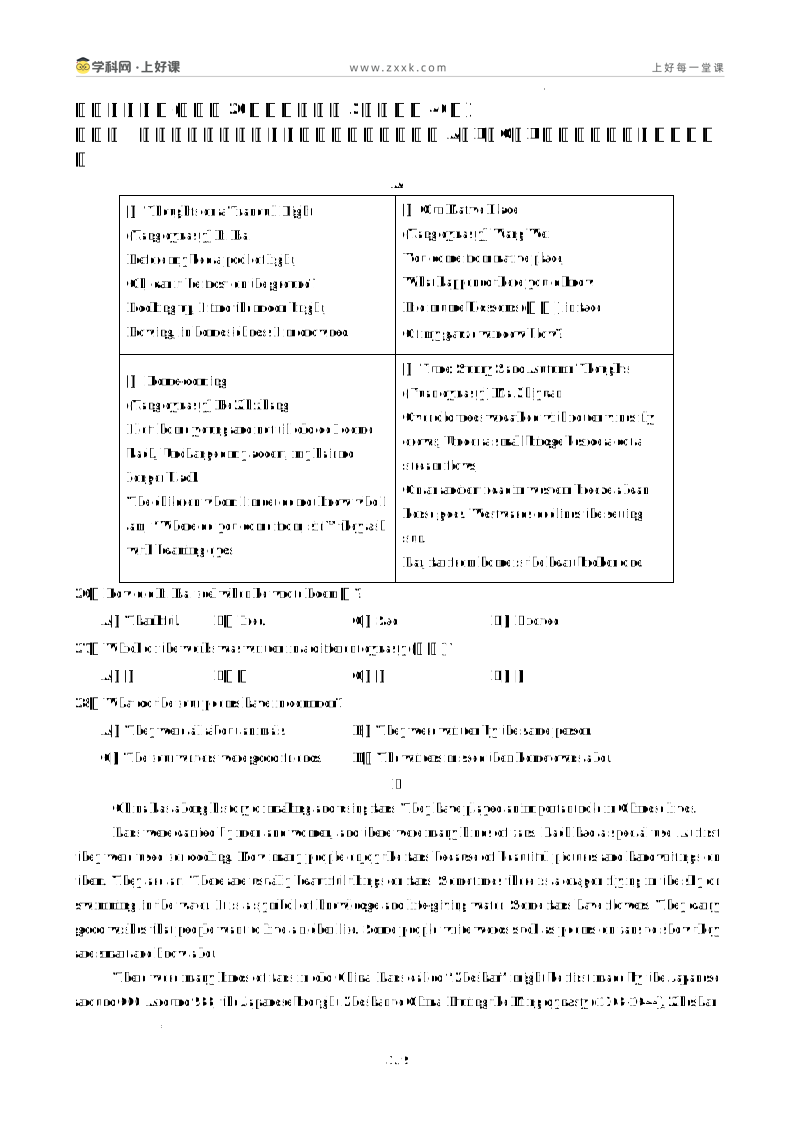
A
① Thoughts on a Tranquil Night
(Tang dynasty) Li Bai
Before my bed a pool of light;
Oh, can it be frost on the ground?
Looking up, I find the moon bright;
Bowing, in homesickness I’m drowned.
② Our Native Place
(Tang dynasty) Wang Wei
You come from native place,
What happened there you’d know.
Did mume blossoms (梅花) in face
Of my gauze window blow?
③ Home-coming
(Tang dynasty) He Zhizhang
I left home young and not till old do I come back, Unchanged my accent, my hair no longer black.
The children whom I meet do not know who I am, “Where do you come from, sir?” they ask with beaming eyes.
④ Tune: Sunny Sand Autumn Thoughts
(Yuan dynasty) Ma Zhiyuan
Over old trees wreathed with rotten vines fly crows; Under a small bridge beside a cot a stream flows;
On an ancient road in western breeze a lean horse goes. Westwards declines the setting sun.
Far, far from home is the heart broken one.
26.How did Li Bai feel when he wrote Poem ①?
A.Thankful. B.Free. C.Sad. D.Excited.
27.Which of the works was written in a different dynasty (朝代)?
A.① B.② C.③ D.④
28.What do the four poems have in common?
A.They were all about animals. B.They were written by the same person.
C.The four writers were good friends. D.The writers missed their hometowns a lot.
B
China has a long history of making and using fans. They have played an important role in Chinese lives.
Fans were carried by men and women, and there were many kinds of fans. Each had a special use. At first they were used for cooling. Now many people enjoy the fans because of beautiful pictures and handwritings on them. They are art. There are usually beautiful things on fans. Sometimes there is a dragon flying in the sky or swimming in the water. It is a symbol of knowledge and life-giving water. Some fans have flowers. They carry good wishes that people want to live a richer life. Some people write words such as poems on fans to show they are smart and know a lot.
There were many kinds of fans in old China. Fans called “Zheshan” might be first made by the Japanese around 600. Around 988, the Japanese brought Zheshan to China. During the Ming dynasty (1368-1644), Zheshan were getting more and more popular. Around 1600, many Chinese and some Japanese fans reached Europe. These were of poor quality in the eyes of Chinese, but many Europeans bought fans for their beauty.
Today people in Japan and China still have fans in their homes. They are often gifts from friends. Although people seldom use fans for cooling now, they are a good match with modern homes because of their special beauty.
29.What were fans used for at the very beginning?
A.Staying cool. B.Writing words.
C.Decorating homes. D.Drawing pictures.
30.How does the writer develop his idea (展开观点) in Paragraph 3?
A.By giving numbers. B.By telling the differences.
C.By asking questions. D.By giving facts in time order.
31.Why did Europeans buy Chinese fans around 1600?
A.The fans were well-made. B.The fans were very cheap.
C.They liked the looks of the fans. D.They needed fans for cooling.
32.What’s the best title for this article?
A.Different Kinds of Fans B.Different Uses of Fans
C.The Beauty and History of Fans D.The Importance of Fans
C
Do you know something about qingtuan? Have you ever eaten it before? Weeks before the Qingming Festival, lots of qingtuan are sold each day.
In the southern part of China, eating qingtuan during the festival is a kind of tradition. It is usually made of sticky rice (糯米) and red bean paste (红豆沙). The secret behind its good taste is the mugwort leaves (艾蒿叶). The plant mainly grows in the Yangtze River Delta. People there usually put qingtuan on the tombs (墓) of their dead family members to cherish the past memory.
Now, qingtuan has already spread its special taste to the northern part of China. Li Yuan, who grew up in Zhejiang Province, brought qingtuan back to Beijing, where he works. “It tastes different in and out of my hometown,” he said. “There’s no place like home.”
Lots of things can be put in qingtuan, such as apples and pears, to meet people’s tastes. The difference of the taste shows that it’s getting more and more popular all over China.
33.How does the writer start the passage?
A.By telling stories. B.By asking questions.
C.By listing numbers. D.By giving examples.
34.Which question does Paragraph 2 answer?
A.How do people make qingtuan? B.When do people grow mugwort?
C.Why are mugwort leaves popular? D.What is qingtuan usually made of?
35.Where does Li Yuan work?
A.In Beijing. B.In Zhejiang.
C.In the Yangtze River. D.In his hometown.
36.What can we know from the passage?
A.Li Yuan grew up in Beijing.
B.Making qingtuan is an exciting thing for Li Yuan.
C.More and more people will enjoy eating qingtuan.
D.People can find mugwort only in the Yangtze River Delta.
D
In the hands of Chinese artisans (手艺人), flour is made into lovely models of people or animals. This art form is called dough figurine (面塑). Among the different styles, Beijing’s Dough Figurine Lang is a special folk art. The nice and lovely handicrafts are storytellers of old and new Beijing. In 2008, it was included in the list of national intangible (非物质) cultural heritage (遗产).
It was created by Lang Shao’ an (郎绍安). He created animals and characters from important people’s stories, history stories, and local operas. What they finished is either put at the end of a thin stick, or on a table for people to see. Some are mostly for children to eat or play with, with simple shapes and colourful decorations, but some are nice pieces of artwork for people to see only. For this reason, during the making process, they are often mixed with additives (添加剂) to stop them from breaking up, and being eaten by animals. After a long time of practice, Lang Shao’ an is good at making dough figurine with beautiful designs.
Lang Jiaizyu (郎佳子彧), born in 1995, is the third- generation (代) man of dough Figurine Lang. By the age of five, he had already made his first dough figurines. When he was 15, he created Beijing Olympic Mascots- shaped dough figurines which were very famous. He looks a bit more fashionable than other folk works of art. In his skilled hands, some figures such as Nezha are popular with young people.
Like most of the other intangible cultural heritage handicrafts in China, not many people like the idea and design of dough Figurine Lang. Few young people are willing to take the time to master a skill that does not make money, which means fewer and fewer people want to spend time on learning the handicraft. Good handicrafts need time, energy and love of artisans from one generation to another.
37.What is special about dough Figurine Lang?
A.It shows people’s lifestyles and hobbies. B.It is popular with both tourists and the locals.
C.It is created by many famous artists. D.It shows Beijing’s colourful culture.
38.Why do artisans add additives to dough figurines?
A.To better protect the things people make. B.To help dough have different shapes.
C.To keep colors brighter and last longer. D.To make dough figurines taste good.
39.Which is the correct order of the following events?
a.dough Figurine Lang was included in the list of national intangible cultural heritage.
b.LangJiaizyu created Beijing Olympic Mascots- shaped dough figurines.
c.Lang Jiaizyu was born as the third- generation inheritor of dough Figurine Lang.
d.LangJiaizyu had made his first dough figurines.
A.a-c-b-d B.c-d-b-a C.a-c-d-b D.c-d-a-b
40.What does the passage mainly want to tell us?
A.To ask people to know some kinds of folk art.
B.To ask people to spend more time learning folk art.
C.To ask people to protect national cultural heritage handicrafts.
D.To teach people ways to enjoy and understand the handicrafts.
第二节 请认真阅读下面短文,从短文后所给的六个选项中选出五个可以填入空白处的最佳选项
Kites were once called zhiyuan in North China and yaozi in South China.The name fengzheng came into use during the Five Dynasties. 41 He once tied a whistle (哨子) made of bamboo to the upper part of his kite so that a zheng sound was made when he was flying the kite. The word for wind is feng, so fengzheng came into use.
How was the kite invented (发明)? 42 But it is widely believed that the earliest kite in the world was made by Mo Di, a famous Chinese philosopher (哲学家) who lived about 2,400 years ago. He spent three years making a bird with wood and successfully flew it. The bird was later regarded (被视为) as the first kite in the world. 43 Lu Ban improved (改进) on kite-making. He made a kite out of bamboo and it flew into the air for as long as three days.
Kite-flying became a kind of recreation (娱乐活动) in the Tang Dynasty. 44 Later, the paper-made kite was invented. Paper-made kites were cheaper to make and then spread quickly among the common (普通) people.
45 The well-known British scientist, Dr Needham, once described kites as an important invention that spread to Europe from China in his book.
A.As time went on, kites flew to different countries in the world.
B.Later, he passed on his kite-making skills to Lu Ban.
C.The kite was also made of paper after the paper was invented by Cai Lun.
D.There are so many different views that it is difficult to know which one is right.
E.At that time, only the royal family (王室) and people of the highest class flew kites.
F.According to a history book, Li Ye, who lived in the Five Dynasties, used to make and fly kites.
第Ⅱ卷(非选择题 共55分)
第Ⅱ卷共26小题,请将答案按要求写在答题卡上。
四、词汇运用(本题共10小题;每小题1分,满分10分)
请认真阅读下面短文,根据语篇内容,在空白处填入括号内单词的正确形式,使短文通顺、连贯。
Woodblock painting (木刻画) in Taohua Wu, 46 special form of Chinese art, has a long history. It dated from the Ming Dynasty (明朝). As one of the most famous cultural 47 (treasure) in China, these colorful paintings are still loved by people today. They often express 48 (happy) and good wishes through bright colors and lively designs.
For centuries, local families have used Taohua Wu paintings to make their homes more beautiful. 49 (put) up nice paintings on the wall is a custom (习俗) in Suzhou. The art 50 (it) carries deep cultural value. For example, a bamboo design 51 (mean) “health and safety” in Chinese culture. People can feel the warmth 52 life of the traditional folk art.
Today, an art center in Taohua Wu not only shows paintings but also tells visitors how it is created. Through learning, people can understand the hard work and the story behind each piece 53 work. The paintings are more than just decorations—they show the spirit of Chinese culture about family, nature, and joy. In 2006, Woodblock painting in Taohua Wu was listed as one of China’s 54 (one) National Intangible Cultural Heritage items (国家非物质文化遗产名录). By learning about these, we help keep this beautiful art 55 (live).
五、短文填空(本题共10小题;每小题1分,满分10分)
请认真阅读下面短文,并根据各题所给首字母的提示,写出一个合适的英语单词完整、正确的形式,使短文通顺。
The traditional Chinese lunar calendar divides the year into 24 solar terms (节气). Grain Rain (谷雨), a 56 the last term in spring, starts on April 20 and ends on May 4. It d 57 from the old saying, “Rain brings up the growth of h 58 of grains.”
With an increase in temperature and rainfall, the grains grow f 59 and stronger. And it’s necessary to protect the crops from insect pests.
Grain Rain falls b 60 the end of spring and the beginning of summer. There is infrequent (罕见的) cold air m 61 to the south and lasting cold air in the north. This period sees warmer weather and an increase in r 62 days.
In southern China, there is an old custom that people drink tea on the day of Grain Rain. It is s 63 that drinking tea on this day is to prevent bad luck. The Grain Rain f 64 is celebrated by fishing villages in northern China. It marks the start of the fishermen’s first voyage (航行) of the year. The custom began more than 2,000 years ago, when people thanked the gods because they p 65 humans from being hurt by heavy storms.
六、阅读与回答问题(本题共5小题;每小题2分,满分10分)
请认真阅读下面短文,并根据短文内容回答问题。
Embroidery (刺绣) is often seen as “women’s work”. People think that it’s useless for a boy to learn embroidery. Therefore, Fu Jian’s parents didn’t want him to work in this industry. But Fu didn’t care. He believed he could do it well.
Fu was born into an embroidery family in Yangzhou. His mother is a master craftsman of Suzhou embroidery. Fu fell in love with this beautiful art when he was four years old. In his last year of high school, Fu was clear about his life goal: to promote this traditional art.
After graduating from college, Fu and his mother built a research center of Suzhou embroidery. Since then, he has created many new stitches (针法). He has also trained many workers.
Fu spends a lot of time on his works. He often works late into the night. Even so, he enjoys his work. “I am doing what I love, so I never feel tired,” said the 37-year-old.
Most recently, the artist “created” a piece of bronze ware (青铜器) on cloth. What gave him the idea to create this work? “Many bronzes can only be seen in museums. A work of embroidery, however, can be hung in one’s home or office. People can see it at any time,” said Fu.
注:每题答案不超过6个单词
66.What does the underlined part “this industry” refer to?
67.When did Fu Jian become interested in embroidery?
68.What was Fu Jian’s life goal?
68.Why does Fu Jian never feel tired?
70.What do you think of Fu Jian?
七、书面表达(本题满分25分)
71.保护和传承中华民族的传统工艺是每个中华儿女的责任,现在得到了越来越多人的重视和关注。最近我校准备举行“你最喜爱的传统工艺”为主题的英语演讲比赛。请你用英语写一篇演讲稿,介绍你最喜爱的一种或两种我国传统的工艺以及它们的使用场景,并分享你的感受。
My favourite traditional Chinese craft
What
介绍一种或两种传统工艺(剪纸,惠山泥人,徽州墨条等)
Why
1.……是中国文化的重要部分
2.……(请你补充1-2点)
Where
1.……
2.……
Feeling
……
注意:1.词数:90-100左右(开头、结尾已给出,不计入总词数):
2.不得透露学校、姓名等任何个人信息,否则不予评分。
My favourite traditional Chinese craft
As we all know, protecting the traditional Chinese crafts is very important.
___________________________________________________________________________________________________________________________________________________________________________________________________________________________________________________________________________________________________________________________________________________________________________________________________________________________________________________________________________________________________________________________________________________________________________________________________________________________________________________________________________________________________________________________________________________________________________________________________________________________________________________
Let’s work together to protect this traditional Chinese craft and keep it alive.
原创精品资源学科网独家享有版权,侵权必究!1
学科网(北京)股份有限公司1 / 14
学科网(北京)股份有限公司
$
2025-2026学年七年级下册英语单元测试(江苏南通专用)
Unit 4·培优卷
学校:___________班级:___________姓名:___________分数:___________
(时间:120分钟,满分:120分)
第I卷(选择题 共65分)
第Ⅰ卷共45小题,请将答案按要求填涂在答题卡上。
一、单项选择(本题共10小题;每小题1分,满分10分)
从A、B、C、D四个选项中,选出可以填入空白处的最佳选项,并在答题卡上将该项涂黑。
1.—What do you think of ______ folk art exhibition in our school?
—It’s wonderful! I learned a lot about Chinese culture.
A.a B.an C.the D./
【答案】C
【详解】句意:——你觉得我们学校的那场民间艺术展览怎么样?——太棒了!我学到了很多关于中国文化的知识。
考查定冠词用法。a一个,泛指,用于辅音音素开头;an一个,泛指,用于元音音素开头;the这/那,特指;/ 表示不使用冠词。根据“in our school”可知,对话双方都知道指的是学校举办的特定展览,应用定冠词表特指。故选C。
2.The 2023 Asian Games in Hangzhou left a deep impression on the world. Many volunteers offered ______ help to visitors from all over the world.
A.they B.their C.them D.theirs
【答案】B
【详解】句意:2023年杭州亚运会给世界留下了深刻的印象。许多志愿者为来自世界各地的游客提供了他们的帮助。
考查代词辨析。they他们,主格,作主语;their他们的,形容词性物主代词,修饰名词;them他们,宾格,作宾语;theirs他们的,名词性物主代词,相当于“their+名词”。根据语境可知,此处是说志愿者提供了他们的帮助,help是名词,前面用形容词性物主代词来修饰,所以用their。故选B。
3.—Our class will have a trip to Nanjing Museum next week.
—That’s great! You can see many ______ Chinese artworks there.
A.valuable B.useless C.boring D.ordinary
【答案】A
【详解】句意:——我们班下周要去南京博物院参观。——太棒了!你可以在那里看到许多有价值的中国艺术品。
考查形容词辨析。valuable有价值的;useless无用的;boring无聊的;ordinary普通的。根据“Nanjing Museum”和“Chinese artworks”可知,南京博物院是收藏珍贵文物的地方,艺术品应是“有价值的”,故选A。
4.With the development of the economy, more and more people pay attention to ______ traditional skills, such as jade carving (玉雕).
A.protect B.protecting C.protected D.to protect
【答案】B
【详解】句意:随着经济的发展,越来越多的人关注保护传统技艺,比如玉雕。
考查动名词作宾语。pay attention to中的to是介词,后接名词或动名词作宾语。pay attention to doing sth.表示“关注做某事、重视做某事”,此处应填动名词。故选B。
5.He is one of the most famous writers ________ young people.
A.between B.among C.in D.of
【答案】B
【详解】句意:他是年轻人中最著名的作家之一。
考查介词辨析。between在……之间,通常指两者之间;among在……之中,通常指三者及以上之间;in在……里面;of……的。根据“young people”可知,年轻人是一个群体,表示“在……之中”应用among。故选B。
6.The team’s ________ of never giving up helped them win the game.
A.spirit B.soul C.mind D.thought
【答案】A
【详解】句意:这支球队永不放弃的精神帮助他们赢得了比赛。
考查名词辨析。spirit精神;soul灵魂;mind头脑;thought想法。根据语境,此处是描述球队“永不放弃”的品质,通常用spirit“精神”来搭配。故选A。
7.I can see ________ school ID cards at the Lost and Found. Let’s call them!
A.Mike and Tom’s B.Mike’s and Tom’s
C.Mike and Tom D.Mike’s and Tom
【答案】B
【详解】句意:我可以在失物招领处看到迈克和汤姆的学生证。我们给他们打电话吧!
考查名词所有格。 句中“school ID cards”表示复数,此处表示迈克和汤姆的学生证,表示分别拥有时需分别加“’s”。故选B。
8.—________ is it from your home to Yangzhou East Railway Station, Tom?
—About ________.
A.How long; 30 minutes’ bus ride B.How long; 30 minutes bus ride
C.How far; 30 minutes’ bus ride D.How far; 30 minutes bus ride
【答案】C
【详解】句意:——汤姆,从你家到扬州东站有多远?——大约30分钟的公交车程。
考查特殊疑问词和名词所有格的用法。How long多久,多长;How far多远。根据回答“About...”和选项可知,这里问的是距离,所以第一个空用How far;“30分钟的公交车程”要用名词所有格形式来表示所属关系,30分钟是复数,其所有格形式是在s后加’,即30 minutes’ bus ride。故选C。
9.It is not wise ________ teenagers to be crazy about Korean stars. It is more important ________ them to learn more about Chinese culture.
A.for; for B.of; for C.of; of D.for; of
【答案】B
【详解】句意:青少年痴迷于韩国明星是不明智的。对他们来说,更多地了解中国文化更为重要。
考查介词辨析。for为了,对于;of……的。“It is + 形容词 + for/of sb. to do sth.”是固定句型,其中介词的选择取决于形容词:当形容词描述的是人的品质、性格(如kind, clever, wise等)时,用介词of,强调“某人具有某种品质”;当形容词描述的是事情的性质(如important, necessary, difficult等)时,用介词for,强调“做某事对某人来说怎么样”。 第一句中,形容词wise描述的是teenagers的品质,故用of;第二句中,形容词important描述的是learn more about Chinese culture这件事的性质,故用for。故选B。
10.What does the sentence mean if we stress (重读) the underlined word?
Tom smiles when he finishes a colorful silk lantern by himself.
A.Tom smiles. It is not somebody else. B.Tom finishes the lantern on his own.
C.The lantern is made of silk, not wood. D.Tom finishes a lantern, not a teapot.
【答案】C
【详解】句意:如果我们强调下划线单词,这个句子是什么意思?汤姆独自完成一盏五颜六色的丝绸灯笼时笑了。
考查句子重读和强调含义。Tom smiles. It is not somebody else.汤姆笑了。不是别人。(强调Tom) ;Tom finishes the lantern on his own.汤姆自己完成了灯笼。(强调by himself);The lantern is made of silk, not wood.这盏灯是丝绸做的,不是木头做的。(强调silk);Tom finishes a lantern, not a teapot.汤姆完成了一盏灯笼,而不是茶壶。(强调lantern)。根据题干中划线词可知,是强调silk,故选C。
二、完形填空(本题共15小题;每小题1分,满分15分)
请认真阅读下面短文,从短文后各题所给的A、B、C、D四个选项中,选出最佳选项.
As students in Jiangsu, you must know Su embroidery (苏绣). But Shu embroidery (蜀绣) is also a famous 11 in China. It is famous for its exciting needlework (针线活) and strong expression.
Shu embroidery is 12 Su embroidery largely because it comes from Sichuan. People there enjoy a 13 lifestyle, so when embroidering, they are usually willing to spend more time 14 it.
Making beautiful Shu embroidery is 15 easy. It takes super skills. Meng Dezhi, 59, was born into a 16 of embroidery artists. She is one of the greatest 17 of Shu embroidery. She has her own workshop. 18 to make excellent Shu embroidery often challenges (挑战) her. Making a piece takes weeks or even a few 19 . In winter, when the temperature is very low, things become even more difficult, 20 Meng’s love for the work always tells her to keep working.
Meng also does a lot to 21 the traditional art from fading (衰落). 22 can make cheap embroideries so few people want to make them by hand. To 23 the traditional art, Meng began to teach young people Shu embroidery skills. She 24 me, “I really feel I have the responsibility (责任) to 25 Shu embroidery skills to young people, to let the skills run from generation to generation”.
11.A.style B.color C.history D.field
12.A.similar to B.the same as C.different from D.close to
13.A.fast B.slow C.busy D.hard
14.A.in B.for C.with D.on
15.A.sometimes B.usually C.always D.never
16.A.family B.school C.neighborhood D.community
17.A.painters B.singers C.masters D.students
18.A.Where B.How C.When D.Who
19.A.hours B.days C.months D.years
20.A.so B.or C.because D.but
21.A.stop B.help C.make D.attract
22.A.Machines B.Schools C.Students D.Animals
23.A.put up B.carry on C.turn on D.hold up
24.A.asked B.told C.spoke D.talked
25.A.sell B.take C.invite D.pass
【答案】11.A 12.C 13.B 14.D 15.D 16.A 17.C 18.B 19.C 20.D 21.A 22.A 23.B 24.B 25.D
【导语】本文主要介绍了蜀绣及蜀绣传承人孟德芝的故事。
11.句意:但蜀绣在中国也是一种著名的刺绣风格。
style风格,样式;color颜色;history历史;field领域。根据“...you must know Su embroidery. But Shu embroidery is also a famous...”可知,本句描述蜀绣本身的属性,它与苏绣一样,也是一种刺绣形式。故选A。
12.句意:蜀绣与苏绣大不相同,主要因为它起源于四川。
similar to与……相似;the same as与……相同;different from不同于;close to接近。根据“because it comes from Sichuan”可知,起源于四川的蜀绣与起源于江苏的苏绣大不相同。故选C。
13.句意:那里的人们享受慢节奏的生活方式,因此在刺绣时,他们通常愿意花更多的时间。
fast快的;slow慢的;busy忙碌的;hard困难的。根据“they are usually willing to spend more time”可知,四川的人们生活节奏比较慢。故选B。
14.句意:那里的人们享受慢节奏的生活方式,因此在刺绣时,他们通常愿意花更多的时间。
in在……里;for为了;with和;on在……上。sb. spend time on sth.“某人在某事上花费时间”,固定表达。故选D。
15.句意:制作精美的蜀绣绝非易事。
sometimes有时;usually通常;always总是;never从不。根据“It takes super skills.”可知,制作蜀绣从来不是一件容易的事情。故选D。
16.句意:59 岁的孟德芝出生于刺绣艺术世家。
family家庭;school学校;neighborhood街区;community社区,社会。本句介绍孟德芝的出身,“born into a family of...” 表示 “出生于……家庭”。故选A。
17.句意:她是蜀绣最杰出的大师之一。
painters画家;singers歌手;masters大师,能手;students学生。根据“She has her own workshop.”可知,孟德芝在蜀绣方面有一定的专业地位。故选C。
18.句意:如何制作出精湛的蜀绣常常给她带来挑战。
Where在哪里;How怎么样;When什么时候;Who谁。根据“make excellent Shu embroidery”和“challenges her”可知,制作蜀绣的方式方法会给她带来挑战,只有B选项符合句意。故选B。
19.句意:制作一件作品需要数周甚至数月时间。
hours小时;days天;months月;years年。根据“takes weeks or even a few...”可知,设空处强调时间的递进,months符合蜀绣制作周期的一般特点,years对于正常的一件作品来说,表达稍显极端。故选C。
20.句意:冬天,气温很低时,事情会变得更困难,但孟德芝对这份工作的热爱总让她坚持下去。
so因此;or或者;because因为;but但是。“Meng’s love for the work always tells her to keep working”与“things become even more difficult”构成转折关系。故选D。
21.句意:孟德芝也做了很多事来阻止这项传统艺术的衰落。
stop阻止;help帮助;make使;attract吸引。根据fading可知,“阻止”蜀绣衰落符合语境。故选A。
22.句意:机器可以制作廉价的刺绣,因此很少有人愿意手工制作。
Machines机器;Schools学校;Students学生;Animals动物。此处与by hand“手工”形成对比,解释传统刺绣衰落的原因,A选项符合句意。故选A。
23.句意:为了传承这项传统艺术,孟德芝开始向年轻人传授蜀绣技艺。
put up张贴;carry on传承,继续;turn on打开;hold up举起。根据“teach young people Shu embroidery skills”可知,教授年轻人蜀绣技艺是为了将这项艺术传承下去。故选B。
24.句意:她告诉我,“我真的觉得我有责任把蜀绣技艺传递给年轻人,让这项技艺代代相传。”
asked询问;told告诉;spoke讲,后接语言;talked谈论,不及物动词。“I really feel...”为孟德芝告诉作者的话,结合设空处后直接接宾语,所以B选项符合句意和语法要求。故选B。
25.句意:她告诉我,“我真的觉得我有责任把蜀绣技艺传递给年轻人,让这项技艺代代相传。”
sell卖;take拿走;invite邀请;pass传递。根据“from generation to generation”可知,pass...to...“把……传给……”,符合“代代相传”的语境。故选D。
三、阅读理解(本题共20小题;每小题2分,满分40分)
第一节 请认真阅读下列短文,从短文后各题所给的A、B、C、D四个选项中,选出最佳选项
A
① Thoughts on a Tranquil Night
(Tang dynasty) Li Bai
Before my bed a pool of light;
Oh, can it be frost on the ground?
Looking up, I find the moon bright;
Bowing, in homesickness I’m drowned.
② Our Native Place
(Tang dynasty) Wang Wei
You come from native place,
What happened there you’d know.
Did mume blossoms (梅花) in face
Of my gauze window blow?
③ Home-coming
(Tang dynasty) He Zhizhang
I left home young and not till old do I come back, Unchanged my accent, my hair no longer black.
The children whom I meet do not know who I am, “Where do you come from, sir?” they ask with beaming eyes.
④ Tune: Sunny Sand Autumn Thoughts
(Yuan dynasty) Ma Zhiyuan
Over old trees wreathed with rotten vines fly crows; Under a small bridge beside a cot a stream flows;
On an ancient road in western breeze a lean horse goes. Westwards declines the setting sun.
Far, far from home is the heart broken one.
26.How did Li Bai feel when he wrote Poem ①?
A.Thankful. B.Free. C.Sad. D.Excited.
27.Which of the works was written in a different dynasty (朝代)?
A.① B.② C.③ D.④
28.What do the four poems have in common?
A.They were all about animals. B.They were written by the same person.
C.The four writers were good friends. D.The writers missed their hometowns a lot.
【答案】26.C 27.D 28.D
【导语】本文是诗歌。本文呈现了四首中国古代诗词的英文翻译版本,它们均蕴含着作者对家乡的思念之情。
26.细节理解题。根据“Bowing, in homesickness I’m drowned.”可知,李白在写这首诗时感到悲伤。故选C。
27.细节理解题。根据“①Thoughts on a Tranquil Night (Tang dynasty) Li Bai”、“②Our Native Place (Tang dynasty) Wang Wei”、“③Home-coming (Tang dynasty) He Zhizhang”和“④Tune: Sunny Sand Autumn Thoughts (Yuan dynasty) Ma Zhiyuan”可知,④的朝代不同。故选D。
28.细节理解题。根据“Bowing, in homesickness I’m drowned.”、“You come from native place, What happened there you’d know.”、“I left home young and not till old do I come back.”和“Far, far from home is the heart broken one.”可知,这四首诗的作者都非常思念家乡。故选D。
B
China has a long history of making and using fans. They have played an important role in Chinese lives.
Fans were carried by men and women, and there were many kinds of fans. Each had a special use. At first they were used for cooling. Now many people enjoy the fans because of beautiful pictures and handwritings on them. They are art. There are usually beautiful things on fans. Sometimes there is a dragon flying in the sky or swimming in the water. It is a symbol of knowledge and life-giving water. Some fans have flowers. They carry good wishes that people want to live a richer life. Some people write words such as poems on fans to show they are smart and know a lot.
There were many kinds of fans in old China. Fans called “Zheshan” might be first made by the Japanese around 600. Around 988, the Japanese brought Zheshan to China. During the Ming dynasty (1368-1644), Zheshan were getting more and more popular. Around 1600, many Chinese and some Japanese fans reached Europe. These were of poor quality in the eyes of Chinese, but many Europeans bought fans for their beauty.
Today people in Japan and China still have fans in their homes. They are often gifts from friends. Although people seldom use fans for cooling now, they are a good match with modern homes because of their special beauty.
29.What were fans used for at the very beginning?
A.Staying cool. B.Writing words.
C.Decorating homes. D.Drawing pictures.
30.How does the writer develop his idea (展开观点) in Paragraph 3?
A.By giving numbers. B.By telling the differences.
C.By asking questions. D.By giving facts in time order.
31.Why did Europeans buy Chinese fans around 1600?
A.The fans were well-made. B.The fans were very cheap.
C.They liked the looks of the fans. D.They needed fans for cooling.
32.What’s the best title for this article?
A.Different Kinds of Fans B.Different Uses of Fans
C.The Beauty and History of Fans D.The Importance of Fans
【答案】29.A 30.D 31.C 32.C
【导语】本文主要介绍了扇子的美和历史。
29.细节理解题。根据“At first they were used for cooling.”可知,起初,扇子是用于保持凉爽。故选A。
30.细节理解题。根据“... around 600. Around 988 ... During the Ming dynasty (1368-1644) ... Around 1600”可知,作者在第3段是按时间顺序来发展自己的观点的。故选D。
31.细节理解题。根据“These were of poor quality in the eyes of Chinese, but many Europeans bought fans for their beauty.”可知,欧洲人是因为喜欢扇子的外观而买扇子的。故选C。
32.最佳标题题。通读全文可知,本文主要介绍了扇子的美及发展历史,C选项为最佳标题。故选C。
C
Do you know something about qingtuan? Have you ever eaten it before? Weeks before the Qingming Festival, lots of qingtuan are sold each day.
In the southern part of China, eating qingtuan during the festival is a kind of tradition. It is usually made of sticky rice (糯米) and red bean paste (红豆沙). The secret behind its good taste is the mugwort leaves (艾蒿叶). The plant mainly grows in the Yangtze River Delta. People there usually put qingtuan on the tombs (墓) of their dead family members to cherish the past memory.
Now, qingtuan has already spread its special taste to the northern part of China. Li Yuan, who grew up in Zhejiang Province, brought qingtuan back to Beijing, where he works. “It tastes different in and out of my hometown,” he said. “There’s no place like home.”
Lots of things can be put in qingtuan, such as apples and pears, to meet people’s tastes. The difference of the taste shows that it’s getting more and more popular all over China.
33.How does the writer start the passage?
A.By telling stories. B.By asking questions.
C.By listing numbers. D.By giving examples.
34.Which question does Paragraph 2 answer?
A.How do people make qingtuan? B.When do people grow mugwort?
C.Why are mugwort leaves popular? D.What is qingtuan usually made of?
35.Where does Li Yuan work?
A.In Beijing. B.In Zhejiang.
C.In the Yangtze River. D.In his hometown.
36.What can we know from the passage?
A.Li Yuan grew up in Beijing.
B.Making qingtuan is an exciting thing for Li Yuan.
C.More and more people will enjoy eating qingtuan.
D.People can find mugwort only in the Yangtze River Delta.
【答案】33.B 34.D 35.A 36.C
【导语】本文是一篇说明文,主要介绍了青团的相关情况,包括其作为中国南方清明节的传统食物的特点、制作原料、象征意义,以及如今在北方的传播和口味的多样化等。
33.细节理解题。根据文章第一段“Do you know something about qingtuan? Have you ever eaten it before?”可知,作者通过提问的方式开始这篇文章。故选B。
34.细节理解题。根据文章第二段“It is usually made of sticky rice (糯米) and red bean paste (红豆沙). The secret behind its good taste is the mugwort leaves (艾蒿叶).”可知,第二段回答了“青团通常由什么制成”这个问题。故选D。
35.细节理解题。根据文章第三段“Li Yuan, who grew up in Zhejiang Province, brought qingtuan back to Beijing, where he works.”可知,在浙江长大的李渊把青团带回了他工作的北京,因此李渊在北京工作。故选A。
36.推理判断题。根据文章第四段“The difference of the taste shows that it’s getting more and more popular all over China.”可推知,越来越多的人会喜欢吃青团。故选C。
D
In the hands of Chinese artisans (手艺人), flour is made into lovely models of people or animals. This art form is called dough figurine (面塑). Among the different styles, Beijing’s Dough Figurine Lang is a special folk art. The nice and lovely handicrafts are storytellers of old and new Beijing. In 2008, it was included in the list of national intangible (非物质) cultural heritage (遗产).
It was created by Lang Shao’ an (郎绍安). He created animals and characters from important people’s stories, history stories, and local operas. What they finished is either put at the end of a thin stick, or on a table for people to see. Some are mostly for children to eat or play with, with simple shapes and colourful decorations, but some are nice pieces of artwork for people to see only. For this reason, during the making process, they are often mixed with additives (添加剂) to stop them from breaking up, and being eaten by animals. After a long time of practice, Lang Shao’ an is good at making dough figurine with beautiful designs.
Lang Jiaizyu (郎佳子彧), born in 1995, is the third- generation (代) man of dough Figurine Lang. By the age of five, he had already made his first dough figurines. When he was 15, he created Beijing Olympic Mascots- shaped dough figurines which were very famous. He looks a bit more fashionable than other folk works of art. In his skilled hands, some figures such as Nezha are popular with young people.
Like most of the other intangible cultural heritage handicrafts in China, not many people like the idea and design of dough Figurine Lang. Few young people are willing to take the time to master a skill that does not make money, which means fewer and fewer people want to spend time on learning the handicraft. Good handicrafts need time, energy and love of artisans from one generation to another.
37.What is special about dough Figurine Lang?
A.It shows people’s lifestyles and hobbies. B.It is popular with both tourists and the locals.
C.It is created by many famous artists. D.It shows Beijing’s colourful culture.
38.Why do artisans add additives to dough figurines?
A.To better protect the things people make. B.To help dough have different shapes.
C.To keep colors brighter and last longer. D.To make dough figurines taste good.
39.Which is the correct order of the following events?
a.dough Figurine Lang was included in the list of national intangible cultural heritage.
b.LangJiaizyu created Beijing Olympic Mascots- shaped dough figurines.
c.Lang Jiaizyu was born as the third- generation inheritor of dough Figurine Lang.
d.LangJiaizyu had made his first dough figurines.
A.a-c-b-d B.c-d-b-a C.a-c-d-b D.c-d-a-b
40.What does the passage mainly want to tell us?
A.To ask people to know some kinds of folk art.
B.To ask people to spend more time learning folk art.
C.To ask people to protect national cultural heritage handicrafts.
D.To teach people ways to enjoy and understand the handicrafts.
【答案】37.D 38.A 39.D 40.C
【导语】本文是一篇说明文,介绍了北京非物质文化遗产 “面人郎” 的起源、艺术特点、传承脉络,并指出其面临的传承困境,旨在呼吁人们关注和保护民族文化遗产手工艺。
37.细节理解题。根据“Among the different styles Beijing’s dough Figuren Lang is a special folk art. The nice and lovely handicrafts are storytellers of old and new Beijing.”可知,面人郎的特别之处在于它展示了北京丰富多彩的文化,故选D。
38.细节理解题。根据“For this reason, during the making process, they are often mixed with additives (添加剂) to stop them from breaking up, and being eaten by animals.”可知,工匠们在面人制作过程中添加添加剂是为了更好地保护制作出来的物品,故选A。
39.推理判断题。根据“Lang Jiaizyu (郎佳子彧), born in 1995, is the third-generation (代) man of dough Figurine Lang.”可知c发生时间最早;根据“By the age of five, he had already made his first dough figurines.”可知d发生在其5岁时,即在1995+5=2000年左右;根据“When he was 15, he created Beijing Olympic Mascots-shaped dough figurines which were very famous.”可知b发生在其15岁时,即在1995+15=2010年左右;根据“In 2008, it was included in the list of national intangible (非物质) cultural heritage (遗产).”可知a发生在2008年。所以正确顺序是c-d-a-b,故选D。
40.主旨大意题。文章介绍了面人郎这一民间艺术的特色、制作情况、传承人的经历等,最后提到像面人郎这样的非物质文化遗产手工艺面临传承困境,所以文章主要是呼吁人们保护国家文化遗产手工艺品,故选C。
第二节 请认真阅读下面短文,从短文后所给的六个选项中选出五个可以填入空白处的最佳选项
Kites were once called zhiyuan in North China and yaozi in South China.The name fengzheng came into use during the Five Dynasties. 41 He once tied a whistle (哨子) made of bamboo to the upper part of his kite so that a zheng sound was made when he was flying the kite. The word for wind is feng, so fengzheng came into use.
How was the kite invented (发明)? 42 But it is widely believed that the earliest kite in the world was made by Mo Di, a famous Chinese philosopher (哲学家) who lived about 2,400 years ago. He spent three years making a bird with wood and successfully flew it. The bird was later regarded (被视为) as the first kite in the world. 43 Lu Ban improved (改进) on kite-making. He made a kite out of bamboo and it flew into the air for as long as three days.
Kite-flying became a kind of recreation (娱乐活动) in the Tang Dynasty. 44 Later, the paper-made kite was invented. Paper-made kites were cheaper to make and then spread quickly among the common (普通) people.
45 The well-known British scientist, Dr Needham, once described kites as an important invention that spread to Europe from China in his book.
A.As time went on, kites flew to different countries in the world.
B.Later, he passed on his kite-making skills to Lu Ban.
C.The kite was also made of paper after the paper was invented by Cai Lun.
D.There are so many different views that it is difficult to know which one is right.
E.At that time, only the royal family (王室) and people of the highest class flew kites.
F.According to a history book, Li Ye, who lived in the Five Dynasties, used to make and fly kites.
【答案】41.F 42.D 43.B 44.E 45.A
【导语】本文介绍了风筝的历史。
41.根据“The name fengzheng came into use during the Five Dynasties.”和“He once tied a whistle (哨子) made of bamboo to the upper part of his kite so that a zheng sound was made when he was flying the kite.”可知,此处介绍五代时期的一个人制作了风筝。F项“据一本史书记载,五代时期的李业曾经制作和放风筝。”符合语境,故选F。
42.根据“How was the kite invented (发明)?”可知,此处关于风筝是如何发明的有不同的观点。D项“有这么多不同的观点,很难知道哪一个是正确的。”符合语境,故选D。
43.根据“Lu Ban improved (改进) on kite-making.”可知,鲁班改进了风筝制作工艺,因此表示墨翟把制作风筝的技巧教给了鲁班。B项“后来,他把制作风筝的技巧传给了鲁班。”符合语境,故选B。
44.根据“Paper-made kites were cheaper to make and then spread quickly among the common (普通) people.”可知,纸制风筝制作成本较低,因此在普通人中迅速传播开来,因此介绍纸质风筝之前,普通人无法使用,因此是高阶层的人才能使用。E项“在那个时候,只有皇室和最高阶层的人才放风筝。”符合语境,故选E。
45.根据“The well-known British scientist, Dr Needham, once described kites as an important invention that spread to Europe from China in his book.”可知,著名的英国科学家李约瑟博士曾在他的书中把风筝描述为一项从中国传到欧洲的重要发明,此处介绍风筝传到了其他国家。A项“随着时间的推移,风筝飞到了世界上不同的国家。”符合语境,故选A。
第Ⅱ卷(非选择题 共55分)
第Ⅱ卷共26小题,请将答案按要求写在答题卡上。
四、词汇运用(本题共10小题;每小题1分,满分10分)
请认真阅读下面短文,根据语篇内容,在空白处填入括号内单词的正确形式,使短文通顺、连贯。
Woodblock painting (木刻画) in Taohua Wu, 46 special form of Chinese art, has a long history. It dated from the Ming Dynasty (明朝). As one of the most famous cultural 47 (treasure) in China, these colorful paintings are still loved by people today. They often express 48 (happy) and good wishes through bright colors and lively designs.
For centuries, local families have used Taohua Wu paintings to make their homes more beautiful. 49 (put) up nice paintings on the wall is a custom (习俗) in Suzhou. The art 50 (it) carries deep cultural value. For example, a bamboo design 51 (mean) “health and safety” in Chinese culture. People can feel the warmth 52 life of the traditional folk art.
Today, an art center in Taohua Wu not only shows paintings but also tells visitors how it is created. Through learning, people can understand the hard work and the story behind each piece 53 work. The paintings are more than just decorations—they show the spirit of Chinese culture about family, nature, and joy. In 2006, Woodblock painting in Taohua Wu was listed as one of China’s 54 (one) National Intangible Cultural Heritage items (国家非物质文化遗产名录). By learning about these, we help keep this beautiful art 55 (live).
【答案】46.a 47.treasures 48.happiness 49.Putting 50.itself 51.means 52.and 53.of 54.first 55.alive
【导语】本文介绍了桃花坞木刻画的历史渊源、艺术特色、文化内涵及其作为非物质文化遗产的当代传承价值。
46.句意:桃花坞木刻画是中国艺术的一种特殊形式。根据“special form of Chinese art”可知,此处应用不定冠词表泛指,且special为辅音音素开头的单词,不定冠词用a。故填a。
47.句意:作为中国最著名的文化瑰宝之一,这些颜色炫丽的画至今仍受人们的喜爱。根据“one of the most famous cultural”可知,此处应用“one of the+形容词最高级+复数名词”表示“最……的……之一”。treasure的复数形式为treasures。故填treasures。
48.句意:它们常通过鲜艳色彩和生动设计表达快乐。express为及物动词,此处应用happy的名词happiness作宾语。故填happiness。
49.句意:在墙上张贴精美画作是苏州的习俗。根据“is a custom”可知,此处应用动词put的动名词putting作主语,位于句首,首字母要大写。故填Putting。
50.句意: 这门艺术本身承载着深厚的文化价值。主语为The art,此处应用it的反身代词itself指代这门艺术本身。故填itself。
51.句意:例如,竹纹在中国文化中象征“健康平安”。句子应用一般现在时,主语为a bamboo design,谓语应用动词mean的三单形式。故填means。
52.句意:人们能感受到传统民间艺术的温度和生命力。根据“warmth”和“life”可知,温度和生命力是传统民间艺术的两个并列特质,通过and连接强调艺术同时具备情感温度与鲜活生命力。故填and。
53.句意:通过学习,人们能够理解每件作品背后的艰辛和故事。根据“each piece…work”可知,此处应用piece of修饰不可数名词。故填of。
54.句意:2006年,桃花坞木刻画被列入中国首批国家级非物质文化遗产名录。根据“China’s…National Intangible Cultural Heritage items”可知,此处应用one的序数词first表示“首批”。故填first。
55.句意:通过了解这些,我们助力让这门美丽的艺术保持生命力。keep sth alive“使某物保持生命力”。故填alive。
五、短文填空(本题共10小题;每小题1分,满分10分)
请认真阅读下面短文,并根据各题所给首字母的提示,写出一个合适的英语单词完整、正确的形式,使短文通顺。
The traditional Chinese lunar calendar divides the year into 24 solar terms (节气). Grain Rain (谷雨), a 56 the last term in spring, starts on April 20 and ends on May 4. It d 57 from the old saying, “Rain brings up the growth of h 58 of grains.”
With an increase in temperature and rainfall, the grains grow f 59 and stronger. And it’s necessary to protect the crops from insect pests.
Grain Rain falls b 60 the end of spring and the beginning of summer. There is infrequent (罕见的) cold air m 61 to the south and lasting cold air in the north. This period sees warmer weather and an increase in r 62 days.
In southern China, there is an old custom that people drink tea on the day of Grain Rain. It is s 63 that drinking tea on this day is to prevent bad luck. The Grain Rain f 64 is celebrated by fishing villages in northern China. It marks the start of the fishermen’s first voyage (航行) of the year. The custom began more than 2,000 years ago, when people thanked the gods because they p 65 humans from being hurt by heavy storms.
【答案】56.(a)s 57.(d)ates 58.(h)undreds 59.(f)aster 60.(b)etween 61.(m)oving 62.(r)ainy 63.(s)aid 64.(f)estival 65.(p)rotected
【导语】本文介绍了中国传统节气“谷雨”的时间、名称由来、气候特点及相关习俗,展现了这一节气与农业生产、民间文化的密切联系。
56.句意:谷雨作为春季的最后一个节气,始于4月20日,止于5月4日。根据“the last term in Spring”可知,此处表示“作为”,结合语境和首字母a提示填“as”,故填(a)s。
57.句意:它源于一句古话:“雨生百谷”。“date from”为固定搭配,意为“源于、来自”。主语是第三人称单数It,故填(d)ates。
58.句意:雨生百谷。hundreds of是固定短语,意为“成百上千的”,“hundreds of grains”即“百谷”,是古语中对谷物的泛指,故填(h)undreds。
59.句意:随着气温升高和降雨量增加,谷物长得更快、更健壮。根据“stronger”(比较级)及“temperature and rainfall increase”的条件,可知谷物生长“更快”,根据句意及首字母f提示,用比较级“faster”,与“stronger”并列。故填(f)aster。
60.句意:谷雨介于春末和夏初之间。“between...and...”为固定搭配,意为“在……和……之间”,结合句意及首字母b提示,填“between”。故填(b)etween。
61.句意:南下的冷空气罕见,北方则有持续的冷空气。根据句意可知,此处表示“向南方移动的空气”,结合首字母m提示,move符合句意,and表示并列,所以此处填moving,故填(m)oving。
62.句意:这段时间天气转暖,雨天增多。根据前文“increase in rainfall”及首字母r提示,可知此处指“雨天”,故填(r)ainy。
63.句意:据说在这一天喝茶可以辟邪。“It is said that...”为固定句型,意为“据说……”,用于引出传统说法,故填(s)aid。
64.句意:中国北方的渔村会庆祝谷雨节。根据“celebrated by fishing villages”及后文“marks the start of the fishermen’s first voyage”,可知此处指“谷雨节”,结合句意及首字母f提示,填festival,故填(f)estival。
65.句意:这项习俗始于 2000 多年前,当时人们感谢神灵保护他们免受暴风雨的伤害。“protect...from...”为固定搭配,意为“保护……免受……”。结合首字母p可知,用protect。根据“began”和“thanked”可知,此处用一般过去时,故填(p)rotected。
六、阅读与回答问题(本题共5小题;每小题2分,满分10分)
请认真阅读下面短文,并根据短文内容回答问题。
Embroidery (刺绣) is often seen as “women’s work”. People think that it’s useless for a boy to learn embroidery. Therefore, Fu Jian’s parents didn’t want him to work in this industry. But Fu didn’t care. He believed he could do it well.
Fu was born into an embroidery family in Yangzhou. His mother is a master craftsman of Suzhou embroidery. Fu fell in love with this beautiful art when he was four years old. In his last year of high school, Fu was clear about his life goal: to promote this traditional art.
After graduating from college, Fu and his mother built a research center of Suzhou embroidery. Since then, he has created many new stitches (针法). He has also trained many workers.
Fu spends a lot of time on his works. He often works late into the night. Even so, he enjoys his work. “I am doing what I love, so I never feel tired,” said the 37-year-old.
Most recently, the artist “created” a piece of bronze ware (青铜器) on cloth. What gave him the idea to create this work? “Many bronzes can only be seen in museums. A work of embroidery, however, can be hung in one’s home or office. People can see it at any time,” said Fu.
注:每题答案不超过6个单词
66.What does the underlined part “this industry” refer to?
67.When did Fu Jian become interested in embroidery?
68.What was Fu Jian’s life goal?
68.Why does Fu Jian never feel tired?
70.What do you think of Fu Jian?
【答案】66.The embroidery industry. 67.When he was four years old. 68.To promote traditional embroidery. 69.Because he loves his work. 70.He is determined and passionate.
【导语】本文讲述了付健不顾父母反对,坚持从事刺绣行业并取得成就的故事。他从小热爱刺绣艺术,大学毕业后与母亲共同建立了苏绣研究中心,并不断创新针法。尽管工作辛苦,但他乐在其中。
66.根据“Embroidery (刺绣) is often seen as ‘women’s work.’…Fu Jian’s parents didn’t want him to work in this industry.”可知,“this industry”指的是“刺绣行业”。故填The embroidery industry.
67.根据“Fu fell in love with this beautiful art when he was four years old.”可知,付健四岁时就对刺绣产生了兴趣。故填When he was four years old.
68.根据“Fu was clear about his life goal: to promote this traditional art.”可知,付健的人生目标是推广这门传统艺术。故填To promote traditional embroidery.
69.根据“I am doing what I love, so I never feel tired.”可知,付健从不感到疲倦是因为他在做自己热爱的事。故填Because he loves his work.
70.根据全文内容可知,付健坚持自己的梦想,克服偏见,并致力于推广传统刺绣艺术,因此他是一个有决心和热情的人。故填He is determined and passionate.
七、书面表达(本题满分25分)
71.保护和传承中华民族的传统工艺是每个中华儿女的责任,现在得到了越来越多人的重视和关注。最近我校准备举行“你最喜爱的传统工艺”为主题的英语演讲比赛。请你用英语写一篇演讲稿,介绍你最喜爱的一种或两种我国传统的工艺以及它们的使用场景,并分享你的感受。
My favourite traditional Chinese craft
What
介绍一种或两种传统工艺(剪纸,惠山泥人,徽州墨条等)
Why
1.……是中国文化的重要部分
2.……(请你补充1-2点)
Where
1.……
2.……
Feeling
……
注意:1.词数:90-100左右(开头、结尾已给出,不计入总词数):
2.不得透露学校、姓名等任何个人信息,否则不予评分。
My favourite traditional Chinese craft
As we all know, protecting the traditional Chinese crafts is very important.
___________________________________________________________________________________________________________________________________________________________________________________________________________________________________________________________________________________________________________________________________________________________________________________________________________________________________________________________________________________________________________________________________________________________________________________________________________________________________________________________________________________________________________________________________________________________________________________________________________________________________________________
Let’s work together to protect this traditional Chinese craft and keep it alive.
【答案】例文
My favourite traditional Chinese craft
As we all know, protecting the traditional Chinese crafts is very important. My favourite craft is paper-cutting. With just scissors and red paper, artists create animals, flowers or Chinese characters. It is often used during the Spring Festival. People stick paper-cuts on windows for good luck.
Another craft I like is clay sculpture. Artists shape clay into lively figures like children or animals. These small statues are usually put on desks as decorations or given as gifts to children. I love these crafts because they are important parts of Chinese culture. They show our creativity and bring beauty to daily life. Every time I see them, I feel proud of our rich cultural heritage.
Let’s work together to protect this traditional Chinese craft and keep it alive.
【详解】[总体分析]
①题材:本文是一篇演讲稿;
②时态:一般现在时;
③提示:写作要点已给出,考生注意不要遗漏要点,并适当添加细节,突出重点。
[写作步骤]
第一步,介绍两种传统的工艺;
第二步,介绍它们的使用场景,并分享你的感受。
[亮点词汇]
①shape…into塑造成
②daily life日常生活
③feel proud of感到自豪
[高分句型]
I love these crafts because they are important parts of Chinese culture.(原因状语从句)
原创精品资源学科网独家享有版权,侵权必究!1
学科网(北京)股份有限公司1 / 14
学科网(北京)股份有限公司
$
2025-2026学年七年级下册英语单元测试(江苏南通专用)
Unit 4·培优卷
学校:___________班级:___________姓名:___________分数:___________
(时间:120分钟,满分:120分)
第I卷(选择题 共65分)
第Ⅰ卷共45小题,请将答案按要求填涂在答题卡上。
一、单项选择(本题共10小题;每小题1分,满分10分)
1.C2.B3.A4.B5.B6.A7.B8.C9.B10.C
二、完形填空(本题共15小题;每小题1分,满分15分)
11.A 12.C 13.B 14.D 15.D 16.A 17.C 18.B 19.C 20.D 21.A 22.A 23.B 24.B 25.D
三、阅读理解(本题共20小题;每小题2分,满分40分)
第一节 请认真阅读下列短文,从短文后各题所给的A、B、C、D四个选项中,选出最佳选项
A
26.C 27.D 28.D
B
29.A 30.D 31.C 32.C
C
33.B 34.D 35.A 36.C
D
37.D 38.A 39.D 40.C
第二节 请认真阅读下面短文,从短文后所给的六个选项中选出五个可以填入空白处的最佳选项
41.F 42.D 43.B 44.E 45.A
第Ⅱ卷(非选择题 共55分)
第Ⅱ卷共26小题,请将答案按要求写在答题卡上。
四、词汇运用(本题共10小题;每小题1分,满分10分)
46.a 47.treasures 48.happiness 49.Putting 50.itself 51.means 52.and 53.of 54.first 55.alive
五、短文填空(本题共10小题;每小题1分,满分10分)
56.(a)s 57.(d)ates 58.(h)undreds 59.(f)aster 60.(b)etween 61.(m)oving 62.(r)ainy 63.(s)aid 64.(f)estival 65.(p)rotected
六、阅读与回答问题(本题共5小题;每小题2分,满分10分)
66.The embroidery industry. 67.When he was four years old. 68.To promote traditional embroidery. 69.Because he loves his work. 70.He is determined and passionate.
七、书面表达(本题满分25分)
My favourite traditional Chinese craft
As we all know, protecting the traditional Chinese crafts is very important. My favourite craft is paper-cutting. With just scissors and red paper, artists create animals, flowers or Chinese characters. It is often used during the Spring Festival. People stick paper-cuts on windows for good luck.
Another craft I like is clay sculpture. Artists shape clay into lively figures like children or animals. These small statues are usually put on desks as decorations or given as gifts to children. I love these crafts because they are important parts of Chinese culture. They show our creativity and bring beauty to daily life. Every time I see them, I feel proud of our rich cultural heritage.
Let’s work together to protect this traditional Chinese craft and keep it alive.
原创精品资源学科网独家享有版权,侵权必究!1
学科网(北京)股份有限公司1 / 14
学科网(北京)股份有限公司
$
资源预览图

1

2
3
所属专辑


相关资源
由于学科网是一个信息分享及获取的平台,不确保部分用户上传资料的 来源及知识产权归属。如您发现相关资料侵犯您的合法权益,请联系学科网,我们核实后将及时进行处理。