Unit 1 Spring Is Coming Lesson 4-6 教学设计 2025-2026学年冀教版英语八年级下册
2026-03-09
|
7页
|
472人阅读
|
1人下载
普通
内容正文:
初 二 年级下 (英语)教学案 备课时间: 使用者
Unit 1 Spring Is Coming
Lesson4 Stories about Spring
主备教师
卢学林
参与教师
八年级全体英语教师
缺课学生
审核人
张莉
课 时
2 period
授课时间
核心
素养目标
Key Competencies Objectives
Period 1:Language Competence:Students will be able to understand and use vocabulary related to spring weather, activities, and cultural traditions (e.g., wild, groundhog, sugar bush, maple syrup);Use the structure "We had so much fun playing outside..." to discuss activities in spring.
Cultural Awareness:Gain an understanding of Canadian spring traditions, such as Groundhog Day and maple syrup making.
Compare spring customs between China and Canada.
Period 2:Thinking Quality:Students will be able to describe spring weather and activities using comparative structures and because for giving reasons.
Learning Ability:Improve reading comprehension by answering questions and completing a mind map.
Develop writing skills by composing an email about spring in their own city.
教学重难点
Key and Difficult Points
Key Points:Mastering the core vocabulary of describing spring.
Understanding and practicing the target language for discussing spring activities.
Comprehending the listening/reading text about Jenny's diary.
Difficult Points:Using the structure "We had so much fun playing... outside"
教学准备Preparation
textbook, exercise book, notebook, recorder, ppt
教学过程 Teaching Process
注重构建“情景导入—任务驱动—问题引领—教师主导—学生主体—思政渗透”的“和美课堂”范式
教学环节Teaching Segments
集体备课设计
Collaborative Lesson Planning Design
教学评一体化
个人备课设计
Individual Lesson Planning Design
情景导入
Situational Lead-in
Talk & Brainstorming
Spring Discussion:Ask students: “What special days do you like in spring?” and “When can you see flowers bloom in your city?”
Invite 2–3 students to share their answers.
Lead-in:Show a picture of a groundhog and ask: “Do you know this animal? What is Groundhog Day?” Introduce the Canadian spring tradition.
活动设计
Activity Design
Step1: Pre-reading - Vocabulary & Prediction
Activity 1: Have students read Jenny’s diary silently.Ask them to answer the comprehension questions (A–B) individually:
A: “Wild” means the spring weather changes a lot — it can be cold and snowy or warm and sunny, with temperatures ranging from -15°C to 15°C.
B: Maple syrup comes from the sugar bush (a big tree farm in the countryside).Check answers as a class and explain key vocabulary (e.g., sugar bush, groundhog, maple syrup).
Activity 2:Language Focus:Highlight the use of until for time: We probably won’t see any flowers until May or June!
Review giving reasons with because: I like spring because there are lots of activities to do.
Step 2:Practice (15 m)Exercise 3: Complete the Mind Map
Have students read the email again and fill in the mind map with details about spring in Edmonton.Check answers as a class:
Exercise 4: Tick & Write Reasons
Have students tick their favourite spring activities and write a reason for each, using because.
Example: I like to fly kites because the wind is perfect in spring.
Invite 2–3 students to share their answers.
Step 3:Post-reading - Consolidation
Writing Task: Email to a Pen Pal
Ask students to write an email to a friend or pen pal in another city, answering the guiding questions:
What is the weather like in your city during spring?
What do you usually do during spring? Why?
Is there any special custom to welcome spring in your hometown?
Encourage students to use vocabulary and sentence patterns from the lesson (e.g., because, until, as low as).
Step 4: Summary & Homework
Research one more spring tradition from another country and prepare a 1-minute presentation.
思政渗透与学科育人有机融合点Subject-based Character Education
Teacher says:"Through this lesson, we've learned about the beauty of spring in Canada. It's important to enjoy the scenery of spring. Sharing our activities also helps us connect with others."
板书设计
Blackboard Design
教学反思Teaching Reflection
Lesson4 Stories about Spring
审 查
意 见
签 字: 年 月 日
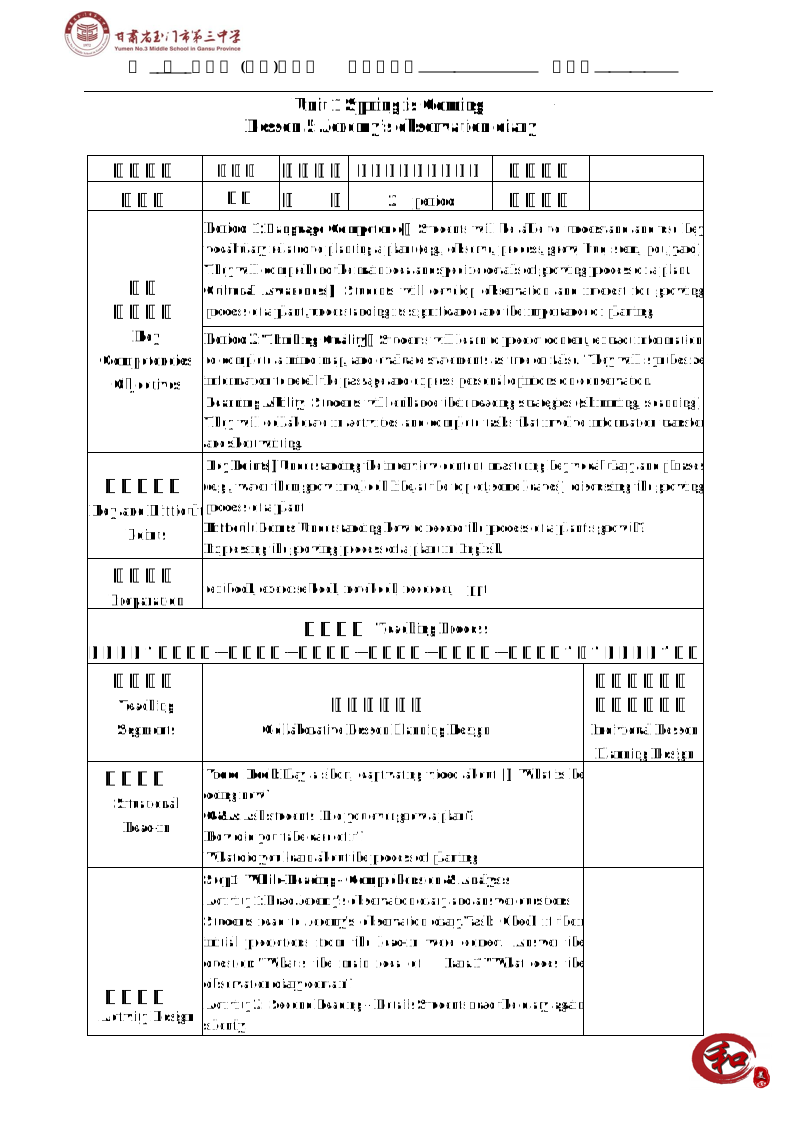
Unit 1 Spring is Coming
Lesson 5:Jeremy’s observation diary
主备教师
卢学林
参与教师
八年级全体英语教师
缺课学生
审核人
张莉
课 时
2 period
授课时间
核心
素养目标
Key Competencies Objectives
Period 1:Language Competence:Students will be able to understand and use key vocabulary related to planting a plant (e.g., observe, process, grow, bud, stem, pot ,yard). They will comprehend the main idea and specific details of growing process of a plant.
Cultural Awareness:Students will develop observation and interest for growing process of a plant ,understanding its significance and the importance of planting.
Period 2:Thinking Quality:Students will learn to predict content, extract information to complete a mind map, and evaluate statements as true or false. They will synthesize information to retell the passage and express personal opinions on conservation.
Learning Ability: Students will enhance their reading strategies (skimming, scanning). They will collaborate in activities and complete tasks that involve information transfer and short writing.
教学重难点
Key and Difficult Points
Key Points:Understanding the interview content; mastering key vocabulary and phrases (e.g., water them,grow into,look like,at the top of,some leaves); discussing the growing process of a plant.
Difficult Points:Understanding how to record the process of a plant’s growth?
Expressing the growing process of a plant in English.
教学准备Preparation
textbook, exercise book, notebook, recorder, ppt
教学过程 Teaching Process
注重构建“情景导入—任务驱动—问题引领—教师主导—学生主体—思政渗透”的“和美课堂”范式
教学环节Teaching Segments
集体备课设计
Collaborative Lesson Planning Design
教学评一体化
个人备课设计
Individual Lesson Planning Design
情景导入
Situational Lead-in
Video Hook:Play a short, captivating video about :What is he doing now?
Q&A:Ask students: Did you ever grow a plant?
How did you take care of it?
What did you learn about the process of planting
活动设计
Activity Design
Step1: While-Reading - Comprehension & Analysis
Activity 1:Read Jeremy's observation diary and answer questions.
Students read to Jeremy's observation diary.Task: Check if their initial predictions from the lead-in were correct. Answer the question: "What’s the main idea of Para.1?"What does the observation diary contain?
Activity 2: Second Reading - Details Students read the diary again silently.
Task: Individually complete the True/False exercise (The process of planting.
Step 2:Language in Focus
Activity: Language Point Practice
Teacher highlights key language points from the text (e.g., the importance of..., enter, follow...and you will see...).
Task:Students complete the relevant exercises from the PPT/worksheet .
Step 3: Post-Reading - Consolidation & Extension
Activity 1: Can you lable the plant.Students complete the passage about growing a plant. Is growing a plant easy?
Pair Work:How to record the growth of the plant?In pairs, students role-play the interview the growth of the plant.
Step 4: Summary & Homework
Basic: Read the interview aloud and retell the content based on the mind map.
Extended:Write a short paragraph (5-7 sentences) about the process of planting.
Practical (Project):Watch the video and practice writing observation diary.
Water them everyday.
Put the pot in the yard to get some sunshine.
Give them a shelf to climb on.
Prepare a short report to share in the next class.
思政渗透与学科育人有机融合点Subject-based Character Education
This lesson aims to foster a sense of recording the growth of the plant. By learning about recording the growth of the plant, students will develop a deeper respect for nature and love the green life.
板书设计
Blackboard Design
教学反思Teaching Reflection
Lesson 5:Jeremy’s observation diary
审 查
意 见
签 字: 年 月 日
Unit 1 Spring Is Coming
Lesson 6 The 24 solar terms
主备教师
卢学林
参与教师
八年级全体英语教师
缺课学生
审核人
张莉
课 时
2 period
授课时间
核心
素养目标
Key Competencies Objectives
Period 1:Language Competence:Students will be able to understand and use key vocabulary related to the 24 solar terms (e.g., reflect,wisdom,ancestor,remind sb of sth,take place,length,honour),They will be able to read and comprehend the 6 solar terms in spring.
Cultural Awareness: Students will recognize the significance of major solar terms
in spring (e.g., Start of Spring,Rain Water,Jingzhe,Grain Rain) in cultural and historical development. They will appreciate the status of the 24 solar terms in China's culture.
Period 2:Thinking Quality:Students will analyze and compare the 6 solar terms in spring. They will synthesize information to create a persuasive presentation about a solar term in spring.
Learning Ability: Students will be able to apply the rules for forming and using the 24 solar terms in spring in farming.Learn about the wisdom of ancestors in farming. They will collaborate to research and present information.
教学重难点
Key and Difficult Points
Key Points:1.Meaning and usage of key vocabulary ( reflect,wisdom,ancestor,remind sb of sth,take place,length,honour, etc.).
2.Read and understand the text and catch the main ideas of the 6 solar terms in spring.
Difficult Points:
Learn about the original and the differences of the 6 solar terms in spring.
教学准备Preparation
textbook, exercise book, notebook, recorder, ppt
教学过程 Teaching Process
注重构建“情景导入—任务驱动—问题引领—教师主导—学生主体—思政渗透”的“和美课堂”范式
教学环节Teaching Segments
集体备课设计
Collaborative Lesson Planning Design
教学评一体化
个人备课设计
Individual Lesson Planning Design
情景导入
Situational Lead-in
Video & Brainstorming
The teacher plays a short, engaging video showcasing the 24 solar terms. then ask and answer.
Quick Quiz: The teacher asks a quick question to engage prior knowledge "What do you know about the 24 solar terms?Sing the song of 24 terms in Chinese together.
活动设计
Activity Design
Step1: Presentation & Practice
Activity 1: Reading for Specific Information
Students read the passage from the PPT silently.
The teacher instructs them to locate the answers to questions .
Activity 2: Drill
1.The teacher directs students' attention to the phrases in red from the PPT.
2.Students work in small groups to summarize the meanings based on the PPT charts. The teacher clarifies and confirms the rules about the 24 solar terms.
Step 2:Production & Application
1.The teacher introduces the main task, inspired by the "Production" section: Read this passage again and fill in the table.
and prepare a short presentation to 'recommend' it to the class."
2. Students work in pairs or small groups to research one of their
favourite solar terms (using textbooks or pre-prepared fact sheets) and draft their presentations. The teacher circulates to provide support.
Step 3: Show Time!
Pair Work: In pairs, students role-play Do you know other solar terms? Share one or two with your classmates.
It falls/occurs/takes place around...
It tells us/It means...
People... during this time.
Step 4: Summary & Homework
1.Basic (Individual): Review the key words and phrases and complete the remaining exercises
2.Extended (Individual):Do you know how other countries celebrate natural cycles and seasonal changes? Search the internet and share your ideas with your partner.
3. Write a short passage (80-100 words) introducing one of your favourite solar terms (can be the one from their presentation).
思政渗透与学科育人有机融合点Subject-based Character Education
Help students develop a sense of loving China's traditional culture by learning about the 24 solar terms.
Foster respect for the wisdom of ancestors by discussing how the 24 solar terms have shaped different civilizations throughout history.
板书设计
Blackboard Design
教学反思Teaching Reflection
Lesson 6 The 24 solar terms
审 查
意 见
签 字: 年 月 日
学科网(北京)股份有限公司
$
资源预览图

1

2
3
相关资源
示范课
由于学科网是一个信息分享及获取的平台,不确保部分用户上传资料的 来源及知识产权归属。如您发现相关资料侵犯您的合法权益,请联系学科网,我们核实后将及时进行处理。