Unit 7Wrapping up the topic 同步练习(培优卷)-2025-2026学年仁爱科普版八年级英语下册
2026-02-05
|
6页
|
1203人阅读
|
35人下载
内容正文:
2025-2026 福建英语新教材仁爱科普版八年级下册同步练习
Unit 7.4 Wrapping up the Topic (培优卷)
一、单项选择题(每题2分,共12分)
1. Lingling ______ afraid of speaking in public since she entered middle school.
A. is always B. was always C. has always been D. will be always
2. Michael advised Li Xiang ______ math problems with classmates instead of giving up easily.
A. discuss B. to discuss C. discussing D. discussed
3. The writer’s teacher kept working hard ______ he could pass the college entrance exam.
A. so that B. because C. though D. if
4. While my mother ______ dinner yesterday evening, I was doing my math homework.
A. cooks B. cooked C. was cooking D. is cooking
5. You’d better not go out to play ______ you finish reviewing your lessons for today.
A. after B. before C. as soon as D. while
6. Practicing ______ English aloud every morning helps improve both pronunciation and memory.
A. read B. to read C. reading D. reads
二、单句语法填空(每题1分,共10分)
1. Li Xiang said math problems always gave him a big ____________(headache) because he couldn’t find ways to solve them.
2. Xiao Ya told Li Xiang that the best way __________(deal) with math problems was to think carefully and discuss with others.
3. Helen Keller went to a special school for _________ deaf and blind at the age of fourteen, where she learned more skills.
4. Please write down the sentences _________ new words in your notebook—this helps you understand how to use the words.
5. The teacher suggested that we practice reading _________(aloud) every day to make our pronunciation better.
6. The writer’s teacher _________(borrow) books from his neighbors when he was young because his family couldn’t afford books.
7. I will call my parents _________ soon as I arrive at the school gate, so they don’t have to worry about me.
8. Keeping a diary in English is very helpful _________ improving our writing skills, according to the learning tips.
9. After years of self-study, the writer’s teacher finally got the chance _________ (enter) his dream college.
10. Math is not just about memorizing formulas—it’s more about _________(think) and trying different solutions.
三、语篇选词填空
阅读短文,从方框中选择适当的单词,并用其正确形式填空(方框中有2个多余单词)
【copy, write, sentence, take, help, diary, remember, useful, practice, aloud, improve, new,】
How to Develop Good English Learning Habits
If you want to learn English well, developing good habits is very important. Here are some useful tips. First, 1.______ down the 2.______ words in a small notebook and 3.______ it with you. You can read these words on the way to school to 4.______ them. Second, when you learn a new word, write a whole 5.______ with it in your notebook. This way, you can learn how to use the word correctly. Third, 6.______ reading 7.______ for 15 minutes every evening. This not only helps you remember texts but also 8.______ your spoken English. Fourth, keep a 9.______ in English. You can write about your daily life in it—it’s 10.______ for your writing. Finally, don’t forget to review what you’ve learned after each lesson!
四、短文填空(每空2分,共10分)
根据短文内容,在空白处填入适当的词或括号内单词的正确形式
My teacher was 1._________(bear) in a poor mountain village in the 1980s. His family had no money, so they couldn’t afford to send him to school. It seemed that he would live in the mountains all his life, just like his parents. 2._________, he never gave up his dream—to see the world beyond the mountains.
To make his dream come true, he 3._________(borrow) books from every possible person he knew. He taught 4.________(he) at home every night after finishing farm work. He didn’t have much time, but he made slow and steady 5._________(progress) day by day. After ten years of hard work, he finally passed the exam to enter college. During his college life, he still worked harder than others. After graduating, he became a teacher in his hometown—he wanted to help more children in the mountains.
Through his own experience, he told us that 6._________(effort) would never be wasted. He often says, “7.________ you have a dream, stick to it. No matter how hard life is, you can realize it with a strong will.”
Now, my teacher is still working in the village school. He has helped hundreds of students go out of the mountains. His story tells us that 8.________ key to success is not luck, but hard work. Every time I want to give up, I think of his story and keep going. I believe I can also achieve my dream, just like he 9._________(do).
This is my teacher’s story—a story that always encourages me to be brave and persistent. I will never forget 10._________ he taught me: “Hard work makes dreams come true.”
五、根据句意及汉语提示填入适当单词或短语(每题1分,共10分)
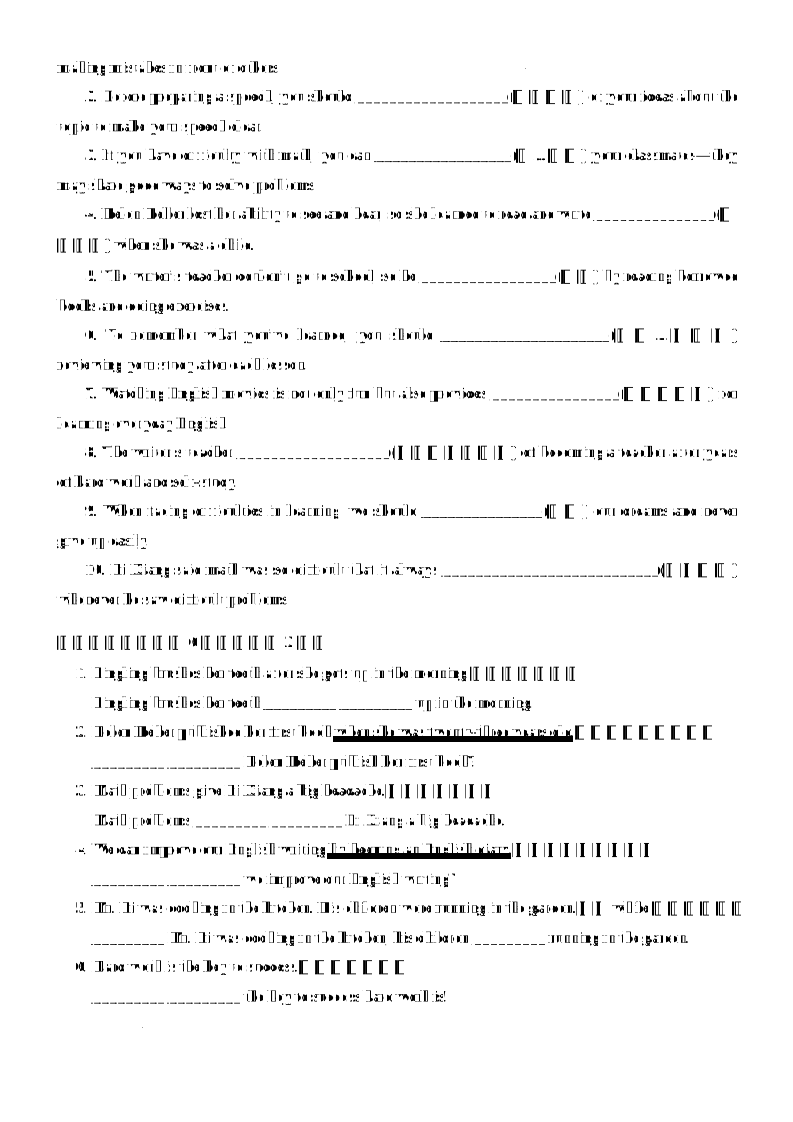
1. Many students are _________________(害怕) speaking in public because they worry about making mistakes in front of others.
2. Before preparing a speech, you should ___________________(列出清单) of your ideas about the topic to make your speech clear.
3. If you have difficulty with math, you can _________________(和…讨论) your classmates—they may share good ways to solve problems.
4. Helen Keller lost her ability to see and hear, so she learned to read and write _______________(通过触摸) when she was a child.
5. The writer’s teacher couldn’t go to school, so he _________________(自学) by reading borrowed books and doing exercises.
6. To remember what you’ve learned, you should _____________________(养成…的习惯) reviewing your study after each lesson.
7. Watching English movies is not only fun but also provides ________________(有用的材料) for learning everyday English.
8. The writer’s teacher ___________________(实现了他的梦想) of becoming a teacher after years of hard work and self-study.
9. When facing difficulties in learning, we should _______________(坚持) our dreams and never give up easily.
10. Li Xiang said math was so difficult that it always ___________________________(让他头疼) whenever he saw difficult problems.
六、句型转换(共6小题,每题2分)
1. Lingling brushes her teeth after she gets up in the morning.(改为同义句)
Lingling brushes her teeth _________ _________ up in the morning.
2. Helen Keller published her first book when she was twenty-three years old.(对划线部分提问)
_________ _________ Helen Keller publish her first book?
3. Math problems give Li Xiang a big headache.(改为否定句)
Math problems _________ _________ Li Xiang a big headache.
4. We can improve our English writing by keeping an English diary.(对划线部分提问)
_________ _________ we improve our English writing?
5. Mr. Li was cooking in the kitchen. His children were running in the garden.(用while合并为一句)
_________ Mr. Li was cooking in the kitchen, his children _________ running in the garden.
6. Hard work is the key to success.(改为感叹句)
_________ _________ the key to success hard work is!
七、汉译英(每题2分,共24分)
1. 玲玲总是害怕在公众面前说话,因为她担心自己会说错话。
_______________________________________________________________________________
_______________________________________________________________________________
2. 迈克尔建议,在演讲前先列出关于主题的想法。
_______________________________________________________________________________
_______________________________________________________________________________
3. 李翔觉得数学很难,每当遇到数学题时,他都感到很头疼。
_______________________________________________________________________________
_______________________________________________________________________________
4. 小雅告诉李翔,和别人讨论能找到解题方法。
_______________________________________________________________________________
_______________________________________________________________________________
5. 海伦·凯勒十九个月大时,一场重病让她既失明又失聪。(Helen Keller, both…and…)
_______________________________________________________________________________
_______________________________________________________________________________
6. 海伦·凯勒六岁时遇到了她的老师,并开始通过触摸学习读写。
_______________________________________________________________________________
_______________________________________________________________________________
7. 为了记住新单词,你应该把它们写在笔记本上,并且随身携带笔记本。(take…with…)
_______________________________________________________________________________
_______________________________________________________________________________
8. 练习大声朗读英语课文不仅能帮助你记忆,还能提高你的发音水平。(not only…but also…)
_______________________________________________________________________________
_______________________________________________________________________________
9. 那个女人一看到树林里冒烟,就立刻给消防员打了电话。(as soon as)
_______________________________________________________________________________
_______________________________________________________________________________
10. 我洗完澡后感觉好多了,于是坐下来复习当天的数学功课。(after, so)
_______________________________________________________________________________
_______________________________________________________________________________
11. 李先生在厨房做饭时,他的孩子们正在花园里玩耍。(while)
_______________________________________________________________________________
_______________________________________________________________________________
12. 作者从老师的故事中学到,努力是成功的关键,只要你坚持你的梦想。(the key to…, as long as, stick to)
_______________________________________________________________________________
_______________________________________________________________________________
Unit 7.4 wrapping up the topic 答案
一、单项选择题
1. C 2. B 3. A 4. C 5. B 6. C
二、单句语法填空
1. headache 2. to deal 3. the 4. with 5. aloud 6. borrowed 7. as 8. for 9. to enter 10. thinking
三、语篇选词填空
1. write 2. new 3. take 4. remember 5. sentence 6. practice 7. aloud 8. improves 9. diary 10. useful
四、短文填空
1. born 2. However 3. borrowed 4. himself 5. progress 6. efforts 7. If 8. the 9. did 10. what
五、根据句意及汉语提示填入适当单词或短语
1. afraid of 2. make a list 3. discuss with 4. by touching 5. taught himself 6. develop a habit of 7. useful materials 8. realized his dream 9. stick to 10. gives him a big headache
六、句型转换
1. after getting 2. When did 3. don’t give 4. How can 5. While; were 6. What important
七、汉译英
1. Lingling is always afraid of speaking in public because she worries that she will say something wrong.
2. Michael suggests making a list of ideas about the topic before giving a speech.
3. Li Xiang thinks math is really difficult, and he feels a big headache whenever he meets math problems.
4. Xiao Ya tells Li Xiang that discussing with others can help find ways to solve the problems
5. When Helen Keller was nineteen months old, a serious illness made her both blind and deaf.
6. Helen Keller met her teacher when she was six, and began to learn to read and write by touching.
7. To remember new words, you should write them down in a notebook and take the notebook with you.
8. Practicing reading English texts aloud can not only help you remember but also improve your pronunciation.
9. The woman called the fireman as soon as she saw the smoke in the woods.
10. I felt much better after taking a shower, so I sat down to review my math lessons that day.
11. While Mr. Li was cooking in the kitchen, his children were playing in the garden.
12. The writer learned from his teacher’s story that hard work is the key to success, and as long as you stick to your dream.
学科网(北京)股份有限公司
$
资源预览图

1

2
3
所属专辑

相关资源
示范课
由于学科网是一个信息分享及获取的平台,不确保部分用户上传资料的 来源及知识产权归属。如您发现相关资料侵犯您的合法权益,请联系学科网,我们核实后将及时进行处理。