考前押题07 阅读理解之话题专练(期末复习专项训练)七年级英语上学期新教材外研版
2025-12-25
|
2份
|
64页
|
656人阅读
|
35人下载
资源信息
| 学段 | 初中 |
|---|---|
| 学科 | 英语 |
| 教材版本 | 初中英语外研版七年级上册 |
| 年级 | 七年级 |
| 章节 | - |
| 类型 | 题集-专项训练 |
| 知识点 | - |
| 使用场景 | 同步教学-期末 |
| 学年 | 2025-2026 |
| 地区(省份) | 全国 |
| 地区(市) | - |
| 地区(区县) | - |
| 文件格式 | ZIP |
| 文件大小 | 2.40 MB |
| 发布时间 | 2025-12-25 |
| 更新时间 | 2025-12-25 |
| 作者 | xkw_027340698 |
| 品牌系列 | 上好课·考点大串讲 |
| 审核时间 | 2025-12-25 |
| 下载链接 | https://m.zxxk.com/soft/55623631.html |
| 价格 | 3.00储值(1储值=1元) |
| 来源 | 学科网 |
内容正文:
专题07 阅读理解之话题专练
话题1 学校生活(重点)
话题4 传统节假日(常考点)
话题2 兴趣爱好(常考点)
话题5 植物的重要性(难点)
话题3 家庭关系(常考点)
话题6 保护动物(难点)
话题1 学校生活
Passage 1
SCHOOL OPEN DAY
DATE: 30 November
TIME
ACTIVITIES (活动)
PLACES
8 am
See around the school and students’ artworks (艺术作品)
Art room
9 am
Watch the students do morning exercises
Playground
9:30 am
Have a parents’ meeting
School hall
10 am
Watch two lessons (English & maths)
Teaching building
1 pm
Attend (参加) the music party (about 90 minutes)
Music room
根据语篇内容, 选择最佳选项。
1.Where don’t the parents go on the School Open Day?
A.To the art room.
B.To the computer room.
C.To the school hall.
2.When do the students do morning exercises?
A.At 8 am. B.At 8: 30 am. C.At 9 am.
3.Where do the parents have a parents’ meeting?
A.In the teaching building.
B.In the playground.
C.In the school hall.
4.What lesson will be open to parents?
A.The art lesson.
B.The English lesson.
C.The music lesson.
5.How long does the School Open Day last (持续)?
A.5 hours.
B.Over 6 hours.
C.Over 7 hours.
【答案】1.B 2.C 3.C 4.B 5.B
【导语】本文是关于学校开放日的活动安排,包括活动的时间、地点及内容。通过这些安排,家长可以参观学校及其教学活动。
1.细节理解题。根据“Art room”和“School Hall”可知,没有提到去电脑室, 故选B。
2.细节理解题。根据“9 am Watch the students do morning exercises”可知,学生们的晨练是在早上九点进行的。故选C。
3.细节理解题。根据“Have a parents’ meeting School Hall”可知,家长会是在学校礼堂进行的。故选C。
4.细节理解题。根据“Watch two lessons (English & maths)”可知,家长可以观看的课是英语课和数学课,故选B。
5.推理判断题。从活动表来看,活动从早上八点开始,到音乐会结束(约90分钟),音乐会下午一点开始,估算可知整个开放日持续超过6小时。故选B。
Passage 2
On the morning of every Monday, two of my children get ready for school. They each carry a large bag with some clothes, a pair of shoes, lots of food and water. But there isn’t any book in it.
Then instead of walking them to school as I do on the other school days, I drive them to a nearby park. This is where they are going to spend the day and have lessons. Right, my boys go to a forest school once a week. It is from 8:30 am to 3:30 pm. A group of kids explore the forests, lakes and animals in nature together.
I loved the idea of the forest school, but I worried about a few things at first. Would the teachers let the kids play freely? Would my kids be safe outside for that long? Would they enjoy themselves?
To my surprise, my boys get used to the school life quickly. Most of the time, they plan their own play, climb tall trees, build fires and do many other interesting things. The teachers never tell them that their play is too high, too fast, or too dangerous. They only follow the kids and help when something goes wrong.
When I pick the boys up at the end of the afternoon, they often look lively, happy and never want to leave. The forest school teaches them to look after themselves and get along well with nature. I think that is important.
1.How do the writer’s sons go to the forest school?
A.On foot. B.By car. C.By bike. D.By bus.
2.What don’t the students need to bring to the forest school?
A.books B.clothes C.food D.water
3.What do we know about the forest school?
A.Students follow teachers all the time.
B.It is a great school for people of different ages.
C.Teachers teach students different subjects in nature.
D.Children explore nature with the help of their teachers.
4.What’s the change in the writer’s feelings toward the forest school?
A.sad-surprised-worried B.nervous-worried-surprised
C.worried-surprised-happy D.happy-surprised-worried
5.What’s the title of the text?
A.A busy day at school B.Helpful teachers and their students
C.Different schools around the world D.Forest school—a different way to learn
【答案】1.B 2.A 3.D 4.C 5.D
【导语】本文主要讲述了作者的两个儿子每周一去森林学校学习的经历,以及作者对这所特殊学校的情感变化和认可。
1.细节理解题。根据“Then instead of walking them to school as I do on the other school days, I drive them to a nearby park.”可知,“drive” 表示 “开车”,直接对应 “By car”。故选B。
2.细节理解题。根据“But there isn’t any book in it.”可知,学生无需带书。故选A。
3.细节理解题。根据“A group of kids explore the forests, lakes and animals in nature together.”和“They only follow the kids and help when something goes wrong.”可知,孩子们在自然中探索,老师会在需要时提供帮助。故选D。
4.推理判断题。根据原文第三段提到 “I worried about a few things”可知,最初担忧(worried);第四段开头 “To my surprise”可知,随后惊讶(surprised);结尾提到孩子回家时 “look lively, happy”(看起来活泼开心),且作者认为森林学校很重要,表明她感到高兴和满意。故选C。
5.最佳标题题。根据“The forest school teaches them to look after themselves and get along well with nature. I think that is important.”及全文可知,全文核心是介绍一种与传统学校不同的学习方式:在森林中探索自然(非书本学习)、孩子自主活动、老师辅助。故选D。
Passage 3
In China, many students spend much of their time on their own things, and don’t help with housework at home. As a result, they don’t have basic life skills. Luckily, things are changing. Now, many schools begin to teach students life skills.
Guangming Middle School has set up some farming clubs. Students learn to plant vegetables there. “At first, I thought I could only grow some vegetables here, but in fact, I have learned a lot about vegetables,” said Chen Jia, a girl at the school.
In Hope Middle School, students have a life skill class. They learn to make dumplings in different shapes. “I couldn’t make dumplings before, but now I am good at doing it. I really love my life skill class. It’s my favorite class,” said Zhang Yan, a boy at the school.
In fact, learning life skills is as important as learning Chinese and maths, because it helps us prepare for our future life. Boys and girls, do you help your parents do housework at home? If not, maybe you should get started now.
1.What is the common problem of most Chinese students?
A.They show no interest in basic skills.
B.They hardly gain any basic life skills.
C.They have no chance to do their own things.
D.They spend little time on their personal hobbies.
2.What has Chen Jia learnt in the farming club?
A.Much about vegetables. B.Just how to plant vegetables.
C.Something about farming. D.How to set up a club.
3.What did Zhang Yan think of his life skill lesson?
A.It was his least favorite class.
B.It’s useful but boring.
C.It made him skilled in making dumplings.
D.It taught him to make dumplings in one shape.
4.Who is the passage written for?
A.Teachers. B.Parents. C.Clubs. D.Students.
5.What will the writer probably agree with?
A.Students should do more homework.
B.Students should only learn Chinese and maths well.
C.Students should learn some basic life skills.
D.Students should not help their parents with the housework.
【答案】1.B 2.A 3.C 4.D 5.C
【导语】本文是一篇说明文,文章主要讲述了中国许多学生缺乏基本生活技能的现象,以及一些学校通过开设农业俱乐部和生活技能课程来改变这一状况。文章强调了学习生活技能的重要性,并呼吁学生们在家帮助父母做家务。
1.细节理解题。根据文章第一段“In China, many students spend much of their time on their own things, and don’t help with housework at home. As a result, they don’t have basic life skills.”可知,大多数中国学生几乎没有任何基本生活技能。故选B。
2.细节理解题。根据文章第二段“At first, I thought I could only grow some vegetables here, but in fact, I have learned a lot about vegetables”可知,陈佳在农业俱乐部学到了很多关于蔬菜的知识。故选A。
3.细节理解题。根据文章第三段“I couldn’t make dumplings before, but now I am good at doing it.”可知,张岩认为生活技能课让他擅长包饺子了。故选C。
4.推理判断题。根据文章最后一段“Boys and girls, do you help your parents do housework at home? If not, maybe you should get started now.”可知,文章是写给学生的。故选D。
5.推理判断题。根据文章最后一段“In fact, learning life skills is as important as learning Chinese and maths, because it helps us prepare for our future life.”可知,作者认为学生应该学习一些基本的生活技能。故选C。
Passage 4
①John Dawkins is a teacher from America. He teaches English at a middle school.
②Before class, Mr Dawkins stands outside the classroom. He greets his students there. He doesn’t just say hello to his students. There are some pictures outside the classroom. He lets the students choose (选择) their favourite way of greeting from the pictures. They can choose a handshake, a high five, a fist bump, a thumbs up, a wave, or a hello!
③Mr Dawkins greets his students every day. He wants to know what his students like. He wants to be there for them. He wants them to be happy. He wants them to know they are important to him.
④The students like Mr Dawkins’ ways of greeting. They think their teacher is great. They are happy to have a teacher like Mr. Dawkins.
1.Mr. Dawkins teaches ________.
A. B. C. D.
2.There are ________ ways of greeting for Mr. Dawkins’ students to choose from.
A.3 B.4 C.5 D.6
3.Paragraph (段落) 3 is about ________ Mr. Dawkins greets his students.
A.how B.when C.why D.where
4.What do the students think of Mr. Dawkins?
A.He looks cool. B.He is a great teacher.
C.He is happy every day. D.He is important to the students.
5.What can we infer (推断) from the passage?
A.Mr. Dawkins loves his students. B.The ways of greeting are not important.
C.Students are very busy at school. D.Greetings make the school life colourful.
【答案】1.A 2.D 3.C 4.B 5.A
【导语】本文主要介绍了来自美国的老师约翰·道金斯独特的问候方式,他让学生从图片中选择自己喜欢的问候方式,学生们很喜欢他的这种方式,认为他是一位很棒的老师。
1.细节理解题。根据“John Dawkins is a teacher from America. He teaches English at a middle school.”可知,道金斯先生教英语。故选A。
2.细节理解题。根据“There are some pictures outside the classroom. He lets the students choose (选择) their favourite way of greeting from the pictures. They can choose a handshake, a high five, a fist bump, a thumbs up, a wave, or a hello!”可知,学生们有六种问候方式可以选择,分别是握手、击掌、碰拳、竖起大拇指、挥手和打招呼。故选D。
3.主旨大意题。根据“Mr Dawkins greets his students every day. He wants to know what his students like. He wants to be there for them. He wants them to be happy. He wants them to know they are important to him.”可知,第三段主要讲述了道金斯先生问候学生的原因。故选C。
4.细节理解题。根据“The students like Mr. Dawkins’ ways of greeting. They think their teacher is great.”可知,学生们认为道金斯先生是一位很棒的老师。故选B。
5.推理判断题。根据“Mr Dawkins greets his students every day. He wants to know what his students like. He wants to be there for them. He wants them to be happy. He wants them to know they are important to him.”以及“The students like Mr. Dawkins’ ways of greeting.”可知他通过让学生选择自己喜欢的问候方式来与学生互动,可见道金斯先生很爱他的学生。故选A。
话题2 兴趣爱好
Passage 1
I go to my guitar class on Monday afternoons. I always run into class and start playing the guitar right away. “Miss Helen,” I say to my music teacher, “The music plays in my head all day and even during other classes!”
A few weeks later, my English teacher says, “Your English grades are not good because your mind is all about playing the guitar.” Later, I study hard in class and practise playing the guitar when I have free time. With time going by, I create a lot of music works even though I’m busy with my studies.
I often show my friends my music works. They feel happy and like them very much. I also tell them I want to be a musician to make many people delighted. To my surprise, making music is good for my English spelling and writing. Now I do very well in English. I feel very happy.
My love for music teaches me to be brave to face any problem and solve it in the end. What I’m good at can also help me do well in other subjects.
1.When does the writer go to his guitar class?
A.Every Sunday morning. B.Every Monday afternoon.
C.Every Saturday morning. D.Every Sunday afternoon.
2.What can we learn from the English teacher’s words according to Paragraph 2?
A.The writer’s grades are getting better.
B.The writer doesn’t like music.
C.The writer is not good at music at all.
D.The writer can’t study English well because of music.
3.What does the underlined word “delighted” mean?
A.Happy. B.Bored. C.Sad. D.Amazed.
4.What kind of person is the writer according to the passage?
A.Lazy. B.Friendly. C.Hard-working. D.Quiet.
5.What is the main idea of the passage?
A.The writer wants to give up music to study English. B.Hobbies can help us with our study sometimes.
C.Music is not as important as other school subjects. D.The teacher’s words help the writer get good grades.
【答案】1.B 2.D 3.A 4.C 5.B
【导语】本文主要讲述了作者因热爱吉他一度影响英语成绩,后通过合理分配时间,既坚持音乐创作又提升了学习成绩,还发现爱好能助力学科学习的经历,体现了爱好与学业可相互促进的道理。
1.细节理解题。根据文章第一段“I go to my guitar class on Monday afternoons.”可知,作者每周一下午去上吉他课,故选B。
2.细节理解题。根据文章第二段英语老师的话“Your English grades are not good because your mind is all about playing the guitar.”可知,作者因专注音乐导致英语成绩不佳,故选D。
3.词句猜测题。结合前文“They feel happy and like them very much.”可推知,作者想成为音乐家让人们感到“愉悦”,“delighted”对应“happy”,故选A。
4.推理判断题。根据“With time going by, I create a lot of music works even though I’m busy with my studies.”以及第三段内容,可知作者在兼顾学业的同时坚持音乐创作,还提升了成绩,体现了“勤奋”的特质,故选C。
5.主旨大意题。文章结尾提到“What I’m good at can also help me do well in other subjects.”,可知核心主旨是“爱好有时能助力学业”,故选B。
Passage 2
Is there a special hobby that you love? Maybe others think it’s a bit odd (奇怪的), but it makes you so happy. You spend lots of time on it, and it always lights up your day.
_______________
Whenever I see my favorite bus on the road, I ask my dad to stop our car. Then I hop on (跳上) a bus tour. Over the past 10 years, I have ridden all the bus lines in Beijing more than 2200 times! I love looking out of the bus window. I see how the city centre gets busier. Riding buses shows me the city and the lives of its people.
Zhang Chuyang, 13, BeijingMelody maker
When I feel something strongly, whether happy or sad, tunes (曲调) jump into my mind. Friday evenings are my special time for writing songs. It’s the best way to relax after a long week.
My friends often write or post photos online to share their feelings. Writing music is a cooler way to do that!
Xie Keyu, 11, NingboLaugh out loud
As a lover of Xiangsheng, or crosstalk, I visit my Xiangsheng teacher every week to learn. It’s not easy. Some scripts (剧本) are longer than our textbooks! And Xiangsheng isn’t that popular these days. But I love the special rhymes (韵词) of it.
Cao Haoran, 13, Tianjin
1.In which SECTION of the newspaper can we read the passage?
A.SPECIAL ME B.SCHOOL LIFE C.STORYLAND D.OUR WORLD
2.The best heading for the paragraph about Zhang Chuyang would be ________________.
A.Buses in Beijing B.Crazy about buses C.Get around the city D.My life in Beijing
3.What does the underlined word “that” refer to (指的是)?
A.Writing online. B.Getting relaxed. C.Sharing feelings. D.Posting photos online.
4.What can we know about Cao Haoran?
A.He goes to a school for Xiangsheng lovers.
B.He hopes to make Xiangsheng popular again.
C.He learns Xiangsheng from his teacher once a week.
D.He loves Xiangsheng though (尽管) it’s difficult to learn.
5.The passage focuses on some students’ ________.
A.hobbies B.talents (天赋) C.school life D.personal information
【答案】1.A 2.B 3.C 4.D 5.A
【导语】本文主要介绍了三位学生独特并且让他们感到快乐的个人爱好。
1.推理判断题。本文主要介绍了三位学生的特殊爱好,属于个人兴趣的介绍,因此应放在SPECIAL ME,即特别的我的板块。故选A。
2.最佳标题题。根据“Whenever I see my favorite bus on the road, I ask my dad to stop our car. Then I hop on a bus tour. Over the past 10 years, I have ridden all the bus lines in Beijing more than 2200 times! I love looking out of the bus window. I see how the city centre gets busier.”可知,张楚阳的爱好是乘坐公交车,在过去的10年里,乘坐了北京所有的公交线路2200多次,表现出对公交的极度热爱,因此最佳标题是Crazy about buses。故选B。
3.词句猜测题。根据“My friends often write or post photos online to share their feelings. Writing music is a cooler way to do that!”可知,朋友们经常在网上写下或上传照片来分享他们的感受,写音乐是一种更酷的方式,此处that指代的是前一句的Sharing feelings。故选C。
4.细节理解题。根据“It’s not easy. ...But I love the special rhymes (韵词) of it.”可知,尽管学习相声有难度,但他依然热爱。故选D。
5.主旨大意题。本文主要围绕几位同学的爱好展开,因此主要内容是hobbies。故选A。
Passage 3
Ben wanted to join a sports club. He filled out this application (申请) form.
1.Which sports club does Ben want to join?
A.Watson Bay Sports Club. B.Newtown Sports Club.
C.Beach Road Sports Club. D.Main Road Sports Club.
2.Ben was __________ years old when he had his last medical examination.
A.eleven B.twelve C.thirteen D.fourteen
3.How long after his last medical examination did Ben fill out this form?
A.Less than three months. B.Almost nine months.
C.About a year. D.About six months.
4.Who did Ben write his letter to?
A.His parents. B.Dr. Ian Smith.
C.Watson Bay Wildcats. D.The secretary of Newtown Sports Club.
5.He wanted the club to __________.
A.know what prize he had ever won B.accept him as a new member
C.help him to go over the form D.know he was a sports lover
【答案】1.B 2.C 3.A 4.D 5.B
【导语】本文主要介绍了Ben想加入体育俱乐部,他填写了申请表并附上信件,表达加入的愿望。
1.细节理解题。从信件抬头 “The secretary, Newtown Sport Club” 可知,Ben 想加入 Newtown 体育俱乐部,故选B。
2.推理判断题。根据“Date of birth: 2/24/1992”和“Date of last medical examination: 2/24/2005”可知,Ben 出生日期是1992年2月24日,上次体检日期是2005年2月24 日,所以Ben上次体检时的年龄为2005-1992=13,故选C。
3.推理判断题。根据“Date of last medical examination: 2/24/2005”和“Date: 5/21/2005”可知,上次体检是2005年2月24 日,填表日期是2005年5月21日,不到三个月,故选A。
4.细节理解题。信件开头是“Dear Sir/Madam”,且寄给 Newtown 体育俱乐部的秘书(The secretary, Newtown Sport Club),故选D。
5.推理判断题。从信件中“I hope to become a member of your club. I’d be grateful if I’ll be accepted by your club.” 可知,他希望被俱乐部接纳为新成员,故选B。
Passage 4
If you’re looking for a new hobby, bird-watching is a good choice (选择). Anyone can do it. It’s an easy hobby. You can watch the birds by yourself or with others. Bird-watching is also a joyful (令人开心的) hobby. Scientists say seeing and hearing birds can help people feel happy.
How to start bird-watching? There are three tips (建议).
First, you need to learn to identify (识别) birds. To watch the birds, you have to get a book about birds first. It will have the information (信息) you need to identify different kinds of birds. You can also use an app (应用程序). Merlin Bird ID is a free app. The app makes identifying birds easy. It will let you identify birds by the sounds they make.
Second, you should know where to go bird-watching. You can observe the birds almost anywhere, even if (即使) you live in the city. Just remember to visit places near water, because when birds get thirsty (渴), they like to go to lakes and rivers.
Third, you had better (最好) get what you need for bird-watching. Sometimes birds are far away in big trees. You can’t see them clearly (清晰地). To watch these birds, you need binoculars (双筒望远镜). Binoculars can help you see birds up close.
Bird-watching is more than a hobby—it’s a great way to enjoy nature. Just go outside to look and listen! You’ll be surprised (惊讶) how many birds are around you.
1.Why does the writer think bird-watching is good?
A.Because we can keep birds at home.
B.Because it doesn’t need much money.
C.Because we can go far to find birds.
D.Because it’s an easy hobby for everyone.
2.What can Merlin Bird ID app help people do?
A.Buy a pair of binoculars.
B.Learn how to make birdhouses.
C.Find good places to watch birds.
D.Identify birds by the sounds easily.
3.What does the underlined word “observe” in Paragraph 4 mean?
A.Catch easily. B.Watch carefully.
C.Hear clearly. D.Hold quickly.
4.Which is TRUE according to the passage?
A.It’s not good to go bird-watching in the city.
B.To take pictures of birds, you need binoculars.
C.Places near rivers are good places for bird-watching.
D.A book about birds tells us how to start bird-watching in a park.
5.What is the passage mainly about?
A.The places to watch birds.
B.The apps to identify birds.
C.The tips to start bird-watching.
D.The books to introduce bird-watching.
【答案】1.D 2.D 3.B 4.C 5.C
【导语】本文主要介绍了培养观鸟爱好的建议。
1.细节理解题。根据“Anyone can do it. It’s an easy hobby.”可知,观鸟对每个人来说都是容易上手的爱好,所以作者认为观鸟是件好事。故选D。
2.细节理解题。根据“The app makes identifying birds easy. It will let you identify birds by the sounds they make.”可知,该应用可帮助人们通过鸟的声音轻松识别鸟类。故选D。
3.词句猜测题。根据“You can observe the birds almost anywhere, even if (即使) you live in the city.”可知,几乎可以在任何地方观察到鸟,划线词意为“观察”,即Watch carefully。故选B。
4.推理判断题。根据“Just remember to visit places near water, because when birds get thirsty (渴), they like to go to lakes and rivers.”可知,当鸟类口渴时,它们喜欢去湖泊和河流,由此推知,河流附近是观鸟的好地方。故选C。
5.主旨大意题。根据文章内容可知,文章主要介绍了开始观鸟的三个建议,包括识别鸟类、观鸟地点、所需装备等。故选C。
话题3 家庭关系
Passage 1
Today is Sunday. Bob is reading a book under a tree. Grandfather, an 80-year-old man, is sitting in the sun. Grandfather sees a model plane in the tree and asks him, “What’s that in the tree, Bob?”
“It’s a model plane.” Bob answers.
Then Grandfather asks him again, “What’s that in the tree, Bob?” “It’s a model plane.” Bob tells him again.
Later, Grandfather asks him that question again. Bob is annoyed and says loudly to Grandfather, “It’s a model plane!”
Grandfather doesn’t say a word. He goes into the house and then comes out with an old diary in his hand. Then he reads, “Wednesday, August 15. Today, my little Bob sees a thing in a tree and asks me what it is. I tell him that it’s a model plane. He asks me many times (次数) and I tell him many times. I am really glad to see his happy face ...”
After hearing that, Bob’s face turns red. He comes to Grandfather and hugs him. He knows he should be patient (耐心的) with his grandfather. He will be old one day.
1.Who is the old man?
A.Bob’s uncle. B.Bob’s father. C.Bob’s grandfather.
2.How many times does Grandfather ask Bob?
A.Twice. B.Three times. C.Four times.
3.What does the underlined word “annoyed” mean in Paragraph 4?
A.Angry. B.Happy. C.Worried.
4.How does Bob feel after hearing Grandfather’s diary?
A.Cool. B.Great. C.Sorry.
5.What is the best title for the text?
A.Keep a Diary Every Day
B.Always Be Patient with the Old
C.How to Find a Model Plane
【答案】1.C 2.B 3.A 4.C 5.B
【导语】本文讲述了祖父问鲍勃同一个问题,问了三遍,鲍勃就感到生气了。他的祖父拿出他的日记,里面记叙了鲍勃问祖父一个问题,问了很多遍,祖父告诉了他很多遍。听了祖父的话后,鲍勃知道他应该对祖父耐心些。
1.细节理解题。根据“Today is Sunday. Bob is reading a book under a tree. Grandfather, an 80-year-old man, is sitting in the sun.”可知,这位老人是鲍勃的祖父,故选C。
2.细节理解题。根据第一段“What’s that in the tree, Bob?”以及第三段“Then Grandfather asks him again, ‘What’s that in the tree, Bob?’”以及第四段“Later, grandfather asks him that question again.”可知,爷爷问鲍勃三次问题,故选B。
3.词句猜测题。根据第四段“Later, Grandfather asks him that question again. Bob is annoyed and says loudly to Grandfather, ‘It’s a model plane!’”可知,鲍勃回答爷爷的声音比较大,结合上文爷爷已经问过两次了,可推知此处是指鲍勃很生气,故选A。
4.推理判断题。根据最后一段“After hearing that, Bob’s face turns red. He comes to Grandfather and hugs him. He knows he should be patient with his grandfather. He will be old one day”可知,听到这些,鲍勃的脸变红了,他知道他应该对他的祖父有耐心,所以鲍勃听了爷爷的日记后应是感觉很抱歉,故选C。
5. 最佳标题题。根据最后一段“After hearing that, Bob’s face turns red. He comes to Grandfather and hugs him. He knows he should be patient with his grandfather. He will be old one day”可知,文章中提到鲍勃应该对爷爷有耐心,因为自己有一天也会变老。因此,最好的标题应该是“Always Be Patient with the Old”,即“永远对老人有耐心”,故选B。
Passage 2
Erin does her ballet practice in the living room. Her sister Hannah watches, looking a bit unhappy. “What’s the matter, Hannah?” asks Erin. “You look so pretty when you dance. I’d so love to be able to dance like that, too!” says Hannah. “That’s a very good idea. I can teach you. Let’s see, what music shall I put on for your first lesson? I know we shall have Swan Lake.” smiles Erin.
Erin runs over to the CD player and puts the disc (唱片) on, and then she returns to the middle of the room. “Come on, Hannah. Stand next to me and do the first position (姿势),” she says. Hannah stands up straight and tall. Slowly, Erin shows Hannah all the positions while Hannah learns her moves. Hannah looks very happy with herself. “It’s really not that challenging. I am sure I can do a pirouette (单脚尖旋转). Look at me,” says Hannah. Then she starts to practice her pirouette, turning round and round. But then, she suddenly falls onto the floor.
Erin comes over and says, “All right, Hannah, today’s practice is over. Let’s have some tea. And tomorrow, I think you should have more lessons. It’s not that easy to dance, is it? However, as long as you keep doing it, you will make it.”
1.How did Hannah feel when watching her sister dancing?
A.Bored. B.Worried. C.Sad. D.Tired.
2.How did Erin help Hannah?
A.By buying her a CD player. B.By showing her dance moves.
C.By teaching her to play music. D.By taking her to a lake.
3.The underlined word “challenging” has the closest meaning to “________”.
A.difficult B.interesting C.important D.dangerous
4.What did Erin try to teach her sister in the end?
A.Seeing is believing. B.Practice makes perfect.
C.Well begun is half done. D.Two heads are better than one.
5.What was Erin like?
A.Quiet. B.Lively. C.Strict. D.Kind.
【答案】1.C 2.B 3.A 4.B 5.D
【导语】本文是一篇记叙文,讲述了姐姐艾琳耐心教导妹妹汉娜学习芭蕾舞,并通过一次失败的尝试让妹妹明白成功需要持续练习的道理。
1.细节理解题。根据“Her sister Hannah watches, looking a bit unhappy. ‘You look so pretty when you dance. I’d so love to be able to dance like that, too!’”可知,汉娜看姐姐跳舞时因羡慕自己做不到而难过,故选C。
2.细节理解题。根据“Slowly, Erin shows Hannah all the positions while Hannah learns her moves.”可知,艾琳通过展示舞蹈动作来帮助汉娜,故选B。
3.词句猜测题。根据“Hannah looks very happy with herself. ‘It’s really not that challenging. I am sure I can do a pirouette.’ ”及后文她尝试旋转摔倒可知,“challenging”意为“困难的”,与“difficult”最接近,故选A。
4.推理判断题。根据“However, as long as you keep doing it, you will make it.”可知,艾琳试着教汉娜“熟能生巧”的道理,故选B。
5.推理判断题。结合全文,艾琳主动提出教汉娜跳舞,在她摔倒后安慰并鼓励她坚持,这些体现了艾琳的善良,故选D。
Passage 3
Do you know how to spend great time with your family? Family is the most important people. Spending time with family is good for both children and parents. Here are some tips on how to spend some great time with family.
Have a family film every week. A free weekend is a great time for a film. Parents and children can take turns (轮流) to choose what films to see. With some popcorn (爆米花) and each one’s favourite drink, parents and children get relaxed (放松的) and laugh when they see the film.
Start a family book club. Everyone in the family book club can take turns to choose books to read. Find a nice place, sit down and talk about them together.
Take a family nature walk. Going into nature gives people a special kind of place. That helps family members enjoy each other’s company and feel relaxed. So take a family nature walk, and enjoy the beauty of nature.
Whatever (无论什么) the activity is, the most important thing is that the family spend some time together and have fun. 根据材料内容选择最佳答案。
1.How does the writer start the text?
A.By singing a song. B.By using numbers.
C.By showing pictures. D.By asking a question.
2.How do parents and children feel when they see a film with some popcorn?
A.Sorry. B.Interested. C.Relaxed. D.Funny.
3.What does the underlined word “company” mean in Chinese?
A.陪伴 B.联系 C.承诺 D.潜力
4.What does the writer want to show us?
A.How to start different kinds of clubs. B.How to make popcorn and drinks.
C.How to introduce different family members. D.How to spend great time with family.
5.What is the structure of the text? (①=Paragraph 1)
A. B. C. D.
【答案】1.D 2.C 3.A 4.D 5.B
【导语】本文主要介绍了与家人共度美好时光的几种方法,包括举办家庭电影之夜、创办家庭读书俱乐部和进行家庭大自然散步。
1.细节理解题。根据“Do you know how to spend great time with your family?”可知,作者通过提问的方式开始这篇文章。故选D。
2.细节理解题。根据“With some popcorn and each one’s favourite drink, parents and children get relaxed and laugh when they see the film.”可知,当父母和孩子一起看电影时他们会感到放松。故选C。
3.词句猜测题。根据“Going into nature gives people a special kind of place. That helps family members enjoy each other’s company and feel relaxed”可知,走进大自然有助于家庭成员享受彼此的陪伴并感到放松。company在此处意为“陪伴”。故选A。
4.主旨大意题。根据文章内容可知,文章围绕“如何与家人共度美好时光”这一主题展开,分别介绍了三种具体的方法。可推知,作者旨在告诉我们如何与家人共度美好时光。故选D。
5.篇章结构题。根据文章内容可知,文章第一段总述主题并提出建议;第二、三、四段分别阐述“举办家庭电影夜”、“创办家庭读书俱乐部”、“进行家庭大自然散步”这三种具体建议;第五段总结强调“家人共度时光”的重要性。结构为“总—分—总”,即①/②③④/⑤。 故选B。
Passage 4
Chinese people write the word “family” as “家”. The “豕” in it means “pig”. In old times, Chinese families kept some animals for meat, sale, or helping with farm work. Pigs are one of them. The word “家” with a pig in a family may show those animals mean a lot to a family. Do you think this idea is special? Let’s learn more about the Chinese family.
There is a strong relationship (关系)between parents, children and other family members in a Chinese family. Parents should set a good example for their children. Children should study hard and be good to each other. Every family member should do some things to make family life better.
Ancestors (祖先)also have a deep relationship with Chinese family. They bring families and family members together. Many people from different families live in different cities and even countries, but they still remember they have the same ancestors. This makes them supportive to each other. They are always ready to help each other. When they think of them, they feel stronger inside.
The idea of “making all the members of the family happy” is always a part of the “China dream”. There are a lot of families in China. When every family is happy, China becomes better and better.
1.Why did Chinese families keep some animals:
a. To eat their meat. b. To sell them for money. c. To keep them as pets. d. To help do farm work.
A.a, b, c B.a, b, d C.a, c, d D.b, c, d
2.What is Paragraph 2 mainly about?
A.Parents’ work in a family. B.Some things to make family life better.
C.Children’s study at school. D.Relationship between family members.
3.What does the underlined word “supportive” mean in Paragraph 3?
A.Polite. B.Helpful. C.Bad. D.Special.
4.We can learn from the last paragraph that ______.
A.China dream is not about families B.making families happy is very easy
C.happy families can make China better D.making families happy is a new idea
5.What is the best title for the passage?
A.The Farm Animals B.The Special Ideas C.The China Dream D.The Chinese Families
【答案】1.B 2.D 3.B 4.C 5.D
【导语】本文是一篇说明文,主要介绍了中国家庭的文化内涵,包括汉字“家”的构成意义、家庭成员之间的关系、祖先对家庭的纽带作用,以及家庭幸福与中国梦的联系。
1.细节理解题。根据文章第1段“In old times, Chinese families kept some animals for meat, sale, or helping with farm work.”可知,选项a(吃肉)、b(售卖)和d(协助农活)均符合原文,而c(当宠物养)未提及。故选B。
2.主旨大意题。根据文章第2段“There is a strong relationship between parents, children and other family members…”可知,本段重点讨论家庭成员间的关系。故选D。
3.词句猜测题。根据文章第3段“They are always ready to help each other.”(他们总是乐于互相帮助。)可知,“supportive”意为“乐于助人的”。故选B。
4.推理判断题。根据文章最后一段“When every family is happy, China becomes better and better.”(当每个家庭都幸福时,中国会变得越来越好。)可推知,家庭幸福能促进国家发展。故选C。
5.最佳标题题。全文围绕中国家庭的文化内涵展开,包括汉字“家”的象征、家庭成员关系、祖先纽带及家庭与国家的关系。选项D(中国家庭)最能概括主题。故选D。
话题4 传统节假日
Passage 1
Qiuyue Wang10 June 2024In China, we celebrated the Dragon Boat Festival recently. I want to know about the festivals in your country. How do you celebrate them?
LIKE (点赞)·COMMENT (评论)·SHARE
Jaehyunan hour agoIn South Korea, Chuseok (秋夕) is around September each year. We eat a lot of delicious food on that day, for example, the songpyeon (松糕), a type of rice cake. It’s in the shape of a half-moon.
Olivia HouseyesterdayMany festivals in Australia are about religion (宗教), like Easter (复活节) and Christmas. Our traditions may not be the same because we are in the Southern Hemisphere (南半球)! For example, Christmas is in summer. You may be surprised that we take a day off for Valentine’s Day (情人节). Some people may celebrate it in a romantic (浪漫的) way, but most people just choose to rest.
Jiayue Wangtwo days agoIn Singapore, we have 11 public festivals every year, such as Chinese New Year, Hari Raya Puasa and Festival of Lights. There are many celebrations.
1.What does Qiuyue Wang want to know about in other countries?
A.Food. B.Festivals. C.Sports. D.History.
2.Who can you ask if you want to know more about Chuseok?
A.Qiuyue Wang. B.Jaehyun.
C.Olivia House. D.Jiayue Wang.
3.How many festivals does Olivia House mention (提到)?
A.One. B.Two. C.Three. D.Four.
4.Why are the traditions in Australia different?
A.Because people have their own idea.
B.Because Australia is in the Southern Hemisphere.
C.Because people like summer a lot.
D.Because people want to have a good rest.
5.Where can we find the text?
A.In a letter. B.In a storybook.
C.On the Internet (网络). D.In newspaper.
【答案】1.B 2.B 3.C 4.B 5.C
【导语】本文围绕不同国家的节日展开讨论, Qiuyue Wang询问其他国家的节日及庆祝方式,Jaehyun、Olivia House、Jiayue Wang分别介绍了韩国、澳大利亚、新加坡的节日情况。
1.细节理解题。根据文章第一段“Qiuyue Wang: I want to know about the festivals in your country. How do you celebrate them?”可知,Qiuyue Wang想了解其他国家的节日。故选B。
2.细节理解题。根据文章第二段“Jaehyun: In South Korea, Chuseok (秋夕), is around September each year.”可知,如果想了解更多关于秋夕的情况,可以问Jaehyun。故选B。
3.细节理解题。根据文章第三段“Olivia House: Many festivals in Australia are about religion (宗教), like Easter (复活节) and Christmas ... You may be surprised that we take a day off for Valentine’s Day (情人节).”可知,Olivia House提到了复活节、圣诞节、情人节三个节日。故选C。
4.细节理解题。根据文章第三段“Olivia House: Our traditions may not be the same because we are in the Southern Hemisphere (南半球)!”可知,澳大利亚的传统不同是因为它在南半球。故选B。
5.推理判断题。根据文中“LIKE (点赞)・COMMENT (评论)・SHARE”这些网络交流常见的互动标识可知,能在网络上找到这段文本。故选C。
Passage 2
Hello, I’m Li Mei! I’m living with my family in Singapore (新加坡). We celebrate the Spring Festival every year. But the Spring Festival here is a little different from that in China.
About a week before the Spring Festival, my parents start cleaning our house. When it’s finished, we go out to buy flowers and put them at home. It’s a tradition for people in Singapore. Then about three days before the Spring Festival, we go to Chinatown to buy food for the big dinner.
One day before the Spring Festival, my grandmother gets up early to cook the big dinner. She can cook very delicious food like laoyusheng (捞鱼生)—a traditional dish for the Spring Festival. There’s fish and different vegetables in it. My grandmother thinks it can bring us good luck.
The next day, we visit my uncle and aunt. I always bring two oranges to them. When we leave, they give me two oranges, too. It’s also a tradition.
Do you want to celebrate the Spring Festival with us? Come to Singapore!
1.Who will clean the house before the Spring Festival in Li Mei’s family?
A.Li Mei. B.Li Mei’s aunt. C.Li Mei’s parents. D.Li Mei’s grandmother.
2.Li Mei’s family go to Chinatown about ________ days before the Spring Festival.
A.two B.three C.five D.seven
3.What’s in laoyusheng?
A.Fish and vegetables. B.Eggs and fruits. C.Beef and vegetables. D.Noodles and chicken.
4.What does Li Mei give her uncle and aunt?
A.Flowers. B.Candies. C.Fish. D.Oranges.
5.What does the passage talk about?
A.Li Mei’s family life. B.The Spring Festival in China.
C.The Spring Festival in Singapore. D.Things to do before the Spring Festival.
【答案】1.C 2.B 3.A 4.D 5.C
【导语】本文主要讲述了居住在新加坡的李梅一家庆祝春节的情况。
1.细节理解题。根据“About a week before the Spring Festival, my parents start cleaning our house.”可知,李梅的父母在春节前开始打扫房子。故选C。
2.细节理解题。根据“Then about three days before the Spring Festival, we go to Chinatown to buy food for the big dinner.”可知,在春节前三天李梅一家去唐人街。故选B。
3.细节理解题。根据“She can cook very delicious food like laoyusheng (捞鱼生) ... There’s fish and different vegetables in it.”可知,捞鱼生里有鱼和不同的蔬菜。故选A。
4.细节理解题。根据“The next day, we visit my uncle and aunt. I always bring two oranges to them.”可知,李梅总是给叔叔和婶婶带橙子。故选D。
5.主旨大意题。通读全文可知,本文主要围绕李梅一家在新加坡如何庆祝春节展开,详细介绍了春节前后的各项传统习俗活动等内容。故选C。
Passage 3
I’m a Chinese girl. My English name is Kathy. Last year, my mother and I stayed in America and went to an American family to celebrate Christmas on Christmas Eve.
Christmas is the most important festival in the Western world. It is on December 25th. We bought some presents for our American friends on our way to their house.
They prepared different kinds of gifts for their family and guests. We can see Christmas candles, cakes, cards, little toys and biscuits in their living room. And sometimes they put up a beautiful Christmas tree at home.
There was a Christmas tree in the corner of the hall. How beautiful it was! We had a big meal. After dinner, they told us some interesting stories about Christmas. We went to bed at midnight. We knew Santa Claus was not true, but we were still waiting for Santa Claus with white beard (胡子) to bring us presents. And we got many beautiful presents the next morning.
I will never forget that Christmas, because I had a good time, and I also knew something about foreign culture.
根据语篇内容,选择最佳选项。
1.Where did Kathy celebrated Christmas?
A.In an American family. B.In China. C.In the corner of a hall.
2.What can we know from the passage?
A.Kathy went to bed late that night.
B.Kathy saw Santa Claus that night.
C.Kathy told some interesting stories about Christmas.
3.Who might (可能) give Kathy presents?
A.Her mother. B.Santa Claus. C.The host.
4.When did Kathy get presents?
A.On December 24th. B.On December 25th. C.On December 26th.
5.How does the author (作者) feel about the foreign culture?
A.The foreign culture is the same as Chinese culture.
B.The foreign culture is different from Chinese culture.
C.The foreign culture is better than Chinese culture.
【答案】1.A 2.A 3.C 4.B 5.B
【导语】本文讲述了一位中国女孩去年在美国过圣诞节的经历。
1.细节理解题。根据“I’m a Chinese girl. My English name is Kathy. Last year, my mother and I stayed in America and went to an American family to celebrate Christmas on Christmas Eve.”可知文章提到Kathy和她的妈妈在一个美国家庭庆祝圣诞节,故选A。
2.细节理解题。根据“We went to bed at midnight.”可知,Kathy当天晚上睡得很晚,故选A。
3.推理判断题。根据“We knew Santa Claus was not true, but we were still waiting for Santa Claus with white beard (胡子) to bring us presents. And we got many beautiful presents the next morning.”可知文章提到圣诞老人不是真的,结合Kathy是在美国朋友家庆祝圣诞,礼物很有可能是主人准备的,故选C。
4.细节理解题。根据“Last year, my mother and I stayed in America and went to an American family to celebrate Christmas on Christmas Eve…Christmas is the most important festival in the Western world. It is on December 25th…We got many beautiful presents the next morning.”可知,Kathy是在12月25日早晨收到礼物的,故选B。
5.推理判断题。根据“I will never forget that Christmas, because I had a good time, and I also knew something about foreign culture.”可知作者提到圣诞节使她对外国文化有了了解,因此外国文化与中国文化是不同的,故选B。
Passage 4
On February 19, 2024, the Miao people celebrated their traditional “Tiaohua” festival in Gaoxing Village. The village is a small place in Guizhou, China.
The “Tiaohua” festival takes place on the fifteenth day of the second lunar month every year. On that day, the Miao people dance and play music. They do this to hope for lots of food from their farms and for everyone to be happy and healthy in the new year. They also talk and enjoy staying together. In this way, they feel close and happy. One special thing they do is play the lusheng. They think it helps bring their wishes up to the sky.
During the festival, there are also parades (游行). People wear colourful clothes and walk through the streets together. Kids take part too. They learn the old dances and dance in their own special ways. It’s significant because it helps them remember their traditions.
The “Tiaohua” festival is a big day of joy, music and dance. It brings everyone together. It’s a way for the Miao people to keep their culture alive and look forward to (期望) the future.
根据语篇内容,选择最佳选项。
1.When did Miao people celebrate the “Tiaohua” festival in 2024?
A.On February 15.
B.On February 19.
C.On February 29.
2.What do the Miao people do on the “Tiaohua” festival?
A.They sing songs.
B.They dance and play music.
C.They do farm work.
3.What does the underlined word “significant” mean in Paragraph 3?
A.Important. B.Shocking. C.Silly.
4.Which of the following is TRUE about the “Tiaohua” festival?
A.People usually play the erhu on that day.
B.Children can’t take part in the parades on that day.
C.People celebrate it to hope for food, happiness and health.
5.What is the main idea of the text?
A.The history of the “Tiaohua” festival.
B.The different dances by the Miao people.
C.The celebrations of the “Tiaohua” festival.
【答案】1.B 2.B 3.A 4.C 5.C
【导语】本文主要介绍了“跳花节”的时间、习俗以及意义等。
1.细节理解题。根据“On February 19, 2024, the Miao people celebrated their traditional ‘Tiaohua’ festival in Gaoxing Village.”可知,人们是在2月19日庆祝的。故选B。
2.细节理解题。根据“On that day, the Miao people dance and play music.”可知,苗族人在“跳花节”这天跳舞和演奏音乐。故选B。
3.词义猜测题。根据“Kids take part too. They learn the old dances and dance in their own special ways. It’s significant because it helps them remember their traditions.”可知,“跳花节”对孩子们来说是重要的,因为它帮助他们记住自己的传统。因此,划线词“significant”的意思是“重要的”。故选A。
4.细节理解题。根据“They do this to hope for lots of food from their farms and for everyone to be happy and healthy in the new year.”可知,苗族人庆祝“跳花节”是希望有很多食物,以及新的一年大家幸福健康。故选C。
5.主旨大意题。通读全文可知,文章主要描述了苗族庆祝“跳花节”的活动,因此主旨是关于“跳花节”的庆祝活动。故选C。
话题5 植物的重要性
Passage 1
Planting trees is important n the world. Today, many countries have such a holiday. In China, National Tree Planting Day is on March 12th. It is a day related (有关系的) to Sun Yat-sen. Sun Yat-sen was a great person in China. But many people don’t know that Sun Yat-sen helped to save trees.
National Tree Planting Day in China started in 1915. From 1916 to 1928, National Tree Planting Day was celebrated on the Chinese Qingming Festival each year. Sun Yat-sen asked people to stop cutting down trees in his books. He planted trees himself with many people. Sun Yat-sen died on March 12th, 1925.
Planting trees is good for our Earth. They can make the world beautiful. Trees give us forests, stop soil (土壤) from losing and protect farmland. They can make the Earth a good place for us to live on.
Without trees, our lives will be difficult. For example, we can’t get fruit and many other things without trees. So it’s important for everyone to plant more trees on National Tree Planting Day.
1.When did National Tree Planting Day start in China?
A.In 1915. B.In 1920. C.In 1925. D.In 1928.
2.Which of the following is TRUE according to the passage?
A.Qingming Festival is a day related to Sun Yat-sen.
B.Many people know Sun Yat-sen helped to save trees.
C.From 1916 to 1928, National Tree Planting Day was on March 12th.
D.Sun Yat-sen told people not to cut down trees in his books.
3.What does the underlined word “They” in Paragraph 3 refer to?
A.Forests. B.Festivals. C.Trees. D.Books.
4.What does the last paragraph mainly talk about?
A.The ways to protect trees.
B.How to stop soil from losing.
C.The history of National Tree Planting Day.
D.The importance of planting trees.
5.Why does the writer write this passage?
A.To show us some helpful ways to save more trees.
B.To tell us what people usually do on National Tree Planting Day.
C.To tell us something about National Tree Planting Day in China.
D.To ask us to learn from a great person in China.
【答案】1.A 2.D 3.C 4.D 5.C
【导语】本文讲述了中国植树节的起源及其与孙中山的关系,强调植树对地球的重要性。
1.细节理解题。根据第二段中的“National Tree Planting Day in China started in 1915”可知,中国的植树节开始于1915年。故选A。
2.细节理解题。根据第二段中的“Sun Yat-sen asked people to stop cutting down trees in his books.”可知,孙中山先生在他的书中要求人们停止砍伐树木。故选D。
3.词义猜测题。根据“Trees give us forests, stop soil (土壤) from losing and protect farmland.”可知,此处讲述树木的好处,树木可以长成森林,防止土壤流失,保护农田。故此处的They指代的是前文中的Trees。故选C。
4.主旨大意题。根据最后一段中的“So it’s important for everyone to plant more trees on National Tree Planting Day.”可知,最后一段主要讲的是种植树木的重要性。故选D。
5.推理判断题。文章介绍了植树节的重要性,还介绍了中国把3月12日定为植树节的原因。由此可知作者写这篇文章的目的是介绍关于植树节的一些事情。故选C。
Passage 2
① Do you know the baobab tree in Africa? There is not much water in Africa. However, there is a kind of magical (神奇的) tree. It can help to solve the water problem. It is the “sacred (神圣的) tree of Africa”—baobab tree (猴面包树) .
② A baobab tree is like an upside-down (倒置的) carrot. It can grow very large. More than 40 people hand by hand can circle it. Baobab trees are not very tall, only about ten meters (米) .
③ A baobab tree is useful for people. A 10-meter-tall baobab tree, it can solve more than 50% of the food problems of a man. When it rains, the baobab tree starts to hold (储存) water. It can hold plenty of water in its body. People can make a hole with a knife in the tree to get clean water. The fruit (果实) of the baobab tree tastes like bread. And it is good for people’s health.
④ Baobab trees are also important for animals! Their fruit is good food for many animals. They can also eat their leaves to get enough water.
根据材料内容选择最佳答案。
1.How does the writer start the text?
A.By using a mind map. B.By asking a question. C.By telling a story. D.By showing a picture.
2.What problem can the baobab tree help solve in Africa?
A.Fruit. B.Water. C.Animal. D.Health.
3.What does a baobab tree look like?
A. B. C. D.
4.What’s the main idea of Paragraph 3?
A.The water problem is serious (严重的) in Africa. B.What a baobab tree looks like.
C.How useful the baobab trees are for people. D.How to get water from the baobab tree.
5.What is the structure (结构) of the text?
A. B. C. D.
【答案】1.B 2.B 3.C 4.C 5.A
【导语】本文是一篇说明文,主要介绍了非洲圣树——猴面包树,包括形状、对人的用处和对动物的用处。
1.细节理解题。根据“Do you know the baobab tree in Africa?”可知,作者以问题开篇。故选B。
2.推理判断题。根据“When it rains, the baobab tree starts to hold (储存) water. It can hold plenty of water in its body. People can make a hole with a knife in the tree to get clean water.”可知,下雨时,猴面包树开始储存水分。它体内能容纳大量水分。人们可以用刀在树上打个洞,取出干净的水。所以猴面包树可以解决非洲水的问题。故选B。
3.细节理解题。根据第二段中“A baobab tree is like an upside-down carrot.”可知,猴面包树像一根倒置的胡萝卜。故选C。
4.主旨大意题。第三段介绍了猴面包树的诸多用处,C项“猴面包树对人们多么有用”可概括本段大意。故选C。
5.篇章结构题。第一段引出猴面包树的主题;第二、第三、第四段分别介绍了猴面包树的形状、对人的用处和对动物的用处,为“总—分”结构。故选A。
Passage 3
①The Christmas party is over. The gifts are opened. The Christmas tree has finished its work. Every year, people around the world buy lots of trees for Christmas. In 2022, people in America bought 20~30 million trees! But where do the trees go after the holiday?
②Many countries recycle (回收) the Christmas trees. For example, in Berlin, people take off toys from the trees and leave the trees on the streets. The trees will be sent to the power stations. Every year, Berlin recycles about 350,000 trees. They can make electricity (电) for 500 families to use for a year.
③In New York people always send their trees to parks. There, the trees are cut into small pieces. The wood pieces are used in gardens to keep the plants warm.
④In some countries, many Christmas trees are sent to zoos. Once a year, elephants in Austria get their favorite food. The trees taste sweet.
⑤The lives of Christmas trees are short, but they bring people so much happiness.
1.What does the underlined word “They” in paragraph 2 refer to?
A.Power stations. B.Christmas trees. C.Many countries. D.Christmas toys.
2.What will people do to Christmas trees in New York?
A.Sell them to zoos. B.Cut them into pieces. C.Send them to stations. D.Leave them on the streets.
3.Where are Christmas trees eaten by elephants?
A.Austria. B.Berlin. C.New York. D.America.
4.Why does the author write the passage?
A.To teach how to plant Christmas trees.
B.To stop people from buying Christmas trees.
C.To show the use of Christmas trees after the holiday.
D.To ask people to buy Christmas trees on Christmas Day.
5.Which of the following is the structure (结构) of the article?
A. B. C. D.
【答案】1.B 2.B 3.A 4.C 5.D
【导语】本文主要介绍不同国家如何处理节后圣诞树的问题。
1.词义猜测题。根据“Many countries recycle (回收) the Christmas trees... Every year, Berlin recycles about 350,000 trees. They can make electricity (电) for 500 families to use for a year.”可知每年柏林回收大约35万棵圣诞树,可以为500个家庭提供一年的电力,所以“They”指的是“Christmas trees”,故选B。
2.细节理解题。根据“In New York people always send their trees to parks. There, the trees are cut into small pieces.”可知在纽约圣诞树被切成小块,故选B。
3.细节理解题。根据“elephants in Austria get their favorite food.”可知奥地利的大象吃圣诞树,故选A。
4.主旨大意题。文章主要介绍不同国家如何处理节后圣诞树的问题,比如回收发电、切成小块、喂给动物等,因此文章目的是展示节后圣诞树的用途,故选C。
5.篇章结构题。第①段引出文章主题,第②③④段分别是三个国家如何处理圣诞树的具体方法,第⑤段进行总结,故选D。
Passage 4
Doug Tallamy is an American scientist on wildlife and insects (昆虫). He always hopes people can grow native (当地的) plants in their gardens.
His new book, Nature’s Best Hope, came out on Earth Day of 2023. The book tells middle school students how to save the world in their own yards. He hopes the new book will carry its message into classrooms around the US. “The idea is that children are the future of our earth,” he said.
The new book tells that children can make easy changes at home to give insects and birds better living places. For example, the students can use metal pots (金属罐) to build a “bee hotel”. “Or you just plant a flower. It’s free and easy to watch it grow, and it makes a big difference,” Tallamy said.
Tai Montanarella, another scientist, helps lead programs for New York Botanical Garden. She said Tallamy’s new book is helpful to share the idea that Americans can do things at home to improve the environment.
Tallamy starts his new book by asking readers to look closely at their yards. “Nature is everywhere. That’s a good thing because humans like you and me wouldn’t live a day without it.” Tallamy writes. “That’s what this book is about—how to create a yard that is a real part of the natural world.”
1.Where is Doug Tallamy from?
A.Britain. B.America. C.China.
2.What does Paragraph 3 (第三段) mainly talk about?
A.What changes children can make at home.
B.How people can build a “bee hotel”.
C.When people can plant a flower in the yard.
3.What did Tai Montanarella think of Tallamy’s new book?
A.Useful. B.Difficult. C.Strange.
4.How does Tallamy start his new book?
A.By carrying the message into classrooms.
B.By telling the children to give insects and birds better living places.
C.By asking readers to look closely at their yards.
5.Who is Tallamy’s new book written for?
A.Workers in the factory.
B.People work on the farm.
C.Students at middle school.
【答案】1.B 2.A 3.A 4.C 5.C
【导语】本文主要介绍了美国科学家Doug Tallamy在他的新书中提出希望人们在自家花园里种一些当地植物,以创造更好的自然环境。
1.细节理解题。根据“Doug Tallamy is an American scientist”可知,Doug Tallamy是一位美国科学家。故选B。
2.主旨大意题。根据“The new book tells that children can make easy changes at home to give insects and birds better living places.”可知,第三段主要讲述孩子们可以在家做一些简单的改变,给昆虫和鸟类更好的生存环境,选项A“孩子在家里可以做出哪些改变”与之相符。故选A。
3.细节理解题。根据“She said Tallamy’s new book is helpful...”可知,Tai Montanarella认为Tallamy的新书很有帮助。故选A。
4.细节理解题。根据“Tallamy starts his new book by asking readers to look closely at their yards.”可知,Tallamy在新书开头要求读者仔细观察他们的院子。故选C。
5.细节理解题。根据“The book tells middle school students how to save the world in their own yards.”可知,这本书告诉中学生如何在自家院子里拯救世界。故选C。
话题6 保护动物
Passage 1
Jack is a postman. He rides his bicycle from village to village. He knows everyone and everyone knows him. Everyone likes Jack, and of course everyone likes getting letters.
“Something for you today,” Jack says and takes a letter out of the bag. Or he says “Sorry, nothing (没有什么) for you today” and rides on.
Even the dogs know and like Jack. They bark at strangers (对陌生人吠), but they never bark at him. But one dog does. Its owner, Mrs Smith, is new to the village. So, every time her dog sees Jack, it starts barking. When he comes to Mrs Smith’s house, Jack rides his bike faster. There are never any letters for her, so he doesn’t need to stop.
Then one day, there is a letter for her. Jack stops his bike a little far from Mrs Smith’s house. The dog starts barking. Mrs Smith comes to the door.
“A letter for you!” Jack shouts (喊).
“Why can’t you bring it to me?” Mrs Smith shouts.
“How about your dog?” Jack says, “I don’t want it to bite (咬) me.”
Mrs Smith laughs. “Don’t worry,” she says. “Everyone knows the old saying, ‘A barking dog never bites.’”
“You know the old saying, and I know it,” Jack says, “but how do you know that your dog knows it?”
1.Jack is a ________ man.
A.tidy B.popular C.handsome D.special
2.We can find that Jack ________.
A.usually keeps letters in his bag B.works from Monday to Saturday
C.doesn’t like dogs D.works in an office
3.What can we know about Mrs Smith?
A.She asks her dog to bark at Jack.
B.She is a newcomer in the village.
C.She never gets any letters from anyone.
D.She is very angry because Jack never brings letters to her.
4.What can you infer (推测) from Jack’s answer?
A.The dog is smart. B.The dog likes him.
C.The dog may bite him. D.The dog can speak English.
5.What is the best title for the passage?
A.A Smart Dog B.A Quiet Postman C.A Postman’s Happy Day D.A Postman’s Problem
【答案】1.B 2.A 3.B 4.C 5.D
【导语】本文主要介绍了Jack在村庄送信,与村民和狗之间发生的故事,尤其是和新搬来村庄的史密斯太太及其爱犬之间的互动。
1.细节理解题。根据“Everyone likes Jack, and of course everyone likes getting letters.”可知,大家都喜欢Jack,所以Jack是个受欢迎的人。故选B。
2.细节理解题。根据“‘Something for you today,’ Jack says and takes a letter out of the bag.”可知,Jack通常把信件放在他的包里。故选A。
3.细节理解题。根据“Its owner, Mrs Smith, is new to the village.”可知,史密斯太太是新搬来这个村庄的。故选B。
4.推理判断题。根据“‘How about your dog?’ Jack says, ‘I don’t want it to bite (咬) me.’”可知,Jack担心狗会咬他,所以推测狗可能会咬他。故选C。
5.最佳标题题。本文主要讲述了Jack在送信过程中遇到的问题,尤其是被史密斯太太家的狗追赶,所以“A Postman’s Problem”最符合文章主旨。故选D。
Passage 2
I like animals very much, especially (尤其) birds. When I have time, I like watching birds and reading books about animals. Let me tell you something about owls and pigeons.
Owls are night animals. They have big eyes. They can see better at night. Owls are very strange (奇怪的). They sleep in the day. At night, they come out to look for food. So animals like owls are called nocturnal ones.
Pigeons are big birds. They like to live in a birdhouse. Many people like to keep pigeons. They make rooms for them near a window.
In the day, pigeons fly away. But at night, they come back. Sometimes people take a pigeon far away from home and they tie (绑) a letter to one of its legs. The pigeon can take the letter back home!
1.What are “nocturnal” animals?
A.Animals that are active at night. B.Animals that eat food in the day.
C.Animals that eat grass. D.Animals that eat meat.
2.What can we learn about owls according to the passage?
A.They sleep at night. B.They can see better at night.
C.They can see better in the day. D.They come out to look for food in the day.
3.Where do people make rooms for pigeons?
A.Near a door. B.In a tree. C.Under a tree. D.Near a window.
4.People sometimes tie a letter to ________.
A.one of the owl’s legs B.the owl’s neck C.one of the pigeon’s legs D.the pigeon’s neck
5.What can we know from the passage?
A.The writer doesn’t like animals. B.The writer thinks owls are clever.
C.Pigeons sometimes lose their way. D.Lots of people like to keep pigeons.
【答案】1.A 2.B 3.D 4.C 5.D
【导语】本文讲了作者喜欢动物,尤其是鸟类,并介绍了猫头鹰和鸽子的特点。
1.细节理解题。根据“They sleep in the day. At night, they come out to look for food. So animals like owls are called nocturnal ones.”可知,猫头鹰白天睡觉,晚上出去觅食,所以像猫头鹰这样的动物是夜间活动的动物。故选A。
2.细节理解题。根据“They can see better at night.”可知,猫头鹰在晚上能看得更清楚。故选B。
3.细节理解题。根据“They make rooms for them near a window.”可知,人们在窗户旁为鸽子们安家。故选D。
4.细节理解题。根据“...they tie (绑) a letter to one of its legs.”可知,人们把信系在鸽子的一条腿上。故选C。
5.细节理解题。根据“Many people like to keep pigeons.”可知,很多人喜欢养鸽子。故选D。
Passage 3
Rex was a strong and smart dog. Rex had a special job—he helped people who were lost or hurt.
One day, a big storm (暴风雨) hit the town. People were stuck in their homes, and some were even trapped outside.
Rex and his friend, Sarah, a kind woman who took care of him, knew they had to help. They put on their raincoats and boots, and set off to find those in need.
Rex used his amazing nose to sniff out people who were lost. He ran through the streets, barking and wagging his tail, encouraging Sarah to follow him. Soon, they found an old man fell down and couldn’t get up. Rex nudged (轻推) him with his nose. Sarah helped the man to his feet, and they all walked safely to a shelter.
Rex and Sarah kept searching, and soon they found a little girl crying in the dark. Rex lay down next to her. Sarah wrapped her in a blanket and carried her to a safe place.
Thanks to Rex’s bravery (勇敢) and Sarah’s kindness, many people were saved that day. People in the town were grateful for them, and Rex became known as a true hero. He loved his job and always did his best to help those in need.
根据语篇内容,选择最佳选项。
1.What was Rex’s special job?
A.Helping old people cross the road.
B.Helping people who were lost or hurt.
C.Playing with children.
2.What happened in the town one day?
A.A big party was held.
B.A big storm hit the town.
C.An earthquake happened.
3.How did Rex find lost people?
A.He used his amazing eyesight.
B.He used his nose to sniff them out.
C.He used his mouth to find them.
4.Who wrapped the little girl in a blanket and carried her to a safe place?
A.Sarah. B.Her mother. C.Rex.
5.What is the last paragraph mainly about?
A.Rex loved playing with children.
B.People in the town were angry with Rex and Sarah.
C.Rex’s bravery made him become a hero.
【答案】1.B 2.B 3.B 4.A 5.C
【导语】本文是一则记叙文,主要讲述了Rex在暴风雨中拯救大家而成为英雄的故事。
1.细节理解题。根据文中“Rex had a special job—he helped people who were lost or hurt.”可知,Rex的特别工作是帮助迷路或受伤的人。故选B。
2.细节理解题。根据文中“One day, a big storm (暴风雨) hit the town.”可知,镇上遭遇了一场大暴风雨。故选B。
3.细节理解题。根据文中“Rex used his amazing nose to sniff out people who were lost.”可知,Rex用他的鼻子嗅出迷路的人。故选B。
4.细节理解题。根据文中“Sarah wrapped her in a blanket and carried her to a safe place.”可知,是Sarah把小女孩用毯子裹起来并带到安全的地方。故选A。
5.主旨大意题。根据最后一段“Thanks to Rex’s bravery (勇敢) and Sarah’s kindness… Rex became known as a true hero.”可知,最后一段主要讲述了Rex因其勇敢而成为英雄。故选C。
Passage 4
People in some US cities often see crows (乌鸦). These black birds like to make yards untidy by knocking over trash cans and pecking (啄) at flowers.
One sunny June morning, a 12-year-old American girl Lucy is reading a book in the living room. Her grandma is making cookies in the kitchen. A repairman (修理工) comes to repair their window and then leaves. But he doesn’t close the back door carefully. Suddenly, four crows fly into the living room. They start pecking the sofa and throwing books and toys everywhere. Soon, the living room is very messy, with books and toys all over the floor. Lucy is really scared (害怕的) because one crow comes close to her many times.
Then, Lucy sees a smart home device (设备) on the coffee table. It can play many sounds. She doesn’t think much and asks the device to play a loud owl’s hooting sound (猫头鹰的叫声). “Because of that sound, the crows are scared and fly out at once,” Lucy tells her grandma happily when she comes out of the kitchen.
Lucy’s quick action stops the crows. Her story shows that smart technology (技术) can help us in unexpected times.
1.Where might the story happen?
A.In Sydney. B.In Wuhan. C.In New York. D.In London.
2.The word “messy” in the passage means ________.
A.untidy B.quiet C.clean D.nice
3.Which is the right order?
① The repairman leaves the door open. ② Lucy asks the smart device for help.
③ A crow comes close to Lucy. ④ Some crows get into the house.
⑤ The hooting sound makes crows fly away.
A.①④③②⑤ B.④①③②⑤ C.①②③④⑤ D.④②③①⑤
4.After the crows leave, Lucy may feel ________.
A.sad B.happy C.tired D.sleepy
5.What would be the best title for the passage?
A.A Helpful Smart Device B.Crows’ Messy Life
C.Lucy’s Quick and Smart Act D.A Sunny Morning
【答案】1.C 2.A 3.A 4.B 5.C
【导语】本文讲述了美国女孩Lucy借助智能设备吓跑闯入的乌鸦,展现智能技术在意外时刻的帮助作用。
1.细节理解题。根据“People in some US cities”可知,故事发生在美国;结合常识,纽约是美国城市。故选C。
2.词句猜测题。根据下文“with books and toys all over the floor”可知,房间是“不整洁的(untidy)”,与“messy”含义一致。故选A。
3.细节理解题。事件顺序为:根据文中“A repairman comes to repair their window and then leaves. But he doesn’t close the back door carefully.”可知,修理工没关好后门,即①;根据文中“Suddenly, four crows fly into the living room.”可知,乌鸦进入房子,即④;根据文中“Lucy is really scared because one crow comes close to her many times.”可知,一只乌鸦靠近Lucy,即③;根据文中“She doesn’t think much and asks the device to play a loud owl’s hooting sound.”可知,Lucy向智能设备求助,即②;根据文中“Because of that sound, the crows are scared and fly out at once.”可知,猫头鹰叫声吓跑乌鸦,即⑤。综上,正确的顺序为①④③②⑤。故选A。
4.推理判断题。根据“Lucy tells her grandma happily”可推知,乌鸦离开后她会感到“开心(happy)”。故选B。
5.最佳标题题。通读全文可知,本文讲述了Lucy利用智能设备快速解决乌鸦闯入的问题,体现她的机智行动,“Lucy’s Quick and Smart Act”最能概括主旨。故选C。
1 / 1
学科网(北京)股份有限公司
学科网(北京)股份有限公司
学科网(北京)股份有限公司
学科网(北京)股份有限公司
$
专题07 阅读理解之话题专练
话题1 学校生活(重点)
话题4 传统节假日(常考点)
话题2 兴趣爱好(常考点)
话题5 植物的重要性(难点)
话题3 家庭关系(常考点)
话题6 保护动物(难点)
话题1 学校生活
Passage 1
SCHOOL OPEN DAY
DATE: 30 November
TIME
ACTIVITIES (活动)
PLACES
8 am
See around the school and students’ artworks (艺术作品)
Art room
9 am
Watch the students do morning exercises
Playground
9:30 am
Have a parents’ meeting
School hall
10 am
Watch two lessons (English & maths)
Teaching building
1 pm
Attend (参加) the music party (about 90 minutes)
Music room
根据语篇内容, 选择最佳选项。
1.Where don’t the parents go on the School Open Day?
A.To the art room.
B.To the computer room.
C.To the school hall.
2.When do the students do morning exercises?
A.At 8 am. B.At 8: 30 am. C.At 9 am.
3.Where do the parents have a parents’ meeting?
A.In the teaching building.
B.In the playground.
C.In the school hall.
4.What lesson will be open to parents?
A.The art lesson.
B.The English lesson.
C.The music lesson.
5.How long does the School Open Day last (持续)?
A.5 hours.
B.Over 6 hours.
C.Over 7 hours.
Passage 2
On the morning of every Monday, two of my children get ready for school. They each carry a large bag with some clothes, a pair of shoes, lots of food and water. But there isn’t any book in it.
Then instead of walking them to school as I do on the other school days, I drive them to a nearby park. This is where they are going to spend the day and have lessons. Right, my boys go to a forest school once a week. It is from 8:30 am to 3:30 pm. A group of kids explore the forests, lakes and animals in nature together.
I loved the idea of the forest school, but I worried about a few things at first. Would the teachers let the kids play freely? Would my kids be safe outside for that long? Would they enjoy themselves?
To my surprise, my boys get used to the school life quickly. Most of the time, they plan their own play, climb tall trees, build fires and do many other interesting things. The teachers never tell them that their play is too high, too fast, or too dangerous. They only follow the kids and help when something goes wrong.
When I pick the boys up at the end of the afternoon, they often look lively, happy and never want to leave. The forest school teaches them to look after themselves and get along well with nature. I think that is important.
1.How do the writer’s sons go to the forest school?
A.On foot. B.By car. C.By bike. D.By bus.
2.What don’t the students need to bring to the forest school?
A.books B.clothes C.food D.water
3.What do we know about the forest school?
A.Students follow teachers all the time.
B.It is a great school for people of different ages.
C.Teachers teach students different subjects in nature.
D.Children explore nature with the help of their teachers.
4.What’s the change in the writer’s feelings toward the forest school?
A.sad-surprised-worried B.nervous-worried-surprised
C.worried-surprised-happy D.happy-surprised-worried
5.What’s the title of the text?
A.A busy day at school B.Helpful teachers and their students
C.Different schools around the world D.Forest school—a different way to learn
Passage 3
In China, many students spend much of their time on their own things, and don’t help with housework at home. As a result, they don’t have basic life skills. Luckily, things are changing. Now, many schools begin to teach students life skills.
Guangming Middle School has set up some farming clubs. Students learn to plant vegetables there. “At first, I thought I could only grow some vegetables here, but in fact, I have learned a lot about vegetables,” said Chen Jia, a girl at the school.
In Hope Middle School, students have a life skill class. They learn to make dumplings in different shapes. “I couldn’t make dumplings before, but now I am good at doing it. I really love my life skill class. It’s my favorite class,” said Zhang Yan, a boy at the school.
In fact, learning life skills is as important as learning Chinese and maths, because it helps us prepare for our future life. Boys and girls, do you help your parents do housework at home? If not, maybe you should get started now.
1.What is the common problem of most Chinese students?
A.They show no interest in basic skills.
B.They hardly gain any basic life skills.
C.They have no chance to do their own things.
D.They spend little time on their personal hobbies.
2.What has Chen Jia learnt in the farming club?
A.Much about vegetables. B.Just how to plant vegetables.
C.Something about farming. D.How to set up a club.
3.What did Zhang Yan think of his life skill lesson?
A.It was his least favorite class.
B.It’s useful but boring.
C.It made him skilled in making dumplings.
D.It taught him to make dumplings in one shape.
4.Who is the passage written for?
A.Teachers. B.Parents. C.Clubs. D.Students.
5.What will the writer probably agree with?
A.Students should do more homework.
B.Students should only learn Chinese and maths well.
C.Students should learn some basic life skills.
D.Students should not help their parents with the housework.
Passage 4
①John Dawkins is a teacher from America. He teaches English at a middle school.
②Before class, Mr Dawkins stands outside the classroom. He greets his students there. He doesn’t just say hello to his students. There are some pictures outside the classroom. He lets the students choose (选择) their favourite way of greeting from the pictures. They can choose a handshake, a high five, a fist bump, a thumbs up, a wave, or a hello!
③Mr Dawkins greets his students every day. He wants to know what his students like. He wants to be there for them. He wants them to be happy. He wants them to know they are important to him.
④The students like Mr Dawkins’ ways of greeting. They think their teacher is great. They are happy to have a teacher like Mr. Dawkins.
1.Mr. Dawkins teaches ________.
A. B. C. D.
2.There are ________ ways of greeting for Mr. Dawkins’ students to choose from.
A.3 B.4 C.5 D.6
3.Paragraph (段落) 3 is about ________ Mr. Dawkins greets his students.
A.how B.when C.why D.where
4.What do the students think of Mr. Dawkins?
A.He looks cool. B.He is a great teacher.
C.He is happy every day. D.He is important to the students.
5.What can we infer (推断) from the passage?
A.Mr. Dawkins loves his students. B.The ways of greeting are not important.
C.Students are very busy at school. D.Greetings make the school life colourful.
话题2 兴趣爱好
Passage 1
I go to my guitar class on Monday afternoons. I always run into class and start playing the guitar right away. “Miss Helen,” I say to my music teacher, “The music plays in my head all day and even during other classes!”
A few weeks later, my English teacher says, “Your English grades are not good because your mind is all about playing the guitar.” Later, I study hard in class and practise playing the guitar when I have free time. With time going by, I create a lot of music works even though I’m busy with my studies.
I often show my friends my music works. They feel happy and like them very much. I also tell them I want to be a musician to make many people delighted. To my surprise, making music is good for my English spelling and writing. Now I do very well in English. I feel very happy.
My love for music teaches me to be brave to face any problem and solve it in the end. What I’m good at can also help me do well in other subjects.
1.When does the writer go to his guitar class?
A.Every Sunday morning. B.Every Monday afternoon.
C.Every Saturday morning. D.Every Sunday afternoon.
2.What can we learn from the English teacher’s words according to Paragraph 2?
A.The writer’s grades are getting better.
B.The writer doesn’t like music.
C.The writer is not good at music at all.
D.The writer can’t study English well because of music.
3.What does the underlined word “delighted” mean?
A.Happy. B.Bored. C.Sad. D.Amazed.
4.What kind of person is the writer according to the passage?
A.Lazy. B.Friendly. C.Hard-working. D.Quiet.
5.What is the main idea of the passage?
A.The writer wants to give up music to study English. B.Hobbies can help us with our study sometimes.
C.Music is not as important as other school subjects. D.The teacher’s words help the writer get good grades.
Passage 2
Is there a special hobby that you love? Maybe others think it’s a bit odd (奇怪的), but it makes you so happy. You spend lots of time on it, and it always lights up your day.
_______________
Whenever I see my favorite bus on the road, I ask my dad to stop our car. Then I hop on (跳上) a bus tour. Over the past 10 years, I have ridden all the bus lines in Beijing more than 2200 times! I love looking out of the bus window. I see how the city centre gets busier. Riding buses shows me the city and the lives of its people.
Zhang Chuyang, 13, BeijingMelody maker
When I feel something strongly, whether happy or sad, tunes (曲调) jump into my mind. Friday evenings are my special time for writing songs. It’s the best way to relax after a long week.
My friends often write or post photos online to share their feelings. Writing music is a cooler way to do that!
Xie Keyu, 11, NingboLaugh out loud
As a lover of Xiangsheng, or crosstalk, I visit my Xiangsheng teacher every week to learn. It’s not easy. Some scripts (剧本) are longer than our textbooks! And Xiangsheng isn’t that popular these days. But I love the special rhymes (韵词) of it.
Cao Haoran, 13, Tianjin
1.In which SECTION of the newspaper can we read the passage?
A.SPECIAL ME B.SCHOOL LIFE C.STORYLAND D.OUR WORLD
2.The best heading for the paragraph about Zhang Chuyang would be ________________.
A.Buses in Beijing B.Crazy about buses C.Get around the city D.My life in Beijing
3.What does the underlined word “that” refer to (指的是)?
A.Writing online. B.Getting relaxed. C.Sharing feelings. D.Posting photos online.
4.What can we know about Cao Haoran?
A.He goes to a school for Xiangsheng lovers.
B.He hopes to make Xiangsheng popular again.
C.He learns Xiangsheng from his teacher once a week.
D.He loves Xiangsheng though (尽管) it’s difficult to learn.
5.The passage focuses on some students’ ________.
A.hobbies B.talents (天赋) C.school life D.personal information
Passage 3
Ben wanted to join a sports club. He filled out this application (申请) form.
1.Which sports club does Ben want to join?
A.Watson Bay Sports Club. B.Newtown Sports Club.
C.Beach Road Sports Club. D.Main Road Sports Club.
2.Ben was __________ years old when he had his last medical examination.
A.eleven B.twelve C.thirteen D.fourteen
3.How long after his last medical examination did Ben fill out this form?
A.Less than three months. B.Almost nine months.
C.About a year. D.About six months.
4.Who did Ben write his letter to?
A.His parents. B.Dr. Ian Smith.
C.Watson Bay Wildcats. D.The secretary of Newtown Sports Club.
5.He wanted the club to __________.
A.know what prize he had ever won B.accept him as a new member
C.help him to go over the form D.know he was a sports lover
Passage 4
If you’re looking for a new hobby, bird-watching is a good choice (选择). Anyone can do it. It’s an easy hobby. You can watch the birds by yourself or with others. Bird-watching is also a joyful (令人开心的) hobby. Scientists say seeing and hearing birds can help people feel happy.
How to start bird-watching? There are three tips (建议).
First, you need to learn to identify (识别) birds. To watch the birds, you have to get a book about birds first. It will have the information (信息) you need to identify different kinds of birds. You can also use an app (应用程序). Merlin Bird ID is a free app. The app makes identifying birds easy. It will let you identify birds by the sounds they make.
Second, you should know where to go bird-watching. You can observe the birds almost anywhere, even if (即使) you live in the city. Just remember to visit places near water, because when birds get thirsty (渴), they like to go to lakes and rivers.
Third, you had better (最好) get what you need for bird-watching. Sometimes birds are far away in big trees. You can’t see them clearly (清晰地). To watch these birds, you need binoculars (双筒望远镜). Binoculars can help you see birds up close.
Bird-watching is more than a hobby—it’s a great way to enjoy nature. Just go outside to look and listen! You’ll be surprised (惊讶) how many birds are around you.
1.Why does the writer think bird-watching is good?
A.Because we can keep birds at home.
B.Because it doesn’t need much money.
C.Because we can go far to find birds.
D.Because it’s an easy hobby for everyone.
2.What can Merlin Bird ID app help people do?
A.Buy a pair of binoculars.
B.Learn how to make birdhouses.
C.Find good places to watch birds.
D.Identify birds by the sounds easily.
3.What does the underlined word “observe” in Paragraph 4 mean?
A.Catch easily. B.Watch carefully.
C.Hear clearly. D.Hold quickly.
4.Which is TRUE according to the passage?
A.It’s not good to go bird-watching in the city.
B.To take pictures of birds, you need binoculars.
C.Places near rivers are good places for bird-watching.
D.A book about birds tells us how to start bird-watching in a park.
5.What is the passage mainly about?
A.The places to watch birds.
B.The apps to identify birds.
C.The tips to start bird-watching.
D.The books to introduce bird-watching.
话题3 家庭关系
Passage 1
Today is Sunday. Bob is reading a book under a tree. Grandfather, an 80-year-old man, is sitting in the sun. Grandfather sees a model plane in the tree and asks him, “What’s that in the tree, Bob?”
“It’s a model plane.” Bob answers.
Then Grandfather asks him again, “What’s that in the tree, Bob?” “It’s a model plane.” Bob tells him again.
Later, Grandfather asks him that question again. Bob is annoyed and says loudly to Grandfather, “It’s a model plane!”
Grandfather doesn’t say a word. He goes into the house and then comes out with an old diary in his hand. Then he reads, “Wednesday, August 15. Today, my little Bob sees a thing in a tree and asks me what it is. I tell him that it’s a model plane. He asks me many times (次数) and I tell him many times. I am really glad to see his happy face ...”
After hearing that, Bob’s face turns red. He comes to Grandfather and hugs him. He knows he should be patient (耐心的) with his grandfather. He will be old one day.
1.Who is the old man?
A.Bob’s uncle. B.Bob’s father. C.Bob’s grandfather.
2.How many times does Grandfather ask Bob?
A.Twice. B.Three times. C.Four times.
3.What does the underlined word “annoyed” mean in Paragraph 4?
A.Angry. B.Happy. C.Worried.
4.How does Bob feel after hearing Grandfather’s diary?
A.Cool. B.Great. C.Sorry.
5.What is the best title for the text?
A.Keep a Diary Every Day
B.Always Be Patient with the Old
C.How to Find a Model Plane
Passage 2
Erin does her ballet practice in the living room. Her sister Hannah watches, looking a bit unhappy. “What’s the matter, Hannah?” asks Erin. “You look so pretty when you dance. I’d so love to be able to dance like that, too!” says Hannah. “That’s a very good idea. I can teach you. Let’s see, what music shall I put on for your first lesson? I know we shall have Swan Lake.” smiles Erin.
Erin runs over to the CD player and puts the disc (唱片) on, and then she returns to the middle of the room. “Come on, Hannah. Stand next to me and do the first position (姿势),” she says. Hannah stands up straight and tall. Slowly, Erin shows Hannah all the positions while Hannah learns her moves. Hannah looks very happy with herself. “It’s really not that challenging. I am sure I can do a pirouette (单脚尖旋转). Look at me,” says Hannah. Then she starts to practice her pirouette, turning round and round. But then, she suddenly falls onto the floor.
Erin comes over and says, “All right, Hannah, today’s practice is over. Let’s have some tea. And tomorrow, I think you should have more lessons. It’s not that easy to dance, is it? However, as long as you keep doing it, you will make it.”
1.How did Hannah feel when watching her sister dancing?
A.Bored. B.Worried. C.Sad. D.Tired.
2.How did Erin help Hannah?
A.By buying her a CD player. B.By showing her dance moves.
C.By teaching her to play music. D.By taking her to a lake.
3.The underlined word “challenging” has the closest meaning to “________”.
A.difficult B.interesting C.important D.dangerous
4.What did Erin try to teach her sister in the end?
A.Seeing is believing. B.Practice makes perfect.
C.Well begun is half done. D.Two heads are better than one.
5.What was Erin like?
A.Quiet. B.Lively. C.Strict. D.Kind.
Passage 3
Do you know how to spend great time with your family? Family is the most important people. Spending time with family is good for both children and parents. Here are some tips on how to spend some great time with family.
Have a family film every week. A free weekend is a great time for a film. Parents and children can take turns (轮流) to choose what films to see. With some popcorn (爆米花) and each one’s favourite drink, parents and children get relaxed (放松的) and laugh when they see the film.
Start a family book club. Everyone in the family book club can take turns to choose books to read. Find a nice place, sit down and talk about them together.
Take a family nature walk. Going into nature gives people a special kind of place. That helps family members enjoy each other’s company and feel relaxed. So take a family nature walk, and enjoy the beauty of nature.
Whatever (无论什么) the activity is, the most important thing is that the family spend some time together and have fun. 根据材料内容选择最佳答案。
1.How does the writer start the text?
A.By singing a song. B.By using numbers.
C.By showing pictures. D.By asking a question.
2.How do parents and children feel when they see a film with some popcorn?
A.Sorry. B.Interested. C.Relaxed. D.Funny.
3.What does the underlined word “company” mean in Chinese?
A.陪伴 B.联系 C.承诺 D.潜力
4.What does the writer want to show us?
A.How to start different kinds of clubs. B.How to make popcorn and drinks.
C.How to introduce different family members. D.How to spend great time with family.
5.What is the structure of the text? (①=Paragraph 1)
A. B. C. D.
Passage 4
Chinese people write the word “family” as “家”. The “豕” in it means “pig”. In old times, Chinese families kept some animals for meat, sale, or helping with farm work. Pigs are one of them. The word “家” with a pig in a family may show those animals mean a lot to a family. Do you think this idea is special? Let’s learn more about the Chinese family.
There is a strong relationship (关系)between parents, children and other family members in a Chinese family. Parents should set a good example for their children. Children should study hard and be good to each other. Every family member should do some things to make family life better.
Ancestors (祖先)also have a deep relationship with Chinese family. They bring families and family members together. Many people from different families live in different cities and even countries, but they still remember they have the same ancestors. This makes them supportive to each other. They are always ready to help each other. When they think of them, they feel stronger inside.
The idea of “making all the members of the family happy” is always a part of the “China dream”. There are a lot of families in China. When every family is happy, China becomes better and better.
1.Why did Chinese families keep some animals:
a. To eat their meat. b. To sell them for money. c. To keep them as pets. d. To help do farm work.
A.a, b, c B.a, b, d C.a, c, d D.b, c, d
2.What is Paragraph 2 mainly about?
A.Parents’ work in a family. B.Some things to make family life better.
C.Children’s study at school. D.Relationship between family members.
3.What does the underlined word “supportive” mean in Paragraph 3?
A.Polite. B.Helpful. C.Bad. D.Special.
4.We can learn from the last paragraph that ______.
A.China dream is not about families B.making families happy is very easy
C.happy families can make China better D.making families happy is a new idea
5.What is the best title for the passage?
A.The Farm Animals B.The Special Ideas C.The China Dream D.The Chinese Families
话题4 传统节假日
Passage 1
Qiuyue Wang10 June 2024In China, we celebrated the Dragon Boat Festival recently. I want to know about the festivals in your country. How do you celebrate them?
LIKE (点赞)·COMMENT (评论)·SHARE
Jaehyunan hour agoIn South Korea, Chuseok (秋夕) is around September each year. We eat a lot of delicious food on that day, for example, the songpyeon (松糕), a type of rice cake. It’s in the shape of a half-moon.
Olivia HouseyesterdayMany festivals in Australia are about religion (宗教), like Easter (复活节) and Christmas. Our traditions may not be the same because we are in the Southern Hemisphere (南半球)! For example, Christmas is in summer. You may be surprised that we take a day off for Valentine’s Day (情人节). Some people may celebrate it in a romantic (浪漫的) way, but most people just choose to rest.
Jiayue Wangtwo days agoIn Singapore, we have 11 public festivals every year, such as Chinese New Year, Hari Raya Puasa and Festival of Lights. There are many celebrations.
1.What does Qiuyue Wang want to know about in other countries?
A.Food. B.Festivals. C.Sports. D.History.
2.Who can you ask if you want to know more about Chuseok?
A.Qiuyue Wang. B.Jaehyun.
C.Olivia House. D.Jiayue Wang.
3.How many festivals does Olivia House mention (提到)?
A.One. B.Two. C.Three. D.Four.
4.Why are the traditions in Australia different?
A.Because people have their own idea.
B.Because Australia is in the Southern Hemisphere.
C.Because people like summer a lot.
D.Because people want to have a good rest.
5.Where can we find the text?
A.In a letter. B.In a storybook.
C.On the Internet (网络). D.In newspaper.
Passage 2
Hello, I’m Li Mei! I’m living with my family in Singapore (新加坡). We celebrate the Spring Festival every year. But the Spring Festival here is a little different from that in China.
About a week before the Spring Festival, my parents start cleaning our house. When it’s finished, we go out to buy flowers and put them at home. It’s a tradition for people in Singapore. Then about three days before the Spring Festival, we go to Chinatown to buy food for the big dinner.
One day before the Spring Festival, my grandmother gets up early to cook the big dinner. She can cook very delicious food like laoyusheng (捞鱼生)—a traditional dish for the Spring Festival. There’s fish and different vegetables in it. My grandmother thinks it can bring us good luck.
The next day, we visit my uncle and aunt. I always bring two oranges to them. When we leave, they give me two oranges, too. It’s also a tradition.
Do you want to celebrate the Spring Festival with us? Come to Singapore!
1.Who will clean the house before the Spring Festival in Li Mei’s family?
A.Li Mei. B.Li Mei’s aunt. C.Li Mei’s parents. D.Li Mei’s grandmother.
2.Li Mei’s family go to Chinatown about ________ days before the Spring Festival.
A.two B.three C.five D.seven
3.What’s in laoyusheng?
A.Fish and vegetables. B.Eggs and fruits. C.Beef and vegetables. D.Noodles and chicken.
4.What does Li Mei give her uncle and aunt?
A.Flowers. B.Candies. C.Fish. D.Oranges.
5.What does the passage talk about?
A.Li Mei’s family life. B.The Spring Festival in China.
C.The Spring Festival in Singapore. D.Things to do before the Spring Festival.
Passage 3
I’m a Chinese girl. My English name is Kathy. Last year, my mother and I stayed in America and went to an American family to celebrate Christmas on Christmas Eve.
Christmas is the most important festival in the Western world. It is on December 25th. We bought some presents for our American friends on our way to their house.
They prepared different kinds of gifts for their family and guests. We can see Christmas candles, cakes, cards, little toys and biscuits in their living room. And sometimes they put up a beautiful Christmas tree at home.
There was a Christmas tree in the corner of the hall. How beautiful it was! We had a big meal. After dinner, they told us some interesting stories about Christmas. We went to bed at midnight. We knew Santa Claus was not true, but we were still waiting for Santa Claus with white beard (胡子) to bring us presents. And we got many beautiful presents the next morning.
I will never forget that Christmas, because I had a good time, and I also knew something about foreign culture.
根据语篇内容,选择最佳选项。
1.Where did Kathy celebrated Christmas?
A.In an American family. B.In China. C.In the corner of a hall.
2.What can we know from the passage?
A.Kathy went to bed late that night.
B.Kathy saw Santa Claus that night.
C.Kathy told some interesting stories about Christmas.
3.Who might (可能) give Kathy presents?
A.Her mother. B.Santa Claus. C.The host.
4.When did Kathy get presents?
A.On December 24th. B.On December 25th. C.On December 26th.
5.How does the author (作者) feel about the foreign culture?
A.The foreign culture is the same as Chinese culture.
B.The foreign culture is different from Chinese culture.
C.The foreign culture is better than Chinese culture.
Passage 4
On February 19, 2024, the Miao people celebrated their traditional “Tiaohua” festival in Gaoxing Village. The village is a small place in Guizhou, China.
The “Tiaohua” festival takes place on the fifteenth day of the second lunar month every year. On that day, the Miao people dance and play music. They do this to hope for lots of food from their farms and for everyone to be happy and healthy in the new year. They also talk and enjoy staying together. In this way, they feel close and happy. One special thing they do is play the lusheng. They think it helps bring their wishes up to the sky.
During the festival, there are also parades (游行). People wear colourful clothes and walk through the streets together. Kids take part too. They learn the old dances and dance in their own special ways. It’s significant because it helps them remember their traditions.
The “Tiaohua” festival is a big day of joy, music and dance. It brings everyone together. It’s a way for the Miao people to keep their culture alive and look forward to (期望) the future.
根据语篇内容,选择最佳选项。
1.When did Miao people celebrate the “Tiaohua” festival in 2024?
A.On February 15.
B.On February 19.
C.On February 29.
2.What do the Miao people do on the “Tiaohua” festival?
A.They sing songs.
B.They dance and play music.
C.They do farm work.
3.What does the underlined word “significant” mean in Paragraph 3?
A.Important. B.Shocking. C.Silly.
4.Which of the following is TRUE about the “Tiaohua” festival?
A.People usually play the erhu on that day.
B.Children can’t take part in the parades on that day.
C.People celebrate it to hope for food, happiness and health.
5.What is the main idea of the text?
A.The history of the “Tiaohua” festival.
B.The different dances by the Miao people.
C.The celebrations of the “Tiaohua” festival.
话题5 植物的重要性
Passage 1
Planting trees is important n the world. Today, many countries have such a holiday. In China, National Tree Planting Day is on March 12th. It is a day related (有关系的) to Sun Yat-sen. Sun Yat-sen was a great person in China. But many people don’t know that Sun Yat-sen helped to save trees.
National Tree Planting Day in China started in 1915. From 1916 to 1928, National Tree Planting Day was celebrated on the Chinese Qingming Festival each year. Sun Yat-sen asked people to stop cutting down trees in his books. He planted trees himself with many people. Sun Yat-sen died on March 12th, 1925.
Planting trees is good for our Earth. They can make the world beautiful. Trees give us forests, stop soil (土壤) from losing and protect farmland. They can make the Earth a good place for us to live on.
Without trees, our lives will be difficult. For example, we can’t get fruit and many other things without trees. So it’s important for everyone to plant more trees on National Tree Planting Day.
1.When did National Tree Planting Day start in China?
A.In 1915. B.In 1920. C.In 1925. D.In 1928.
2.Which of the following is TRUE according to the passage?
A.Qingming Festival is a day related to Sun Yat-sen.
B.Many people know Sun Yat-sen helped to save trees.
C.From 1916 to 1928, National Tree Planting Day was on March 12th.
D.Sun Yat-sen told people not to cut down trees in his books.
3.What does the underlined word “They” in Paragraph 3 refer to?
A.Forests. B.Festivals. C.Trees. D.Books.
4.What does the last paragraph mainly talk about?
A.The ways to protect trees.
B.How to stop soil from losing.
C.The history of National Tree Planting Day.
D.The importance of planting trees.
5.Why does the writer write this passage?
A.To show us some helpful ways to save more trees.
B.To tell us what people usually do on National Tree Planting Day.
C.To tell us something about National Tree Planting Day in China.
D.To ask us to learn from a great person in China.
Passage 2
① Do you know the baobab tree in Africa? There is not much water in Africa. However, there is a kind of magical (神奇的) tree. It can help to solve the water problem. It is the “sacred (神圣的) tree of Africa”—baobab tree (猴面包树) .
② A baobab tree is like an upside-down (倒置的) carrot. It can grow very large. More than 40 people hand by hand can circle it. Baobab trees are not very tall, only about ten meters (米) .
③ A baobab tree is useful for people. A 10-meter-tall baobab tree, it can solve more than 50% of the food problems of a man. When it rains, the baobab tree starts to hold (储存) water. It can hold plenty of water in its body. People can make a hole with a knife in the tree to get clean water. The fruit (果实) of the baobab tree tastes like bread. And it is good for people’s health.
④ Baobab trees are also important for animals! Their fruit is good food for many animals. They can also eat their leaves to get enough water.
根据材料内容选择最佳答案。
1.How does the writer start the text?
A.By using a mind map. B.By asking a question. C.By telling a story. D.By showing a picture.
2.What problem can the baobab tree help solve in Africa?
A.Fruit. B.Water. C.Animal. D.Health.
3.What does a baobab tree look like?
A. B. C. D.
4.What’s the main idea of Paragraph 3?
A.The water problem is serious (严重的) in Africa. B.What a baobab tree looks like.
C.How useful the baobab trees are for people. D.How to get water from the baobab tree.
5.What is the structure (结构) of the text?
A. B. C. D.
Passage 3
①The Christmas party is over. The gifts are opened. The Christmas tree has finished its work. Every year, people around the world buy lots of trees for Christmas. In 2022, people in America bought 20~30 million trees! But where do the trees go after the holiday?
②Many countries recycle (回收) the Christmas trees. For example, in Berlin, people take off toys from the trees and leave the trees on the streets. The trees will be sent to the power stations. Every year, Berlin recycles about 350,000 trees. They can make electricity (电) for 500 families to use for a year.
③In New York people always send their trees to parks. There, the trees are cut into small pieces. The wood pieces are used in gardens to keep the plants warm.
④In some countries, many Christmas trees are sent to zoos. Once a year, elephants in Austria get their favorite food. The trees taste sweet.
⑤The lives of Christmas trees are short, but they bring people so much happiness.
1.What does the underlined word “They” in paragraph 2 refer to?
A.Power stations. B.Christmas trees. C.Many countries. D.Christmas toys.
2.What will people do to Christmas trees in New York?
A.Sell them to zoos. B.Cut them into pieces. C.Send them to stations. D.Leave them on the streets.
3.Where are Christmas trees eaten by elephants?
A.Austria. B.Berlin. C.New York. D.America.
4.Why does the author write the passage?
A.To teach how to plant Christmas trees.
B.To stop people from buying Christmas trees.
C.To show the use of Christmas trees after the holiday.
D.To ask people to buy Christmas trees on Christmas Day.
5.Which of the following is the structure (结构) of the article?
A. B. C. D.
Passage 4
Doug Tallamy is an American scientist on wildlife and insects (昆虫). He always hopes people can grow native (当地的) plants in their gardens.
His new book, Nature’s Best Hope, came out on Earth Day of 2023. The book tells middle school students how to save the world in their own yards. He hopes the new book will carry its message into classrooms around the US. “The idea is that children are the future of our earth,” he said.
The new book tells that children can make easy changes at home to give insects and birds better living places. For example, the students can use metal pots (金属罐) to build a “bee hotel”. “Or you just plant a flower. It’s free and easy to watch it grow, and it makes a big difference,” Tallamy said.
Tai Montanarella, another scientist, helps lead programs for New York Botanical Garden. She said Tallamy’s new book is helpful to share the idea that Americans can do things at home to improve the environment.
Tallamy starts his new book by asking readers to look closely at their yards. “Nature is everywhere. That’s a good thing because humans like you and me wouldn’t live a day without it.” Tallamy writes. “That’s what this book is about—how to create a yard that is a real part of the natural world.”
1.Where is Doug Tallamy from?
A.Britain. B.America. C.China.
2.What does Paragraph 3 (第三段) mainly talk about?
A.What changes children can make at home.
B.How people can build a “bee hotel”.
C.When people can plant a flower in the yard.
3.What did Tai Montanarella think of Tallamy’s new book?
A.Useful. B.Difficult. C.Strange.
4.How does Tallamy start his new book?
A.By carrying the message into classrooms.
B.By telling the children to give insects and birds better living places.
C.By asking readers to look closely at their yards.
5.Who is Tallamy’s new book written for?
A.Workers in the factory.
B.People work on the farm.
C.Students at middle school.
话题6 保护动物
Passage 1
Jack is a postman. He rides his bicycle from village to village. He knows everyone and everyone knows him. Everyone likes Jack, and of course everyone likes getting letters.
“Something for you today,” Jack says and takes a letter out of the bag. Or he says “Sorry, nothing (没有什么) for you today” and rides on.
Even the dogs know and like Jack. They bark at strangers (对陌生人吠), but they never bark at him. But one dog does. Its owner, Mrs Smith, is new to the village. So, every time her dog sees Jack, it starts barking. When he comes to Mrs Smith’s house, Jack rides his bike faster. There are never any letters for her, so he doesn’t need to stop.
Then one day, there is a letter for her. Jack stops his bike a little far from Mrs Smith’s house. The dog starts barking. Mrs Smith comes to the door.
“A letter for you!” Jack shouts (喊).
“Why can’t you bring it to me?” Mrs Smith shouts.
“How about your dog?” Jack says, “I don’t want it to bite (咬) me.”
Mrs Smith laughs. “Don’t worry,” she says. “Everyone knows the old saying, ‘A barking dog never bites.’”
“You know the old saying, and I know it,” Jack says, “but how do you know that your dog knows it?”
1.Jack is a ________ man.
A.tidy B.popular C.handsome D.special
2.We can find that Jack ________.
A.usually keeps letters in his bag B.works from Monday to Saturday
C.doesn’t like dogs D.works in an office
3.What can we know about Mrs Smith?
A.She asks her dog to bark at Jack.
B.She is a newcomer in the village.
C.She never gets any letters from anyone.
D.She is very angry because Jack never brings letters to her.
4.What can you infer (推测) from Jack’s answer?
A.The dog is smart. B.The dog likes him.
C.The dog may bite him. D.The dog can speak English.
5.What is the best title for the passage?
A.A Smart Dog B.A Quiet Postman C.A Postman’s Happy Day D.A Postman’s Problem
Passage 2
I like animals very much, especially (尤其) birds. When I have time, I like watching birds and reading books about animals. Let me tell you something about owls and pigeons.
Owls are night animals. They have big eyes. They can see better at night. Owls are very strange (奇怪的). They sleep in the day. At night, they come out to look for food. So animals like owls are called nocturnal ones.
Pigeons are big birds. They like to live in a birdhouse. Many people like to keep pigeons. They make rooms for them near a window.
In the day, pigeons fly away. But at night, they come back. Sometimes people take a pigeon far away from home and they tie (绑) a letter to one of its legs. The pigeon can take the letter back home!
1.What are “nocturnal” animals?
A.Animals that are active at night. B.Animals that eat food in the day.
C.Animals that eat grass. D.Animals that eat meat.
2.What can we learn about owls according to the passage?
A.They sleep at night. B.They can see better at night.
C.They can see better in the day. D.They come out to look for food in the day.
3.Where do people make rooms for pigeons?
A.Near a door. B.In a tree. C.Under a tree. D.Near a window.
4.People sometimes tie a letter to ________.
A.one of the owl’s legs B.the owl’s neck C.one of the pigeon’s legs D.the pigeon’s neck
5.What can we know from the passage?
A.The writer doesn’t like animals. B.The writer thinks owls are clever.
C.Pigeons sometimes lose their way. D.Lots of people like to keep pigeons.
Passage 3
Rex was a strong and smart dog. Rex had a special job—he helped people who were lost or hurt.
One day, a big storm (暴风雨) hit the town. People were stuck in their homes, and some were even trapped outside.
Rex and his friend, Sarah, a kind woman who took care of him, knew they had to help. They put on their raincoats and boots, and set off to find those in need.
Rex used his amazing nose to sniff out people who were lost. He ran through the streets, barking and wagging his tail, encouraging Sarah to follow him. Soon, they found an old man fell down and couldn’t get up. Rex nudged (轻推) him with his nose. Sarah helped the man to his feet, and they all walked safely to a shelter.
Rex and Sarah kept searching, and soon they found a little girl crying in the dark. Rex lay down next to her. Sarah wrapped her in a blanket and carried her to a safe place.
Thanks to Rex’s bravery (勇敢) and Sarah’s kindness, many people were saved that day. People in the town were grateful for them, and Rex became known as a true hero. He loved his job and always did his best to help those in need.
根据语篇内容,选择最佳选项。
1.What was Rex’s special job?
A.Helping old people cross the road.
B.Helping people who were lost or hurt.
C.Playing with children.
2.What happened in the town one day?
A.A big party was held.
B.A big storm hit the town.
C.An earthquake happened.
3.How did Rex find lost people?
A.He used his amazing eyesight.
B.He used his nose to sniff them out.
C.He used his mouth to find them.
4.Who wrapped the little girl in a blanket and carried her to a safe place?
A.Sarah. B.Her mother. C.Rex.
5.What is the last paragraph mainly about?
A.Rex loved playing with children.
B.People in the town were angry with Rex and Sarah.
C.Rex’s bravery made him become a hero.
Passage 4
People in some US cities often see crows (乌鸦). These black birds like to make yards untidy by knocking over trash cans and pecking (啄) at flowers.
One sunny June morning, a 12-year-old American girl Lucy is reading a book in the living room. Her grandma is making cookies in the kitchen. A repairman (修理工) comes to repair their window and then leaves. But he doesn’t close the back door carefully. Suddenly, four crows fly into the living room. They start pecking the sofa and throwing books and toys everywhere. Soon, the living room is very messy, with books and toys all over the floor. Lucy is really scared (害怕的) because one crow comes close to her many times.
Then, Lucy sees a smart home device (设备) on the coffee table. It can play many sounds. She doesn’t think much and asks the device to play a loud owl’s hooting sound (猫头鹰的叫声). “Because of that sound, the crows are scared and fly out at once,” Lucy tells her grandma happily when she comes out of the kitchen.
Lucy’s quick action stops the crows. Her story shows that smart technology (技术) can help us in unexpected times.
1.Where might the story happen?
A.In Sydney. B.In Wuhan. C.In New York. D.In London.
2.The word “messy” in the passage means ________.
A.untidy B.quiet C.clean D.nice
3.Which is the right order?
① The repairman leaves the door open. ② Lucy asks the smart device for help.
③ A crow comes close to Lucy. ④ Some crows get into the house.
⑤ The hooting sound makes crows fly away.
A.①④③②⑤ B.④①③②⑤ C.①②③④⑤ D.④②③①⑤
4.After the crows leave, Lucy may feel ________.
A.sad B.happy C.tired D.sleepy
5.What would be the best title for the passage?
A.A Helpful Smart Device B.Crows’ Messy Life
C.Lucy’s Quick and Smart Act D.A Sunny Morning
1 / 1
学科网(北京)股份有限公司
学科网(北京)股份有限公司
学科网(北京)股份有限公司
学科网(北京)股份有限公司
$
资源预览图
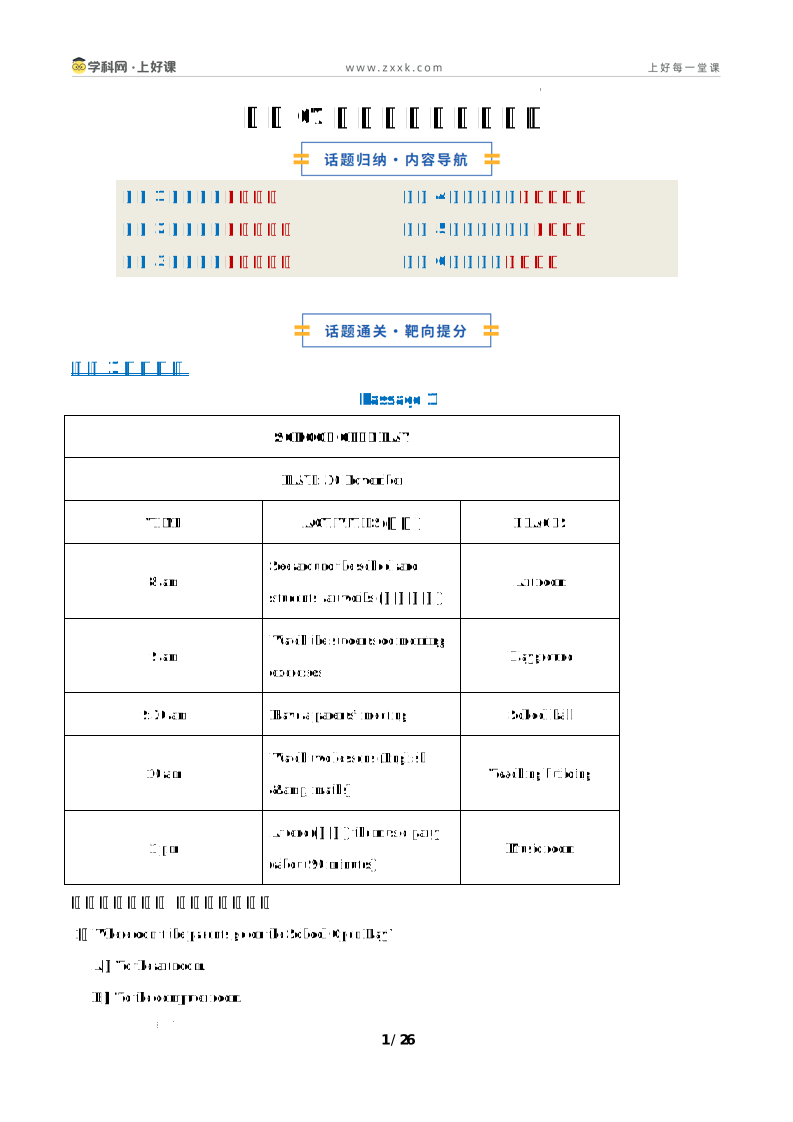
1

2

3

相关资源
由于学科网是一个信息分享及获取的平台,不确保部分用户上传资料的 来源及知识产权归属。如您发现相关资料侵犯您的合法权益,请联系学科网,我们核实后将及时进行处理。