Unit 8 Protecting the environment-Lesson 1 Let's clean it up! 教学设计2025-2026学年冀教版英语八年级上册
2025-09-06
|
5页
|
322人阅读
|
4人下载
普通
资源信息
| 学段 | 初中 |
|---|---|
| 学科 | 英语 |
| 教材版本 | 初中英语冀教版八年级上册 |
| 年级 | 八年级 |
| 章节 | Lesson 1 Let's clean it up! |
| 类型 | 教案-教学设计 |
| 知识点 | - |
| 使用场景 | 同步教学-新授课 |
| 学年 | 2025-2026 |
| 地区(省份) | 全国 |
| 地区(市) | - |
| 地区(区县) | - |
| 文件格式 | DOCX |
| 文件大小 | 55 KB |
| 发布时间 | 2025-09-06 |
| 更新时间 | 2025-09-06 |
| 作者 | 匿名 |
| 品牌系列 | - |
| 审核时间 | 2025-09-06 |
| 下载链接 | https://m.zxxk.com/soft/53798677.html |
| 价格 | 0.50储值(1储值=1元) |
| 来源 | 学科网 |
内容正文:
Unit 8 Protecting the environment-Lesson 1 Let's clean it up!
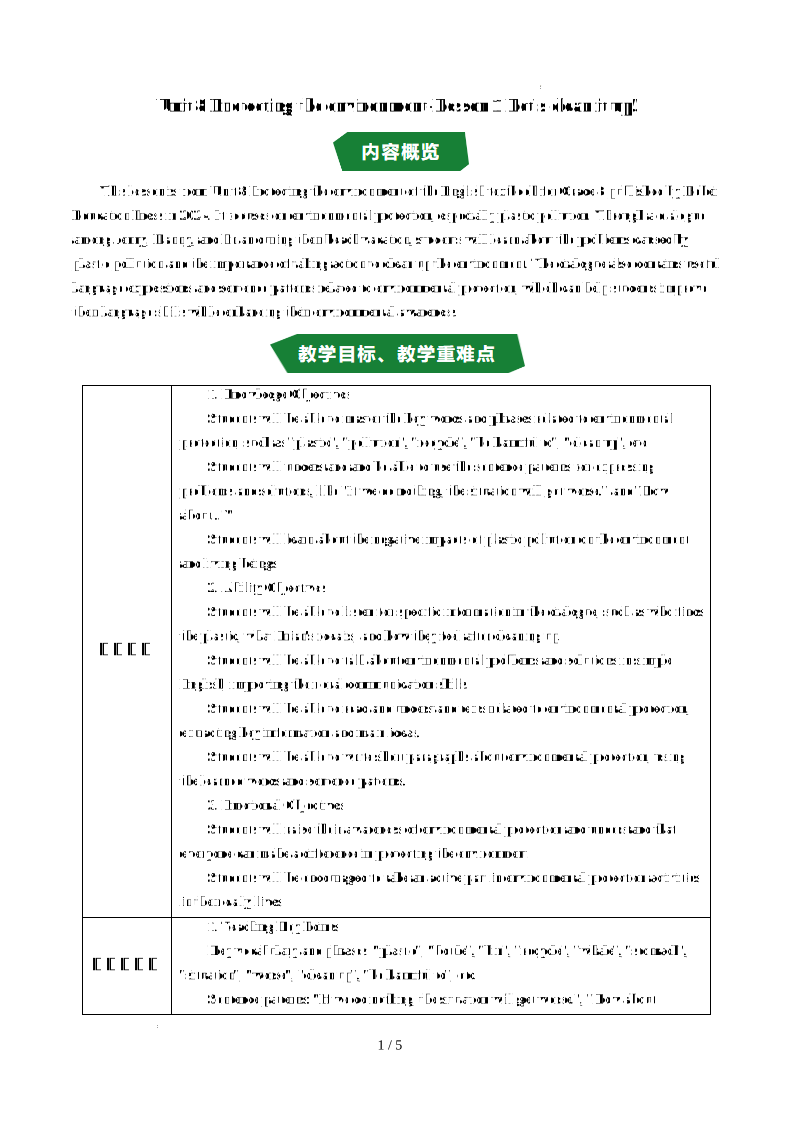
This lesson is from Unit 8 Protecting the environment of the English textbook for Grade 8 published by Hebei Education Press in 2024. It focuses on environmental protection, especially plastic pollution. Through a dialogue among Jenny, Danny, and Brian during their beach vacation, students will learn about the problems caused by plastic pollution and the importance of taking action to clean up the environment. The dialogue also contains useful language expressions and sentence patterns related to environmental protection, which can help students improve their language skills while enhancing their environmental awareness.
教学目标
1. Knowledge Objectives
Students will be able to master the key words and phrases related to environmental protection, such as "plastic", "pollution", "recycle", "be harmful to", "clean up", etc.
Students will understand and be able to use the sentence patterns for expressing problems and solutions, like "If we do nothing, the situation will get worse." and "How about...?"
Students will learn about the negative impacts of plastic pollution on the environment and living beings.
2. Ability Objectives
Students will be able to listen for specific information in the dialogue, such as who finds the plastic, what Brian's idea is, and how they feel after cleaning up.
Students will be able to talk about environmental problems and solutions in simple English, improving their oral communication skills.
Students will be able to read and understand texts related to environmental protection, extracting key information and main ideas.
Students will be able to write short paragraphs about environmental protection, using the learned words and sentence patterns.
3. Emotional Objectives
Students will raise their awareness of environmental protection and understand that everyone can make a difference in protecting the environment.
Students will be encouraged to take an active part in environmental protection activities in their daily lives.
教学重难点
1. Teaching Key Points
Key vocabulary and phrases: "plastic", "bottle", "bin", "recycle", "whale", "stomach", "situation", "worse", "clean up", "be harmful to", etc.
Sentence patterns: "If we do nothing, the situation will get worse.", "How about cleaning up the beach?", "Good idea!"
The process of the characters in the dialogue taking action to clean up the beach and their feelings after that.
2. Teaching Difficult Points
How to make students deeply understand the severity of environmental problems, especially plastic pollution, and arouse their sense of responsibility for environmental protection.
How to help students use the learned language knowledge to freely express their opinions and ideas about environmental protection in real - life situations.
The usage and understanding of the conditional sentence "If we do nothing, the situation will get worse."
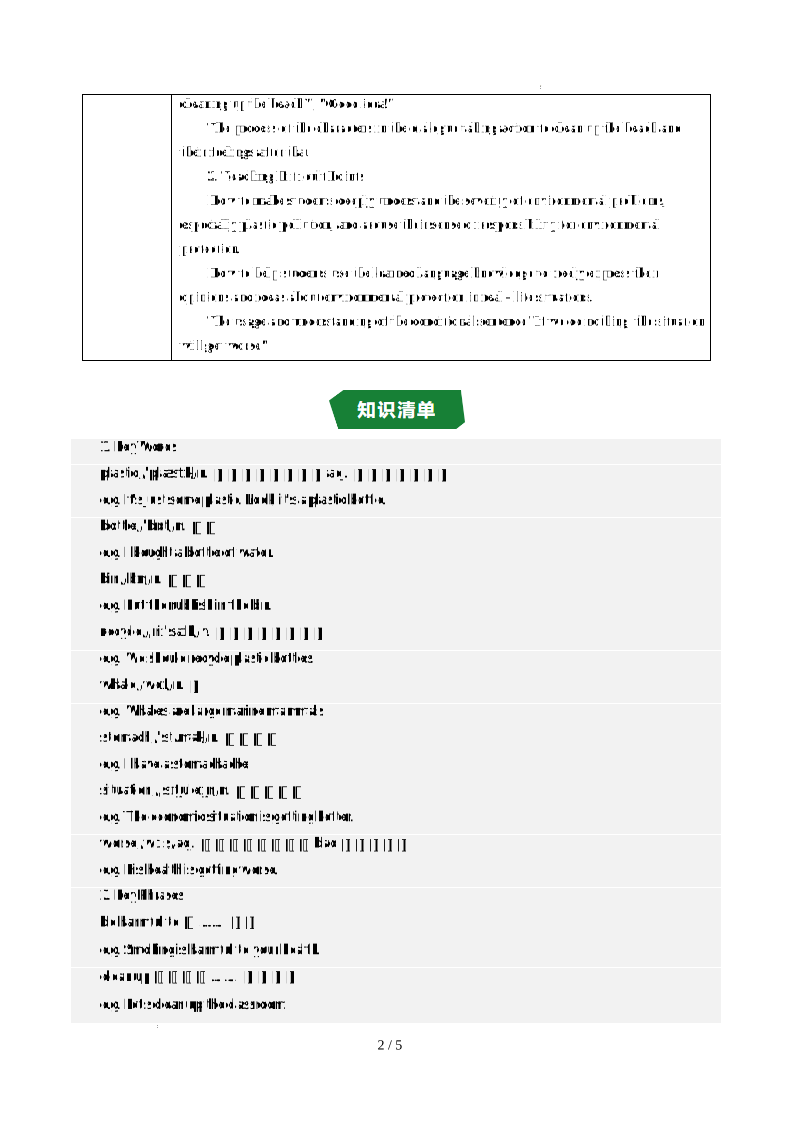
1. Key Words
plastic /ˈplæstɪk/n. 塑料;塑料制品;adj. 塑料的;可塑的
e.g. It's just some plastic. Look, it's a plastic bottle.
bottle /ˈbɒtl/n. 瓶子
e.g. I bought a bottle of water.
bin /bɪn/n. 垃圾箱
e.g. Put the rubbish in the bin.
recycle /ˌriːˈsaɪkl/v. 回收利用;再利用
e.g. We should recycle plastic bottles.
whale /weɪl/n. 鲸
e.g. Whales are large marine mammals.
stomach /ˈstʌmək/n. 胃;腹部
e.g. I have a stomachache.
situation /ˌsɪtʃuˈeɪʃn/n. 状况;形势
e.g. The economic situation is getting better.
worse /wɜːs/adj. 更糟的;更坏的(bad 的比较级)
e.g. His health is getting worse.
2. Key Phrases
be harmful to 对…… 有害
e.g. Smoking is harmful to your health.
clean up 清理;把…… 打扫干净
e.g. Let's clean up the classroom.
pick up 捡起;拾起
e.g. He picked up the pen on the ground.
all kinds of 各种各样的
e.g. There are all kinds of flowers in the garden.
3. Key Sentence Patterns
If we do nothing, the situation will get worse.
This is a conditional sentence. The main clause uses the simple future tense, and the subordinate clause uses the simple present tense. It shows the consequence if no action is taken.
How about cleaning up the beach?
This is a sentence pattern used to make a suggestion. "How about..." is followed by a gerund (verb + -ing).
Good idea!
It is used to express agreement with a suggestion. Similar expressions are "Great idea!", "Sounds good!"
教学过程
1. Warming - up (5 minutes)
Greet the students as usual.
Show some pictures of beautiful natural scenery, such as clean beaches, clear rivers, and green forests, and ask students: "How do you feel when you see these pictures?" Then show some pictures of polluted environments, like beaches full of garbage, dirty rivers, and smog - filled skies, and ask: "What about these pictures? How do you feel now?" Lead students to talk about their feelings and introduce the topic of environmental protection.
2. Pre - listening (8 minutes)
Write two questions on the blackboard:
How often do you clean your house?
How does plastic pollution affect sea life?
Let students think about these questions and discuss them in pairs. Then ask some pairs to share their answers with the class.
Present new words and phrases related to the topic. Use pictures or real - life examples to help students understand. For example, show a plastic bottle and teach the word "plastic" and "bottle", and then throw the bottle into a bin and teach "bin". Explain the meaning and usage of "recycle", "be harmful to", etc. by giving examples.
Drill the new words and phrases. Read them aloud several times, and then ask students to read after you, first in chorus and then individually. Correct their pronunciation in time.
3. While - listening (12 minutes)
Tell students that they are going to listen to a conversation among Jenny, Danny, and Brian during their beach vacation. Let them listen carefully and answer the following questions:
Who is having a vacation on the beach?
Who finds the plastic in the ocean?
What is Brian's idea about the garbage on the beach?
How do they feel after cleaning up the beach?
Play the recording for the first time. Students listen and try to answer the questions. After that, check the answers with the class.
Play the recording again. This time, ask students to fill in the blanks in the handout:
Jenny, Danny, and Brian were on a beach vacation with their families. Jenny stepped on a ______________. Danny saw a man leaving his garbage on the beach. They thought the situation would ____________ if people did not take action to protect the beach. So they decided to ____________ the beach.
They asked their family members to help. They spent the afternoon ___________ all kinds of garbage on the beach. They __________ that they made a difference in keeping the beach clean and protecting the ocean and its creatures.
Check the answers and let students read the completed passage aloud to ensure they understand the content of the dialogue.
4. Post - listening (12 minutes)
Divide students into groups of four. Let them role - play the dialogue in their groups. Encourage them to use their own voices and expressions to make the role - play more vivid.
After the role - play, ask some groups to come to the front of the class and perform the dialogue for the whole class. Other students watch and listen carefully, and then give their comments and evaluations.
Have a group discussion. Pose the question: "What else can we do to protect the environment besides cleaning up the beach?" Each group discusses and writes down as many ideas as possible. Then each group selects a representative to report their ideas to the class. Write the good ideas on the blackboard.
5. Summary and Homework (8 minutes)
Summary: Summarize the key points of this lesson with the students, including new words, phrases, sentence patterns, and the main idea of the dialogue. Emphasize the importance of environmental protection.
Homework:
Ask students to write a short passage about an environmental problem they are concerned about and the solutions they think of. They should use at least five words and three sentence patterns learned in this lesson.
Encourage students to start from small things in their daily lives to protect the environment, such as reducing the use of plastic bags, recycling waste paper, etc., and record their actions in a small notebook.
教学反思
After this lesson, students should have a better understanding of environmental protection, especially plastic pollution, and master some related English words, phrases, and sentence patterns. The use of pictures, recordings, role - plays, and group discussions can effectively arouse students' interest and enthusiasm, and help them actively participate in classroom activities. However, there may still be some problems. For example, in the group discussion part, some students may not be able to express their ideas fluently due to limited language ability. In the future teaching, more language input and speaking practice should be provided. Also, when dealing with the difficult point of the conditional sentence, more examples and exercises can be given to help students better understand and use it. In general, this lesson should achieve the expected teaching goals, but continuous improvement is needed to better meet the learning needs of students.
2 / 37
学科网(北京)股份有限公司
学科网(北京)股份有限公司
$
资源预览图
1
2
相关资源
由于学科网是一个信息分享及获取的平台,不确保部分用户上传资料的 来源及知识产权归属。如您发现相关资料侵犯您的合法权益,请联系学科网,我们核实后将及时进行处理。