Unit 8 Let's celebrate!-Grammar 教学设计 2024-2025学年译林版英语七年级上册
2025-08-27
|
4页
|
306人阅读
|
216人下载
普通
资源信息
| 学段 | 初中 |
|---|---|
| 学科 | 英语 |
| 教材版本 | 初中英语译林版七年级上册 |
| 年级 | 七年级 |
| 章节 | Grammar |
| 类型 | 教案-教学设计 |
| 知识点 | - |
| 使用场景 | 同步教学-新授课 |
| 学年 | 2024-2025 |
| 地区(省份) | 全国 |
| 地区(市) | - |
| 地区(区县) | - |
| 文件格式 | DOCX |
| 文件大小 | 50 KB |
| 发布时间 | 2025-08-27 |
| 更新时间 | 2025-08-27 |
| 作者 | 匿名 |
| 品牌系列 | - |
| 审核时间 | 2025-08-27 |
| 下载链接 | https://m.zxxk.com/soft/53640509.html |
| 价格 | 0.00储值(1储值=1元) |
| 来源 | 学科网 |
内容正文:
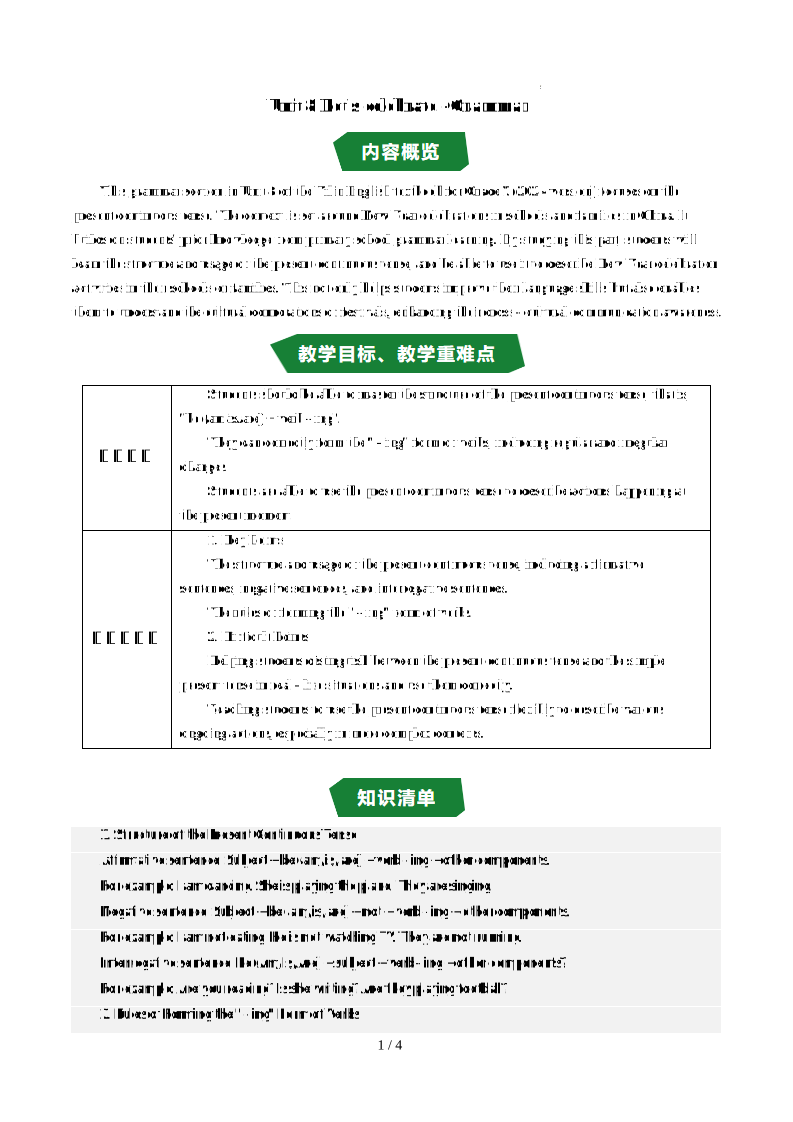
Unit 8 Let's celebrate!-Grammar
This grammar section in Unit 8 of the Yilin English textbook for Grade 7 (2024 version) focuses on the present continuous tense. The context is set around New Year celebrations in schools and families in China. It builds on students' prior knowledge from primary school grammar learning. By studying this part, students will learn the structure and usage of the present continuous tense, and be able to use it to describe New Year celebration activities in their schools or families. This not only helps students improve their language skills but also enables them to understand the cultural connotations of festivals, enhancing their cross - cultural communication awareness.
教学目标
Students should be able to master the structure of the present continuous tense, that is, "be (am/is/are) + verb - ing".
They can correctly form the " - ing" form of verbs, including regular and irregular changes.
Students are able to use the present continuous tense to describe actions happening at the present moment.
教学重难点
1. Key Points
The structure and usage of the present continuous tense, including affirmative sentences, negative sentences, and interrogative sentences.
The rules of forming the " - ing" form of verbs.
2. Difficult Points
Helping students distinguish between the present continuous tense and the simple present tense in real - life situations and use them correctly.
Teaching students to use the present continuous tense flexibly to describe various ongoing actions, especially in more complex contexts.
1. Structure of the Present Continuous Tense
Affirmative sentence: Subject + be (am/is/are) + verb - ing + other components.
For example: I am dancing. She is playing the piano. They are singing.
Negative sentence: Subject + be (am/is/are) + not + verb - ing + other components.
For example: I am not eating. He is not watching TV. They are not running.
Interrogative sentence: Be (Am/Is/Are) + subject + verb - ing + other components?
For example: Are you reading? Is she writing? Are they playing football?
2. Rules of Forming the " - ing" Form of Verbs
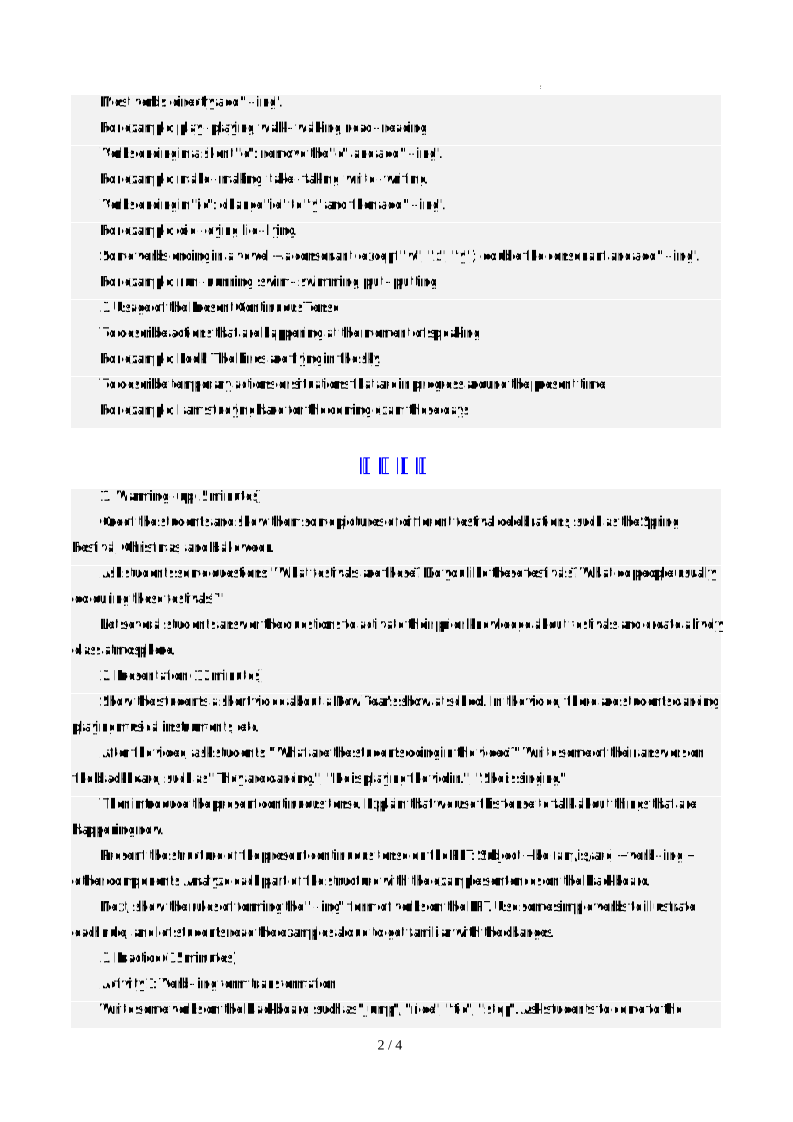
Most verbs: directly add " - ing".
For example: play - playing, walk - walking, read - reading.
Verbs ending in a silent "e": remove the "e" and add " - ing".
For example: make - making, take - taking, write - writing.
Verbs ending in "ie": change "ie" to "y" and then add " - ing".
For example: die - dying, lie - lying.
Some verbs ending in a vowel + a consonant (except "w", "x", "y"): double the consonant and add " - ing".
For example: run - running, swim - swimming, put - putting.
3. Usage of the Present Continuous Tense
To describe actions that are happening at the moment of speaking.
For example: Look! The birds are flying in the sky.
To describe temporary actions or situations that are in progress around the present time.
For example: I am studying hard for the coming exam these days.
教学过程
1. Warming - up (5 minutes)
Greet the students and show them some pictures of different festival celebrations, such as the Spring Festival, Christmas, and Halloween.
Ask students some questions: "What festivals are these? Do you like these festivals? What do people usually do during these festivals?"
Let several students answer the questions to activate their prior knowledge about festivals and create a lively class atmosphere.
2. Presentation (12 minutes)
Show the students a short video about a New Year's show at school. In the video, there are students dancing, playing musical instruments, etc.
After the video, ask students: "What are the students doing in the video?" Write some of their answers on the blackboard, such as "They are dancing.", "He is playing the violin.", "She is singing."
Then introduce the present continuous tense. Explain that we use this tense to talk about things that are happening now.
Present the structure of the present continuous tense on the PPT: Subject + be (am/is/are) + verb - ing + other components. Analyze each part of the structure with the example sentences on the blackboard.
Next, show the rules of forming the " - ing" form of verbs on the PPT. Use some simple verbs to illustrate each rule, and let students read the examples aloud to get familiar with the changes.
3. Practice (15 minutes)
Activity 1: Verb - ing form transformation
Write some verbs on the blackboard, such as "jump", "ride", "tie", "stop". Ask students to come to the blackboard one by one and write the " - ing" form of these verbs. After they finish, check the answers together and correct any mistakes.
Activity 2: Sentence making
Divide the students into pairs. Give each pair a set of flashcards. On each flashcard, there is a subject (such as "I", "he", "they") and an action verb (such as "draw", "clean", "play"). The students need to make sentences in the present continuous tense using the words on the flashcards. For example, if a pair gets the cards "I" and "draw", they should say "I am drawing." Walk around the classroom to monitor their activities and offer help if necessary.
Activity 3: Listening practice
Play a short dialogue recording. In the dialogue, two people are talking about what their friends are doing at a party. After playing the recording once, ask students some general questions, such as "Where are they talking about? What kind of party is it?" Then play the recording again, and ask students to write down what each person's friends are doing. Check the answers with the whole class.
4. Consolidation (8 minutes)
Show the students some pictures of people doing different things. Each picture has a sentence below it with a blank. For example, a picture shows a girl reading a book, and the sentence is "The girl ____ (read) a book."
Ask students to fill in the blanks with the correct form of the verb in the present continuous tense. Let them work individually first, and then ask them to check their answers with their deskmates. Finally, check the answers with the whole class.
Present some more complex sentences with time adverbials. For example, "Look! The children ____ (fly) kites in the park now. They often ____ (fly) kites on weekends." Ask students to choose the correct form of the verb (present continuous tense or simple present tense) and explain the reasons. Guide students to distinguish between the two tenses in different contexts.
5. Summary and Homework (5 minutes)
Summary
Summarize the key points of this class with the students, including the structure and usage of the present continuous tense, and the rules of forming the " - ing" form of verbs. Ask students to recall and share what they have learned in this class.
Homework
Ask students to write a short passage about what their family members are doing at the moment, using at least 5 sentences in the present continuous tense.
Ask students to find some English texts about festival celebrations and mark the sentences in the present continuous tense.
教学反思
After this class, overall, most students can understand the basic structure and usage of the present continuous tense. Through various practice activities, students have had many opportunities to practice using this tense, which has improved their speaking and writing abilities to a certain extent. However, there are still some areas that need improvement.
In the teaching process, some students had difficulty in forming the " - ing" form of irregular verbs, especially for verbs like "die" and "lie". In the future, more targeted exercises should be designed to strengthen this part. Also, when distinguishing between the present continuous tense and the simple present tense, some students still made mistakes. It may be necessary to provide more real - life examples and create more complex contexts in class to help students better understand the differences between the two tenses.
In terms of teaching methods, group work and pair work were well - received by students, as they increased students' participation and communication in class. But during the group activities, there were a few students who were less active. In the future, more attention should be paid to these students to ensure that every student can actively participate in classroom learning.
2 / 37
学科网(北京)股份有限公司
学科网(北京)股份有限公司
$$
资源预览图
1
2
相关资源
由于学科网是一个信息分享及获取的平台,不确保部分用户上传资料的 来源及知识产权归属。如您发现相关资料侵犯您的合法权益,请联系学科网,我们核实后将及时进行处理。