专题20 阅读理解(细节题)-2025年中考英语【命题趋向+考点探究+素养提升】专练(江苏专用
2025-05-06
|
2份
|
46页
|
1113人阅读
|
66人下载
精品
资源信息
| 学段 | 初中 |
|---|---|
| 学科 | 英语 |
| 教材版本 | - |
| 年级 | 九年级 |
| 章节 | - |
| 类型 | 教案-讲义 |
| 知识点 | - |
| 使用场景 | 中考复习 |
| 学年 | 2025-2026 |
| 地区(省份) | 江苏省 |
| 地区(市) | - |
| 地区(区县) | - |
| 文件格式 | ZIP |
| 文件大小 | 3.08 MB |
| 发布时间 | 2025-05-06 |
| 更新时间 | 2025-05-06 |
| 作者 | TP-lucky |
| 品牌系列 | - |
| 审核时间 | 2025-05-06 |
| 下载链接 | https://m.zxxk.com/soft/51975824.html |
| 价格 | 3.00储值(1储值=1元) |
| 来源 | 学科网 |
内容正文:
专题18 阅读理解(细节题)
目录
第一部分:命题趋向(思维导图+中考命题趋向分析+重点掌握)
第二部分:考点探究(知识点罗列+3年真题演练)
第三部分:素养提升(单项选择+ 用动词的适当形式填空+完成句子)
1. 思维导图
2. 趋向分析
细节题是中考英语阅读理解中较为基础的题型, “阅读理解细节题”2025中考其核心特点在于答案能直接对应原文中的具体信息,学生无需进行深层推理或复杂分析,只需精准定位并匹配文本内容,即可得出正确答案。这种题型主要考查学生的信息检索和文本对照能力,要求学生能快速在语篇中找到关键信息,并准确判断选项与原文表述是否一致。
考点一 简单细节判断
首先,题干定位关键词—扫描题干,根据关键词明确答题方向,如数字、时间、原因、事件、目的、方式、现象、特征等;然后,查找原文找对应,用略读与查读技巧定位与关键词相关的原文信息;最后,比较选项与原文的对应信息,直接锁定正确答案。
以特殊疑问词引导的问题最为常见,例如:“What did the author do after arriving at the park?”(询问事件内容);“Who helped the old man carry the heavy box?”(询问人物);“When did the accident happen?”(询问时间);“Where did they meet for the first time?”(询问地点);“How did she solve the problem?”(询问方式) 。这类问题直接指向文本中的具体细节,目标明确。还有 “How many...”“How much...” 等询问数量的问题,如 “How many students participated in the competition?”;以及 “Which of the following is mentioned?”“Which of the following statements is true according to the passage?” 这类要求判断选项信息是否在原文提及或表述是否正确的提问方式。最显著的标志词就是各类特殊疑问词(what、who、when、where、how、why、which、how many、how much 等),这些疑问词直接决定了答案的类型和在文中的检索方向。例如,看到 “when” 就要在文中寻找时间相关表述,看到 “where” 则聚焦于地点信息。
真题演练
(2024·江苏淮安·中考真题)Mary began to like her life here. Every morning, she went outside after breakfast and spent most of the day in the grounds. The cold wind brought pink to her face. And she finished all of her food each evening. She was much healthier. After dinner, she liked sitting near the fire and talking to Martha.
“Why does Mr. Craven hate the locked garden?” Mary asked once.
“It was Mrs. Craven’s garden and she loved it. She looked after the flowers together with Mr. Craven. No gardeners were allowed in.”
“But what happened?” Mary asked,
“There was an old tree in the garden with a branch (树枝) like a seat, Mrs. Craven often sat there, reading and talking. One day, the branch broke and she fell down. She was badly hurt and died soon. Mr. Craven locked the garden and never talked about it.”
Mary seldom felt sorry for anyone, but now she understood how sad her uncle must be.
The wind roared around the house, and the doors and windows banged. Mary listened, and through the noise she thought that she heard a child crying.
“Can you hear someone crying?” she asked Martha.
Martha seemed pretty nervous. “No,” she answered. “It’s only the wind or the servant who works in the kitchen. She’s got a toothache. Perhaps she’s crying. I’m going to check if she needs any help.” After the words. Martha left the room quickly.
When Martha left her alone. Mary decided to explore the house. She went quietly along corridors and up and down stairs. In the silence of the house she heard again the sound of a child crying. She stopped to listen at a door, but then another door opened and Mrs. Medlock came out, “What are you doing here?” she said, and she took Mary by the arm and pulled her away. “Get back to your room at once.”
—Adapted from The Secret Garden
24. From Paragraph One, we know _________.
A. Mary seldom went outside B. Mary didn’t like Martha
C. Mary felt bored with the life D. Mary became much healthier
25. Mr. Craven _________ after his wife died.
A. locked himself in the garden B. never talked about the garden
C. cut down the tree in the garden D. didn’t talk to anyone
26. Why did Mary explore the house after Martha left?
A. To find where the crying came from. B. To know the house better.
C. To help the servant in the kitchen. D. To listen at a door of the house.
考点二 综合细节判断
1. 是非判断题
是非判断题在中考英语阅读理解中属于对文本细节理解要求较高的题型,核心在于通过对选项与原文内容的细致比对,判断选项陈述是否与原文一致,答案通常以 “True/False” 或选择符合 / 不符合原文的选项呈现。该题型不仅考查学生的信息检索能力,更着重考查学生对文本细节的精准把握以及逻辑判断能力,要求学生能够敏锐识别信息差异和潜在陷阱。以 “Which of the following is NOT true?”(以下哪一项不正确?)为典型,此类问题要求学生在四个选项中找出与原文内容不符的陈述。“Which statement is correct?”(哪一个陈述是正确的?)则需要学生从多个选项中甄别出与原文一致的内容。这种提问方式下,选项可能涉及不同方面的信息,如人物行为、事件时间、地点等,需要学生全面理解原文后进行判断。还有诸如 “Which of the following is mentioned EXCEPT...”(除了…… 以下哪项未被提及?)、“All of the following are true EXCEPT...”(除了…… 以下所有选项都是正确的)等提问形式,这类问题增加了答题难度,要求学生不仅要判断选项内容是否在原文出现,还需准确识别未提及的信息。此类题型最明显的标志词为 “not”“except”“all except” 等否定或排除类词汇。看到这些标志词,学生需明确题目要求是找出错误信息、未提及信息或排除不符合原文的选项,从而调整答题思路,避免因审题不清而误判。
真题演练
(2025·江苏南通·一模)Everyone is talking about artificial intelligence (AI) these days. Have you ever dreamed of using AI to help with your studies?
Well, don’t just dream about it. The “AI-powered study rooms” that are popping up all over the country promise to do just that.
Once you sign up, you’ll get a tablet(平板电脑) with “AI apps”. These apps will “create personalized study plans” and “tailor exercises based on your progress” to help you learn more effectively. These study rooms also claim that their services are more affordable than traditional tutors(家教). The tablet, along with the first month of tutoring, usually costs 5,000 yuan. After that, it’s about 2,000 yuan per month.
Don’t these promises sound attractive? But hold your horses! You’d better finish reading this article before asking your parents to pay the money.
Many parents who have signed their children up for these “Al-powered study rooms” are far from impressed. The “AI apps” don’t live up to their promises. They just spot mistakes and offer repetitive exercises. On top of that, students are basically following pre-recorded lessons. “These so-called ‘AI-powered study rooms’ are more of a trick than a real display of new technologies,” some parents complain.
Don’t feel discouraged, though. Your dream of learning with AI is still alive. There is just no need for you to spend a fortune on a paid “study room” to jump on the AI bandwagon.
From Moonshot AI to DeepSeek, many companies offer their AI chatbots for free. You can use them to help with your studies right at home. The key is to learn how to use them wisely. Asking AI to do all the exercises for you simply isn’t the way to go! Instead, you can ask for clearer and more detailed explanations if you are confused about something in class. You can also share some English sentences or compositions with an AI chatbot and ask it to point out any mistakes. It can even give you some exercises to help you improve. It will take some time and practice to become a smart AI user, but that effort will serve you better than just sitting in an “AI-powered study room”.
1. What can you learn about “AI-powered study rooms” from the passage?
A. They can really satisfy all the parents’ needs.
B. They are getting popular all over the country.
C. They are more expensive than traditional tutors.
D. They provide users with the same study plan.
2. What does the underlined sentence “But hold your horses!” probably mean?
A. Please keep your horses moving smoothly.
B. Please hurry up, or you will miss the chance.
C. Please stop your horses to have a look at it.
D. Please keep calm before making a decision.
3. According to some parents, which of the following is TRUE?
A. “AI-powered study rooms” have greatly improved children’s study.
B. “AI-powered study rooms” are not so effective as they promised.
C. “AI-powered study rooms” make good use of new technologies.
D. “AI-powered study rooms” have impressed parents with new skills.
4. What’s the purpose of writing the article?
A. To encourage us to use AI tools. B. To show us what AI chatbots can do.
C. To tell us to be wise AI users. D. To explain why AI tools become popular.
2. 排序题
排序题在中考英语阅读理解中,聚焦于考查学生对语篇中事件发展逻辑、步骤先后顺序的梳理和理解能力。题目要求学生依据文本内容,将给定的事件、步骤或行为按照发生的先后顺序进行正确排列,旨在测试学生能否清晰把握文章的叙事脉络或说明顺序,需要学生具备较强的逻辑分析与信息整合能力。“Which order is correct?”(哪一个顺序是正确的?)此类提问最为直接,要求学生从多个选项中挑选出与原文事件发展顺序一致的排列。例如,原文讲述制作蛋糕的过程,选项中会给出不同的步骤排列组合,学生需从中找出正确的顺序。“What is the correct sequence?”(正确的顺序是什么?)同样是让学生判断事件、步骤的正确先后顺序。这种提问方式下,选项可能涉及到对整个事件流程的完整排序,也可能聚焦于某几个关键环节的顺序判断。有时也会出现如 “Arrange the following events in the order they happened.”(按照事件发生的顺序排列下列事件)等类似的提问形式,其核心都是围绕事件顺序的判断展开。题目通常会给出 3 - 5 个事件、步骤或行为,以短句或短语形式呈现,选项则是这些内容不同顺序的排列组合。这些事件、步骤紧密关联,且在原文中有明确的先后顺序线索,可能通过时间、空间、逻辑关系等多种方式体现。
真题演练
(2024·江苏南通·中考真题)My friend Julie and I are keen on creating a beautiful green town.
Gardening Course
Every September, our city has a special festival. Crowds of happy people go to the park, waving ribbons in their hands. That’s because the gardening competition takes place there.
For Julie and me, it was a pity that we couldn’t take part in the competition, for that was also the first day of our high school. We buried ourselves in choosing courses. We wanted to learn all about plants, gardening and farming. Finally, a course called Agriculture and Wildlife came into our sight. We thought it would help us succeed as gardeners.
Project presentation
After a year’s study, Julie advised me to give a presentation. There was a small plastic model of my idea on the table. On the other side of the table, my teachers were waiting to see my project—the green farm.
“Good morning!” I said “During my studies I’ve learned a lot about city farming. Now. I want to do something with what I’ve learned.”
I showed them the model. “This is the high street of our town. This is an old, nine-floor car park. No one has used it for the last two years and it’s now for sale.”
I continued the presentation. They could see my designs on the big screen when I talked.
“I’ve designed a city farm using the car park building. There will be eight floors to farm fruit and vegetables. This design can help us collect rainwater to wet the soil. And we can also use energy from the sun to power the special growing lights. “
“I will hire the space out to local people and they will sell everything good enough for the environment in local shops. Also, the ninth floor will be for those who want to grow their own plants.”
My audience looked interested and my project got the highest marks in my class. But in the real world. it couldn’t happen because the car park was not available.
▲
Later, Julie helped me search the town for the perfect place for gardening, not in front of the Town Hall or the shopping centre. We tried to look for something different. Somewhere that was not the best neighbourhood, but a poor one. One where the road was full of holes and the pavement (人行道) was all broken. At last, we made it.
In the neighbourbood, we posted letters through people’s doors with gardening instructions. More and more people cared about that and began to plant vegetable gardens.
Then in the same neighbourhood, we put grass over those broken old pavements for the kids to play on. Finally, we put up a sign that said, “Have fun here.”
When we finished, we were both covered in soil and completely exhausted. But Julie put an arm around my shoulders and smiled. “Not bad!” she said. “We can do more to make our town greener!”.
7. Which of the following is the correct order of the story?
a. Julie helped find a perfect place for gardening.
b. The writer explained the green farm project.
c. Julie and the writer posted letters to neighbours.
d. Julie and the writer were busy choosing the courses.
e. Old pavements were covered with grass for kids to play on.
A. d-b-a-c-e B. d-a-b-e-c C. a-b-c-e-d D. a-d-b-c-e
3. 数据/图表计算题
在中考英语阅读理解中,数据 / 图表题是一类极具特色的题型,它突破了纯文字信息的考查模式,要求学生通过对文中数据、图表(如柱状图、折线图、表格、饼状图等)的观察、分析与推断,获取具体信息。此类题型不仅考查学生的英语阅读能力,还融合了数据分析、逻辑推理等综合能力,重点检验学生能否准确提取图表关键信息,理解数据背后的含义,并与文本内容相结合进行合理推断,对学生的信息处理能力提出了更高要求。“What does the chart show?”(图表展示了什么?)这类提问较为宽泛,要求学生从整体上把握图表所传达的核心信息。 “What percentage…?”(…… 的百分比是多少?)此类问题聚焦于图表中的具体数据比例。比如,在一个关于学生兴趣爱好的饼状图中,题目问 “喜欢音乐的学生占比是多少?”,学生需要从图表中准确读取相应数据进行回答。还有诸如 “How many…?”(…… 有多少?) 用于询问数量;“Which category has the highest/lowest value?”(哪个类别数值最高 / 最低?) 考查对数据大小的比较;“What is the change in…from year A to year B?”(从 A 年到 B 年…… 的变化是怎样的?) 关注数据的变化情况等提问方式。这些问题从不同角度考查学生对数据 / 图表的理解和分析能力。题目通常会在文章中嵌入图表,或直接给出与文本内容相关的数据列表。图表类型多样,数据信息丰富,且可能存在多个数据维度。选项的设置往往围绕图表中的关键数据、数据变化趋势、数据间的关系等方面展开,有些选项可能对数据进行简单计算、对比或推理,有些则会设置干扰项,如错误的数据解读、片面的信息提取等,增加答题的难度和区分度。
真题演练
Passage 1
(2025·江苏泰州·一模)
Unlocking Real Happiness
①When I was your age, my mom always told me, “I just want you to be happy.” She didn’t care what I grew up to be as long as I promised to stay happy. But what exactly is happiness? Is it a destination (目的地), or is it more like a road that never ends?
②Is happiness on social media(媒体)? It surely seems that way. People love posting (发布) perfect pictures of their best moments online. But if you ever want to feel bad about your life, just jump online and look through those posts. Platforms like Weibo and Xiaohongshu make us believe that we could be prettier, healthier, wealthier, and of course, happier. Plenty of research has connected social media use to low moods. One U. S. study found that people who use social media for more than two hours a day are twice as likely to feel lonely.
③But what if we’re the ones posting? When we share a happy moment, we must have felt happy. But over the years, I’ve come to discover and experience the “hedonic treadmill(快乐适应)”. We get excited and happy when something good happens, but after a while, we return to feeling the same as before. In other words, happiness only lasts for so long. As the influences of one “happy” moment go off, we set out in search of new sources of happiness. And social media has made this search harder than ever.
④Happily, there’s still hope for us to find lasting happiness: It’s called “emotional authenticity(情感真实性)”. This happens when we allow ourselves to feel and experience feelings like anger, fear and sadness. It’s not easy, but when we are honest about our experiences, we build deeper and more meaningful connections with others. And those friendships bring us smiles that last much longer than any number of “likes” on a screen!
⑤March 20th is World Happiness Day. Take it as a reminder that happiness isn’t about running after a picture-perfect life. Trying to be happy all the time is like trying to catch a unicorn (独角兽)-it’ s just not going to happen. Instead, pay attention to your own journey and accept different feelings you’ll feel along the way.
2. Which of the following charts shows the change in our feelings after something good happens to us according to the text?
A. B. C. D.
Passage 2
Unlocking Real Happiness
When I was your age, my mom always told me, “I just want you to be happy. “She didn’t care what I grew up to be as long as I promised to stay happy. But what exactly is happiness? Is it a destination(目的地), or is it more like a road that never ends?
Is happiness on social media? It sure seems that way. People love posting perfect pictures of their best moments online. But if you ever want to feel bad about your life, just jump online and scroll through(滚屏浏览) those posts. Platforms like Weibo and Xiaohongshu make us believe that we could be prettier, healthier, wealthier, and of course, happier. Plenty of research has linked(联系) social media use to low moods(心情). One U.S.study found that people who use social media for more than two hours a day are twice as likely to feel lonely.
________ When we share a happy moment, we must have felt happy, right? Well, yes, but over the years, I’ve come to discover—and experience—the “hedonic treadmill.” We get excited when something good happens, but after a short time, we return to feeling the same as before. In other words, happiness only lasts for so long. As the effects(影响) of one “happy” moment wear off, we set out in search(搜寻) of new sources of happiness. And social media has made this search harder than ever.
Happily, there’s still hope for us to find lasting happiness:It’s called “emotional authenticity.” This happens when we allow ourselves to feel and process emotions(情绪) like anger, disappointment, fear and sadness. It’s not easy, but when we are honest about our experiences, we build deeper and more meaningful connections with others. And those friendships bring us smiles that last much longer than any number of “likes” on a screen!
March 20th is World Happiness Day. Take it as a reminder that happiness isn’t about chasing a picture-perfect life. Trying to be happy all the time is like trying to catch a unicorn (独角兽)—it’s just not going to happen. Instead, focus on your own journey and accept the variety (不同种类) of emotions you’ll feel along the way.
8. Which line in the following chart correctly shows the change in our emotions after something happy happens to us?
A. A B. B C. C D. D
Passage 1
(2025·江苏徐州·模拟预测)One day, a young king went out to hunt deer, when he carelessly became separated from others. Wondering around, the king saw a farmhouse that was surrounded by a garden, and inside the garden was a young woman.
The king spoke to her: “Tell me, what plants are you growing here?” “I am raising pumpkins,” she replied, “as you can see.” She had a quick glance at the pile of pumpkins behind her and gave a quick smile to the king. He couldn’t help but smile back.
As the king returned to the city, a thought began to grow in his mind. “Perhaps, I might think up a test to see just how smart this young woman might be.” he thought.
The king then ordered a soldier to carry a new jar without handles to the young woman’s house. The soldier told the young woman that the jar was from the king and she should put a whole enough big pumpkin inside the jar with a small opening at the top. And the soldier also said that the king wanted the jar and the pumpkin must remain whole.
The young woman returned a message to the king that such a task might take a long time. In fact, it was several months before the young woman arrived at the palace. In her hands she held the same jar, and sure enough, a whole pumpkin sat inside it. The king was amazed that he had no idea how she could have brought this about!
Here was her answer to the king: She had placed a pumpkin bud(花蕾), which was still connected to a vine(藤蔓) in the ground, inside the jar through its small opening. As time flies, the pumpkin bud grew into a full-sized pumpkin.
1. What was the king doing when he became separated from others?
A. Hunting rabbits. B. Hunting deer. C. Picking flowers. D. Walking in the garden.
2. Which picture below is the jar carried to the woman from the king?
A. B. C. D.
3. Why did the king send a soldier to the young woman’s house with a jar?
A. To give her a gift. B. To sell her a jar. C. To ask for help. D. To test her wisdom.
4. What was the king’s special request for the pumpkin?
A. It should be cut in half. B. It should be painted gold.
C. It should fit perfectly inside the jar. D. It should be delivered quickly.
Passage 2
(2025·江苏苏州·一模)“The cleaners said we could collect our things today,” Mom said on the drive to school, in her soft voice.
“Do you think ... they saved Big Dog?” Jet tried to sound common, but his throat felt tight(喉咙发紧).
He was worried. Big Dog was his favourite toy. Grandpa had won for him at the fair when he was five. At eight, Jet didn’t need to sleep with it anymore, but it still sat on the shelf above his bed, the shelf that was burned by the fire.
“I am not sure,” Mom said with eyes fixed on the road. “The photo albums(相册) ... they didn’t make it.”
Jet could tell she was really sad.
“We’ll open the boxes together after school,” Mom hugged him goodbye and drove off.
Jet tried to study all day, but he couldn’t keep his mind off Big Dog. He held tight(紧紧地) to his backpack through the halls and it felt like he was carrying his old friend Big Dog. During library time, he checked out a book about dogs.
When Mr. Light said students could do free-draw in the art class, Jet looked at the empty paper. He thought of his mom picking up the boxes of things that had been damaged(破坏) by the fire. Then he realized how sad his mom would be about the photo albums. Most things could still be bought at the store. But the pictures were gone forever. At that moment, he knew what he could draw.
His pencil began to move. There was a picture of Christmas morning, presents under shining lights. Another picture was of that stormy night in the tent when Mom told ghost stories. When the bell rang, twelve drawings formed an album.
After school, when seeing Big Dog waiting for him in the back seat, Jet gave his mom a big hug.
“I have a surprise for you too.” Jet said.
As they went through the pictures, Jet’s mom laughed and cried. At the end of the book was a blank page.
“Looks as if there’s room for one more picture,” Mom said, smiling. “Do you mind if I draw it?”
Jet dug into his backpack and handed her a pencil and some markers. She drew a picture of them sitting in the car looking through their first photo album since the fire.
“I love it, Mom!” Jet said. “Let’s go home and see what other surprises we can find in those boxes.”
5. Why was Jet worried about Big Dog?
A. Because he lost it at his school. B. Because it was a gift for his grandpa.
C. Because his mom wanted to throw it away. D. Because it might have been damaged in fire.
6. What can we learn from the underlined sentence?
A. Jet’s backpack was too heavy. B. Jet missed Big Dog very much.
C. Jet wanted to show Big Dog to his classmates. D. Jet was afraid someone would steal his backpack.
7. Why did Jet decide to draw pictures in art class?
A. To make a new album for his mom. B. To practise his drawing skills. C. To sell his pictures in the store for money. D. To win a prize for the best artist.
8. What does the blank page at the end of Jet’s album mean to his family?
A. Luck. B. Hope. C. Dream. D. Peace.
Passage 3
(2025·江苏南通·一模)Ne Zha 2 is breaking box office records in China and around the world, becoming the first Asian film to enter the top ten highest-grossing movies worldwide. Experts predict the film could earn over 15 billion yuan, which means it could break into the global top five.
The success of the film is largely because of the high quality of its animation, but reviewers also note the story, which is not only entertaining but also manages to reach deeply into the human heart. The story is based on Investiture of the Gods, a 16th-century novel inspired by an ancient Chinese myth.
A myth is where all storytelling begins. Every culture has myths that try to explain the history of its people, and these myths often include supernatural beings that control the forces of the Earth and the lives of its inhabitants. In other words, myths are how the ancients were able to understand the world.
In modern times, science has swept away the idea of the supernatural. We know physics and chemistry, and we understand what causes natural phenomena(现象) such as earthquakes and volcanoes. However, what science has failed to explain, and perhaps never can, is our human “sense”—the special awareness of ourselves, including our thoughts, memories and emotions. This is why myths, the stories our ancestors told, still have a strong connection to the modern world. They help us understand what it means to be human and to live with other human beings.
Ne Zha 2 is a great example. It focuses on the coming-of-age journey of the rebellious(叛逆的) boy and explores common themes such as family bonds and responsibility. The main character Ne Zha is a demon(魔) and a troublemaker, but he is also a boy who wants love and understanding. There is a touching scene in the movie when his mother has to say goodbye. She says, “Every day I spend with you, I am very happy. I have never cared whether you are a fairy or a demon. I only know you are my son, and ▲ .”
A mother’s love is timeless and universal, and so are the lessons of ancient myths. These tales are deeply rooted in our psychology(心理), which is why they remain popular today. While our “scientific” minds know that these stories can’t be factual, our “consciousness” understands that they are true.
9. According to the reviewers, what makes Ne Zha 2 a success?
A. The wonderful scenes and character designs.
B. The record-breaking box-office performance.
C. The well-known characters and movie makers.
D. The excellent quality and the touching story.
10. Why do myths still have a connection to the modern world?
A. Because humans know nature very well.
B. Because humans have a special awareness.
C. Because the idea of the supernatural is true.
D. Because science can explain the supernatural.
11. Which of the following might be the best choice for “ ▲ ”?
A. I am sorry you are a demon B. I will always punish you
C. I will love you forever D. I am sure you’ll be a fairy
12. What’s the best title for the passage?
A. The Power of Myth B. A Troublemaker
C. Ne Zha and His Family D. A Mother’s Love
Passage 4
(2025·江苏常州·模拟预测)①Since the pre-Qin period, Chengdu has been an important cultural town in China. But what really makes the city special culturally, is its opera. An important part of Sichuan Opera is face changing where colored masks are changed within the blink(眨眼) of an eye.
②It is widely believed that face changing could be traced back(追溯) to ancient times. In order to scare away the dangerous animals and protect themselves, people painted their faces in different colors. Later this technique was taken into the art of Sichuan Opera and brought onto stage.
③Face-changing skills are mainly divided into three types: wiping the face, blowing the face and pulling the face. Before performing the skill of wiping the face, the performer will first paint on some parts of his face. While on the stage, he could change the color of his face by wiping it. To perform the skill of blowing the face, the performer needs to do a movement of kissing the ground and blowing the box full of cosmetic powders(化妆粉). And then the powders are blown to his face, changing the color into another.
④The skill of pulling the face is more difficult than the other two. Under the cover of fast movements, the performer pulls each piece of the facial masks which is tied with a thin thread(线) and stuck to his face to change the color of his face. ________ For this, the performer must work very well and have great skills. And face changing techniques are a secret handed down from generation to generation of performers.
⑤Face changing is not only an acrobatic skill(杂技), but it also has rich cultural meaning. The different kinds of characters and personalities that Sichuan Opera brings alive can be found among common people. This is why it continues to be popular for a long time.
13. Which of the following is TRUE according to Paragraph 1?
A. Chengdu became culturally important after the pre-Qin period.
B. Face-changing requires changing masks quickly during performances.
C. Face-changing is the only special part of Sichuan Opera.
D. Sichuan Opera started during the pre-Qin period.
14. Which sentence can be put in the ________?
A. However, one can easily know what the facial masks are made of.
B. However, only men performers can have the chance to learn this skill.
C. Surprisingly, no matter how close one is to the stage, he can’t tell how the masks change.
D. Surprisingly, no matter how many masks the performer wears, the color remains the same.
15. What can we infer from the passage?
A. Pulling the face is the least difficult type of face changing.
B. People used to paint their faces to make themselves look funny.
C. Face changing is very special because it can only be watched in Chengdu.
D. Good traditional art can’t be lasting unless it is connected with people’s life
16. Which of the following shows the structure of this passage?
A. B.
C. D.
Passage 5
(24-25九年级下·江苏宿迁·阶段练习)“Now, it is a fact, gentlemen, as you may see for yourselves that my hair is a full and rich red. So I decided to apply for the vacancy(空缺职位).”
“Well, Mr. Holmes, every man who had red hair was there to answer the advertisement. But, as Spaulding said, there were not many with the real vivid flame-coloured red. When I saw all these men, I wanted to go away, but Spaulding refused. He pushed and pulled until we moved through the crowd, and right up to the office.”
“There was nothing in the office but a couple of wooden chairs and a table, a small man with a head that was redder than mine wasting behind the table. He said a few words to each candidate and then he sent them away. Getting a place in the League did not seem to be very easy. However, when it was our turn the little man closed the door so he could have a private word with us.”
“This is Mr. Jabez Wilson,” my assistant said, “and he wants to apply a place in the League.”
“And he is perfect for it,” the other answered. “I cannot remember the last time I saw hair so perfect.” He took a step backwards and looked at my hair until I felt embarrassed. Then suddenly he moved forward, shook my hand, and congratulated me on my success.
“The vacancy is yours,” he said. “Excuse me for taking an obvious precaution.” And with that he took my hair in both his hands, and pulled until I shouted with the pain. “There is water in your eyes. Now I know that your hair is real. We have to be careful.” He stepped over to the window and shouted through it at the top of his voice that the vacancy was full. We heard a groan of disappointment and the men went away in different directions until there was not one red-head left, except me and the manager...”
——Taken from The Red-Headed League
17. Why did the manager pull Mr. Jabez Wilson’s hair?
A. Because he wanted to make Mr. Jabez Wilson believe him.
B. Because he liked Mr. Jabez Wilson’s red hair.
C. Because he wanted to make friends with Mr. Jabez Wilson.
D. Because he thought Mr. Jabez Wilson’s red hair was the best.
18. The underlined word “he” in Paragraph 5 refers to(指) _________?
A. Mr. Holmes B. Spaulding C. Mr. Jabez Wilson D. The little man
19. Which of the following is NOT true according to the passage?
A. Mr. Jabez Wilson applied for the vacancy in the league finally.
B. Getting a place in the League did not seem to be very easy.
C. People who had red hair were there to answer the advertisement.
D. Only Spaulding thought Wilson was the right person for the vacancy.
20. What does the underlined word “apply” mean in Paragraph 1?
A. 索要 B. 拒绝 C. 应聘 D. 感谢
Passage 6
(2025·江苏徐州·模拟预测)It seems you can ask artificial intelligence (AI) programs anything, and they’ll give you an answer. So, can they tell jokes? This question was raised by UK comedian(喜剧演员) Karen Hobbs in one of her shows in June last year. Instead of the usual jokes she created, Hobbs told jokes written by ChatGPT.
When Hobbs asked ChatGPT for a joke, it gave one about a man joking about getting bored with his shopping-obsessed(痴迷于购物的) girlfriend. Even when she asked to tell it from a woman’s perspective(视角), it was still a shopping-obsessed girlfriend but told in the first person.
It’s no surprise that many jokes by AI come from a man’s perspective, as men are much more common in comedy. The BBC said that AI storytelling can only create stories based on(基于) what is already there.
A good joke in real life can always change based on the audience’s reaction(反应). This is a skill that often leads comedians to improvise(即兴创作). That’s something that AI can’t do for now.
For example, in improv, comedians don’t make preparations. They depend only on their natural reaction to the audience.
However, that could change. Research is already being done to give AI a greater understanding of the world around it, which makes the future of AI jokes still uncertain(难预料的).
21. What did the UK comedian Karen Hobbs do in one of her shows last June?
A. She told her own jokes. B. She sang a song.
C. She asked AI to tell jokes. D. She danced on stage.
22. What kind of joke did ChatGPT tell when Hobbs asked for one?
A. A joke about a man who loves cooking. B. A joke about a couple who love traveling.
C. A joke about a child who loves playing games. D. A joke about a woman who loves shopping.
23. Why do many AI jokes seem to be from a man’s perspective?
A. Because men write most of the jokes. B. Because AI prefers men’s jokes.
C. Because men are more common in comedy. D. Because women don’t like jokes.
24. What does the future of AI jokes look like according to the passage?
A. It’s uncertain and still being researched. B. It’s certain and bright.
C. AI will never be able to tell jokes. D. AI jokes are already better than human jokes.
Passage 7
(2025·江苏盐城·一模)Have you ever heard of Wang Zhenyi? She was a great Chinese scientist. She was born in the Qing Dynasty. At that time, girls had no chance to get a formal education. However, her father and grandfather were open-minded. They thought girls should share equal chances with boys. They encouraged her to read the books in their home library. Wang Zhenyi educated herself and read a lot about astronomy(天文学), maths, geography as well as medicine. Later, she decided to focus on astronomy.
In her time, many people expected the stars to tell what was going to happen. They thought certain events in the sky, such as lunar eclipses(月食), happened when gods were angry. But Wang Zhenyi thought differently. She believed in facts and observation. In order to explain those “strange” events, she did some experiments. In one, she used a table as the earth, a lamp as the sun and a mirror as the moon. She moved them around to show what actually happens during a lunar eclipse: when the earth is passing directly between the sun and the moon, the sunlight cannot reach the moon and the moon “disappears”.
During her short life, Wang Zhenyi wrote many articles about her research. In her articles, she explained difficult ideas in clear and simple ways so that people could understand science more easily. She made science available to more people.
25. What does the underlined word “equal” mean in the sentence?
A. Same. B. Different. C. Important D. Unusual.
26. How did Wang Zhenyi explain the strange events?
A. She used the knowledge learned from books.
B. She tried out some useful experiments.
C. She drew some simple pictures.
D. She used her imagination and made new tools.
27. What words can be used to describe Wang Zhenyi?
A. Hard-working and humorous. B. Poor but lucky.
C. Curious and easy-going. D. Creative and knowledgeable.
28. What did the writer try to introduce in this passage?
A. A great woman scientist in ancient China.
B. A meaningful story.
C. An interesting experiment.
D. The ways to study astronomy.
Passage 8
(2025·江苏无锡·一模)As new technology is introduced, there are many who worry about its influence on our jobs. It is believed that with the rise of robotics and artificial intelligence, many people’s jobs are likely to be lost to automation(自动化).
Automation in the work place is nothing new. Machines have been doing boring and repetitive tasks for us for years. In fact, the International Federation of Robotics says that in manufacturing(制造业) there are now 74 robots per 10,000 employees(员工). That has risen from 66 in 2015.
General Manager of a tech firm Nuance, Bernard Louvat, believes that “AI is a big threat(威胁) to low-skilled jobs, no question.” He also thinks that AI chatbots will replace(取代) most call centre-workers within a few years.
And that’s just one industry. A recent report from the McKinsey Global Institute, says that nearly two thirds of all jobs could have at least 30% of their activities automated by 2030.
However, McKinsey also believes that this new technology will also “create new jobs that do not exist today, much as technologies in the past have done.”
“It’s an evolution(演化) of work,” says I an Barkin, a robotic process automation expert. As low-skilled jobs are taken on by Al, people will need to learn new skills. “This calls on us to focus on up-skilling. Technology can lead to job reductions but it doesn’t have to,” says Barkin.
Whether or not robotics and AI will leave us all jobless remains to be seen. Views on the subject are mixed. Increased automation could indeed lead to a loss of some jobs, but at the same time is likely to create many more as new-skills are required. Will they balance out? I’ll get my Al assistant to get back to you on that one.
29. According to Paragraph one, what do many people worry about?
A. Rising cost of living. B. Increase in job satisfaction.
C. Reduction in job chances. D. Improvement in skill requirements.
30. How many robots per 10,000 employees were there in manufacturing according to the International Federation of Robotics in 2015?
A. 66. B. 74. C. 30. D. 140.
31. Which of the following is McKinsey’s opinion?
A. AI has little influence on low-skilled industries.
B. We should pay attention to improving our skills.
C. All jobs could have at least 30% of their activities automated by 2030.
D. AI presents challenges to low-skilled jobs, but it also creates new jobs.
32. What does the writer think about the influence the technology on the job market?
A. The writer thinks it bad and will make many people lose jobs.
B. The writer totally supports its development because it will help people get jobs.
C. The writer doesn’t mention what he or she thinks.
D. The writer is not sure whether it is good.
Passage 9
(24-25九年级下·江苏苏州·阶段练习)A company based in California is well on its way to creating something magic. It uses only microbes(微生物), water, and elements(元素) found in the air to create non-animal meat and seafood.
The process is actually a lot like making yogurt(酸奶) or cheese. In the past, some researchers found that certain microbes could change CO2 into a protein(蛋白质) when mixed with water and energy and this is the technology that Air Protein uses. Once the protein is taken from the air, the company then tries to change its form and create proteins that copy the taste and look of animal proteins. The company mainly pays attention to the meat industry, but this technology can also be used for seafood and cheese.
It was seeing the bad influence of Hurricane Katrina that led Dr. Lisa Dyson, the founder of Air Protein, to begin thinking seriously about climate change and what she could do to reduce its effect. “Just viewing the terrible damage that even did and thinking about how climate scientists have been warning us that these weather events are going to become more serious, I wanted to be a part of the solution(解决方案),” she said. Dyson began to take an interest in the food industry because of the greenhouse gasses it produces. It is the meat industry that is responsible for(对……负责) that. Yet meat consumption(消耗量) is still growing all over the world.
Air Protein’s solution could help reduce that, because the process of making the meat uses CO2 already in the air. The energy the company uses is all renewable(可再生的) wind and solar power. And the new technology uses 1.5 million times less land and 15,000 times less water than the beef industry does. These are both resources that are badly needed to fight climate change.
As Dyson mentioned, there’s a bright future when we change how our food is made. More industries should learn from Air Protein and produce food in a way that isn’t harming the planet.
33. What’s the second paragraph mainly about?
A. The features of animal proteins. B. The difficulty in setting up Air Protein.
C. How Air Protein makes meat from the air. D. Why the man-made protein is healthy.
34. What encourages Dyson to start the new business?
A. Her wish to improve food safety. B. Her care for climate problems.
C. The slow growth of the meat industry. D. The increasing consumption of seafood.
35. What do we know about Air Protein’s new technology?
A. It becomes popular in the beef industry.
B. It makes the poor land suitable for farming.
C. It develops products with great medical value.
D. It brings an environmentally friendly production process.
36. What’s the writer’s attitude (态度) towards Air Protein’s solution?
A. Supportive. B. Uncertain. C. Worried. D. Doubtful.
Passage 10
(24-25九年级下·江苏南京·开学考试)It is like a scene from a horror film: a spider web is several meters wide, which is home to thousands of spiders. And that was what Jason G. Goldman, an animal behavior researcher, found along a muddy path in the Peruvian Amazon jungle — the web arched from tree to tree, a structure containing too many spiders to count. They appeared to function as a society, just like ants or bees.
Anelosimus eximius, the species Goldman met in the rainforest, is not the only kind of social spiders in the world, but it does construct the biggest webs. Some can reach more than 7.6m long and 1.5m wide. A web of that size could contain as many as 50,000 individual spiders.
Anelosimus eximius was first discovered more than a century ago by a French scientist named Eugene Simon. More social spiders have been discovered since. One was found as recently as 2006.
An Anelosimus eximius colony(群体) contains adult males and females as well as youngsters, but the majority of spiders on the web are females. Males account for only between 5% and 22% of any colony’s population. Social spiders work together to build, maintain and clean their webs. They work together to catch prey (猎物), and dine together when they trap a large feast. The females work together to care for the young in the colony. They feed their youngsters by vomiting(吐出) up food for them, just like mother birds.
Why did these spiders become social? Researchers have discovered three ecological(生态的) elements that often lead to cooperative(合作的) living among spiders.
Social spiders tend to feed on bigger prey, for one thing. Spiders living in places where it is difficult to hunt large or more profitable prey alone may eventually figure out that it is in their interest to work together.
37. What can we know about Anelosimus eximius from the text?
A. Its latest branch was found in 2006.
B. It was discovered by Jason G. Goldman.
C. It has been in existence for less than a century.
D. It builds bigger webs than other kinds of spiders.
38. Which of the following correctly shows the parts of an Anelosimus eximius colony?
A. B. C. D.
39. What’s the main feature of social spiders?
A. They live on big prey. B. They care for the young.
C. They live and work together. D. They mainly exist in the rainforest.
40. The following paragraph would discuss ________.
A. new threats to spiders’ colonies B. new research on spiders’ colonies
C. more reasons for spiders’ cooperative living D. more species of social spiders in the world
Passage 11
(24-25九年级下·江苏南通·开学考试)Watson won his most important game and became Southern Chess Master in 1977. He was given the silver cup.
“It isn’t rightly mine,” he said, when he was holding the cup.” “It was won two years ago when I was on holiday in…”
“A family was staying at my hotel at that time. Mrs. Prig, the mother, was told that I played chess; and she begged me to give her young son a game. ‘He’s only ten.’ she said, ‘I’ve been told that he plays quite well. ‘
“Well, as you can guess, I wasn’t too happy. A player likes the opponent(对手) to play as well as he does. But it was holiday time and I agreed to play. We placed the board in the garden. The game began. I hoped it would be quick — and so it was.
“I soon knew that David Prig was no learner. After ten minutes his sister came outside and began to play tennis against a wall. The boy seemed to lose interest in our game. He moved a piece(棋子) without care. I gave my attention to the board.
“Call me when you are ready, Mr. Watson,” he said.
When I was ready? I looked up. He had gone off to play with his sister. I studied the board, and found I was driven into corner. So it went on with David: a quick move, then tennis, back to the board, then back to his sister. My difficult condition became impossible to change. I was beaten. Oh, so easily, by a ten-year-old chess player. He was the winner—in twenty-eight minutes.
“David Prig, a name to remember. I had a chance to use his game today, and it won this cup for me. To him, of course, it is only one of a hundred, or perhaps a thousand, winning games.”
41. When Mr. Watson said, “It isn’t rightly mine. It was won …”, he meant ________ two years before.
A. he had played chess with a little boy for twenty-eight minutes
B. he had had a chance to take part in an important game
C. he had learned how to play chess from a child
D. he had learned a good game from a child
42. Before the game, Mr. Watson was quite sure that ________.
A. the boy played as well as he did
B. he would be Southern Chess Master two years later
C. he could win the game easily
D. the boy would win the game quickly
43. Why did David play tennis while he was playing chess with Watson?
Because he ________.
A. had no interest in playing chess with adults
B. was not good at playing chess
C. liked playing tennis much better than playing chess
D. played chess much better than Watson
44. From the story, we know that ________.
A. David Prig was the real winner
B. Mr. Watson was the real winner
C. neither of them was the real winner
D. both of them were the real winners
Passage 12
Mary went to see Colin the next morning. He looked sad and tired and his face was white. Mary knew that this was the moment to tell him everything.
“Can I trust you?” Mary asked.
“Yes—yes!” he whispered.
“Dickon is coming to see you tomorrow. And also … I … I found the door into the secret garden.”
Colin’s eyes grew bigger and bigger.
Mary went on, “Colin, we’re going to take you there!”
The next day, a strong servant(仆人) carried Colin downstairs and put him in his wheelchair. Dickon was waiting for him outside. Dickon pushed the wheelchair slowly and carefully. Mary walked next to it. They went across the lawn to the long road near the wall.
“This is where I walked up and down looking for the door,” whispered Mary. They walked a bit further then Mary whispered again: “The robin flew over the wall here. And there,” she said, pointing under a big bush in the flower bed, “is where I found the key”.
Then Dickon stopped pushing the chair.
“And look!” Mary moved the ivy branch(常春藤树枝). “Here is the door. Dickon, push him in—push him in quickly!”
When they were inside the garden, Colin looked round and round. He saw the walls and the earth and the trees with their new green leaves. In the grass under the trees there were flowers—gold and purple and white. The trees were covered in pink and white flowers. The sun was warm on his face. Mary and Dickon looked at him. He looked different. His face was pink, not white.
“Mary! Dickon! I'm going to get well!” Colin suddenly cried. “And I’m going to live forever and ever!”
Dickon pushed his wheelchair slowly round and round the garden. He often stopped to show Colin something—green buds(嫩芽), a feather, an empty eggshell.
“I’m going to come back tomorrow, and the day after, and the day after,” said Colin.
45. The underlined sentence in paragraph 5 shows that Colin was ______.
A. glad to see Mary again B. afraid of meeting Dickon
C. tired and didn’t feel well D. interested in the secret garden
46. Where did Mary find the key to the secret garden?
A. On a long road. B. In the wheelchair.
C. Under a big bush. D. Behind the ivy branch.
47. Which is the right order of the following events?
a. Dickon pushed the wheelchair across the lawn.
b. Colin told Mary and Dickon he would get well.
c. Colin was carried downstairs and put in his wheelchair.
d. Mary moved the ivy branch and showed them the door.
e. Colin was excited to see trees and flowers in the garden.
A. c-a-d-e-b B. c-d-b-a-e C. a-d-e-c-b D. a-c-b-e-d
48. Why did Colin say “I’m going to get well”?
A. He had fun visiting his new friends.
B. He felt hopeful in the lively garden.
C. He found a special plant for his illness.
D. He could walk around the garden himself.
Passage 13
Auggie’s Story
Sleep
I’d been reading for over an hour and sleep still didn’t come. It was almost two a. m. Everyone else was asleep. I had my flashlight(手电筒) on under the sleeping bag. Maybe the light was why I couldn’t sleep, but I was too afraid to turn it off. What had happened kept coming back to my mind.
When we got back to the camp, no one noticed we’d been gone. The teachers and all the other kids were still watching the movie. They didn’t know how something bad had just happened to me and Jack. It’s so strange how that can be, how you could have a night that’s the worst in your life, but to everybody else it’s just a usual night.
Amos, Miles and Henry brought us back to our seats. Then they returned to their own seats. In a way, everything was exactly as we had left it. The sky was the same. The movie was the same. Everyone’s faces were the same. Mine was the same.
But something was different. Something had changed.
Home
“So, do you want to hear about the bad part or the good part first?” I asked Mum.
“Whatever you want to talk about,” she answered.
“Well, except for last night, I had a fantastic time,” I said. “I feel like they ruined(毁坏) the whole trip for me.”
“No, sweetie. Don’t let them do that to you. You were there for more than forty-eight hours, and that awful part lasted one hour. Don’t let them take that away from you, okay?”
“I know.” I nodded. “But do I always have to worry about bad guys like that? Like when I grow up, is it always going to be like this?”
“There are always going to be bad guys in the world, Auggie,” she said, looking at me. “But I really believe there are more good people on this earth than bad people, and the good people watch out for each other and take care of each other. Just like Jack was there for you. And Amos. And those other kids.”
“Oh yeah, Miles and Henry,” I answered. “They were amazing, too. It’s very strange because Miles and Henry haven’t even really been very nice to me at all during the year.”
“Sometimes people surprise us,” she said, rubbing the top of my head.
49. Why couldn’t Auggie fall asleep?
A. He kept thinking about something. B. He was doing bedtime reading.
C. He was looking for his flashlight. D. He didn’t like his sleeping bag.
50. According to the first part, what was different at the camp?
A. The sky. B. Auggie’s face. C. The movie. D. Auggie’s feeling.
51. Auggie was worried that ______.
A. his mum would feel unhappy B. bad guys would always be around
C. he would not have a good trip D. Jack would not be his friend any more
52. What do we know about Miles and Henry?
A. They ruined Auggie’s whole trip. B. They took something away from Auggie.
C. They were nice to Auggie this time. D. They were Auggie’s best friends.
学科网(北京)股份有限公司
$$
专题18 阅读理解(细节题)
目录
第一部分:命题趋向(思维导图+中考命题趋向分析+重点掌握)
第二部分:考点探究(知识点罗列+3年真题演练)
第三部分:素养提升(单项选择+ 用动词的适当形式填空+完成句子)
1. 思维导图
2. 趋向分析
细节题是中考英语阅读理解中较为基础的题型, “阅读理解细节题”2025中考其核心特点在于答案能直接对应原文中的具体信息,学生无需进行深层推理或复杂分析,只需精准定位并匹配文本内容,即可得出正确答案。这种题型主要考查学生的信息检索和文本对照能力,要求学生能快速在语篇中找到关键信息,并准确判断选项与原文表述是否一致。
考点一 简单细节判断
首先,题干定位关键词—扫描题干,根据关键词明确答题方向,如数字、时间、原因、事件、目的、方式、现象、特征等;然后,查找原文找对应,用略读与查读技巧定位与关键词相关的原文信息;最后,比较选项与原文的对应信息,直接锁定正确答案。
以特殊疑问词引导的问题最为常见,例如:“What did the author do after arriving at the park?”(询问事件内容);“Who helped the old man carry the heavy box?”(询问人物);“When did the accident happen?”(询问时间);“Where did they meet for the first time?”(询问地点);“How did she solve the problem?”(询问方式) 。这类问题直接指向文本中的具体细节,目标明确。还有 “How many...”“How much...” 等询问数量的问题,如 “How many students participated in the competition?”;以及 “Which of the following is mentioned?”“Which of the following statements is true according to the passage?” 这类要求判断选项信息是否在原文提及或表述是否正确的提问方式。最显著的标志词就是各类特殊疑问词(what、who、when、where、how、why、which、how many、how much 等),这些疑问词直接决定了答案的类型和在文中的检索方向。例如,看到 “when” 就要在文中寻找时间相关表述,看到 “where” 则聚焦于地点信息。
真题演练
(2024·江苏淮安·中考真题)Mary began to like her life here. Every morning, she went outside after breakfast and spent most of the day in the grounds. The cold wind brought pink to her face. And she finished all of her food each evening. She was much healthier. After dinner, she liked sitting near the fire and talking to Martha.
“Why does Mr. Craven hate the locked garden?” Mary asked once.
“It was Mrs. Craven’s garden and she loved it. She looked after the flowers together with Mr. Craven. No gardeners were allowed in.”
“But what happened?” Mary asked,
“There was an old tree in the garden with a branch (树枝) like a seat, Mrs. Craven often sat there, reading and talking. One day, the branch broke and she fell down. She was badly hurt and died soon. Mr. Craven locked the garden and never talked about it.”
Mary seldom felt sorry for anyone, but now she understood how sad her uncle must be.
The wind roared around the house, and the doors and windows banged. Mary listened, and through the noise she thought that she heard a child crying.
“Can you hear someone crying?” she asked Martha.
Martha seemed pretty nervous. “No,” she answered. “It’s only the wind or the servant who works in the kitchen. She’s got a toothache. Perhaps she’s crying. I’m going to check if she needs any help.” After the words. Martha left the room quickly.
When Martha left her alone. Mary decided to explore the house. She went quietly along corridors and up and down stairs. In the silence of the house she heard again the sound of a child crying. She stopped to listen at a door, but then another door opened and Mrs. Medlock came out, “What are you doing here?” she said, and she took Mary by the arm and pulled her away. “Get back to your room at once.”
—Adapted from The Secret Garden
24. From Paragraph One, we know _________.
A. Mary seldom went outside B. Mary didn’t like Martha
C. Mary felt bored with the life D. Mary became much healthier
25. Mr. Craven _________ after his wife died.
A. locked himself in the garden B. never talked about the garden
C. cut down the tree in the garden D. didn’t talk to anyone
26. Why did Mary explore the house after Martha left?
A. To find where the crying came from. B. To know the house better.
C. To help the servant in the kitchen. D. To listen at a door of the house.
【答案】24. D 25. B 26. A
24. 细节理解题。根据“She was much healthier”可知,她健康多了。故选D。
25. 细节理解题。根据“One day, the branch broke and she fell down. She was badly hurt and died soon. Mr. Craven locked the garden and never talked about it”可知,他妻子去世之后,他再也没有谈论过那个花园。故选B。
26. 细节理解题。根据“Perhaps she’s crying. I’m going to check if, she needs any help”以及“When Martha left her alone. Mary decided to explore the house. She went quietly along corridors and up and down stairs. In the silence of the house she heard again the sound of a child crying”可知,她想知道哭声来自哪里。故选A。
考点二 综合细节判断
1. 是非判断题
是非判断题在中考英语阅读理解中属于对文本细节理解要求较高的题型,核心在于通过对选项与原文内容的细致比对,判断选项陈述是否与原文一致,答案通常以 “True/False” 或选择符合 / 不符合原文的选项呈现。该题型不仅考查学生的信息检索能力,更着重考查学生对文本细节的精准把握以及逻辑判断能力,要求学生能够敏锐识别信息差异和潜在陷阱。以 “Which of the following is NOT true?”(以下哪一项不正确?)为典型,此类问题要求学生在四个选项中找出与原文内容不符的陈述。“Which statement is correct?”(哪一个陈述是正确的?)则需要学生从多个选项中甄别出与原文一致的内容。这种提问方式下,选项可能涉及不同方面的信息,如人物行为、事件时间、地点等,需要学生全面理解原文后进行判断。还有诸如 “Which of the following is mentioned EXCEPT...”(除了…… 以下哪项未被提及?)、“All of the following are true EXCEPT...”(除了…… 以下所有选项都是正确的)等提问形式,这类问题增加了答题难度,要求学生不仅要判断选项内容是否在原文出现,还需准确识别未提及的信息。此类题型最明显的标志词为 “not”“except”“all except” 等否定或排除类词汇。看到这些标志词,学生需明确题目要求是找出错误信息、未提及信息或排除不符合原文的选项,从而调整答题思路,避免因审题不清而误判。
真题演练
(2025·江苏南通·一模)Everyone is talking about artificial intelligence (AI) these days. Have you ever dreamed of using AI to help with your studies?
Well, don’t just dream about it. The “AI-powered study rooms” that are popping up all over the country promise to do just that.
Once you sign up, you’ll get a tablet(平板电脑) with “AI apps”. These apps will “create personalized study plans” and “tailor exercises based on your progress” to help you learn more effectively. These study rooms also claim that their services are more affordable than traditional tutors(家教). The tablet, along with the first month of tutoring, usually costs 5,000 yuan. After that, it’s about 2,000 yuan per month.
Don’t these promises sound attractive? But hold your horses! You’d better finish reading this article before asking your parents to pay the money.
Many parents who have signed their children up for these “Al-powered study rooms” are far from impressed. The “AI apps” don’t live up to their promises. They just spot mistakes and offer repetitive exercises. On top of that, students are basically following pre-recorded lessons. “These so-called ‘AI-powered study rooms’ are more of a trick than a real display of new technologies,” some parents complain.
Don’t feel discouraged, though. Your dream of learning with AI is still alive. There is just no need for you to spend a fortune on a paid “study room” to jump on the AI bandwagon.
From Moonshot AI to DeepSeek, many companies offer their AI chatbots for free. You can use them to help with your studies right at home. The key is to learn how to use them wisely. Asking AI to do all the exercises for you simply isn’t the way to go! Instead, you can ask for clearer and more detailed explanations if you are confused about something in class. You can also share some English sentences or compositions with an AI chatbot and ask it to point out any mistakes. It can even give you some exercises to help you improve. It will take some time and practice to become a smart AI user, but that effort will serve you better than just sitting in an “AI-powered study room”.
1. What can you learn about “AI-powered study rooms” from the passage?
A. They can really satisfy all the parents’ needs.
B. They are getting popular all over the country.
C. They are more expensive than traditional tutors.
D. They provide users with the same study plan.
2. What does the underlined sentence “But hold your horses!” probably mean?
A. Please keep your horses moving smoothly.
B. Please hurry up, or you will miss the chance.
C. Please stop your horses to have a look at it.
D. Please keep calm before making a decision.
3. According to some parents, which of the following is TRUE?
A. “AI-powered study rooms” have greatly improved children’s study.
B. “AI-powered study rooms” are not so effective as they promised.
C. “AI-powered study rooms” make good use of new technologies.
D. “AI-powered study rooms” have impressed parents with new skills.
4. What’s the purpose of writing the article?
A. To encourage us to use AI tools. B. To show us what AI chatbots can do.
C. To tell us to be wise AI users. D. To explain why AI tools become popular.
【答案】1. B 3. B
【导语】本文是一篇说明文。主要讲述了“人工智能自习室”的现状和问题,并建议读者明智地使用人工智能工具。
1. 细节理解题。根据“The ‘AI-powered study rooms’ that are popping up all over the country promise to do just that.”可知,“人工智能自习室”在全国范围内越来越受欢迎。故选B。
3. 细节理解题。根据“Many parents who have signed their children up for these ‘AI-powered study rooms’ are far from impressed. The ‘AI apps’ don’t live up to their promises.”可知,一些家长认为“人工智能自习室”并不像它们承诺的那样有效。故选B。
2. 排序题
排序题在中考英语阅读理解中,聚焦于考查学生对语篇中事件发展逻辑、步骤先后顺序的梳理和理解能力。题目要求学生依据文本内容,将给定的事件、步骤或行为按照发生的先后顺序进行正确排列,旨在测试学生能否清晰把握文章的叙事脉络或说明顺序,需要学生具备较强的逻辑分析与信息整合能力。“Which order is correct?”(哪一个顺序是正确的?)此类提问最为直接,要求学生从多个选项中挑选出与原文事件发展顺序一致的排列。例如,原文讲述制作蛋糕的过程,选项中会给出不同的步骤排列组合,学生需从中找出正确的顺序。“What is the correct sequence?”(正确的顺序是什么?)同样是让学生判断事件、步骤的正确先后顺序。这种提问方式下,选项可能涉及到对整个事件流程的完整排序,也可能聚焦于某几个关键环节的顺序判断。有时也会出现如 “Arrange the following events in the order they happened.”(按照事件发生的顺序排列下列事件)等类似的提问形式,其核心都是围绕事件顺序的判断展开。题目通常会给出 3 - 5 个事件、步骤或行为,以短句或短语形式呈现,选项则是这些内容不同顺序的排列组合。这些事件、步骤紧密关联,且在原文中有明确的先后顺序线索,可能通过时间、空间、逻辑关系等多种方式体现。
真题演练
(2024·江苏南通·中考真题)My friend Julie and I are keen on creating a beautiful green town.
Gardening Course
Every September, our city has a special festival. Crowds of happy people go to the park, waving ribbons in their hands. That’s because the gardening competition takes place there.
For Julie and me, it was a pity that we couldn’t take part in the competition, for that was also the first day of our high school. We buried ourselves in choosing courses. We wanted to learn all about plants, gardening and farming. Finally, a course called Agriculture and Wildlife came into our sight. We thought it would help us succeed as gardeners.
Project presentation
After a year’s study, Julie advised me to give a presentation. There was a small plastic model of my idea on the table. On the other side of the table, my teachers were waiting to see my project—the green farm.
“Good morning!” I said “During my studies I’ve learned a lot about city farming. Now. I want to do something with what I’ve learned.”
I showed them the model. “This is the high street of our town. This is an old, nine-floor car park. No one has used it for the last two years and it’s now for sale.”
I continued the presentation. They could see my designs on the big screen when I talked.
“I’ve designed a city farm using the car park building. There will be eight floors to farm fruit and vegetables. This design can help us collect rainwater to wet the soil. And we can also use energy from the sun to power the special growing lights. “
“I will hire the space out to local people and they will sell everything good enough for the environment in local shops. Also, the ninth floor will be for those who want to grow their own plants.”
My audience looked interested and my project got the highest marks in my class. But in the real world. it couldn’t happen because the car park was not available.
▲
Later, Julie helped me search the town for the perfect place for gardening, not in front of the Town Hall or the shopping centre. We tried to look for something different. Somewhere that was not the best neighbourhood, but a poor one. One where the road was full of holes and the pavement (人行道) was all broken. At last, we made it.
In the neighbourbood, we posted letters through people’s doors with gardening instructions. More and more people cared about that and began to plant vegetable gardens.
Then in the same neighbourhood, we put grass over those broken old pavements for the kids to play on. Finally, we put up a sign that said, “Have fun here.”
When we finished, we were both covered in soil and completely exhausted. But Julie put an arm around my shoulders and smiled. “Not bad!” she said. “We can do more to make our town greener!”.
7. Which of the following is the correct order of the story?
a. Julie helped find a perfect place for gardening.
b. The writer explained the green farm project.
c. Julie and the writer posted letters to neighbours.
d. Julie and the writer were busy choosing the courses.
e. Old pavements were covered with grass for kids to play on.
A. d-b-a-c-e B. d-a-b-e-c C. a-b-c-e-d D. a-d-b-c-e
【答案】7. A
7. 细节理解题—排序题。根据“for that was also the first day of our high school. We buried ourselves in choosing courses”可知刚开始作者和朋友在忙着选课,故d排第一位,排除CD;根据“After a year’s study, Julie advised me to give a presentation.”可知作者介绍了她的绿色农场项目,故b排第二位,排除B。故选A。
3. 数据/图表计算题
在中考英语阅读理解中,数据 / 图表题是一类极具特色的题型,它突破了纯文字信息的考查模式,要求学生通过对文中数据、图表(如柱状图、折线图、表格、饼状图等)的观察、分析与推断,获取具体信息。此类题型不仅考查学生的英语阅读能力,还融合了数据分析、逻辑推理等综合能力,重点检验学生能否准确提取图表关键信息,理解数据背后的含义,并与文本内容相结合进行合理推断,对学生的信息处理能力提出了更高要求。“What does the chart show?”(图表展示了什么?)这类提问较为宽泛,要求学生从整体上把握图表所传达的核心信息。 “What percentage…?”(…… 的百分比是多少?)此类问题聚焦于图表中的具体数据比例。比如,在一个关于学生兴趣爱好的饼状图中,题目问 “喜欢音乐的学生占比是多少?”,学生需要从图表中准确读取相应数据进行回答。还有诸如 “How many…?”(…… 有多少?) 用于询问数量;“Which category has the highest/lowest value?”(哪个类别数值最高 / 最低?) 考查对数据大小的比较;“What is the change in…from year A to year B?”(从 A 年到 B 年…… 的变化是怎样的?) 关注数据的变化情况等提问方式。这些问题从不同角度考查学生对数据 / 图表的理解和分析能力。题目通常会在文章中嵌入图表,或直接给出与文本内容相关的数据列表。图表类型多样,数据信息丰富,且可能存在多个数据维度。选项的设置往往围绕图表中的关键数据、数据变化趋势、数据间的关系等方面展开,有些选项可能对数据进行简单计算、对比或推理,有些则会设置干扰项,如错误的数据解读、片面的信息提取等,增加答题的难度和区分度。
真题演练
Passage 1
(2025·江苏泰州·一模)
Unlocking Real Happiness
①When I was your age, my mom always told me, “I just want you to be happy.” She didn’t care what I grew up to be as long as I promised to stay happy. But what exactly is happiness? Is it a destination (目的地), or is it more like a road that never ends?
②Is happiness on social media(媒体)? It surely seems that way. People love posting (发布) perfect pictures of their best moments online. But if you ever want to feel bad about your life, just jump online and look through those posts. Platforms like Weibo and Xiaohongshu make us believe that we could be prettier, healthier, wealthier, and of course, happier. Plenty of research has connected social media use to low moods. One U. S. study found that people who use social media for more than two hours a day are twice as likely to feel lonely.
③But what if we’re the ones posting? When we share a happy moment, we must have felt happy. But over the years, I’ve come to discover and experience the “hedonic treadmill(快乐适应)”. We get excited and happy when something good happens, but after a while, we return to feeling the same as before. In other words, happiness only lasts for so long. As the influences of one “happy” moment go off, we set out in search of new sources of happiness. And social media has made this search harder than ever.
④Happily, there’s still hope for us to find lasting happiness: It’s called “emotional authenticity(情感真实性)”. This happens when we allow ourselves to feel and experience feelings like anger, fear and sadness. It’s not easy, but when we are honest about our experiences, we build deeper and more meaningful connections with others. And those friendships bring us smiles that last much longer than any number of “likes” on a screen!
⑤March 20th is World Happiness Day. Take it as a reminder that happiness isn’t about running after a picture-perfect life. Trying to be happy all the time is like trying to catch a unicorn (独角兽)-it’ s just not going to happen. Instead, pay attention to your own journey and accept different feelings you’ll feel along the way.
2. Which of the following charts shows the change in our feelings after something good happens to us according to the text?
A. B. C. D.
【答案】2. C
2. 细节判断题。根据“We get excited and happy when something good happens, but after a while, we return to feeling the same as before.”可知,当好事发生时,我们会感到兴奋和快乐,但过了一段时间,我们会恢复到以前的感觉,故图表显示情绪先上升后下降。故选C。
Passage 2
Unlocking Real Happiness
When I was your age, my mom always told me, “I just want you to be happy. “She didn’t care what I grew up to be as long as I promised to stay happy. But what exactly is happiness? Is it a destination(目的地), or is it more like a road that never ends?
Is happiness on social media? It sure seems that way. People love posting perfect pictures of their best moments online. But if you ever want to feel bad about your life, just jump online and scroll through(滚屏浏览) those posts. Platforms like Weibo and Xiaohongshu make us believe that we could be prettier, healthier, wealthier, and of course, happier. Plenty of research has linked(联系) social media use to low moods(心情). One U.S.study found that people who use social media for more than two hours a day are twice as likely to feel lonely.
________ When we share a happy moment, we must have felt happy, right? Well, yes, but over the years, I’ve come to discover—and experience—the “hedonic treadmill.” We get excited when something good happens, but after a short time, we return to feeling the same as before. In other words, happiness only lasts for so long. As the effects(影响) of one “happy” moment wear off, we set out in search(搜寻) of new sources of happiness. And social media has made this search harder than ever.
Happily, there’s still hope for us to find lasting happiness:It’s called “emotional authenticity.” This happens when we allow ourselves to feel and process emotions(情绪) like anger, disappointment, fear and sadness. It’s not easy, but when we are honest about our experiences, we build deeper and more meaningful connections with others. And those friendships bring us smiles that last much longer than any number of “likes” on a screen!
March 20th is World Happiness Day. Take it as a reminder that happiness isn’t about chasing a picture-perfect life. Trying to be happy all the time is like trying to catch a unicorn (独角兽)—it’s just not going to happen. Instead, focus on your own journey and accept the variety (不同种类) of emotions you’ll feel along the way.
8. Which line in the following chart correctly shows the change in our emotions after something happy happens to us?
A. A B. B C. C D. D
【答案】 8. D
8. 细节理解题。根据“We get excited when something good happens, but after a short time, we return to feeling the same as before.”可知我们的情绪在经历快乐事件后会短暂上升,然后回到原来的水平,故选D。
Passage 1
(2025·江苏徐州·模拟预测)One day, a young king went out to hunt deer, when he carelessly became separated from others. Wondering around, the king saw a farmhouse that was surrounded by a garden, and inside the garden was a young woman.
The king spoke to her: “Tell me, what plants are you growing here?” “I am raising pumpkins,” she replied, “as you can see.” She had a quick glance at the pile of pumpkins behind her and gave a quick smile to the king. He couldn’t help but smile back.
As the king returned to the city, a thought began to grow in his mind. “Perhaps, I might think up a test to see just how smart this young woman might be.” he thought.
The king then ordered a soldier to carry a new jar without handles to the young woman’s house. The soldier told the young woman that the jar was from the king and she should put a whole enough big pumpkin inside the jar with a small opening at the top. And the soldier also said that the king wanted the jar and the pumpkin must remain whole.
The young woman returned a message to the king that such a task might take a long time. In fact, it was several months before the young woman arrived at the palace. In her hands she held the same jar, and sure enough, a whole pumpkin sat inside it. The king was amazed that he had no idea how she could have brought this about!
Here was her answer to the king: She had placed a pumpkin bud(花蕾), which was still connected to a vine(藤蔓) in the ground, inside the jar through its small opening. As time flies, the pumpkin bud grew into a full-sized pumpkin.
1. What was the king doing when he became separated from others?
A. Hunting rabbits. B. Hunting deer. C. Picking flowers. D. Walking in the garden.
2. Which picture below is the jar carried to the woman from the king?
A. B. C. D.
3. Why did the king send a soldier to the young woman’s house with a jar?
A. To give her a gift. B. To sell her a jar. C. To ask for help. D. To test her wisdom.
4. What was the king’s special request for the pumpkin?
A. It should be cut in half. B. It should be painted gold.
C. It should fit perfectly inside the jar. D. It should be delivered quickly.
【答案】1. B 2. A 3. D 4. C
【导语】本文是一篇记叙文。主要讲述了一位年轻的国王在打猎时与其他人走散,遇到一位种植南瓜的年轻女子,并设计了一个测试她智慧的挑战。
1. 细节理解题。根据“One day, a young king went out to hunt deer, when he carelessly became separated from others.”可知,国王在猎鹿时与其他人走散。故选B。
2. 细节理解题。根据“The king then ordered a soldier to carry a new jar without handles to the young woman’s house.”和“she should put a whole enough big pumpkin inside the jar with a small opening at the top.”可知,国王派人送去的罐子是没有把手的,并且罐子的顶部有个小的开口。图片A符合。故选A。
3. 细节理解题。根据“Perhaps, I might think up a test to see just how smart this young woman might be.”可知,国王派人送去罐子的目的是测试女子的智慧。故选D。
4. 细节理解题。根据“The soldier told the young woman that the jar was from the king and she should put a whole enough big pumpkin inside the jar with a small opening at the top.”可知,国王的特殊要求是南瓜必须完整地放入罐子中。故选C。
Passage 2
(2025·江苏苏州·一模)“The cleaners said we could collect our things today,” Mom said on the drive to school, in her soft voice.
“Do you think ... they saved Big Dog?” Jet tried to sound common, but his throat felt tight(喉咙发紧).
He was worried. Big Dog was his favourite toy. Grandpa had won for him at the fair when he was five. At eight, Jet didn’t need to sleep with it anymore, but it still sat on the shelf above his bed, the shelf that was burned by the fire.
“I am not sure,” Mom said with eyes fixed on the road. “The photo albums(相册) ... they didn’t make it.”
Jet could tell she was really sad.
“We’ll open the boxes together after school,” Mom hugged him goodbye and drove off.
Jet tried to study all day, but he couldn’t keep his mind off Big Dog. He held tight(紧紧地) to his backpack through the halls and it felt like he was carrying his old friend Big Dog. During library time, he checked out a book about dogs.
When Mr. Light said students could do free-draw in the art class, Jet looked at the empty paper. He thought of his mom picking up the boxes of things that had been damaged(破坏) by the fire. Then he realized how sad his mom would be about the photo albums. Most things could still be bought at the store. But the pictures were gone forever. At that moment, he knew what he could draw.
His pencil began to move. There was a picture of Christmas morning, presents under shining lights. Another picture was of that stormy night in the tent when Mom told ghost stories. When the bell rang, twelve drawings formed an album.
After school, when seeing Big Dog waiting for him in the back seat, Jet gave his mom a big hug.
“I have a surprise for you too.” Jet said.
As they went through the pictures, Jet’s mom laughed and cried. At the end of the book was a blank page.
“Looks as if there’s room for one more picture,” Mom said, smiling. “Do you mind if I draw it?”
Jet dug into his backpack and handed her a pencil and some markers. She drew a picture of them sitting in the car looking through their first photo album since the fire.
“I love it, Mom!” Jet said. “Let’s go home and see what other surprises we can find in those boxes.”
5. Why was Jet worried about Big Dog?
A. Because he lost it at his school. B. Because it was a gift for his grandpa.
C. Because his mom wanted to throw it away. D. Because it might have been damaged in fire.
6. What can we learn from the underlined sentence?
A. Jet’s backpack was too heavy. B. Jet missed Big Dog very much.
C. Jet wanted to show Big Dog to his classmates. D. Jet was afraid someone would steal his backpack.
7. Why did Jet decide to draw pictures in art class?
A. To make a new album for his mom. B. To practise his drawing skills. C. To sell his pictures in the store for money. D. To win a prize for the best artist.
8. What does the blank page at the end of Jet’s album mean to his family?
A. Luck. B. Hope. C. Dream. D. Peace.
【答案】5. D 6. B 7. A 8. B
【导语】本文是一篇记叙文,主要讲述了Jet和他的妈妈在火灾后整理物品时,Jet担心他最喜欢的玩具Big Dog是否被损坏,以及他如何通过绘画来安慰妈妈的故事。
5. 细节理解题。根据“He was worried. Big Dog was his favourite toy...the shelf that was burned by the fire.”可知,Jet担心Big Dog可能被火灾损坏。故选D。
6. 词句猜测题。根据“He held tight (紧紧地) to his backpack through the halls and it felt like he was carrying his old friend Big Dog.”可知,Jet紧紧地抱着他的背包,感觉就像在抱着他的老朋友Big Dog,可看出Jet非常想念Big Dog。故选B。
7. 推理判断题。根据“Then he realized how sad his mom would be about the photo albums. Most things could still be bought at the store. But the pictures were gone forever. At that moment, he knew what he could draw.”可知,Jet意识到妈妈失去相册会有多难过,所以他决定画画是为了给妈妈制作一个新的相册。故选A。
8. 推理判断题。根据“‘Looks as if there’s room for one more picture,’ Mom said, smiling. ‘Do you mind if I draw it?’”可推知,空白页象征着希望,意味着他们可以继续添加新的回忆。故选B。
Passage 3
(2025·江苏南通·一模)Ne Zha 2 is breaking box office records in China and around the world, becoming the first Asian film to enter the top ten highest-grossing movies worldwide. Experts predict the film could earn over 15 billion yuan, which means it could break into the global top five.
The success of the film is largely because of the high quality of its animation, but reviewers also note the story, which is not only entertaining but also manages to reach deeply into the human heart. The story is based on Investiture of the Gods, a 16th-century novel inspired by an ancient Chinese myth.
A myth is where all storytelling begins. Every culture has myths that try to explain the history of its people, and these myths often include supernatural beings that control the forces of the Earth and the lives of its inhabitants. In other words, myths are how the ancients were able to understand the world.
In modern times, science has swept away the idea of the supernatural. We know physics and chemistry, and we understand what causes natural phenomena(现象) such as earthquakes and volcanoes. However, what science has failed to explain, and perhaps never can, is our human “sense”—the special awareness of ourselves, including our thoughts, memories and emotions. This is why myths, the stories our ancestors told, still have a strong connection to the modern world. They help us understand what it means to be human and to live with other human beings.
Ne Zha 2 is a great example. It focuses on the coming-of-age journey of the rebellious(叛逆的) boy and explores common themes such as family bonds and responsibility. The main character Ne Zha is a demon(魔) and a troublemaker, but he is also a boy who wants love and understanding. There is a touching scene in the movie when his mother has to say goodbye. She says, “Every day I spend with you, I am very happy. I have never cared whether you are a fairy or a demon. I only know you are my son, and ▲ .”
A mother’s love is timeless and universal, and so are the lessons of ancient myths. These tales are deeply rooted in our psychology(心理), which is why they remain popular today. While our “scientific” minds know that these stories can’t be factual, our “consciousness” understands that they are true.
9. According to the reviewers, what makes Ne Zha 2 a success?
A. The wonderful scenes and character designs.
B. The record-breaking box-office performance.
C. The well-known characters and movie makers.
D. The excellent quality and the touching story.
10. Why do myths still have a connection to the modern world?
A. Because humans know nature very well.
B. Because humans have a special awareness.
C. Because the idea of the supernatural is true.
D. Because science can explain the supernatural.
11. Which of the following might be the best choice for “ ▲ ”?
A. I am sorry you are a demon B. I will always punish you
C. I will love you forever D. I am sure you’ll be a fairy
12. What’s the best title for the passage?
A. The Power of Myth B. A Troublemaker
C. Ne Zha and His Family D. A Mother’s Love
【答案】9. D 10. B 11. C 12. A
【导语】本文是一篇说明文。主要讲述了电影《哪吒2》的成功原因、神话故事的现代意义以及其中体现的母爱主题。
9. 细节理解题。根据“The success of the film is largely because of the high quality of its animation, but reviewers also note the story, which is not only entertaining but also manages to reach deeply into the human heart.”可知,电影的成功源于其优秀的质量和感人的故事。故选D。
10. 细节理解题。根据“However, what science has failed to explain, and perhaps never can, is our human ‘sense’—the special awareness of ourselves, including our thoughts, memories and emotions. This is why myths, the stories our ancestors told, still have a strong connection to the modern world.”可知,神话与现代世界的联系源于人类独特的自我意识。故选B。
11. 推理判断题。根据“Every day I spend with you, I am very happy. I have never cared whether you are a fairy or a demon. I only know you are my son”可知,此处想表达无论哪吒是魔是仙,母亲永远爱他。选项C“我会永远爱你”符合语境。故选C。
12. 最佳标题题。通读全文并根据“These tales are deeply rooted in our psychology (心理), which is why they remain popular today.”可知,全文围绕神话的力量展开,讲述了《哪吒2》的成功、神话的现代意义及其对人类心理的影响。由此可知,最佳标题应体现神话的持久影响力。选项A“神话的力量”最适合当标题。故选A。
Passage 4
(2025·江苏常州·模拟预测)①Since the pre-Qin period, Chengdu has been an important cultural town in China. But what really makes the city special culturally, is its opera. An important part of Sichuan Opera is face changing where colored masks are changed within the blink(眨眼) of an eye.
②It is widely believed that face changing could be traced back(追溯) to ancient times. In order to scare away the dangerous animals and protect themselves, people painted their faces in different colors. Later this technique was taken into the art of Sichuan Opera and brought onto stage.
③Face-changing skills are mainly divided into three types: wiping the face, blowing the face and pulling the face. Before performing the skill of wiping the face, the performer will first paint on some parts of his face. While on the stage, he could change the color of his face by wiping it. To perform the skill of blowing the face, the performer needs to do a movement of kissing the ground and blowing the box full of cosmetic powders(化妆粉). And then the powders are blown to his face, changing the color into another.
④The skill of pulling the face is more difficult than the other two. Under the cover of fast movements, the performer pulls each piece of the facial masks which is tied with a thin thread(线) and stuck to his face to change the color of his face. ________ For this, the performer must work very well and have great skills. And face changing techniques are a secret handed down from generation to generation of performers.
⑤Face changing is not only an acrobatic skill(杂技), but it also has rich cultural meaning. The different kinds of characters and personalities that Sichuan Opera brings alive can be found among common people. This is why it continues to be popular for a long time.
13. Which of the following is TRUE according to Paragraph 1?
A. Chengdu became culturally important after the pre-Qin period.
B. Face-changing requires changing masks quickly during performances.
C. Face-changing is the only special part of Sichuan Opera.
D. Sichuan Opera started during the pre-Qin period.
14. Which sentence can be put in the ________?
A. However, one can easily know what the facial masks are made of.
B. However, only men performers can have the chance to learn this skill.
C. Surprisingly, no matter how close one is to the stage, he can’t tell how the masks change.
D. Surprisingly, no matter how many masks the performer wears, the color remains the same.
15. What can we infer from the passage?
A. Pulling the face is the least difficult type of face changing.
B. People used to paint their faces to make themselves look funny.
C. Face changing is very special because it can only be watched in Chengdu.
D. Good traditional art can’t be lasting unless it is connected with people’s life
16. Which of the following shows the structure of this passage?
A. B.
C. D.
【答案】13. B 14. C 15. D 16. A
【导语】本文主要讲述了四川变脸艺术的起源、技巧及其文化意义。
13. 细节理解题。根据“An important part of Sichuan Opera is face changing where colored masks are changed within the blink(眨眼) of an eye.”可知,川剧的一个重要部分是变脸,在眨眼之间变色的面具。故选B。
14. 推理判断题。根据第四段“For this, the performer must work very well and have great skill. And face changing techniques are a secret handed down from generation to generation of performers.”可知,表演者必须表现得很好,技术高超,因此人们无法发现破绽,选项C“令人惊讶的是,无论一个人离舞台有多近,他都不知道面具会如何变化。”符合语境。故选C。
15. 推理判断题。根据第五段“The different kinds of characters and personalities that Sichuan Opera brings alive... This is why it continues to be popular for a long time.”可知,川剧所带来的各种不同的人物和个性在普通人中都可以找到。这就是为什么它持续流行了很长一段时间。因此传统艺术要与人们的日常生活相联系。故选D。
16. 篇章结构题。文章①第一段“An important part of Sichuan Opera is face changing where colored masks are changed within the blink of an eye.”介绍变脸的历史地位,引出下文;②第二段讲述了变脸的用途;③第三、四段分别介绍了变脸的步骤:擦脸、吹脸和拉脸;④最后一段总结变脸继续长期流行的原因。根据以上内容可知,本文属于总分总结构。故选A。
Passage 5
(24-25九年级下·江苏宿迁·阶段练习)“Now, it is a fact, gentlemen, as you may see for yourselves that my hair is a full and rich red. So I decided to apply for the vacancy(空缺职位).”
“Well, Mr. Holmes, every man who had red hair was there to answer the advertisement. But, as Spaulding said, there were not many with the real vivid flame-coloured red. When I saw all these men, I wanted to go away, but Spaulding refused. He pushed and pulled until we moved through the crowd, and right up to the office.”
“There was nothing in the office but a couple of wooden chairs and a table, a small man with a head that was redder than mine wasting behind the table. He said a few words to each candidate and then he sent them away. Getting a place in the League did not seem to be very easy. However, when it was our turn the little man closed the door so he could have a private word with us.”
“This is Mr. Jabez Wilson,” my assistant said, “and he wants to apply a place in the League.”
“And he is perfect for it,” the other answered. “I cannot remember the last time I saw hair so perfect.” He took a step backwards and looked at my hair until I felt embarrassed. Then suddenly he moved forward, shook my hand, and congratulated me on my success.
“The vacancy is yours,” he said. “Excuse me for taking an obvious precaution.” And with that he took my hair in both his hands, and pulled until I shouted with the pain. “There is water in your eyes. Now I know that your hair is real. We have to be careful.” He stepped over to the window and shouted through it at the top of his voice that the vacancy was full. We heard a groan of disappointment and the men went away in different directions until there was not one red-head left, except me and the manager...”
——Taken from The Red-Headed League
17. Why did the manager pull Mr. Jabez Wilson’s hair?
A. Because he wanted to make Mr. Jabez Wilson believe him.
B. Because he liked Mr. Jabez Wilson’s red hair.
C. Because he wanted to make friends with Mr. Jabez Wilson.
D. Because he thought Mr. Jabez Wilson’s red hair was the best.
18. The underlined word “he” in Paragraph 5 refers to(指) _________?
A. Mr. Holmes B. Spaulding C. Mr. Jabez Wilson D. The little man
19. Which of the following is NOT true according to the passage?
A. Mr. Jabez Wilson applied for the vacancy in the league finally.
B. Getting a place in the League did not seem to be very easy.
C. People who had red hair were there to answer the advertisement.
D. Only Spaulding thought Wilson was the right person for the vacancy.
20. What does the underlined word “apply” mean in Paragraph 1?
A. 索要 B. 拒绝 C. 应聘 D. 感谢
【答案】17. D 18. C 19. D 20. C
【导语】本文主要讲述了杰伯斯·威尔逊申请加入“红发联盟”的经历。他因为拥有一头鲜红的头发而决定申请这个空缺职位。在面试过程中,经理通过拉扯他的头发来确认他的头发是真实的,最终他成功获得了这个职位。
17. 细节理解题。根据“I cannot remember the last time I saw hair so perfect.”以及“And with that he took my hair in both his hands, and pulled until I shouted with the pain. ‘There is water in your eyes. Now I know that your hair is real.”可知,此处应该表示他认为,杰伯斯·威尔逊的红头发是最好的,所以拉一下确认是否是真的。故选D。
18. 词句猜测题。根据“‘This is Mr. Jabez Wilson,’ my assistant said, ‘and he wants to apply a place in the League.’”和“And he is perfect for it,”可知,he指代前文出现的Mr. Jabez Wilson。故选C。
19. 细节理解题。根据“The vacancy is yours,”可知,杰伯斯·威尔逊终于申请到联盟里的一个空缺职位。A项正确;根据“Getting a place in the League did not seem to be very easy.”可知,在联盟中取得一席之地似乎并不容易。B项正确;根据“every man who had red hair was there to answer the advertisement.”可知,那些有红头发的人去应征了。C项正确;根据“‘And he is perfect for it,’the other answered.”及“‘The vacancy is yours,’ he said.”可知,并不是只有斯波丁认为威尔逊是填补这一空缺的合适人选。D项错误。故选D。
20. 词句猜测题。根据“as you may see for yourselves that my hair is a full and rich red. So I decided to apply for the vacancy.”以及后文“The vacancy is yours”可知,全文是围绕申请这个职位空缺展开的。apply的意思是“申请;应聘”。故选C。
Passage 6
(2025·江苏徐州·模拟预测)It seems you can ask artificial intelligence (AI) programs anything, and they’ll give you an answer. So, can they tell jokes? This question was raised by UK comedian(喜剧演员) Karen Hobbs in one of her shows in June last year. Instead of the usual jokes she created, Hobbs told jokes written by ChatGPT.
When Hobbs asked ChatGPT for a joke, it gave one about a man joking about getting bored with his shopping-obsessed(痴迷于购物的) girlfriend. Even when she asked to tell it from a woman’s perspective(视角), it was still a shopping-obsessed girlfriend but told in the first person.
It’s no surprise that many jokes by AI come from a man’s perspective, as men are much more common in comedy. The BBC said that AI storytelling can only create stories based on(基于) what is already there.
A good joke in real life can always change based on the audience’s reaction(反应). This is a skill that often leads comedians to improvise(即兴创作). That’s something that AI can’t do for now.
For example, in improv, comedians don’t make preparations. They depend only on their natural reaction to the audience.
However, that could change. Research is already being done to give AI a greater understanding of the world around it, which makes the future of AI jokes still uncertain(难预料的).
21. What did the UK comedian Karen Hobbs do in one of her shows last June?
A. She told her own jokes. B. She sang a song.
C. She asked AI to tell jokes. D. She danced on stage.
22. What kind of joke did ChatGPT tell when Hobbs asked for one?
A. A joke about a man who loves cooking. B. A joke about a couple who love traveling.
C. A joke about a child who loves playing games. D. A joke about a woman who loves shopping.
23. Why do many AI jokes seem to be from a man’s perspective?
A. Because men write most of the jokes. B. Because AI prefers men’s jokes.
C. Because men are more common in comedy. D. Because women don’t like jokes.
24. What does the future of AI jokes look like according to the passage?
A. It’s uncertain and still being researched. B. It’s certain and bright.
C. AI will never be able to tell jokes. D. AI jokes are already better than human jokes.
【答案】21. C 22. D 23. C 24. A
【导语】本文是一篇说明文。主要探讨了人工智能是否能讲笑话以及人工智能笑话的特点和局限性。
21. 细节理解题。根据“Instead of the usual jokes she created, Hobbs told jokes written by ChatGPT.”可知,去年6月,英国喜剧演员Karen Hobbs在她的一档节目中邀请人工智能讲笑话。故选C。
22. 细节理解题。根据“it gave one about a man joking about getting bored with his shopping-obsessed (痴迷于购物的) girlfriend.”以及后文“it was still a shopping-obsessed girlfriend”可知,ChatGPT讲述了一个喜欢购物的女人的笑话。故选D。
23. 细节理解题。根据“It’s no surprise that many jokes by AI come from a man’s perspective, as men are much more common in comedy.”可知,许多人工智能笑话似乎都是从男性的角度出发,是因为男性在喜剧中更常见。故选C。
24. 细节理解题。根据“Research is already being done to give AI a greater understanding of the world around it, which makes the future of AI jokes still uncertain ( 难预料的)”可知,人工智能笑话的未来是不确定的,仍在研究中。故选A。
Passage 7
(2025·江苏盐城·一模)Have you ever heard of Wang Zhenyi? She was a great Chinese scientist. She was born in the Qing Dynasty. At that time, girls had no chance to get a formal education. However, her father and grandfather were open-minded. They thought girls should share equal chances with boys. They encouraged her to read the books in their home library. Wang Zhenyi educated herself and read a lot about astronomy(天文学), maths, geography as well as medicine. Later, she decided to focus on astronomy.
In her time, many people expected the stars to tell what was going to happen. They thought certain events in the sky, such as lunar eclipses(月食), happened when gods were angry. But Wang Zhenyi thought differently. She believed in facts and observation. In order to explain those “strange” events, she did some experiments. In one, she used a table as the earth, a lamp as the sun and a mirror as the moon. She moved them around to show what actually happens during a lunar eclipse: when the earth is passing directly between the sun and the moon, the sunlight cannot reach the moon and the moon “disappears”.
During her short life, Wang Zhenyi wrote many articles about her research. In her articles, she explained difficult ideas in clear and simple ways so that people could understand science more easily. She made science available to more people.
25. What does the underlined word “equal” mean in the sentence?
A. Same. B. Different. C. Important D. Unusual.
26. How did Wang Zhenyi explain the strange events?
A. She used the knowledge learned from books.
B. She tried out some useful experiments.
C. She drew some simple pictures.
D. She used her imagination and made new tools.
27. What words can be used to describe Wang Zhenyi?
A. Hard-working and humorous. B. Poor but lucky.
C. Curious and easy-going. D. Creative and knowledgeable.
28. What did the writer try to introduce in this passage?
A. A great woman scientist in ancient China.
B. A meaningful story.
C. An interesting experiment.
D. The ways to study astronomy.
【答案】25. A 26. B 27. D 28. A
【导语】本文介绍了清朝著名女科学家——王贞仪。
25. 词义猜测题。根据“They thought girls should share equal opportunities with boys. They encouraged her to read the books in their home library.”可知,他们鼓励她读家里图书馆的书,所以是认为女孩应该和男孩享有平等的机会。故选A。
26. 细节理解题。根据“In order to explain those ‘strange’ events, she did some experiments.”可知,为了解释这些“奇怪”的事件,她做了一些实验。故选B。
27. 推理判断题。根据“In order to explain those ‘strange’ events, she did some experiments.”和“During her short life, Wang Zhenyi wrote many articles about her research.”可知,王贞仪是一位有创造力且博学的人,故选D。
28. 主旨大意题。本文介绍了清朝著名女科学家王贞仪。故选A。
Passage 8
(2025·江苏无锡·一模)As new technology is introduced, there are many who worry about its influence on our jobs. It is believed that with the rise of robotics and artificial intelligence, many people’s jobs are likely to be lost to automation(自动化).
Automation in the work place is nothing new. Machines have been doing boring and repetitive tasks for us for years. In fact, the International Federation of Robotics says that in manufacturing(制造业) there are now 74 robots per 10,000 employees(员工). That has risen from 66 in 2015.
General Manager of a tech firm Nuance, Bernard Louvat, believes that “AI is a big threat(威胁) to low-skilled jobs, no question.” He also thinks that AI chatbots will replace(取代) most call centre-workers within a few years.
And that’s just one industry. A recent report from the McKinsey Global Institute, says that nearly two thirds of all jobs could have at least 30% of their activities automated by 2030.
However, McKinsey also believes that this new technology will also “create new jobs that do not exist today, much as technologies in the past have done.”
“It’s an evolution(演化) of work,” says I an Barkin, a robotic process automation expert. As low-skilled jobs are taken on by Al, people will need to learn new skills. “This calls on us to focus on up-skilling. Technology can lead to job reductions but it doesn’t have to,” says Barkin.
Whether or not robotics and AI will leave us all jobless remains to be seen. Views on the subject are mixed. Increased automation could indeed lead to a loss of some jobs, but at the same time is likely to create many more as new-skills are required. Will they balance out? I’ll get my Al assistant to get back to you on that one.
29. According to Paragraph one, what do many people worry about?
A. Rising cost of living. B. Increase in job satisfaction.
C. Reduction in job chances. D. Improvement in skill requirements.
30. How many robots per 10,000 employees were there in manufacturing according to the International Federation of Robotics in 2015?
A. 66. B. 74. C. 30. D. 140.
31. Which of the following is McKinsey’s opinion?
A. AI has little influence on low-skilled industries.
B. We should pay attention to improving our skills.
C. All jobs could have at least 30% of their activities automated by 2030.
D. AI presents challenges to low-skilled jobs, but it also creates new jobs.
32. What does the writer think about the influence the technology on the job market?
A. The writer thinks it bad and will make many people lose jobs.
B. The writer totally supports its development because it will help people get jobs.
C. The writer doesn’t mention what he or she thinks.
D. The writer is not sure whether it is good.
【答案】29. C 30. A 31. D 32. D
【导语】本文讨论了新技术(如机器人和人工智能)对就业市场的影响,指出自动化可能取代部分工作,但同时也会创造新的就业机会。
29. 细节理解题。根据“It is believed that with the rise of robotics and artificial intelligence, many people’s jobs are likely to be lost to automation.”可知,许多人担心工作机会减少。故选C。
30. 细节理解题。根据“In fact, the International Federation of Robotics says that in manufacturing there are now 74 robots per 10,000 employees. That has risen from 66 in 2015.”可知,2015年制造业中每1万名员工中有66台机器人。故选A。
31. 细节理解题。根据“McKinsey also believes that this new technology will also ‘create new jobs that do not exist today, much as technologies in the past have done.’ ”可知,麦肯锡认为人工智能既对低技能工作构成挑战,也会创造新工作。故选D。
32. 推理判断题。根据“Whether or not robotics and AI will leave us all jobless remains to be seen. Views on the subject are mixed.”(机器人和人工智能是否会让我们失业还有待观察。对此问题的看法不一。)可推知,作者不确定新技术对就业市场的影响是好是坏。故选D。
Passage 9
(24-25九年级下·江苏苏州·阶段练习)A company based in California is well on its way to creating something magic. It uses only microbes(微生物), water, and elements(元素) found in the air to create non-animal meat and seafood.
The process is actually a lot like making yogurt(酸奶) or cheese. In the past, some researchers found that certain microbes could change CO2 into a protein(蛋白质) when mixed with water and energy and this is the technology that Air Protein uses. Once the protein is taken from the air, the company then tries to change its form and create proteins that copy the taste and look of animal proteins. The company mainly pays attention to the meat industry, but this technology can also be used for seafood and cheese.
It was seeing the bad influence of Hurricane Katrina that led Dr. Lisa Dyson, the founder of Air Protein, to begin thinking seriously about climate change and what she could do to reduce its effect. “Just viewing the terrible damage that even did and thinking about how climate scientists have been warning us that these weather events are going to become more serious, I wanted to be a part of the solution(解决方案),” she said. Dyson began to take an interest in the food industry because of the greenhouse gasses it produces. It is the meat industry that is responsible for(对……负责) that. Yet meat consumption(消耗量) is still growing all over the world.
Air Protein’s solution could help reduce that, because the process of making the meat uses CO2 already in the air. The energy the company uses is all renewable(可再生的) wind and solar power. And the new technology uses 1.5 million times less land and 15,000 times less water than the beef industry does. These are both resources that are badly needed to fight climate change.
As Dyson mentioned, there’s a bright future when we change how our food is made. More industries should learn from Air Protein and produce food in a way that isn’t harming the planet.
33. What’s the second paragraph mainly about?
A. The features of animal proteins. B. The difficulty in setting up Air Protein.
C. How Air Protein makes meat from the air. D. Why the man-made protein is healthy.
34. What encourages Dyson to start the new business?
A. Her wish to improve food safety. B. Her care for climate problems.
C. The slow growth of the meat industry. D. The increasing consumption of seafood.
35. What do we know about Air Protein’s new technology?
A. It becomes popular in the beef industry.
B. It makes the poor land suitable for farming.
C. It develops products with great medical value.
D. It brings an environmentally friendly production process.
36. What’s the writer’s attitude (态度) towards Air Protein’s solution?
A. Supportive. B. Uncertain. C. Worried. D. Doubtful.
【答案】33. C 34. B 35. D 36. A
【导语】本文主要介绍了加州的Air Protein公司利用微生物等从空气中制造非动物肉类和海鲜的技术,阐述其创始人受气候变化影响开启这项业务的缘由,强调该技术在环保方面的优势,并呼吁更多行业借鉴这种环保的食品生产方式 。
33. 段落主旨题。根据第二段“The process is actually a lot like making yogurt (酸奶) or cheese.”,接着详细说明了Air Protein公司利用特定微生物将二氧化碳转化为蛋白质,再改变蛋白质形式来制造肉类的过程,可知主要讲的是Air Protein如何从空气中制造肉,故选C。
34. 细节理解题。根据第三段“It was seeing the bad influence of hurricane Katrina that led Dr. Lisa Dyson, the founder of Air Protein, to begin thinking seriously about climate change and what she could do to reduce its effect...I wanted to be a part of the solution (解决方案)”可知,Dyson是因为关注气候变化问题,希望为解决气候问题出一份力才开始这项新业务,故选B。
35. 推理判断题。根据第四段“Air Protein’s solution could help reduce that, because the process of making the meat uses CO₂ already in the air. The energy the company uses is all renewable (可再生的) wind and solar power. And the new technology uses 1.5 million times less land and 15,000 times less water than the beef industry does.”可知,该技术利用空气中的二氧化碳,使用可再生能源,且比牛肉行业更少地使用土地和水,这说明它带来了一个对环境友好的生产过程,故选D。
36. 观点态度题。根据最后一段“As Dyson mentioned, there’s a bright future when we change how our food is made. More industries should learn from Air Protein and produce food in a way that isn’t harming the planet.”可知,作者认为当改变食物生产方式会有光明未来,还建议更多行业向Air Protein学习,由此可推断作者对Air Protein的解决方案是支持的态度,故选A。
Passage 10
(24-25九年级下·江苏南京·开学考试)It is like a scene from a horror film: a spider web is several meters wide, which is home to thousands of spiders. And that was what Jason G. Goldman, an animal behavior researcher, found along a muddy path in the Peruvian Amazon jungle — the web arched from tree to tree, a structure containing too many spiders to count. They appeared to function as a society, just like ants or bees.
Anelosimus eximius, the species Goldman met in the rainforest, is not the only kind of social spiders in the world, but it does construct the biggest webs. Some can reach more than 7.6m long and 1.5m wide. A web of that size could contain as many as 50,000 individual spiders.
Anelosimus eximius was first discovered more than a century ago by a French scientist named Eugene Simon. More social spiders have been discovered since. One was found as recently as 2006.
An Anelosimus eximius colony(群体) contains adult males and females as well as youngsters, but the majority of spiders on the web are females. Males account for only between 5% and 22% of any colony’s population. Social spiders work together to build, maintain and clean their webs. They work together to catch prey (猎物), and dine together when they trap a large feast. The females work together to care for the young in the colony. They feed their youngsters by vomiting(吐出) up food for them, just like mother birds.
Why did these spiders become social? Researchers have discovered three ecological(生态的) elements that often lead to cooperative(合作的) living among spiders.
Social spiders tend to feed on bigger prey, for one thing. Spiders living in places where it is difficult to hunt large or more profitable prey alone may eventually figure out that it is in their interest to work together.
37. What can we know about Anelosimus eximius from the text?
A. Its latest branch was found in 2006.
B. It was discovered by Jason G. Goldman.
C. It has been in existence for less than a century.
D. It builds bigger webs than other kinds of spiders.
38. Which of the following correctly shows the parts of an Anelosimus eximius colony?
A. B. C. D.
39. What’s the main feature of social spiders?
A. They live on big prey. B. They care for the young.
C. They live and work together. D. They mainly exist in the rainforest.
40. The following paragraph would discuss ________.
A. new threats to spiders’ colonies B. new research on spiders’ colonies
C. more reasons for spiders’ cooperative living D. more species of social spiders in the world
【答案】37. D 38. A 39. C 40. C
【导语】本文介绍研究人员对蜘蛛的研究发现。
37. 细节理解题,根据“Anelosimus eximius, the species Goldman met in the rainforest, is not the only kind of social spiders in the world, but it does construct the biggest webs.”可知,Anelosimus eximius这种蜘蛛可以编织最大的蜘蛛网。故选D。
38. 细节理解题。根据“An Anelosimus eximius colony (群体) contains adult males and females as well as youngsters, but the majority of spiders on the web are females. Males account for only between 5% and 22% of any colony’s population.”可知,在Anelosimus eximius这种蜘蛛群体中,大多数是雌蛛,雄蛛只占5%到22%。故选A。
39. 细节理解题。根据“Social spiders work together to build, maintain and clean their webs.”可知,群居蜘蛛在一起工作;再根据“Researchers have discovered three ecological (生态的) elements that often lead to cooperative (合作的) living among spiders.”可知,群居蜘蛛是一起生活的。故选C。
40. 推理判断题。倒数第二段提出问题:为什么Anelosimus eximius这种蜘蛛会有群居性?研究人员发现有三个生态因素,最后一段介绍了第一个原因,由此可推知文章接下来会介绍另外两点。故选C。
Passage 11
(24-25九年级下·江苏南通·开学考试)Watson won his most important game and became Southern Chess Master in 1977. He was given the silver cup.
“It isn’t rightly mine,” he said, when he was holding the cup.” “It was won two years ago when I was on holiday in…”
“A family was staying at my hotel at that time. Mrs. Prig, the mother, was told that I played chess; and she begged me to give her young son a game. ‘He’s only ten.’ she said, ‘I’ve been told that he plays quite well. ‘
“Well, as you can guess, I wasn’t too happy. A player likes the opponent(对手) to play as well as he does. But it was holiday time and I agreed to play. We placed the board in the garden. The game began. I hoped it would be quick — and so it was.
“I soon knew that David Prig was no learner. After ten minutes his sister came outside and began to play tennis against a wall. The boy seemed to lose interest in our game. He moved a piece(棋子) without care. I gave my attention to the board.
“Call me when you are ready, Mr. Watson,” he said.
When I was ready? I looked up. He had gone off to play with his sister. I studied the board, and found I was driven into corner. So it went on with David: a quick move, then tennis, back to the board, then back to his sister. My difficult condition became impossible to change. I was beaten. Oh, so easily, by a ten-year-old chess player. He was the winner—in twenty-eight minutes.
“David Prig, a name to remember. I had a chance to use his game today, and it won this cup for me. To him, of course, it is only one of a hundred, or perhaps a thousand, winning games.”
41. When Mr. Watson said, “It isn’t rightly mine. It was won …”, he meant ________ two years before.
A. he had played chess with a little boy for twenty-eight minutes
B. he had had a chance to take part in an important game
C. he had learned how to play chess from a child
D. he had learned a good game from a child
42. Before the game, Mr. Watson was quite sure that ________.
A. the boy played as well as he did
B. he would be Southern Chess Master two years later
C. he could win the game easily
D. the boy would win the game quickly
43. Why did David play tennis while he was playing chess with Watson?
Because he ________.
A. had no interest in playing chess with adults
B. was not good at playing chess
C. liked playing tennis much better than playing chess
D. played chess much better than Watson
44. From the story, we know that ________.
A. David Prig was the real winner
B. Mr. Watson was the real winner
C. neither of them was the real winner
D. both of them were the real winners
【答案】41. D 42. C 43. D 44. A
【导语】本文主要讲述了沃森赢得了他最重要的一场比赛,成为了一名国际象棋大师,然后他说这个是依靠了一个孩子的技巧获胜的。
41. 推理判断题。根据下文所回忆的那局输掉的棋可推知此话的意思是他从那个孩子那里学到了一局好棋,所以选D。
42. 细节理解题。根据“‘Well, as you can guess, I wasn’t too happy. A player likes the opponent (对手) to play as well as he does. But it was holiday time and I agreed to play.’” 以及 “I hoped it would be quick — and so it was.”可知,Watson起初认为小男孩是初学者,觉得自己能轻松赢下比赛。故选C。
43. 推理判断题。根据那小男孩即便是在“a quick move, then tennis, back to the board, then back to his sister.”这种情况下还是赢得了这局棋,这说明他的水平是明显高于对方的,故选D。
44. 细节理解题。根据作者所表达的情感及“I had a chance to use his game today, and it won this cup for me.”一句可知,戴维是真正的获胜者,故选A。
Passage 12
Mary went to see Colin the next morning. He looked sad and tired and his face was white. Mary knew that this was the moment to tell him everything.
“Can I trust you?” Mary asked.
“Yes—yes!” he whispered.
“Dickon is coming to see you tomorrow. And also … I … I found the door into the secret garden.”
Colin’s eyes grew bigger and bigger.
Mary went on, “Colin, we’re going to take you there!”
The next day, a strong servant(仆人) carried Colin downstairs and put him in his wheelchair. Dickon was waiting for him outside. Dickon pushed the wheelchair slowly and carefully. Mary walked next to it. They went across the lawn to the long road near the wall.
“This is where I walked up and down looking for the door,” whispered Mary. They walked a bit further then Mary whispered again: “The robin flew over the wall here. And there,” she said, pointing under a big bush in the flower bed, “is where I found the key”.
Then Dickon stopped pushing the chair.
“And look!” Mary moved the ivy branch(常春藤树枝). “Here is the door. Dickon, push him in—push him in quickly!”
When they were inside the garden, Colin looked round and round. He saw the walls and the earth and the trees with their new green leaves. In the grass under the trees there were flowers—gold and purple and white. The trees were covered in pink and white flowers. The sun was warm on his face. Mary and Dickon looked at him. He looked different. His face was pink, not white.
“Mary! Dickon! I'm going to get well!” Colin suddenly cried. “And I’m going to live forever and ever!”
Dickon pushed his wheelchair slowly round and round the garden. He often stopped to show Colin something—green buds(嫩芽), a feather, an empty eggshell.
“I’m going to come back tomorrow, and the day after, and the day after,” said Colin.
45. The underlined sentence in paragraph 5 shows that Colin was ______.
A. glad to see Mary again B. afraid of meeting Dickon
C. tired and didn’t feel well D. interested in the secret garden
46. Where did Mary find the key to the secret garden?
A. On a long road. B. In the wheelchair.
C. Under a big bush. D. Behind the ivy branch.
47. Which is the right order of the following events?
a. Dickon pushed the wheelchair across the lawn.
b. Colin told Mary and Dickon he would get well.
c. Colin was carried downstairs and put in his wheelchair.
d. Mary moved the ivy branch and showed them the door.
e. Colin was excited to see trees and flowers in the garden.
A. c-a-d-e-b B. c-d-b-a-e C. a-d-e-c-b D. a-c-b-e-d
48. Why did Colin say “I’m going to get well”?
A. He had fun visiting his new friends.
B. He felt hopeful in the lively garden.
C. He found a special plant for his illness.
D. He could walk around the garden himself.
【答案】45. D 46. C 47. A 48. B
【导语】本文摘自《秘密花园》,讲述了科林和朋友玛丽以及迪肯进入了神奇的秘密花园的故事。
45. 细节理解题。根据文中“Dickon is coming to see you tomorrow. And also … I … I found the door into the secret garden.”可知,科林对听到的消息感到惊奇并对秘密花园感兴趣。故选D。
46. 细节理解题。根据文中“she said, pointing under a big bush in the flower bed. ‘is where I found the key.’”可知Mary是在花坛里的一个大灌木丛下找到了钥匙。故选C。
47. 细节理解题。根据“The next day, a strong servant (仆人) carried Colin downstairs and put him in his wheelchair.”,“Dickon pushed the wheelchair slowly and carefully. Mary walked next to it. They went across the lawn to the long road near the wall.”,“Mary moved the ivy branch (常春藤树枝). ‘Here is the door. Dickon, push him in—push him in quickly!’”,“He looked different. His face was pink, not white.”和“‘Mary! Dickon! I’m going to get well!’”可知故事发展的正确顺序为c-a-d-e-b。故选A。
48. 细节理解题。根据“And I’m going to live forever and ever!”可知,科林在秘密花园里感到了希望。故选B。
Passage 13
Auggie’s Story
Sleep
I’d been reading for over an hour and sleep still didn’t come. It was almost two a. m. Everyone else was asleep. I had my flashlight(手电筒) on under the sleeping bag. Maybe the light was why I couldn’t sleep, but I was too afraid to turn it off. What had happened kept coming back to my mind.
When we got back to the camp, no one noticed we’d been gone. The teachers and all the other kids were still watching the movie. They didn’t know how something bad had just happened to me and Jack. It’s so strange how that can be, how you could have a night that’s the worst in your life, but to everybody else it’s just a usual night.
Amos, Miles and Henry brought us back to our seats. Then they returned to their own seats. In a way, everything was exactly as we had left it. The sky was the same. The movie was the same. Everyone’s faces were the same. Mine was the same.
But something was different. Something had changed.
Home
“So, do you want to hear about the bad part or the good part first?” I asked Mum.
“Whatever you want to talk about,” she answered.
“Well, except for last night, I had a fantastic time,” I said. “I feel like they ruined(毁坏) the whole trip for me.”
“No, sweetie. Don’t let them do that to you. You were there for more than forty-eight hours, and that awful part lasted one hour. Don’t let them take that away from you, okay?”
“I know.” I nodded. “But do I always have to worry about bad guys like that? Like when I grow up, is it always going to be like this?”
“There are always going to be bad guys in the world, Auggie,” she said, looking at me. “But I really believe there are more good people on this earth than bad people, and the good people watch out for each other and take care of each other. Just like Jack was there for you. And Amos. And those other kids.”
“Oh yeah, Miles and Henry,” I answered. “They were amazing, too. It’s very strange because Miles and Henry haven’t even really been very nice to me at all during the year.”
“Sometimes people surprise us,” she said, rubbing the top of my head.
49. Why couldn’t Auggie fall asleep?
A. He kept thinking about something. B. He was doing bedtime reading.
C. He was looking for his flashlight. D. He didn’t like his sleeping bag.
50. According to the first part, what was different at the camp?
A. The sky. B. Auggie’s face. C. The movie. D. Auggie’s feeling.
51. Auggie was worried that ______.
A. his mum would feel unhappy B. bad guys would always be around
C. he would not have a good trip D. Jack would not be his friend any more
52. What do we know about Miles and Henry?
A. They ruined Auggie’s whole trip. B. They took something away from Auggie.
C. They were nice to Auggie this time. D. They were Auggie’s best friends.
【答案】49. A 50. D 51. B 52. C
【导语】本文主要讲述了Auggie在参加学校组织的露营时发生了一些不好的事,他回到家中和妈妈讲述了他的经历,妈妈告诉他世界上的好人远比坏人多。
49. 细节理解题。根据“What had happened kept coming back to my mind.”可知,Auggie睡不着是因为他一直在想一些事情。故选A。
50. 推理判断题。根据“The sky was the same. The movie was the same. Everyone’s faces were the same. Mine was the same.”和“But something was different. Something had changed.”可知,天空还是一样,电影也是一样,每个人的脸都一样,Auggie的脸也一样,但是有些事不一样了,有些事改变了。由此推知,是Auggie的感觉不一样了。故选D。
51. 细节理解题。根据“But do I always have to worry about bad guys like that? Like when I grow up, is it always going to be like this?”可知,Auggie担心坏人会一直在身边。故选B。
52. 推理判断题。根据“‘Oh yeah, Miles and Henry,’ I answered. ‘They were amazing, too. It’s very strange because Miles and Henry haven’t even really been very nice to me at all during the year.’”可推知, 虽然Miles和Henry这一年对Auggie一点都不友好,但是这次露营时对他很好。故选C。
学科网(北京)股份有限公司
$$
资源预览图
1
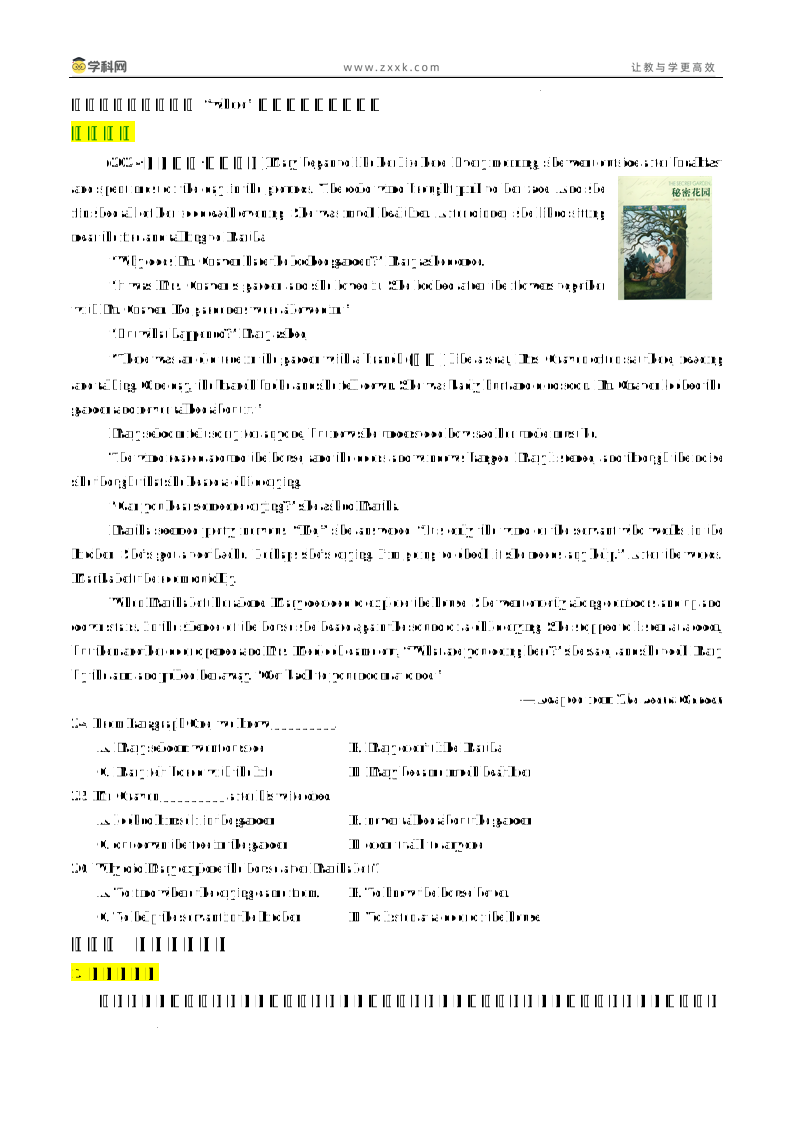
2
3
所属专辑

相关资源
由于学科网是一个信息分享及获取的平台,不确保部分用户上传资料的 来源及知识产权归属。如您发现相关资料侵犯您的合法权益,请联系学科网,我们核实后将及时进行处理。