Unit 5 Section Ⅱ Using language(学案)-【成才之路】2024-2025学年高中新课程英语必修第三册同步学习指导(外研版2019)
2025-06-03
|
2份
|
7页
|
32人阅读
|
5人下载
教辅

资源信息
| 学段 | 高中 |
|---|---|
| 学科 | 英语 |
| 教材版本 | 高中英语外研版必修第三册 |
| 年级 | 高一 |
| 章节 | Using language |
| 类型 | 学案 |
| 知识点 | - |
| 使用场景 | 同步教学-新授课 |
| 学年 | 2025-2026 |
| 地区(省份) | 全国 |
| 地区(市) | - |
| 地区(区县) | - |
| 文件格式 | ZIP |
| 文件大小 | 1.01 MB |
| 发布时间 | 2025-06-03 |
| 更新时间 | 2025-06-03 |
| 作者 | 河北万卷文化有限公司 |
| 品牌系列 | 成才之路·高中新教材同步学习指导 |
| 审核时间 | 2025-03-31 |
| 下载链接 | https://m.zxxk.com/soft/51357965.html |
| 价格 | 3.00储值(1储值=1元) |
| 来源 | 学科网 |
内容正文:
10. failure fail
Ⅱ. 1. bring. . . into focus 2. in search of 3. open up 4. by the
end of 5. turn around 6. focus on 7. figure out 8. result in
9. refer to 10. stand for 11. take risks 12. benefit from. . .
13. up to
Ⅲ. 1. to reach India by sea 2. thus marking the beginning of
European exploration of the Americas
Ⅳ.(一)1. C
(二)1. D 2. B 3. A 4. C 5. D
(三)1. powerful 2. to enjoy 3. was climbing 4. It 5. who
6. into 7. the 8. toughness 9. resulting 10. totally
课内要点探究
核心词汇
1.①be confirmed ②confirmation ③It has been confirmed that
④confirmed me in
2.①with ②into ③crowd into many tourist attractions crowded
with tourists
3.①to find ②at ③ in ④attempting to make their own tea
making an attempt to make their own tea
4.①failures ②in ③to persuade
重点短语
1.①on ②into ③Focus on what you are doing
2.①out ②showing ③figure out ④keeping her figure
3.①resulting ②resulted in ③As a result
4.①reference ②referred to as ③查阅 ④指的是 ⑤提到
重点句式
1.①to tell ②to make ③to ④to stimulate
2.①making ② to be told ③ leaving nothing valuable ④only
to find
长句分析
1.去年,成百上千的人花了大把的钱来体验一次他们知道会有
拥挤、不适和危险的经历。
2.目前还不清楚他是否在被夺去生命之前成功登上珠峰峰顶。
3. 2011年,美国登山运动员艾伦·阿内特说过类似于马洛里的
一些话。当年,阿内特登上了珠穆朗玛峰,并打算登上世界各
地的其他高山。
随堂达标验收
Ⅰ. 1. zones 2. initial 3. sheer 4. attempt 5. oxygen 6. thrill
7. crowd 8. psychologists
Ⅱ. 1. failure 2. thrilled 3. Initially 4. crowded 5. around
6. of 7. into 8. out
Ⅲ. 1. the first student to be admitted 2. It is a pity that 3. It has
been confirmed that 4. building up our body 5. With his attention
focused on a bird
Section Ⅱ Using language
课前自主预习
Ⅰ. 1. port 2. alcohol 3. rubber 4. cotton 5. guideline
6. stretch 7. unaware aware 8. wool woolen 9. bleeding
bleed blood 10. injury injure
Ⅱ. Once the wound is cleaned and dry
Ⅲ. would + do was / were going to + do 1、2、3 被动 4
课内要点探究
核心词汇
1.① awareness ② of ③ unaware ④ As ⑤ raise peoples
awareness of environmental protection
2.①to ②under ③Guided by a local guide With a local guide
guiding us Under the guidance of a local guide
3.①to ②injured ③do an injury to
重点句式
① seen ② Once this difficulty is overcome ③ once you
have confidence
单元语法精析
一、①would get ②he would leave office soon
二、①was leaving ②to go ③to change ④to get
三、①would be back ②we would never permit such a thing to
happen ③if we were going to watch the game ④would know the
answer to the problem now
专项练习
Ⅰ. 1. would be 2. would win 3. would spend 4. would buy got
5. to be made 6. was leaving 7. was going to speak 8. came
9. would be rewarded 10. would call
Ⅱ. 1. was about to give up 2. were on the point of leaving the
house 3. would play with his friends in this pond 4. she was
coming to see 5. would not / wouldnt fear failure
随堂达标验收
Ⅰ. 1. stretch 2. rubber 3. bleeding 4. port 5. unaware
6. bandage 7. cotton 8. wool 9. injuries 10. guideline
Ⅱ. 1. was leaving 2. would go 3. will be 4. would visit 5. to
cry 6. will go 7. to change 8. to close 9. would take / was taking
10. would replace
Ⅲ. 1. was going to 2. would be here 3. wouldnt finish 4. was
going to take care of 5. would ignore
Section Ⅲ Developing ideas & Presenting ideas
课前自主预习
Ⅰ. 1. charge 2. captain 3. ahead 4. chapter 5. nut 6. ray
7. gradually 8. wrinkled 9. shore 10. carpet 11. beneath
12. resident 13. male 14. servant serve service 15. permit
permission 16. fascinated fascination fascinate 17. relate
relation related 18. astonish astonished astonishing astonishment
19. consume consumer consumption 20. distinguish distinguished
21. surround surrounding surroundings 22. intensity intense
23. vibration vibrate 24. depth deep 25. broad broaden
Ⅱ. 1. in broad daylight 2. journey into 3. along with 4. in
charge 5. be fascinated by 6. no longer 7. at a distance of
8. account for 9. make sense 10. work out 11. as though / if
12. schools of 13. appeal to sb.
Ⅲ. 1. one of his men following some steps behind
2. as if an exchange of words
3. was the calm surface of the sea
Ⅳ.(一)
B
—221—
6. It gave me a real thrill (刺激)to see her again
after so many years.
7. Though I havent met him for many years,I could
recognize him immediately when I saw him in the
crowd (人群).
8. Nowadays, psychologists (心理学家)are in
greater demand due to the pressure of work.
Ⅱ '/,;<=
1. The marriage was a failure (fail)and they both
wanted to be free of it.
2. I am thrilled (thrill)and delighted that he can be
here tonight.
3. Initially (initial), she believed him, but
gradually,she found him dishonest.
4. On National Day,the streets were crowded
(crowd)with a large number of people.
5. What annoys me most is that every time I turn
around ,he seems to be checking up on me.
6. Many people leave their villages in search of
work in big cities every year.
7. Today the problem of cloning has been brought
into focus; different people hold different
opinions.
8. We must figure out how to solve the problem in
order to finish the assignment on time.
Ⅲ '/:>
1.李华是我们学校第一个被北京大学录取的学生。
Li Hua was the first student to be admitted into
Peking University in our school.
2.你错过了上周的运动会太可惜了。
It is a pity that you missed the sports meeting
last week.
3.已经证实,家庭氛围对孩子的身心健康有很大的
影响。
It has been confirmed that the atmosphere of the
family has a great effect on childrens mental and
physical health.
4.我们班经常举行各种各样的体育活动,增强了我
们的体质。
Our class often holds all kinds of sports activities,
building up our body .
5.由于男孩的注意力集中在窗外的一只小鸟上,他
没有听到老师在说什么。
With his attention focused on a bird out of the
window,the boy didnt hear what the teacher was
saying.
请同学们认真完成练案[17
]
Section Ⅱ Using language
+,-./0
Ⅰ %&'(
1. n.港,港口
2. n.酒精
3. n.橡胶,合成橡胶
4. n.棉布,棉纱
5. n.指导方针,指导原则
6. v.延伸,绵延
7. adj.未觉察到的,未意识到的→
adj.意识到的;明白的
8. n.羊毛,毛织物→
adj.羊毛的
9. n.流血,失血→ v.流
血→ blood n.血
10. n.伤,损害→ injure v.伤害
Ⅱ -./0
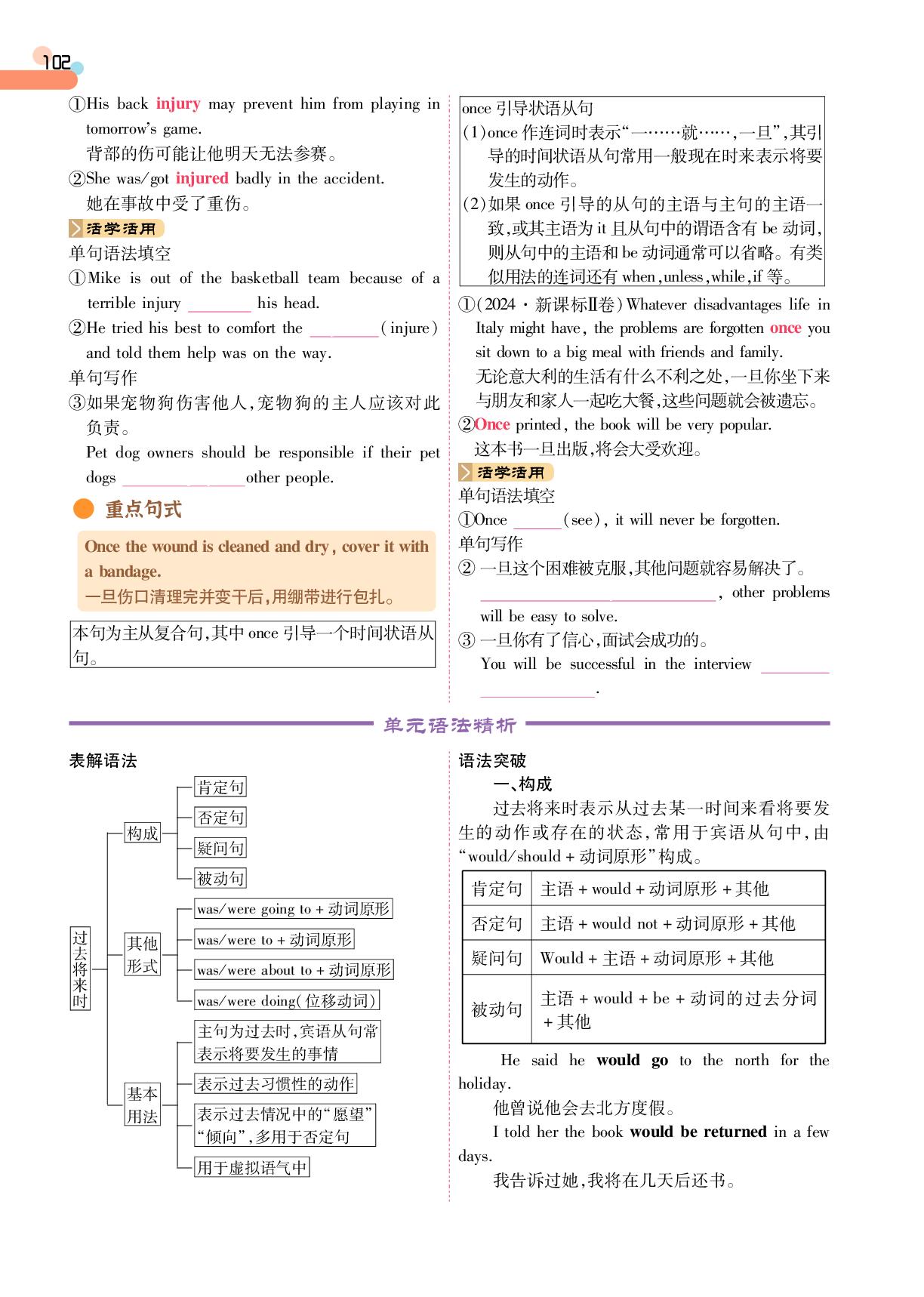
once一旦,引导时间状语从句
Once the wound is cleaned and dry ,cover it
with a bandage.
一旦伤口被清理了,干了,用绷带包上。
Ⅲ ,;!"
1. Last year,hundreds of people spent good money on
an experience that they knew would include
crowds,discomfort and danger.
2. Many would become sick,due to the extreme cold
and low air pressure,and a few would even lose
their lives.
3. Sadly,Mallory would die on the mountain in 1924
,
"!!
although his body would not be found until many
years later.
4. . . . who climbed Qomolangma in that year and was
going to climb other high mountains around the
world.
探究发现
过去将来时的构成有: would + do 和was /
were going to + do 两种形式;句1、2、3 的构成
是would + do,其中句3中的would not be found
是过去将来时的被动 形式;句4 的构成
是:was going to do
。
+12345
● %&(5
1. unaware adj.未觉察到的;未意识到的
(1)be / become unaware of / that未意识到……
(2)aware adj.意识到;觉察到
be / become aware of / that. . .意识到……
make sb. aware of / that. . .使某人意识到……
as far as Im aware = as far as I know据我所知
(3)awareness n.意识;知道
raise ones awareness of. . .增强某人对……的
意识
①Many people are unaware of just how much food
and drink they consume.
许多人并不知道他们究竟消耗掉了多少食品和
饮料。
②(2023·1 月浙江卷)My goal is to help my
students develop awareness of their strengths,
weaknesses,and learning needs,and to enable
them to learn throughout their lives.
我的目标是帮助我的学生意识到自己的优点,
缺点和学习需求,让他们终生学习。
6768
单句语法填空
①(2024·新课标Ⅱ卷)This is why Campbell has
set out to raise awareness (aware)of AI and its
future now—several decades before these
developments are expected to take place.
②As is known to all,education is a process,and
people are gradually aware of its importance.
③ I get so absorbed in doing something that I am
unaware (aware)of things happening around me.
④ As far as Im aware,a lot of crime is
connected with drugs.
单句写作
⑤我们最好发起一项运动,以加强人们对环境保护
的意识。
Wed better launch a campaign to raise peoples
awareness of environmental protection .
2. guideline n.指导方针,指导原则
(1)guidance n.指导,引导
under the guidance of在……的指导下
(2)guide n.指南;指导的事物;导游;向导
vt.领路;指引,指导
guide sb. to do sth.指导某人去做某事
guide sb. to / towards. . .带领某人去……
①This is a simple design guideline.
这是一条简单的设计指导原则。
②(2024·新课标Ⅰ卷)The garden also contains a
winding path that guides visitors through the twelve
regions of the Silk Road.
花园里还有一条蜿蜒的小路,引导游客穿越丝绸
之路的十二个区域。
6768
单句语法填空
①It was she that guided the blind man to the
street.
②Activities all take place under the guidance of an
experienced tutor.
句型转换
③We were guided by a local guide and visited the
famous church.
→ Guided by a local guide ,we visited the
famous church.(用过去分词短语作状语)
→ With a local guide guiding us ,we visited the
famous church.(用with的复合结构)
→ Under the guidance of a local guide ,we
visited the famous church.(用介词短语结构)
3. injury n.伤害;损害
(1)injury to. . .对……的伤害
(2)injure v.使受伤;弄伤
(3)injured adj.受伤的
be badly / seriously injured
严重受伤
"!"
①His back injury may prevent him from playing in
tomorrows game.
背部的伤可能让他明天无法参赛。
②She was / got injured badly in the accident.
她在事故中受了重伤。
6768
单句语法填空
①Mike is out of the basketball team because of a
terrible injury to his head.
②He tried his best to comfort the injured (injure)
and told them help was on the way.
单句写作
③如果宠物狗伤害他人,宠物狗的主人应该对此
负责。
Pet dog owners should be responsible if their pet
dogs do an injury to other people.
● )*/0
Once the wound is cleaned and dry,cover it with
a bandage.
一旦伤口清理完并变干后,用绷带进行包扎。
本句为主从复合句,其中once引导一个时间状语从
句。
once引导状语从句
(1)once作连词时表示“一……就……,一旦”,其引
导的时间状语从句常用一般现在时来表示将要
发生的动作。
(2)如果once引导的从句的主语与主句的主语一
致,或其主语为it且从句中的谓语含有be动词,
则从句中的主语和be动词通常可以省略。有类
似用法的连词还有when,unless,while,if等。
①(2024·新课标Ⅱ卷)Whatever disadvantages life in
Italy might have,the problems are forgotten once you
sit down to a big meal with friends and family.
无论意大利的生活有什么不利之处,一旦你坐下来
与朋友和家人一起吃大餐,这些问题就会被遗忘。
②Once printed,the book will be very popular.
这本书一旦出版,将会大受欢迎。
6768
单句语法填空
①Once seen (see),it will never be forgotten.
单句写作
②一旦这个困难被克服,其他问题就容易解决了。
Once this difficulty is overcome ,other problems
will be easy to solve.
③一旦你有了信心,面试会成功的。
You will be successful in the interview once you
have confidence
.
!"KLM@
表解语法
过
去
将
来
时
—
—构成—
—肯定句
—否定句
—疑问句
—被动句
—其他形式—
—was / were going to +动词原形
—was / were to +动词原形
—was / were about to +动词原形
—was / were doing(位移动词)
—基本用法—
—主句为过去时,宾语从句常表示将要发生的事情
—表示过去习惯性的动作
—表示过去情况中的“愿望”“倾向”,多用于否定句
—用于虚拟语气中
语法突破
一、构成
过去将来时表示从过去某一时间来看将要发
生的动作或存在的状态,常用于宾语从句中,由
“would / should +动词原形”构成。
肯定句主语+ would +动词原形+其他
否定句主语+ would not +动词原形+其他
疑问句Would +主语+动词原形+其他
被动句主语+ would + be +动词的过去分词
+其他
He said he would go to the north for the
holiday.
他曾说他会去北方度假。
I told her the book would be returned in a few
days.
我告诉过她,我将在几天后还书
。
"!#
6768
单句语法填空
① Though lacking experience, Mike was
convinced that he would get (get)a higher pay by
working hard.
单句写作
②当他表示他很快就会离职时,我们都很
惊讶。
We were all surprised when he made it clear that
he would leave office soon .
二、其他形式
1.“was / were going to +动词原形”表示过去曾
经打算或计划要做的事情或过去的客观迹象表明
要发生的动作。
It seemed as if it was going to rain.
看来好像要下雨。
He told me he was going to learn another
foreign language.
他告诉我说,他打算学另一门外语。
2.“was / were to +动词原形”表示过去按计划
或安排将在某个将来时间发生的动作。
He said he was to finish the work in a week.
他说他将在一周内完成这项工作。
She told me that she was to raise money for the
charity.
她告诉过我她要为慈善事业筹集资金。
3.“was / were about to +动词原形”表示过去即
将要发生的动作。
We were about to go into the cinema when
Mary appeared.
我们正要走进电影院时,玛丽出现了。
4.“was / were doing”表示过去将来时,用于几
个表示位移的动词,如leave,come,go,arrive等,表
示过去预计要发生的动作。
David was leaving for Hawaii in a few hours.
戴维几个小时后就要去夏威夷。
6768
单句语法填空
① The conductor told us that the train was
leaving (leave)at five the next morning.
②The boy was about to go (go)to bed when
someone knocked at the door.
③He didnt know that the accident was
to change (change)his whole life.
④I was going to get (get)out of the building
in case it went up in flames.
三、基本用法
1.主句为过去时,宾语从句常表示将要发生的
事情。
He said that the meeting would begin at half
past nine.
他说会议将在九点半开始。
She said she was going to speak at the meeting.
她说她将在会上发言。
2.表示过去习惯性的动作。
During that period, he would do morning
exercises every day.
在那段时间,他每天晨练。
3.表示过去情况中的“愿望”“倾向”,多用于
否定句,译为“不肯”或“不会”。
It was raining hard,but nobody would stop
working.
雨下得很大,但没有人愿意停止工作。
4.过去将来时,用于虚拟语气中。
If I were you,I would not do that.
如果我是你的话,我就不会那样做。
If I had a chance to study abroad,I would study
at Harvard University.
如果我有机会出国学习的话,我就会去哈佛
大学。
I wish he would go with me to the cinema
tonight.
我希望今晚他能和我一起去看电影。
6768
单句写作
①我哥哥告诉我他星期天回来。
My brother told me that he would be back on
Sunday.
②他们知道我们绝不会允许这样的事发生。
They knew that we would never permit such a
thing to happen. .
③老师问我们是否去看比赛。
The teacher asked us if we were going to watch
the game. .
④如果他当时专心听老师讲课,他现在就知道
问题的答案了。
If he had listened to the teacher attentively then,
he would know the answer to the problem now.
.
"!$
专项练习
Ⅰ.单句语法填空
1. Li Ming said he would be (be)happy if Brian
came to China the next month.
2.(2023·全国乙卷)She said she had felt confident
all along that she would win (win).
3. Jenny said she would spend (spend)her holiday
in China next summer.
4. He promised that he would buy (buy)some
gifts for us when he got (get)there.
5. The discovery of gold in Australia led thousands to
believe that a fortune was to be made (make).
6. Mr Green was leaving (leave)for Hawaii a few
hours later.
7. He was going to speak (speak)at the meeting,
but his heart attack prevented him.
8. I didnt know when she would come,but when she
came (come)I would let you know.
9. If the monkeys touched the left side of the screen,
they would be rewarded (reward)seven drops of
water or juice.
10.(2023·新高考Ⅰ卷改编)He decided to build
what he would call (call) an ecomachine
later.
Ⅱ.单句写作
1.这个人正要放弃,这时他被一艘大船发现了。
(about;give up)
The man was about to give up when he was
found by a big ship.
2.他们正要离开房子,这时有人敲门。(point)
They were on the point of leaving the house
when someone knocked at the door.
3.当他是个孩子时,他常常和朋友在这个池塘玩
耍。(play)
When he was a child,he would play with his
friends in this pond. .
4.她在昨天写的信中告诉我她将要来看我。
(come)
She told me that she was coming to see me in
the letter she wrote yesterday.
5.汤姆记得失败是成功之母,所以他将不会害怕失
败。(failure)
Tom remembered that failure is the mother of
success,so he would not / wouldnt fear failure.
.
EFGHIJ
Ⅰ '(9:
1. On the Taihu Lake,mists and waves stretch (延
伸)far into the distance.
2. The electric wires are protected by a rubber (橡
胶)covering.
3. She cut her finger on a piece of glass and it is
bleeding (流血).
4. We will pay a visit to the ancient port (港口)
and the museum tomorrow.
5. They worked from seven to twelve, unaware (未
意识到的)of tiredness.
6. He tied the bandage (绷带)tightly on his leg so
that it would stay in place.
7. Compared with the silk coat,the cotton (棉布)
one is more suitable for me.
8. Our country import wool (羊毛)and other
goods from Australia every year.
9. An earthquake hit the southeast of the country,
causing 6 deaths and hundreds of injuries (伤).
10. A newlypublished guideline (指导方针)on
senior high school education reform aims to
improve education quality.
Ⅱ '/,;<=
1. The man told us that the bus was leaving (leave)
at five the next morning.
2. I wasnt sure whether he would go (go) to
Beijing the next morning.
3. My father is fiftysix. In two years he will be (be)
fiftyeight.
4. Whenever she had time,she would visit (visit)
her parents with her husband.
5. The baby was going to cry (cry)loudly if she
didnt see her mother.
6. If it doesnt rain he will go (go) to the
countryside to see his teacher.
7. He didnt know that the experience was to chan
(change)his whole life.
8. The boy was about to close (close)the door
when someone knocked at the door.
9. The girl said that she would take / was taking
(take)
her mother for holiday the next month.
"!%
10. He asked what would replace (replace)the old
material in the future.
Ⅲ '/:>
1.我正要告诉他,但他不给我机会。
I was going to tell him,but he didnt give me a
chance.
2.他说他将在八点钟到达这里。
He said he would be here at eight oclock.
3.我知道约翰在下午5点前结束不了工作。
I knew John wouldnt finish the work by 5:00 p. m.
4.他说他将照看这个婴儿。
He said that he was going to take care of the
baby.
5.他们害怕如果把他惹恼他会不理他们。
They feared that he would ignore them if they
displeased him.
请同学们认真完成练案[18
]
Section Ⅲ Developing ideas & Presenting ideas
+,-./0
Ⅰ %&'(
1. n.主管,负责
2. n.船长
3. adv.在前面
4. n.章节
5. n.坚果(仁)
6. n.光线,光束
7. adv.逐渐地,逐步地
8. adj.有皱褶的
9. n.岸,滨
10. n.地毯
11. prep.在……之下,在……正下方
12. n.居民,住户
13. n.雄性动物
14. n.仆人,佣人→
v.服务;伺候→ n.服务;招待
15. v.允许,准许,许可→
n.允许,准许
16. adj.被迷住的,被吸引住的→
n.魅力;魔力→
v.使着迷
17. v.相联系,有关联;讲述→
n.联系,关系→ adj.有
关系的,有关联的
18. v.使吃惊,使惊讶→
adj.感到吃惊的,惊讶的→
adj.令人吃惊的→ n.吃惊,惊讶
19. v.消耗→ n.消费
者→ n.消耗;消费
20. v.看清;认出→
adj.卓越的;著名的
21. v.环绕,围绕→
adj.周围的→ n.环境
22. n.(光、声等的)强度→
adj.强烈的;紧张的
23. n.震颤,震动→
v.使震动;使颤动
24. n.深,深度→
adj.深的
25. adj.宽的,阔的→
v.加宽
Ⅱ )*+,
1. 在大白天
2. ……之旅
3. 和……一起
4. 掌管;负责
5. 被……迷住/吸引
6. 不再
7. 在……远处
8. 解释……的原因;(数量
上、比例上)占
9. 有意义;讲的通
10. 解决;弄明白;计划
11. 好像
12. 成群的
13.
吸引某人
"!&
资源预览图

1

2
3

相关资源
由于学科网是一个信息分享及获取的平台,不确保部分用户上传资料的 来源及知识产权归属。如您发现相关资料侵犯您的合法权益,请联系学科网,我们核实后将及时进行处理。