甘肃省天水市麦积区甘泉中学2023—2024学年八年级下学期第二次月考测试英语试卷
2025-02-17
|
5页
|
113人阅读
|
1人下载
资源信息
| 学段 | 初中 |
|---|---|
| 学科 | 英语 |
| 教材版本 | - |
| 年级 | 八年级 |
| 章节 | - |
| 类型 | 试卷 |
| 知识点 | - |
| 使用场景 | 同步教学-阶段检测 |
| 学年 | 2024-2025 |
| 地区(省份) | 甘肃省 |
| 地区(市) | 天水市 |
| 地区(区县) | 麦积区 |
| 文件格式 | DOCX |
| 文件大小 | 41 KB |
| 发布时间 | 2025-02-17 |
| 更新时间 | 2025-02-17 |
| 作者 | 匿名 |
| 品牌系列 | - |
| 审核时间 | 2025-02-17 |
| 下载链接 | https://m.zxxk.com/soft/50490689.html |
| 价格 | 1.00储值(1储值=1元) |
| 来源 | 学科网 |
内容正文:
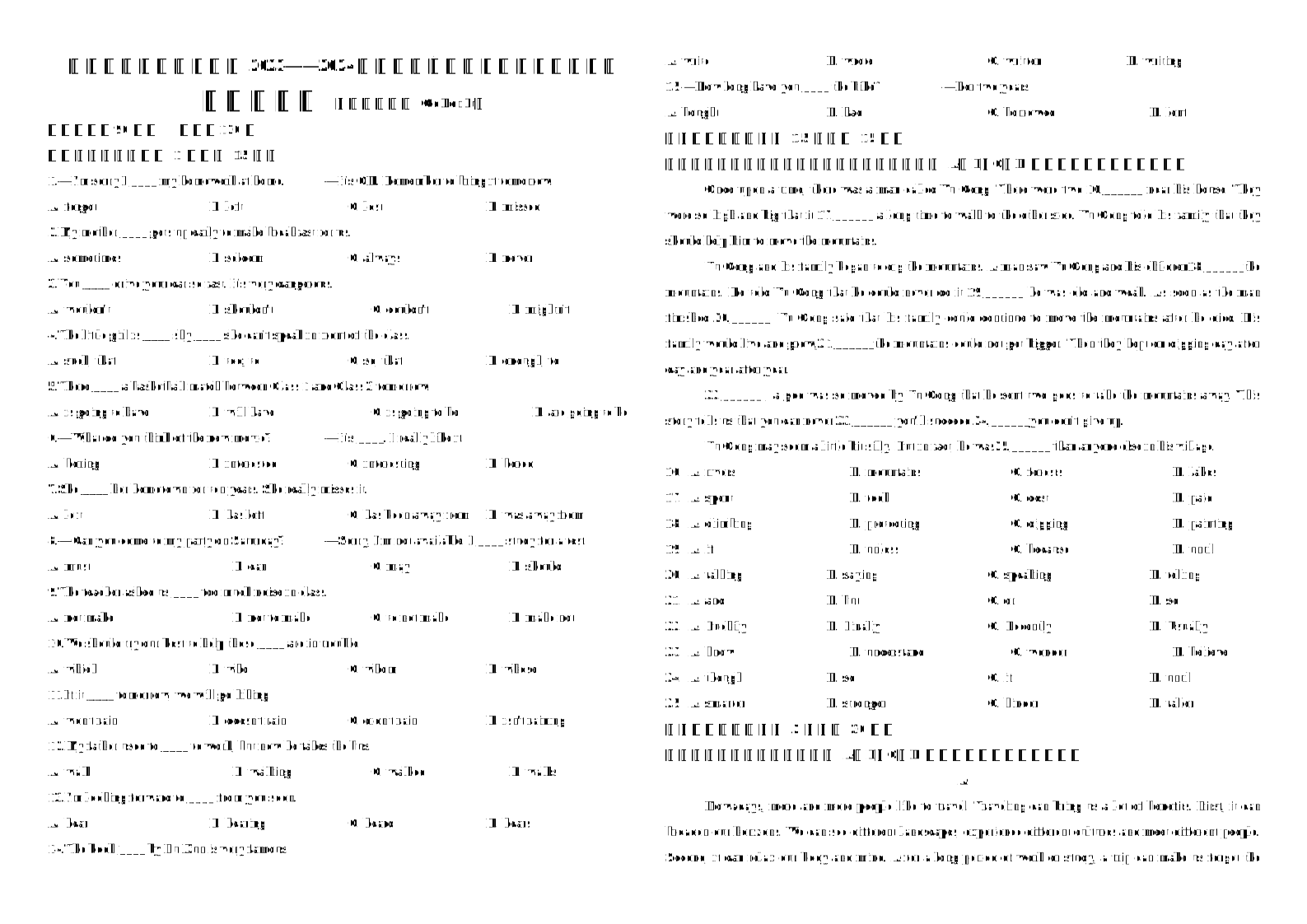
天水市麦积区甘泉中学2023——2024学年度第二学期第二次月考测试卷
八年级英语 (人教新目标 Go For It)
考试时间:90 分钟 满分:120 分
一、单项选择(每题 1 分,共 15 分)
1.—I'm sorry I ____ my homework at home. —It's OK. Remember to bring it tomorrow.
A. forgot B. left C. lost D. missed
2.My mother ____ gets up early to make breakfast for us.
A. sometimes B. seldom C. always D. never
3.You ____ drive your car so fast. It's very dangerous.
A. wouldn't B. shouldn't C. couldn't D. mightn't
4.The little girl is ____ shy ____ she can't speak in front of the class.
A. such; that B. too; to C. so; that D. enough; to
5.There ____ a basketball match between Class 1 and Class 3 tomorrow.
A. is going to have B. will have C. is going to be D. are going to be
6.—What do you think of the new movie? —It's ____. I really like it.
A. boring B. interested C. interesting D. bored
7.She ____ her hometown for ten years. She really misses it.
A. left B. has left C. has been away from D. was away from
8.—Can you come to my party on Saturday? —Sorry, I'm not available. I ____ study for a test.
A. must B. can C. may D. should
9.The teacher asked us ____ too much noise in class.
A. not make B. not to make C. to not make D. make not
10.We should try our best to help those ____ are in trouble.
A. which B. who C. whom D. whose
11.If it ____ tomorrow, we will go hiking.
A. won't rain B. doesn't rain C. didn't rain D. isn't raining
12.My father used to ____ to work, but now he takes the bus.
A. walk B. walking C. walked D. walks
13.I'm looking forward to ____ from you soon.
A. hear B. hearing C. heard D. hears
14.The book ____ by Lu Xun is very famous.
A. write B. wrote C. written D. writing
15.—How long have you ____ the bike? —For two years.
A. bought B. had C. borrowed D. lent
二、完形填空(每题 1.5 分,共 15 分)
通读下面短文,掌握其大意,然后从每题所给的 A、B、C、D 四个选项中选出最佳选项。
Once upon a time, there was a man called Yu Gong. There were two 16.______ near his house. They were so high and big that it 17.______ a long time to walk to the other side. Yu Gong told his family that they should help him to move the mountains.
Yu Gong and his family began to dig the mountains. A man saw Yu Gong and his children18.______the mountains. He told Yu Gong that he could never do it 19.______ he was old and weak. As soon as the man finished 20.______, Yu Gong said that his family could continue to move the mountains after he died. His family would live and grow,21.______the mountains could not get bigger. Then they kept on digging day after day and year after year.
22.______ , a god was so moved by Yu Gong that he sent two gods to take the mountains away. This story tells us that you can never 23.______ you'll succeed 24.______you don't give up.
Yu Gong may seem a little bit silly. But in fact, he was25.______ than anyone else in his village.
16. A. rivers B. mountains C. forests D. lakes
17. A. spent B. took C. cost D. paid
18. A. climbing B. protecting C. digging D. painting
19. A. if B. unless C. because D. until
20. A. talking B. saying C. speaking D. telling
21. A. and B. but C. or D. so
22. A. Luckily B. Finally C. Recently D. Usually
23. A. know B. understand C. wonder D. believe
24. A. though B. so C. if D. until
25. A. smarter B. stronger C. kinder D. taller
三、阅读理解(每题 2 分,共 30 分)
阅读下列短文,从每题所给的 A、B、C、D 四个选项中选出最佳选项。
A
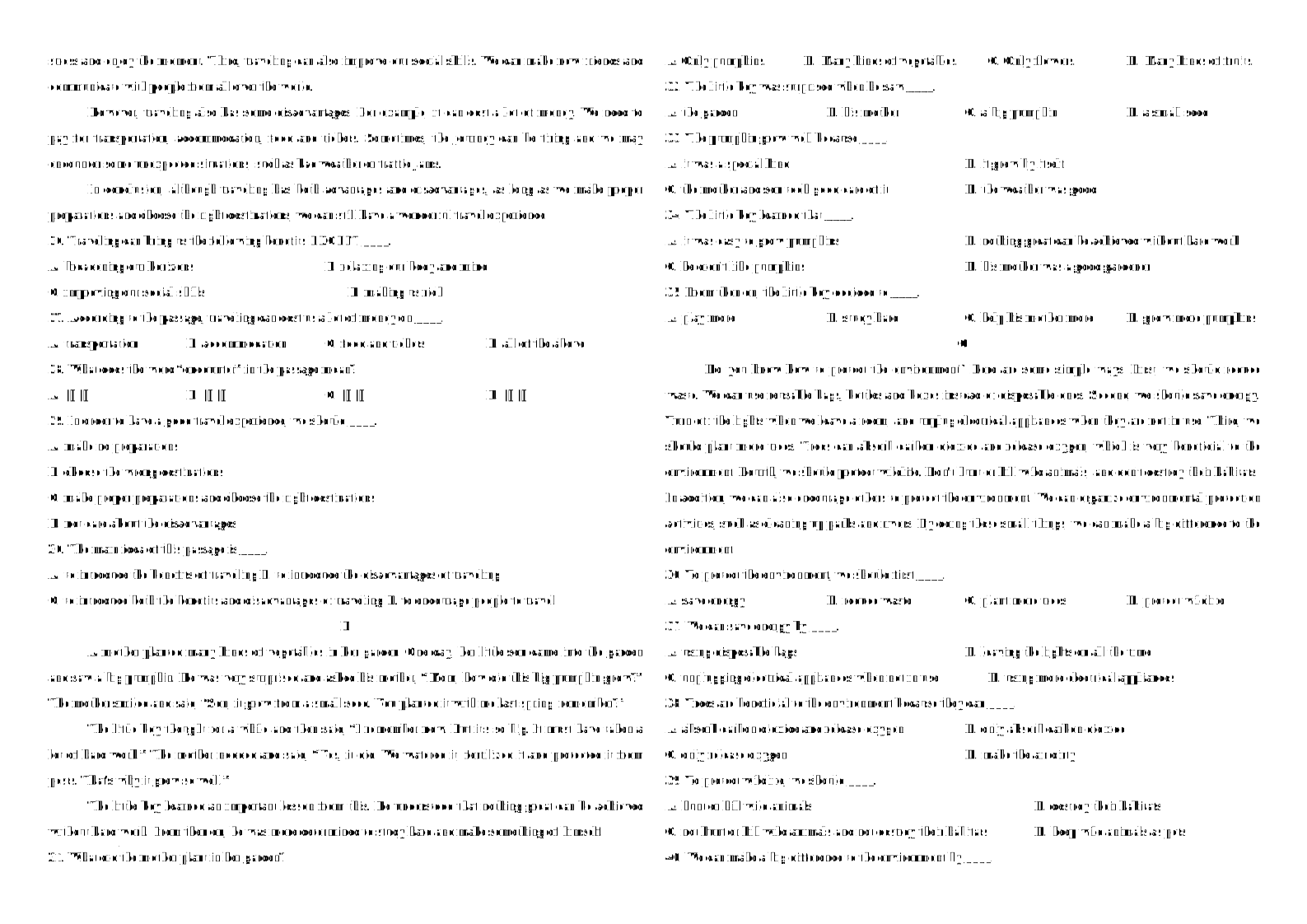
Nowadays, more and more people like to travel. Traveling can bring us a lot of benefits. First, it can broaden our horizons. We can see different landscapes, experience different cultures and meet different people. Second, it can relax our body and mind. After a long period of work or study, a trip can make us forget the stress and enjoy the moment. Third, traveling can also improve our social skills. We can make new friends and communicate with people from all over the world.
However, traveling also has some disadvantages. For example, it can cost a lot of money. We need to pay for transportation, accommodation, food and tickets. Sometimes, the journey can be tiring and we may encounter some unexpected situations, such as bad weather or traffic jams.
In conclusion, although traveling has both advantages and disadvantages, as long as we make proper preparations and choose the right destinations, we can still have a wonderful travel experience.
26. Traveling can bring us the following benefits EXCEPT ____.
A. broadening our horizons B. relaxing our body and mind
C. improving our social skills D. making us rich
27. According to the passage, traveling can cost us a lot of money on ____.
A. transportation B. accommodation C. food and tickets D. all of the above
28. What does the word “encounter” in the passage mean?
A. 避免 B. 遭遇 C. 期待 D. 处理
29. In order to have a good travel experience, we should ____.
A. make no preparations
B. choose the wrong destinations
C. make proper preparations and choose the right destinations
D. not care about the disadvantages
30. The main idea of this passage is ____.
A. to introduce the benefits of traveling B. to introduce the disadvantages of traveling
C. to introduce both the benefits and disadvantages of traveling D. to encourage people to travel
B
A mother planted many kinds of vegetables in her garden. One day, her little son came into the garden and saw a big pumpkin. He was very surprised and asked his mother, “Mom, how did this big pumpkin grow?” The mother smiled and said, “Son, it grew from a small seed. You planted it with me last spring, remember?”
The little boy thought for a while and then said, “I remember now. But it's so big. It must have taken a lot of hard work.” The mother nodded and said, “Yes, it did. We watered it, fertilized it and protected it from pests. That's why it grew so well.”
The little boy learned an important lesson from this. He understood that nothing great can be achieved without hard work. From then on, he was more determined to study hard and make something of himself.
31. What did the mother plant in her garden?
A. Only pumpkins. B. Many kinds of vegetables. C. Only flowers. D. Many kinds of fruits.
32. The little boy was surprised when he saw ____.
A. the garden B. his mother C. a big pumpkin D. a small seed
33. The pumpkin grew well because ____.
A. it was a special kind B. it grew by itself
C. the mother and son took good care of it D. the weather was good
34. The little boy learned that ____.
A. it was easy to grow pumpkins B. nothing great can be achieved without hard work
C. he didn't like pumpkins D. his mother was a good gardener
35. From then on, the little boy decided to ____.
A. play more B. study hard C. help his mother more D. grow more pumpkins
C
Do you know how to protect the environment? Here are some simple ways. First, we should reduce waste. We can use reusable bags, bottles and boxes instead of disposable ones. Second, we should save energy. Turn off the lights when we leave a room, and unplug electrical appliances when they are not in use. Third, we should plant more trees. Trees can absorb carbon dioxide and release oxygen, which is very beneficial to the environment. Fourth, we should protect wildlife. Don't hunt or kill wild animals, and don't destroy their habitats.
In addition, we can also encourage others to protect the environment. We can organize environmental protection activities, such as cleaning up parks and rivers. By doing these small things, we can make a big difference to the environment.
36. To protect the environment, we should first ____.
A. save energy B. reduce waste C. plant more trees D. protect wildlife
37. We can save energy by ____.
A. using disposable bags B. leaving the lights on all the time
C. unplugging electrical appliances when not in use D. using more electrical appliances
38. Trees are beneficial to the environment because they can ____.
A. absorb carbon dioxide and release oxygen B. only absorb carbon dioxide
C. only release oxygen D. make the air dirty
39. To protect wildlife, we should ____.
A. hunt or kill wild animals B. destroy their habitats
C. not hunt or kill wild animals and not destroy their habitats D. keep wild animals as pets
40. We can make a big difference to the environment by ____.
A. doing nothing B. only protecting wildlife
C. doing small things like reducing waste, saving energy, etc. D. only planting more trees
四、语法填空(每题 1 分,共 10 分)
阅读下面短文,在空白处填入一个适当的词,或填入括号中所给单词的正确形式。
Last Sunday, I went to the park with my friends. We 41_______(decide) to have a picnic there. When we arrived, we found a nice place under a big tree and 42_______ (lay) out our food. There were sandwiches, fruits, cookies and drinks.
We were enjoying our food when suddenly a dog came running towards us. It looked very hungry. I 43_______ (take) out a piece of bread and threw it to the dog. The dog caught it and ate it quickly. Then it wagged its tail 44_______ (happy) and lay down beside us.
After that, we played some games. One of my friends 45_______ (suggest) playing frisbee. We had a lot of fun. While we 46 _______(play), the dog joined us. It seemed to understand our games and was very excited.
As the sun was going down, we knew it was time to go home. We packed up our things and said goodbye to the dog. I think it was a great day. I'm looking forward to 47_______ (go) to the park again and maybe 48_______ (meet) the dog again.
I also learned that animals are our friends. We should be kind to them. If we all do our part, the world will be a better place. Next time, I plan to bring some food for the dog and other animals in the park. I believe that kindness 49 _______(spread) and more people will care about animals.
Now, I'm writing this article to share my experience with you. I hope you 50_______ (enjoy) reading it.
五、书面表达(30 分)
假如你是李华,你们学校最近开展了 “校园文明月” 活动,请你根据以下提示,用英语写一篇短文,介绍这次活动。
活动目的:培养学生的文明习惯,营造良好的校园氛围;
活动时间:持续一个月;
活动内容:保持校园清洁,使用礼貌用语,遵守交通规则等;
活动效果:校园环境得到改善,同学们的行为更加文明;
你的感受。
要求:1. 词数:800 左右;
2.可适当增加细节,以使行文连贯;
3.短文标题自拟。
答案解析
一、单项选择
1. B。“leave sth. + 地点” 表示 “把某物落在某地”,forget 后面一般不接地点状语,lost 意为 “丢失”,miss 意为 “错过,想念”,这里指把作业落在家里,所以选 B。
2. C。根据常识,妈妈总是早起为家人做早饭,sometimes 意为 “有时”,seldom 意为 “很少”,never 意为 “从不”,always 意为 “总是”,故选 C。
3. B。shouldn't 意为 “不应该”,表示建议,这里指你不应该开车太快,很危险;wouldn't 是 will not 的过去式,意为 “不会”;couldn't 意为 “不能,不可能”;mightn't 意为 “可能不”,所以选 B。
4. C。“so + 形容词 / 副词 + that” 引导结果状语从句,表示 “如此…… 以至于”,such 后接名词短语,too...to 意为 “太…… 而不能”,to 后接动词原形,enough 修饰形容词 / 副词时要后置,这里 shy 是形容词,所以选 C。
5. C。there be 句型的将来时结构为 “there is/are going to be” 或 “there will be”,主语是 a basketball match 为单数,所以选 C。
6. C。以 -ing 结尾的形容词修饰物,以 -ed 结尾的形容词修饰人,这里说电影有趣,用 interesting,boring 意为 “无聊的”,interested 意为 “感兴趣的”,bored 意为 “感到无聊的”,所以选 C。
7. C。根据 for ten years 可知要用现在完成时,leave 是短暂性动词,不能和一段时间连用,要换成 be away from,所以选 C。
8. A。must 意为 “必须”,这里指我必须为考试学习;can 意为 “能,会”;may 意为 “可能”;should 意为 “应该”,根据语境选 A。
9. B。ask sb. not to do sth. 要求某人不要做某事,是固定搭配,所以选 B。
10. B。先行词 those 指人,在定语从句中作主语,要用 who,which 指物,whom 作宾语,whose 表示所属关系,所以选 B。
11. B。if 引导条件状语从句,遵循 “主将从现” 原则,从句用一般现在时,主语是 it,否定形式为 doesn't rain,所以选 B。
12. A。used to do sth. 过去常常做某事,后面接动词原形,所以选 A。
13. B。look forward to doing sth. 期待做某事,to 是介词,后面接动名词,所以选 B。
14. C。这里用过去分词 written 作后置定语,修饰 the book,表示 “被鲁迅写的书”,write 是动词原形,wrote 是过去式,writing 是现在分词,所以选 C。
15. B。根据 How long 可知要用延续性动词,bought 是短暂性动词,have 是延续性动词,borrowed 和 lent 也是短暂性动词,这里指拥有自行车多久,所以选 B。
二、完形填空
16. B。根据后文 “Yu Gong told his family that they should help him to move the mountains.” 可知他家附近有两座山,选 B。
17. B。It takes sb. some time to do sth. 是固定句型,意为 “做某事花费某人多长时间”,spent 的主语是人,cost 的主语是物,paid 与 for 搭配,常用于 pay money for sth.,所以选 B。
18. C。根据前文 “Yu Gong and his family began to dig the mountains.” 可知这里是看到他们在挖山,选 C。
19. C。这里是说那个人认为愚公做不到是因为他年老体弱,if 意为 “如果”,unless 意为 “除非”,because 意为 “因为”,until 意为 “直到”,所以选 C。
20. B。say 强调说话的内容,talk 侧重交谈,speak 常接语言,tell 意为 “告诉,讲述”,这里指那个人说完,强调内容,所以选 B。
21. B。前后句是转折关系,山不会变大但家人会繁衍,and 表示并列,but 表示转折,or 表示选择,so 表示结果,所以选 B。
22. B。luckily 意为 “幸运地”,finally 意为 “最后”,recently 意为 “最近”,usually 意为 “通常”,这里指最后神被感动,派神把山移走,所以选 B。
23. A。这里指你永远不知道你会不会成功,know 意为 “知道”,understand 意为 “理解”,wonder 意为 “想知道”,believe 意为 “相信”,所以选 A。
24. C。if 引导条件状语从句,意为 “如果”,这里指如果你不放弃,你就不知道会不会成功,though 意为 “尽管”,so 意为 “所以”,until 意为 “直到”,所以选 C。
25. A。根据前文愚公坚持移山,看似傻,实际上比村里其他人都聪明,smarter 意为 “更聪明”,stronger 意为 “更强壮”,kinder 意为 “更善良”,taller 意为 “更高”,所以选 A。
三、阅读理解
A
26. D。根据文中 “Traveling can bring us a lot of benefits. First, it can broaden our horizons... Second, it can relax our body and mind... Third, traveling can also improve our social skills.” 可知旅行不能让我们变富,选 D。
27. D。根据 “For example, it can cost a lot of money. We need to pay for transportation, accommodation, food and tickets.” 可知旅行在交通、住宿、食物和门票上都要花钱,选 D。
28. B。encounter 所在句 “Sometimes, the journey can be tiring and we may encounter some unexpected situations” 意思是有时旅程会很累,我们可能会遭遇一些意想不到的情况,所以 encounter 意为 “遭遇”,选 B。
29. C。根据 “In conclusion, although traveling has both advantages and disadvantages, as long as we make proper preparations and choose the right destinations, we can still have a wonderful travel experience.” 可知要做好准备并选对目的地,选 C。
30. C。文章既介绍了旅行的好处,又介绍了坏处,所以主旨是介绍旅行的利弊,选 C。
B
31. B。根据 “A mother planted many kinds of vegetables in her garden.” 可知妈妈种了很多种蔬菜,选 B。
32. C。根据 “One day, her little son came into the garden and saw a big pumpkin. He was very surprised” 可知小男孩看到大南瓜很惊讶,选 C。
33. C。根据 “We watered it, fertilized it and protected it from pests. That's why it grew so well.” 可知是母子俩悉心照料南瓜才长得好,选 C。
34. B。根据 “He understood that nothing great can be achieved without hard work.” 可知小男孩明白了没有努力什么伟大的事都做不成,选 B。
35. B。根据 “From then on, he was more determined to study hard and make something of himself.” 可知小男孩决定努力学习,选 B。
C
36. B。根据 “First, we should reduce waste.” 可知保护环境首先要减少浪费,选 B。
37. C。根据 “Second, we should save energy. Turn off the lights when we leave a room, and unplug electrical appliances when they are not in use.” 可知不使用电器时拔掉插头可以节能,选 C。
38. A。根据 “Trees can absorb carbon dioxide and release oxygen, which is very beneficial to the environment.” 可知树能吸收二氧化碳释放氧气,选 A。
39. C。根据 “Fourth, we should protect wildlife. Don't hunt or kill wild animals, and don't destroy their habitats.” 可知要保护野生动物,不捕杀、不破坏栖息地,选 C。
40. C。根据 “By doing these small things, we can make a big difference to the environment.” 可知做像减少浪费、节能等小事能对环境有很大影响,选 C。
四、语法填空
41. decided。根据 Last Sunday 可知用一般过去时,动词用过去式,故填 decided。
42. laid。and 连接并列谓语,根据 arrived 可知用一般过去时,lay 的过去式是 laid,故填 laid。
43. took。根据前文可知用一般过去时,take 的过去式是 took,故填 took。
44. happily。修饰动词 wagged 用副词,happy 的副词是 happily,故填 happily。
45. suggested。根据前文可知用一般过去时,suggest 的过去式是 suggested,故填 suggested。
46. were playing。while 引导时间状语从句,强调主句动作发生时,从句动作正在进行,根据 joined 可知主句是一般过去时,从句用过去进行时,主语 we 是复数,故填 were playing。
47. going。look forward to doing sth. 期待做某事,故填 going。
48. meeting。and 连接并列成分,与 going 并列,故填 meeting。
49. will spread。根据语境可知用一般将来时,故填 will spread。
50. enjoy。hope 后接宾语从句,从句用一般现在时,主语 you 是第二人称,动词用原形,故填 enjoy。
五、作文
Campus Civilization Month”
Our school has carried out the “Campus Civilization Month” activity recently. It lasted for one month, aiming to foster students’ civilized habits and create a pleasant campus atmosphere.
During this month, we were required to keep the campus clean, always using polite language and following traffic rules on campus. As a result, the campus environment has been much improved and our behaviors have become more civilized.
I really benefited a lot from it. I’ve realized that small acts of kindness can make a big difference. I’ll keep behaving well to contribute to a better campus.
学科网(北京)股份有限公司
$$
资源预览图
1
2
相关资源
由于学科网是一个信息分享及获取的平台,不确保部分用户上传资料的 来源及知识产权归属。如您发现相关资料侵犯您的合法权益,请联系学科网,我们核实后将及时进行处理。