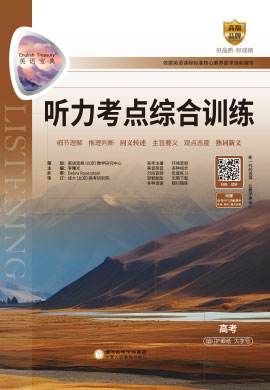
高考听力考点综合训练(14)-【英语宝典】高考英语听力考点综合训练
2024-09-27
|
3份
|
6页
|
60人阅读
|
5人下载

内容正文:
32
高考听力考点综合训练 14
难度:★★★★ 录音原文见本书第 131 页
听下面 5 段对话。每段对话后有一个小题,从题中所给的 A、B、C 三个选项中选出最佳选项。听
完每段对话后,你都有 10 秒钟的时间来回答有关小题和阅读下一小题。每段对话仅读一遍。
第 一 节
1 What is the man doing?
A. Preparing dinner. B. Answering the phone. C. Looking for something.
2 Why does the woman speak to the man?
A. To get some information. B. To discuss a schedule. C. To make a travel plan.
3 How long has the train already stayed at the station?
A. 15 minutes. B. 14 minutes. C. 8 minutes.
4 What does the woman think of old movies?
A. Enjoyable. B. Educational. C. Boring.
5 What degree does the man plan to start next year?
A. Doctorate. B. Master. C. Bachelor.
听下面 5 段对话或独白。每段对话或独白后有几个小题,从题中所给的 A、B、C 三个选项中选出
最佳选项。听每段对话或独白前,你将有时间阅读各个小题,每小题 5 秒钟;听完后,各小题将给
出 5 秒钟的作答时间。每段对话或独白读两遍。
第 二 节
听第 6段材料,回答第 6至 7题。
6 What does the man want to do?
A. Change his seat. B. Confirm his booking. C. Book a flight.
7 When is the man’s flight?
A. At 6:25 a.m. B. At 6:25 p.m. C. At 10 p.m.
听第 7段材料,回答第 8至 9题。
8 Why does the man look pale?
A. He lost his job. B. He had a stressful work. C. He argued with his boss.
9 What does the woman suggest the man do?
A. Ask for help. B. Go to see a doctor. C. Finish the projects.
听第 8段材料,回答第 10 至 12 题。
10 What are the speakers mainly talking about?
A. What transport to take.
B. How to carry their luggage.
C. Where to spend vacation.
33
听力考点综合训练 高考
随 记
随
11 Why does the woman want to take a train there?
A. To carry more luggage. B. To save money. C. To enjoy the scenery.
12 What will the speakers do next?
A. Check the tickets. B. Arrange the luggage. C. Buy suitcases.
听第 9段材料,回答第 13 至 16 题。
13 Why is the woman interviewing the man?
A. To collect data for a project. B. To do a market research. C. To introduce a school.
14 What does the woman ask the man about first?
A. His eating habits. B. His way to exercise. C. His personal information.
15 What do we know about the man’s family?
A. They seldom cook at home.
B. They usually watch movies at home.
C. They go to restaurants once a month.
16 Where does the man usually do exercise?
A. At the gym. B. At home. C. Outdoors.
听第 10 段材料,回答第 17 至 20 题。
17 Who are the listeners?
A. Residence advisors. B. College students. C. Visitors.
18 How long will the dormitories be closed?
A. About twenty days. B. About one month. C. About two months.
19 What will lead to a fine?
A. Failing to leave the room by June third.
B. Forgetting to turn in the key before leaving.
C. Leaving personal things inside the room.
20 What will the speaker do with the room damage?
A. Have it repaired. B. Write a report. C. Contact residence advisors.
classic n.(书、电影或歌曲的)经典作品;名著;杰作 doctorate n. 博士学位
assign v. 分配(某物);分派;布置(工作、任务等) farmland n. [U] 农田;耕地
claim v. 认领 destination n. 目的地;终点 survey n. 民意调查;民意测验
work out 锻炼 be aware of 意识到 Take your time. 别着急。
claim: 作 动 词 一 般 表 示“ 宣 称”。 在 Text 8 里“The only thing you have to do is claim your
luggage at the destination.”,claim 意为“认领”,此处为熟词新义。
work out:作动词短语一般表示“解决;算出”。在 Text 9 里“I rarely leave the house to work
out”,work out 意为“锻炼”,此处为熟词新义。
语 提拓块 升 14展
131
听力考点综合训练 高考
Text 1
M: Oh, I can’t find my phone. Call me from your phone.
W: I hear it ringing! It sounds like it’s coming from the
kitchen or our bathroom.
M: What are you talking about? Here it is, right on the
table.
Text 2
W: What time is your mother arriving?
M: She was supposed to catch the noon bus but she
called to say that she had missed it. So she plans to
take the 3:30 which will get her here about dinner
time.
Text 3
M: How long will the train stay here? I want to have
some more fresh air on the platform.
W: Let’s see. The train arrived at 10:15 and will leave at
10:29. You have six more minutes, I think.
3. How long has the train already stayed at the station?
A. 15 minutes. B. 14 minutes. C. 8 minutes.
【答案】C
【分析】推理判断题。女士说火车在 10:15 到达,在 10:29 离开,
他们现在还有6分钟时间。可以推断出火车“已经停留了8分钟”,
故选 C 项。
→
Text 4
W: I love to spend my free time watching movies.
old-fashioned, but my parents don’t want to change
it. They have lived here since 1938.
M: mWhen are we going to see the horse, Mary? I want
to go for a ride.
W: mWe’ll go there when we’ve seen everything here.
Text 9
W: How are you enjoying working in China? nYou’ve
been here for a while, haven’t you?
M: nIt’s twelve months today.
W: Wow, it’s gone quickly. Is everything OK?
M: oThe first six months were tough. I didn’t know
anybody, so I only had my own company in a
strange place.
W: I think we’ve all been through that.
M: But it’s fine now. I made friends and have gotten
used to the local traditions here.
W: How are you finding things like shopping and the
bank? Are you having any problems dealing with
them?
M: Not really. When I’m shopping I just pick things off
the shelf, and I try to get to the bank as soon as it
opens, to avoid the waiting lines.
W: Sounds like you’re dealing well with not speaking
Chinese.
M: pThe main problem occurs when I get my hair cut.
They just don’t understand I want the same kind of
haircut all year round — not shorter in the summer.
W: How about having someone write a note for you so
you can take it with you?
M: Yes, I might just do that.
W: qDo you think you might learn Chinese?
M: qYes, I’d like to, although it looks extremely difficult.
Text 10
W: The word “pub” is the short form of “public
house” in Great Britain. rIt is supposed to be the
Englishmen’s favorite meeting place, where they can
get together with friends over a pint of beer and talk
about football, horse racing, or business. Pubs are
usually open from 11 a.m. to midnight.
You may notice that the pub is the Englishmen’s
meeting place. sIt is not quite respectable for a
woman to go into a pub alone. She must have a man
to go with her. Perhaps that’s partly the reason why
pubs depress me — rthey are intended mainly to
meet male interests.
Most Englishmen have their favorite local pub, where
they can escape from the pressures of family life or
work. Indeed, tmany men dream of retiring from
their 9 to 5 jobs and buying a little country pub,
where they imagine they always be the host of a week-
long party.
高考听力考点综合训练(14)
132
录音原文
M: Me too. I especially enjoy the classics.
W: Really? I have a hard time sitting through old
movies.
Text 5
M: Finished your Bachelor’s degree?
W: Yeah. I’m going to Harvard to do post-graduate work
in Medicine. And you?
M: I’m gonna start my Doctorate in Computer next year.
Text 6
W: Good morning. May I help you?
M: Good morning. fI’d like to book a seat on a flight
from Beijing to New York on July 10th, please.
W: Would you like a morning or an afternoon flight?
M: gThe afternoon flight, please.
W: Just a moment, please. gThere are seats available on
a flight leaving at 6:25. Would you like this flight?
M: gYes, a first class single ticket, in the name of John
Robert.
W: All right. I’ve booked a seat for you on Flight 351.
You can confirm this booking next week.
Text 7
W: Steve, you look pale. What’s wrong with you?
M: I didn’t sleep last night. And I feel depressed.
W: Have you met any troubles? Tell me, maybe I can
help.
M: hWell, I’m under a lot of pressure. My boss assigned
me three projects. But now I still haven’t finished
any of them.
W: But if you can’t finish them iyou can ask someone
else to help you. You have to relax.
M: Thank you for your advice.
Text 8
M: jHow shall we go to Amsterdam?
W: I prefer to travel by train.
M: It’ll take us much longer than by air.
W: I’ve never made any long distance trip by train in
Europe. Each time I take a plane, I want to change.
I believe that’ll be more interesting. kI want to see
more of the view along the way.
M: Yes, it’s nice. The view is wonderful as the train
passes farmland, mountains, rivers and woods. I feel
excited already. But I’m a little bit worried about our
luggage.
W: Don’t worry. The rail system has a perfect luggage
service. The only thing you have to do is claim your
luggage at the destination.
M: Oh, is that so? When shall we leave?
W: Take your time. lWe’ll have to book our tickets first.
Text 9
W: mHello. I’m doing a survey for a school project, and I
was wondering if I could ask you a few questions.
M: Of course. Go ahead.
W: Thanks. nFirst, can you tell me a little bit about you
and your family?
M: I’m 38 years old. I’m married, and I have two kids: a
six-year-old daughter and a two-year-old son.
W: Great. And how often do you eat in restaurants or
cafes? Would you say once a month, a couple of
times a month, once a week, or more than once a
week?
M: Uh, I’d say a couple of times a month. It’s usually
easier for us to cook at home.
W: OK. And how often do you go to the movies?
M: Hmm... maybe once a month. oWe watch movies at
home a lot.
W: All right. The last question is about exercise: How
often do you go to the gym, go running, or play
sports outdoors?
M: Well, I definitely exercise more than once a week. pI
have some weights and exercise machines, so I rarely
leave the house to work out.
W: It seems you spend most of your time at home...
Text 10
W: Good afternoon! qI’m Iris Done, Housing Director
here at the university. I’m visiting all the dormitories
this week to inform students about check-out
133
听力考点综合训练 高考
Text 1
W: You heard Professor Johnson before, right? How
would you describe his lectures?
M: Well, let me put it this way. I would never stay awake
in one of his classes without first drinking at least
two cups of coffee.
Text 2
M: I have to go to class before I have a test. But if I
could, I’d go to the movies with you.
W: That’s too bad. I wish that you could come along.
Text 3
M: So how is your new roommate?
W: She really makes me angry.
M: What happened?
W: She’s always making loud noises at midnight. When
I remind her, she’s always rude.
Text 4
W: I’ve got two tickets for today’s game. Do you want to
come along?
M: It’ll be on television. Besides, it’s really too cold
for me.
Text 5
W: Excuse me, when is the library open?
M: The library is open from 8 a.m. until 9 p.m., Monday
through Friday, noon until 6 p.m., on Saturday and
Sunday, and twenty-four hours a day during finals
week.
5. How long is the library open on weekdays?
A. 6 hours. B. 9 hours. C. 13 hours.
【答案】C
【分析】推理判断题。男士说图书馆每周一到周五早上8点开门,
晚上 9 点关门。可以推断出图书馆在工作日的营业时间是“13
小时”,故选 C 项。
→
Text 6
W: fWhat about the camping on Saturday?
M: Great. But I didn’t see you in the camp, Jane, did
you go?
W: No, I didn’t. I was sick on Friday night and didn’t get
better until Sunday.
M: Oh, no! It’s a pity that you missed the barbecue there.
The weather was perfect for a barbecue — warm and
sunny, but not too hot.
W: Lucky you! By the way, where are you going now?
M: gI have a thank-you card for Mrs. Brown — the nice
camp organizer, I’m going to deliver it to her house.
Do you want to come with me?
W: gSure, I’d like to.
Text 7
M: I’ve heard that you play the violin very well.
W: Thank you. That’s my hobby.
M: It’s a nice hobby. How long have you played that
instrument?
W: Five years. What do you do in your spare time?
procedures. I know you have a lot on your mind
with finals coming up, but there are a few things you
need to be aware of as you prepare to leave for the
vacation. rThese dormitories will be closed during
the summer months and reopen on September 1st.
You must leave your room by July 3rd. If this causes
a problem for you, you should contact my office as
soon as possible. sYou should remember to turn in
your room key before you leave. If you fail to return
your key, you will pay $20 to the Housing Office. So
don’t forget that. You must also make sure that all of
your personal things have been cleared out of your
room. tYou should report on the form any damage
to your room which occurred over the last year,
such as holes in the room’s walls, door, or windows.
That way our summer repairmen will know where
to make repairs before the next school year starts.
If you have any questions during the next few days,
please ask your residence advisors or call my office.
Now please take one of the forms as they’re passed
around.
高考听力考点综合训练(15)
201
听力考点综合训练 高考
参考答案
高考听力考点综合训练(1)
1-5 ACACC 6-10 CAACC
11-15 BAABB 16-20 CBBBA
高考听力考点综合训练(2)
1-5 BCACB 6-10 BCBBB
11-15 CACAC 16-20 AACAC
高考听力考点综合训练(3)
1-5 BBACA 6-10 CABBC
11-15 CBAAC 16-20 CABBC
高考听力考点综合训练(4)
1-5 ABBCA 6-10 BBCAC
11-15 CAACA 16-20 BCBCA
高考听力考点综合训练(5)
1-5 BAACC 6-10 BBABC
11-15 BACAB 16-20 CACAC
高考听力考点综合训练(6)
1-5 BABCB 6-10 CBCAC
11-15 ABBCA 16-20 AACBC
高考听力考点综合训练(7)
1-5 ABBAC 6-10 BCBAA
11-15 CBCAA 16-20 CABCC
高考听力考点综合训练(8)
1-5 ACACC 6-10 BABCA
11-15 CCBAC 16-20 BABAB
高考听力考点综合训练(9)
1-5 BAAAC 6-10 BBABC
11-15 ACABB 16-20 CCACB
高考听力考点综合训练(10)
1-5 ABCBA 6-10 BBACB
11-15 CAACB 16-20 CABCC
高考听力考点综合训练(11)
1-5 CCABC 6-10 BACAA
11-15 BCBBC 16-20 BCAAB
高考听力考点综合训练(12)
1-5 ABCAB 6-10 ACBCA
11-15 BCBCA 16-20 BCBCA
高考听力考点综合训练(13)
1-5 ACABA 6-10 ACABA
11-15 CBBAC 16-20 CBBCC
高考听力考点综合训练(14)
1-5 CACCA 6-10 CBBAA
11-15 CAACB 16-20 BBCBA
高考听力考点综合训练(15)
1-5 BCACC 6-10 BABCC
11-15 ABCBA 16-20 CBCAA
高考听力考点综合训练(16)
1-5 CBABC 6-10 BBACC
11-15 AAABC 16-20 CABAC
高考听力考点综合训练(17)
1-5 CABBB 6-10 CACAB
11-15 ACAAB 16-20 BBCCA
高考听力考点综合训练(18)
1-5 ABABB 6-10 CCABC
11-15 ACACA 16-20 ABCBA
高考听力考点综合训练(19)
1-5 BBABA 6-10 CCACC
11-15 ABBAC 16-20 ACBAB
高考听力考点综合训练(20)
1-5 BBCAC 6-10 BACBA
11-15 BCACA 16-20 CAABC
高考听力考点综合训练(21)
1-5 BCBCB 6-10 ABABA
11-15 CACBA 16-20 BCACA
高考听力考点综合训练(22)
1-5 BBCAC 6-10 CBABA
11-15 BCCBC 16-20 AACAA
高考听力考点综合训练(23)
1-5 ABCBA 6-10 CCACA
11-15 CABAB 16-20 CABBC
高考听力考点综合训练(24)
1-5 ABABB 6-10 CACAB
11-15 ABCAC 16-20 AACCB
高考听力考点综合训练(25)
1-5 ACBCA 6-10 ABACB
11-15 BCAAC 16-20 CBCBA
高考听力考点综合训练(26)
1-5 AACAB 6-10 AACAB
11-15 BCBCB 16-20 BCACC
资源预览图

1
相关资源
示范课
由于学科网是一个信息分享及获取的平台,不确保部分用户上传资料的 来源及知识产权归属。如您发现相关资料侵犯您的合法权益,请联系学科网,我们核实后将及时进行处理。