选择性必修第一册 Unit 3 The Art of Painting 第1课时(Word教师用书)-【创新方案】2025年高考英语一轮总复习(译林版2020)
2024-10-10
|
19页
|
73人阅读
|
0人下载
教辅

资源信息
| 学段 | 高中 |
|---|---|
| 学科 | 英语 |
| 教材版本 | 高中英语译林版选择性必修第一册 |
| 年级 | 高三 |
| 章节 | Unit 3 The Art of Painting |
| 类型 | 教案-讲义 |
| 知识点 | 词汇 |
| 使用场景 | 高考复习-一轮复习 |
| 学年 | 2025-2026 |
| 地区(省份) | 全国 |
| 地区(市) | - |
| 地区(区县) | - |
| 文件格式 | DOCX |
| 文件大小 | 118 KB |
| 发布时间 | 2024-10-10 |
| 更新时间 | 2024-10-10 |
| 作者 | 山东一帆融媒教育科技有限公司 |
| 品牌系列 | 创新方案·高三总复习一轮 |
| 审核时间 | 2024-08-14 |
| 下载链接 | https://m.zxxk.com/soft/46768414.html |
| 价格 | 4.00储值(1储值=1元) |
| 来源 | 学科网 |
内容正文:
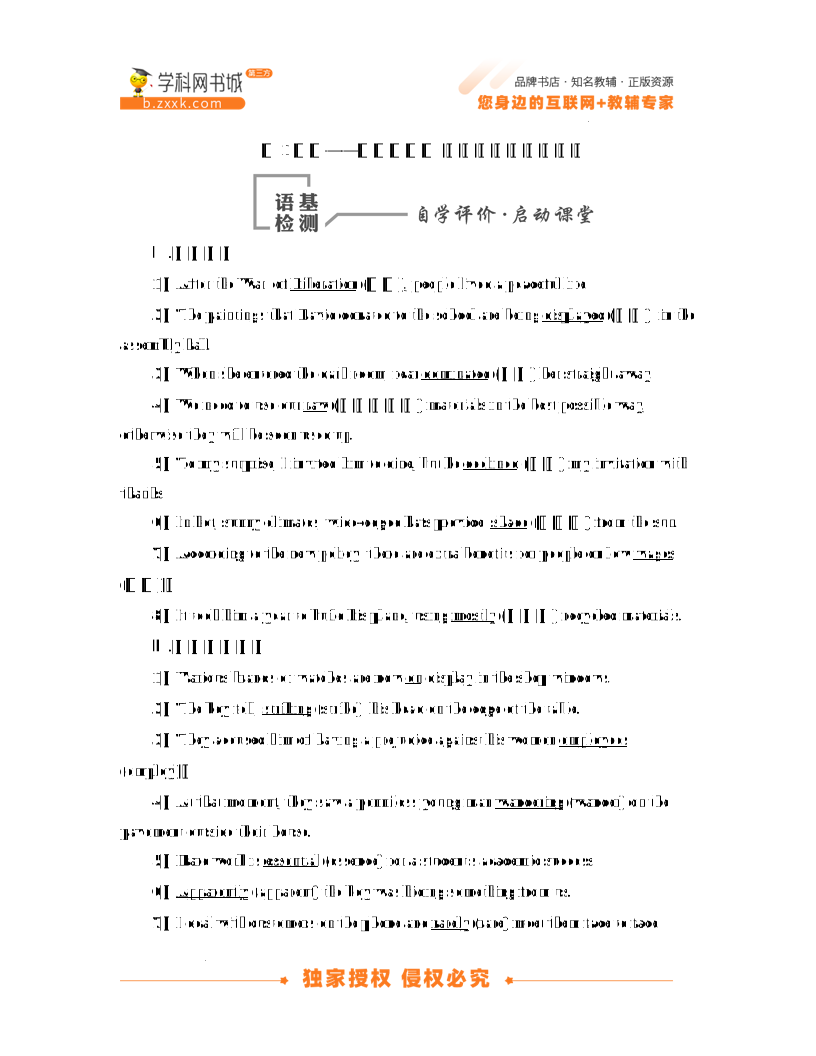
第1课时——精析重难点·核心词汇的深化学习
Ⅰ.单词拼写
1.After the War of Liberation (解放), people lived a peaceful life.
2.The paintings that David donated to the school are being displayed (展出) in the assembly hall.
3.When she entered the dark room, fear dominated (支配) her straight away.
4.We need to use our raw (未经加工的) materials in the best possible way, otherwise they will be soon used up.
5.To my surprise, I invited him to dine, but he declined (谢绝) my invitation with thanks.
6.In hot, sunny climates, wide-edged hats provide shade (阴凉处) from the sun.
7.According to the new policy, there are extra benefits for people on low wages (工资).
8.It took him a year to build his plane, using mostly (主要地) recycled materials.
Ⅱ.单句语法填空
1.Various brands of watches are now on display in the shop windows.
2.The boy fell, striking (strike) his head on the edge of the table.
3.They accused him of having a prejudice against his women employees (employ).
4.At that moment, they saw a penniless young man wandering (wander) on the pavement outside their house.
5.Hard work is essential (essence) for a student's academic success.
6.Apparently (apparent) the boy was hiding something from us.
7.I deal with customers on the phone and rarely (rare) meet them face to face.
8.The children have made arrangements (arrange) for their trip to the Great Wall.
9.Critical (critic) thinking is the most important thinking skill you need for your life.
10.The sun began to rise in the sky, bathing (bathe) the mountain in golden light.
Ⅲ.熟词生义
1.The opening paragraph invokes a vision of England in the early Middle Ages.画面
2.It's easy to be distracted and let your attention wander.走神
3.As the dusk shaded into night, we drove slowly through narrow alleys.逐渐变成
4.I offered to give them a lift but they declined.谢绝
5.In the Middle Ages England waged war on France.发动
Ⅳ.选词填空
as opposed to, be struck by, up close, at first sight, result in, take up, all walks of life, pick up1.He will take_up his post as the head of the civil courts at the end of next month.
2.He is athletic as_opposed_to his deskmate, who is very quiet.
3.To observe sea life up_close,_people have made different kinds of special equipment.
4.If left untreated, the illness will eventually result_in blindness.
5.The visitors were_struck_by the city's beauty immediately they arrived there.
6.He picked_up his cap from the floor and stuck it back on his head.
7.You and I feel like old friends at_first_sight and are destined to be very good cooperative partners.
8.Our local government received many letters of congratulations from all_walks_of_life.
Ⅴ.多维表达
1.(完成句子)It_is_said_that some new rules will come into operation next month.
据说一些新的规章制度将于下个月生效。
2.(完成句子)To be honest, I don't like the_way_that/in_which_he_speaks_to_me.
老实说,我不喜欢他跟我说话的方式。
3.(完成句子)Please don't consult a dictionary every_time_you_meet_a_new_word.(every time)
请不要每次遇到生词就查词典。
4.If you want to be a champion, that little extra thing you have done in your preparation will set you apart from your competitors.
→If you want to be a champion, it's_that_little_extra_thing_you_have_done_in_your_preparation_that_will_set_you_apart_from_your_competitors.(用强调句升级)
5.It was such a cold day that there was nobody in the street.
→Such_a_cold_day_was_it_that_there_was_nobody_in_the_street.(用倒装句升级)
1.wander vi.& vt.闲逛,漫步;走失;走神;蜿蜒曲折 n.游荡;闲逛
|助|表|达|
(续写之环境描写)The moon cast a bright light over the town.We wandered around the street in the moonlight.
月亮给小镇撒下了清辉,我们在月色下漫步街头。
|辨|析|清| (写出下列句中加黑部分的词性及含义)
①Wander among a variety of shops selling gifts while enjoying a live music show and nice street entertainment.vi.漫步,闲逛
②The child wandered off and got lost, which made her parents very worried.vi.走失
③I went to the park and had a wander around.n.游荡;闲逛
④She drove with her mind wandering, which caused an accident.vi.走神
|精|归|纳|
wander around/about 徘徊,游荡
wander away 走散
wander off/from ... 偏离……
|应|用|通|(完成句子)
⑤Keep your answers simple and don't wander_off/from_the_point.
把你的答案说简单点,别偏离正题。
⑥I came across an old classmate in the street yesterday but her mind seemed_to_be_wandering and she didn't recognize me.昨天,我在街上偶然遇到一个老同学,但她好像在走神,没认出我来。
2.strike vt.& vi.突然想到;撞,碰;打;突击;罢工;划(火柴) n.罢工;袭击;击,打
|助|表|达|
(2023·浙江1月高考写作)Throughout the event, I was struck by the incredible variety of plants that exist in our world and learned a lot about plants.
在整个活动中,我被我们世界上存在的各种各样的植物所吸引,并学到了很多关于植物的知识。
|精|归|纳|
(1)be struck by ... 被……打动/迷住了
It strikes sb. that ... 某人突然想起……
strike ... into one's heart 使某人对……刻骨铭心
(2)be on strike 在罢工
go on strike 举行罢工
(3)stricken adj. 受灾的
striking adj. 显著的,惊人的
|应|用|通|(单句语法填空/句型转换)
①So striking (strike) is the overall development in China that they feel eager to familiarize themselves with what is going on in China.
②Hundreds of rescue workers are being sent to the stricken (strike) area.
③Mount Tai strikes its beauty beyond description into my heart.
④I thought of a good idea that we would visit the newly-opened national park.
→It_struck_me that we would visit the newly-opened national park.
⑤He was struck by the beauty of the poem and forgot to have dinner.
→Struck_by_the_beauty_of_the_poem,_he forgot to have dinner.(过去分词短语作状语)
3.bathe vt.以(光线)洒满,覆盖,使沐浴(在光线里);用水清洗
|助|表|达|
(续写之景物描写)Bathed in the first rays of the sun, I wandered around the country lanes alone.
沐浴在第一缕阳光中,我独自徘徊在乡间小路上。
|精|归|纳|
(1)go bathing 去(海里、河里、湖里等)游泳
be bathed in 沉浸于,沐浴在
(2)bath n. 洗澡;沐浴;浴盆
have/take a bath=have/take a shower 洗澡
|应|用|通|(单句语法填空/完成句子)
①After the match, bathed (bathe) with sweat, he had a cool shower.
②The village was bathed in brilliant sunshine.
③I shall have a hot bath (bathe) and go to bed.
④The doctor asked him to bathe_his_eyes twice a day.医生要求他一天清洗眼睛两次。
⑤On hot days we often bathe/go_bathing in the swimming pool.
在炎热的天气里我们经常去游泳池游泳。
⑥Her face was_bathed_in_tears.
她的脸上满是泪水。
4.arrange vt.& vi.整理,布置;安排,筹备
|助|表|达|
(话题写作之活动介绍)In order to help them experience traditional Chinese culture, we arranged for them to learn Kungfu and enjoy Peking Opera from 1:30 p.m. to 5:00 p.m.
为了帮助他们体验中国传统文化,我们安排他们在下午1:30~5:00学习功夫并欣赏京剧。
|精|归|纳|
(1)arrange sth. for sb. 为某人安排某事
arrange to do sth. 安排做某事
arrange for ... to do sth. 安排……做某事
It is/was arranged that ... 商定/说好……
(2)arrangement n. 安排;筹备;布置;整理
make arrangements for ... 为……做安排
|应|用|通|(单句语法填空/完成句子)
①If you are interested, please sign up at the office before 5:00 p.m. next Thursday so that we will make necessary arrangements (arrange).
②For your visit here, we have arranged for you to_take (take) part in a variety of activities.
③Parents arrange everything for children and spare no effort to pave the way for their success.
④It_was_arranged_that they should leave for Shenyang the following morning.
已安排好他们第二天早上动身去沈阳。
⑤Jack will arrange_for_a_taxi_to_pick_us_up at 10 o'clock at the bus station.
杰克将安排出租车10点在公共汽车站接我们。
名师指津:表示“安排某人/物做某事”不能用arrange sb./sth. to do sth.,而应用arrange for sb./sth. to do sth.。
5.apparent adj.显而易见,明白易懂,显然
|助|表|达|
(话题写作之观点表述)It is apparent that younger and older generations hold opposing ideas to this phenomenon.
显然,年轻一代和老一代对这一现象的看法截然不同。
|精|归|纳|
(1)It's apparent that ... 显而易见的是……
(2)apparently adv. 显然地;显而易见地
|应|用|通|(单句语法填空/句型转换)
①Then, for no apparent (apparently) reason, the train suddenly stopped.
②Carelessness is apparently (apparent) bad because it always leads to failure, but on the other hand, failure can teach us a good lesson.
③Apparently, young children can't control themselves when they play video games.
→It's_apparent_that young children can't control themselves when they play video games.
6.expose vt.揭露,揭穿;暴露,显露;使遭受;使接触
|巧|串|记|
We should expose the kids to as much art and culture as possible.Being exposed to such atmosphere will greatly benefit their growth.
我们应该让孩子们接触尽可能多的艺术和文化,这种氛围的熏陶将十分有益于他们的成长。
|精|归|纳|
(1)expose ... to ... 使……接触……
expose oneself to ... 使自己面临……;使自己暴露于……
(2)exposed adj. 暴露的,无遮蔽的
be exposed to 遭受到;(使)接触到
|应|用|通|(单句语法填空/句式升级)
①Many people think we shouldn't expose the children to playing (play) computer games.
②Being_exposed (expose) to nuclear radiation, even for a short time, may influence genes in human body.
③The more birds are exposed (expose) to light, the more active they are at night.
④If you expose yourself to the sunlight for a long time, you will get your skin harmed.
→If you are_exposed_to_the_sunlight_for_a_long_time,_you will get your skin harmed.
→Exposing_yourself_to_the_sunlight_for_a_long_time,_you will get your skin harmed.
→Exposed_to_the_sunlight_for_a_long_time,_you will get your skin harmed.
7.decline n.衰退,衰落,减少,下降 vi.& vt.减少,下降,衰退,衰落;谢绝
|助|表|达|
(话题写作之环保)There's a widely-held belief that the diversity of species has been on the decline/in decline in the past few years.
人们普遍认为过去几年物种多样性在减少。
|精|归|纳|
(1)on the decline=in decline 下降;处于衰退中
a decline in ……方面的下降/减少
go/fall into (a) decline 陷入衰退,开始衰落
(2)decline to do sth. 拒绝做某事
decline by/to ... 下降了/下降到……
|应|用|通|(同义替换/完成句子)
①The number of tourists to the place reduced by 10% last year.declined
②She declined_to_have_lunch with her friend, saying that she wasn't feeling well.
她拒绝和朋友一起吃午餐,说她感觉身体不舒服。
③His health fell_into_a_decline after he was injured in the accident.
在事故中受伤后,他的健康状况每况愈下。
8.pick up捡起,拾起;接收(信号);(偶然)学会;得到;整理;(用车)接;(身体)好转;买到;(跌倒后)慢慢站起身
|助|表|达|
(应用文之建议信)Once you pick up some bad habits, you may find it hard to get rid of them.
你一旦染上一些坏习惯,就会发现它们很难除掉。
|辨|析|清| (写出下列句中加黑部分的含义)
①The room must be picked up before the guests arrive.收拾
②My radio can pick up the BBC programmes clearly.收听
③The school bus picks up the children three times every day.(用车)接
④It's surprising that your brother picked up Russian so quickly — he hasn't lived there very long.(偶然)学会
⑤Business has been depressing but they expect it to pick up again.情况好转
|精|归|纳|
pick out 挑出;辨别出;挑选;领会;理解
pick off 摘掉;摘下来
pick from 从……中挑选
pick over 精挑细选
|应|用|通|(选用上述短语填空)
⑥A waiter brought you food and drink that you picked_from a menu.
⑦He has picked_up slowly since he came out of hospital.
⑧All the best apples have been picked_off by the children.
⑨The detective picked_out the words with difficulty.
语境迁移应用(运用本单元知识完成下面语段)
To encounter Van Gogh
I, an art lover, visited an art gallery last Sunday.As I ①wandered_through_the_gallery (在画廊里闲逛), I noticed an ②exhibition (exhibit) held on the second floor, where I appreciated many wonderful (用本单元词汇替换黑体词:③outstanding) paintings.Beside the paintings, there were some introductions to the famous artists.The artist who ④made_the_deepest_impression_on_me (给我留下了最深刻的印象) was Van Gogh.
He worked in an art gallery when he was 16 years old.It was more than a decade later that he took arts seriously, from which he drew much comfort.As he began to show (用本单元词汇替换黑体词:⑤display) a talent for painting, he realized that art was his true career (用本单元词汇替换黑体词:⑥calling).In 1886, he began to form his own style.While the colors of his paintings are similar to those in the Impressionist paintings, Van Gogh's works had strong lines, as ⑦opposed (oppose) to the softer edges of Impressionism.He finally became one of the most gifted artists of his generation.
[课时作业评价] 主题阅读集群训练
Ⅰ.阅读理解
A
(2024·衡水调研)Growing up in rural Jiangsu Province, Yu Jigao showed a strong interest in fine arts at an early age and studied on his own for years.His hard work paid off later.In the early 1950s, he made his way to Nanjing Normal University, where he learned painting theories and techniques from some famous artists.It was then that Yu found his lifelong artistic zeal for gongbi.Gongbi paintings usually describe birds and flowers, symbols of beauty and joy, in an artistic way with intense colors.
After graduating from the art school, Yu began his professional career at the Jiangsu Traditional Chinese Painting Institute in 1957.He has since published a series of art collections.Since 1959, Yu has contributed a series of works to many important sites.Yu's works have also been displayed in a range of national and international exhibitions.From 1986 to 1997, he held his exhibitions in such places as Beijing, Guangzhou and New York.Both the themes and artistic techniques have won widespread praise in the past years.
While observing traditional rules, he uses accurate lines, powerful brush movements as well as the interplay between dark and light to represent the harmony of nature.Though he adopts a realistic style, he tries to enrich his works with spiritual beauty through his brush.Yu says, “That feeling turns into the images of singing birds and elegant flowers in my paintings.” Thanks to his careful observation of nature and artistic sensitivity, Yu is able to combine realistic description with artistic expression in his brushwork.
Now as a national top-level artist, Yu maintains a simple and easy-going style.In addition to artistic creation, Yu has devoted himself to promoting his painting style as the cultural heritage of China.“Art is part of my life,” Yu says.“I am proud to be a flower-bird painter.I hope to create a bright future for it through my efforts.”
语篇解读:本文是一篇记叙文。文章介绍了中国当代杰出的工笔花鸟画大家喻继高先生。
1.What does the underlined word “zeal” in Paragraph 1 mean?
A.Request. B.Passion.
C.Justice. D.Fund.
解析:选B 词义猜测题。根据上文的“In the early 1950s ... from some famous artists.”及下文内容可知,在学习绘画理论和技巧时,喻继高发现了他对工笔画所怀有的艺术热情。故推测,zeal意为“热情”。
2.What does Paragraph 2 mainly tell us about Yu?
A.His school life.
B.His painting techniques.
C.His achievements in painting.
D.His contributions to the art school.
解析:选C 段落大意题。综合本段内容可知,本段主要讲述了喻继高在绘画方面的艺术成就。
3.Which is Yu's painting feature?
A.Adopting abstract objects.
B.Excluding plants and animals.
C.Combining traditional rules with a realistic style.
D.Representing the imbalance between nature and humans.
解析:选C 细节理解题。根据第三段前两句可知,喻继高的绘画风格结合了传统规则和现实主义风格。
4.What does Yu expect of his painting style?
A.It will be passed on.
B.It will change over time.
C.It will look more complicated.
D.It will reach the top international level.
解析:选A 推理判断题。根据最后一段中的“I hope to create a bright future for it through my efforts.”可知,喻继高希望通过努力为自己的绘画风格创造一个光明的未来,即他希望自己的绘画风格被传承下去。
B
(2024·济南质检)Radiocarbon dating has revealed two fake (伪造的) paintings in France — probably the first time the technique has been used in a police investigation. The paintings were supposedly works from around the early twentieth century. But a team led by scientist Lucile Beck at the University of Paris-Saclay dated them to some time within the past 70 years.
The use of radiocarbon dating is gaining popularity, thanks to advances that require smaller samples than ever before. Removing tinier samples from artworks is becoming more palatable to museums and owners of paintings. If there is a chance that a painting is genuine — and therefore valuable — they don't want the collection of larger samples to damage it.
All living things take in carbon, including radioactive carbon-14, from the atmosphere and food. When a plant commonly used to make canvas (油画布) dies, the carbon-14 that it contained continues to fall off. Radiocarbon dating measures what's left to estimate the time that's passed, says Mariaelena Fedi, a physicist at the National Institute for Nuclear Physics in Florence, Italy.
Atomic-bomb (原子弹的) testing, which began in the 1940s and took off in the 1950s, quickly increased the amount of carbon-14 in the atmosphere. Carbon-14 peaked around 1964 and went down after a partial ban on nuclear tests. Researchers can easily identify materials containing modern bomb-produced radiocarbon because their carbon-14 concentrations are higher than pre-1950s levels. Beck's team tested its samples to see whether they bore the feature of that bomb-produced radioactive carbon-14.
The canvas fiber from the paintings clearly contained carbon from either the mid-1950s or after the year 2000, the researchers reported. Beck acknowledged that, ideally, the team would do further chemical analysis to support its findings, but the researchers were limited by the tight time.
语篇解读:本文是一篇说明文。利用碳定年法,法国警方发现了两幅赝品画。文章具体介绍了碳定年法的工作原理等。
5.What does the underlined word “palatable” in Paragraph 2 probably mean?
A.Impressive. B.Acceptable.
C.Expensive. D.Difficult.
解析:选B 词义猜测题。根据画线词下文可知,博物馆和画作所有者都不希望作品受到损坏,所以从艺术品中提取更小的样本,对博物馆和画作所有者来说正在变得更容易接受。故画线词意为“可接受的”。
6.How does radiocarbon dating work?
A.By removing samples from artworks.
B.By requiring the smaller samples.
C.By measuring the carbon-14 left.
D.By testing the carbon in the sample.
解析:选C 细节理解题。根据第三段尤其是该段尾句中的“Radiocarbon dating measures what's left to estimate the time that's passed”可知,碳定年法通过测量剩下的碳14来估算时间。
7.What can we learn about atomic-bomb testing in Paragraph 4?
A.It produced more carbon-14.
B.It helped identify fake paintings.
C.It reduced carbon concentrations.
D.It has been stopped completely.
解析:选A 细节理解题。根据第四段的“Atomic-bomb testing ... increased the amount of carbon-14 in the atmosphere.”可知,20世纪40年代开始的原子弹试验迅速增加了大气中碳14的含量。
8.Which of the following is the best title for the text?
A.Paintings waiting to be identified
B.Two fake paintings found in France
C.New technology in paintings becomes a hit
D.Radiocarbon dating proves an anti-fake helper
解析:选D 标题归纳题。本文首段主要介绍了利用碳定年法发现两幅赝品画这一事件,引出了本文主题,即碳定年法能判定真伪。由此可以推知,D项“碳定年法成了防伪助手”最适合作本文标题。
Ⅱ.阅读七选五
(2024·济南质检)Hungarian artist Zoltan Viczan has revealed his love and memories of his homeland in a series of new glass artworks at the exhibition, Layers of Hungary, which is taking place at Picnic Gallery in downtown Shanghai from Oct. 13 to Nov. 15.
Born in Hungary in 1979, Viczan began his studies in glass art at an early age in Budapest. __9__ He is known for having developed his own style and techniques for glass engraving (雕刻).
Traditional glassmaking in the West originated in Italy, where the royal court forced master crafts people to live on an island and create fine goods, Viczan says.__10__ Then they took the technique to other parts of Europe, such as Czechoslovakia, Hungary, Poland and Slovakia.
Viczan came to Asia and then moved to Shanghai in 2016. Generally many expatriates (侨民) socialized with people from their countries to overcome homesickness.__11__
In the exhibition, visitors will see a map of Hungary sculpted in cast glass and decorated with traditional Hungarian glass patterns, and works describing the city of Budapest and Lake Balaton, the largest lake in Central Europe.
__12__ For example, he removed the protective and reflective layers of the mirror to create a window on the surface that reveals the layer underneath. He even placed multiple layers of these windows in front of each other, creating a 3D effect that changes when viewed from different angles.
__13__ “We live in an infinitely complex world that we have no way to fully understand,” he says.“Through our experiences, we form a world view that becomes our reality, which will be challenged when we are exposed to new ideas. These layers of realizations are the signs of our personal development.”
A.He has practiced the art form for nearly 30 years.
B.The works on show reflect Viczan's unique methods.
C.This is the first time he has presented his creations.
D.Some managed to escape despite of the risks of death.
E.Viczan chose to represent memories of his homeland through his art.
F.The artist believes this is a good way to show idea about people's viewpoints of reality.
G.It recalled the beauty of the calm, flat water which starts rippling after throwing a pebble in it.
语篇解读:本文是一篇说明文。文章主要介绍了匈牙利艺术家Zoltan Viczan的一些个人经历和作品特色。
9.解析:选A 上文介绍了Viczan开始学习玻璃艺术的年龄和地点,后文提到了他这项技术的特色,本句应承接上文继续说明Viczan从事这种艺术形式的时间。故A项“他已经练习这种艺术形式近30年了”符合语境,A项中“He”指代上文的“Viczan”。
10.解析:选D 上文提到王室迫使工匠大师住在一个岛上,创造出精美的产品,后文则说工匠把这项技术带到了其他地方,说明这些工匠设法从岛上逃走了。故D项“尽管有死亡的危险,一些人还是设法逃脱了”承上启下,符合语境。
11.解析:选E 上文提到外籍人士与来自他们国家的人交往以克服思乡之苦,E项“Viczan选择通过艺术来展现他对家乡的回忆”承接上文,说明Viczan是如何克服思乡的。
12.解析:选B 后文的例子表明Viczan可以创造出从不同角度观看时变化的3D效果,说明他的作品具有创新性和独特性。故B项“展出的作品反映了Viczan独特的方法”符合语境。
13.解析:选F 后文主要引用了Viczan对现实世界的一些看法和认识,故F项“这位艺术家认为这是一个很好的方式来展示人们对现实的观点”符合语境,F项中的“reality”对应后文中的“reality”。
Ⅲ.完形填空
(2024·四省联考)Dr Smith of New York works at a center for children who can't learn well.One day a father brought his son to him for__14__ at his office.
The father told Dr Smith about his son, “My son has __15__ in learning and can't even play baseball.He isn't doing well because he doesn't try.I have done everything for him.I have even shouted at him.But nothing __16__.”
After Dr Smith tested the boy, he __17__ his father.He asked the father to sit in front of a __18__ and then gave him a pencil and a piece of paper.There was a __19__ on the paper.He asked the father to look only in the mirror and __20__ the lines of the star with the pencil.The father made the same __21__ anyone made.Every time he __22__ the pencil, it went the wrong way.The father's face became red.
At this __23__ the doctor shouted at him, “Hurry up! Why are you __24__ so long? You can't do such an __25__ thing! You don't know left from right!” These __26__ made the father very angry.
“Now you can __27__, can't you?” the doctor said to him. “Your son has felt just like that all the time.You scolded (训斥) him too often, so he didn't try any more.He was afraid of making mistakes.”__28__ the father understood everything.He put his face down, feeling so sorry.
语篇解读:本文是一篇记叙文。文章讲述了一个父亲带着学习有困难的孩子去做检查,结果发现,父亲才是那个造成孩子学习困难的人。这个故事告诉我们,好的教育是欣赏而不是训斥。
14.A.testing B.acting
C.teaching D.playing
解析:选A 根据第三段中的“After Dr Smith tested the boy”可知,这个父亲带孩子来找Dr Smith的目的是测试孩子。
15.A.confidence B.interest
C.experience D.difficulty
解析:选D 根据下文“He isn't doing well because he doesn't try.”可知,这个父亲认为孩子什么都做不好,说明他认为这个孩子应该是在学习上有困难。
16.A.returns B.helps
C.appears D.remains
解析:选B 根据语境及but表示转折可知,父亲做的事情并没有起任何作用。
17.A.waited for B.searched for
C.believed in D.called in
解析:选D 根据下文中的“He asked the father to sit in front of a ________ and then gave him a pencil and a piece of paper.”可知,Dr Smith 把这个父亲叫进来了。call in“叫来”。
18.A.mirror B.television
C.painting D.desk
解析:选A 根据下文中的“He asked the father to look only in the mirror”可知,这个父亲面前是一面镜子。
19.A.face B.line
C.number D.star
解析:选D 根据下文中的“and ________ the lines of the star with the pencil”可知,纸上有一颗星星。
20.A.remove B.follow
C.cross D.cut
解析:选B 根据前文“gave him a pencil and a piece of paper.There was a ________ on the paper”可知,此处应该是用铅笔描绘星星的线条。
21.A.decisions B.choices
C.mistakes D.patterns
解析:选C 根据下文中的“Every time he ________ the pencil, it went the wrong way.”可知,这个父亲犯了任何一个人都会犯的错误。
22.A.touched B.dropped
C.moved D.sharpened
解析:选C 根据语境可知,这个父亲每次一移动笔,就描错了。
23.A.speed B.corner
C.end D.point
解析:选D 根据语境可知,这个父亲每次描绘都会出错,他脸红了。在这个时候,Dr Smith朝他大声嚷嚷。at this point “在这个时候”。
24.A.staying B.taking
C.preparing D.writing
解析:选B 根据空前“Hurry up!”可知,Dr Smith在朝这个父亲嚷嚷为什么花费这么长时间。
25.A.easy B.important
C.obvious D.exciting
解析:选A 根据语境和常识可知,描绘物体的线条应是一件简单的事。
26.A.ideas B.words
C.questions D.instructions
解析:选B 根据语境可知,Dr Smith 说的这些话让这个父亲非常生气。
27.A.relax B.leave
C.understand D.promise
解析:选C 根据下文的“Your son has felt just like that ...making mistakes”和“understood everything”可知,Dr Smith用这种方法让父亲明白孩子的感受。
28.A.Interestingly B.Absolutely
C.Suddenly D.Unfortunately
解析:选C 根据语境可知,听了Dr Smith的话,这个父亲突然明白了一切,低下头,感到很抱歉。
学科网(北京)股份有限公司
$$
资源预览图
1

2

3
相关资源
由于学科网是一个信息分享及获取的平台,不确保部分用户上传资料的 来源及知识产权归属。如您发现相关资料侵犯您的合法权益,请联系学科网,我们核实后将及时进行处理。