专题03 Units 3~4(语篇综合练)英语新教材冀教版八年级上册
|
2份
|
16页
|
18人阅读
|
0人下载
内容正文:
专题03 Units 3~4(语篇综合练)
(建议用时:40分钟)
完形填空
人与自我:自卑的男孩在老师鼓励和同学帮助下改变学习方法、重拾自信
阅读A
人与社会:三位同学分别介绍自己听课、合作、提问的学习方法
阅读B
人与社会:书信:外国笔友请教怎样学好汉语,作者回信介绍学习方法
阅读C
人与自我:班会采访:三位同学谈自己的长处、不足和新学期计划
阅读还原
人与自我:说明文:成为更好的学习者的五个做法
任务型阅读
人与自我:日记:作者和同桌结对学习、互相帮助的一天
一、完形填空
阅读下面短文,从短文后各题所给的四个选项A、B、C、D中,选出可以填入空白处的最佳选项。
Zhang Hua is my deskmate. One year ago, he was very 1______ and never put up his hand in class. He often said he was not clever, so he felt 2______ every day.
One Monday, our teacher said to him, “Everyone has his own 3______ and weaknesses. You 4______ believe in yourself and try new ways.” Zhang Hua decided 5______ a study group with three classmates.
In the group, they read English stories and did maths exercises together. When someone made a mistake, the others never 6______ at him. They helped him 7______ the problem carefully instead.
Little by little, Zhang Hua became outgoing. He began to 8______ his ideas with us in class and answered questions bravely.
Last term, he got a good 9______ in the English test. He told me, “If you keep working hard, you 10______ make progress and become a better you.”
1.A. outgoing B. shy C. brave D. funny
2.A. happy B. excited C. sad D. proud
3.A. strengths B. hobbies C. lessons D. problems
4.A. shouldn't B. should C. couldn't D. needn't
5.A. join B. joining C. to join D. joined
6.A. smile B. laugh C. shout D. look
7.A. work out B. give up C. hand in D. take away
8.A. share B. hide C. copy D. lose
9.A. grade B. gift C. price D. seat
10.A. can't B. must C. will D. needn't
二、阅读理解
A
Three students' ways to learn better
Zhang Rui
I was afraid of English at first. Now I listen to the teacher carefully in class and take notes in my own way. After school, I review my notes for twenty minutes and read one English story every day. My listening and reading are much better now.
Chen Yu
I learn best when I study with others. Every Friday, three classmates and I meet in the school library. We ask and answer questions and explain difficult points to each other. Teaching others helps me understand better.
Liu Yang
I used to keep quiet because I was afraid of making mistakes. My teacher told me that mistakes help us learn. Now I put up my hand and ask questions in class. I also write down my mistakes in a notebook and check them every weekend.
1.What does Zhang Rui do after school?
A. He reviews his notes. B. He watches TV.
C. He plays sports. D. He teaches others.
2.How does Chen Yu learn better?
A. By reading stories alone. B. By studying with classmates.
C. By taking notes in class. D. By asking his parents.
3.What can we learn from Liu Yang?
A. We should keep quiet in class.
B. We should never make mistakes.
C. Making mistakes can help us learn.
D. We should copy others' answers.
B
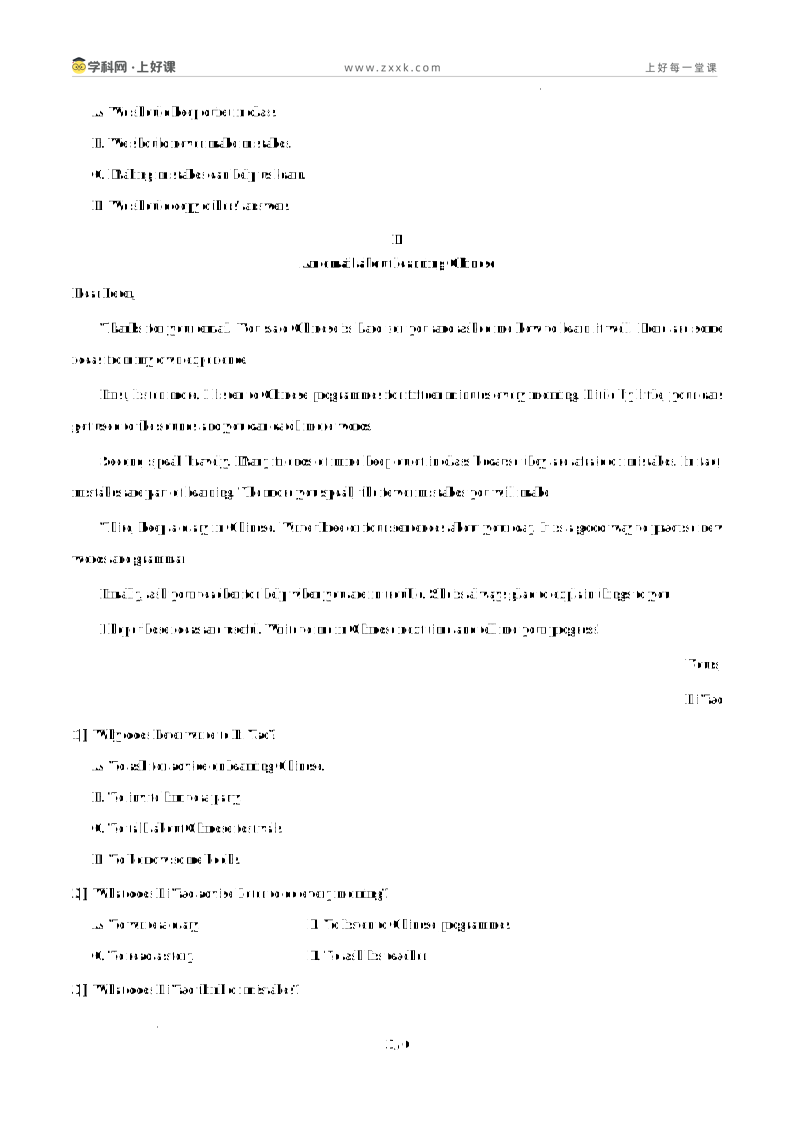
An email about learning Chinese
Dear Peter,
Thanks for your email. You said Chinese is hard for you and asked me how to learn it well. Here are some ideas from my own experience.
First, listen more. I listen to Chinese programmes for fifteen minutes every morning. Little by little, your ears get used to the sounds and you can catch more words.
Second, speak bravely. Many friends of mine keep quiet in class because they are afraid of mistakes. In fact, mistakes are part of learning. The more you speak, the fewer mistakes you will make.
Third, keep a diary in Chinese. Write three or four sentences about your day. It is a good way to practise new words and grammar.
Finally, ask your teacher for help when you are in trouble. She is always glad to explain things to you.
I hope these ideas are useful. Write to me in Chinese next time and tell me your progress!
Yours,
Li Tao
1.Why does Peter write to Li Tao?
A. To ask for advice on learning Chinese.
B. To invite him to a party.
C. To talk about Chinese festivals.
D. To borrow some books.
2.What does Li Tao advise Peter to do every morning?
A. To write a diary. B. To listen to Chinese programmes.
C. To read a story. D. To ask his teacher.
3.What does Li Tao think of mistakes?
A. They are easy to avoid. B. They are part of learning.
C. They make us shy. D. They are not important at all.
4.What is the email mainly about?
A. Peter's school life in China.
B. How to learn Chinese well.
C. Chinese traditional festivals.
D. How to make pen friends.
C
Our plans for the new term
Our class held a class meeting last Friday. The topic was “Know yourself and make a better plan”. Three students talked about their strengths, weaknesses and plans for the new term.
Li Ming: I do well in maths and I like thinking about difficult problems. But my English is poor, especially listening. This term I plan to read one English story every day and ask my classmates for help. I want to be better at English.
Wang Fang: I am good at singing, but I am too shy to sing in front of others. My teacher said I should believe in myself. So I decided to join the school singing club. I hope to sing on the school stage one day.
Zhao Lei: I am strong and I enjoy sports, but I am not careful enough with my homework. I often make small mistakes. From now on I will check my homework twice before handing it in, and I will also help my deskmate with his maths.
1.What is Li Ming poor at?
A. Maths. B. English listening.
C. Singing. D. Sports.
2.Why does Wang Fang plan to join the singing club?
A. To make more friends. B. To become less shy and show herself.
C. To learn to play the piano. D. To help her teacher.
3.What will Zhao Lei do with his homework?
A. Hand it in earlier.
B. Ask others to do it.
C. Check it twice before handing it in.
D. Write it in a new notebook.
4.What is the passage mainly about?
A. A class meeting about students' plans to improve themselves.
B. Three students' favourite subjects.
C. How to join a school club.
D. A singing competition at school.
三、阅读还原
阅读短文,根据短文内容从下面方框内的七个选项中选择五个还原到文中,使短文意思通顺、结构完整。
Everyone wants to do well at school, but not everyone knows how. Good learners often share some useful habits.
First, set a small goal for each week. 1. A clear goal helps you know what to do next, and a small success can make you feel confident.
Second, find your own way of learning. Some students learn better by reading, and others learn better by listening. 2.
Third, never be afraid of mistakes. 3. When you find a mistake, write it down and think about why you made it.
Fourth, learn with others. 4. You can explain difficult points to each other, and you will understand them better.
Finally, ask for help when you need it. 5. They are always ready to help you. With these habits, you will become a better learner.
A. Your teachers and classmates are your best helpers.
B. For example, you can plan to read one story every day.
C. Working in a study group is a good way to learn together.
D. Mistakes are just steps on your way to success.
E. Try to find the way that fits you best.
F. Never spend too much time on computer games.
G. Many students like to do sports after class.
四、任务型阅读
October 12th, Saturday Sunny
Today our class started a “study partner” activity. My partner is Chen Jie. She is quiet and was afraid of speaking English in class.
In the morning, we read an English story together. I helped her with new words, and she taught me how to work out a maths problem. We found that we are good at different things.
In the afternoon, we made a small plan for next week. We will meet in the library every Wednesday and Friday. We also decided to write down our mistakes in a notebook.
Before we went home, Chen Jie said she felt much better about English. I learned that helping others is also a good way to improve myself.
根据短文内容,回答下列问题(不超过6个词)
1.What activity did the class start today?
____________________________________________________
2.What did Chen Jie teach the writer to do?
____________________________________________________
3.When will they meet in the library?
____________________________________________________
4.Where will they write down their mistakes?
____________________________________________________
5.What did the writer learn today?
____________________________________________________
1 / 7
学科网(北京)股份有限公司
$
专题03 Units 3~4(语篇综合练)
(建议用时:40分钟)
完形填空
人与自我:自卑的男孩在老师鼓励和同学帮助下改变学习方法、重拾自信
阅读A
人与社会:三位同学分别介绍自己听课、合作、提问的学习方法
阅读B
人与社会:书信:外国笔友请教怎样学好汉语,作者回信介绍学习方法
阅读C
人与自我:班会采访:三位同学谈自己的长处、不足和新学期计划
阅读还原
人与自我:说明文:成为更好的学习者的五个做法
任务型阅读
人与自我:日记:作者和同桌结对学习、互相帮助的一天
一、完形填空
阅读下面短文,从短文后各题所给的四个选项A、B、C、D中,选出可以填入空白处的最佳选项。
Zhang Hua is my deskmate. One year ago, he was very 1______ and never put up his hand in class. He often said he was not clever, so he felt 2______ every day.
One Monday, our teacher said to him, “Everyone has his own 3______ and weaknesses. You 4______ believe in yourself and try new ways.” Zhang Hua decided 5______ a study group with three classmates.
In the group, they read English stories and did maths exercises together. When someone made a mistake, the others never 6______ at him. They helped him 7______ the problem carefully instead.
Little by little, Zhang Hua became outgoing. He began to 8______ his ideas with us in class and answered questions bravely.
Last term, he got a good 9______ in the English test. He told me, “If you keep working hard, you 10______ make progress and become a better you.”
1.A. outgoing B. shy C. brave D. funny
【答案】B
【详解】句意:一年前,他非常害羞,从不在课堂上举手。outgoing 外向的;shy 害羞的;brave 勇敢的;funny 有趣的。由后半句 never put up his hand in class(从不在课堂上举手)可知他不敢表现自己,性格比较害羞,故选 B。
2.A. happy B. excited C. sad D. proud
【答案】C
【详解】句意:他常说自己不聪明,因此每天都感到难过。happy 高兴的;excited 兴奋的;sad 难过的;proud 自豪的。上文写他否定自己、不敢举手,这种心态带来的是低落情绪,四个选项中只有 sad 符合语境,故选 C。
3.A. strengths B. hobbies C. lessons D. problems
【答案】A
【详解】句意:每个人都有他自己的长处和短处。strengths 长处、优点;hobbies 爱好;lessons 课程;problems 问题。句中与 weaknesses(短处)并列,构成“长处与短处”的固定表达,故选 A。
4.A. shouldn't B. should C. couldn't D. needn't
【答案】B
【详解】句意:你应该相信自己,尝试新的方法。should 应该,表示提出建议;shouldn't 不应该;couldn't 不能;needn't 不必。老师是在鼓励他,给出正面建议,用 should,故选 B。
5.A. join B. joining C. to join D. joined
【答案】C
【详解】句意:张华决定和三位同学一起组建学习小组。decide to do sth. 意为“决定做某事”,decide 后接动词不定式作宾语,故选 C。
6.A. smile B. laugh C. shout D. look
【答案】B
【详解】句意:组内有人出错时,其他人从不嘲笑他。laugh at sb. 意为“嘲笑某人”,符合“别人出错时不嘲笑”的语境;smile at 对……微笑,shout at 对……大喊,look at 看,均不合语义,故选 B。
7.A. work out B. give up C. hand in D. take away
【答案】A
【详解】句意:他们反而耐心地帮他解出这道题。work out 解决、算出;give up 放弃;hand in 上交;take away 拿走。宾语 the problem 与 work out 搭配表示“把题解出来”,故选 A。
8.A. share B. hide C. copy D. lose
【答案】A
【详解】句意:他开始在课堂上和我们分享自己的想法。share sth. with sb. 与某人分享某物;hide 隐藏;copy 抄袭;lose 丢失。由后文 answered questions bravely 可知他变得愿意表达,故选 A。
9.A. grade B. gift C. price D. seat
【答案】A
【详解】句意:上学期,他在英语考试中取得了好成绩。grade 成绩、等级;gift 礼物;price 价格;seat 座位。get a good grade in the English test 是“英语考试取得好成绩”的常用搭配,故选 A。
10.A. can't B. must C. will D. needn't
【答案】C
【详解】句意:如果你一直努力,你一定会取得进步,成为更好的自己。此处为 if 引导的条件状语从句,遵循“主将从现”,主句用一般将来时 will make,故选 C。
二、阅读理解
A
Three students' ways to learn better
Zhang Rui
I was afraid of English at first. Now I listen to the teacher carefully in class and take notes in my own way. After school, I review my notes for twenty minutes and read one English story every day. My listening and reading are much better now.
Chen Yu
I learn best when I study with others. Every Friday, three classmates and I meet in the school library. We ask and answer questions and explain difficult points to each other. Teaching others helps me understand better.
Liu Yang
I used to keep quiet because I was afraid of making mistakes. My teacher told me that mistakes help us learn. Now I put up my hand and ask questions in class. I also write down my mistakes in a notebook and check them every weekend.
1.What does Zhang Rui do after school?
A. He reviews his notes. B. He watches TV.
C. He plays sports. D. He teaches others.
【答案】A
【解析】细节定位题。根据 Zhang Rui 一段中“After school, I review my notes for twenty minutes and read one English story every day.”可知,他放学后复习笔记并读英语故事;B 看电视、C 做运动文中未提及,D 教别人是陈宇的做法,故选 A。
2.How does Chen Yu learn better?
A. By reading stories alone. B. By studying with classmates.
C. By taking notes in class. D. By asking his parents.
【答案】B
【解析】细节理解题。Chen Yu 一段开头写“I learn best when I study with others.”,后文又写他和三位同学每周五在图书馆互相提问、讲解难点,可见他是通过与同学合作学习来提高的;A 独自读故事是张瑞的做法,C 做笔记也是张瑞的做法,D 向父母请教文中没有,故选 B。
3.What can we learn from Liu Yang?
A. We should keep quiet in class.
B. We should never make mistakes.
C. Making mistakes can help us learn.
D. We should copy others' answers.
【答案】C
【解析】推理判断题。刘洋一段写“My teacher told me that mistakes help us learn.”,并且他把错题记在本子上每周检查,说明错误能帮助人进步;A 上课保持安静是他过去的状态而非结论,B 与原文相反,D 抄袭答案文中没有,故选 C。
B
An email about learning Chinese
Dear Peter,
Thanks for your email. You said Chinese is hard for you and asked me how to learn it well. Here are some ideas from my own experience.
First, listen more. I listen to Chinese programmes for fifteen minutes every morning. Little by little, your ears get used to the sounds and you can catch more words.
Second, speak bravely. Many friends of mine keep quiet in class because they are afraid of mistakes. In fact, mistakes are part of learning. The more you speak, the fewer mistakes you will make.
Third, keep a diary in Chinese. Write three or four sentences about your day. It is a good way to practise new words and grammar.
Finally, ask your teacher for help when you are in trouble. She is always glad to explain things to you.
I hope these ideas are useful. Write to me in Chinese next time and tell me your progress!
Yours,
Li Tao
1.Why does Peter write to Li Tao?
A. To ask for advice on learning Chinese.
B. To invite him to a party.
C. To talk about Chinese festivals.
D. To borrow some books.
【答案】A
【解析】细节理解题。回信第二段写“You said Chinese is hard for you and asked me how to learn it well.”,说明彼得写信是为了请教怎样学好汉语;B 邀请参加聚会、C 谈论中国节日、D 借书,信中均未提及,故选 A。
2.What does Li Tao advise Peter to do every morning?
A. To write a diary. B. To listen to Chinese programmes.
C. To read a story. D. To ask his teacher.
【答案】B
【解析】细节定位题。信中写“I listen to Chinese programmes for fifteen minutes every morning.”,李涛的建议是每天早上听十五分钟汉语节目;写日记是第三条建议但并非每天早上做,读书、请教老师也不属于早晨的安排,故选 B。
3.What does Li Tao think of mistakes?
A. They are easy to avoid. B. They are part of learning.
C. They make us shy. D. They are not important at all.
【答案】B
【解析】细节理解题。原文“In fact, mistakes are part of learning.”直接说明李涛认为错误是学习的一部分,并且“The more you speak, the fewer mistakes you will make.”鼓励多开口;A 容易避免、C 让人害羞、D 完全不重要均与原文不符,故选 B。
4.What is the email mainly about?
A. Peter's school life in China.
B. How to learn Chinese well.
C. Chinese traditional festivals.
D. How to make pen friends.
【答案】B
【解析】主旨大意题。全文围绕“asked me how to learn it well”展开,从多听、敢说、写日记、请教老师四方面给出建议,因此主旨是介绍学好汉语的方法;A 中国校园生活、C 中国传统节日、D 如何交笔友都只是零散词语,不是全文中心,故选 B。
C
Our plans for the new term
Our class held a class meeting last Friday. The topic was “Know yourself and make a better plan”. Three students talked about their strengths, weaknesses and plans for the new term.
Li Ming: I do well in maths and I like thinking about difficult problems. But my English is poor, especially listening. This term I plan to read one English story every day and ask my classmates for help. I want to be better at English.
Wang Fang: I am good at singing, but I am too shy to sing in front of others. My teacher said I should believe in myself. So I decided to join the school singing club. I hope to sing on the school stage one day.
Zhao Lei: I am strong and I enjoy sports, but I am not careful enough with my homework. I often make small mistakes. From now on I will check my homework twice before handing it in, and I will also help my deskmate with his maths.
1.What is Li Ming poor at?
A. Maths. B. English listening.
C. Singing. D. Sports.
【答案】B
【解析】细节定位题。李明一段写“But my English is poor, especially listening.”,说明他英语较弱,尤其是听力;A 数学是他的长处,C 唱歌是王芳的长处,D 体育是赵磊的长处,故选 B。
2.Why does Wang Fang plan to join the singing club?
A. To make more friends. B. To become less shy and show herself.
C. To learn to play the piano. D. To help her teacher.
【答案】B
【解析】推理判断题。王芳说自己“too shy to sing in front of others”,老师让她相信自己,她“decided to join the school singing club”并希望有一天在学校舞台上唱歌,可见她入社是为了克服害羞、展示自己;A 交朋友、C 学钢琴、D 帮助老师文中均无依据,故选 B。
3.What will Zhao Lei do with his homework?
A. Hand it in earlier.
B. Ask others to do it.
C. Check it twice before handing it in.
D. Write it in a new notebook.
【答案】C
【解析】细节定位题。赵磊一段写“From now on I will check my homework twice before handing it in.”,即交作业前检查两遍;A 提前交、B 让别人代做、D 换新本子均非原文内容,故选 C。
4.What is the passage mainly about?
A. A class meeting about students' plans to improve themselves.
B. Three students' favourite subjects.
C. How to join a school club.
D. A singing competition at school.
【答案】A
【解析】主旨大意题。首段点明班会主题是“Know yourself and make a better plan”,下文三位同学分别介绍自己的长处、不足以及新学期的改进计划,全文围绕“认识自己、制定计划、做更好的自己”展开;B 最喜欢的科目、C 如何加入社团、D 歌唱比赛都只是局部信息,故选 A。
三、阅读还原
阅读短文,根据短文内容从下面方框内的七个选项中选择五个还原到文中,使短文意思通顺、结构完整。
Everyone wants to do well at school, but not everyone knows how. Good learners often share some useful habits.
First, set a small goal for each week. 1. A clear goal helps you know what to do next, and a small success can make you feel confident.
Second, find your own way of learning. Some students learn better by reading, and others learn better by listening. 2.
Third, never be afraid of mistakes. 3. When you find a mistake, write it down and think about why you made it.
Fourth, learn with others. 4. You can explain difficult points to each other, and you will understand them better.
Finally, ask for help when you need it. 5. They are always ready to help you. With these habits, you will become a better learner.
A. Your teachers and classmates are your best helpers.
B. For example, you can plan to read one story every day.
C. Working in a study group is a good way to learn together.
D. Mistakes are just steps on your way to success.
E. Try to find the way that fits you best.
F. Never spend too much time on computer games.
G. Many students like to do sports after class.
1.【答案】B
【解析】逻辑匹配题。本段讲“每周定一个小目标”,空白前一句是“set a small goal for each week”,后一句解释目标的作用。B 项“例如,你可以计划每天读一个故事”正是把“小目标”具体化,与前后句构成举例关系,故选 B。F 项谈电脑游戏、G 项谈课后运动,都与“目标”无关。
2.【答案】E
【解析】逻辑匹配题。本段讲“找到适合自己的学习方式”,空白前一句说有人靠读、有人靠听,E 项“试着找到最适合你的方式”对前文进行总结,与段落中心完全一致,故选 E。A 项谈求助对象、C 项谈小组合作,属于后文内容。
3.【答案】D
【解析】逻辑匹配题。本段中心是“不要害怕错误”,空白后一句讲发现错误后要记录、反思。D 项“错误只是你走向成功路上的台阶”承接段落主题,并引出后文对待错误的态度,故选 D。B 项谈读书计划、G 项谈运动,与本段无关。
4.【答案】C
【解析】逻辑匹配题。本段讲“和别人一起学”,空白后一句说“你们可以互相讲解难点”,说明是在小组中合作。C 项“在学习小组中一起学习是一种好方法”正好点明方式,故选 C。A 项是最后一段“求助”的内容,位置不符。
5.【答案】A
【解析】逻辑匹配题。本段讲“需要时要求助”,空白后一句“They are always ready to help you.”中的 they 必须指代人。A 项“老师和同学是你最好的帮手”既点明 they 的所指,又与本段主题一致,故选 A。其他选项均不能提供复数人物指代。
四、任务型阅读
October 12th, Saturday Sunny
Today our class started a “study partner” activity. My partner is Chen Jie. She is quiet and was afraid of speaking English in class.
In the morning, we read an English story together. I helped her with new words, and she taught me how to work out a maths problem. We found that we are good at different things.
In the afternoon, we made a small plan for next week. We will meet in the library every Wednesday and Friday. We also decided to write down our mistakes in a notebook.
Before we went home, Chen Jie said she felt much better about English. I learned that helping others is also a good way to improve myself.
根据短文内容,回答下列问题(不超过6个词)
1.What activity did the class start today?
____________________________________________________
2.What did Chen Jie teach the writer to do?
____________________________________________________
3.When will they meet in the library?
____________________________________________________
4.Where will they write down their mistakes?
____________________________________________________
5.What did the writer learn today?
____________________________________________________
1.【答案】A study partner activity.
【解析】细节提取。日记第一句“Today our class started a “study partner” activity.”直接点明活动名称,摘取核心短语作答,共 4 个词,符合“不超过 6 个词”的要求。
2.【答案】To work out maths problems.
【解析】细节提取。第二段写“she taught me how to work out a maths problem.”,问题问“教作者做什么”,把宾语从句转换为不定式“To work out maths problems.”作答,共 5 个词。
3.【答案】Every Wednesday and Friday.
【解析】细节提取。第三段“We will meet in the library every Wednesday and Friday.”给出见面时间与地点,问时间直接摘取“Every Wednesday and Friday.”,共 4 个词。
4.【答案】In a notebook.
【解析】细节提取。第三段末句“We also decided to write down our mistakes in a notebook.”中的 in a notebook 表示地点,直接作答,共 3 个词。
5.【答案】Helping others helps improve ourselves.
【解析】细节提取。末段“I learned that helping others is also a good way to improve myself.”说明作者的收获,概括为“Helping others helps improve ourselves.”,共 5 个词,主语用动名词短语,语法正确。
1 / 7
学科网(北京)股份有限公司
$
资源预览图