Unit 5 Power of Ideas 单元话题语法填空10篇-2026-2027学年九年级英语上册(人教版)
|
2份
|
20页
|
432人阅读
|
12人下载

内容正文:
Unit 5 Power of Ideas
单元话题语法填空练习
单元话题:发明与创造
阅读下面短文,根据语境或所给单词的提示,在每个空格内填入恰当的词,要求所填的词意义准确、形式正确,使短文意思完整、行文连贯。
As we know, paper is one of the most important 1 (invention) in human history. But before paper was invented, people wrote or drew on materials such as bamboo, silk, animal hide, and 2 (wood) blocks. Writing materials were 3 (real) expensive and few people learned to read. Therefore, few people wrote. This all changed, thanks 4 a man named Cai Lun.
Paper had already existed (存在) in China, but the process for 5 (produce) it was difficult and the paper was of low quality. Cai Lun began experimenting (试验) with many different materials and different methods 6 (turn) those materials into paper. In the year 105, he made it from tree bark, bamboo, cloth rags, and fishing nets. His paper was 7 (strong) and cheaper than any paper that had been made before.
With Cai Lun’s papermaking method, Chinese culture 8 (grow) more rapidly over the next several centuries. That’s because ideas were much easier to share as more people learned to read. The use of paper spread abroad, helping other cultures record 9 spread their ideas. Today, Cai Lun is considered 10 national hero in China. But the whole world should remember the clever Chinese papermaker forever.
阅读下面短文,根据语境或所给单词的提示,在空白处填入适当的词或用括号中所给词的正确形式填空,每空不超过两词。要求所填的词意义准确、形式正确,使短文意思完整、行文连贯。
In August 2026, two middle school students from Shenzhen made the news. They invented a "mini home environmental factory" to deal with food waste. Since the project 1 (begin), great changes have taken place. The project 2 (reach) plenty of communities every month. Thousands of people have learned how to protect the environment. Their community now looks much 3 (good) than before.
In the factory, the students learned to deal with different 4 (kind) of kitchen waste carefully. The machine 5 (make) to use black soldier flies (黑水虻) to eat the waste. It was a great 6 (achieve) for the young students. Their invention won a first prize at 7 German invention fair (展会). Many people came to learn from them.
8 (they) actions have encouraged many people. They learned that everyone can play an important part 9 protecting the environment. It is not just a slogan (口号). 10 we keep working together, we can make a bigger difference.
阅读下面短文,在空白处填入一个适当的单词或填入括号内单词的正确形式。
In the early 20th century, fresh food was hard to keep. In winter there was often a 1 (short) of it.
In 1912, 2 American man named Clarence Birdseye travelled to the cold north of Canada. There he watched local fishermen catch fish through 3 (hole) on the icy lake. As the fishermen pulled out the fish, they left them to freeze (冷冻) in the cold air. Then people could keep them for long periods 4 (support) their family. When people wanted some to eat, they could defrost (解冻) them 5 losing any of the freshness.
Suddenly, Birdseye realized something: Freezing food very 6 (rapid) is the key to keeping 7 (it) freshness. This is easy in very cold environments. But in much 8 (warm) and even hotter environments, people have to freeze food slowly. During the process, ice crystals (冰晶) grow inside food. It 9 (change) the food’s taste.
After years of hard work, he 10 (invent) machines to freeze food fast and founded his own company. In 1930, his frozen food went on sale for the 11 (one) time in America. Gradually, people found that frozen food was cheap, convenient and fresh. Since then frozen food 12 (become) a common part of our everyday life.
Today hundreds of kinds of frozen foods 13 (produce) and sold widely all over the world. A hole in the ice, a frozen fish and a man who kept thinking—these show 14 a great invention began. If an idea is put 15 good use, it can bring about great changes in our everyday life.
阅读下面短文,在空白处填入括号内单词的正确形式。
Beep! Beep! Beep! The barcode technology makes it faster and easier to buy things. You have probably 1 (see) the black-and-white barcode on the product packaging (外包装). In 2026, the 2 (invent) is 55 years old.
In 1971, an IBM engineer came up with a code (代码) that could be printed on packages. Then the barcode, a complete code system, was formed. The system has been used by many companies since 1974. Before this, shopkeepers had to spend much time 3 (record) prices by hand.
Actually, a barcode is 4 (real) a simple idea: it shows each product’s information in different numbers (just like the ID card number), and then it includes these numbers into a code and prints it for computers 5 (read). Today, barcodes are scanned (扫描) over six billion times every day.
A barcode carries information such as the 6 (product) price and production date. It can also help stores know about 7 (they) products. For example, if there are ten 8 (camera) and a customer buys one, it will be recorded and then the store 9 (own) knows there are nine left. In the 1980s, libraries started to use barcodes to record their books.
Inspired by the barcode, QR codes (二维码) have been invented. They can hold 10 (much) information than barcodes. They can tell customers what materials are used in a product or if the product is suitable for certain people. This keeps providing the customers with greater trust in the products they will buy.
阅读下面短文,在空白处填入适当的单词或用括号内单词的正确形式填空。每空不超过两词。
What if a boat could carry people and clean water at the same time? In South Korea, a company called Ecopeace has 1 (create) the Healing Boat to do just that. The company was 2 (found) in 2012. The Healing Boat is driven by energy from the sun, so it can travel without using oil. As it moves across lakes, it also helps clean the water by filtering (滤) it.
The Healing Boat can carry up to eight 3 (passenger). According to Ecopeace, about 100 tons of water can be cleaned by it every day. With its help, waste and 4 (harm) green algae (水藻) are cleared from the water. 5 this way, fish and other animals can be protected, and clean water can be enjoyed by people.
In the day, 6 boat gives visitors short tours of local freshwater areas. People can learn about the waterways 7 see several landmarks during the 30-minute ride. At night, the boat is used for fun activities such as food truck tours and fireworks shows. 3D videos about underwater ecosystems are also offered to visitors and help 8 (they) learn more about how the boat itself protects nature.
The Healing Boat 9 (real) helps make water protection more interesting for the public. Besides, Ecopeace hopes 10 (cooperate) with other organizations in the future to play a greater role in protecting water resources.
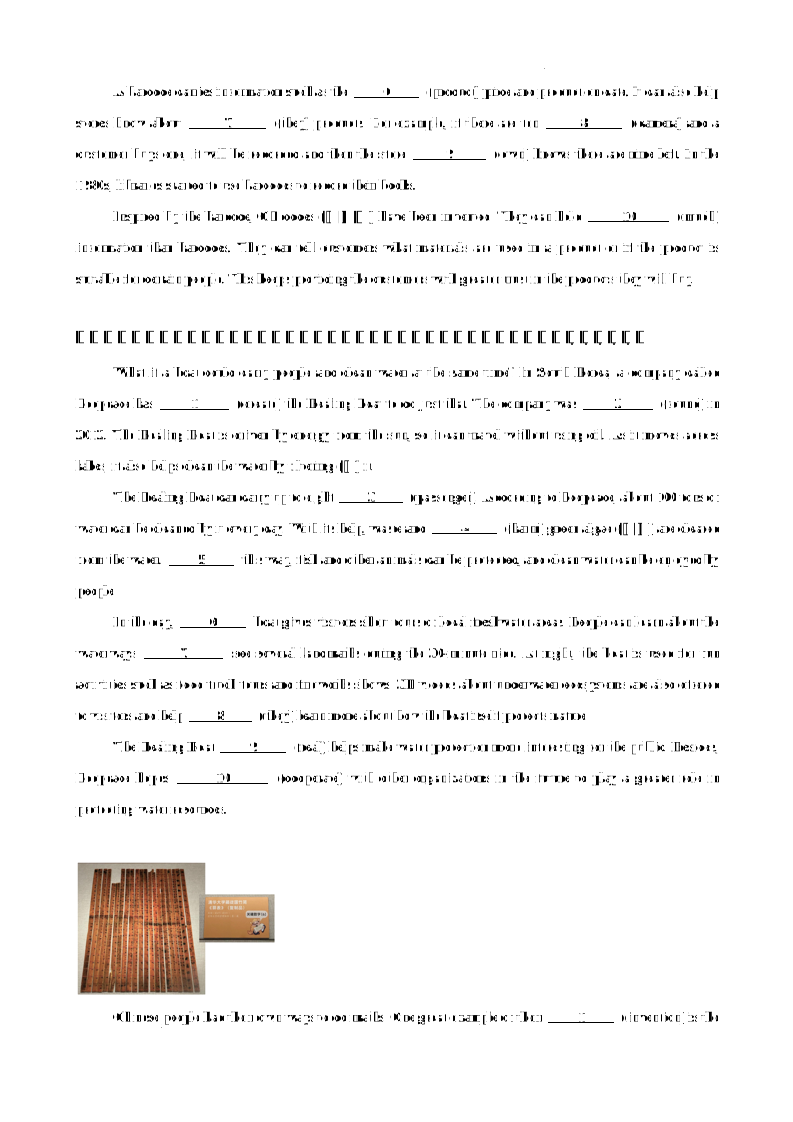
Chinese people had their own ways to do maths. One great example of their 1 (invention) is the Suanbiao (算表), an ancient maths tool from the Tsinghua Bamboo Slips. It goes back to the 2 (four) century BC (公元前).
The Suanbiao is famous for its clever design. It looks like a big table of numbers on pieces of bamboo. People used it 3 (work) out problems like 35 times 47. They could do it very 4 (quick). At that time, it was also 5 very useful tool for people’s jobs and daily life.
Each of the pieces has its own numbers, so the whole table is easy to use. In the past, users 6 (find) the right numbers on the table and got the answers in just a few seconds.
The Suanbiao looks simple, 7 it shows the clever ideas of ancient Chinese people. In 2017, it set a world record as the oldest table of its kind in the world. Today, many people think it is as important 8 any other great invention in the history of maths.
For many history fans today, nothing is 9 (good) than seeing this ancient tool with their own eyes. Students can also make a paper copy of it and try it by 10 (they). The more we learn about it, the prouder we are of Chinese culture.
A long time ago, there was a clever man in ancient China named Cang Jie. He was in charge of (负责) recording important events.
At that time, there were no words, no pens, and no paper. People could only record information by piling up (堆积) 1 (stone). However, as their activities became more complex (复杂的), the stones turned into a big mess. Later, clever people 2 (invent) a new way to record events; tying knots in ropes. The knots had different sizes, and each size represented a different thing. At first, this worked well, 3 soon, there were too many things, and the knots became 4 (bad) than the stones.
5 (solve) the problem, Cang Jie came up with a new idea. He started adding shells (贝壳) and little stones 6 the knots to make the records clearer. At first, this new method worked well. But one day, the Yellow Emperor had an important meeting with another chief named Chi You. Cang Jie used his “shell-and-knot method” to record the time and place; however, he made a mistake. He thought, “This method isn’t 7 (well) enough.”
One winter day, Cang Jie saw a hunter on the road looking for wild bear tracks. 8 hunter explained, “Each animal has different footprints. A skillful hunter can tell them apart.” When Cang Jie heard this, he suddenly had an idea. He thought, “If everything 9 (have) its own shape, why not draw their shapes to represent them?” And he discovered that these simple symbols could record many things without mistakes.
Cang Jie showed the symbols to the Yellow Emperor, who exclaimed (惊叹), “This is an amazing invention! We will call them ‘characters’”. In the 10 (twenty) century, Chinese characters became famous all over the world.
阅读下面短文,在空白处填入一个适当的单词或括号内单词的正确形式。
My story began in 1973. I was very different from the phones people use today. I was big, heavy and not easy 1 (carry). An American engineer called Martin Cooper used a phone like me to make the 2 (one) mobile phone call. It was an important moment in my story.
During the 1980s, I 3 (slow) became more popular. 4 , I was still expensive, so only a small number of people could afford me. I was not very convenient either. People carried me in their hands or bags, and I took up quite a lot of space.
In the 1990s, I changed a lot. I became smaller and 5 (cheap). I could also send short messages, so people could use me to talk to friends in 6 new way. More and more people started to have me.
Then, in 2007, something important happened. The iPhone 7 (arrive). I had a touch screen and could connect to the internet. From then on, I was no longer just a phone. I became a small computer.
Today, I can do many things. People use me to make calls, send messages, take 8 (photo), watch videos, listen to music, play games and use different apps. I am now an important part of everyday life.
What will I be like 9 the future? Perhaps I will become smaller, smarter and more 10 (use). I can’t wait for this day to come!
阅读短文,在空白处填入一个适当的单词或者括号内单词的正确形式。
Paper is one of the greatest 1 (invent) in Chinese history. It was created by Cai Lun during the Han Dynasty. He worked very hard, but his early tries did not go well. Despite failing many times, his curiosity always drove him 2 (explore). He 3 (stick) to testing different materials like tree bark, old cloth, and fishing nets.
His efforts 4 (true) paid off. He created a cheap and light kind of paper. Before this, people wrote 5 bamboo or silk. Bamboo was heavy, and silk was expensive, so only rich people could write. Cai Lun’s paper was 6 (success) because everyone could use it. His idea spread all over the world, and other countries improved 7 (they) too. They used new materials and made paper even better.
Today, paper is everywhere. People want 8 (create) new things with it every day. We use it every day without thinking about it. For thousands of years, people 9 (respect) Cai Lun for his great gift to the world. His story shows us that hard work matters. If you have a dream, keep going. 10 the road is long and full of problems, you can make it one day.
阅读下面短文,在空白处填入1个适当的单词或括号内单词的正确形式。
Now there are over 30 million deaf (聋的) children around the world. Deaf children often have difficulty in 1 (learn) to read. To make a difference, smartphone maker Huawei is 2 (will) to help out, and it has created an AI app called StorySign.
The app is easy to use. First, open the app. Then, take out your book and scan (扫描) the 3 (page) with your phone. After that, an AI character called Star will turn the words into sign language (手语), helping deaf children enjoy 4 good read.
The developers designed Star to be like an older sister or a friend, 5 they wanted kids to feel close to her. Star can help deaf children read and understand books. She is also able 6 (express) herself fully in sign language. She even wears a hearing aid (助听器). In this way, deaf children can not only learn to read, but also enjoy spending time 7 the AI character.
So far, the app 8 (help) thousands of families around the world. And now it is available (可用的) in 14 different sign languages, giving deaf children a 9 (practice) tool to make reading easier. “We just want to help families with deaf children to enjoy a 10 (relax) story time,” said a Huawei worker.
学科网(北京)股份有限公司
$
Unit 5 Power of Ideas
单元话题语法填空练习
单元话题:发明与创造
阅读下面短文,根据语境或所给单词的提示,在每个空格内填入恰当的词,要求所填的词意义准确、形式正确,使短文意思完整、行文连贯。
As we know, paper is one of the most important 1 (invention) in human history. But before paper was invented, people wrote or drew on materials such as bamboo, silk, animal hide, and 2 (wood) blocks. Writing materials were 3 (real) expensive and few people learned to read. Therefore, few people wrote. This all changed, thanks 4 a man named Cai Lun.
Paper had already existed (存在) in China, but the process for 5 (produce) it was difficult and the paper was of low quality. Cai Lun began experimenting (试验) with many different materials and different methods 6 (turn) those materials into paper. In the year 105, he made it from tree bark, bamboo, cloth rags, and fishing nets. His paper was 7 (strong) and cheaper than any paper that had been made before.
With Cai Lun’s papermaking method, Chinese culture 8 (grow) more rapidly over the next several centuries. That’s because ideas were much easier to share as more people learned to read. The use of paper spread abroad, helping other cultures record 9 spread their ideas. Today, Cai Lun is considered 10 national hero in China. But the whole world should remember the clever Chinese papermaker forever.
【导语】本文是一篇记叙文,介绍蔡伦改进造纸术,讲述造纸术出现前后的变化以及它对文化传播的重大意义。
1.句意:众所周知,纸是人类历史上最重要的发明之一。one of the+形容词最高级+可数名词复数,invention的复数形式是inventions,因此填inventions。
2.句意:但是在纸被发明之前,人们在竹子、丝绸、兽皮和木简上面书写或者绘画。修饰名词blocks要用形容词,wood对应的形容词是wooden,wooden表示“木制的”,因此填wooden。
3.句意:书写材料真的很贵,很少有人学习阅读。修饰形容词expensive要用副词,real对应的副词是really,really表示“真正地”,因此填really。
4.句意:这一切都改变了,多亏一个名叫蔡伦的人。固定搭配thanks to,to表示“多亏”,因此填to。
5.句意:纸在中国早就存在,但是生产它的工序很难,而且纸的质量很差。介词for后面接动名词,produce的动名词形式是producing,因此填producing。
6.句意:蔡伦尝试很多不同材料以及不同方法把这些材料变成纸。不定式作后置定语,methods to do sth.,to turn表示“去转变”,因此填to turn。
7.句意:他造出来的纸比之前造出的任何纸都更结实、更便宜。后面有than,要用形容词比较级,strong的比较级是stronger,stronger表示“更结实的”,因此填stronger。
8.句意:借助蔡伦的造纸方法,在接下来的几个世纪里,中国文化发展得更加迅速。根据上下文历史叙事语境,此处应用过去时态,grow的过去式是grew,因此填grew。
9.句意:纸张的使用传到国外,帮助其他文化记录并且传播他们的思想。record和spread是并列动作,and表示“并且”,表并列,因此填and。
10.句意:如今,蔡伦在中国被看作一名民族英雄。national是以辅音音素开头,a表示“一名”,因此填a。
阅读下面短文,根据语境或所给单词的提示,在空白处填入适当的词或用括号中所给词的正确形式填空,每空不超过两词。要求所填的词意义准确、形式正确,使短文意思完整、行文连贯。
In August 2026, two middle school students from Shenzhen made the news. They invented a "mini home environmental factory" to deal with food waste. Since the project 1 (begin), great changes have taken place. The project 2 (reach) plenty of communities every month. Thousands of people have learned how to protect the environment. Their community now looks much 3 (good) than before.
In the factory, the students learned to deal with different 4 (kind) of kitchen waste carefully. The machine 5 (make) to use black soldier flies (黑水虻) to eat the waste. It was a great 6 (achieve) for the young students. Their invention won a first prize at 7 German invention fair (展会). Many people came to learn from them.
8 (they) actions have encouraged many people. They learned that everyone can play an important part 9 protecting the environment. It is not just a slogan (口号). 10 we keep working together, we can make a bigger difference.
【导语】本文介绍深圳两名中学生发明“迷你家庭环保工厂”处理厨余垃圾,并产生积极影响的故事。
1.句意:自从这个项目开始以来,发生了巨大的变化。根据主句“have taken place”可知,此处为since引导的现在完成时的时间状语从句,表示过去发生的事情,需用一般过去时,begin的过去式是began。
2.句意:该项目每月惠及众多社区。句子描述客观事实,主语“The project”是第三人称单数,需用一般现在时,reach的第三人称单数形式是reaches。
3.句意:他们的社区现在看起来比以前好多了。空格后“than before”是比较级的标志词,表示与以前比较,且前有“much”修饰,需用形容词good的比较级形式better。
4.句意:在工厂里,学生们学会了小心处理不同种类的厨余垃圾。“different kinds of”是固定短语,意为“不同种类的”,kind用复数形式kinds。
5.句意:这台机器被制造出来使用黑水虻吃掉垃圾。根据语境可知机器已经制造完成,主语“The machine”与动词“make”之间是被动关系,叙述过去发生的事情,需用一般过去时的被动语态,主语为单数,be动词用was,make的过去分词为made。
6.句意:这对年轻学生来说是一个巨大的成就。空格前有不定冠词“a”和形容词“great”修饰,需用名词单数形式,achieve的名词形式是achievement。
7.句意:他们的发明在德国的一个发明展上获得了一等奖。空格后“German invention fair”为可数名词单数,此处表示泛指“一个”,且German以辅音音素开头,需用不定冠词a修饰。
8.句意:他们的行动鼓励了许多人。空格后是名词“actions”,需用形容词性物主代词作定语,指代“他们的”,they对应的形容词性物主代词是Their,位于句首首字母大写。
9.句意:他们了解到每个人都可以在保护环境中发挥重要作用。“play an important part in doing sth.”是动词短语,意为“在做某事中发挥重要作用”,为固定搭配。
10.句意:如果我们继续共同努力,我们就能产生更大的影响。空格后是完整句子,与主句构成条件关系,需用从属连词If引导条件状语从句,位于句首首字母大写。
阅读下面短文,在空白处填入一个适当的单词或填入括号内单词的正确形式。
In the early 20th century, fresh food was hard to keep. In winter there was often a 1 (short) of it.
In 1912, 2 American man named Clarence Birdseye travelled to the cold north of Canada. There he watched local fishermen catch fish through 3 (hole) on the icy lake. As the fishermen pulled out the fish, they left them to freeze (冷冻) in the cold air. Then people could keep them for long periods 4 (support) their family. When people wanted some to eat, they could defrost (解冻) them 5 losing any of the freshness.
Suddenly, Birdseye realized something: Freezing food very 6 (rapid) is the key to keeping 7 (it) freshness. This is easy in very cold environments. But in much 8 (warm) and even hotter environments, people have to freeze food slowly. During the process, ice crystals (冰晶) grow inside food. It 9 (change) the food’s taste.
After years of hard work, he 10 (invent) machines to freeze food fast and founded his own company. In 1930, his frozen food went on sale for the 11 (one) time in America. Gradually, people found that frozen food was cheap, convenient and fresh. Since then frozen food 12 (become) a common part of our everyday life.
Today hundreds of kinds of frozen foods 13 (produce) and sold widely all over the world. A hole in the ice, a frozen fish and a man who kept thinking—these show 14 a great invention began. If an idea is put 15 good use, it can bring about great changes in our everyday life.
【导语】本文是一篇记叙文,讲述了20世纪初美国人Clarence Birdseye在加拿大北部观察到渔民冷冻鱼能长期保鲜的现象,从而意识到快速冷冻是保持食物新鲜的关键,经过多年努力发明了快速冷冻机器并创立公司,使冷冻食品成为日常生活的一部分。
1.句意:冬天经常会出现食物短缺。根据“a”修饰,应用名词单数形式,short的名词为shortage,意为“短缺”。
2.句意:1912年,一位名叫Clarence Birdseye的美国人前往加拿大寒冷的北部。此处表示泛指“一位美国人”,且“American”以元音音素开头,应用不定冠词an。
3.句意:在那里,他看着当地渔民在结冰的湖面上通过冰洞捕鱼。结合语境,渔民捕鱼需在冰面上凿出多个冰洞,应用可数名词复数形式,hole的复数为holes。
4.句意:然后人们可以把它们保存很长时间来养家糊口。此处表示目的,应用不定式作目的状语,support的动词原形为support。故填to support。
5.句意:当人们想吃一些时,他们可以解冻它们而不会失去任何新鲜度。此处表示“没有、不”,应用介词without,构成“without losing”。
6.句意:突然,Birdseye意识到:非常快速地冷冻食物是保持其新鲜度的关键。修饰动词“freeze”应用副词,rapid的副词为rapidly,意为“快速地”。
7.句意:突然,Birdseye意识到:非常快速地冷冻食物是保持其新鲜度的关键。修饰名词“freshness”应用形容词性物主代词,it的形容词性物主代词为its,意为“它的”。
8.句意:但在更温暖甚至更热的环境中,人们不得不缓慢地冷冻食物。与“hotter”并列,应用比较级形式,warm的比较级为warmer。
9.句意:在这个过程中,冰晶在食物内部生长。它改变了食物的味道。描述一般事实,主语“It”为第三人称单数,change用三单形式changes。
10.句意:经过多年的努力,他发明了快速冷冻食物的机器,并创立了自己的公司。描述过去发生的动作,应用一般过去时,invent的过去式为invented。
11.句意:1930年,他的冷冻食品在美国首次上市销售。表示“第一次”,应用序数词,one的序数词为first。
12.句意:从那时起,冷冻食品已经成为我们日常生活中常见的一部分。时间状语“Since then”与现在完成时连用,主语“frozen food”为不可数名词,助动词用has,become的过去分词为become。故填has become。
13.句意:如今,数百种冷冻食品被生产出来并在全世界广泛销售。主语“hundreds of kinds of frozen foods”与produce之间为被动关系,描述一般事实,应用一般现在时的被动语态,主语为复数,be动词用are,produce的过去分词为produced。故填are produced。
14.句意:冰上的一个洞、一条冷冻的鱼和一个不断思考的人——这些展示了一个伟大的发明是如何开始的。此处引导宾语从句,表示“如何”,应用how。
15.句意:如果一个想法得到很好的利用,它就能给我们的日常生活带来巨大的变化。“put...to good use”为固定搭配,意为“好好利用……”,介词用to
阅读下面短文,在空白处填入括号内单词的正确形式。
Beep! Beep! Beep! The barcode technology makes it faster and easier to buy things. You have probably 1 (see) the black-and-white barcode on the product packaging (外包装). In 2026, the 2 (invent) is 55 years old.
In 1971, an IBM engineer came up with a code (代码) that could be printed on packages. Then the barcode, a complete code system, was formed. The system has been used by many companies since 1974. Before this, shopkeepers had to spend much time 3 (record) prices by hand.
Actually, a barcode is 4 (real) a simple idea: it shows each product’s information in different numbers (just like the ID card number), and then it includes these numbers into a code and prints it for computers 5 (read). Today, barcodes are scanned (扫描) over six billion times every day.
A barcode carries information such as the 6 (product) price and production date. It can also help stores know about 7 (they) products. For example, if there are ten 8 (camera) and a customer buys one, it will be recorded and then the store 9 (own) knows there are nine left. In the 1980s, libraries started to use barcodes to record their books.
Inspired by the barcode, QR codes (二维码) have been invented. They can hold 10 (much) information than barcodes. They can tell customers what materials are used in a product or if the product is suitable for certain people. This keeps providing the customers with greater trust in the products they will buy.
【答案】
1.seen 2.invention 3.recording 4.really 5.to read 6.product’s 7.their 8.cameras 9.owner 10.more
【导语】本文主要介绍了条形码(barcode)的发明、工作原理、应用以及由其启发而发明的二维码(QR code)。
1.句意:你或许已经见过商品外包装上黑白相间的条形码。该处需一个动词,在句中作谓语;根据空前的“have probably”可知,此处构成现在完成时,结构为“have/has+过去分词”,see的过去分词为seen。故填seen。
2.句意:在2026年,这项发明已经有55年的历史。该处需一个名词,在句中作主语;后面的is提示语义与事物名称相关;冠词the后接名词,is提示为名词单数。invent的名词形式为invention,意为“发明”。故填invention。
3.句意:在这之前,店主不得不花费大量时间手工记录价格。该处需一个动名词,在句中作宾语;spend time提示语义与花费时间做某事相关;固定搭配“spend time doing sth.”,意为“花费时间做某事”,record的动名词形式为recording。故填recording。
4.句意:实际上,条形码确实是一个简单的构想。该处需一个副词,在句中作状语;此处用来加强语气,用副词修饰。结合括号内单词real,故填really。
5.句意:它用不同数字展示每件商品的信息,就像身份证号码一样,接着它把这些数字编入编码并打印出来,供电脑读取。该处需一个动词不定式,在句中作目的状语;固定句型“for sb./sth. to do sth.”,意为“供某人/某物做某事”,动词不定式作目的状语。故填to read。
6.句意:条形码承载诸如商品价格和生产日期这类信息。该处需一个名词所有格,在句中作定语;price提示语义与所属关系相关;空处修饰后面的名词price,表示“产品的”,应使用名词所有格形式。结合括号内单词product,故填product’s。
7.句意:它也可以帮助商店了解它们的商品。该处需一个形容词性物主代词,在句中作定语;修饰名词products提示语义与所属相关;空处修饰后面的名词products,应使用形容词性物主代词,they的形容词性物主代词为their。故填their。
8.句意:例如,如果有十台相机,一位顾客买走一台,它会被记录下来,然后店主就知道还剩下九台。该处需一个名词复数,在句中作宾语;ten提示语义与数量相关;数词ten后接可数名词复数。结合括号内单词camera,故填cameras。
9.句意:例如,如果有十台相机,一位顾客买走一台,它会被记录下来,然后店主就知道还剩下九台。该处需一个名词,在句中作主语;knows there are nine left提示语义与人相关;空处与store构成复合名词作主语,表示“店主”,own的名词形式为owner,knows提示是单数。故填owner。
10.句意:它们能够储存比条形码更多的信息。该处需一个形容词比较级,在句中作定语;than提示语义与比较相关;根据空后的“than”可知,此处应使用比较级,much的比较级为more。故填more。
阅读下面短文,在空白处填入适当的单词或用括号内单词的正确形式填空。每空不超过两词。
What if a boat could carry people and clean water at the same time? In South Korea, a company called Ecopeace has 1 (create) the Healing Boat to do just that. The company was 2 (found) in 2012. The Healing Boat is driven by energy from the sun, so it can travel without using oil. As it moves across lakes, it also helps clean the water by filtering (滤) it.
The Healing Boat can carry up to eight 3 (passenger). According to Ecopeace, about 100 tons of water can be cleaned by it every day. With its help, waste and 4 (harm) green algae (水藻) are cleared from the water. 5 this way, fish and other animals can be protected, and clean water can be enjoyed by people.
In the day, 6 boat gives visitors short tours of local freshwater areas. People can learn about the waterways 7 see several landmarks during the 30-minute ride. At night, the boat is used for fun activities such as food truck tours and fireworks shows. 3D videos about underwater ecosystems are also offered to visitors and help 8 (they) learn more about how the boat itself protects nature.
The Healing Boat 9 (real) helps make water protection more interesting for the public. Besides, Ecopeace hopes 10 (cooperate) with other organizations in the future to play a greater role in protecting water resources.
【导语】本文介绍韩国一家公司研发的“治愈之船”,它依靠太阳能运行,既能载人游览,又可以净化水体,助力水资源保护。
1.句意:在韩国,一家名叫Ecopeace的公司研发出了“治愈之船”来实现这一点。该处需一个动词过去分词,在句中和has共同构成现在完成时,create的过去分词是created。
2.句意:这家公司成立于2012年。该处需一个动词过去分词;主语The company与动词found之间是被动关系,且时间状语in 2012表明是一般过去时,被动语态结构为“was+过去分词”。此处found意为“建立”,其过去分词为founded。
3.句意:这艘治愈之船最多可以搭载八名乘客。数词eight后接可数名词复数,passenger的复数形式为passengers。
4.句意:在它的帮助下,废弃物和有害水藻从水中被清理掉。该处需一个形容词,在句中作定语修饰名词green algae;harm的形容词形式为harmful,表示“有害的”。
5.句意:用这种方式,鱼类和其他动物可以得到保护,人们也能享用干净的水。in this way是固定短语,表示“用这种方式”,符合语境,句首首字母大写。故填In。
6.句意:白天,这艘船带领游客短途游览当地淡水区域。该处需一个定冠词,在句中修饰名词boat;此处特指上文提到的The Healing Boat,用定冠词the。
7.句意:人们可以了解水道,并且在30分钟的航行中观赏几处地标。该处需一个并列连词,在句中连接两个并列的谓语动词;learn about和see是并列的谓语动词,表示顺承关系,应用连词and连接。
8.句意:3D视频也提供给游客,帮助他们更多地了解船本身如何保护自然。空处位于动词help之后作宾语,应用人称代词的宾格形式,故填them。
9.句意:这艘治愈之船确实让大众对水环境保护更感兴趣。空处修饰动词helps,应用副词形式,real的副词形式为really。
10.句意:此外,Ecopeace希望未来和其他机构合作,在水资源保护方面发挥更大作用。固定搭配“hope to do sth.”表示“希望做某事”。故填to cooperate。
阅读下面短文,在空格处填入一个适当的词或使用括号中词语的正确形式填空,并将答案填写在答题卷规定的位置上。
Chinese people had their own ways to do maths. One great example of their 1 (invention) is the Suanbiao (算表), an ancient maths tool from the Tsinghua Bamboo Slips. It goes back to the 2 (four) century BC (公元前).
The Suanbiao is famous for its clever design. It looks like a big table of numbers on pieces of bamboo. People used it 3 (work) out problems like 35 times 47. They could do it very 4 (quick). At that time, it was also 5 very useful tool for people’s jobs and daily life.
Each of the pieces has its own numbers, so the whole table is easy to use. In the past, users 6 (find) the right numbers on the table and got the answers in just a few seconds.
The Suanbiao looks simple, 7 it shows the clever ideas of ancient Chinese people. In 2017, it set a world record as the oldest table of its kind in the world. Today, many people think it is as important 8 any other great invention in the history of maths.
For many history fans today, nothing is 9 (good) than seeing this ancient tool with their own eyes. Students can also make a paper copy of it and try it by 10 (they). The more we learn about it, the prouder we are of Chinese culture.
【导语】本文主要介绍了中国古代的数学工具——清华简《算表》的历史、设计、用途及其在数学史上的重要地位。
1.句意:它们的发明中一个伟大例子就是算表,是清华简里古老的数学工具。前面是their (形容词性物主代词,后接名词),invention为可数名词,此处指多项发明,用复数。故填inventions。
2.句意:它追溯到公元前四世纪。century前面要用序数词表示“第几世纪”,four的序数词是fourth。
3.句意:人们用它来解决像35乘47这类问题。固定结构use sth. to do sth. 意为“用某物去做某事”,不定式表目的。故填to work。
4.句意:他们能够快速地完成计算。此处修饰动词do,要用副词,quick的副词形式是quickly。
5.句意:在那时,它也是一件在人们工作与日常生活中非常有用的工具。本句是第一次介绍这件工具,表泛指“一件工具”,useful发音是以辅音音素/j/开头,所以用a。
6.句意:在过去,使用者在算表上找到对应的数字,短短几秒就能算出答案。根据“In the past”在过去,判断句子时态为一般过去时,find的过去式是found。
7.句意:算表看起来简单,但是它展现了古代中国人巧妙的构思。前半句说外观简单,后半句体现古人智慧,前后是转折关系,用but。
8.句意:如今很多人认为它和数学史上其他任何伟大发明一样重要。固定结构as…as,意为“和……一样”,用于原级比较。
9.句意:对于许多历史爱好者而言,没有什么比得上亲眼看见这件古老工具更好。后面出现than,表示比较,good的比较级是better。
10.句意:学生也可以制作纸质版本,自己动手试一试。根据主语Students (学生们,复数),句子表达“学生们独自、自己尝试”。by + 反身代词 是固定结构by oneself,表示“独自,亲自”;主语是they,对应的反身代词是themselves。
A long time ago, there was a clever man in ancient China named Cang Jie. He was in charge of (负责) recording important events.
At that time, there were no words, no pens, and no paper. People could only record information by piling up (堆积) 1 (stone). However, as their activities became more complex (复杂的), the stones turned into a big mess. Later, clever people 2 (invent) a new way to record events; tying knots in ropes. The knots had different sizes, and each size represented a different thing. At first, this worked well, 3 soon, there were too many things, and the knots became 4 (bad) than the stones.
5 (solve) the problem, Cang Jie came up with a new idea. He started adding shells (贝壳) and little stones 6 the knots to make the records clearer. At first, this new method worked well. But one day, the Yellow Emperor had an important meeting with another chief named Chi You. Cang Jie used his “shell-and-knot method” to record the time and place; however, he made a mistake. He thought, “This method isn’t 7 (well) enough.”
One winter day, Cang Jie saw a hunter on the road looking for wild bear tracks. 8 hunter explained, “Each animal has different footprints. A skillful hunter can tell them apart.” When Cang Jie heard this, he suddenly had an idea. He thought, “If everything 9 (have) its own shape, why not draw their shapes to represent them?” And he discovered that these simple symbols could record many things without mistakes.
Cang Jie showed the symbols to the Yellow Emperor, who exclaimed (惊叹), “This is an amazing invention! We will call them ‘characters’”. In the 10 (twenty) century, Chinese characters became famous all over the world.
【答案】
1.stones 2.invented 3.but 4.worse 5.To solve 6.to 7.good 8.The 9.has 10.twentieth
【导语】本文讲述了中国古代人物仓颉受猎人辨别动物脚印的启发,在结绳记事等早期记录方式相继失效后,创造出汉字雏形符号的相关传说故事。
1.句意:人们只能通过堆积石头来记录信息。此处表示堆积石头,是泛指多个石头,用可数名词stone的复数形式stones。
2.句意:后来,聪明的人发明了一种记录事件的新方法;在绳子上打结。故事整体为一般过去时,动词invent用过去式invented。
3.句意:起初,这还行,但很快,东西太多了,结变得比石头还糟糕。前文说结绳记事一开始效果好,后文说事情变多后出问题,是转折关系,填并列连词but。
4.句意:起初,这还行,但很快,东西太多了,结变得比石头还糟糕。空后有than表示比较,bad要用比较级worse。
5.句意:为了解决这个问题,仓颉想出了一个新主意。想出新主意是为了解决问题,此处应用不定式to solve表示目的,句首首字母要大写。
6.句意:他开始在结上加入贝壳和小石头,使记录更清晰。固定搭配add sth. to sth.表示“把某物添加到某物上”,故填介词to。
7.句意:他想:“这个方法还不够好。”空处在be动词后作表语,应用形容词,well作形容词表示“健康的”,不符合语义,与其相对的形容词good表示“好的”,符合语义。
8.句意:猎人解释说:“每种动物都有不同的脚印。一个熟练的猎人可以把它们区分开来。”此处特指前文提到的那个猎人,用定冠词The,句首首字母大写。
9.句意:他想:“既然万物都有自己的形状,为什么不把它们的形状画出来呢?”引号内是直接引语,用一般现在时,主语everything是不定代词,谓语动词用第三人称单数has。
10.句意:在二十世纪,汉字闻名世界。固定表达in the+序数词+century表示“在第几世纪”,twenty的序数词是twentieth。
阅读下面短文,在空白处填入一个适当的单词或括号内单词的正确形式。
My story began in 1973. I was very different from the phones people use today. I was big, heavy and not easy 1 (carry). An American engineer called Martin Cooper used a phone like me to make the 2 (one) mobile phone call. It was an important moment in my story.
During the 1980s, I 3 (slow) became more popular. 4 , I was still expensive, so only a small number of people could afford me. I was not very convenient either. People carried me in their hands or bags, and I took up quite a lot of space.
In the 1990s, I changed a lot. I became smaller and 5 (cheap). I could also send short messages, so people could use me to talk to friends in 6 new way. More and more people started to have me.
Then, in 2007, something important happened. The iPhone 7 (arrive). I had a touch screen and could connect to the internet. From then on, I was no longer just a phone. I became a small computer.
Today, I can do many things. People use me to make calls, send messages, take 8 (photo), watch videos, listen to music, play games and use different apps. I am now an important part of everyday life.
What will I be like 9 the future? Perhaps I will become smaller, smarter and more 10 (use). I can’t wait for this day to come!
【导语】本文以第一人称(手机的视角)讲述了手机从1973年诞生到现在的演变历程,包括体积庞大、价格昂贵到逐渐普及、功能增多,再到智能手机时代的到来。最后展望了未来手机将变得更小巧、更智能、更有用。
1.句意:我又大又重,不容易携带。“be+adj.+to do”结构中,用不定式表示被动含义,意为“不容易被携带”,carry的不定式是to carry。
2.句意:一位名叫马丁·库珀的美国工程师用一部像我的手机拨打了第一通移动电话。表示“第一通”,用序数词first,修饰mobile phone call,故填first。
3.句意:在20世纪80年代,我慢慢地变得更受欢迎。修饰动词became用副词,slow的副词形式是slowly。
4.句意:然而,我仍然很贵,所以只有少数人买得起我。前后句是转折关系,“更受欢迎”与“仍然很贵”形成对比,用连词副词however,句首首字母大写,故填However。
5.句意:我变得更小、更便宜。与前面的smaller并列,且暗含与过去相比,用比较级。cheap的比较级是cheaper。
6.句意:所以人们可以用一种新方式与朋友交谈。way是可数名词单数,且new以辅音音素/n/开头,表示“一种新方式”,用不定冠词a。
7.句意:iPhone问世了。描述过去发生的事情(in 2007提示过去时),用动词的过去式,arrive的过去式是arrived。
8.句意:人们用我打电话、发信息、拍照、看视频、听音乐、玩游戏和使用不同的应用程序。photo是可数名词,此处表示“拍照”这一泛指的动作,用复数形式photos。
9.句意:在未来我会是什么样子?in the future是固定搭配,意为“在未来”,故填in。
10.句意:也许我会变得更小、更智能、更有用。与smaller, smarter并列,且暗含比较含义,use的形容词形式是useful,其比较级是more useful,故填useful。
阅读短文,在空白处填入一个适当的单词或者括号内单词的正确形式。
Paper is one of the greatest 1 (invent) in Chinese history. It was created by Cai Lun during the Han Dynasty. He worked very hard, but his early tries did not go well. Despite failing many times, his curiosity always drove him 2 (explore). He 3 (stick) to testing different materials like tree bark, old cloth, and fishing nets.
His efforts 4 (true) paid off. He created a cheap and light kind of paper. Before this, people wrote 5 bamboo or silk. Bamboo was heavy, and silk was expensive, so only rich people could write. Cai Lun’s paper was 6 (success) because everyone could use it. His idea spread all over the world, and other countries improved 7 (they) too. They used new materials and made paper even better.
Today, paper is everywhere. People want 8 (create) new things with it every day. We use it every day without thinking about it. For thousands of years, people 9 (respect) Cai Lun for his great gift to the world. His story shows us that hard work matters. If you have a dream, keep going. 10 the road is long and full of problems, you can make it one day.
【答案】
1.inventions 2.to explore 3.stuck 4.truly 5.on 6.successful 7.theirs 8.to create 9.have respected 10.Though/Although
【导语】本文讲述蔡伦造纸的故事。蔡伦历经多次失败,坚持探索试验,造出轻便廉价的纸;造纸术传遍世界并不断被改良。文章告诉我们:努力很重要,心怀梦想就要坚持下去,不惧艰难终会成功。
1.句意:纸是中国历史上最伟大的发明之一。one of+the+形容词最高级+可数名词复数;invent的名词形式为invention,复数为inventions。
2.句意:尽管失败很多次,但好奇心一直驱使他去探索。drive sb. to do sth.“驱使某人做某事”,此处需用动词不定式,即to explore。
3.句意:他坚持测试不同的材料,比如树皮、旧布料和渔网。全文讲述蔡伦的故事,为一般过去时;stick的过去式是stuck。
4.句意:他的努力真的得到了回报。副词修饰动词短语paid off;true的副词形式为truly“真正地”。
5.句意:在这之前,人们在竹简或者丝帛上书写。write on…“在……上面书写”,需用介词on。
6.句意:蔡伦造的纸很成功,因为所有人都能用得起。be动词was后接形容词作表语;success的形容词形式为successful“成功的”。
7.句意:他的想法传遍全世界,其他国家也对造纸术加以改进。此处表示其他国家的造纸术,后面没有名词,需用名词性物主代词,they的名词性物主代词是theirs。
8.句意:人们每天都想用纸创造新的事物。want to do sth.“想要做某事”,此处需用动词不定式,即to create。
9.句意:数千年来,人们一直因为他带给世界的这份伟大馈赠而敬重蔡伦。时间标志For thousands of years“数千年来”,对应现在完成时:have/has+过去分词;主语people为复数,助动词用have,respect的过去分词为respected,即have respected。
10.句意:虽然道路漫长,充满困难,但总有一天你会成功。虽然路途漫长,但能成功,两者为让步关系,需用though/although引导让步状语从句,置于句首,首字母大写。
阅读下面短文,在空白处填入1个适当的单词或括号内单词的正确形式。
Now there are over 30 million deaf (聋的) children around the world. Deaf children often have difficulty in 1 (learn) to read. To make a difference, smartphone maker Huawei is 2 (will) to help out, and it has created an AI app called StorySign.
The app is easy to use. First, open the app. Then, take out your book and scan (扫描) the 3 (page) with your phone. After that, an AI character called Star will turn the words into sign language (手语), helping deaf children enjoy 4 good read.
The developers designed Star to be like an older sister or a friend, 5 they wanted kids to feel close to her. Star can help deaf children read and understand books. She is also able 6 (express) herself fully in sign language. She even wears a hearing aid (助听器). In this way, deaf children can not only learn to read, but also enjoy spending time 7 the AI character.
So far, the app 8 (help) thousands of families around the world. And now it is available (可用的) in 14 different sign languages, giving deaf children a 9 (practice) tool to make reading easier. “We just want to help families with deaf children to enjoy a 10 (relax) story time,” said a Huawei worker.
【导语】本文是一篇说明文。文章主要介绍了一款名为StorySign的AI应用程序,它能够将书本上的文字转化为手语,从而帮助失聪儿童更好地进行阅读。
1.句意:失聪儿童在学习阅读方面经常有困难。have difficulty in doing sth.意为“做某事有困难”,介词in后须接动名词形式learning。
2.句意:为了改变这种状况,智能手机制造商华为愿意提供帮助,并开发了一款名为StorySign的AI应用程序。be willing to do sth.意为“乐意做某事”,因此填willing。
3.句意:然后,拿出你的书,用手机扫描书页。page是可数名词,此处指书本上的书页,表示复数意义,因此填名词复数pages。
4.句意:之后,一个名叫Star的AI角色会将文字转化为手语,帮助失聪儿童享受美好的阅读时光。read在此处作名词,意为“阅读时光”,enjoy a good read意为“享受美好的阅读时光”,此处泛指一段美好的阅读时光,需要用不定冠词a。
5.句意:开发者将Star设计得像一个姐姐或朋友,因为他们希望孩子们能对她感到亲近。分析句子结构可知,前后两句为因果关系,后句是解释前句的原因,因此填because。
6.句意:她还能够用手语充分表达自己。be able to do sth.意为“能够做某事”,设空处应填动词不定式to express。
7.句意:这样,失聪儿童不仅能学习阅读,还能享受与这个AI角色共度的时光。spend time with sb.意为“和某人一起度过时光”,因此填介词with。
8.句意:到目前为止,这款应用程序已经帮助了全世界成千上万的家庭。根据句首的时间状语“So far”可知,句子应用现在完成时,其结构为“have/has+过去分词”;主语the app为第三人称单数,助动词用has,因此填has helped。
9.句意:现在它支持14种不同的手语,为失聪儿童提供了一个实用的工具,让阅读变得更容易。设空处修饰后面的名词tool,应用形容词形式作定语;practice的形容词为practical,意为“实用的”。
10.句意:一名华为员工说:“我们只是想帮助有失聪儿童的家庭享受一段令人放松的故事时光。”设空处修饰名词短语“story time”,指事物的特征,应用-ing结尾的形容词relaxing,意为“令人放松的”。
学科网(北京)股份有限公司
$
资源预览图