Unit6Section B1a-1e课件2026-2027学年人教版九年级英语上册
|
14页
|
2118人阅读
|
6人下载
普通
内容正文:
Unit 6 Beyond Earth
Section B How far can we go into space? (1a-1e)
Have you ever stared at stars at night and wondered what stars really are?
Where do you prefer to find information about space exploration? Choose the ones that are true for you.
A. Popular science magazines.
B. Science fiction books.
C. Online news.
1a
Now, let's read the text and find out what challenges we face in reaching the stars!
(1) What do you see in this picture?
I see a kind of spacecraft or space machine in the dark space.
(2) Look at the title and picture, what do you think the text might be about?
It’s about exploring space / reaching for the stars /
space travel.
(3) What kind of text do you think it could be, a story,
a poem, or a science article?
I think it is a popular science article. It talks about real
space exploration and space probes.
1b
Look and predict.
Reaching for the Stars
Before you read, decide what kind of text it is. Is it a sci-fi story, popular science article, news report, or something else?
Identifying the text type
Paragraph 1
Long distance space travel is difficult for humans.
A
Humans have long been curious about the stars.
In the future, it may be possible to visit a star.
C
No spacecraft has travelled close to a star.
1b
Match the paragraphs with main ideas.
Paragraph 2
Paragraph 3
Paragraph 4
B
C
D
5
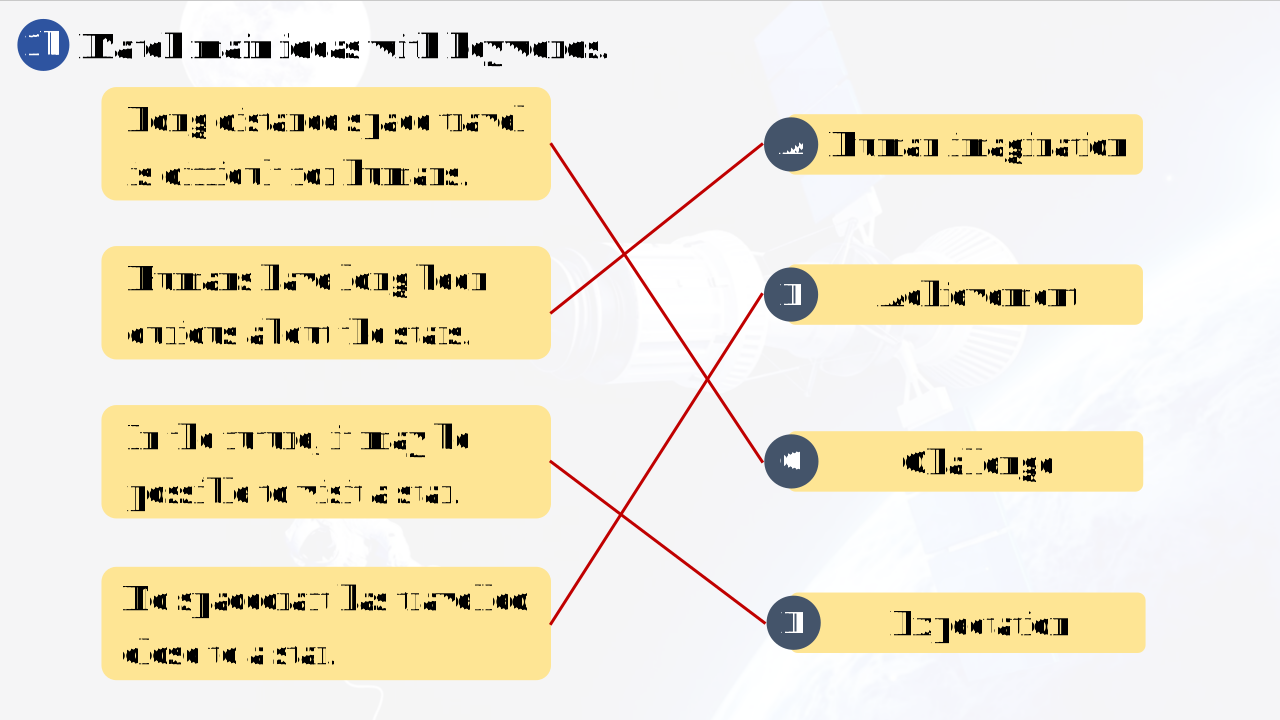
Long distance space travel is difficult for humans.
Humans have long been curious about the stars.
In the future, it may be possible to visit a star.
No spacecraft has travelled close to a star.
Human imagination
A
Achievement
B
Challenge
C
Expectation
D
1b
Match main ideas with keywords.
6
1b
Read Para. 1 and answer the questions.
Since the beginning of human history, people have looked up at the stars and wondered what they were like. Many ancient cultures believed that these points of light were from gods or other mysterious worlds. However, as science and technology developed, we learnt the truth about stars. They are real places like our own sun, and they are farther away than anyone imagined. This raises the question: Can we visit the stars one day?
1
1. What did some ancient cultures think about the stars? Why?
Many ancient cultures believed that these points of light were from gods, or
other mysterious worlds. Because they did not understand science, they used
stars to explain the world.
2. What truth have we learnt about stars?
They are real places like our own sun, and they are farther away than anyone
imagined.
7
1b
Read Para. 2 and answer the questions.
The man-made object which has travelled farthest from Earth is Voyager 1. This spacecraft was launched in 1977. In case Voyager 1 is found by alien life, a special record with sounds and pictures from Earth is carried on board. It shows who we are and where we are from. By 2025, Voyager 1 was over 25 billion kilometres from Earth, but that is still a long way from Earth’s second-closest star, Proxima Centauri. That star is 4.2 light years away—about 40 trillion kilometres!
2
1. How does the author tell us the truth of the fact that no spacecraft has travelled
close to another star?
By giving the example of Voyager 1, which is a man-made object and has
travelled farthest from earth to explore outer space.
2. What is carried on board by Voyager 1? Why?
A special record with sounds and pictures from Earth. It shows who we are and
where we are from in case alien life finds it.
8
1b
Read Para. 3 and fill in the blanks.
The challenge of visiting the stars gets even bigger for space flights with humans. The farthest that any human has travelled in space is only about 400,000 kilometres, to the far side of the moon. Time is a big problem. At present, even a journey to the planet Mars will take around six to nine months. What will the astronauts eat and drink during this period? And how about their health and safety? These problems grow when we talk about visiting another star. It might take hundreds of thousands of years to get there!
3
• What is the farthest trip that a human has travelled from Earth? Do you know
any details about it?
The farthest humans have travelled is about 400,000 kilometres, to the far side
of the moon. This was done during the Apollo missions, like Apollo 13, when
astronauts orbited the moon.
The problem with human space travel Visiting the stars is even more difficult for space flights with ________.
The farthest distance humans have gone in space About ________ kilometres (to the far side of the moon).
Time to Mars Around ______ to ______ months.
Big problems for astronauts Food, drink, ________ and safety.
Time to another star Could take ______________________ years.
humans
400,000
six
nine
health
hundreds of thousands of
9
Apollo missions
The Apollo program was NASA’s famous space project to send humans to the Moon. It ran from 1961 to 1972. Neil Armstrong became the first human to walk on the Moon.
That’s one small step for a man, one giant leap for mankind.
—Neil Armstrong
1b
Read Para. 4 and answer the questions.
Scientists, however, believe that visiting the stars is not a completely wild dream. One idea is to have the astronauts sleep during their journey, like some animals do in winter. Another is to develop much faster spacecraft. While this is not possible right now, with nations and scientists cooperating with one another, there is hope that the necessary technology will be developed. Humans have photographed other galaxies, set foot on the moon, and even successfully landed rovers on Mars. It seems likely that one day we will reach the stars.
1. What are the two ideas for travelling to stars?
One idea is to have the astronauts sleep during their journey, like some animals
do in winter. Another is to develop much faster spacecraft.
2. What do you think about the future of space exploration?
I think the future of space exploration is exciting, and humans may travel to
Mars and discover new planets.
4
11
People learnt the _____
about stars as science and technology developed.
Humans looked up at the stars and _______ what they were like.
Human
Imagination
Voyager 1 carried a
special _______________
_____________________.
Voyager 1 was
launched in _______.
Achievement
Astronauts may face health and ________ problems.
Even a journey to the planet Mars will take around _____ months.
Challenge
We can ________ much
faster spacecraft.
Astronauts can _____
during their journey.
Expectation
Can we visit
the stars
one day?
wondered
truth
1977
record with sounds
6 to 9
safety
sleep
develop
1d
Complete the mind map with the information from the text.
and pictures
12
(2) To go farther into space, what else do we need to do?
Sample answers:
Technology
• faster spacecraft
• better energy
• AI & automation
Cooperation
• countries work together
• share costs & resources
• global knowledge
Other ideas
• more time & patience
• more money funding
• inspire new generations
Human body
• food & water supply
• long-term sleep
• radiation protection
13
Thank you
$
资源预览图