四川自贡市荣县启明集团2026-2027学年上学期第一学月巩固练习九年级英语试题
2026-10-14
|
6页
|
17人阅读
|
0人下载
内容正文:
荣县启明集团第一学月巩固练习九年级
英 语 试 题
本试卷共四部分,满分150分。考试时间为120分钟。答卷前,考生务必将自己的姓名、准考证号填写在答题卡上,并在规定位置粘贴考试用条形。答卷时,须将答案答在答题卡上,在本试卷、草稿纸是答题无效。考试结束后,本试卷由学生自己保留,只将答题卡交回。
注意事项:必须使用2B铅笔将答案标号填涂在答题卡上对应题目标号的位置上,如需改动,用橡皮擦干净后,再选涂其他答案标号。
第一部分 听力(共两节,满分30分)
第一节 (共15小题;每小题1.5分,满分22.5分)
听下面12段对话。每段对话后有一个或几个小题,从每题所给的A 、B 、C 三个选项中选出最佳选项,并标在试卷的相应位置。听完每段对话后,你都有5秒钟的时间来回答有关小题和阅读下一小题。每段对话读两遍。
1. What sport did the man like best when he was a kid?
2. What did Mrs Brown often share with Lily?
3. What instrument is the girl’s music teacher good at playing?
4. How did the man go to school when he was young?
5. Who won this year’s “City Star” award?
听下面一段材料,回答第6小题。
6. What did the woman listen to on the radio for fun?
A. Songs. B. News. C. Stories.
听下面一段材料,回答第7小题。
7. How long did the girl’s grandpa’s first train trip take?
A. Two hours. B. One day. C. Two days.
听下面一段材料,回答第8小题。
8. What is Mr Carter’s job?
A. A policeman. B. A bus driver. C. A doctor.
听下面一段材料,回答第9小题。
9. What does Max practise doing every day?
A. Singing. B. Drawing. C. Writing.
听下面一段材料,回答第10小题。
10. What is the man doing?
A. Drawing a map. B. Giving directions. C. Locating his school.
听下面一段材料,回答第11至12题。
11. Who is Mr Johnson?
A. Jamie’s teacher. B. Jamie’s neighbour. C. Jamie’s friend.
12. How long has the book corner been there?
A. For one year. B. For two years. C. For three years.
听下面一段材料,回答第13至15题。
13. Where was the man’s village located?
A. In the mountains. B. Near a city. C. By the sea.
14. How did the man get to school?
A. By bus. B. On foot. C. By bike.
15. How often did the man go back home?
A. Once a week. B. Twice a month. C. Once a month.
第二节 (共5小题;每小题1.5分,满分7.5分)
听下面一段独白。根据独白内容,请在空白处写出正确的单词,每空填一词。听独白前,你将有10秒钟的时间阅读下面内容,独白读三遍。
16. My grandfather’s life taught me the value of hard work and .
17. Every morning, he helped the chickens and then walked an hour to school.
18. He entered a great university and studied .
19. But he has never his village.
20. Now school buses run on it, and village reach city markets in just an hour.
第二部分 阅读(共两节,满分40分)
第一节 (共15小题;每小题2分,满分30分)
阅读下列短文,从每题所给的A、B、C三个选项中选出最佳选项。
A
World’s Tallest Bridge Opens in China
The world’s tallest bridge has opened to traffic in Guizhou, Southwest China. Standing 625 meters above the Beipan River, the Huajiang Grand Canyon Bridge is nearly nine times the height of San Francisco’s Golden Gate Bridge. With a main span (跨距) of 1,420 meters, the 2,890-meter-long bridge is a key link in Guizhou’s expressway network, cutting travel time across the deep canyon(峡谷) from two hours to just two minutes.
▲
Known as the Garbage (垃圾) Mountain of Delhi, Ghazipur Landfill(垃圾填埋场), built in 1984, is the world’s highest garbage mountain. Standing 72 meters tall — almost as tall as the Taj Mahal — it covers an area of about 70 acres (英亩) and holds over 14 million metric tonnes (公吨) of waste. Although the landfill reached its maximum capacity (最大容量) in 2002, hundreds of tons of garbage is still added every day, causing serious problems for the environment and the local population.
World’s Largest Mosquito Factory Built in Brazil
Wolbito do Brasil, the world’s largest mosquito (蚊子) factory, has been built in Curitiba, producing 100 million mosquito eggs per week to fight against mosquito-borne diseases such as dengue fever. Covering over 3,500 square meters, the factory breeds (培育) Aedes aegypti mosquitoes that carry the Wolbachia bacteria (细菌). These “good mosquitoes” mate with wild ones, passing the bacteria to their young and cutting the risk of virus spread.
21. In which part of the newspaper can we read the news?
A.WORLD. B. TRAVEL. C. BUSINESS.
22. What is true about the Huajiang Grand Canyon Bridge?
A. It is the longest bridge in the world. B. It has a main span of 2,890 meters.
C. It has greatly shortened the travel time.
23. The best title for the second piece of news would be “___ ▲___ ”
A. World’s Highest Garbage Mountain Built in India B. The Taj Mahal: Taller Than a Garbage Pile
C. A 70-Acre Landfill Reaches Its Maximum Capacity
24. What is the purpose of the mosquito factory?
A. To control the number of mosquitoes in nature. B. To produce mosquito eggs for medical research.
C. To help prevent the spread of mosquito-borne diseases.
25. What does the above news focus on?
A. Famous buildings. B. Global records. C. Environmental problems.
B
Huang Xuhua, the main designer of China’s first-generation nuclear submarines (核潜艇), passed away on February 6th, 2025, in Wuhan, Hubei. Huang was born in March 1926 in a doctor’s family in Guangdong. Growing up during the war, Huang entered Shanghai Jiao Tong University to study shipbuilding. He expected to use his knowledge to protect the country. After graduating in 1949, he joined the Communist Party of China and started his work in China’s shipbuilding industry.
Huang began working on the top-secret “09 Project” in 1958 to develop China’s first nuclear submarine and became one of its leading scientists. When he joined the project, China had no basic conditions for this high-tech work. The researchers knew nothing about it, and other countries kept the technology secret. Huang and his team worked hard to make it. In 1970, they built China’s first nuclear-powered submarine—Type 091. China became the fifth country to have one. While some media called him “the father of China’s nuclear submarines,” Huang said, “China’s nuclear submarines were the result of the teamwork efforts. I was simply doing my duty.”
▲ From 2017 to 2020, he was awarded national-level honors three times by President Xi Jinping. He cared a lot about the future of science and technology in China, as well as the growth of young people. He donated over 20 million yuan to support scientific research, education, and the spread of scientific knowledge. He spent his whole life developing China’s nuclear submarine industry and strengthening national defense (国防), which encourages us to try our best to make the country stronger.
“We are deeply sorry for his passing. But we must tell our children about Huang’s story, helping them remember history and inspiring them to fight for our country,” said Mr Wang, who came to mourn (哀悼) Huang with his children.
26.Why did Huang Xuhua study shipbuilding?
A. Because he was born in a shipbuilding family. B. Because he wished to protect the country.
C. Because he was talented in building ships.
27.What does the underlined word “it” refer to in Paragraph 2?
A. The “09 Project”. B. China’s shipbuilding industry. C. The technology of developing nuclear submarines.
28.Which of the following can be put in____▲____?
A. Huang’s life was full of achievements. B. Huang’s life was full of challenges.
C. Huang’s life was full of mysteries.
29.What can we infer(推测) from the passage about Huang?
A. He cared most about his family. B. He thought highly of the power of teamwork.
C. He was proud of his role in developing nuclear submarines.
30.What is the purpose of this passage?
A. To introduce Huang’s contributions and encourage people to learn from him.
B. To explain why China became the fifth country to have nuclear submarines.
C. To explore the development of China’s nuclear submarines.
C
①Blind boxes have become very popular for toys in China. The idea is simple: the buyers won’t know which toys they get until they open the boxes. It’s a bit like gambling (赌博), but everyone gets a toy, so no one ends up with nothing.
②Pop Mart is a well-known company (公司). It began as a small shop in Beijing’s Zhongguancun area, selling different kinds of goods(货物). Later, the company found toys were their most popular and best-selling goods. So they thought selling toys might be the best idea.
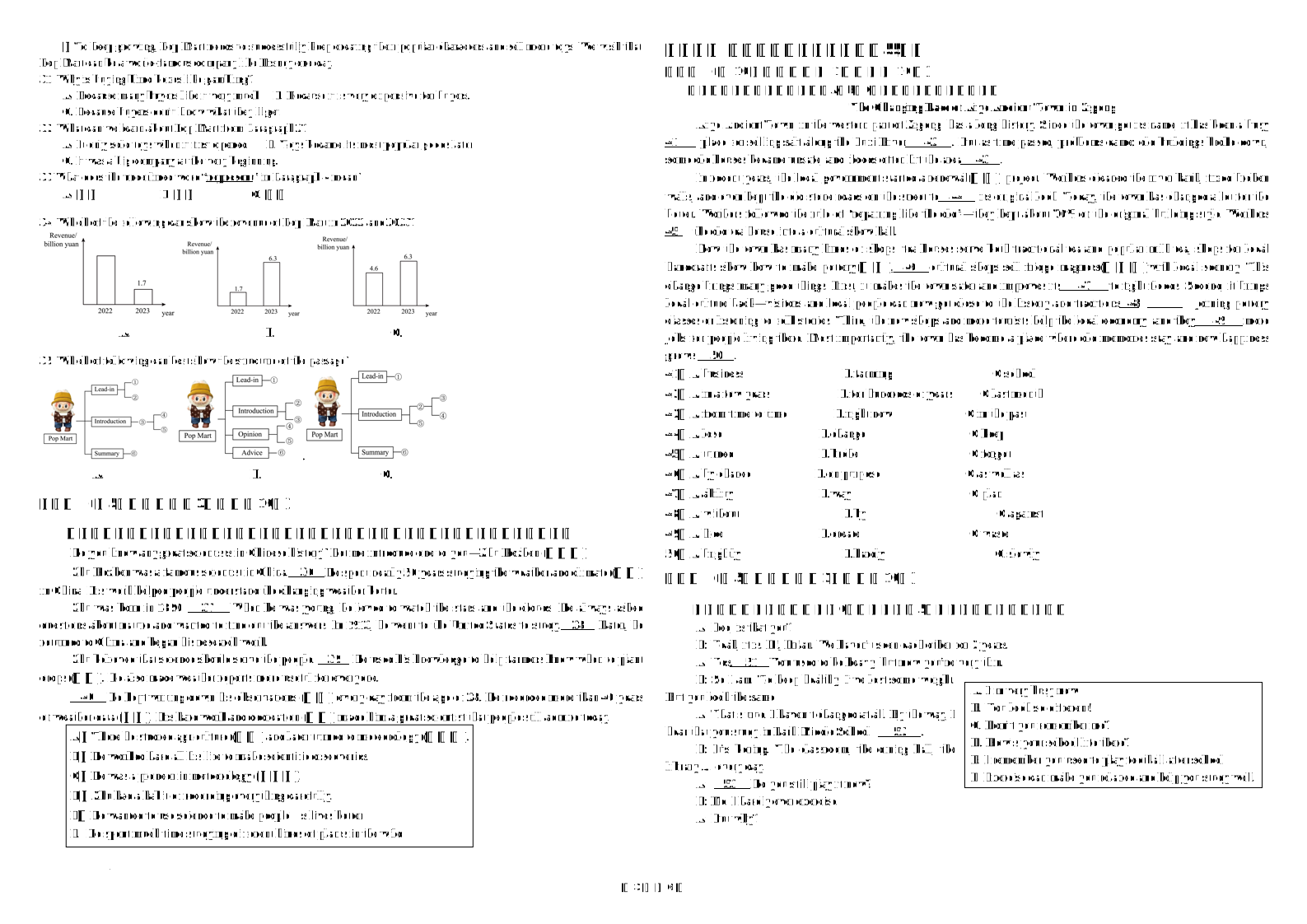
③The idea for blind boxes was from gashapon (扭蛋机) in Japan, which sells blind toys in capsules (胶囊). Although the toys inside Pop Mart’s blind boxes cost only about 2 dollars, they sell for around 8 dollars each. This brings the company a lot of money. Pop Mart had around 6.3 billion yuan in revenue (收入) in the year of 2023, 1.7 billion yuan more compared with 2022.
④These toys easily become popular with young people because they’re fun and surprising. Some buyers have collected over 1,000 dolls, showing how much they enjoy them. Maybe they think the dolls represent their personality, or they simply like sharing cute things with others.
⑤However, the blind box is as hard to stop as gambling. Some hard-to-find toys are already sold at higher prices in second-hand markets. Some countries have taken actions to stop or control blind box sales.
⑥To keep growing, Pop Mart needs to successfully keep creating their popular characters and sell more toys. We wish that Pop Mart can be a world-famous company like Disney one day.
31. Why is buying blind boxes like gambling?
A. Because many buyers like it very much. B. Because it is very expensive for buyers.
C. Because buyers don’t know what they’ll get.
32. What can we learn about Pop Mart from Paragraph 2?
A. It only sold toys when it first opened. B. Toys became its most popular goods later.
C. It was a big company at the very beginning.
33.What does the underlined word “represent” in Paragraph 4 mean?
A. 代表 B. 伤害 C. 发现
34. Which of the following can show the revenue of Pop Mart in 2022 and 2023?
A. B. C.
35. Which of following can best show the structure of the passage?
.
A. B. C.
第二节 (共5小题;每小题2分,满分10分)
阅读下面短文,从短文后的选项中选出可以填入空白处的最佳选项。选项中有一项为多余选项。
Do you know any great scientists in Chinese history? Let me introduce one to you—Zhu Kezhen (竺可桢).
Zhu Kezhen was a famous scientist in China. 36 He spent nearly 50 years studying the weather and climate (气候) in China. His work helped people understand the changing weather better.
Zhu was born in 1890. 37 When he was young, he loved to watch the stars and the clouds. He always asked questions about nature and wanted to find out the answers. In 1913, he went to the United States to study. 38 Later, he returned to China and began his research work.
Zhu believed that science should serve the people. 39 He used his knowledge to help farmers know when to plant crops (庄稼). He also made weather reports more useful for everyone.
40 He kept writing down his observations (观察) every day from the age of 28. He recorded more than 40 years of weather data (数据). His hard work and dedication (奉献) made him a great scientist that people still admire today.
A.There he studied agriculture (农业) and later turned to meteorology (气象学).
B.He worked hard all his life to make scientific discoveries.
C.He was a pioneer in meteorology (气象学).
D.Zhu had a habit of recording everything carefully.
E.He wanted to use science to make people’s lives better.
F. He spent much time studying different kinds of plants in the wild.
第三部分 语言运用(共五节,满分55分)
第一节 (共10小题;每小题1分,满分10分)
阅读下面短文,从每题所给的A、B、C三个选项中选出最佳选项。
The Changing Face of Aiye Ancient Town in Zigong
Aiye Ancient Town, in the western part of Zigong, has a long history. Since the town got its name, it has been a busy 41 place for selling salt along the Fuxi River 42 . But as time passed, problems came: old buildings broke down, some old houses became unsafe, and floods often hit the area 43 .
In recent years, the local government started a renewal(翻新) project. Workers cleaned the river bank, fixed broken walls, and even kept the old stone roads on the street to 44 its original look. Today, the town has changed a lot for the better. Workers followed the rule of “repairing like the old”—they kept about 70% of the original building style. Workers 45 the old tea house into a cultural show hall.
Now the town has many kinds of shops: tea houses serve both traditional tea and popular milk tea, shops for local handcrafts show how to make pottery(陶器), 46 cultural shops sell fridge magnets(冰箱贴)with local scenery. This change brings many good things. First, it makes the town safer and improves its 47 to fight floods. Second, it brings local culture back—visitors and local people can now get close to the history and traditions 48 joining pottery classes or listening to folk stories. Third, the new shops and more tourists help the local economy, and they 49 more jobs for people living there. Most importantly, the town has become a place where old memories stay and new happiness grows 50 .
41.A.business B.farming C.school
42.A.in a few years B.for hundreds of years C.last month
43.A.from time to time B.right now C.in the past
44.A.lose B.change C.keep
45.A.turned B.broke C.forgot
46.A.by chance B.on purpose C.as well as
47.A.ability B.way C.plan
48.A.without B.by C.against
49.A.hide B.create C.waste
50.A.brightly B.hardly C.slowly
第二节 (共5小题;每小题2分,满分10分)
阅读下面对话,从方框内的6个选项中选择5个恰当的句子完成此对话。
A: Leo, is that you?
B: Yeah, it is. Hi, Brian. We haven’t seen each other for 3 years.
A: Yes. 51 You used to be heavy, but now you’re very thin.
B: So I am. To keep healthy, I’ve lost some weight. But you look the same.
A. I’m very busy now.
B. You look so different!
C. Don’t you remember me?
D. How’s your school life there?
E. I remember you used to play football after school.
F. Exercise can make you relaxed and help you study well.
A: That’s true. I haven’t changed at all. By the way, I hear that you study in Park Middle School. 52 .
B: It’s boring. The classroom, the dining hall, the library … every day.
A: 53 Do you still play it now?
B: No. I hardly ever exercise.
A: But why?
(
第
3
页
共
4
页
)
学科网(北京)股份有限公司
B: 54 I have to do lots of homework after school every day.
A: I’m sorry to hear that. But you should exercise every day. 55
B: OK. I’ll take your advice.
第三节 (共10小题;每小题1.5分,满分15分)
阅读下面短文,在空白处填入1个适当的单词或括号内单词的正确形式。
In Shaanxi Province, the No.6064 publicbenefit slowspeed train plays 56 important part in mountain people’s life. It 57 (bring) many new chances for local people since it started running.
Years ago, the train was in poor condition. Passengers 58 (face) terrible travel conditions without heating. Back in those years, the workers had to deal with all kinds of difficulties by 59 (they). However, 60 the support of the government, the conditions of this publicbenefit train have 61 (great) improved. A station 62 (manage) says the train brings many advantages. It helps farmers sell home-grown goods.
63 all, it gives hope to families who once suffered from 64 (hungry). He thought it was necessary for train workers 65 (provide) cheap and safe trips for villagers.
Thanks to this special train, local villagers have benefited a lot.
第四节 (共5小题;每小题2分,满分10分)
阅读下面短文,完成表格,每空一词。
Farming and creativity don’t often go hand in hand, but rice paddy art (稻田画) is turning ordinary fields into pictures. However, you may be asking, “How is the art created from only rice plants?” The secret is to use different kinds of rice seeds. As the plants grow, each type shows a different color, from green to purple, to bring an artwork to life.
Creating rice paddy art takes a lot of work and planning. First, farmers draw a picture with a computer program. Then, they mark the design on a map of the field. This helps show which kind of rice should be planted in each section. After that, they’re ready to sow (播种) the seeds, either with the help of drones or volunteers.
Rice paddy art in China started in 2010 in Shenyang, showing dragons and Chinese paintings. Then the practice started to catch on in some other places like Harbin and Hangzhou. On October 24, 2023, a huge 3D rice field painting in Tianjin set a Guinness World Record! Named “Celebrating Harvest, Promoting Harmony”, it covers 50,798 square meters—bigger than any other 3D rice field artwork ever around the world.
Rice paddy art is a fun way to bring beauty and energy to the countryside. A great number of tourists come to the countryside to enjoy the new art form. It is a great example of how tradition and creativity can go together to uplift communities.
Rice Paddy art: Painting with Plants
A general introduction
◆It is turning fields into ____66____.
◆It’s clear and easy to see them from high places.
◆There are different types of designs.
The ____67____
◆First, farmers draw a picture on the computer.
◆Then, they ____68____ the design on a map of the field.
◆After that, they sow different seeds.
The spread
◆China’s rice paddy art started in Shenyang.
◆It caught on in other places then.
◆Tianjin made the ____69____ 3D rice paddy artwork in the world.
The value
◆It brings beauty and energy to the countryside in a fun way.
◆It draws a lot of tourists to the countryside.
◆It connects ____70____ with creativity.
第五节 (共5小题;每小题2分,满分10分)
阅读下面短文,回答5个问题。
Wang Zhenyi (1768-1797) was a famous woman scientist. She was very interested in reading when she was a child and was very clever. Her grandfather was her first teacher in astronomy (天文学), her grandmother was her teacher of poems, and her father taught her medicine, geography, and maths.
Although she only lived to be twenty-nine, Wang Zhenyi wrote a lot of articles on astronomy, such as Theory of the Earth's Roundness. Not only did she study the research of others, but also she was able to do her own research. Wang's most famous experiment (实验) was done at her home in Nanjing. She placed a round table in a garden to be the Earth, and hung (悬挂) a lamp to be the sun. Then on one side of the table she had a round mirror as the moon. She moved these three things as if they were the sun, Earth, and moon. Her findings were recorded in her article, The Explanation of a Lunar Eclipse.
She worked hard at her study of maths. She rewrote the book Principles of Calculation and this made learning maths easier for beginners. She also wrote a book called The Simple Principles of Calculation when she was twenty-four. Her studies were difficult but she once said, "There were times when I had to put down my pen. But I love the subject, so I won't give up."
71.When was Wang Zhenyi born?
72.Who taught Wang Zhenyi poems?
73.Where did Wang Zhenyi do her most famous experiment?
74.Why did Wang Zhenyi rewrite the book Principles of Calculation?
75.What can you learn from Wang Zhenyi?
第四部分 书面表达(共一节,满分25分)
假如你是李华,你市日报社正在举办以“What Surprises Me About My Hometown”为题的英文征文活动,让大家记录家乡的那些使自己感到惊喜的变化。请你结合下面的信息,用英语写一篇短文向报社投稿。内容包括:
1. 环境方面的变化;
2. 交通方面的变化;
3. 人们身上发生的变化。
注意: 1. 词数为80左右; 2. 可适当增加细节,以使行文连贯; 3. 文中不能出现真实姓名及学校名称; 4. 开头已给出,不计入总词数。
What Surprises Me About My Hometown
In recent years, my hometown has changed a lot, which surprises me greatly.________________________________
荣县启明集团九年级第一学月巩固练习
英 语 参 考 答 案
第一部分:听力
1-5: ABCBC 6-10: CCBBC 11-15: BCABC
16. kindness 17.feed 18.engineering 19. forgotten 20. products
第二部分:阅读理解
A篇:21-25:ACACB
B篇:26-30:BCABA
C篇:31-35:CBACB
六选五:36-40: CBAED
第三部分:语言运用
完形填空:41-45:ABACA 46-50 :CABBA
六选五: 51-55:BDEAF
语法填空:
56. an 57. has brought 58.faced 59.themselves 60.with
61.greatly 62.manager 63.Above 64.hunger 65. to provide
阅读填空:
66.pictures 67.steps 68. mark 69.biggest/largest 70.tradition
任务型阅读;
71. In 1768. / She was born in 1768.
72.Her grandmother. /H er grandmother taught her.
73.At her home in Nanjing.
74.To make learning maths easier for beginners./ To help beginners learn maths.
75.Her spirit of loving learning/ never give up.(言之有理即可)
76.书面表达:
【答案】例文:
What Surprises Me About My Hometown
In recent years, my hometown has changed a lot, which surprises me greatly.
First, the environment is much cleaner than before. People put rubbish into bins and the streets look tidy. The air is fresher because there are more trees and green spaces. Second, the traffic is better now. The roads are wider and smoother, and more buses run on time. It’s convenient to travel around.Also, people in my hometown have become friendlier. They always help each other and smile at visitors.
I feel proud of these great changes. My hometown surprises me, and I love it more.
听力材料
第一节
听下面一段材料,回答第1小题。
W: Dad, you didn’t have phones when you were a kid. What did you do for fun?
M: We played real games outside! My favourite was basketball.
听下面一段材料,回答第2小题。
M: Who helped you most when you first moved to this city, Lily?
W: My neighbour, Mrs Brown. She often made delicious soup and shared it with me.
听下面一段材料,回答第3小题。
M: Why are you interested in instruments now, Amy?
W: My new music teacher can play the piano well! She inspired me to learn an instrument.
听下面一段材料,回答第4小题。
W: Dad, how did you go to school when you were my age?
M: By bike. The school was too far to walk and we didn’t have a car.
听下面一段材料,回答第5小题。
W: Who won the “City Star” award this year for their inspiring work?
M: Dr Li from the Central Hospital. She spent all her free time treating poor families in the villages for free.
第二节
听下面一段材料,回答第6小题。
M: What did you do for fun when there was no internet, Mum?
W: Do you remember the old radio in your grandparents’ house? I listened to stories on it.
听下面一段材料,回答第7小题。
W: My grandpa said his first train trip took two days!
M: Two days? Now it takes only two hours to get to the same city by plane. Travel has become much faster.
听下面一段材料,回答第8小题。
W: Is there anyone you really admire in our community, Ben?
M: Yes. I admire Mr Carter, the bus driver. He is kind to every passenger and he is always helpful.
听下面一段材料,回答第9小题。
W: Why are you so hard-working, Max? You practise drawing every day.
M: I want to be an artist in the future.
听下面一段材料,回答第10小题。
W: Why are you looking at this old map, Grandpa?
M: I’m trying to find my old school. But all these small roads are gone now. Wide streets have replaced them.
听下面一段材料,回答第11至12题。
W: Who do you admire most, Jamie?
M: Mr Johnson. He’s my neighbour. He used to be a history teacher.
W: Why him?
M: After he stopped teaching three years ago, he turned a small room in our community into a book corner for everyone.
W: A book corner? How does it work?
M: Anyone can pick up a book there and read for free. Many neighbours also put their own books there to share. I shared some books about art last month.
听下面一段材料,回答第13至15题。
M: When I was your age, I lived high up in the mountains. Our village was small — no school, no shops.
W: No school? Where did you study?
M: The nearest school was in a town. To get there, I had to walk. It was a two-hour journey one way, down the mountain roads.
W: Two hours every day? That’s impossible!
M: Not every day. The journey was too long, so I only came back home once a month.
W: I can’t even imagine doing that. That must have been so hard, Dad.
听下面一段材料,回答第16至20题。
I admire my grandfather most. His life taught me the value of hard work and kindness. He grew up in a small mountain village. Every morning, he helped feed the chickens and then walked an hour to school. At night, he studied late. His efforts paid off — he entered a great university and studied engineering. After university, he started a small factory with two college friends, making car parts. Now, the factory is very successful. But he has never forgotten his village. Last year, he paid to build a better road. Now school buses run on it, and village products reach city markets in just an hour. I want to be like him one day.
(
第
4
页
共
5
页
)
学科网(北京)股份有限公司
$
资源预览图

1

2
3
相关资源
示范课
由于学科网是一个信息分享及获取的平台,不确保部分用户上传资料的 来源及知识产权归属。如您发现相关资料侵犯您的合法权益,请联系学科网,我们核实后将及时进行处理。