Unit 4 第5课时 Section B 3a-3c-【七彩课堂】2026-2027学年九年级上册英语同步课件(人教版·新教材)
|
2份
|
15页
|
121人阅读
|
4人下载
教辅

内容正文:
Friday, november, twenty years. In the past, I always felt stressed when I had to give a speech. I used to spend lots of time trying to memorize my speech, but I still forgot some parts. Last week, I decided to find out what the right way is to memorize the speech. I looked online and asked friends, and I found many useful methods. I learned how to create a speech outline. Instead of trying to remember every word of my speech, I remembered the keywords first. Then I formed images of these keywords in my mind and link them in order. Another method is to divide the speech in the short sections. I practice the first section until I could fully recall IT. Then I moved on to the next. This helped me define without which parts of the speech I needed to work on the most. Finally, a friend told me that I should have confidence in myself. Nobody knows my speech except me. If I do forget some words, I shouldn't panic. Just remember the keywords in continue I followed all these great methods in my speech today was a great success.
Section B 3a—3c
Unit 4
Our Memory
Objectives
◆ Get detailed information from Billy’s diary about
memory‑improving methods for a speech.
◆ Finish the table about memory challenge, goal, methods
and result.
◆ Sum up practical ways to deal with their own memory
difficulties.
◆ Write a short diary entry with simple object clauses to
show their memory‑improvement plan.
Play a game
key words
divide
confidence
review
outline
image
section
practice
Play a game
What was your memory challenge just now?
What can you do to remember more words?
key words
divide
confidence
review
outline
image
section
practice
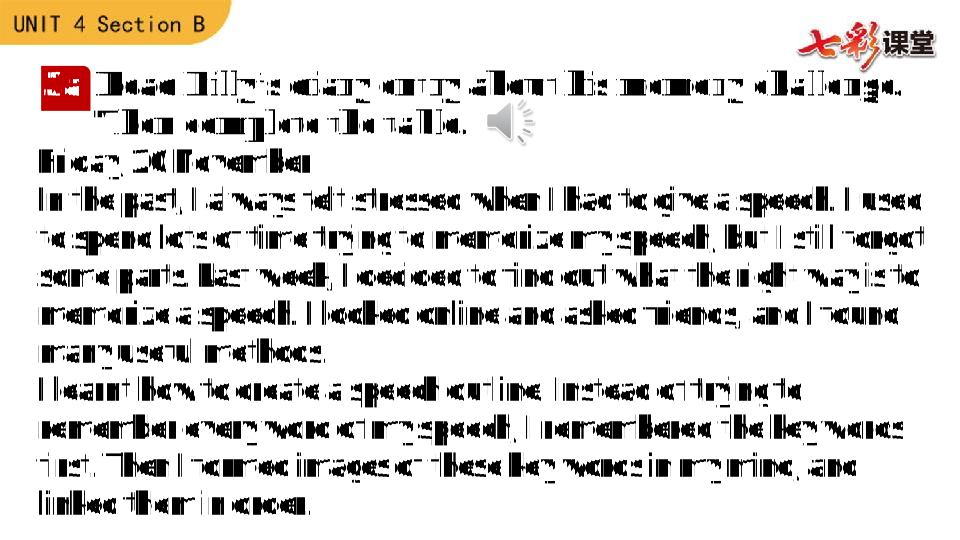
3a Read Billy’s diary entry about his memory challenge.
Then complete the table.
Friday, 20 November
In the past, I always felt stressed when I had to give a speech. I used to spend lots of time trying to memorize my speech, but I still forgot some parts. Last week, I decided to find out what the right way is to memorize a speech. I looked online and asked friends, and I found many useful methods.
I learnt how to create a speech outline. Instead of trying to remember every word of my speech, I remembered the key words first. Then I formed images of these key words in my mind, and linked them in order.
3a Read Billy’s diary entry about his memory challenge.
Then complete the table.
Another method is to divide the speech into short sections. I practised the first section until I could fully recall it. Then I moved on to the next. This helped me to find out which parts of the speech I needed to work on the most.
Finally, a friend told me that I should have confidence in myself. Nobody knows my speech except me. If I do forget some words, I shouldn’t panic. Just remember the key words and continue!
I followed all these great methods and my speech today was a great success!
Billy used to spend much time memorizing speeches, but he still forgot some parts.
To find the right way to memorize a speech.
Create a speech outline.
Divide the speech into short sections.
Build self-confidence.
Billy followed these methods and his speech today was a great success.
·Divide your goal into smaller ones if it is difficult.
·List three methods to improve your memory.
·There is no one-size-fits-all method. Practise to find out what
works the best for you.
3b
What is your biggest memory challenge? Use the table in 3a to create a plan to overcome the challenge. Here are some tips.
3c
Write a diary entry to start tracking your progress. Reward yourself for each small step forward. You are sure to get better!
1. I learnt how to create a speech outline. 我学会了怎样拟定演讲大纲。
outline /ˈaʊt.laɪn/ 作名词,意为“纲要”,它作名词还可以表示“轮廓线;略图”。outline还可以作动词,意为“概述;显示……的轮廓,勾勒……的外形”。
You should draw up a plan or outline for the essay.
你应该为文章草拟个计划或提纲。
She drew the figures in outline. 她简略地勾勒出人物的轮廓。
They saw the huge building outlined against the sky.
他们看见了在天空的映衬下那座巨大建筑的轮廓。
Language points
Language Points
2. Another method is to divide the speech into short sections. 另一种方法是把演讲分成小的部分。
divide /dɪˈvaɪd/作动词,意为“(把……)分成”,它作动词还可以表示“使分开;除以”。divide还可以作名词,意为“分歧”。
Let’s divide the cake into four parts. 我们把蛋糕分成四份。
The wall divides the garden from the road.
这堵墙把花园和马路隔开。
10 divided by 2 is 5. 10除以2等于5。
There is a divide between us. 我们之间有分歧。
3. I practised the first section until I could fully recall it.
我练习第一部分直到我能完全回想起来。
fully /ˈfʊli/作副词,意为“完全地”。
I fully understand your situation. 我完全理解你的处境。
She is fully prepared for the exam. 她为考试做了充分准备。
根据 Billy 的日记内容,判断句子正 (T) 误 (F)。
( ) 1. Billy felt relaxed when he had to give a speech in the past.
( ) 2. Billy tried to remember every word of his speech before.
( ) 3. One of Billy’s methods is to create a speech outline and remember key words.
( ) 4. Billy thinks we should panic if we forget some words in a speech.
( ) 5. Billy’s speech became successful after he used good memory methods.
Exercises
F
T
T
F
T
伴你成长
null
88973.93
$
资源预览图