Unit 3 Family Matters Presenting ideas Writing about a family memory教学设计-2026-2027学年高中英语外研版(2019)必修第一册
2026-09-18
|
6页
|
102人阅读
|
0人下载
普通
摘要:
该高中英语教学设计聚焦必修第一册Unit 3“家庭记忆记叙文”写作,通过褪色家庭照片与轻音乐激活学生家庭记忆,以问题链引导关注细节,串联前四课时家庭主题体验,借助5W框架、范文情感转折分析及句子框架搭建学习支架。
此资料亮点显著,范文“焦蛋故事”以日常细节传递温暖,降低写作焦虑,5W框架与转折句设计培养思维品质,3-2-1同伴互评提升学习能力,分层作业满足不同需求。既助学生提升语言能力与情感表达,又为教师提供清晰教学流程与评价标准,高效落实单元育人目标。
内容正文:
Unit 3 Period 5 Writing about a family memory
(语篇深度分析/可观测评价/作业分层)
教学基本信息
单元名称
必修第一册 Unit 3 Family Matters
学科
英语
学段
高中
年级
高一第一学期
主要教材
书名:普通高中教科书·英语必修第一册;出版社:外语教学与研究出版社;出版日期:2019年7月
课时安排
1课时(40min)
课型
写作课(家庭记忆记叙文)
设计理念
本课时是 Unit 3 的写作产出课,依据《普通高中英语课程标准(2017年版2020年修订)》"英语学习活动观",将前四课时的"家庭主题体验"转化为个人书面叙事。教学遵循"学习理解—应用实践—迁移创新":先读范文日记(煎蛋故事)感知"家庭记忆"的要素与情感转折,再用 5W 框架规划个人记忆,最后写出≥80词记叙文并互评。课程呼应单元终局目标"书写自己的家庭记忆",把 Period 1 的冲突、Period 3 的沟通、Period 4 的亲情,汇聚为一篇有温度的个人叙事,实现"从感知家庭到创造个人叙事"的意义闭环。
单元育人蓝图
与课时定位
【单元育人蓝图】
本单元五条育人目标:
1. 用英语描述至少 3 种家庭关系类型(代际冲突/手足之情/家庭日常),并举例说明每种关系中沟通的重要性
2. 在阅读戏剧与特写后,分析至少 2 个人物的立场、动机与冲突根源,并用自己的话复述情节
3. 用英语得体地向家人道歉(含原因解释与弥补方案),并在对话中运用重音增强道歉力度
4. 正确运用 5 种基本时态描述家庭事件的时体特征
5. 写一篇 ≥ 80 词的家庭记忆记叙文,包含时间/场景/人物/事件/情感转折
【单元意义链】
从"感知家庭多样性"→"直面代际冲突"→"理解沟通方式"→"体认手足之情"→"书写家庭记忆(本课时·第五站)"——本课时是单元意义链的第五站(收束·终点),学生用英语创造属于自己的家庭叙事。
【课时定位与关系】
本课时是单元意义链的第五站(收束·终点)——把前四课时的情感体验转化为书面产出。课时2时态(讲变化)+ 课时3外貌/沟通 + 课时4亲情体认,共同为写作提供语言与情感素材 → 后续:课时6项目实践(家庭日出行)
【主题语境】
"人与自我——个人、家庭、社区及学校生活" + "人与自我——生命的意义与价值"
【本课时聚焦的育人目标】
• 目标5:写≥80词家庭记忆记叙文,含时间/场景/人物/事件/情感转折(本课时核心产出)
【课时育人价值】
当学生用笔写下"妈妈生日那盘焦掉的煎蛋",他们不是在练英语,而是在重温和家人之间某个被爱的瞬间。写作让"Family Matters"从课文走进生命——语言在此刻有了温度,这也是单元育人最柔软也最持久的落点。
教材分析
【What · 主题语境与内容信息】
① 主题语境(thematic context):本课属"人与自我——个人、家庭、社区及学校生活"(课标表 2 子主题 1),是单元"家庭记忆"主题的书面产出。
② 语篇内容信息(content information):教材提供一篇范文日记——作者整理房间发现旧照,忆起十年前妈妈生日偷偷做煎蛋却烧焦,妈妈尝后说"不坏",母子笑吃完;结尾"this weekend is her 45th birthday, I'll make them again"。配套规划表(Who/When/Where/What/Why special)与有用表达(Last summer… / It made me feel… / I learnt that…)。
【Why · 主题意义(传递意图与价值取向)】
① 写作意图(writer's intention):编者用一篇"不完美却温暖"的范文,告诉学生"好故事不需轰轰烈烈"——日常细节里的爱最动人,降低写作焦虑,引导真实表达。
② 价值取向与立德树人(values & education):
- 思维品质:通过规划表梳理叙事要素,锻炼逻辑组织;
- 学习能力:借有用表达搭建写作支架,从模仿到创造;
- 情感态度:体认"家庭记忆=被爱的证据",培养感恩与表达爱的能力;
- 文化意识:理解"家庭记忆叙事"是中西方共通的情感表达方式。
【How · 语篇组织特征(体裁、篇章结构、语言特征)】
① 体裁(text type):个人记叙文 / 日记(first-person narrative),情感主线清晰。
② 篇章结构(organization):采用"触发(发现照片)→ 回忆(事件经过)→ 转折(焦蛋变笑)→ 落点(将重做+感悟)"的情感弧。
③ 语言特征(language features):
- 时态:一般过去时叙述往事(was tidying / decided / ended up),现在时收尾感悟(this weekend is…);呼应课时2;
- 情感表达:It made me feel… / I learnt that… / love is a magical ingredient;
- 连接词:Last summer / Many years ago / In 2015 锚定时间。
学情分析
What I know
知识储备:学生能写简单过去时叙事;课时2已学五种时态,课时3学外貌/变化描写,可调用。
生活经验:学生有大量家庭记忆素材(生日、旅行、犯错被原谅),但"用英文写有情感转折的故事"是首次。
What I want to know
疑惑点:"老师,80词会不会太长?""情感转折怎么写才不假?"
兴趣点:学生想写自己真实的故事,但怕写不好。
What I learned
学生能用 5W 规划记忆;能写≥80词含情感转折的记叙文;能运用时间连接词与情感表达。
【预判困难与应对策略】
预判困难
应对策略
叙事流水账,缺情感转折
用规划表强制填"Why special / emotional turning point";范文标注转折句(burnt→laughed)
时态混用(过去/现在)
范文用双色标过去/现在;提供"叙事用过去,感悟用现在"口诀
情感表达套话(I was happy)
提供细腻表达库(It made me feel so warm / I learnt that love is…),鼓励真实细节
教学目标
1. 语言能力
能用 5W 框架(Who/When/Where/What/Why)规划一篇家庭记忆的情节。
能写出≥80词记叙文,包含 setting / characters / actions / emotional turning point,正确使用时态。
2. 学习能力
能运用教材有用表达(Last summer… / It made me feel… / I learnt that…)搭建写作支架,从模仿到创造。
3. 文化意识
能理解"家庭记忆叙事"是情感表达的普遍方式,培养感恩与表达爱的意识。
4. 思维品质
能通过规划表梳理叙事逻辑,并设计真实的情感转折,锻炼逻辑与审美思维。
【可观测评价标准】
→ 学生能完成 5W 规划表(Activity 2 五栏填写完整)
→ 学生写出≥80词记叙文含情感转折(Activity 4 达标+≥1处 It made me feel / I learnt)
→ 学生互评能指出同伴故事的转折句(Activity 5 准确标注)
教学重难点
教学重点
叙事规划与写作:用 5W 框架组织,写出含情感转折的≥80词记叙文。
教学难点
情感转折的真实表达:避免套话,用细节承载情感(如"焦蛋→笑吃完"),而非直说"我很感动"。
教学资源
课件PPT(范文标注、5W 规划表模板、有用表达库),黑板、白板。
教学活动设计
教学过程
教师活动
学生活动
活动意图
活动层次
Step 1
(3 mins)
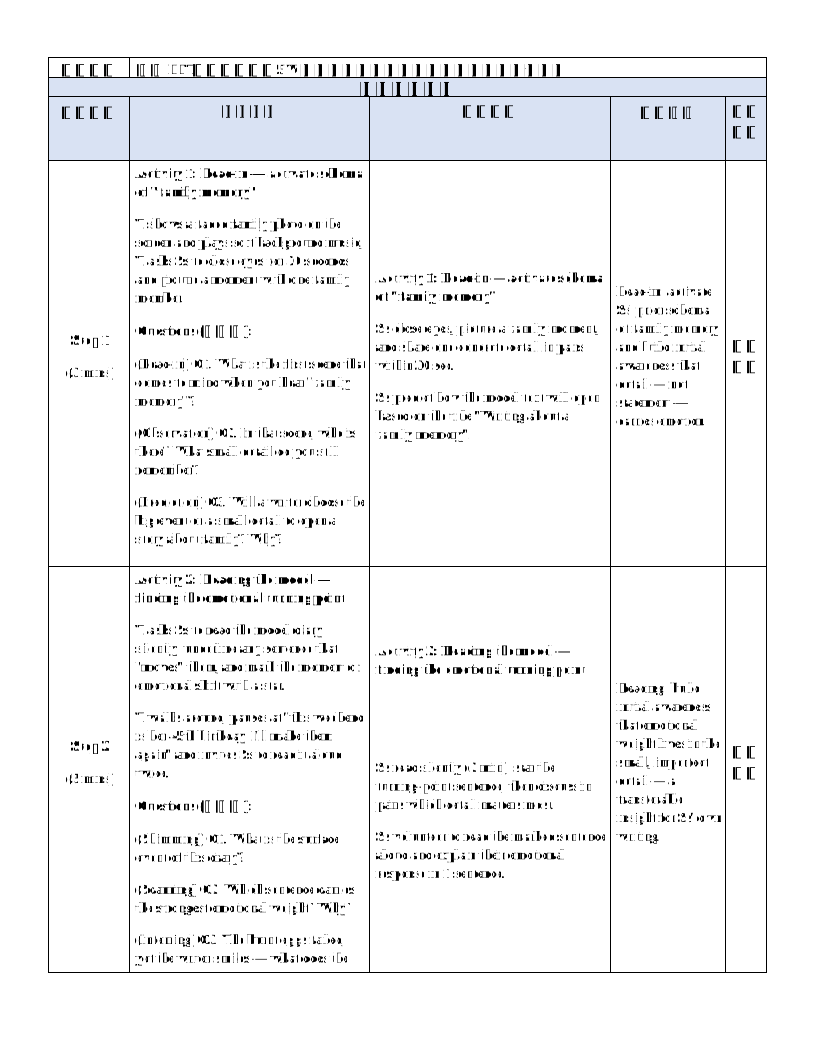
Activity 1: Lead-in — activate schema of "family memory"
T shows a faded family photo on the screen and plays soft background music; T asks Ss to close eyes for 30 seconds and picture a moment with one family member.
Questions (问题链):
(Lead-in) Q1. What is the first scene that comes to mind when you hear "family memory"?
(Observation) Q2. In that scene, who is there? What small detail do you still remember?
(Prediction) Q3. Will a writer choose the big event or a small detail to open a story about family? Why?
Activity 1: Lead-in — activate schema of "family memory"
Ss close eyes, picture a family moment, and share one concrete detail in pairs within 30 sec.
Ss predict how the model text will open based on the title "Writing about a family memory".
Lead-in: activate Ss' prior schema of family memory and build initial awareness that detail — not statement — carries emotion.
学习理解
Step 2
(5 mins)
Activity 2: Reading the model — finding the emotional turning point
T asks Ss to read the model diary silently, underline any sentence that "moves" them, and mark the moment of emotional shift with a star.
T walks around, pauses at "this weekend is her 45th birthday, I'll make them again" and invites Ss to read it aloud twice.
Questions (问题链):
(Skimming) Q1. What is the surface event of this diary?
(Scanning) Q2. Which sentence carries the strongest emotional weight? Why?
(Inferring) Q3. The burnt eggs failed, yet the writer smiles — what does the smile really mean?
(Evaluating) Q4. Could a "perfect" event make the same impression? Why or why not?
Activity 2: Reading the model — finding the emotional turning point
Ss read silently (2 min), star the turning-point sentence, then discuss in pairs which detail matters most.
Ss volunteer to read the marked sentence aloud and explain their emotional response in 1 sentence.
Reading: build initial awareness that emotional weight lives in the small, imperfect detail — a transferable insight for Ss' own writing.
学习理解
Step 3
(8 mins)
Activity 3: Deconstructing structure — event → turning point → reflection
T draws a three-block structure on the board: [Event setting] → [Emotional turning point] → [Reflection], and labels the model diary accordingly.
T models thinking aloud: "I see burnt eggs in the setting, 'her 45th birthday' as the turning point, and 'I'll make them again' as the reflection."
Questions (问题链):
(Identifying) Q1. What three parts does the writer use to organize this diary?
(Analyzing) Q2. Why does the writer put the reflection LAST instead of FIRST?
(Comparing) Q3. If the reflection came first, would the diary feel different? How?
(Transferring) Q4. Could this three-block pattern work for other family memories? Give an example.
Activity 3: Deconstructing structure — event → turning point → reflection
Ss fill a 3-column graphic organizer (Event / Turning point / Reflection) for the model.
Ss compare their organizers in groups of 4 and add any detail they missed.
Structure: make the implicit writing pattern explicit so Ss can transfer it to their own family-memory diary.
应用实践
Step 4
(10 mins)
Activity 4: Building scaffold — drafting an outline with sentence frames
T distributes a planning sheet with three K-W-L columns and four sentence frames (e.g. "The moment I keep returning to is ___ because ___").
T models filling the first row on the board: T chooses a memory, identifies one turning-point detail, and drafts the reflection aloud.
Questions (问题链):
(Planning) Q1. What one family moment do you want to write about?
(Focusing) Q2. What feeling do you most want the reader to feel?
(Detailing) Q3. What small, concrete detail can BEST show that feeling (not tell)?
(Framing) Q4. How will you open your diary so the reader enters your memory, not yours?
Activity 4: Building scaffold — drafting an outline with sentence frames
Ss fill the planning sheet silently (3 min): choose the memory, pick one detail, sketch a reflection.
Ss try the four sentence frames orally with a partner (2 min) and pick the one that fits best.
Scaffolding: lower the writing barrier — Ss do not face a blank page; they re-organize ready-made frames around their own memory.
应用实践
Step 5
(8 mins)
Activity 5: Peer review — 3-2-1 feedback on the outline
T projects a 3-2-1 peer-review card (3 stars = what works, 2 questions = what to clarify, 1 wish = one suggestion).
T models giving feedback on a sample outline (1 min) so Ss hear the language: "I see ___. I wonder ___. I wish ___."
Questions (问题链):
(Checking) Q1. Does the outline have a clear emotional turning point?
(Probing) Q2. Is the chosen detail concrete enough, or is it still a general statement?
(Anticipating) Q3. If you read only the reflection, will you feel what the writer wants you to feel?
Activity 5: Peer review — 3-2-1 feedback on the outline
Ss exchange outlines with a partner and complete the 3-2-1 card (3 min).
Ss receive feedback, ask one clarifying question, and note one revision they will make.
Peer review: turn the audience into a learning resource — Ss learn to read like a writer and revise before drafting the full diary.
迁移创新
Step 6
(6 mins)
Activity 6: Wrap-up & Option-tiered assignment
T recaps the lesson's question chain (Q1 schema → Q2 detail → Q3 structure → Q4 reflection) and writes "detail—small, real" on the board as today's takeaway.
T displays the homework options: Option A (必做) write a 120-word diary; Option B (选做) add a second turning point; Option C (挑战) exchange diaries and give 3-2-1 feedback.
Questions (问题链):
(Reflecting) Q1. Which Step today changed the way you think about "family memory"?
(Transferring) Q2. How will you apply the three-block structure to your next diary?
(Self-assessing) Q3. Which Option will you choose, and why is it a fair challenge for you?
Activity 6: Wrap-up & Option-tiered assignment
Ss complete an exit ticket (1 sentence): the one detail they will NOT forget from today's class.
Ss choose their Option A/B/C and write it on the homework slip.
Wrap-up: consolidate the day's core insight ("detail—not statement—carries emotion") and let every student pick a just-right challenge for independent writing.
迁移创新
分层作业
【作业一(基础巩固)·必做】根据课堂 5W 规划表,把草稿补全至≥80词,用红笔标出所有过去时动词,订正错误。
【作业二(提高迁移)·推荐】将草稿润色,加入至少 2 处细腻描写(如动作、神色、对话),誊写干净,并读给家人听、记录他们的反应一句英文。
【作业三(拓展探究)·选做】把这篇家庭记忆配上 1 张手绘或照片,做成"家庭记忆卡",下节课在班级"Family Matters 墙"展示。
教学内容
思维脉络
Unit 3 Family Matters ·
Period 5 · Writing a family memory
感知(输入梳理)
• 范文:煎蛋故事(不完美却温暖)
• 情感转折:burnt → laughed → love is magical
• 5W 框架:Who/When/Where/What/Why
规划(内化转化)
• 我的记忆 5W 规划
• 设计转折句
• 有用表达库:Last summer / It made me feel / I learnt
产出(远迁素养)
• 独立写作≥80词(过去叙事+现在感悟)
• 同伴互评:转折真实性
• 核心立意:家庭记忆=被爱的证据
教学反思
优点:
1. 范文选得巧:"焦蛋故事"不完美却温暖,极大降低学生写作焦虑,证明"好故事在日常"。
2. 5W 框架防流水账:强制规划+转折句,学生叙事有逻辑有情感高点,不再是事件罗列。
3. 互评聚焦真实:同伴互评找"转折是否假",培养审辩与精细表达,超出单纯语法纠错。
缺点:
1. 课堂写作时间紧:10 分钟限时写≥80词,基础弱学生难完成,草稿质量参差。
2. 时态仍出错:部分学生叙事中混入现在时,需更多现场巡视纠正。
改进:
1. 把 Activity 3 写作延长至 12 分钟,Activity 5 互评缩至 5 分钟,保产出。
2. 写作时投屏"过去/现在双色范例",学生边写边对标。
学科网(北京)股份有限公司
$
资源预览图

1

2
3

相关资源
示范课
由于学科网是一个信息分享及获取的平台,不确保部分用户上传资料的 来源及知识产权归属。如您发现相关资料侵犯您的合法权益,请联系学科网,我们核实后将及时进行处理。