Unit 4 Amazing Plants and Animals Section B (1a-1f) 教学设计2026-2027学年人教版英语八年级上册
2026-09-09
|
6页
|
162人阅读
|
25人下载
普通
摘要:
该初中英语教学设计聚焦蜜蜂的生态与社会意义及科普文结构特征,通过蜜蜂摇摆舞视频和“Bee Action”游戏导入,激活学生兴趣与已有知识,读前结合标题图片预测内容,读中用形容词 hunt 和思维导图提取信息,构建学习支架。
此资料亮点在于融合语言能力、思维品质与文化意识培养,通过预测、思维导图等任务提升语言理解表达能力,小组讨论与段落写作发展分析归纳思维,生态保护主题与共生关系分享强化人类命运共同体意识,为教师提供结构化活动与分层作业,助力高效教学,帮助学生提升综合素养与生态责任感。
内容正文:
人民教育出版社 八年级上册
Unit 4 Amazing Plants and Animals
Section B (1a-1f)
· Content analysis
Centred on bees, this discourse explores their importance to Earth’s ecosystems and human society, including their pollination function, fascinating habits and population decline, and advocates bee protection. A series of reading tasks (1a‑1f) guide students to predict, process and output information about bees.
The author aims to inform students of bees’ ecological and social significance and help them acquire the structural and linguistic features of popular‑science texts. Adopting a concerned and persuasive tone about bee population decline, the text fosters students’ awareness of ecological protection, evokes their empathy, and inspires them to take action to protect bees. It conveys the values of respecting nature and maintaining ecological balance.
As a popular‑science article, it follows a well‑organized structure: an introduction that hooks readers with a supermarket‑shopping scenario and guiding questions; a main body where each paragraph opens with a topic sentence to illustrate bees’ importance and unique traits; and a conclusion appealing for bee‑protection efforts. A chain of reading tasks (1a‑1f) is designed to practise students’ reading competence.
In terms of language, it avoids complicated scientific jargon and adopts everyday vocabulary, simple sentence patterns and interactive questions (e.g. “Imagine you go to the supermarket… How would you feel?”) to improve readability and engagement. Logical reasoning together with visual aids (pictures of pollination and honeycombs) further facilitates readers’ comprehension.
· Learning Objectives
By the end of this section, students will be able to:
1. predict the text content from the title and illustrations, extract key information about bees and organize it with a mind‑map;
2. recognize the structural and stylistic features of popular‑science articles;
3. summarize the main idea and create a suitable new title for the text;
4. figure out the author’s purpose, raise ecological awareness and value harmonious human‑nature coexistence;
5. describe natural symbiotic relationships among plants, animals and humans, and spark interest in scientific exploration of living creatures.
· Focal and Difficult Points
Focal Points
1. Understand bees’ vital role in pollination and ecosystems, and master core vocabulary for describing bees.
2. Extract textual information about bees’ importance, fascinating facts and population‑decline issues.
Difficult Points
1. Accurately apply relevant vocabulary to describe bees and their ecological significance.
2. Synthesize information to finish the mind‑map and express ideas logically in open‑ended tasks.
· Procedures
Teaching Activities
Learning Activities
Purposes
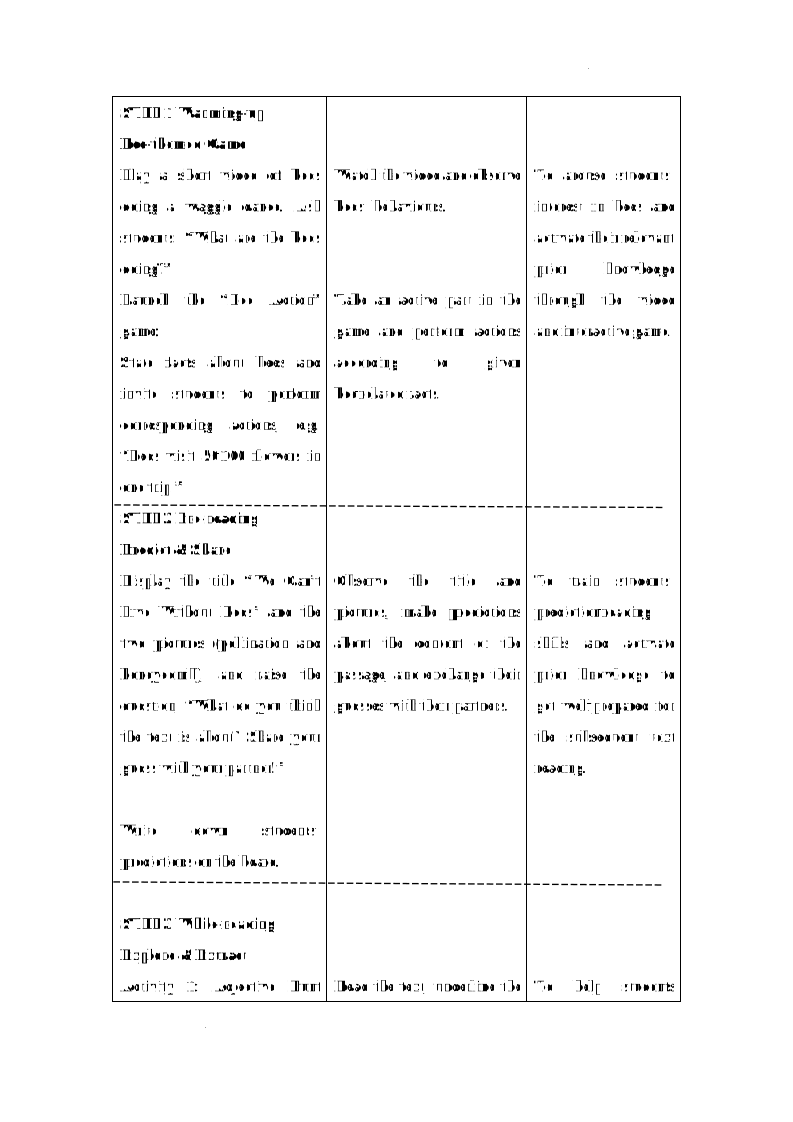
STEP 1 Warming-up
Bee-themed Game
Play a short video of bees doing a waggle dance. Ask students: “What are the bees doing?”
Launch the “Bee Action” game:
State facts about bees and invite students to perform corresponding actions, e.g. “Bees visit 50‑100 flowers in one trip!”
STEP 2 Pre-reading
Predict & Share
Display the title “We Can’t Live Without Bees” and the two pictures (pollination and honeycomb), and raise the question, “What do you think the text is about? Share your guess with your partner!”
Write down students’ predictions on the board.
STEP 3 While-reading
Explore & Extract
Activity 1: Adjective Hunt (1b)
Say, “Let’s read the text and find the adjectives the writer uses to describe bees. Underline them and let’s see who finds the most!”
Activity 2: Mind Map Creation (1c)
Show a blank mind map and guide students to fill in the mind map with information from the text. Ask them to start with ‘their greatest work’.
STEP 4 Post-reading
Discuss & Create
Activity 1: Group Discussion (1d)
Divide students into groups, assign the three discussion questions in 1d, and require each group to select a reporter to present group ideas.
Activity 2: Paragraph Writing (1e)
Guide students to play the role of the writer and write a new paragraph about bees with relevant fun facts or bee-protection suggestions.
STEP 5 Extension
Symbiosis Sharing (1f)
Guide students to think about the symbiotic relationship among plants, animals and humans, and encourage them to share relevant examples with partners.
STEP 6 Homework
Must‑do
1. Finish the mind‑map supplement, and sort out bees’ importance, interesting facts and existing problems in English.
2. Recite key sentences about bees from the text.
e.g., Bees are very hard‑working animals, and their greatest work is pollination.
Choose-to-do
1. Write a 50‑word short essay Bees and Us, introducing the relationship between bees and humans as well as practical protection suggestions.
2. Collect information about one insect you are interested in (e.g., butterfly, ant), and prepare an English sharing about its symbiotic relationship with humans for the next class.
Watch the video and observe bees’ behaviours.
Take an active part in the game and perform actions according to given bee‑related facts.
Observe the title and pictures, make predictions about the content of the passage, and exchange their guesses with their partners.
Read the text, underline the adjectives about bees and share the findings.
Work in pairs to extract information from the text and complete the mind map.
Discuss the assigned questions in groups and elect a reporter to share group opinions.
Finish the paragraph writing independently by adding bee-related fun facts and practical protection suggestions.
Think independently of ecological symbiosis examples and share ideas with partners.
To arouse students’ interest in bees and activate their relevant prior knowledge through the video and interactive game.
To train students’ prediction‑reading skills and activate prior knowledge to get well‑prepared for the subsequent text reading.
To help students grasp key details of the text.
To guide students to sort out core information by using a mind map.
To develop students’ critical thinking and oral expression skills.
To enhance students’ writing ability and deepen their understanding of bees.
To expand students’ ecological cognition and develop their cooperative communication skills.
To consolidate students’ in-class knowledge and language accumulation.
To develop students’ writing competence, independent inquiry ability and ecological awareness.
· Blackboard Design
学科网(北京)股份有限公司
$
资源预览图

1

2
3
相关资源
示范课
由于学科网是一个信息分享及获取的平台,不确保部分用户上传资料的 来源及知识产权归属。如您发现相关资料侵犯您的合法权益,请联系学科网,我们核实后将及时进行处理。