2026-2027学年译林八年级上册英语 Unit 1~2 单元阶段性提优拔尖专项训练(二)
2026-08-02
|
2份
|
7页
|
597人阅读
|
31人下载
摘要:
**基本信息**
聚焦八年级上册Unit1-2核心语法与语篇能力,通过多题型系统整合词汇、语法及阅读写作,强化语言运用与思维训练。
**专项设计**
|模块|题量/典例|题型特征|知识逻辑|
|----|-----------|----------|----------|
|单项选择|15题|考查代词/比较级/非谓语等|覆盖基础语法网络,从词法到句法递进|
|完形填空|15题|故事类语篇|动词/连词等在语境中运用,培养逻辑推理|
|阅读理解|10题|实验/文学/新闻体裁|细节与推理能力,渗透文化意识|
|填空/翻译/写作|25题|词性转换与综合表达|词汇语法综合应用,提升语言输出能力|
内容正文:
新译林八年级上册英语 Unit 1~2 单元阶段性提优拔尖专项训练(二)
一、单项选择(共15小题:每小题1分,计15分)
BDCAD BBBCB CBBCB
二、完形填空(共15小题:每小题1分,计15分)
DCBDA CDBAB ACBDC
三、阅读理解(共10小题:每小题2分,计20分)
DDB BAD CACB
四、阅读表达(共5小题;每小题2分,计10分)
1. It was a blue sky with no wind or rain.
2. Because he didn’t look cross that day.
3. Those green points in the earth.
4. The robin.
5. She may use the key for the secret garden.
五、填空题(共10小题:每小题1分,计10分)
importance carefully International encouragement importantly
suggestions truth peaceful lay thicker
六、翻译句子(共5小题:每小题2分,计10分)
1. When I feel worried or unhappy, I always go to her.
2. The teacher is telling the students to be aware of the importance of time.
3. I will pay special attention to green energy.
4. Time flies when we are enjoying school!
5. We go to different classrooms for different lessons.
七、写作(计20分)
例文:
My best friend
Paul is my best friend. He is a Grade 8 student in Sunshine Middle School. He has a square face with glasses. He looks tall and strong. And he always has a smile on his face.
Paul is not only patient but also helpful. He is always ready to help others. For example, he often helps me with my math. He always gives his seat to the old man on the bus.He can keep secrets.
His school starts at 8 a.m. and ends at 5 p.m. on weekdays. Maths and Art are his favourite subjects. He has different kinds of after-school activities such as football, swimming, painting and so on.
He wants to be an artist when he grows up because he likes drawing so much and he is also good at it. I hope his dream will come true.
学科网(北京)股份有限公司
$
新译林八年级上册英语 Unit 1~2 单元阶段性提优拔尖专项训练(二)
时间:80 min 满分:100分
一、单项选择(共15小题:每小题1分,计15分)
1. — Angela usually comes to school earlier than ________ students in our class.
— The early bird catches the worm. She studies better this term.
A. another B. the other C. any other D. any
2. He spends as much time as he can ________ English every day.
A. to practise to speak B. practise to speak
C. practising to speak D. practising speaking
3. — Bob, ________ sunshine is good for us and makes us happy. Let’s go out for a walk.
—I’d love to, but I’m ________ tired today. What about tomorrow?
A. a bit; a bit B. a bit; a bit of C. a bit of; a bit D. a bit of; a bit of
4. —What can we learn from the traffic safety lesson?
—It tells us that ________ we pay attention to ________ traffic rules, ________ we will be.
A. the more; following; the safer B. the most; follow; the safest
C. more; following; safer D. most; following; safest
5. —How are the dishes in the new restaurant?
—Terrible! Nothing tastes _______.
A. best B. better C. worst D. worse
6. Amy’s English is better than ________ in her class.
A. the other boy’s B. any boy’s C. other boy’s D. any other boy’s
7. —What a beautiful skirt! I would like to buy a skirt like this, Mom.
—OK, we can buy ________ one than this, but ________ this.
A. a cheaper, not as nice as B. a cheaper, as nice as
C. a nicer, not as cheap as D. a nicer, not so cheap as
8. Look! A number of people ________ at Renmin Square there. The number of them ________ becoming _________.
A. are, is, more and more B. are, is, larger and larger
C. are, are, more and more D. is, are, larger and larger
9. —How do you like the talk show?
—I think it’s _________, but some people think it’s so ________.
A. wonderful enough, bored B. enough wonderful, boring
C. wonderful enough, boring D. wonderfully enough, boring
10. —Liu Tao never read the book The Adventure of Tom Sawyer, ________ he?
—________. He told me it was very interesting. He would like to read it again.
A. did; No, he didn’t B. did; Yes, he did
C. didn’t; Yes, he did D. didn’t; No, he didn’t
11. The book was cheap but it’s too big to ________ in my bag, so I didn’t take it.
A. put B. hold C. fit D. have
12. I found ________ not easy to do birdwatching alone in the beginning.
A. that B. it C. its D. it’s
13. ________ of the two men over there is my brother.
A. Older B. The older C. The oldest D. The elder
14. We can add suffix (后缀) “-ful” to the following words to form adjectives except ________.
A. help B. use C. end D. meaning
15. —Dead to rights is the most meaningful historical film I have ever seen.
—________. It is worth watching a second time.
A. That’s a good idea B. I can’t agree more
C. I don’t think so D. It’s hard to say
二、完形填空(共15小题:每小题1分,计15分)
A father and his son went to a kite-flying festival. When they 1 , there were many parents and children playing in the park. The son was happy when he saw the sky was full of colourful 2 . He wanted to fly a kite, too. So they went to a kite shop and 3 a beautiful one.
The father is 4 at flying kites. Soon the kite was high up in the sky. 5 , the son said, “Dad, it seems that the string (线) is stopping the kite from flying higher. 6 we cut it, the kite will be free and fly even higher. Can we cut it?” The father said 7 but just cut the string off. The kite really went higher. This 8 the little boy happy.
But then, after a few minutes, the kite started to 9 slowly. And it soon fell onto the ground. The son was 10 to see this. He asked his father, “I thought that after cutting the string, the kite would fly higher. But 11 did it fall down?”
The father smiled and said, “The role of the string was not stopping the kite going higher, 12 was helping it stay in the sky, because the kite itself couldn’t fly up. When you 13 the string, it could no longer support the kite.”
In our life, we may sometimes feel like there are some things that are holding us back and stopping us from 14 . But in fact, these might be the things that support us the 15 . We can really grow up and become better by knowing the importance of these things.
1. A. waited B. tried C. sat D. arrived
2. A. clouds B. birds C. kites D. planes
3. A. made B. bought C. sold D. painted
4. A. weak B. angry C. bad D. good
5. A. After a while B. At the same time C. At the moment D. The other day
6. A. When B. Before C. If D. After
7. A. everything B. something C. anything D. nothing
8. A. left B. made C. found D. wished
9. A. come down B. take off C. fly away D. fly up
10. A. excited B. surprised C. cheerful D. glad
11. A. why B. where C. when D. how
12. A. and B. or C. but D. yet
13. A. caught B. cut C. got D. showed
14. A. learning B. playing C. leaving D. growing
15. A. least B. less C. most D. more
三、阅读理解(共10小题:每小题2分,计20分)
A
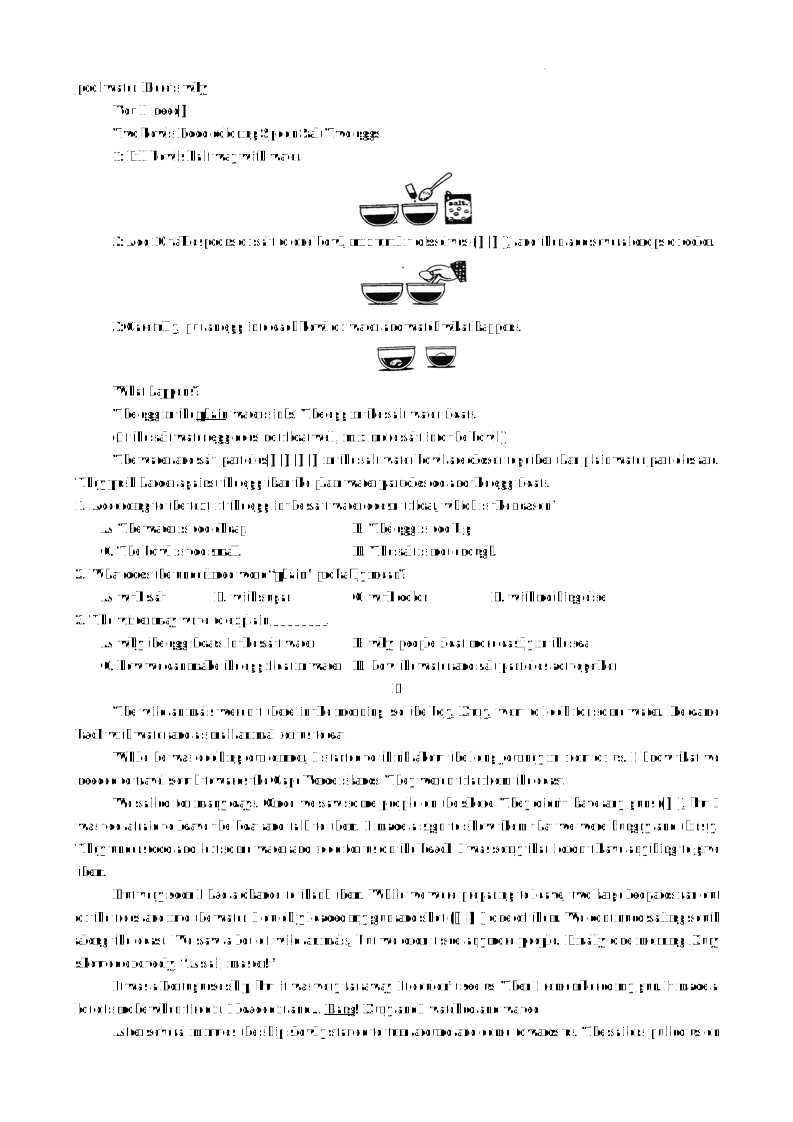
If you have ever been swimming in the ocean, you may have noticed that sea water is easier to float in than pool water. Here’s why.
You’ll need:
Two bowls Food coloring Spoon Salt Two eggs
1: Fill bowls half way with water.
2:Add 10 tablespoons of salt to one bowl, mix until it dissolves (溶解), and then add several drops of color.
3:Carefully, put an egg into each bowl of water and watch what happens.
What happens?
The egg in the plain water sinks. The egg in the salt water floats.
(If the salt water egg does not float well, mix more salt into the bowl )
The water and salt particles(粒子)in the salt water bowl are closer together than plain water particles are. They push harder against the egg than the plain water particles do and the egg floats.
1. According to the text, if the egg in the salt water doesn’t float, which is the reason?
A. The water is too cheap. B. The egg is too big.
C. The bowl is too small. D. The salt is not enough.
2. What does the underlined word “plain” probably mean?
A. with salt B. with sugar C. with color D. with nothing else
3. The writer may write to explain ________.
A. why the egg floats in the salt water B. why people float more easily in the sea
C. how we can make the egg float in water D. how the water and salt particles act together
B
The wild animals weren’t there in the morning, so the boy, Xury, went to look for some water. He came back with water and a small animal for us to eat.
While he was cooking our dinner, I started to think about the long journey in front of us. I know that we needed to travel south towards the Cape Verde islands. They weren’t far from the coast.
We sailed for many days. Once we saw some people on the shore. They didn’t have any guns (枪), but I was too afraid to leave the boat and talk to them. I made a sign to show them that we were hungry and thirsty. They understood and left some water and food for us on the beach. I was sorry that I didn’t have anything to give them.
But very soon I had a chance to thank them. While we were preparing to leave, two large leopards ran out of the trees and into the water. I quickly loaded my gun and shot (射击) one of them. We continued sailing south along the coast. We saw a lot of wild animals, but we didn’t see anymore people. Finally one morning Xury shouted excitedly, “A sail, master!”
It was a Portuguese ship, but it was very far away. It couldn’t see us. Then I remembered my gun. It made a lot of smoke when fired it. I loaded it and… Bang! Xury and I watched and waited.
After several minutes the ship slowly started to turn around and come towards us. The sailors pulled us on board. They only spoke Portuguese, but luckily, there was a man from Scotland on the ship. With his help, I found that we were going to Brazil.
— Taken from Robinson Crusoe
4. What Robinson’s personalities can we find according to the passage?
A. Trusting and gentle. B. Careful and clever.
C. Humorous and funny. D. Generous and honest.
5. What does the underlined word “Bang” most probably mean?
A. The loud sound of the gunshot. B. The shouts from Xury and I.
C. The sail on the Portuguese ship. D. The wild animal from the sea.
6. How did Robinson finally catch the attention of the Portuguese ship?
A. By shooting a leopard. B. By screaming for help.
C. By lighting smoke signals. D. By firing a gun to make smoke.
C
On September 3, 2025, Tian’anmen Square witnessed a big military parade(阅兵)to mark the 80th anniversary of victory in the Chinese People’s War of Resistance Against Japanese Aggression and the World Anti-Fascist War. Thousands of people gathered early to watch this historic event, which sent a strong message of peace and strength to the world.
It began with a serious ceremony. President Xi reviewed the troops and gave a speech. Behind him stood big buildings shaped like the Great Wall, with the numbers “1945” and “2025”, which symbolized the long journey from victory to modern progress. More than 20 foreign leaders attended the event, including Russian President Vladimir Putin and North Korean leader Kim Jong Un, showing international support for China’s efforts to remember history and develop peace.
China’s newest military progress was shown in the parade. More than 10,000 soldiers walked in very tidy lines, and after them came hundreds of modern weapons(武器). These included items such as driverless fighting machines, super-fast missiles, and tools for Internet battles. Many weapons were shown publicly for the first time ever, such as systems to stop drones and items for fighting under the sea.
China paid a high cost for the victory in the war. Over 35 million Chinese soldiers and common people lost their lives, and the country fought for 14 years to stop Japan’s invasion(入侵). The parade let the world know about these losses and showed China’s current (当前的) role as a global peacekeeper.
The parade ended with a flight show of more than 100 planes, leaving colorful trails in the sky. President Xi’s speech stressed again that China’s promise is to keep world peace and its goals for becoming modern. As the country moves to become a fully modern society by 2035, the event showed both its pride in history and its hopes for the future.
7. What did the parade mark?
A. The 80th anniversary of WWI. B. The 80th anniversary of the founding of PRC.
C. The 80th anniversary of victory in WWII. D. The 100th anniversary of the Communist Party of China.
8. Why did foreign leaders attend?
A. To show support. B. To join the parade.
C. To buy weapons. D. To watch the flight show.
9. What can we know from the passage?
A. China will be the strongest in 2035. B. The parade is just for showing power.
C. China values peace very much. D. Few countries support China’s peace efforts.
10. What’s the right order of this passage?
①President Xi reviewed the troops. ②Military achievements were shown.
③A flight show amazed everybody. ④Thousands of people gathered.
A. ④②①③ B. ④①②③ C. ①②④③ D. ①④②③
四、阅读表达(共5小题;每小题2分,计10分)
根据短文内容,回答下列问题。(不超过8个词)
The next two days it rained and it was very windy, so Mary couldn’t go outside. Then, on the third morning when she opened her eyes and looked out of the window, she had a big surprise. She called to Martha, “Martha! Come and look at the moor!”
There was a blue sky with no wind or rain.
“Yes,” said Martha with a smile. “The spring’s coming.”
After breakfast, Martha went to visit her mother for the day. Mary felt lonely in the house without her, so she went outside into the bright sunshine. She ran round and round the fountain ten times, and soon she started to feel better. Ben Weatherstaff was in the vegetable garden. He didn’t look cross that day so she went to speak to him.
“The spring’s coming,” he said to her. “Can you see those green points in the earth?”
Mary looked. “What are they?” she asked.
“They’re spring flowers—crocuses, snowdrops and daffodils.” Then the robin appeared and sat on the ground near them.
“Is spring coming in the secret garden, too?” Mary asked Ben. “Or are all the flowers dead?”
“Ask the robin,” said Ben Weatherstaff. “He’s the only one who knows.” And he went back to work.
The robin was hopping around on the ground. Mary was watching him when she saw something in the earth. She picked it up. It was an old key.
“The key to the secret garden!” she whispered excitedly.
Mary looked at the key for a long time. Then she put it in her pocket and walked back to her room.
1. How was the weather on the third morning?
2. Why did Mary go to speak to Ben Weatherstaff?
3. What makes Ben Weatherstaff think the spring is coming?
4. Who knows if spring is coming in the secret garden?
5. What may Mary use the old key for?
五、填空题(共10小题:每小题1分,计10分)
1. Teenagers should know the (important) of self-control.
2. On snowy days, a driver must drive as (care) as possible.
3. At Shanghai Pudong (国际) Airport, you can find flights to places around the world.
4. With the (encourage) of his teacher, Tom became more confident in learning English.
5. Most (重要), remember to call me when you arrive safely.
6. The (建议) they have offered are very useful. We should take them.
7. The old woman wanted to know the (true) about the matter. But nobody told her.
8. Miss Chen likes living in this small town because it’s a(n) (peace) place.
9. She ________(lie)in bed and read a book yesterday.
10. I suppose you know the brown bear has the _____ ___(thick)fur of the two.
六、翻译句子(共5小题:每小题2分,计10分)
1. 我感到担心或不高兴时,我总是可以去找他。
_________________________________________________________
2. 老师正告诉学生们要意识到时间的重要性。
_________________________________________________________
3. 我将特别关注绿色能源。
_________________________________________________________
4. 当我们享受学校生活时,时间过得飞快!
_________________________________________________________
5. 我们去不同的教室上不同的课。
_________________________________________________________
七、写作(计20分)
以“My best friend”为题,写一篇短文介绍你最好的朋友Paul,他是阳光中学八年级的学生。
外貌
方脸,明亮大眼睛,戴眼镜,高而强壮,脸上总带微笑
性格及具体事例
耐心,保守秘密,乐于助人(请举一例)
学校生活
八点开始上课,五点结束; 最喜欢的科目:数学,美术;
各种各样的课外活动,……
未来计划
……(自拟一至两句)
要求:
1.文章必须包含所提供的主要信息,并作适当发挥;
2.文中不得出现真实的人名和校名;
3.词数80词左右
My best friend
________________________________________________________________________________________________________________________________________________________________________________________________________________________________________________________________________________________________________________________________________________________________________________________________________________________________________________________________________________________________________________________________________________________________________________________________________________________________________________________________________________________________________________________________________________________________________________________________________________________________________________________________________________________________________________________________________________________________________________________________________
学科网(北京)股份有限公司
$
资源预览图

1

2
3

相关资源
示范课
由于学科网是一个信息分享及获取的平台,不确保部分用户上传资料的 来源及知识产权归属。如您发现相关资料侵犯您的合法权益,请联系学科网,我们核实后将及时进行处理。