UNIT 4 Protecting our heritage sites(课时跟踪检测)-【优学精研】2027年高考英语一轮总复习学用Word(译林版)
2026-10-14
|
2份
|
9页
|
5人阅读
|
0人下载

摘要:
**基本信息**
围绕“文化遗产保护”主题,整合科技前沿(如ARCHiVE机器人修复、细菌艺术修复)与教育传承素材,通过阅读理解、七选五、读后续写等题型,考查语言理解、逻辑衔接及综合表达能力,适配高中英语一轮复习巩固需求。
**题型特征**
|题型|题量|知识覆盖|命题特色|
|----|----|----------|----------|
|阅读理解|6题|细节理解、主旨大意、推理判断|情境融合科技与文化,如AI修复文物、细菌修复画作,问题设计梯度分明|
|阅读七选五|5题|篇章结构、逻辑衔接|聚焦教育在遗产保护中的作用,考查信息匹配与段落组织能力|
|读后续写|1题|情节发展、语言表达|以文化遗产发现为线索,需合理续写并体现思维连贯性|
内容正文:
UNIT 4 Protecting our heritage sites
Ⅰ.阅读理解
A
(2026·浙江宁波二模)In a quiet corner of Oxford University’s Bodleian Library, a robotic arm flips through a 15th-century manuscript, its high-resolution cameras capturing every faded ink stroke.This is ARCHiVE (Automated Robotic Cultural Heritage Inspection and Verification Engine), a £2.3 million project revolutionizing how fragile artifacts are preserved and studied.Combining robotics, artificial intelligence, and advanced imaging, ARCHiVE represents a model shift in cultural conservation.
Traditional conservation methods often risk damaging delicate materials.ARCHiVE’s robotic system, equipped with micro-sensors and AI algorithms, can detect cracks invisible to the human eye and predict structural weaknesses before they worsen.“It’s like having a doctor for ancient books,” explains Dr.Emily Carter, lead conservator.Since its 2022 launch, ARCHiVE has scanned over 8,000 items, from Egyptian papyri to medieval maps, with 99.7% accuracy in damage assessment.Its non-invasive approach has reduced physical handling by 85%, significantly lowering the risk of accidental damage.
The project’s digital twin technology creates exact virtual copies, allowing global access to restricted collections.During the 2023 Cairo Museum flood, ARCHiVE’s digital models enabled researchers to virtually “restore” water-damaged artifacts within hours.“We’re not just saving objects,” says Carter, “we’re preserving humanity’s collective memory.” This technology has also democratized access, with over 50,000 digital artifacts now available to researchers and the public worldwide.
However, some scholars argue that over-reliance on technology may distance researchers from hands-on experience.“You can’t smell history through a screen,” protests Prof.James Whitaker, a traditionalist at Cambridge.Others worry about data ownership, as scanned artifacts become digital assets potentially controlled by tech corporations.A 2024 survey revealed that 62% of conservators fear losing control over digitized cultural heritage.
ARCHiVE’s next phase involves 4D scanning, capturing how materials change over time.Pilot tests on Viking ship timbers have already revealed previously unknown construction techniques.Meanwhile, UNESCO is developing global standards for digital heritage, ensuring these technological marvels serve humanity rather than corporate interests.As Carter reflects, “Our ancestors left us these treasures; our duty is to pass them forward — both physically and digitally.”
1.What is the main function of ARCHiVE’s robotic system?( )
A.Repairing damaged artifacts. B.Creating virtual museum tours.
C.Identifying and forecasting damage. D.Selling digital copies of artifacts.
2.How did ARCHiVE help during the Cairo Museum flood?( )
A.By raising emergency funds online. B.By training local conservation staff.
C.By physically moving artifacts to safety. D.By providing digital models for restoration.
3.What is Prof.Whitaker’s main concern about ARCHiVE?( )
A.Data ownership concerns. B.Loss of direct experience.
C.High operating costs. D.Environmental impact.
B
(2026·湘东十校联考)Spanish scientist Pilar Bosch has found a way to use bacteria to repair 18th-century paintings.
Bosch, a microbiologist, tells Reuters she got the idea for the method while considering possibilities for a paper toward her doctoral degree.During this process, she discovered someone else’s paper that suggested bacteria can be used to restore artworks.
At around the same time, Bosch learned that her mother was struggling to find a good method for restoring 18th-century paintings.The paintings, by Spanish artist Antonio Palomino, sat in Santos Juanes — one of the oldest churches in the city of Valencia.
Bosch said her mother, Pilar Roig, noted how difficult the restoration process at the church was.One reason was the glue used to remove the paintings from the walls in the 1960s.The substance was nearly impossible to remove completely.
“My mother had a very difficult problem to solve and I found a paper about bacteria used to clean murals in Italy,” Bosch said.A fresco is a kind of painting that often appears across a large wall.
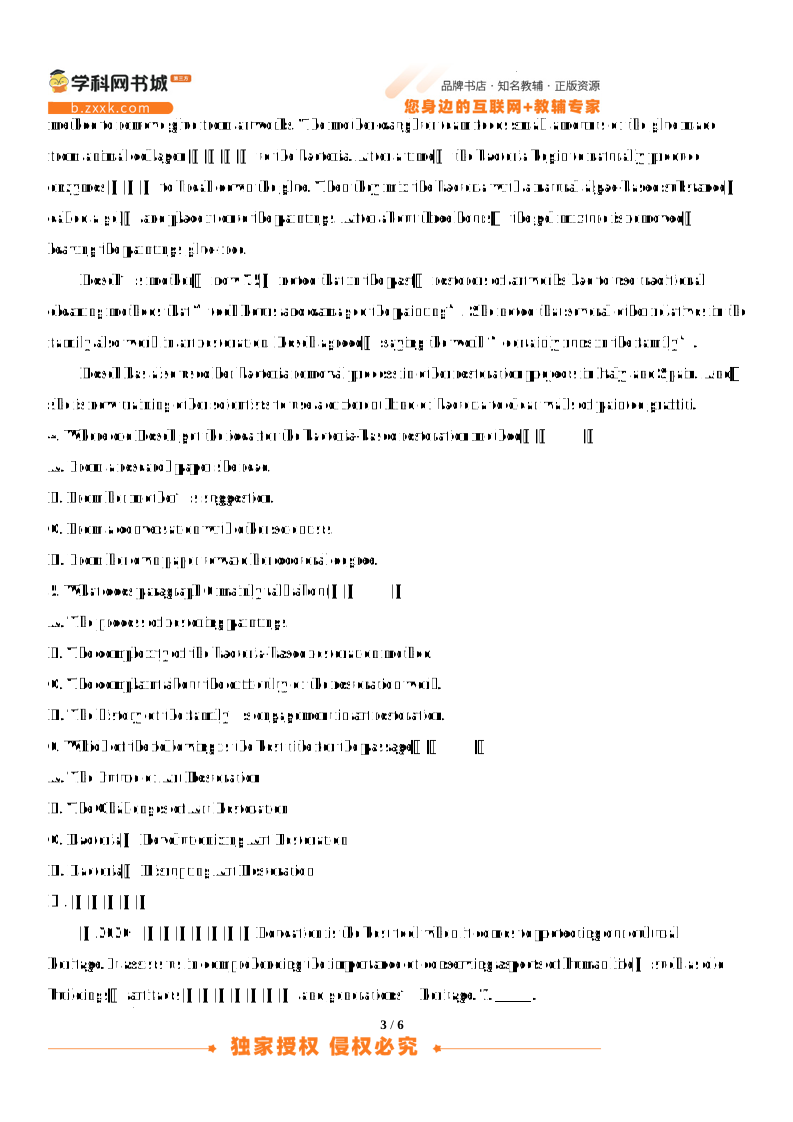
Bosch added she decided to write her doctoral paper on the same subject.That was more than ten years ago.Today, she gets to work with her mother on the church restoration.They are using the bacteria method to remove glue from artworks.The mother-daughter team feeds small amounts of the glue made from animal collagen (胶原) to the bacteria.After a time, the bacteria begin to naturally produce enzymes (酶) to break down the glue.Then they mix the bacteria with a natural algae-based substance, called a gel, and place it onto the paintings.After about three hours, the gel mixture is removed, leaving the paintings glue-free.
Bosch’s mother, now 75, noted that in the past, restorers of artworks had to use traditional cleaning methods that “took hours and damaged the painting”.She noted that several other relatives in the family also work in art restoration.Bosch agreed, saying the work “certainly runs in the family”.
Bosch has also used her bacteria removal process in other restoration projects in Italy and Spain.And, she is now training other scientists to use a different kind of bacteria to clear walls of painted graffiti.
4.Where did Bosch get the idea for the bacteria-based restoration method?( )
A.From a research paper she read.
B.From her mother’s suggestion.
C.From a conversation with other scientists.
D.From her own paper toward her doctoral degree.
5.What does paragraph 6 mainly talk about?( )
A.The process of restoring paintings.
B.The complexity of the bacteria-based restoration method.
C.The complaint about the difficulty of the restoration work.
D.The history of the family’s engagement in art restoration.
6.Which of the following is the best title for the passage?( )
A.The Future of Art Restoration
B.The Challenges of Art Restoration
C.Bacteria: Revolutionizing Art Restoration
D.Bacteria: Disrupting Art Restoration
Ⅱ.阅读七选五
(2026·齐鲁名校联考)Education is the best tool when it comes to protecting our cultural heritage.It assists us in comprehending the importance of conserving aspects of human life, such as old buildings, artifacts (历史文物), and generations’ heritage.7. .
Teaching Everyone Why Heritage Matters
Suppose society did not know why specific structures or specific dances were essential.This is where education comes into play.8. . Thus, we can learn about the history of these treasures.This knowledge makes people appreciate their cultures since they can identify what makes them different from other regions and have the urge to protect them.
Bringing Heritage into Schools
Have you ever been in a history or an art class, and suddenly the teacher starts talking about a specific building or painting? That is because schools are introducing heritage into their curriculum.This way, students become familiar with history and craft culture.9. .
10.
It is not enough to know why preserving our heritage is necessary; it is also necessary to know how to do it correctly.This is where training programs come in to help.They educate those who handle old structures or artifacts on maintaining them in their excellent state.These programs range from architects to museum curators (负责人), and they equip them with the tools to protect our heritage for the future.
Bringing Different Experts Together
This means that protecting our history is a team effort that may involve people with a historical background, architects, and scientists.11. . This way, they manage to find the best solutions to preserve history without any misunderstandings or losses.
A.Training people to be heritage heroes
B.Understanding the ways of preserving heritage
C.They also learn the value of preserving such items
D.Thus, we are turning children into young heritage experts
E.It can inform everyone about the importance of cultural heritage
F.Let us look at how education plays a vital role in preserving heritage
G.Education allows these specialists to communicate with each other and cooperate
Ⅲ.读后续写
阅读下面材料,根据其内容和所给段落开头语续写两段,使之构成一篇完整的短文。
Tommy wanted to find out more about the book he found in his grandma’s attic (阁楼), but didn’t know where to begin.He couldn’t read what was written in it or on it, so he probably wouldn’t get very far.But he was a guy who never gave up easily.He decided to start with the illustrations since they were the most undamaged part.
He spent hours on the computer trying to find out about the images and the book.Unfortunately, the illustrations weren’t very clear.He was slowly becoming desperate when suddenly he found something.Tommy was taken aback by the article he was reading.He could not believe his eyes.Was he dreaming? He took a closer look at the image on his computer monitor and compared it with the book.There was no question in his mind that it was real.Could this be happening?
Still, he could not be sure.He needed to confirm that the book was what he believed it to be, and he knew exactly where to go.He carefully put the book into a bag and jumped on his bicycle to run across town.After a few minutes, he arrived at the pawn shop (当铺) and was greeted by the owner, Victor.When Tommy informed him of the item he had brought, Victor appeared a little upset and said, “I have no time for this.” It was evident that Victor did not believe him.
Tommy was starting to doubt himself — it wasn’t crazy that the guy didn’t trust him, but he didn’t think he could trust himself either! Still, Tommy wasn’t going to let Victor turn him away — he needed answers, and he wasn’t going to get them if he didn’t find out the truth.So he took the book out of his bag and put it down on the counter, and Victor’s eyes went wide.He asked where the book had come from, and Tommy said it was from his grandmother.
注意:(1)续写词数应为150个左右;(2)请按如下格式作答。
Victor asked him to wait, and he went into his office to make a telephone call.
At last, the expert turned around and spoke to Tommy.
1 / 1
学科网(北京)股份有限公司
$
UNIT 4 Protecting our heritage sites
Ⅰ.
语篇解读:本文是一篇新闻报道。文章围绕一个名为ARCHiVE的科技项目展开,介绍了该项目如何利用机器人技术、人工智能和高级成像技术来革新文化遗产的保护和研究方式。
1.C 细节理解题。根据第二段第二句可知,ARCHiVE的机器人系统配备微型传感器和人工智能算法,能检测到人眼看不见的裂缝并预测结构弱点,也就是能识别和预测损坏。
2.D 细节理解题。根据第三段第二句可知,在2023年开罗博物馆遭受洪水期间,ARCHiVE是通过提供数字模型用于修复文物来提供帮助的。
3.B 细节理解题。根据第四段前两句可知,James Whitaker教授认为过度依赖技术会让研究人员远离亲身接触文物的体验,他抗议说“你无法通过屏幕闻到历史的气息”,即他主要担心的是失去直接体验。
语篇解读:本文是一篇说明文。文章主要介绍了西班牙科学家Pilar Bosch如何通过细菌来修复18世纪画作,包括这种方法相比传统手段的优势。
4.A 细节理解题。根据第四段以及第五段第一句可知,Bosch是从她读到的一篇研究论文中得到了基于细菌的修复方法的想法。
5.A 段落大意题。第六段主要描述了使用细菌去除胶水的具体过程,包括给细菌喂食少量的由动物胶原蛋白制成的胶水、细菌产生酶来分解胶水、将细菌与一种天然的藻类基质混合后涂抹在画作上等步骤。
6.C 标题归纳题。根据全文,尤其是第一段可知,文章主要介绍了Bosch发现并使用细菌修复18世纪画作的方法。
Ⅱ.
语篇解读:本文是一篇说明文。文章主要介绍了教育在文化遗产保护方面能发挥的作用。
7.F 上文说明了教育在保护文化遗产方面是最好的工具以及其对理解保护人类生活方面的重要性,下文从多个方面阐述了教育在保护文化遗产方面的作用。F项(让我们看看教育在保护文化遗产方面是如何发挥重要作用的)承上启下。
8.E 上文提出假设社会不知道为什么某些特定事物重要性的情况,接着说明教育在此发挥作用。E项(它可以让每个人都了解文化遗产的重要性)对上文进行解释说明,其中It指代上文的education。
9.C 上文讲述了学校将文化遗产引入课程,使学生熟悉历史和工艺文化。C项(他们还学习了保护这些物品的价值)对上文进一步说明,They指代上文的students。
10.A 本段主要讲述了培训项目对那些处理古建筑或文物的人进行教育,让他们学会正确保护文化遗产的方法,把他们培养成保护文化遗产的人才。A项(培养人们成为文化遗产的守护者)符合该段主旨,可作为小标题。
11.G 上文说明保护历史需要团队合作,涉及有历史背景的人、建筑师和科学家等。G项(教育让这些专家能够相互交流与合作)和上文为因果关系,说明从而找到保护历史的最佳方案。
Ⅲ.
Victor asked him to wait, and he went into his office to make a telephone call.Tommy stood there, his heart pounding in his chest like a wild drum.Every second seemed to stretch into an eternity as he stared at the old book lying on the counter, its secrets still veiled.Outside, the world carried on with its usual hustle and bustle, but in that small pawn shop, time seemed to stand still.After what felt like an age, Victor emerged from his office, his expression unreadable.“The expert will be here soon,” he muttered, his eyes darting back to the book.Tommy nodded, his throat too dry to speak.
At last, the expert turned around and spoke to Tommy.His voice was calm yet carried an undertone of excitement.“This book,” he began, “is truly remarkable.It dates back to a bygone era, a time when knowledge was carefully preserved in the written word.Its illustrations are not just art; they’re a window into the past.” Tommy listened, his eyes widening with each word.The expert explained the book held valuable insights into a particular period of history.Tommy realized that he had stumbled upon a literary treasure, which he now had the responsibility to safeguard.With a newfound sense of purpose, he vowed to share this discovery with the world, ensuring the book’s story would be told for generations to come.
学科网(北京)股份有限公司
$
资源预览图

1

2
3
相关资源
示范课
由于学科网是一个信息分享及获取的平台,不确保部分用户上传资料的 来源及知识产权归属。如您发现相关资料侵犯您的合法权益,请联系学科网,我们核实后将及时进行处理。