江苏常州卷-备战2026年中考英语新课标(核心素养)状元冲刺卷
2026-06-12
|
5份
|
47页
|
513人阅读
|
12人下载

摘要:
**基本信息**
以核心素养为导向,融合科技前沿(如AI学习工具)、文化传承(如电子字体、古筝推广)等真实情境,梯度覆盖语言知识与综合能力,适配中考三轮冲刺需求。
**题型特征**
|题型|题量/分值|知识覆盖|命题特色|
|----|-----------|----------|----------|
|单项填空|10/10|语法(时态/从句)、习语、语音|结合语境考查语法应用,融入文化习语(如butterflies in my stomach)与语音重音,提升语言能力|
|完形填空|12/12|词汇、上下文逻辑|以心理学实验为情境,通过“努力悖论”培养推理与分析的思维品质|
|阅读理解|14/28|社会热点(负责任旅游)、文化(英语习语)、科技(儿童学习研究)|素材时代性强,如电子字体文化传承、AI学习工具讨论,强化信息获取与批判性思维|
|书面表达|1/15|议论文写作|围绕AI工具利弊,考查观点表达与建议提出,体现思维品质与语言综合运用能力|
内容正文:
江苏常州卷
备战2026年中考英语新课标(核心素养)状元冲刺卷
注意事项:
1. 本试卷满分为90分.考试时间为100分钟.考生须将答案书写在答题卡上,写在试卷上的一律无效.
2. 答题前,考生务必将自己的姓名、考试号填写在试卷上,并填写答题卡上的考生信息.考试结束后,请将本试卷和答题卡一并交回.
一、单项填空(共10小题;每小题1分,满分10分)
从题中所给的A、B、C、D四个选项中,选出最佳选项,并在答题卡上将该项涂黑。
1.—He said he ________ Kate for 2 years.
—Really? Kate has never told us anything about her marriage.
A.had been married to B.has got married with
C.has married to D.had been married with
2.And I ________ you should add pictures and use colours to make your page more attractive.
A.support B.suggest C.introduce D.influence
3.—How did you feel before giving the speech in front of the whole school?
—To be honest, I had ________.
A.a sweet tooth B.green fingers
C.a heart of gold D.butterflies in my stomach
4.一般情况下,下列句子对重音标注正确的是________
A.So 'what can you 'do? B.'How 'about swimming?
C.Just go 'out 'and have fun. D.'She’s taller than her 'sister.
5.________ in this small village that I spent the happiest days of my childhood.
A.It was B.That was C.There was D.Where was
6.I ________ he will come to the party tonight because he told me he would, but my sister ________ he is too busy.
A.don’t doubt that; doubts whether B.doubt that; doesn’t doubt that
C.doubt whether; doubts that D.don’t doubt whether; doesn’t doubt that
7.—Nancy, you ________ have a balanced diet, or your health will lose its balance.
—OK, Mum.
A.should B.must C.may D.could
8.—Why haven’t you asked her to come here?
—She __________ an important experiment when I found her and she __________ it.
A.is doing; didn’t finish B.did; wouldn’t finish
C.was doing; hasn’t finished D.has done; hasn’t finished
9.Which do you enjoy ________ the weekends, fishing or watching TV?
A.spent B.spending C.spend D.to spend
10.Sometimes Tom with his parents ________ TV after dinner, but now they ________ books.
A.is watching; read B.watch; are reading
C.watches; are reading D.watches; read
二、完形填空 (共12小题;每小题1分,满分12分)
阅读下面短文,从短文后各题所给的A、B、C、D四个选项中,选出最佳选项,并在答题卡上将该项涂黑。
Do you ever dream of doing nothing at all, lying on a grassland for a whole afternoon, just staring at the sky and listening to the silence? It may sound like a lovely idea, but in fact we can find doing nothing at all—and no sleep— 11 to do.
In a famous study a few years ago at the University of Virginia, participants (参加者) were led one at a time into a completely 12 room with no distractions (分心之物). They had no phones, no books, no screens—and they weren’t allowed to take a nap. Electrodes (电极) were fitted to their ankles, and they were left alone for 15 minutes. It was a 13 to kick back and relax for a short while.
So, how did it go? Well, before being left alone, participants were 14 how to press a computer key connected to a machine that gave an electric shock (电击). You 15 think that having tried it once, no one would want to do it again. Wrong! 16 , 71% of the men and 25% of the women gave themselves at least one electric shock during their time alone and one man shocked himself a shocking 190 times. It turns out that having 17 to do was so torturous (折磨人的) that many of the participants prefer to, in fact, torture themselves rather than put up with no distraction.
This experiment is an extreme (极端的) 18 , but we know from everyday life that people continuously choose to do things they don’t need to do and which are sometimes 19 . Think of your friends who run 40 kilometers at a time or set punishing rules at the gym. They go way beyond (超出) what is 20 for their health and fitness.
Michael Inzlicht from the University of Toronto calls this the paradox (悖论) of effort (努力). Sometimes we take the easy way and do as little as possible, but other times we actually enjoy the situations more when we have to work hard. The 21 of putting in effort can be so great that we choose not to take the easy way out. For example, we might spend hours solving a difficult math problem on our own instead of just 22 the answer on a learning app.
11.A.important B.fun C.difficult D.special
12.A.modern B.empty C.old D.big
13.A.exam B.chance C.gift D.difference
14.A.advised B.offered C.shown D.recommended
15.A.should B.might C.can D.need
16.A.In fact B.After all C.For example D.As a result
17.A.something B.anything C.nothing D.everything
18.A.imagination B.example C.purpose D.opinion
19.A.painful B.possible C.relaxing D.scared
20.A.required B.decided C.created D.hidden
21.A.harm B.method C.joy D.doubt
22.A.giving up B.making up C.putting up D.looking up
三、阅读理解(共14小题;每小题2分,满分28分)
阅读下列短文,从短文后各题所给的A、B、C、D四个选项中,选出最佳选项,并在答题卡上将该项涂黑。
A
What’s your dream holiday? Watching wildlife in Kenya? Boating down the Amazon? Sunbathing in Malaysia? New chances are opening up all the time to explore the world. So we visit travel agents, compare packages and prices, and pay our money.
We know what our holiday costs us. But do we know what it might cost someone else. It’s true that many poorer countries now depend on tourism for foreign income. Unfortunately, though, tourism often harms the local people more than it helps them.
It might cost their homes and lands. In Myanmar,5,200 people were forced to leave their homes among the pagodas (佛塔) in Bagan so that tourists could visit the pagodas.
Tourism might also cost the local people their livelihood and dignity. Local workers often find only menial (卑微的) jobs in the tourist industry. And most of the profits do not help the local economy. Instead, profits return to the tour operators in wealthier countries. When the Maasai people in Tanzania were driven from their lands, some moved to city slums. Others now make a little money selling souvenirs (纪念品) or posing for photos.
Problems like these were noticed more than 20 years ago. But now some non-government organizations, tour operators and local governments are working together to begin correcting them. Tourists, too, are putting on the pressure.
The result is responsible tourism, or “ethical tourism”. Ethical tourism has people at its heart. New international agreements and codes of conduct can help protect the people’s lands, homes, economies and cultures. The beginnings are small, though, and the problems are complex.
But take heart. The good news is that everyone, including us, can play a part to help the local people in the places we visit. Tour operators and companies can help by making sure that local people work in good conditions and earn reasonable wages.
They can make it a point to use only locally owned hotel, restaurants and guide services. They can share profits fairly to help the local economy. And they can involve the local people in planning and managing tourism.
What can tourists do? First, we can ask tour companies to provide information about the conditions of local citizens. We can then make our choices and tell them why. And while we’re abroad, we can: Buy local foods and products, not imported ones. Pay a fair price for goods and services and not bargain for the cheapest price. Avoid flaunting wealth. Ask before taking photographs of people. They are not just part of the landscape!
Let’s enjoy our holiday and make sure others do, too.
23.What is probably the best title for the article?
A.Tourism Causes Bad Effects B.Tourism Calls for Good Behavior
C.Holidays Bring a Lot of Fun D.Holidays Cost More Than You Think
24.Which of the following is not mentioned?
A.Local people were well paid to leave their lands.
B.Tourists may stay in hotels opened by local people.
C.Local people are mainly provided with low-paying work.
D.Tourists could bargain with local people for a reasonable price.
25.The underlined phrase “take heart” means “________”.
A.pay attention B.take care C.cheer up D.calm down
B
(Scene: Three students, Leo, Mia, and Sam, are sitting on the playground. Leo looks worried while looking at his English notes.)
Leo: Ugh, I don’t get it! People around me have been using so many weird expressions these days. I feel totally lost.
Mia: What happened?
Leo: Well, first, we were discussing the class monitor election. Everyone knew that Tom was not a good choice because he was too shy, but nobody dared to say it in front of him. Then, one of the students just sighed (叹气) and said, “We are ignoring the elephant in the room.”
Sam: (Laughing) That sounds confusing. What else?
Leo: Then later, I heard a classmate complaining about his noisy deskmate, saying, “He really gets my goat!” When I got home yesterday, my mom even told me I needed to have my ducks in a row for my exams. Elephants, goats, and ducks? Animals everywhere, but no logic!
Sam: Wait, an elephant, a goat, and ducks? What are you guys talking about? It sounds like a zoo in here!
Mia: Don’t worry, Sam. Leo is talking about English idioms. They often sound strange if you translate them word for word. Let’s look them up online together.
(They open a laptop and start searching.)
Mia: Okay, here is the first one—the elephant in the room. It doesn’t mean a real animal. It refers to a huge problem that everyone avoids talking about. Its first recorded use was in a short story written by Ivan Krylov in 1814. In the story, a man visited a museum and noticed all kinds of small and unimportant things, but failed to see a huge elephant in the room.
Leo: Ah, that makes sense! Tom being a bad monitor was our “elephant.” What about “getting someone’s goat”? I thought I bought an animal.
Sam: Let me check… Wow, this origin is cool! Get someone’s goat actually comes from horse-racing. Goats are used to keep horses quiet. To calm down an easily upset horse, its owner puts a goat near the horse the night before the race. However, some competitors steal the goat to upset the horse and make the horse lose the race! So, if you get someone’s goat, you make them angry or upset.
Sam: And the last one—have one’s ducks in a row. One story about the origin of this expression is that it comes from the world of nature. Mother ducks often get their young to line up in a straight line before travelling over land or water. As long as this line is formed, any baby duck that falls behind will be easy to notice. So, if you “have your ducks in a row”, it means that you are ▲ and have everything in order.
Leo: I get it now! Thanks, guys!
26.Why do the competitors steal the goat?
A.To stop the goat from racing.
B.To make the horse calm down.
C.To make the goat’s owner angry.
D.To make the horse lose the race.
27.Which word is the most suitable for “ ▲ ”?
A.energetic B.confident C.organized D.skillful
28.Who uses the English idiom properly?
A.Mr. Li says, “Your improvement in P.E. really gets my goat, Tom.”
B.Tina says, “My family send wishes on New Year because it’s the elephant in the room.”
C.He has practised his speech many times. He has his ducks in a row for the show.
D.Jack says, “We should talk about the elephant in the room — the beautiful weather.”
29.What do the three English idioms have in common?
A.They show us how clever the animals are in nature.
B.They connect animals with situations in our daily life.
C.They talk about animals causing uncomfortable feelings.
D.They all come from old stories written by famous writers.
C
Wang Tingrui’s story with digital fonts (电子字体) began with an old book. He scanned (扫描) each character (汉字), turned them into digital forms, and called the font “Kinghwa Old Songti.” His work shows the spirit of young people who try to save the old shapes of Chinese characters and share them with the world.
To understand his effort, we need to look at the history of printing. In the Song Dynasty, people started to use movable type (活字印刷). Centuries later, Gutenberg created metal movable type in Europe, and this idea came back to East Asia in the nineteenth century.
From the late nineteenth century to the twentieth century, lead types (铅字块) flourished in East Asia. Two main styles, Songti and Heiti, became the most common. They were widely used in newspapers and textbooks. These fonts made reading clearer and became part of daily life.
But with the rise of digital publishing, lead types soon disappeared. Although many old ones were thrown away or changed into other things, ▲ . Some shops let visitors try printing with them, and some companies made digital copies. However, many readers felt these copies were not the same as the real ones, because they lost the special marks of hand work.
Today, other “font archaeologists (字体考古学家)” like Wang continue this work. They scan old books, save rare characters, and even use AI to rebuild missing ones. For them, fonts are not just tools for writing, but also cultural treasures that carry memories and value.
Wang still adds new characters to his digital font. Every discovery keeps part of Chinese tradition alive. Every font saved is a memory kept, and a future protected.
30.Which shows the development of the fonts mentioned in the passage?
A.Metal movable type→Movable type→Digital fonts.
B.Movable type→Metal movable type→Digital fonts.
C.Digital fonts→Movable type→Metal movable type.
D.Movable type→Digital fonts→Metal movable type.
31.What drove Wang to create “Kinghwa Old Songti”?
A.A task to produce new art styles.
B.A plan to follow foreign printers.
C.A wish to protect traditional characters.
D.A need to make money from business.
32.Which of the following can be put in _ ▲ ?
A.digital copies were easy to make B.people no longer loved printing
C.the types were very useless D.a few pieces were well kept
33.Which sentence uses “flourish” the same way as the underlined word?
A.He flourished his new car proudly in the neighborhood.
B.Online short videos flourished fast among the young.
C.Wild mushrooms flourish after rain, but don’t eat them.
D.She opened the gift box with a flourish before her friends.
D
Are children smarter than adults? The answer is “yes” when they learn new things. A new study shows that kids pick up new knowledge and skills faster than adults.
The study was carried out by famous scientists around the world. In the study, some kids and adults learned the same lessons of new information and skills. The children were 8 to 11 years old. And the adults were 18 to 35 years old. The scientists looked at their GABA (γ-氨基丁酸) levels before, during and after these lessons. GABA is a chemical (化学物质) that our brains produce. It helps us remember newly learned information.
According to the study, the GABA levels in the children’s brains increased quickly during the lessons. This increase lasted for several minutes after the lessons were over. In the adults, however, there was no change in their GABA levels during or after the lessons.
The scientists tested their learning. The results found that the children did learn better. They learned more in the same amount of time than the adults.
This study encourages people to give children more chances to learn new skills. It could also be used to help adults learn faster. “We might develop a new technology, for example, to increase the amount of GABA in adults’ brain,” said one of the scientists.
34.What is the article mainly used to introduce?
A.A science lesson. B.A science research.
C.A special chemical. D.A group of scientists.
35.Why do children learn new knowledge faster than adults according to the article?
A.Because they’ re young enough to accept more new knowledge.
B.Because the adults are too busy to get more new knowledge.
C.Because their brains produce GABA when they learn new knowledge.
D.Because the adults’ brains have fewer GABA levels than children.
36.What does the underlined word “amount” in Paragraph 4 mean in Chinese?
A.数量 B.内容 C.质量 D.过程
四、还原信息(共4小题;每小题1.5分,满分6分)
阅读下面短文,从短文后所给的六个选项中选出四个可以填入空白处的最佳选项。
Peng Jingxuan is a 28-year-old student studying the harp at a music school in France. A few years ago, she noticed a growing interest in Chinese culture among local youths. 37 , they knew little about Chinese instruments.
Peng thought of the guzheng. She started learning the instrument at the age of seven. 38 She began playing the instrument on the streets of France. The videos of her playing in a traditional Chinese dress won her many fans.
Peng plays different types of songs. She combines the sounds of the guzheng with jazz, rock and other music genres. Many people prefer songs with a strong Chinese flavor. They like her performance of Blue and White Porcelain on the guzheng, for example. Some have even danced to her fast-paced performances. Once, three tango dancers came to perform together with Peng.
Many of her foreign fans have asked Peng how to buy and play the guzheng. “In the future, I want to promote guzheng educational activities,” she said. 39
Peng’s efforts are not only bringing the charm of the guzheng to the world but also building a bridge between different cultures. 40 And her story is an inspiration for those who want to share Chinese culture globally.
A.She decided to share its beauty with the locals.
B.However, this interest didn’t extend to Chinese instruments
C.I hope more people can find the charm of the instrument!
D.She is a talented musician with a strong passion for the guzheng.
E.Her performances are a great success among the local people.
F.Through her music, she shows the unique features of the guzheng.
五、阅读回答(共4小题;前3小题每题2分,第4小题3分,满分9分)
阅读下面短文,回答短文后的问题。(前3题每题答案不超过10个词)。
Remember to eat your fruits and vegetables. They might just improve your memory.
Scientists have found out several kinds of products—including vegetables which have green leaves, orange and red vegetables, are good for memory.
Researchers at Harvard University have found that men who insist on eating those fruits and vegetables over a period of 20 years were more likely to have better memory skills than those who seldom eat them. The study followed about 27,800 men in health care jobs over 20 years, and surveyed them on their diets and other health-related topics every four years.
Toward the end of the study, the researchers started asking them questions about their memory. For example, “Do you have more trouble than usual remembering a short list of things, such as a shopping list?” or “Do you have more trouble than usual following a group conversation or a story in a TV program because of your memory?” “A growing number of “yes” answers to such questions can mean their memory is going down,” the researchers said.
The participants (参与者) were divided into five groups, based on how many servings (分量) of vegetables and fruits they got each day, from six servings in the healthiest group to just two servings. The six-serving eaters were 34 percent less likely to be forgetful. And the results were even better if the men happened to eat carotenoids (类胡萝卜素)—rich vegetables, such as carrots and pumpkins. Besides, those who drank orange juice often were 47 percent less likely to become forgetful, compared with those who drank orange juice less than once a month.
“Our studies provide further evidence that diet choices can be important to keep your brain healthy,” researchers said.
41.How long did the researchers follow the participants in the study?
42.According to the study, what vegetables are good for people’s memory?
43.According to the 4th paragraph, what can mean a person’s memory is becoming worse?
44.What do the researchers think the studies can prove?
六、综合填空(共10小题;每小题1分,满分10分)
阅读下面短文,在空白处填入一个适当的单词或括号内单词的正确形式。
English language is always changing. English words don’t stay 45 same. New words are needed for new ideas and new inventions. Different words come into use, or old words are used 46 a new way.
English can be changed 47 borrowing words from other languages. The word “tomato” was 48 (borrow)from Mexico and “tea” came from China and so on. Now new space and science words are being borrowed from other countries, too.
New words are formed by 49 (add)two words together. “Countryside” and “earthquake” are made up of two 50 (part).
Sometimes new words are 51 (short)forms of old words. The word “photo” 52 (make)from “photograph” by cutting off the end of the longer word, “plane was made by cutting off the front part of “airplane”.
The names 53 people and products can become new words, too. Our “sandwich” was named after a man named Sandwich. And “ cellulose tape”(透明胶带)was a name given by the company that 54 (one)made the product.
七、书面表达(共1题;满分15分)
55.现在,AI学习工具如“DeepSeek”等变得越来越流行。你们班就此开展了一场讨论。请你以“DeepSeek: A Good Servant (仆人) or a Bad Master (主人)?”为题,结合下面表格中同学们的讨论内容,谈谈你的看法及建议。
For (A good servant)
help...become better learners
provide quick answers
make problems easier
...
Against (A bad master)
copy answers without thinking
may provide incorrect answers
...
Your opinion & advice
建议至少两条
要求:
1. 词数80—100词;
2. 短文须包含表格中所有要点并适当发挥;
3. 文中不得出现真实的人名、校名;
4. 短文首句已给出,不计入总词数。
DeepSeek: A Good Servant or a Bad Master?
AI learning tools like DeepSeek are becoming increasingly popular among students. _____
__________________________________________________________________________________________________________________________________________________________________________________________________________________________________________________________________________________________________________________________________________________________________________________________________________________________________________________________________________________________
学科网(北京)股份有限公司
$江苏常州卷
备战2026年中考英语新课标(核心素养)状元冲刺卷
姓
名:
条码
粘贴
处
准考
证
注意事项
1.
答题前,考生先将自己的姓名、准考证号码填写清楚。
2.
请将准考证条码粘贴在右侧的「条码粘贴处1的方框内。
3
选择题必须使用2B铅笔填涂;非选择题必须用o.5mm黑色字迹的签字笔填写,
字体工整。
4.
请按题号顺序在各题的答题区内作答,超出范围的答案无效,在草纸、试卷上
作答无效。
5,保持卡面清洁,不要折叠、不要弄破、弄皱,不准使用涂改液、刮纸刀。
6.填涂样例
,正确」
选择题(请角2B铅笔填涂)
1.[A][B1[C][D
6.LA1「B1[C1HD1
11.[A1IB1[C1[D1
16.IA1[B1「C1「D1
2.[A]IB]ICjID]
7.AjIBjICID]
12.[A1[B1IC1D1
17.[A]IB]ICIID
3.[A][B]ICJID]
8.[A][B][C][D]
13.[A][B][CID
18.[A][B][C][D]
4.JAlIBIICID
9[A]IB][C]ID]
14.IA1[B1[C1[D
19.JAlIBIICIID
5.[A][B][C][D]
10.A]IB]IC]ID]
15.[A][B][C][D]
20.[A][B][C][D
21.[A1[B][C][D
26.[A][B][C][D
31.[A][B][C][
36.[A1B1「C1[D
22.(Aj[Bj[CjiD
27[Aj[Bj[Cj[D
32.[A][B]
iD
37.[A][B][C][D
23.[A][B][C][D
28.[A][B][C][D
38.[A1「B1IC1[D1「E1[F
A]
29.[A][B][C][
ID
30.
D
A]B]]
35
A]C]]
40.IA1
英语第1页(共2页)
请在各题目的答题区域内作答,超出黑色矩形边框限定区域的答案无效!
五、阅读回答(朱生小题朝前小题每题子,分超出第4处题份限满分的分无效:
阅读下面短文,回答短文后的问题。(前3题每题答案不超过10个词)。
41.
42.
43.
44
六、综合填空(共10小题:每小题1分,满分10分)
阅读下面短文,在空白处填入一个适当的单词或括号内单词的正确形式。
45
46.
47.
48.
49.
50.
51.
52.
53.
54.
七、书面表达(共1题,满分15分)
DeepSeek:A Good Servant or a Bad Master?
AI learning tools like DeepSeek are becoming increasingly popular among students.
英语第2页(共2页)
请在各题目的答题区域内作答,超出黑色矩形边框限定区域的答案无效:
英语第1页(共2页)
■江苏常州卷
备战2026年中考英语新课标(核心素养)状元冲刺卷
姓
名:
条
码粘贴处
准考证号:
缺考标记▣
注意事项
违纪标记一
1.答题前,考生先将自己的姓名、准考证号码填写清楚。
以上标记由监考
2.
请将准考证条码粘贴在右侧的[条码粘贴处]的方框内。
3.
选择题必须使用2B铅笔填涂;非选择题必须用0.5mm黑色字迹的签字笔填写,字体工整。
人员用2B铅笔
4.
请按题号顺序在各题的答题区内作答,超出范围的答案无效,在草纸、试卷上作答无效。
填涂!
5.
保持卡面清洁,不要折叠、不要弄破、弄皱,不准使用涂改液、刮纸刀。
填涂样例正确[■]错误[-][√][×]
选择题(请用2B铅笔填涂)
1.[A][B][C][D]
6.MA][B][C][D]
11[A][B][CJ[D]
16.IA][B][C][D]
2.[A][B][CI[D]
7.A][B][C[D]
12.[A][B][CJ[D]
17.[A][B][C][D]
3.[A][B][CJ[D]
8.[A][B][C][D]
13.[A][B][CJ[D]
18.[A][B][C][D]
4.A][B][C][D]
9.A][B][C][D]
14.A][B][C][D]
19.[A][B][C][D]
5.[A][B][C][D]
10.[A][B][C][D]
15.[A][B][CJ[D]
20.[A][B][C][D]
21.[A][B][C][D]
26.[A][B][C][D]
31.[A][B][C][D]
36.[A][B][C][D]
22[A][B][C][D]
27.[A][B][C][D1
32.[A][B][C][D]
37[A][B][C][D][E][F]
23[A][B][C][D]
28.[A][B][C][D]
33.[A][B][C][D]
38.[A][B][C][D][E[F]
24.[A[B][C][D]
29.[A][B][C][D]
34.[AJ[B][CJ[D]
39.[AJ[B][C][D][E][F]
25.[A][B][C][D]
30.[A][B][C][D]
35.[A][B][CJ[D]
40.[A][B][C][D][E][F]
请在各题目的答题区域内作答,超出黑色矩形边框限定区域的答案无效!
英语第1页(共2页)
请在各题目的答题区域内作答,超出黑色矩形边框限定区域的答案无效!
五、阅读回答共4小题;前3小题每题2分,第4小题3分,满分9分)
阅读下面短文,回答短文后的问题。(前3题每题答案不超过10个词)。
41.
42.
43.
44.
六、综合填空(共10小题,每小题1分,满分10分)
阅读下面短文,在空白处填入一个适当的单词或括号内单词的正确形式。
45.
46.
47.
48.
49
50.
51.
52.
53.
54.
七、书面表达共1题:满分15分)
DeepSeek:A Good Servant or a Bad Master?
AI learning tools like DeepSeek are becoming increasingly popular among students.
请在各题目的答题区域内作答,超出黑色矩形边框限定区域的答案无效!
英语第2页(共2页)
■
英语第1页(共2页)
■
■ (
………………○………………
外
………………○………………
装
………………○………………
订
………………○………………
线
………………○………………
) (
………………○………………
内
………………○………………
装
………………○………………
订
………………○………………
线
………………○………………
) (
此卷只装订
不密封
)
(
………………○………………
内
………………○………………
装
………………○………………
订
………………○………………
线
………………○………………
………………○………………
外
………………○………………
装
………………○………………
订
………………○………………
线
………………○………………
… 学校:
______________
姓名:
_____________
班级:
_______________
考号:
______________________
)
江苏常州卷
备战2026年中考英语新课标(核心素养)状元冲刺卷
注意事项:
1. 本试卷满分为90分.考试时间为100分钟.考生须将答案书写在答题卡上,写在试卷上的一律无效.
2. 答题前,考生务必将自己的姓名、考试号填写在试卷上,并填写答题卡上的考生信息.考试结束后,请将本试卷和答题卡一并交回.
一、单项填空(共10小题;每小题1分,满分10分)
从题中所给的A、B、C、D四个选项中,选出最佳选项,并在答题卡上将该项涂黑。
1.—He said he ________ Kate for 2 years.
—Really? Kate has never told us anything about her marriage.
A.had been married to B.has got married with
C.has married to D.had been married with
2.And I ________ you should add pictures and use colours to make your page more attractive.
A.support B.suggest C.introduce D.influence
3.—How did you feel before giving the speech in front of the whole school?
—To be honest, I had ________.
A.a sweet tooth B.green fingers
C.a heart of gold D.butterflies in my stomach
4.一般情况下,下列句子对重音标注正确的是________
A.So 'what can you 'do? B.'How 'about swimming?
C.Just go 'out 'and have fun. D.'She’s taller than her 'sister.
5.________ in this small village that I spent the happiest days of my childhood.
A.It was B.That was C.There was D.Where was
6.I ________ he will come to the party tonight because he told me he would, but my sister ________ he is too busy.
A.don’t doubt that; doubts whether B.doubt that; doesn’t doubt that
C.doubt whether; doubts that D.don’t doubt whether; doesn’t doubt that
7.—Nancy, you ________ have a balanced diet, or your health will lose its balance.
—OK, Mum.
A.should B.must C.may D.could
8.—Why haven’t you asked her to come here?
—She __________ an important experiment when I found her and she __________ it.
A.is doing; didn’t finish B.did; wouldn’t finish
C.was doing; hasn’t finished D.has done; hasn’t finished
9.Which do you enjoy ________ the weekends, fishing or watching TV?
A.spent B.spending C.spend D.to spend
10.Sometimes Tom with his parents ________ TV after dinner, but now they ________ books.
A.is watching; read B.watch; are reading
C.watches; are reading D.watches; read
二、完形填空 (共12小题;每小题1分,满分12分)
阅读下面短文,从短文后各题所给的A、B、C、D四个选项中,选出最佳选项,并在答题卡上将该项涂黑。
Do you ever dream of doing nothing at all, lying on a grassland for a whole afternoon, just staring at the sky and listening to the silence? It may sound like a lovely idea, but in fact we can find doing nothing at all—and no sleep— 11 to do.
In a famous study a few years ago at the University of Virginia, participants (参加者) were led one at a time into a completely 12 room with no distractions (分心之物). They had no phones, no books, no screens—and they weren’t allowed to take a nap. Electrodes (电极) were fitted to their ankles, and they were left alone for 15 minutes. It was a 13 to kick back and relax for a short while.
So, how did it go? Well, before being left alone, participants were 14 how to press a computer key connected to a machine that gave an electric shock (电击). You 15 think that having tried it once, no one would want to do it again. Wrong! 16 , 71% of the men and 25% of the women gave themselves at least one electric shock during their time alone and one man shocked himself a shocking 190 times. It turns out that having 17 to do was so torturous (折磨人的) that many of the participants prefer to, in fact, torture themselves rather than put up with no distraction.
This experiment is an extreme (极端的) 18 , but we know from everyday life that people continuously choose to do things they don’t need to do and which are sometimes 19 . Think of your friends who run 40 kilometers at a time or set punishing rules at the gym. They go way beyond (超出) what is 20 for their health and fitness.
Michael Inzlicht from the University of Toronto calls this the paradox (悖论) of effort (努力). Sometimes we take the easy way and do as little as possible, but other times we actually enjoy the situations more when we have to work hard. The 21 of putting in effort can be so great that we choose not to take the easy way out. For example, we might spend hours solving a difficult math problem on our own instead of just 22 the answer on a learning app.
11.A.important B.fun C.difficult D.special
12.A.modern B.empty C.old D.big
13.A.exam B.chance C.gift D.difference
14.A.advised B.offered C.shown D.recommended
15.A.should B.might C.can D.need
16.A.In fact B.After all C.For example D.As a result
17.A.something B.anything C.nothing D.everything
18.A.imagination B.example C.purpose D.opinion
19.A.painful B.possible C.relaxing D.scared
20.A.required B.decided C.created D.hidden
21.A.harm B.method C.joy D.doubt
22.A.giving up B.making up C.putting up D.looking up
三、阅读理解(共14小题;每小题2分,满分28分)
阅读下列短文,从短文后各题所给的A、B、C、D四个选项中,选出最佳选项,并在答题卡上将该项涂黑。
A
What’s your dream holiday? Watching wildlife in Kenya? Boating down the Amazon? Sunbathing in Malaysia? New chances are opening up all the time to explore the world. So we visit travel agents, compare packages and prices, and pay our money.
We know what our holiday costs us. But do we know what it might cost someone else. It’s true that many poorer countries now depend on tourism for foreign income. Unfortunately, though, tourism often harms the local people more than it helps them.
It might cost their homes and lands. In Myanmar,5,200 people were forced to leave their homes among the pagodas (佛塔) in Bagan so that tourists could visit the pagodas.
Tourism might also cost the local people their livelihood and dignity. Local workers often find only menial (卑微的) jobs in the tourist industry. And most of the profits do not help the local economy. Instead, profits return to the tour operators in wealthier countries. When the Maasai people in Tanzania were driven from their lands, some moved to city slums. Others now make a little money selling souvenirs (纪念品) or posing for photos.
Problems like these were noticed more than 20 years ago. But now some non-government organizations, tour operators and local governments are working together to begin correcting them. Tourists, too, are putting on the pressure.
The result is responsible tourism, or “ethical tourism”. Ethical tourism has people at its heart. New international agreements and codes of conduct can help protect the people’s lands, homes, economies and cultures. The beginnings are small, though, and the problems are complex.
But take heart. The good news is that everyone, including us, can play a part to help the local people in the places we visit. Tour operators and companies can help by making sure that local people work in good conditions and earn reasonable wages.
They can make it a point to use only locally owned hotel, restaurants and guide services. They can share profits fairly to help the local economy. And they can involve the local people in planning and managing tourism.
What can tourists do? First, we can ask tour companies to provide information about the conditions of local citizens. We can then make our choices and tell them why. And while we’re abroad, we can: Buy local foods and products, not imported ones. Pay a fair price for goods and services and not bargain for the cheapest price. Avoid flaunting wealth. Ask before taking photographs of people. They are not just part of the landscape!
Let’s enjoy our holiday and make sure others do, too.
23.What is probably the best title for the article?
A.Tourism Causes Bad Effects B.Tourism Calls for Good Behavior
C.Holidays Bring a Lot of Fun D.Holidays Cost More Than You Think
24.Which of the following is not mentioned?
A.Local people were well paid to leave their lands.
B.Tourists may stay in hotels opened by local people.
C.Local people are mainly provided with low-paying work.
D.Tourists could bargain with local people for a reasonable price.
25.The underlined phrase “take heart” means “________”.
A.pay attention B.take care C.cheer up D.calm down
B
(Scene: Three students, Leo, Mia, and Sam, are sitting on the playground. Leo looks worried while looking at his English notes.)
Leo: Ugh, I don’t get it! People around me have been using so many weird expressions these days. I feel totally lost.
Mia: What happened?
Leo: Well, first, we were discussing the class monitor election. Everyone knew that Tom was not a good choice because he was too shy, but nobody dared to say it in front of him. Then, one of the students just sighed (叹气) and said, “We are ignoring the elephant in the room.”
Sam: (Laughing) That sounds confusing. What else?
Leo: Then later, I heard a classmate complaining about his noisy deskmate, saying, “He really gets my goat!” When I got home yesterday, my mom even told me I needed to have my ducks in a row for my exams. Elephants, goats, and ducks? Animals everywhere, but no logic!
Sam: Wait, an elephant, a goat, and ducks? What are you guys talking about? It sounds like a zoo in here!
Mia: Don’t worry, Sam. Leo is talking about English idioms. They often sound strange if you translate them word for word. Let’s look them up online together.
(They open a laptop and start searching.)
Mia: Okay, here is the first one—the elephant in the room. It doesn’t mean a real animal. It refers to a huge problem that everyone avoids talking about. Its first recorded use was in a short story written by Ivan Krylov in 1814. In the story, a man visited a museum and noticed all kinds of small and unimportant things, but failed to see a huge elephant in the room.
Leo: Ah, that makes sense! Tom being a bad monitor was our “elephant.” What about “getting someone’s goat”? I thought I bought an animal.
Sam: Let me check… Wow, this origin is cool! Get someone’s goat actually comes from horse-racing. Goats are used to keep horses quiet. To calm down an easily upset horse, its owner puts a goat near the horse the night before the race. However, some competitors steal the goat to upset the horse and make the horse lose the race! So, if you get someone’s goat, you make them angry or upset.
Sam: And the last one—have one’s ducks in a row. One story about the origin of this expression is that it comes from the world of nature. Mother ducks often get their young to line up in a straight line before travelling over land or water. As long as this line is formed, any baby duck that falls behind will be easy to notice. So, if you “have your ducks in a row”, it means that you are ▲ and have everything in order.
Leo: I get it now! Thanks, guys!
26.Why do the competitors steal the goat?
A.To stop the goat from racing.
B.To make the horse calm down.
C.To make the goat’s owner angry.
D.To make the horse lose the race.
27.Which word is the most suitable for “ ▲ ”?
A.energetic B.confident C.organized D.skillful
28.Who uses the English idiom properly?
A.Mr. Li says, “Your improvement in P.E. really gets my goat, Tom.”
B.Tina says, “My family send wishes on New Year because it’s the elephant in the room.”
C.He has practised his speech many times. He has his ducks in a row for the show.
D.Jack says, “We should talk about the elephant in the room — the beautiful weather.”
29.What do the three English idioms have in common?
A.They show us how clever the animals are in nature.
B.They connect animals with situations in our daily life.
C.They talk about animals causing uncomfortable feelings.
D.They all come from old stories written by famous writers.
C
Wang Tingrui’s story with digital fonts (电子字体) began with an old book. He scanned (扫描) each character (汉字), turned them into digital forms, and called the font “Kinghwa Old Songti.” His work shows the spirit of young people who try to save the old shapes of Chinese characters and share them with the world.
To understand his effort, we need to look at the history of printing. In the Song Dynasty, people started to use movable type (活字印刷). Centuries later, Gutenberg created metal movable type in Europe, and this idea came back to East Asia in the nineteenth century.
From the late nineteenth century to the twentieth century, lead types (铅字块) flourished in East Asia. Two main styles, Songti and Heiti, became the most common. They were widely used in newspapers and textbooks. These fonts made reading clearer and became part of daily life.
But with the rise of digital publishing, lead types soon disappeared. Although many old ones were thrown away or changed into other things, ▲ . Some shops let visitors try printing with them, and some companies made digital copies. However, many readers felt these copies were not the same as the real ones, because they lost the special marks of hand work.
Today, other “font archaeologists (字体考古学家)” like Wang continue this work. They scan old books, save rare characters, and even use AI to rebuild missing ones. For them, fonts are not just tools for writing, but also cultural treasures that carry memories and value.
Wang still adds new characters to his digital font. Every discovery keeps part of Chinese tradition alive. Every font saved is a memory kept, and a future protected.
30.Which shows the development of the fonts mentioned in the passage?
A.Metal movable type→Movable type→Digital fonts.
B.Movable type→Metal movable type→Digital fonts.
C.Digital fonts→Movable type→Metal movable type.
D.Movable type→Digital fonts→Metal movable type.
31.What drove Wang to create “Kinghwa Old Songti”?
A.A task to produce new art styles.
B.A plan to follow foreign printers.
C.A wish to protect traditional characters.
D.A need to make money from business.
32.Which of the following can be put in _ ▲ ?
A.digital copies were easy to make B.people no longer loved printing
C.the types were very useless D.a few pieces were well kept
33.Which sentence uses “flourish” the same way as the underlined word?
A.He flourished his new car proudly in the neighborhood.
B.Online short videos flourished fast among the young.
C.Wild mushrooms flourish after rain, but don’t eat them.
D.She opened the gift box with a flourish before her friends.
D
Are children smarter than adults? The answer is “yes” when they learn new things. A new study shows that kids pick up new knowledge and skills faster than adults.
The study was carried out by famous scientists around the world. In the study, some kids and adults learned the same lessons of new information and skills. The children were 8 to 11 years old. And the adults were 18 to 35 years old. The scientists looked at their GABA (γ-氨基丁酸) levels before, during and after these lessons. GABA is a chemical (化学物质) that our brains produce. It helps us remember newly learned information.
According to the study, the GABA levels in the children’s brains increased quickly during the lessons. This increase lasted for several minutes after the lessons were over. In the adults, however, there was no change in their GABA levels during or after the lessons.
The scientists tested their learning. The results found that the children did learn better. They learned more in the same amount of time than the adults.
This study encourages people to give children more chances to learn new skills. It could also be used to help adults learn faster. “We might develop a new technology, for example, to increase the amount of GABA in adults’ brain,” said one of the scientists.
34.What is the article mainly used to introduce?
A.A science lesson. B.A science research.
C.A special chemical. D.A group of scientists.
35.Why do children learn new knowledge faster than adults according to the article?
A.Because they’ re young enough to accept more new knowledge.
B.Because the adults are too busy to get more new knowledge.
C.Because their brains produce GABA when they learn new knowledge.
D.Because the adults’ brains have fewer GABA levels than children.
36.What does the underlined word “amount” in Paragraph 4 mean in Chinese?
A.数量 B.内容 C.质量 D.过程
四、还原信息(共4小题;每小题1.5分,满分6分)
阅读下面短文,从短文后所给的六个选项中选出四个可以填入空白处的最佳选项。
Peng Jingxuan is a 28-year-old student studying the harp at a music school in France. A few years ago, she noticed a growing interest in Chinese culture among local youths. 37 , they knew little about Chinese instruments.
Peng thought of the guzheng. She started learning the instrument at the age of seven. 38 She began playing the instrument on the streets of France. The videos of her playing in a traditional Chinese dress won her many fans.
Peng plays different types of songs. She combines the sounds of the guzheng with jazz, rock and other music genres. Many people prefer songs with a strong Chinese flavor. They like her performance of Blue and White Porcelain on the guzheng, for example. Some have even danced to her fast-paced performances. Once, three tango dancers came to perform together with Peng.
Many of her foreign fans have asked Peng how to buy and play the guzheng. “In the future, I want to promote guzheng educational activities,” she said. 39
Peng’s efforts are not only bringing the charm of the guzheng to the world but also building a bridge between different cultures. 40 And her story is an inspiration for those who want to share Chinese culture globally.
A.She decided to share its beauty with the locals.
B.However, this interest didn’t extend to Chinese instruments
C.I hope more people can find the charm of the instrument!
D.She is a talented musician with a strong passion for the guzheng.
E.Her performances are a great success among the local people.
F.Through her music, she shows the unique features of the guzheng.
五、阅读回答(共4小题;前3小题每题2分,第4小题3分,满分9分)
阅读下面短文,回答短文后的问题。(前3题每题答案不超过10个词)。
Remember to eat your fruits and vegetables. They might just improve your memory.
Scientists have found out several kinds of products—including vegetables which have green leaves, orange and red vegetables, are good for memory.
Researchers at Harvard University have found that men who insist on eating those fruits and vegetables over a period of 20 years were more likely to have better memory skills than those who seldom eat them. The study followed about 27,800 men in health care jobs over 20 years, and surveyed them on their diets and other health-related topics every four years.
Toward the end of the study, the researchers started asking them questions about their memory. For example, “Do you have more trouble than usual remembering a short list of things, such as a shopping list?” or “Do you have more trouble than usual following a group conversation or a story in a TV program because of your memory?” “A growing number of “yes” answers to such questions can mean their memory is going down,” the researchers said.
The participants (参与者) were divided into five groups, based on how many servings (分量) of vegetables and fruits they got each day, from six servings in the healthiest group to just two servings. The six-serving eaters were 34 percent less likely to be forgetful. And the results were even better if the men happened to eat carotenoids (类胡萝卜素)—rich vegetables, such as carrots and pumpkins. Besides, those who drank orange juice often were 47 percent less likely to become forgetful, compared with those who drank orange juice less than once a month.
“Our studies provide further evidence that diet choices can be important to keep your brain healthy,” researchers said.
41.How long did the researchers follow the participants in the study?
42.According to the study, what vegetables are good for people’s memory?
43.According to the 4th paragraph, what can mean a person’s memory is becoming worse?
44.What do the researchers think the studies can prove?
六、综合填空(共10小题;每小题1分,满分10分)
阅读下面短文,在空白处填入一个适当的单词或括号内单词的正确形式。
English language is always changing. English words don’t stay 45 same. New words are needed for new ideas and new inventions. Different words come into use, or old words are used 46 a new way.
English can be changed 47 borrowing words from other languages. The word “tomato” was 48 (borrow)from Mexico and “tea” came from China and so on. Now new space and science words are being borrowed from other countries, too.
New words are formed by 49 (add)two words together. “Countryside” and “earthquake” are made up of two 50 (part).
Sometimes new words are 51 (short)forms of old words. The word “photo” 52 (make)from “photograph” by cutting off the end of the longer word, “plane was made by cutting off the front part of “airplane”.
The names 53 people and products can become new words, too. Our “sandwich” was named after a man named Sandwich. And “ cellulose tape”(透明胶带)was a name given by the company that 54 (one)made the product.
七、书面表达(共1题;满分15分)
55.现在,AI学习工具如“DeepSeek”等变得越来越流行。你们班就此开展了一场讨论。请你以“DeepSeek: A Good Servant (仆人) or a Bad Master (主人)?”为题,结合下面表格中同学们的讨论内容,谈谈你的看法及建议。
For (A good servant)
help...become better learners
provide quick answers
make problems easier
...
Against (A bad master)
copy answers without thinking
may provide incorrect answers
...
Your opinion & advice
建议至少两条
要求:
1. 词数80—100词;
2. 短文须包含表格中所有要点并适当发挥;
3. 文中不得出现真实的人名、校名;
4. 短文首句已给出,不计入总词数。
DeepSeek: A Good Servant or a Bad Master?
AI learning tools like DeepSeek are becoming increasingly popular among students. __________________
________________________________________________________________________________________________________________________________________________________________________________________________________________________________________________________________________________________________________________________________________________________________________________________________________________________________________________________________________________________________________________________________________________________________________
第3页(共8页) 第4页(共8页)
第1页(共8页) 第2页(共8页)
学科网(北京)股份有限公司
$
江苏常州卷
备战2026年中考英语新课标(核心素养)状元冲刺卷
注意事项:
1. 本试卷满分为90分.考试时间为100分钟.考生须将答案书写在答题卡上,写在试卷上的一律无效.
2. 答题前,考生务必将自己的姓名、考试号填写在试卷上,并填写答题卡上的考生信息.考试结束后,请将本试卷和答题卡一并交回.
一、单项填空(共10小题;每小题1分,满分10分)
从题中所给的A、B、C、D四个选项中,选出最佳选项,并在答题卡上将该项涂黑。
1.—He said he ________ Kate for 2 years.
—Really? Kate has never told us anything about her marriage.
A.had been married to B.has got married with
C.has married to D.had been married with
【答案】A
【难度】0.4
【知识点】含since/for的现在完成时、延续性动词与非延续性动词
【详解】句意:——他说他和凯特结婚两年了。——真的吗?凯特从未告诉我们任何关于她婚姻的事。
be married to sb.表示“与某人结婚”,是固定短语,介词用to,排除B、D;结合“for 2 years”可知,和一段时间连用,谓语动词应是延续性动词,be married是延续性状态,marry是瞬间动词;主句He said是一般过去时,从句动作发生在“说”之前,需用过去完成时。故选用had been married to。
2.And I ________ you should add pictures and use colours to make your page more attractive.
A.support B.suggest C.introduce D.influence
【答案】B
【难度】0.4
【知识点】动词辨析、suggest
【详解】句意:我建议你应该添加图片和使用颜色,让你的页面更吸引人。
support支持;suggest建议;introduce介绍;influence影响。根据“you should add pictures and use colours”可知,说话人是在提出建议,因此应选suggest。
3.—How did you feel before giving the speech in front of the whole school?
—To be honest, I had ________.
A.a sweet tooth B.green fingers
C.a heart of gold D.butterflies in my stomach
【答案】D
【难度】0.4
【知识点】谚语/习语
【详解】句意:——你在全校师生面前发表演讲前感觉如何?——说实话,我感到很紧张。
考查习语。a sweet tooth喜欢吃甜食;green fingers有园艺天赋;a heart of gold心地善良;butterflies in my stomach紧张不安,心里七上八下。根据“How did you feel before giving the speech in front of the whole school?”可知,此处是询问在全校师生面前发表演讲前的感受,结合选项可知,应是感到紧张不安,所以用“butterflies in my stomach”。故选D。
4.一般情况下,下列句子对重音标注正确的是________
A.So 'what can you 'do? B.'How 'about swimming?
C.Just go 'out 'and have fun. D.'She’s taller than her 'sister.
【答案】A
【难度】0.4
【知识点】句子重读
【详解】句意:一般情况下,下列句子对重音标注正确的是:那么你能做些什么呢?
考查对句子重音分布的判断。特殊疑问句中,通常需重读特殊疑问词与实义动词,该句对应“what”与“do”,A选项的重音标注符合特殊疑问句的重音规律。故选A。
5.________ in this small village that I spent the happiest days of my childhood.
A.It was B.That was C.There was D.Where was
【答案】A
【难度】0.4
【知识点】It be...that/who强调句、was
【详解】句意:就是在这个小村庄里,我度过了童年最快乐的时光。
考查强调句。强调句的基本结构是“It is/was+被强调部分+that/who+其他部分”。本句被强调的是地点状语in this small village,结合“spent”可知,时态为一般过去时,用It was。故选A。
6.I ________ he will come to the party tonight because he told me he would, but my sister ________ he is too busy.
A.don’t doubt that; doubts whether B.doubt that; doesn’t doubt that
C.doubt whether; doubts that D.don’t doubt whether; doesn’t doubt that
【答案】A
【难度】0.4
【知识点】if/whether引导宾语从句、that引导宾语从句、whether
【详解】句意:我不怀疑他今晚会来参加派对,因为他告诉过我他会来,但我姐姐怀疑他是否太忙了。
考查动词及宾语从句的引导词。doubt怀疑,don’t doubt表示“不怀疑”;doubt that表示“怀疑……”;doubt whether表示“怀疑是否……”。根据句意,第一空表示“我不怀疑他会来”,所以用 don’t doubt that;第二空表示“但我姐姐怀疑他是否太忙”,用doubts whether。故选A。
7.—Nancy, you ________ have a balanced diet, or your health will lose its balance.
—OK, Mum.
A.should B.must C.may D.could
【答案】B
【难度】0.4
【知识点】could、May、must、should、must表示必须
【详解】句意:——Nancy,你必须均衡饮食,否则你的健康将会失衡。——好的,妈妈。
考查情态动词。should应该;must必须;may可能;could可能。根据“you ... have a balanced diet, or your health will lose its balance.”可知,妈妈对Nancy发出警告,要求她必须均衡饮食,否则健康会出问题。Nancy的回答“OK, Mum.”也表明她接受了这个要求,进一步支持“must”的强制性语气。因此,must 是最准确的选择。故选B。
8.—Why haven’t you asked her to come here?
—She __________ an important experiment when I found her and she __________ it.
A.is doing; didn’t finish B.did; wouldn’t finish
C.was doing; hasn’t finished D.has done; hasn’t finished
【答案】C
【难度】0.4
【知识点】表示持续(动作未完成)、表示过去某一时刻正在发生的动作
【详解】句意:——你为什么没叫她过来?——当我发现她的时候,她正在做实验,而且还没有完成。
考查时态。根据“when I found her”可知,此处描写我找到她的过去那一刻,她正在做某事,故第一个空用过去进行时,其结构为was/were doing,主语为She,需用was;实验“未完成”的状态从过去持续到现在,强调对现在的影响,故第二空需用现在完成时,其结构为has/have+done,主语为she,助动词否定形式需hasn’t;finish的过去分词为finished。故选C。
9.Which do you enjoy ________ the weekends, fishing or watching TV?
A.spent B.spending C.spend D.to spend
【答案】D
【难度】0.4
【知识点】动词不定式作目的状语
【详解】句意:周末你喜欢钓鱼还是看电视?
考查非谓语动词。spent过去分词;spending现在分词;spend原形;to spend动词不定式。根据“Which do you enjoy …the weekends, fishing or watching TV ?”可知,此处为固定用法“Which do you prefer/like/enjoy to do”,表示“选择做某事”,应用动词不定式表示目的。故选D。
10.Sometimes Tom with his parents ________ TV after dinner, but now they ________ books.
A.is watching; read B.watch; are reading
C.watches; are reading D.watches; read
【答案】C
【难度】0.4
【知识点】with/along with/together with、表示正在进行的动作、表示经常性动作/状态
【详解】句意:有时汤姆和他的父母晚饭后看电视,但现在他们正在看书。
考查主谓一致和现在进行时。第一空,根据“Sometimes”可知,此处为一般现在时,with连接并列主语时,谓语动词与with前的主语保持人称和数的一致,所以此处应用第三人称单数watches,排除A项和B项;第二空,根据“now”可知,此处应用现在进行时,排除D项。故选C。
二、完形填空 (共12小题;每小题1分,满分12分)
阅读下面短文,从短文后各题所给的A、B、C、D四个选项中,选出最佳选项,并在答题卡上将该项涂黑。
Do you ever dream of doing nothing at all, lying on a grassland for a whole afternoon, just staring at the sky and listening to the silence? It may sound like a lovely idea, but in fact we can find doing nothing at all—and no sleep— 11 to do.
In a famous study a few years ago at the University of Virginia, participants (参加者) were led one at a time into a completely 12 room with no distractions (分心之物). They had no phones, no books, no screens—and they weren’t allowed to take a nap. Electrodes (电极) were fitted to their ankles, and they were left alone for 15 minutes. It was a 13 to kick back and relax for a short while.
So, how did it go? Well, before being left alone, participants were 14 how to press a computer key connected to a machine that gave an electric shock (电击). You 15 think that having tried it once, no one would want to do it again. Wrong! 16 , 71% of the men and 25% of the women gave themselves at least one electric shock during their time alone and one man shocked himself a shocking 190 times. It turns out that having 17 to do was so torturous (折磨人的) that many of the participants prefer to, in fact, torture themselves rather than put up with no distraction.
This experiment is an extreme (极端的) 18 , but we know from everyday life that people continuously choose to do things they don’t need to do and which are sometimes 19 . Think of your friends who run 40 kilometers at a time or set punishing rules at the gym. They go way beyond (超出) what is 20 for their health and fitness.
Michael Inzlicht from the University of Toronto calls this the paradox (悖论) of effort (努力). Sometimes we take the easy way and do as little as possible, but other times we actually enjoy the situations more when we have to work hard. The 21 of putting in effort can be so great that we choose not to take the easy way out. For example, we might spend hours solving a difficult math problem on our own instead of just 22 the answer on a learning app.
11.A.important B.fun C.difficult D.special
12.A.modern B.empty C.old D.big
13.A.exam B.chance C.gift D.difference
14.A.advised B.offered C.shown D.recommended
15.A.should B.might C.can D.need
16.A.In fact B.After all C.For example D.As a result
17.A.something B.anything C.nothing D.everything
18.A.imagination B.example C.purpose D.opinion
19.A.painful B.possible C.relaxing D.scared
20.A.required B.decided C.created D.hidden
21.A.harm B.method C.joy D.doubt
22.A.giving up B.making up C.putting up D.looking up
【答案】
11.C 12.B 13.B 14.C 15.B 16.A 17.C 18.B 19.A 20.A 21.C 22.D
【难度】0.4
【知识点】说明文、科普知识
【导语】本文通过弗吉尼亚大学的实验,说明人难以忍受无所事事的状态,甚至会自我折磨,进而引出努力悖论的概念。
11.句意:这听起来可能是个不错的主意,但事实上,我们会发现无所事事——还不睡觉——是很难做到的。
important重要的;fun有趣的;difficult困难的;special特别的。根据“71% of the men and 25% of the women gave themselves at least one electric shock during their time alone”以及下文的实验可知,无所事事的状态让参与者难以忍受,此处指这件事很难做到,故选C。
12.句意:几年前,弗吉尼亚大学进行了一项著名的研究,研究人员将参与者一个接一个地带进一个完全空荡的房间,里面没有任何让人分心的东西。
modern现代的;empty空荡的;old老旧的;big大的。根据“with no distractions”可知,房间里没有分心之物,说明是空荡荡的,故选B。
13.句意:这本是一个可以放松休息片刻的机会。
exam考试;chance机会;gift礼物;difference差异。根据“to kick back and relax for a short while”可知,待在没有干扰的房间里本是放松的机会,故选B。
14.句意:在被单独留下之前,研究人员向参与者演示了如何按下一个与电击器相连的电脑按键。
advised建议;offered提供;shown演示;recommended推荐。根据“how to press a computer key connected to a machine that gave an electric shock”可知,研究人员是向参与者演示按键的方法,故选C。
15.句意:你可能会认为,试过一次之后,没有人会想再试一次。
should应该;might可能;can能够;need需要。根据“think that having tried it once, no one would want to do it again”可知,这是一种推测,表示可能会这么认为,故选B。
16.句意:事实上,71%的男性和25%的女性在独处时至少电击了自己一次,还有一名男性电击了自己惊人的190次。
In fact事实上;After all毕竟;For example例如;As a result结果。前文说可能觉得没人会再电击自己,后文给出相反的实验结果,用“in fact”引出实际情况,故选A。
17.句意:事实证明,无所事事是如此折磨人,以至于许多参与者宁愿自我折磨,也不愿忍受没有任何干扰的状态。
something某事;anything任何事;nothing没有事;everything每件事。根据前文“doing nothing at all”以及“It turns out that having...to do was so torturous”可知,此处指的是无所事事的状态,故选C。
18.句意:这个实验是一个极端的例子,但我们从日常生活中可以知道,人们总是会选择去做一些并非必要的事情,这些事情有时甚至是痛苦的。
imagination想象;example例子;purpose目的;opinion观点。根据“This experiment is an extreme (极端的)...but we know from everyday life that...”可知,这个实验是一个极端的例子,故选B。
19.句意:这个实验是一个极端的例子,但我们从日常生活中可以知道,人们总是会选择去做一些并非必要的事情,这些事情有时甚至是痛苦的。
painful痛苦的;possible可能的;relaxing放松的;scared害怕的。根据“run 40 kilometers at a time or set punishing rules at the gym”可知,这些事情是让人痛苦的,故选A。
20.句意:他们所做的远远超出了健康和健身所必需的范畴。
required必需;decided决定;created创造;hidden隐藏。根据“They go way beyond”可知,他们做的事情超出了健康所需的程度,故选A。
21.句意:付出努力的乐趣可能是如此巨大,以至于我们选择不走捷径。
harm伤害;method方法;joy乐趣;doubt怀疑。根据“but other times we actually enjoy the situations more when we have to work hard”可知,付出努力也能带来乐趣,故选C。
22.句意:例如,我们可能会花几个小时自己解决一道数学难题,而不是直接在学习应用程序上查找答案。
giving up放弃;making up编造;putting up张贴;looking up查找。根据“the answer on a learning app”可知,此处指在应用程序上查找答案,故选D。
三、阅读理解(共14小题;每小题2分,满分28分)
阅读下列短文,从短文后各题所给的A、B、C、D四个选项中,选出最佳选项,并在答题卡上将该项涂黑。
A
What’s your dream holiday? Watching wildlife in Kenya? Boating down the Amazon? Sunbathing in Malaysia? New chances are opening up all the time to explore the world. So we visit travel agents, compare packages and prices, and pay our money.
We know what our holiday costs us. But do we know what it might cost someone else. It’s true that many poorer countries now depend on tourism for foreign income. Unfortunately, though, tourism often harms the local people more than it helps them.
It might cost their homes and lands. In Myanmar,5,200 people were forced to leave their homes among the pagodas (佛塔) in Bagan so that tourists could visit the pagodas.
Tourism might also cost the local people their livelihood and dignity. Local workers often find only menial (卑微的) jobs in the tourist industry. And most of the profits do not help the local economy. Instead, profits return to the tour operators in wealthier countries. When the Maasai people in Tanzania were driven from their lands, some moved to city slums. Others now make a little money selling souvenirs (纪念品) or posing for photos.
Problems like these were noticed more than 20 years ago. But now some non-government organizations, tour operators and local governments are working together to begin correcting them. Tourists, too, are putting on the pressure.
The result is responsible tourism, or “ethical tourism”. Ethical tourism has people at its heart. New international agreements and codes of conduct can help protect the people’s lands, homes, economies and cultures. The beginnings are small, though, and the problems are complex.
But take heart. The good news is that everyone, including us, can play a part to help the local people in the places we visit. Tour operators and companies can help by making sure that local people work in good conditions and earn reasonable wages.
They can make it a point to use only locally owned hotel, restaurants and guide services. They can share profits fairly to help the local economy. And they can involve the local people in planning and managing tourism.
What can tourists do? First, we can ask tour companies to provide information about the conditions of local citizens. We can then make our choices and tell them why. And while we’re abroad, we can: Buy local foods and products, not imported ones. Pay a fair price for goods and services and not bargain for the cheapest price. Avoid flaunting wealth. Ask before taking photographs of people. They are not just part of the landscape!
Let’s enjoy our holiday and make sure others do, too.
23.What is probably the best title for the article?
A.Tourism Causes Bad Effects B.Tourism Calls for Good Behavior
C.Holidays Bring a Lot of Fun D.Holidays Cost More Than You Think
24.Which of the following is not mentioned?
A.Local people were well paid to leave their lands.
B.Tourists may stay in hotels opened by local people.
C.Local people are mainly provided with low-paying work.
D.Tourists could bargain with local people for a reasonable price.
25.The underlined phrase “take heart” means “________”.
A.pay attention B.take care C.cheer up D.calm down
【答案】23.D 24.A 25.C
【难度】0.4
【知识点】议论文、旅行
【导语】本文为议论文,讨论了尽管旅游业为贫困国家带来收入,但也常损害当地人的土地、生计与尊严,而通过推行“负责任的旅游”,游客、旅行社和政府可以共同改善这一状况。
【详解】23.根据第二段“We know what our holiday costs us. But do we know what it might cost someone else”,可知随后全文围绕旅游给当地带来的隐藏代价(家园、生计等)以及如何进行道德旅游展开。D项准确概括了文章关于旅游隐藏成本的核心主题。
24.根据第三段“5,200 people were forced to leave their homes”和第四段“When the Maasai people in Tanzania were driven from their lands”可知,当地人是被迫离开,文中并未提及他们离开土地获得了丰厚的报酬,故A项未提及。B项对应第八段“use only locally owned hotel”;C项对应第四段“find only menial jobs”;D项对应倒数第二段“Pay a fair price... and not bargain for the cheapest price”。
25.划线短语“take heart”位于第七段段首,其后紧接着说“The good news is that everyone... can play a part to help...”。上文讲述了旅游带来的问题,此处语境转折表示希望,因此take heart译为“振作起来,感到欣慰”,与cheer up意思相近。
B
(Scene: Three students, Leo, Mia, and Sam, are sitting on the playground. Leo looks worried while looking at his English notes.)
Leo: Ugh, I don’t get it! People around me have been using so many weird expressions these days. I feel totally lost.
Mia: What happened?
Leo: Well, first, we were discussing the class monitor election. Everyone knew that Tom was not a good choice because he was too shy, but nobody dared to say it in front of him. Then, one of the students just sighed (叹气) and said, “We are ignoring the elephant in the room.”
Sam: (Laughing) That sounds confusing. What else?
Leo: Then later, I heard a classmate complaining about his noisy deskmate, saying, “He really gets my goat!” When I got home yesterday, my mom even told me I needed to have my ducks in a row for my exams. Elephants, goats, and ducks? Animals everywhere, but no logic!
Sam: Wait, an elephant, a goat, and ducks? What are you guys talking about? It sounds like a zoo in here!
Mia: Don’t worry, Sam. Leo is talking about English idioms. They often sound strange if you translate them word for word. Let’s look them up online together.
(They open a laptop and start searching.)
Mia: Okay, here is the first one—the elephant in the room. It doesn’t mean a real animal. It refers to a huge problem that everyone avoids talking about. Its first recorded use was in a short story written by Ivan Krylov in 1814. In the story, a man visited a museum and noticed all kinds of small and unimportant things, but failed to see a huge elephant in the room.
Leo: Ah, that makes sense! Tom being a bad monitor was our “elephant.” What about “getting someone’s goat”? I thought I bought an animal.
Sam: Let me check… Wow, this origin is cool! Get someone’s goat actually comes from horse-racing. Goats are used to keep horses quiet. To calm down an easily upset horse, its owner puts a goat near the horse the night before the race. However, some competitors steal the goat to upset the horse and make the horse lose the race! So, if you get someone’s goat, you make them angry or upset.
Sam: And the last one—have one’s ducks in a row. One story about the origin of this expression is that it comes from the world of nature. Mother ducks often get their young to line up in a straight line before travelling over land or water. As long as this line is formed, any baby duck that falls behind will be easy to notice. So, if you “have your ducks in a row”, it means that you are ▲ and have everything in order.
Leo: I get it now! Thanks, guys!
26.Why do the competitors steal the goat?
A.To stop the goat from racing.
B.To make the horse calm down.
C.To make the goat’s owner angry.
D.To make the horse lose the race.
27.Which word is the most suitable for “ ▲ ”?
A.energetic B.confident C.organized D.skillful
28.Who uses the English idiom properly?
A.Mr. Li says, “Your improvement in P.E. really gets my goat, Tom.”
B.Tina says, “My family send wishes on New Year because it’s the elephant in the room.”
C.He has practised his speech many times. He has his ducks in a row for the show.
D.Jack says, “We should talk about the elephant in the room — the beautiful weather.”
29.What do the three English idioms have in common?
A.They show us how clever the animals are in nature.
B.They connect animals with situations in our daily life.
C.They talk about animals causing uncomfortable feelings.
D.They all come from old stories written by famous writers.
【答案】26.D 27.C 28.C 29.B
【难度】0.4
【知识点】语言与文化、记叙文
【导语】本文是一段校园对话,Leo因不理解几个英语习语而困惑,Mia和Sam为他解释了“the elephant in the room”、“get someone’s goat”和“have one’s ducks in a row”的含义与起源。
【详解】26.根据原文:“some competitors steal the goat to upset the horse and make the horse lose the race!”可知,竞争对手偷山羊的目的是让马烦躁,从而输掉比赛。
27.根据原文“have your ducks in a row”的解释:“Mother ducks often get their young to line up in a straight line... if you ‘have your ducks in a row’, it means that you are ___ and have everything in order.” 该习语的意思是“把事情安排得井井有条”,对应“organized(有条理的)”。
28.根据原文可知“have his ducks in a row”意为“把事情安排妥当”,C项中多次练习演讲、为演出做好准备,用法正确。
29.三个习语都包含动物(elephant、goat、ducks),且都用来描述日常生活中的情境。
C
Wang Tingrui’s story with digital fonts (电子字体) began with an old book. He scanned (扫描) each character (汉字), turned them into digital forms, and called the font “Kinghwa Old Songti.” His work shows the spirit of young people who try to save the old shapes of Chinese characters and share them with the world.
To understand his effort, we need to look at the history of printing. In the Song Dynasty, people started to use movable type (活字印刷). Centuries later, Gutenberg created metal movable type in Europe, and this idea came back to East Asia in the nineteenth century.
From the late nineteenth century to the twentieth century, lead types (铅字块) flourished in East Asia. Two main styles, Songti and Heiti, became the most common. They were widely used in newspapers and textbooks. These fonts made reading clearer and became part of daily life.
But with the rise of digital publishing, lead types soon disappeared. Although many old ones were thrown away or changed into other things, ▲ . Some shops let visitors try printing with them, and some companies made digital copies. However, many readers felt these copies were not the same as the real ones, because they lost the special marks of hand work.
Today, other “font archaeologists (字体考古学家)” like Wang continue this work. They scan old books, save rare characters, and even use AI to rebuild missing ones. For them, fonts are not just tools for writing, but also cultural treasures that carry memories and value.
Wang still adds new characters to his digital font. Every discovery keeps part of Chinese tradition alive. Every font saved is a memory kept, and a future protected.
30.Which shows the development of the fonts mentioned in the passage?
A.Metal movable type→Movable type→Digital fonts.
B.Movable type→Metal movable type→Digital fonts.
C.Digital fonts→Movable type→Metal movable type.
D.Movable type→Digital fonts→Metal movable type.
31.What drove Wang to create “Kinghwa Old Songti”?
A.A task to produce new art styles.
B.A plan to follow foreign printers.
C.A wish to protect traditional characters.
D.A need to make money from business.
32.Which of the following can be put in _ ▲ ?
A.digital copies were easy to make B.people no longer loved printing
C.the types were very useless D.a few pieces were well kept
33.Which sentence uses “flourish” the same way as the underlined word?
A.He flourished his new car proudly in the neighborhood.
B.Online short videos flourished fast among the young.
C.Wild mushrooms flourish after rain, but don’t eat them.
D.She opened the gift box with a flourish before her friends.
【答案】30.B 31.C 32.D 33.B
【难度】0.4
【知识点】说明文、中华文化、发明与创造
【导语】本文是一篇说明文,讲述了Wang Tingrui通过扫描古籍汉字创建数字字体“京华老宋体”的故事,以及字体从活字印刷到数字字体的发展历程。
30.细节理解题。根据文章“In the Song Dynasty, people started to use movable type...Centuries later, Gutenberg created metal movable type in Europe...But with the rise of digital publishing...and some companies made digital copies.”可知字体发展顺序为:活字印刷→金属活字→数字字体。故选B。
31.细节理解题。根据文章“His work shows the spirit of young people who try to save the old shapes of Chinese characters...”可知,Wang Tingrui的动机是保护传统汉字形态。故选C。
32.推理判断题。根据文章“Some shops let visitors try printing with them, and some companies made digital copies.”可知,一些商店允许访客尝试用它们进行印刷,也有一些公司制作了数字复制品,这说明铅字被保留了。选项D“仍有少量被完好保存下来”符合语境。故选D。
33.词句猜测题。根据文章“...lead types flourished in East Asia. Two main styles, Songti and Heiti, became the most common. They were widely used in newspapers and textbooks.”可知,铅字主要的两种字体风格被广泛应用,说明铅字在东亚地区兴盛,“flourished”指“兴盛”,与选项B“网络短视频在年轻人中迅速风靡。”意思相近。故选B。
D
Are children smarter than adults? The answer is “yes” when they learn new things. A new study shows that kids pick up new knowledge and skills faster than adults.
The study was carried out by famous scientists around the world. In the study, some kids and adults learned the same lessons of new information and skills. The children were 8 to 11 years old. And the adults were 18 to 35 years old. The scientists looked at their GABA (γ-氨基丁酸) levels before, during and after these lessons. GABA is a chemical (化学物质) that our brains produce. It helps us remember newly learned information.
According to the study, the GABA levels in the children’s brains increased quickly during the lessons. This increase lasted for several minutes after the lessons were over. In the adults, however, there was no change in their GABA levels during or after the lessons.
The scientists tested their learning. The results found that the children did learn better. They learned more in the same amount of time than the adults.
This study encourages people to give children more chances to learn new skills. It could also be used to help adults learn faster. “We might develop a new technology, for example, to increase the amount of GABA in adults’ brain,” said one of the scientists.
34.What is the article mainly used to introduce?
A.A science lesson. B.A science research.
C.A special chemical. D.A group of scientists.
35.Why do children learn new knowledge faster than adults according to the article?
A.Because they’ re young enough to accept more new knowledge.
B.Because the adults are too busy to get more new knowledge.
C.Because their brains produce GABA when they learn new knowledge.
D.Because the adults’ brains have fewer GABA levels than children.
36.What does the underlined word “amount” in Paragraph 4 mean in Chinese?
A.数量 B.内容 C.质量 D.过程
【答案】34.B 35.C 36.A
【难度】0.4
【知识点】科普知识、说明文
【导语】本文主要介绍了一项关于儿童与成人学习新事物速度差异的科学研究。研究发现,儿童在学习过程中大脑产生的GABA(一种帮助记忆的化学物质)水平会迅速增加,而成人则没有这种变化,这解释了为什么儿童学习新知识比成人更快。
【详解】34.文章开篇提出问题,随后详细介绍了一项由全球著名科学家进行的研究(A new study shows... The study was carried out...),包括研究对象、过程、发现及意义。因此,文章主要介绍的是一项科学研究(A science research)。
35.第二段提到:“GABA is a chemical... It helps us remember newly learned information.” 第三段指出:“According to the study, the GABA levels in the children’s brains increased quickly during the lessons... In the adults, however, there was no change...” 这说明儿童学得更快是因为他们在学习时大脑会产生GABA来帮助记忆,而成人没有这种反应。C项符合文意。A、B项文中未提及;D项错误,文中说的是成人在学习过程中GABA水平“no change”(无变化),而非原本水平就少。
36.第四段句子为:“They learned more in the same amount of time than the adults.” 意为“在相同的时间量/数量内,他们比成年人学到了更多”。此处“amount”指时间的“数量”或“长短”,对应中文“数量”。
四、还原信息(共4小题;每小题1.5分,满分6分)
阅读下面短文,从短文后所给的六个选项中选出四个可以填入空白处的最佳选项。
Peng Jingxuan is a 28-year-old student studying the harp at a music school in France. A few years ago, she noticed a growing interest in Chinese culture among local youths. 37 , they knew little about Chinese instruments.
Peng thought of the guzheng. She started learning the instrument at the age of seven. 38 She began playing the instrument on the streets of France. The videos of her playing in a traditional Chinese dress won her many fans.
Peng plays different types of songs. She combines the sounds of the guzheng with jazz, rock and other music genres. Many people prefer songs with a strong Chinese flavor. They like her performance of Blue and White Porcelain on the guzheng, for example. Some have even danced to her fast-paced performances. Once, three tango dancers came to perform together with Peng.
Many of her foreign fans have asked Peng how to buy and play the guzheng. “In the future, I want to promote guzheng educational activities,” she said. 39
Peng’s efforts are not only bringing the charm of the guzheng to the world but also building a bridge between different cultures. 40 And her story is an inspiration for those who want to share Chinese culture globally.
A.She decided to share its beauty with the locals.
B.However, this interest didn’t extend to Chinese instruments
C.I hope more people can find the charm of the instrument!
D.She is a talented musician with a strong passion for the guzheng.
E.Her performances are a great success among the local people.
F.Through her music, she shows the unique features of the guzheng.
【答案】37.B 38.A 39.C 40.F
【难度】0.4
【知识点】中华文化、其他著名人物、音乐与舞蹈
【导语】本文是一篇记叙文。文章主要讲述了中国留学生彭静旋发现法国青年对中国乐器缺乏了解后,通过在街头表演古筝、融合多元音乐风格的方式推广中国文化,最终成功搭建跨文化桥梁的故事。
37.根据上文“a growing interest in Chinese culture among local youths”和下文“they knew little about Chinese instruments”可知,当地年轻人对中国文化兴趣日益浓厚,而后文说他们对中国乐器知之甚少,前后是转折关系,所以此处是指兴趣未延伸到中国乐器上;选项B“然而,这种兴趣并没有延伸到中国乐器上。”符合语境,起到了承上启下的作用。故选B。
38.根据上文“Peng thought of the guzheng. She stated learning the instrument at the age of seven.”和下文“She began playing the instrument on the streets of France.”可知,彭静旋从小学习古筝,后文提到她开始在法国街头演奏,所以此处需要一个过渡句说明她“决定推广古筝”;选项A“她决定与当地人分享古筝的美。”符合语境。故选A。
39.根据上文“In the future, I want to promote guzheng educational activities,”可知,彭静旋想要推广古筝教育活动,那么此处应进一步表达她的期望;选项C“我希望更多的人能发现这种乐器的魅力!”符合语境。故选C。
40.根据上文“not only bringing the charm of the guzheng to the world but also building a bridge between different cultures.”和下文“And her story is an inspiration for those who want to share Chinese culture globally.”可知,上文总结她努力搭建文化交流桥梁,下文说她的事迹激励他人,那么这里需要具体说明她如何实现这一目标;选项F“通过她的音乐,她展示了古筝的独特之处。”符合语境。故选F。
五、阅读回答(共4小题;前3小题每题2分,第4小题3分,满分9分)
阅读下面短文,回答短文后的问题。(前3题每题答案不超过10个词)。
Remember to eat your fruits and vegetables. They might just improve your memory.
Scientists have found out several kinds of products—including vegetables which have green leaves, orange and red vegetables, are good for memory.
Researchers at Harvard University have found that men who insist on eating those fruits and vegetables over a period of 20 years were more likely to have better memory skills than those who seldom eat them. The study followed about 27,800 men in health care jobs over 20 years, and surveyed them on their diets and other health-related topics every four years.
Toward the end of the study, the researchers started asking them questions about their memory. For example, “Do you have more trouble than usual remembering a short list of things, such as a shopping list?” or “Do you have more trouble than usual following a group conversation or a story in a TV program because of your memory?” “A growing number of “yes” answers to such questions can mean their memory is going down,” the researchers said.
The participants (参与者) were divided into five groups, based on how many servings (分量) of vegetables and fruits they got each day, from six servings in the healthiest group to just two servings. The six-serving eaters were 34 percent less likely to be forgetful. And the results were even better if the men happened to eat carotenoids (类胡萝卜素)—rich vegetables, such as carrots and pumpkins. Besides, those who drank orange juice often were 47 percent less likely to become forgetful, compared with those who drank orange juice less than once a month.
“Our studies provide further evidence that diet choices can be important to keep your brain healthy,” researchers said.
41.How long did the researchers follow the participants in the study?
42.According to the study, what vegetables are good for people’s memory?
43.According to the 4th paragraph, what can mean a person’s memory is becoming worse?
44.What do the researchers think the studies can prove?
【答案】
41.Over 20 years.
42.Carrots and pumpkins.
43.A growing number of “yes” answers to such questions.
44.The studies provide further evidence that diet choices can be important to keep your brain healthy.
【难度】0.4
【知识点】说明文、科普知识
【导语】本文是一篇说明文,主要讲述了科学研究发现吃蔬菜和水果的人的记忆力要比不吃的好,倡导人们要多吃蔬菜和水果。
【详解】41.根据“The study followed about 27,800 men in health care jobs over 20 years”可知,在这项研究中,研究者跟踪参与者20多年。故填Over 20 years。
42.根据“And the results were even better if the men happened to eat carotenoids (类胡萝卜素)—rich vegetables, such as carrots and pumpkins.”可知,胡萝卜和南瓜这两种蔬菜对人们的记忆有好处。故填Carrots and pumpkins。
43.根据“A growing number of ‘yes’ answers to such questions can mean their memory is going down,”可知,这些问题回答的“yes”多意味着记忆力下降。故填A growing number of “yes” answers to such questions。
44.根据“Our studies provide further evidence that diet choices can be important to keep your brain healthy,”可知,研究为饮食选择对于保持你的头脑健康这一情况提供证据。故填The studies provide further evidence that diet choices can be important to keep your brain healthy。
六、综合填空(共10小题;每小题1分,满分10分)
阅读下面短文,在空白处填入一个适当的单词或括号内单词的正确形式。
English language is always changing. English words don’t stay 45 same. New words are needed for new ideas and new inventions. Different words come into use, or old words are used 46 a new way.
English can be changed 47 borrowing words from other languages. The word “tomato” was 48 (borrow)from Mexico and “tea” came from China and so on. Now new space and science words are being borrowed from other countries, too.
New words are formed by 49 (add)two words together. “Countryside” and “earthquake” are made up of two 50 (part).
Sometimes new words are 51 (short)forms of old words. The word “photo” 52 (make)from “photograph” by cutting off the end of the longer word, “plane was made by cutting off the front part of “airplane”.
The names 53 people and products can become new words, too. Our “sandwich” was named after a man named Sandwich. And “ cellulose tape”(透明胶带)was a name given by the company that 54 (one)made the product.
【答案】
45.the 46.in 47.by 48.borrowed 49.adding 50.parts 51.shorter 52.was made 53.of 54.first
【难度】0.4
【知识点】科普知识、语言与文化
【分析】本文主要讲述了英语单词在不断的变化,并介绍了英语新的单词变化的方式。
45.句意:英语单词不会保持不变。
根据前文English language is always changing“英语总是在变化”,可知,此空处所在句子表示“英语单词不会保持不变”,固定搭配stay the same“保持不变”,所以空格处填the。故答案为the。
46.句意:不同的词开始被使用,或者旧的单词以一种新的用法被使用。
根据前文English words don’t stay the same“英语单词不会保持不变”,可知,旧的单词也会以新的方式被使用,固定搭配in a new way“用一个新的方式”,介词in表示“用……方式”,所以空格处填in。故答案为in。
47.句意:英语可以通过借用其他语言中的单词来改变。
根据下文The word “tomato” was...from Mexico and “tea” came from China“‘西红柿’这个单词是从墨西哥借用过来的,茶这个单词来自中国”,可知,英语单词可以通过借用其他语言的单词来改变,空格处表示“通过某种方式”,且空格后borrowing是动名词,所以空格处填介词by。故答案为by。
48.句意:“西红柿”这个单词是从墨西哥借用过来的,茶这个单词来自中国。
此空处表示“‘西红柿’这个单词是从墨西哥借用过来”,主语the word和谓语动词borrow之间是被动关系,所以空格处填过去分词borrowed。故答案为borrowed。
49.句意:新的单词是通过把两个单词加到一起形成的。
空格前by表示“通过某种方式”,是介词,后接动名词。根据括号内提示词,add是动词,对应的动名词是adding。故答案为adding。
50.句意:“乡下”和“地震”就是由两部分组成的。
空格前two后接复数名词,根据括号内提示词,part表示“部分”,是可数名词,对应的复数形式是parts。故答案为parts。
51.句意:有时新的单词就是旧单词更短的形式。
根据下文The word “photo”was...(make)from “photograph” by cutting off the end of the longer word“photo是从photograph去掉后半部分而来的”,可知,通过举例说明“photo”这个单词的由来,我们可以看到新的单词比旧的单词要更短,所以空格处要用形容词的比较级shorter。故答案为shorter。
52.句意:单词“photo”是由单词“photograph”去掉后半部分而来的……
根据句意,此空处表示“单词‘photo’是由单词‘photograph’去掉后半部分而来的”,主语photo与谓语动词make是被动关系,所以用被动语态be made from。photo这个单词的形成是发生在过去的,且word是单数形式,所以be动词用一般过去时单数形式was,故空格处填was made。故答案为was made。
53.句意:人名和产品的名字也可以变成新的单词。
根据后文Our “sandwich” was named after a man named Sandwich“我们的‘三明治’就从一个名叫Sandwich的人而来的”,可知,人的名字也可以变成新的单词。此空用of所有格形式,表示所属关系,所以空格处填of。故答案为of。
54.句意:“透明胶带”是由第一个生产这个产品的公司取名的。
根据句子结构,此空处是由that引导的定语从句,先行词是company。根据前文The names of people and products can become new words, too“人名和产品的名字也可以变成新的单词”,可知,“透明胶带”这个单词就是由第一个生产这个产品的公司名字来命名的,表示顺序,用序数词。one是基数词,对应的序数词是first。故答案为first。
七、书面表达(共1题;满分15分)
55.现在,AI学习工具如“DeepSeek”等变得越来越流行。你们班就此开展了一场讨论。请你以“DeepSeek: A Good Servant (仆人) or a Bad Master (主人)?”为题,结合下面表格中同学们的讨论内容,谈谈你的看法及建议。
For (A good servant)
help...become better learners
provide quick answers
make problems easier
...
Against (A bad master)
copy answers without thinking
may provide incorrect answers
...
Your opinion & advice
建议至少两条
要求:
1. 词数80—100词;
2. 短文须包含表格中所有要点并适当发挥;
3. 文中不得出现真实的人名、校名;
4. 短文首句已给出,不计入总词数。
DeepSeek: A Good Servant or a Bad Master?
AI learning tools like DeepSeek are becoming increasingly popular among students. _____
__________________________________________________________________________________________________________________________________________________________________________________________________________________________________________________________________________________________________________________________________________________________________________________________________________________________________________________________________________________________
【答案】
DeepSeek: A Good Servant or a Bad Master?
AI learning tools like DeepSeek are becoming increasingly popular among students. Most students think DeepSeek is a good servant. It helps them become better learners by providing quick answers and rich resources, making difficult problems easier to understand.
However, some classmates see DeepSeek as a bad master. Depending on it too much may lead them to merely copy answers and stop thinking independently. Sometimes the information provided may even be incorrect.
From my view, DeepSeek should assist rather than replace us. We should use it for ideas but always check and understand the answers. Most importantly, we must think for ourselves. Only in this way can we make AI a good servant in our studies.
【难度】0.4
【知识点】意见/建议、议论文、科学技术
【详解】[总体分析]
①题材:本文是一篇议论文,为材料作文;
②时态:时态为“一般现在时”;
③提示:写作要点已给出,包括支持DeepSeek作为好仆人的理由、反对DeepSeek作为坏主人的理由以及个人看法和建议,考生应注意不要遗漏这些要点,并适当添加细节。
[写作步骤]
第一步,表明写作意图。通过描述DeepSeek在学生中的流行程度来引出讨论的主题;
第二步,具体阐述写作内容。从支持者和反对者的角度分别阐述DeepSeek作为好仆人和坏主人的理由;
第三步,书写结语。提出个人看法和建议,强调DeepSeek应作为辅助工具而非替代品,鼓励学生独立思考。
[亮点词汇]
①assist rather than replace辅助而非替代
②provide quick answers and rich resources提供快速答案和丰富资源
③think independently独立思考
④make...a good servant使……成为好仆人
[高分句型]
①Most students think DeepSeek is a good servant. (复合句,包含宾语从句和现在分词短语作结果状语)
②Only in this way can we make AI a good servant in our studies. (倒装句)
学科网(北京)股份有限公司
$
资源预览图

1

2
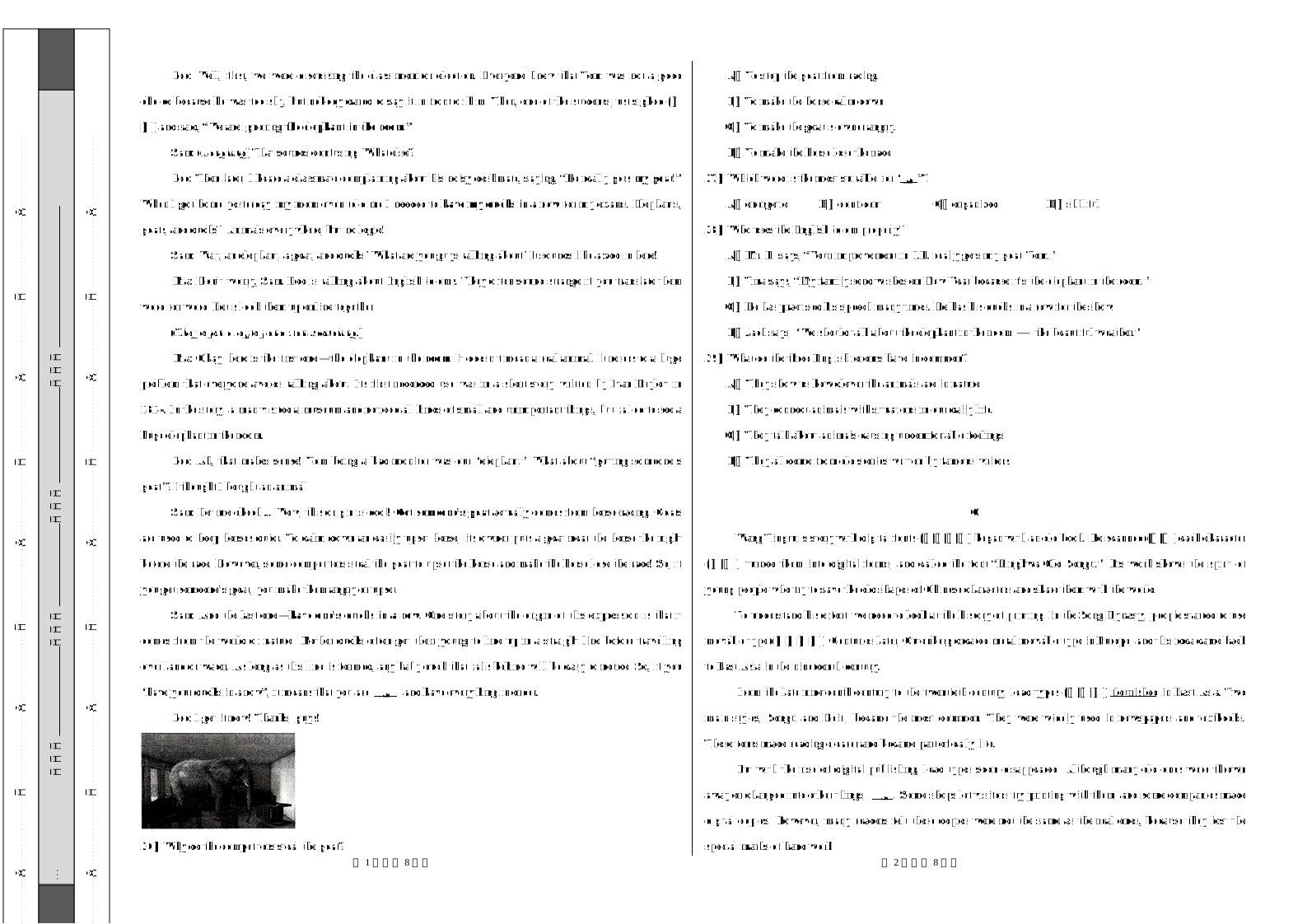
3

相关资源
示范课
由于学科网是一个信息分享及获取的平台,不确保部分用户上传资料的 来源及知识产权归属。如您发现相关资料侵犯您的合法权益,请联系学科网,我们核实后将及时进行处理。