黑龙江省绥化市第七中学2025-2026学年高二下学期6月期中英语试题
2026-06-07
|
5页
|
11人阅读
|
0人下载
资源信息
| 学段 | 高中 |
|---|---|
| 学科 | 英语 |
| 教材版本 | - |
| 年级 | 高二 |
| 章节 | - |
| 类型 | 试卷 |
| 知识点 | - |
| 使用场景 | 同步教学-期中 |
| 学年 | 2026-2027 |
| 地区(省份) | 黑龙江省 |
| 地区(市) | 绥化市 |
| 地区(区县) | 北林区 |
| 文件格式 | DOCX |
| 文件大小 | 50 KB |
| 发布时间 | 2026-06-07 |
| 更新时间 | 2026-06-07 |
| 作者 | 匿名 |
| 品牌系列 | - |
| 审核时间 | 2026-06-07 |
| 下载链接 | https://m.zxxk.com/soft/58236843.html |
| 价格 | 2.00储值(1储值=1元) |
| 来源 | 学科网 |
摘要:
**基本信息**
绥化市第七中学高二英语期中试卷全面覆盖听力、阅读、语言运用及书面表达模块,素材聚焦成长选择、习惯养成等学生生活主题,如阅读B篇Emily的大学抉择、完形填空Li Ming克服拖延症,在真实情境中提升语言能力与思维品质。
**题型特征**
|题型|题量/分值|知识覆盖|命题特色|
|----|-----------|----------|----------|
|听力|20题/30分|日常对话、新闻报道|情境贴近生活,如交通方式选择、校园活动|
|阅读|20题/50分|书籍推荐、成长感悟、习惯养成、沟通演变|问题设计梯度分明,如推理题(27题)与主旨题(35题)结合|
|语言运用|25题/30分|词汇辨析、语法填空|完形填空以自我管理为主题,语法填空聚焦时间管理策略|
|书面表达|2题/40分|应用文写作、英译汉|回信解决手机沉迷问题,翻译题含情感表达(如“心都要碎了”)|
内容正文:
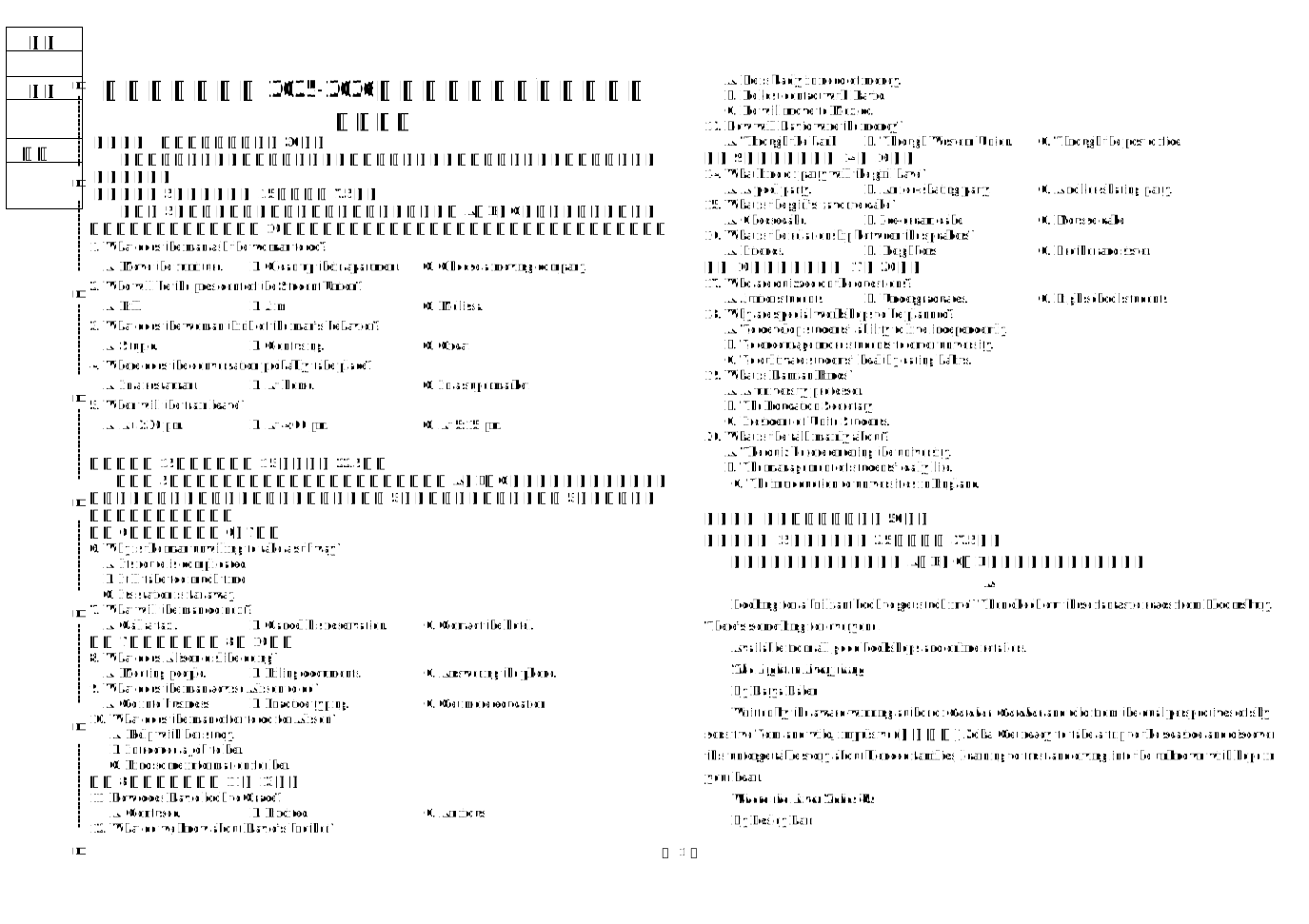
装 ------------------- 订 ------------------ 线 ---------------- 内 ---------------- 不 ---------------- 能 ---------------- 答 ---------------- 题
姓名
班级
考号
绥化市第七中学2025-2026学年度第二学期期中考试卷
高二英语
第一部分 听力(共两节,满分30分)
做题时,先将答案标在试卷上。录音内容结束后,你将有两分钟的时间将试卷上的答案转涂到答题卡上。
第一节(共5小题;每小题1.5分,满分7.5分)
听下面5段录音。每段录音后有一个小题,从题中所给的A、B、C三个选项中选出最佳选项。听完每段录音后,你都有10秒钟的时间来回答有关小题和阅读下一小题。每段录音播放两遍。
1. What does the man ask the woman to do?
A. Move the furniture. B. Clean up their apartment. C. Choose a moving company.
2. Who will be the president of the Student Union?
A. Bill. B. Jim. C. Melissa.
3. What does the woman think of the man’s behavior?
A. Stupid. B. Confusing. C. Great.
4. Where does the conversation probably take place?
A. In a restaurant. B. At home. C. In a supermarket.
5. When will the train leave?
A. At 3:30 pm. B. At 4:00 pm. C. At 5:15 pm.
第二节(共15小题;每小题1.5分,满分22.5分)
听下面5段录音。每段录音后有几个小题,从题中所给的A、B、C三个选项中选出最佳选项。听每段录音前,你将有时间阅读各个小题,每小题5秒钟;听完后,每小题都有5秒钟的作答时间。每段录音播放两遍。
听第6段录音,回答第6、7题。
6. Why is the man unwilling to take a subway?
A. Its route is complicated.
B. It’ll take too much time.
C. Its station is far away.
7. What will the man do next?
A. Call a taxi. B. Cancel his reservation. C. Contact the hotel.
听第7段录音,回答第8至10题。
8. What does Alison dislike doing?
A. Meeting people. B. Filing documents. C. Answering the phone.
9. What does the man advise Alison to do?
A. Go into business. B. Practice typing. C. Get more education.
10. What does the man offer to do for Alison?
A. Help with her study.
B. Introduce a job to her.
C. Find some information for her.
听第8段录音,回答第11至13题。
11. How does David look to Grace?
A. Confused. B. Excited. C. Anxious.
12. What do we know about David’s brother?
A. He is badly in need of money.
B. He lost contact with David.
C. He will move to Mexico.
13. How will David wire the money?
A. Through the bank. B. Through Western Union. C. Through the post office.
听第9段录音,回答第14至16题。
14. What kind of party will the girl have?
A. A pool party. B. An ice-skating party. C. A roller-skating party.
15. What is the girl’s favorite cake?
A. Cheesecake. B. Ice-cream cake. C. Mousse cake.
16. What is the relationship between the speakers?
A. Friends. B. Neighbors. C. Brother and sister.
听第10段录音,回答第17至20题。
17. Who are quizzed on the questions?
A. Junior students. B. Undergraduates. C. High school students.
18. Why are special workshops to be planned?
A. To develop students’ ability to live independently.
B. To encourage more students to enter university.
C. To cultivate students’ healthy eating habits.
19. What is Damian Hinds?
A. A university professor.
B. The Education Secretary.
C. President of Unite Students.
20. What is the talk mainly about?
A. The quiz before entering the university.
B. The management of students’ daily life.
C. The introduction to universities in England.
第二部分 阅读(共两节,满分50分)
第一节(共15小题;每小题2.5分,满分37.5分)
阅读下列短文,从每题所给的A、B、C、D四个选项中选出最佳选项。
A
Looking for a brilliant book to get stuck into? Then check out these fantastic reads from Bloomsbury. There’s something for everyone .
Available from all good bookshops and online retailers.
The Light in Everything
By Katya Balen
Written by the award-winning author of October, October and told from the dual perspectives of shy, sensitive Tom and wild, impulsive (易冲动的) Zoha. Get ready to take a trip to the seaside and discover this unforgettable story about blended families, learning to trust and diving into the unknown with hope in your heart.
Where the River Takes Us
By Lesley Parr
It was February 1974. There are whispers echoing through the valley — tales of a wild beast roaming the mountains. When a reward is offered for proof of its existence, Jason and his friends are determined to find the creature first. But it’s more than a quest for Jason — the money is a way for him and his older brother to stay together. The perfect pick for fans of historical adventures.
Cameron Battle & the Escape Trials
By Jamar J. Perry
This thrilling, action-packed sequel to Cameron Battle and the Hidden Kingdoms sees Cameron and his friends return to Chidani. Along the way they are faced with impossible challenges and threats at every turn. This won’t be an easy journey, but the true path to greatness is worth it.
The World at the End of the Road
By Adís Þórarinsdóttir & Huldar Bjarnadóttir
For city girl Dísa, being sent to a tiny Icelandic fishing village leads to an unexpected journey of discovery when she uncovers a mystery in her grandmother’s cottage and befriends a boy who sees the island differently. It’s a heartwarming story about self-discovery and connection — perfect for readers who love tales with heart, mystery, and a touch of wild nature.
21. What do The Light in Everything and The World at the End of the Road have in common?
A. Sequels to award-winning books. B. Set in seaside villages.
C. Stories of growth and relationships. D. Told from two characters’ views.
22. Which book best suits a reader who enjoys stories about brotherhood and survival?
A. The Light in Everything. B. Where the River Takes Us.
C. Cameron Battle & the Escape Trials. D. The World at the End of the Road.
23. Where is the text probably taken from?
A. A student book review blog. B. A school reading club newsletter.
C. A library reading list. D. A publisher’s new book page.
B
Growing up means different things to different people. For some, it is about getting more freedom. For others, it is about taking on more responsibilities. But one thing is certain: growing up requires us to make choices.
Seventeen-year-old Emily is facing such a choice. She has been accepted to two universities. One is close to home, where her family and friends are. The other is across the country, offering a program she is truly passionate about—marine biology (海洋生物学). Her parents support her either way, but they remind her that being far away means she will have to handle everything on her own.
“I’m excited but also scared,” Emily admits. “If I go far away, I’ll miss birthdays, holidays, and everyday moments with my family. But if I stay, I might regret not following my dream.”
Emily’s situation is common among young people. The process of growing up often involves weighing what we want against what we are willing to leave behind.
24. What does the author say about growing up in Paragraph 1?
A. It is always easy. B. It only brings freedom.
C. It requires making choices. D. It means leaving home.
25. What does the underlined word “passionate” in Paragraph 2 probably mean?
A. Having strong interest. B. Feeling worried.
C. Being uncertain. D. Showing no feeling.
26. What is Emily worried about if she chooses the faraway university?
A. The program is too difficult. B. Her parents don’t support her.
C. She will miss important family moments. D. She cannot afford the tuition.
27. What can we learn from Emily’s story?
A. Growing up is always fun. B. Young people should stay close to home.
C. Growing up often means making difficult choices. D. Parents should decide for their children.
C
Have you ever set a goal and given up halfway? You are not alone. Many people struggle with self-improvement because they expect results too quickly.
James Clear, author of Atomic Habits, suggests that small changes are more powerful than big ones. He uses the example of ice. If you heat ice from -10°C to -1°C, it remains ice. But when you raise the temperature to 0°C, it melts. The change seems sudden, but the work was happening all along.
The same is true for habits. If you read one page every day, you won’t feel like you are making progress. But after a year, you will have finished several books. If you exercise for ten minutes daily, you won’t see changes immediately. But after months, your health will improve.
The key is to focus on the system, not the goal. Instead of saying “I want to write a book,” say “I will write one paragraph every day.” The process itself will lead you to the result.
28. Why do many people fail in self-improvement according to the passage?
A. They set too small goals. B. They expect results too quickly.
C. They don’t have enough time. D. They don’t know what they want.
29. What does the example of ice mainly show?
A. Ice melts at 0°C. B. Progress happens slowly before it shows.
C. Temperature changes are sudden. D. Water is important for life.
30. What does James Clear suggest we focus on?
A. The final goal. B. The fast result.
C. The daily process. D. The difficulty of change.
31. Which of the following best follows the advice in the passage?
A. “I will run a marathon next month.”
B. “I will practice English for 15 minutes every day.”
C. “I will become famous one day.”
D. “I will stop playing video games forever.”
D
Times change, and so do the ways we communicate. In the past, letters were the main means of long-distance communication. A letter from Beijing to Shanghai could take three days. People wrote carefully because they knew the words would travel far and last long.
Then came the telephone. It allowed people to hear each other’s voices instantly. Conversations became more natural and immediate. However, people still valued the written word for important matters.
Today, we have instant messaging, social media, and video calls. We can reach anyone, anywhere, at any time. But this convenience comes at a cost. Many people complain that communication today feels "shallow".We send quick messages without thinking deeply. We respond with emojis instead of words.We
have hundreds of"friends" online but few we truly know.
Some experts argue that we are losing the art of deep communication.When we write a letter, we think about every word. When we send a text, we think about every word. When we send a text,we barely pause. The result is that our connections, though more numerous, are often less meaningful.
32.What does the author say about letters in the past?
A. They were slow but thoughtful.
B.They were expensive to send.
C.They were only used for business.
D.They were hard to understand.
33.What does the underlined word "shallow" in Paragraph 3 probably mean?
A. Deep and meaningful. B.Quick and without depth.
C.Funny and interesting. D. Long and detailed.
34.According to experts, what is the problem with modern communication?
A.It takes too much time. B.It is too expensive.
C.It lacks depth and meaning. D. It is not convenient.
35.What is the author's attitude towards the change in communication?
A.Completely positive.
B.Completely negative.
C.Concerned but balanced.
D.Uninterested.
第二节 七选五 (共5题,每题2.5分,满分12.5分)
How to Develop Self-Discipline
Self-discipline is the ability to make yourself do what you should do, even when you don't feel like it. It's a key to success in many areas of life. Here are some practical ways to build it.
36 Start with one small area, like making your bed every morning. A small win creates a sense of accomplishment.
Second, know your weaknesses. 37 If you know you can't resist your phone while studying, put it in another room.
Third, create a clear plan. Vague goals like "study more" are hard to follow. 38 For example, "study math for 30 minutes right after dinner."
Fourth, learn to say "no". 39 Politely declining an invitation to hang out when you need to finish a project is an act of self-discipline.
Finally, forgive yourself for mistakes. 40 Don't let one slip-up derail your entire effort. Just get back on track tomorrow.
A. Identify what tempts you to stray from your goals.
B. Everyone fails sometimes.
C. You should never take a break.
D. Instead, set specific, measurable actions.
E. First, start small.
F. Saying "yes" to everything can distract you from your priorities.
G. Always compare yourself to others.
第三部分 语言运用 (共两节,满分30分)
第一节 完形填空 (共15题,每题1分,满分15分)
Li Ming used to be a typical procrastinator. He often 41 his homework until Sunday night, which led to 42 sleep and poor grades. Feeling 43 , he decided to make a change. His first step was to 44 a goal: finish all weekend homework by Saturday noon. To achieve this, he made a 45 plan. On Friday night, he listed all his 46 . On Saturday morning, he started with the 47 subject first, which was math.
It was challenging. His phone kept 48 him. But he remembered his teacher's words: "Improving yourself 49 self-control." So he turned off his phone and put it in another room. 50 he finished his math homework two hours later. That small success gave him 51 . He continued with English and Chinese. By Saturday afternoon, all his homework was done.
For the first time, he had a 52 Sunday. He could relax without worrying. His parents were 53 of his new-found responsibility. Li Ming learned that overcoming a bad habit is not about 54 willpower, but about making a smart plan and sticking to it. He now believes that anyone can 55 their potential with the right strategy.
41. A. complete B. start C. put off D. enjoy
42. A. enough B. little C. sound D. extra
43. A. proud B. excited C. stressed D. relaxed
44. A. set B. miss C. change D. find
45. A. daily B. weekly C. monthly D. yearly
46. A. games B. tasks C. dreams D. problems
47. A. easiest B. most interesting C. hardest D. favourite
48. A. helping B. teaching C. distracting D. praising
49. A. requires B. avoids C. hates D. lacks
50. A. Sadly B. Finally C. Suddenly D. Hopefully
51. A. fear B. doubt C. sadness D. confidence
52. A. busy B. free C. tiring D. boring
53. A. tired B. afraid C. proud D. ashamed
54. A. pure B. weak C. little D. lost
55. A. limit B. hide C. lose D. achieve
第二节 语法填空 (共10题,每题1.5分,满分15分)
阅读下面短文,在空白处填入1个适当的单词或括号内单词的正确形式。
Effective time management is a key skill for students, but it is often 56. ______ (easy) said than done. Many teenagers struggle 57. ______ balancing schoolwork, hobbies, and rest. However, learning to manage your time 58. ______ (wise) can greatly reduce stress and improve your grades.The first step is 59. ______ (make) a to-do list. Write down everything you need to do, from homework 60. ______ chores. Then, prioritize the tasks. Decide which ones are the most important and do 61. ______ (they) first. Another useful technique is62. ______ (break) a large task into smaller, manageable parts. For example, instead of 63. ______ (write) "study for history exam", you can write "review Chapter 1", then "review Chapter 2".Remember, a good plan is useless 64. ______ you follow it. So, stick to your schedule as much as possible. If you get distracted, don't give up. Just take a short break and start again. With consistent effort, you 65. ______ (see) a big difference in your productivity.
第4部分 书面表达(共两节,满分40分)
第一节(满分16分)
假定你是李华,你的朋友王明在邮件中提到他最近沉迷手机,影响了学习和生活,他对此感到苦恼。请你给他写一封回信,分享你改掉类似习惯的经验,并给出建议。
注意: 写作词数应为80左右;
提示词:
mobile phone手机
bad habit坏习惯
self-discipline自律
goal setting 目标设定
self-improvement 自我改善
take action采取行动
Dear Wang Ming,
第二节(满分24分)英译汉
1. She decided to move to a new city.
--------------------------------------------------
2. Change can be difficult but exciting.
——————————————————————————————————————
3. They are looking forward to a better future.
——————————————————————————————————————
4. A new chapter means new experiences.
——————————————————————————————————————
5. The day I heard that the Rainbow Bookstore was closing after 50 years of business, I was heartbroken.
6.Sighing deeply, he told me how it was becoming difficult to run an independent bookstore.
7.More and more customers were being attracted by chain stores and online discounts.
8.I'm so pleased to see that everything I wanted it to offer to the community is still here
——————————————————————————————————
答案
第一部分 听力(共两节,满分30分)
1~5 BBCAB 6~10 ACBCC 11~15 CABBA 16~20 CCABA
第二部分 阅读
A 21-23 CBD
B 24-27 CACC
C 28-31 BBCB
D 32-35 ABCC
七选五
36-40 E A D F B
第三部分 语言运用 (共两节,满分30分)
完形填空
41-45CBCAB
46-50BCCAB
51-55 DBCAD
语法填空
1. easier 37. with/in 38. wisely 39. to make 40. to
2. them 42. to break 43. writing 44. if/unless 45. will see
第四部分 书面表达
第一节(满分16分)略
第二节(满分24分)英译汉
1.她决定搬到一个新城市。
2.改变可能是难得但是令人兴奋的。
3. 他们正期盼着更好的未来。
4.新的篇章意味着新的经历。
5.听说经营了50年的彩虹书店要停业的那天,我的心都要碎了。
6. 他深深地叹了口气,他告诉我经营独立书店越来越难。
7.越来越多的顾客被连锁店和网店的折扣吸引
8.我很高兴,我想让书店奉献给社区的一切都还在。
第三部分 语言运用 (共两节,满分30分)
第 页 共 5 页
第 页9
学科网(北京)股份有限公司
$
资源预览图
1

2

相关资源
由于学科网是一个信息分享及获取的平台,不确保部分用户上传资料的 来源及知识产权归属。如您发现相关资料侵犯您的合法权益,请联系学科网,我们核实后将及时进行处理。