江西南昌市青山湖区江西科技学院附属中学2025-2026学年第二学期高一年级5月月考英语试题
 切换试卷
切换试卷
2026-06-01
|
15页
|
3人阅读
|
0人下载
资源信息
| 学段 | 高中 |
|---|---|
| 学科 | 英语 |
| 教材版本 | 高中英语人教版必修第三册 |
| 年级 | 高一 |
| 章节 | - |
| 类型 | 试卷 |
| 知识点 | - |
| 使用场景 | 同步教学-阶段检测 |
| 学年 | 2026-2027 |
| 地区(省份) | 江西省 |
| 地区(市) | 南昌市 |
| 地区(区县) | 青山湖区 |
| 文件格式 | DOCX |
| 文件大小 | 156 KB |
| 发布时间 | 2026-06-01 |
| 更新时间 | 2026-06-01 |
| 作者 | 学科网试题平台 |
| 品牌系列 | - |
| 审核时间 | 2026-06-01 |
| 下载链接 | https://m.zxxk.com/soft/58156249.html |
| 价格 | 1.00储值(1储值=1元) |
| 来源 | 学科网 |
内容正文:
江科附中2025-2026学年第二学期高一年级月考英语试卷
卷面分数:150分 考试时间:120分钟 命题人:高一英语组 审题人:高一英语组
第一部分 听力第一节(共两节,满分30分)听下面5段对话。每段对话后有一个小题,从题中所给的ABC三个选项中选出最佳选项。听完每段对话后,你都有10秒钟的时间来回答有关小题和阅读下一小题。每段对话读两遍。
1. When will the man leave for the party?
A. At about 4:00 p.m. B. At about 4:30 p.m. C. At about 5:30 p.m.
2. What are the speakers mainly talking about?
A. Their hobbies. B. Their schedules. C. Their travel plans.
3. What does the man suggest?
A. Taking the subway. B. Changing the flight. C. Trying another route.
4. What does the woman imply?
A. She is out of shape. B. She dislikes sports. C. She wants to try gymnastics.
5. What is the man’s problem?
A. He missed the meeting. B. He forgot the report at home. C. He didn’t know the deadline.
第二节 听5段对话或独白。每段对话或独白后有几个小题,从题中所给ABC三个选项中选出最佳选项。听每段对话或独白前,你有时间阅读各个小题,每小题5秒钟;听完后各小题将给出5秒钟的作答时间。每段对话或独白读两遍。
听第6段材料,回答第6、7题。
6. Why does the man choose the cafe downstairs?
A. For its lower price. B. For its better taste. C. For its shorter distance.
7. How much will the woman pay?
A. $12. B. $16. C. $20.
听第7段材料,回答第8至10题。
8. Why is George at the store?
A. To look for ideas for clothing design.
B. To purchase furniture for a new office.
C. To sell tables and chairs with his friend.
9. What was the man’s last job?
A. A market promoter. B. A clothing designer. C. A car salesman.
10. What does the woman want to do?
A. Start a business. B. Study marketing. C. Write a book.
听第8段材料,回答第11至13题。
11. What did the man do while in Amsterdam?
A. bought gifts. B. Booked a hotel. C. Rented a car.
12. What does the woman hope for?
A. A hotel near shops. B. A cheaper room. C. A city tour guide.
13. What is the Central Garden?
A. A museum. B. A shopping area. C. An amusement park.
听第9段材料,回答第14至16题。
14. What does the man say the gold cup was used for?
A. Serving tea. B. Drinking wine. C. Holding soup.
15. Why is the gold cup more valuable today?
A. It was used by the wealthy. B. It has become extremely rare. C. It represents a social privilege.
16. What do the speakers plan to do next?
A. Buy a gold cup. B. Take photos of the cup. C. Check out other items.
听第10段材料,回答第17至20题。
17. Why do plants produce sounds?
A. To communicate. B. To speed up growth. C. To defend themselves.
18. How did researchers run the experiment?
A. By tracking the growth of plants.
B. By testing plants’ response to noise.
C. By stressing plants in different ways.
19. What happened to the second group of plants?
A. They were not watered. B. Their stems were cut off. C. They were left untouched.
20. What may the new software help farmers do?
A. Monitor crop health. B. Reduce insect damage. C. Offer planting methods.
第二部分 阅读(共两节,满分50分)
第一节(共15小题,每小题2.5分,满分37.5分)阅读下列短文,从每题所给的A、B、C和D四个选项中,选出最佳选项。
A
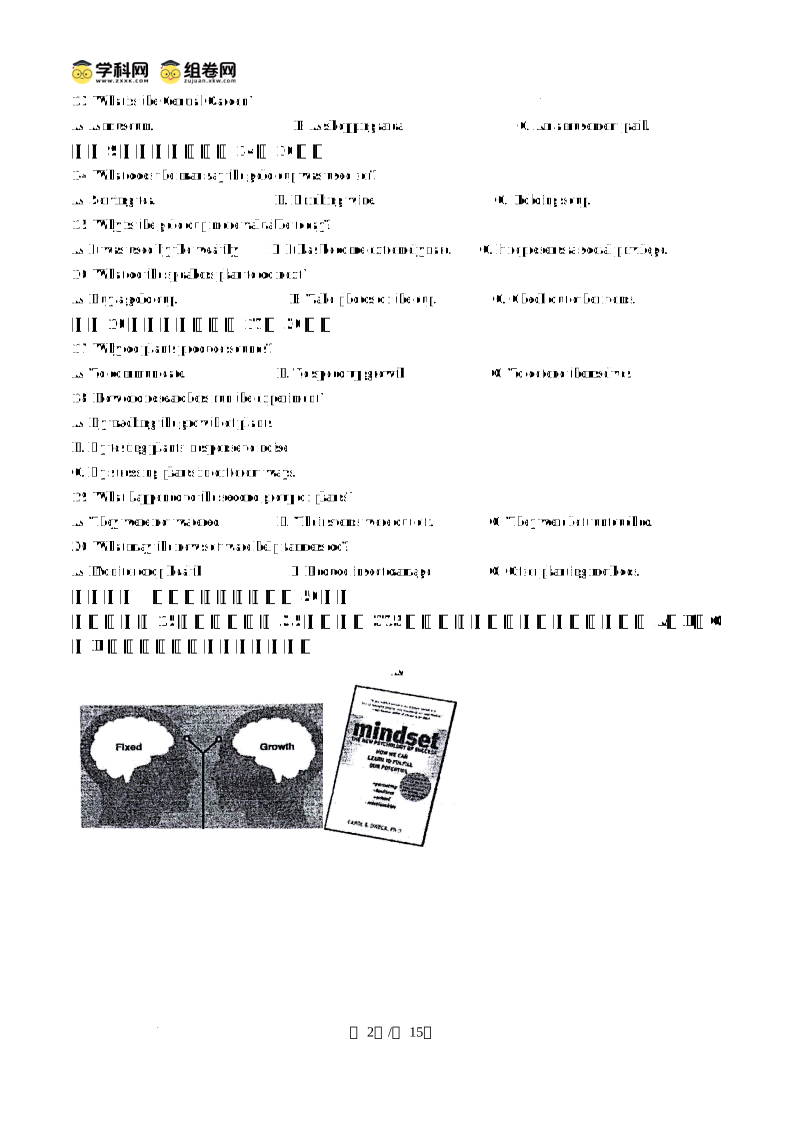
People with fixed mindsets believe that:
●Skill, intelligence and talents are natural.
●Failure is shameful and should be avoided.
●Some people are naturally good at things while others not.
●You are not in control of your abilities.
People with growth mindsets believe that:
●You have the capacity to learn and grow your skills.
●Failure is a valuable lesson.
●People who are good at something are good because they build that ability.
●You are in control of your abilities.
have a desire to look smart, so tend to:
—Avoid challenges.
—Give up easily.
—See effort as fruitless or worse.
—Ignore useful negative feedback.
—Feel threatened by the success of others.
have a desire to learn, so tend to:
—Embrace challenges.
—Persist in the face of setbacks.
—See effort as the path to mastery.
—Learn from criticism.
—Find lessons and inspiration in the success of others.
As a result, they may stay at the same level early and achieve less than their full potential.
As a result, they reach ever-higher levels of achievement.
Change can be tough, but I’ve never heard anyone say it wasn’t worth it. Did changing to a growth mindset solve all my problems? No. But I know that I have a different life because of it—a richer one.
1. The book “mindset” is intended to _________.
A. tell readers that two different mindsets lead to different results
B. illustrate that people with different mindsets hold different beliefs
C. help readers believe people act differently when facing challenges
D. persuade people to learn to change so as to enjoy a more fruitful life
2. Generally speaking, people with fixed mindsets are mostly _________.
A. successful B. straightforward C. intelligent D. narrow-minded
3. A person with a growth mindset is likely to say _________.
A. “If I win, I’ll be somebody; if I lose, I’ll be nobody.”
B. “To be good at sports, you need to be naturally gifted.”
C. “Learn techniques and skills and practice them regularly, and you will always improve.”
D. “You have a certain level of ability in sports and you cannot really do much to change it.”
Beijing helped make my dreams come true. When I studied in Beijing, it heard my voice, accompanied me through sunrise and sunset and gave me courage to move forward.
The beauty of Beijing is deeply carved in my mind. Against the red walls and green riles (瓦) of the Forbidden City, sparkling snowflakes float down from the sky, creating a beautiful and serene picture.
To me, who grew up in the tropics, snow seems as attractive as the forbidden fruit from the Garden of Eden. After a night's snow, everywhere magically becomes as beautiful as a fairy tale.
Did you see the first snow in Beijing in the winter of 2020-2021? I saw it and touched it in person. Located in the outskirts (市郊) of Beijing, Beijing WTown (古北水镇) is a small town with many of the architectural features of the classical gardens in the historical city of Suzhou in eastern China. When snow fall, it looks like a perfect landscape painting. I still feel warm when I recall the scene now, and words can't adequately express my feelings at that time. A scene like this is capable of relieving any amount stress for tourists.
I love Beijing not only for its fascinating sights but also for the precious friendship I established with international students studying here. Beijing is a place where students from various countries meet. Although it often seems exciting when we meet, saying goodbye remains inevitable. Even though all good things must come to an end, everything has its season, and the time to come together will come again.
Many other moments inspire me to express my feelings to Beijing. I know that these memories will eventually dissolve in fragments of time, but so what? I love Beijing and always will.
4. Why does the author compare snow to the forbidden fruit in paragraph 3?
A. To praise Beijing. B. To show her love of snow.
C. To describe snow. D. To state the truth of weather.
5. What does the underlined word “inevitable” in the last to second paragraph mean?
A. Unavoidable. B. Important. C. Valuable. D. Challenging.
6. What can we learn about the author according to the text?
A. She liked the sunrise and sunset in Beijing.
B. She was sensitive to the weather of Beijing.
C. She was attracted by different aspects in Beijing.
D. She felt both happy and sad in Beijing WTown.
7. What can be a suitable title for the text?
A. An Unforgettable Journey B. The Snow in Beijing
C. A Beautiful City—WTown D. My Beijing Fascination
After Taylor Swift, the “Mona Lisa” is probably the most recognizable female face in the world. Every day around 20,000 people stare at the Leonardo da Vinci’s painting in the Louvre. Yet it became famous not because of a tempting semi-smile. Until a worker stole the masterpiece in 1911, it was still mostly unknown; viewers flooded in to see what a French newspaper called “an enormous, horrific, gaping void (空白)”.
Classics of art, literature and music are supposed to carry some mysterious appeal that endures across the ages. But as Rochelle Gurstein, a historian, writes in a new book, the “timeless classic” is anything but. “What I believed was written in stone was actually written in water”, she argues. Classics come and go.
Take other celebrated works of art. Until the end of the 19th century Michelangelo’ s “David” had only his fig leaf to protect him from the weather in Piazza della Signoria in Florence. He attracted more pigeons than visitors; visitors preferred the artist’s sculpture of Moses in Rome. Before the famous “Venus de Milo” was discovered in 1820, viewers were crazy about “Venus de Medici”, a delicate sculpture most people alive today have never heard of.
Much as in art, the classics of music and literature have not always been set in stone either. Today, Johann Sebastjan Bach is often regarded as the master of classical music. But after his death in 1750, Bach’s compositions fell out of fashion until Felix Mendelssohn, a German composer, rediscovered them in the 1820s. Herman Melville’s masterpiece “Moby Dick” was largely forgotten until critics such as Raymond Weaver, a professor at Columbia University rescued him from the depth of a nobody around the centenary of his birth in 1919.
“The status of classics” depends on critics and shows the power of passionate writers to change the way people look at art. Tastes evolve, and they should. But culture lives on only as long as people continue to argue over what counts as a classic today. The true enemy of the classic is not relativism or awakening. It is silence.
8. What made the painting “Mona Lisa” famous?
A. The theft. B. The semi-smile. C. The report. D. The painter.
9. What does Rochelle think of classics?
A. Enduring. B. Fading. C. Changeable. D. Admirable.
10. How does the author develop paragraph 4?
A. By making a comparison. B. By offering examples.
C. By giving an explanation. D. By giving a description.
11. What might ultimately discourage the development of classics?
A. The ignorance of culture. B. The course of time.
C. The evolution of tastes. D. The lack of criticism.
A new study has revealed a critical cybersecurity issue: artificial intelligence (AI) is capable of designing DNA segments for a wide range of dangerous proteins, and these segments often slip past the cybersecurity checks that DNA companies rely on.
Major biotech companies, which produce custom-made DNA for scientific research, have long had screening (筛查) processes. These measures prevent harmful materials (like smallpox (天花)) from reaching bad actors. But AI can “paraphrase” the DNA codes of poisonous proteins. As Eric Horvitz, Microsoft’s chief scientific officer, explains, AI rewrites these genetic codes in a way that preserves the proteins’ original structure and importantly, their potential harmful function.
A quick fix was developed and added to the screening software. However, it is far from perfect; it still fails to detect a small but significant part of the risky DNA variants. This discovery has worsened long-term worries about AI misusing powerful biological tools. Horvitz acknowledges that AI-driven protein design is a promising frontier, already advancing medicine and public health, but he warns that like many powerful technologies, it carries a risk of abuse.
To reduce the risks, the team of the study held back some key information and entrusted a non-profit organization with controlling access to their data. Horvitz notes that this is the first time such a model has been used to manage the risks of sharing potentially harmful information in science.
Views vary on the issue. Arturo Casadevall, a microbiologist recognized the study for identifying problems and attempting to solve them. Yet, he also points out that the research team did not conduct lab tests to confirm if the AI-designed proteins would actually behave like real biological threats. David Relman, a researcher at Stanford University, views the study as valuable but admits it leaves an urgent question: how to keep up with the “speeding AI express” of potential biothreats. James Diggans, from major DNA provider Twist Bioscience, notes that actual cases of misuse are extremely rare — his company has referred fewer than five cases to law in the past decade.
12. What can we learn about AI’s “paraphrase” of DNA codes from the passage?
A. It changes the structure of poisonous proteins.
B. It makes the harmful function of proteins disappear.
C. It helps the dangerous DNA segments avoid checks.
D. It is a technology developed by major biotech companies.
13. What is the shortcoming of the existing solution?
A. It cannot detect any risky DNA variants at all.
B. It can’t identify a certain part of the potentially dangerous DNA.
C. It makes the screening software work slowly.
D. It can only detect the DNA variants related to certain illnesses.
14. How did the study team ensure the safety of key information?
A. By cooperating with another organization.
B. By preventing the abuse of the research data.
C. By showing the uniqueness of their research model.
D. By sharing the data with major companies.
15. What is the author’s attitude towards AI’s ability to design dangerous DNA segments?
A. Supportive. B. Opposed. C. Indifferent. D. Objective.
第二节(共5小题,每小题2.5分,共12.5分)
阅读下面短文,从短文后的选项中选出可以填入空白处的最佳选项。选项中有两项为多余选项。
Move House Without the Waste
If you’ve got a house move coming up, then you’ll know that it can be a stressful experience. With everything going on, reducing the environmental impact of moving may not be high on your list of priorities. ____16____. Thankfully, there are a few clever ways to green your move and save some money.
Firstly, it’s always best to declutter (清理) before you even start thinking about packing. Getting rid of stuff you don’t need means you need fewer boxes and fewer packaging materials. ____17____, saving money and reducing pollution.
Once you’ve decluttered, you can move on to the packing stage. Many removal companies supply their own brand-new boxes at an additional cost. To save resources (and a bit of cash), it’s best to foster (培养) a good relationship with local shops. ____18____. However, you can ask the staff when the delivery day is and then pop in that day to collect some cardboard boxes before they are sent to recycling.
____19____ — using suitcases instead of boxes. Ask your friends and family if you can borrow some. Laundry bags are also an excellent option. You can generally fit a lot in them and they are much easier to carry than boxes.
And finally, you can’t move your goods with cardboard boxes alone. Delicate items need some form of protection during the move. ____20____. If you find yourself short on recycled materials, you can also use clean towels and clothes to wrap breakables in. This is also a clever space-saving technique!
A. They have a good supply of boxes
B. Yet moving can be quite a wasteful process
C. It may also mean you need a smaller removal truck
D. Moreover, get creative with items you are clearing out
E. Most of them won’t store cardboard boxes as it’s a fire risk
F. You can keep old newspapers or air-filled packaging beforehand
G. Alternatively, you can use other everyday items for packing
第三部分 语言运用(共两节,满分30分)
第一节(共15小题;每小题1分,满分15分)
阅读下面短文,从每题所给的A、B、C、D四个选项中选出可以填入空白处的最佳选项。
My father was not the most gifted man on two legs when it came to dancing, but he knew that helping his only baby daughter, despite how ____21____ it made him feel, was part of his job.
Growing up in an Irish Catholic (天主教的) family, my dad ____22____ strict tradition, but he allowed us the opportunity to follow our own path. While he demonstrated moral living by ____23____, we were never forced to be like him. I’m sure it must have been ____24____ at times when we ignored our forefathers (祖先) ____25____. But my father provided a(n) ____26____ where my three brothers and I were to find in life what was right for us.
I was ____27____ for my first dance at six years old. It was my dad who took me there. Gently but firmly holding my sweaty hand, he ____28____ me to the center of the room to join all the other little girls and didn’t ____29____ until he knew I felt safe.
_____30_____, a stroke (中风) destroyed his once strong legs, but that never prevented my 93-year-old father from _____31_____ me in a beautiful waltz (华尔兹舞). By giving me the freedom to _____32_____ my life, _____33_____ he didn’t always approve, my father gave me his blessing to become the woman I was meant to be.
To all you fathers who’ve impacted and _____34_____ your children to dance by stepping out of your comfort zones (舒适区) , whether it be in mind, body or soul – this one’s for you! You are the one that gives a child the _____35_____ to stand on the center stage of life.
21. A. uncomfortable B. unthinkable C. fortunate D. convenient
22. A. opposed B. observed C. broke D. ignored
23. A. standard B. rule C. law D. example
24. A. upsetting B. pleasing C. encouraging D. cheering
25. A. gifts B. customs C. work D. freedom
26. A. occasion B. playground C. convenience D. environment
27. A. frightened B. surprised C. bored D. satisfied
28. A. forced B. followed C. led D. dragged
29. A. stop B. leave C. smile D. shout
30. A. Unfortunately B. Undoubtedly C. Consequently D. Accidentally
31. A. finding B. encouraging C. joining D. awakening
32. A. rebuild B. value C. continue D. explore
33. A. in case B. even though C. now that D. as if
34. A. taught B. helped C. forced D. begged
35. A. problem B. order C. courage D. challenge
第二节(共10小题;每小题1.5分,满分15分)括号内单词的正确形式。
阅读下面短文,在空白处填入1个适当的单词或括号内单词的正确形式。
“The astronaut” had for a long time seemed sacred and distant to Gui Haichao until he became a member of the Astronaut Center of China.
In 2005, Gui became a student at the School of Astronautics under Beihang University, ____36____ (majority) in spacecraft design and engineering. After graduation he returned to Beihang to teach. His colleagues decorated the lab ____37____ flowers to welcome his return. In 2018, Gui and his colleagues ____38____ (tell) that China’s manned space authorities had decided to select the third batch of astronauts. Gui sometimes dreamed about doing his research in space, ____39____ he immediately filled in the application form. His friends sent him warm ____40____ (congratulate) on his decision. After several rounds of physical checks and professional tests, Gui succeeded. He remained modest and energetic, a quality ____41____ (shape) by years of hard work. Gui once told one of his friends privately that the physical training at the astronaut center posed ____42____ huge challenge to him, a dilemma ____43____ he had to choose between quitting and persisting. He ____44____ (flexible) adjusted his workout schedule to cope with the demanding tasks and managed to pass all tests.
Thanks to his hard work, Gui was chosen for the Shenzhou XVI mission and became the first civilian and scientist in this country ____45____ (travel) in orbit.
第一节 应用文写作(共两节,满分40分)
46. 假定你是李华,上个月校学生会在学校操场举行了爱心义卖(charity sale)活动。请你为学校英语校报写一篇关于该活动的英文报道。内容包括:
1. 活动的时间、地点和目的;
2. 活动的具体情况;
3. 你的收获。
注意:
1. 写作词数应为80左右;
2. 请按如下格式在答题卡的相应位置作答。
A Charity Sale in Our School
____________________________________________________________________________________________________________________________________________________________________________________________________________________________________________________________________________________________________________________________________________________________________________________________________________________________________________________________________________
47. 阅读下面材料,根据其内容和所给段落开头语续写两段,使之构成一篇完整的短文。
Ted pressed his nose against the store window that stood between him and a metallic-blue 21-speed racer. “Look at that bike, Sam! I want that bike!”
“Get away from there before Mr. Huan makes you clean the drool (口水) from his store window!” His friend Sam laughed and pulled Ted away.
“Well, my birthday’s tomorrow, and I’ve been dropping a lot of hints at home, like the ads and pictures of the bike. I’ve just got to have it so I can go anywhere I want!”
“Your dad’s out of work,” Sam said quietly, “and I bet that bike’s awfully expensive. But don’ t be sad, you can ride my bike around the lake if you want.”
Ted didn’t answer. “Yeah,” he thought, “but you only turn 13 once. Mom and Dad always promised me something special when I became a teenager.” He jumped on a hydrant (消防栓) and balanced a moment before jumping down again.“He’ll find a job soon.”
When he got home, his parents were in the kitchen talking. Ted hugged them and went to the living room. Flopping down on the couch, he dug between the cushions for the remote. As he flipped through TV stations, he caught snatches (片段) of his parents’conversation. There were words like “overqualified” and “mortgage” and something about unemployment checks. Ted felt upset and turned the volume higher.
The next morning, Ted’s father woke him. “Hey, Son, Mom had to go to work early, so I’ll be making your birthday breakfast. Do you want anything special? Maybe something with wheels?” Ted was suddenly wide awake. He threw back the covers and bounded (蹦着跑) into the kitchen. There, wrapped in newspaper and tied with a crooked bow, was a bicycle-shaped package.
“Dad!” Ted tore through the newspaper, and then suddenly stopped and stared. There stood not the shiny racing bike but a secondhand 10-speed. The chrome had been shined up, and the frame was freshly painted, but it was not new.
注意:
1. 续写词数应为150个左右;
2. 请按如下格式作答。
It was not what he had hoped for.
______________________________________________________________________________________________________________________________________________________________________________________________________________________________________________________________________________________________________________________________________________________________________________________________________________________________________________
Suddenly, he was ashamed of himself.
______________________________________________________________________________________________________________________________________________________________________________________________________________________________________________________________________________________________________________________________________________________________________________________________________________________________________________
江科附中2025-2026学年第二学期高一年级月考英语试卷
卷面分数:150分 考试时间:120分钟 命题人:高一英语组 审题人:高一英语组
第一部分 听力第一节(共两节,满分30分)听下面5段对话。每段对话后有一个小题,从题中所给的ABC三个选项中选出最佳选项。听完每段对话后,你都有10秒钟的时间来回答有关小题和阅读下一小题。每段对话读两遍。
1. When will the man leave for the party?
A. At about 4:00 p.m. B. At about 4:30 p.m. C. At about 5:30 p.m.
2. What are the speakers mainly talking about?
A. Their hobbies. B. Their schedules. C. Their travel plans.
3. What does the man suggest?
A. Taking the subway. B. Changing the flight. C. Trying another route.
4. What does the woman imply?
A. She is out of shape. B. She dislikes sports. C. She wants to try gymnastics.
5. What is the man’s problem?
A. He missed the meeting. B. He forgot the report at home. C. He didn’t know the deadline.
第二节 听5段对话或独白。每段对话或独白后有几个小题,从题中所给ABC三个选项中选出最佳选项。听每段对话或独白前,你有时间阅读各个小题,每小题5秒钟;听完后各小题将给出5秒钟的作答时间。每段对话或独白读两遍。
听第6段材料,回答第6、7题。
6. Why does the man choose the cafe downstairs?
A. For its lower price. B. For its better taste. C. For its shorter distance.
7. How much will the woman pay?
A. $12. B. $16. C. $20.
听第7段材料,回答第8至10题。
8. Why is George at the store?
A. To look for ideas for clothing design.
B. To purchase furniture for a new office.
C. To sell tables and chairs with his friend.
9. What was the man’s last job?
A. A market promoter. B. A clothing designer. C. A car salesman.
10. What does the woman want to do?
A. Start a business. B. Study marketing. C. Write a book.
听第8段材料,回答第11至13题。
11. What did the man do while in Amsterdam?
A. bought gifts. B. Booked a hotel. C. Rented a car.
12. What does the woman hope for?
A. A hotel near shops. B. A cheaper room. C. A city tour guide.
13. What is the Central Garden?
A. A museum. B. A shopping area. C. An amusement park.
听第9段材料,回答第14至16题。
14. What does the man say the gold cup was used for?
A. Serving tea. B. Drinking wine. C. Holding soup.
15. Why is the gold cup more valuable today?
A. It was used by the wealthy. B. It has become extremely rare. C. It represents a social privilege.
16. What do the speakers plan to do next?
A. Buy a gold cup. B. Take photos of the cup. C. Check out other items.
听第10段材料,回答第17至20题。
17. Why do plants produce sounds?
A. To communicate. B. To speed up growth. C. To defend themselves.
18. How did researchers run the experiment?
A. By tracking the growth of plants.
B. By testing plants’ response to noise.
C. By stressing plants in different ways.
19. What happened to the second group of plants?
A. They were not watered. B. Their stems were cut off. C. They were left untouched.
20. What may the new software help farmers do?
A. Monitor crop health. B. Reduce insect damage. C. Offer planting methods.
第二部分 阅读(共两节,满分50分)
第一节(共15小题,每小题2.5分,满分37.5分)阅读下列短文,从每题所给的A、B、C和D四个选项中,选出最佳选项。
A
【1~3题答案】
【答案】1. D 2. D 3. C
【4~7题答案】
【答案】4. B 5. A 6. C 7. D
【8~11题答案】
【答案】8. A 9. C 10. B 11. D
【12~15题答案】
【答案】12. C 13. B 14. A 15. D
第二节(共5小题,每小题2.5分,共12.5分)
阅读下面短文,从短文后的选项中选出可以填入空白处的最佳选项。选项中有两项为多余选项。
【16~20题答案】
【答案】16. B 17. C 18. E 19. G 20. F
第三部分 语言运用(共两节,满分30分)
第一节(共15小题;每小题1分,满分15分)
阅读下面短文,从每题所给的A、B、C、D四个选项中选出可以填入空白处的最佳选项。
【21~35题答案】
【答案】21. A 22. B 23. D 24. A 25. B 26. D 27. A 28. C 29. B 30. A 31. C 32. D 33. B 34. B 35. C
第二节(共10小题;每小题1.5分,满分15分)括号内单词的正确形式。
【36~45题答案】
【答案】36. majoring
37. with 38. were told
39. so 40. congratulations
41. shaped 42. a
43. that 44. flexibly
45. to travel
第一节 应用文写作(共两节,满分40分)
【46题答案】
【答案】A Charity Sale in Our School
On March 20th, a charity sale, organized by the Student Union, was held on our school playground to raise money for children in need.
Students from different grades participated enthusiastically, bringing handmade crafts, books, snacks, etc., and setting up stands to sell them at affordable prices. So much excitement was in the air that teachers and parents were attracted and participated. The playground buzzed with creativity — DIY workshops, a lively talent show, and interactive games drew most crowds. Two hours later, 10,200 yuan was raised.
Through this experience, we not only learned the value of teamwork but also felt the joy of helping others. As one participant puts it, small actions can make a big difference.
【47题答案】
【答案】One possible version:
It was not what he had hoped for. There was a silence as he stared at the gift shining hopefully among the newspaper. He looked away, swallowing down a lump. “Dad knows I wanted a new bike,” he thought, “not an old used one.” “I know it’s not exactly what you wanted, but ...” Ted looked up at him and saw his own disappointment mirrored in his father’s eyes. He thought of the hours his father must have spent sanding and painting shining and oiling it, to give his son something special.
Suddenly, he was ashamed of himself. “Are you kidding, Dad?” Ted hugged his father. “Hey, now I can get a paper route and help out around here. Thank you, Dad!” The phone rang, and Ted ran to answer it.“Hi, Sam! Come on over and see my new bike! We can go for a ride down to the lake.” Ted looked over at his father, who smiled back as he picked up the paper.
第1页/共1页
学科网(北京)股份有限公司
$
资源预览图
1
2
3
相关资源
由于学科网是一个信息分享及获取的平台,不确保部分用户上传资料的 来源及知识产权归属。如您发现相关资料侵犯您的合法权益,请联系学科网,我们核实后将及时进行处理。