江苏省昆山市2026年初三英语二模适应性测试卷1
2026-05-30
|
10页
|
104人阅读
|
2人下载
资源信息
| 学段 | 初中 |
|---|---|
| 学科 | 英语 |
| 教材版本 | - |
| 年级 | 九年级 |
| 章节 | - |
| 类型 | 试卷 |
| 知识点 | - |
| 使用场景 | 中考复习-二模 |
| 学年 | 2026-2027 |
| 地区(省份) | 江苏省 |
| 地区(市) | 苏州市 |
| 地区(区县) | 昆山市 |
| 文件格式 | DOCX |
| 文件大小 | 35 KB |
| 发布时间 | 2026-05-30 |
| 更新时间 | 2026-05-30 |
| 作者 | CuiEnglish |
| 品牌系列 | - |
| 审核时间 | 2026-05-30 |
| 下载链接 | https://m.zxxk.com/soft/58129179.html |
| 价格 | 1.00储值(1储值=1元) |
| 来源 | 学科网 |
摘要:
**基本信息**
以真实情境融合语言能力与文化意识,通过科技前沿(智能高铁)、社会热点(学校午餐计划)及文化传承(剪纸、传统节日)素材,适配初三二模综合测评需求。
**题型特征**
|题型|题量/分值|知识覆盖|命题特色|
|----|-----------|----------|----------|
|完形填空|10题/10分|形容词(cold)、名词(police)等词汇|以助人故事考查语境理解,培育善良品质|
|阅读理解|15题/30分|细节查找(周六活动)、主旨归纳(高铁标题)|融入磁悬浮技术、营养健康等真实话题,提升信息获取能力|
|书面表达|1题/25分|节日时间、活动、意义表达|通过邮件介绍中秋节,强化跨文化沟通与家国情怀|
内容正文:
江苏省昆山市2026年初三英语二模适应性测试卷1
(满分:100分 考试时间:100分钟)
第一部分 完形填空 (共 10 小题;每小题 1 分,满分 10 分)
请认真阅读下面短文,从短文后各题所给的 A、B、C、D 四个选项中,选出最佳选项。
It was a cold winter morning. Li Ming, a 14-year-old boy, was walking to school when he saw an old woman sitting on the ground. She looked 1 and hungry. Li Ming stopped and asked, "Are you okay, Grandma?" The woman shook her head and said she had lost her way.
Li Ming took out his phone and called the 2 . The police arrived quickly. They helped the woman find her home. Before she left, she held Li Ming's hand and said, "Thank you, young man. You are a 3 boy."
Li Ming felt very happy. He realized that helping others made him feel 4 . From that day on, he decided to do more good deeds.
In the following months, Li Ming joined a volunteer group. They visited a 5 home every Sunday. They brought food and clothes to the elderly. They also played games and 6 stories with them. "My grandmother passed away two years ago," Li Ming said. "When I talk to these old people, I feel like I am talking to her."
One day, the group received a letter. It was from the old woman Li Ming had helped. She wrote, "I have been 7 for you. You are like a ray of sunshine in my life."
Li Ming was deeply 8 . He learned that kindness is a language that everyone can 9 . A small act of kindness can 10 a person's life. He promised to keep helping others forever.
1. A. cold B. happy C. angry D. excited
2. A. doctor B. teacher C. police D. fireman
3. A. lazy B. kind C. rude D. shy
4. A. good B. sad C. tired D. worried
5. A. hospital B. school C. old people's D. children's
6. A. read B. shared C. wrote D. forgot
7. A. looking B. waiting C. asking D. searching
8. A. moved B. stopped C. caught D. broken
9. A. understand B. speak C. see D. hear
10. A. save B. change C. end D. start
第二部分 阅读理解 (共 15 小题;每小题 2 分,满分 30 分)
请认真阅读下面短文,从短文后各题所给的 A、B、C、D 四个选项中,选出最佳选项。
A
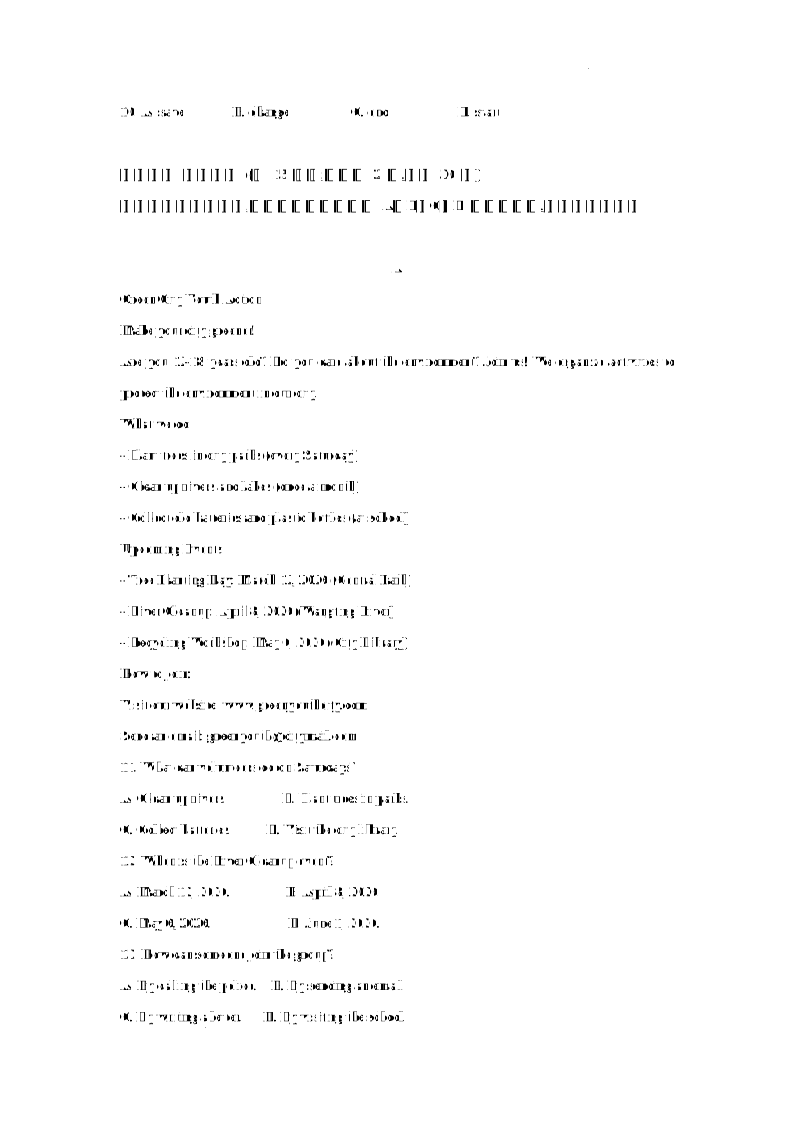
Green City Youth Action
Make your city greener!
Are you 12-18 years old? Do you care about the environment? Join us! We organize activities to protect the environment in our city.
What we do:
- Plant trees in city parks (every Saturday)
- Clean up rivers and lakes (once a month)
- Collect old batteries and plastic bottles (at school)
Upcoming Events:
- Tree Planting Day: March 12, 2026 (Central Park)
- River Cleanup: April 8, 2026 (Wangting River)
- Recycling Workshop: May 6, 2026 (City Library)
How to join:
Visit our website: www.greenyouthcity.com
Send an email: greenyouth@citymail.com
11. What can volunteers do on Saturdays?
A. Clean up rivers. B. Plant trees in parks.
C. Collect batteries. D. Visit the city library.
12. When is the River Cleanup event?
A. March 12, 2026. B. April 8, 2026.
C. May 6, 2026. D. June 1, 2026.
13. How can someone join the group?
A. By calling the police. B. By sending an email.
C. By writing a letter. D. By visiting the school.
B
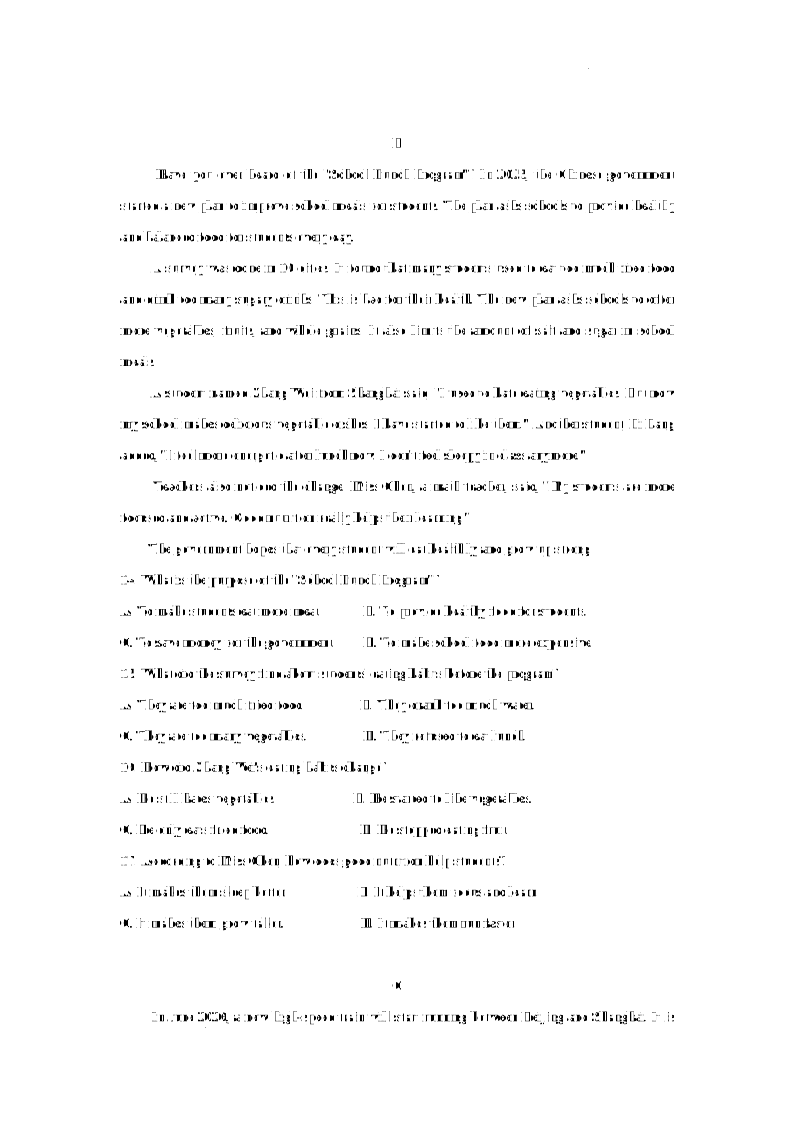
Have you ever heard of the "School Lunch Program"? In 2025, the Chinese government started a new plan to improve school meals for students. The plan asks schools to provide healthy and balanced food for students every day.
A survey was done in 10 cities. It found that many students used to eat too much fried food and drink too many sugary drinks. This is bad for their health. The new plan asks schools to offer more vegetables, fruits, and whole grains. It also limits the amount of salt and sugar in school meals.
A student named Zhang Wei from Shanghai said, "I used to hate eating vegetables. But now my school makes delicious vegetable dishes. I have started to like them." Another student, Li Fang, added, "I feel more energetic after lunch now. I don't feel sleepy in class anymore."
Teachers also noticed the change. Miss Chen, a math teacher, said, "My students are more focused and active. Good nutrition really helps their learning."
The government hopes that every student will eat healthily and grow up strong.
14. What is the purpose of the "School Lunch Program"?
A. To make students eat more meat. B. To provide healthy food for students.
C. To save money for the government. D. To make school food more expensive.
15. What did the survey find about students' eating habits before the program?
A. They ate too much fried food. B. They drank too much water.
C. They ate too many vegetables. D. They refused to eat lunch.
16. How did Zhang Wei's eating habits change?
A. He still hates vegetables. B. He started to like vegetables.
C. He only eats fried food. D. He stopped eating fruit.
17. According to Miss Chen, how does good nutrition help students?
A. It makes them sleep better. B. It helps them focus and learn.
C. It makes them grow taller. D. It makes them run faster.
C
In June 2026, a new high-speed train will start running between Beijing and Shanghai. It is called the "Intelligent Bullet Train" (智能复兴号). It is the fastest train in China, with a top speed of 450 kilometers per hour.
The train uses a new technology called "magnetic levitation" (磁悬浮). Instead of wheels touching the tracks, the train floats above the tracks using magnets. This makes the ride very smooth and quiet. The train is also very safe. It has a smart system that can detect problems before they happen.
A reporter named Wang Lei was invited to ride the train. He said, "I was amazed by the speed. The scenery outside the window was like a blur. But inside the train, it was very quiet. I could even hear my own breath."
The train also has comfortable seats, fast WiFi, and a restaurant car. It takes only 2 hours and 30 minutes to travel from Beijing to Shanghai. That is half the time of the older high-speed train.
The new train will help people travel faster and easier. It also shows how China is leading the world in technology.
18. What is the top speed of the new train?
A. 300 km/h. B. 350 km/h. C. 400 km/h. D. 450 km/h.
19. How does the train move without wheels touching the tracks?
A. It uses rockets. B. It uses magnets. C. It uses wind. D. It uses fuel.
20. How long does the new train take from Beijing to Shanghai?
A. 4 hours. B. 3 hours. C. 2 hours 30 minutes. D. 5 hours.
21. What is the best title for this passage?
A. The Old High-Speed Train. B. China's New Intelligent Bullet Train.
C. How to Travel Around the World. D. A New Restaurant in Shanghai.
D
Lin Tao was a quiet boy. He hardly talked to anyone at school. His classmates thought he was shy. But inside, Lin Tao was just scared of saying the wrong thing.
One day, his English teacher, Mr. Lee, asked the class to give a speech about their dreams. Lin Tao panicked. He did not want to stand in front of the class. He tried to hide behind his book.
Mr. Lee noticed this. He walked to Lin Tao's desk and said softly, "I know you are nervous. But a true man steps forward even when he is afraid." Then Mr. Lee told the class a story about his own fear of speaking in public. "I used to shake before every speech," Mr. Lee said. "But I learned that everyone is afraid. The brave ones just try anyway."
Lin Tao took a deep breath. He stood up and walked to the front. His voice was small at first, but he kept going. He talked about his dream of becoming a doctor. When he finished, the whole class clapped.
After that day, Lin Tao joined the school's speech club. He still got nervous sometimes, but he never gave up. He knew that trying was more important than being perfect.
22. Why did Lin Tao avoid talking to others?
A. He was lazy. B. He was scared of saying the wrong thing.
C. He was angry. D. He did not like his classmates.
23. What did Mr. Lee do to help Lin Tao?
A. He forced Lin Tao to go to the front. B. He shared his own story of fear.
C. He gave Lin Tao a zero. D. He ignored Lin Tao.
24. What did Lin Tao do after his speech?
A. He quit the class. B. He joined the speech club.
C. He ran away. D. He hid behind his book.
25. What is the lesson from this story?
A. Practice makes perfect. B. Only smart people can speak well.
C. It is okay to be afraid as long as you try. D. Speech is not important.
第三部分 信息还原 (共 5 小题;每小题 1 分,满分 5 分)
请认真阅读下面短文,从短文后的选项中选出能填入空白处的最佳选项。选项中有两项为多余选项。
Do you know how much time we spend on electronic devices? According to a 2026 report, teenagers use screens for about 5 hours a day. That is a lot of time. 26 . It can affect our eyes and our sleep.
Doctors suggest taking a "screen break" every hour. 27 . You can stand up, walk around, or look out the window. This helps your eyes rest.
Another tip is to use the 20-20-20 rule. 28 . Then, look at something 20 feet away for 20 seconds.
You should also turn off your phone one hour before bedtime. 29 . It makes it easier to fall asleep.
Finally, spend time outside. Go for a walk or play sports. 30 . If you follow these rules, you will feel healthier and happier.
A. This means every 20 minutes, look away from the screen.
B. It helps your body and mind relax.
C. Spending too much time on screens is not good for our health.
D. Remember to charge your phone every night.
E. The blue light from the screen can make it hard to sleep.
F. Watching too much TV is bad.
G. Instead of scrolling on your phone, go outside and enjoy the sun.
第四部分 词汇运用 (共 13 小题;每小题 1 分,满分 13 分)
第一节 根据下列句子所给汉语注释或首字母,写出空缺处各单词的正确形式。每空限填一词。
31. My sister wants to be a ________ (护士) when she grows up.
32. Can you p________ the book to me? I can't reach it.
33. The box is too heavy. I need some ________ (帮助).
34. She is very p________. She never gives up, even when things are hard.
35. Look! The children are ________ (飞) kites in the park.
36. I have a ________ (头痛). I need to rest.
37. We should keep our classroom ________ (干净的) every day.
38. Don't forget to b________ your homework to school tomorrow.
第二节 请认真阅读下面短文,从方框中选择适当的单词或短语,在横线上填入其正确形式。每个单词或短语仅用一次。
at first give up because of depend on a number of
In modern life, people 39________ technology for almost everything. 40________, we use our phones to shop, learn, and communicate.
However, 41________ experts say we should have a "digital detox" (数码排毒). This means spending less time online. Many people feel stressed 42________ too much screen time.
If you feel tired, do not 43________. Just try to go outside and talk to people face to face.
第五部分 短文填空 (共 10 小题;每小题 1 分,满分 10 分)
请认真阅读下面短文,在横线上填入一个适当的单词或括号内单词的正确形式。
Chinese paper cutting (剪纸) is a traditional art form. It has a history of more than 1,500 years. People use scissors 44________ (cut) paper into beautiful pictures.
The pictures are often red. Red 45________ (symbolize) happiness and good luck in China. Common designs include flowers, animals, and 46________ (character) from Chinese stories.
During the Spring Festival, people put paper cuttings 47________ their windows and doors. They believe this will bring good luck to their 48________ (family).
In the past, paper cutting was a skill that girls had 49________ (learn). Today, many people around the world 50________ (interest) in it. They learn 51________ to make paper cuttings in art classes.
One famous paper cutting artist is Wang Fang. She has been doing paper cutting 52________ she was 10 years old. She says, "Paper cutting is not just a hobby. It is a way to keep our 53________ (culture) alive."
If you have scissors and paper, you can try it too. It is very fun!
第六部分 阅读表达 (共 3 小题;54 题 2 分,55 题 2 分,56 题 3 分;满分 7 分)
请认真阅读下面短文,用英语回答短文后的问题。
Have you ever heard of "e-waste"? E-waste means old computers, phones, and other electronic devices. Every year, people around the world produce 50 million tons of e-waste. Only 20% of it is recycled. The rest goes into landfills. This is bad for the environment.
E-waste contains dangerous materials. If they get into the soil or water, they can hurt plants and animals. But e-waste also has valuable materials like gold, silver, and copper. If we recycle it, we can save natural resources.
Some countries have started e-waste collection programs. In Norway, people can take their old phones to special bins. In Japan, companies have to recycle their old machines. China also has a law that requires electronic companies to collect and recycle e-waste.
As students, we can help too. Don't throw your old phone in the trash. Find a recycling center near you. You can also encourage your parents and friends to do the same. Together, we can make a big difference.
54. What is e-waste?
_______________________________________________________________________________
55. What are two reasons why e-waste is both good and bad?
_______________________________________________________________________________
56. How can students help with the e-waste problem? (Give 2 examples.)
_______________________________________________________________________________
第七部分 书面表达 (共 1 题;满分 25 分)
57. 假如你是李华,你的英国笔友Tom对中国传统节日很感兴趣。请你写一封邮件给他,介绍一个中国节日(如春节、中秋节、端午节等)。
内容包括:
(1) 节日的时间;
(2) 节日的传统活动;
(3) 节日对人们的意义。
要求:
(1) 词数 100 左右;
(2) 适当展开想象,增加细节;
(3) 文中不得出现真实校名和姓名等信息。
Dear Tom,
I am glad to know that you are interested in Chinese traditional festivals. I would like to introduce to you._______________________________________________________________
_______________________________________________________________________________
_______________________________________________________________________________
_______________________________________________________________________________
_______________________________________________________________________________
_______________________________________________________________________________
_______________________________________________________________________________
_______________________________________________________________________________
Yours,
Li Hua
参考答案
第一部分 完形填空:1-5 ACBAC 6-10 BBACB
第二部分 阅读理解:11-15 BBBAB 16-20 BBDBC 21-25 BBBBC
第三部分 信息还原:26-30 CAEGB
第四部分 词汇运用:31. nurse 32. pass 33. help 34. patient 35. flying 36. headache 37. clean 38. bring 39. depend on 40. At first 41. a number of 42. because of 43. give up
第五部分 短文填空:44. to cut 45. symbolizes 46. characters 47. on 48. families 49. to learn 50. are interested 51. how 52. since 53. culture
第六部分 阅读表达:54. E-waste means old computers, phones, and other electronic devices. 55. It is bad because it contains dangerous materials that hurt the environment. It is good because it has valuable materials like gold and silver. 56. (1) Don't throw old phones in the trash. (2) Find a recycling center near you. (Any reasonable answers accepted)
第七部分 书面表达(范文)
Dear Tom,
I am glad to know that you are interested in Chinese traditional festivals. I would like to introduce the Mid-Autumn Festival to you.
The Mid-Autumn Festival is on the 15th day of the 8th lunar month. It is a time for families to get together. On this day, people eat mooncakes and enjoy the full moon. Children love to carry lanterns and listen to the story of Chang'e flying to the moon.
This festival is important because it symbolizes reunion and harmony. It reminds us to love our family and appreciate the beauty of life.
I hope you can come to China and celebrate this festival with me one day.
Yours,
Li Hua
学科网(北京)股份有限公司
$
资源预览图

1
2
3
相关资源
由于学科网是一个信息分享及获取的平台,不确保部分用户上传资料的 来源及知识产权归属。如您发现相关资料侵犯您的合法权益,请联系学科网,我们核实后将及时进行处理。