(山东济南专用)期末提分卷-- 2025-2026学年英语七年级下学期 人教版
2026-05-30
|
3份
|
32页
|
113人阅读
|
2人下载

资源信息
| 学段 | 初中 |
|---|---|
| 学科 | 英语 |
| 教材版本 | 初中英语人教版七年级下册 |
| 年级 | 七年级 |
| 章节 | - |
| 类型 | 试卷 |
| 知识点 | - |
| 使用场景 | 同步教学-期末 |
| 学年 | 2026-2027 |
| 地区(省份) | 山东省 |
| 地区(市) | 济南市 |
| 地区(区县) | - |
| 文件格式 | ZIP |
| 文件大小 | 5.74 MB |
| 发布时间 | 2026-05-30 |
| 更新时间 | 2026-05-30 |
| 作者 | 名卓英语 |
| 品牌系列 | - |
| 审核时间 | 2026-05-30 |
| 下载链接 | https://m.zxxk.com/soft/58124285.html |
| 价格 | 3.00储值(1储值=1元) |
| 来源 | 学科网 |
摘要:
**基本信息**
山东济南专用七年级下学期人教版英语期末提分卷,120分钟150分,涵盖听力、阅读、语言运用及写作,通过跨文化素材(如肢体语言差异)、生活情境(宠物与音乐、公园游玩写作)考查语言能力与文化意识,适配期末综合评估需求。
**题型特征**
|题型|题量/分值|知识覆盖|命题特色|
|----|-----------|----------|----------|
|听力|20题/30分|日常交际、信息获取|对话与短文结合,考查细节与主旨理解|
|阅读|25题/50分|跨文化(A篇)、科普(B篇)、人物故事(C篇)、传统体育(D篇)|分层设题(略读/扫读),七选五考查语篇衔接|
|语言运用|30题/35分|语法(完形填空)、词汇(阅读填空)、情景对话|完形填空融入文化适应(交换生故事),补全对话贴近校园生活|
|写作|6题/35分|图文应答、短文写作|情境运用(图片描述)与真实交际(朋友圈动态)结合,培养表达能力|
内容正文:
(山东济南专用)期末提分卷-- 2025-2026学年
七年级下学期 人教版 解析卷
英语
(考试时间:120分钟 试卷满分:150分)
注意事项:
1.答卷前,考生务必将自己的姓名、准考证号、座号等填写在答题卡和试卷指定位置上。
2.回答选择题时,选出每小题答案后,用2B铅笔把答题卡上对应题目的答案标号涂黑。如需改动,用橡皮擦干净后,再选涂其他答案标号。回答非选择题时,用0.5mm黑色签字笔将答案写在答题卡上。写在本试卷上无效。
3.考试结束后,将本试卷和答题卡一并交回。
第一部分 听力(共四节,满分30分)
第一节(共5个小题:每小题1.5分,满分7.5分)
1.
A.Huge. B.Africa. C.Bamboo.
【答案】B
【原文】Where do the giraffes come from?
2.
A.No problem. B.I like swimming. C.Very cold today.
【答案】A
【原文】Can I call you back later?
3.
A.They are healthy. B.I like potatoes. C.I don’t like potatoes.
【答案】B
【原文】Do you like potatoes or tomatoes?
4.
A.5 kilos. B.15 years old. C.25 dollars.
【答案】A
【原文】How many kilos of fruit would you like to buy?
5.
A.On the bed. B.Size M. C.100 yuan.
【答案】A
【原文】Where is her pink jacket?
第二节(共5个小题:每小题1.5分,满分7.5分)
6.What’s Jerry’s hometown famous for?
A.Flowers. B.Tea. C.Vegetables.
【答案】B
【原文】A: Hi, Jerry. Where are you from?
B: I’m from Fujian. My hometown is famous for its tea.
7.What house does Helen live in?
A.A tall building. B.A town house. C.A mobile home.
【答案】B
【原文】A: What type of house do you live in, Helen?
B: I live in a townhouse in the west of London.
8.What colour is Jack’s coat?
A.Grey. B.Blue. C.Black.
【答案】B
【原文】M: Mary, do you know which coat is Tim’s?
W: The gray one is his. The blue one is Jack’s.
9.Who is watering flowers?
A.Ben. B.Ben’s father. C.Ben’s mother.
【答案】B
【原文】A: Are your parents at home, Ben?
B: Yes. My mother is cooking. My father is watering flowers. As for me, I am watching TV.
10.How long can a pine (松树) live?
A.For 100 years. B.For 500 years. C.For 1,000 years.
【答案】C
【原文】A: How long can a pine live, Mr Gao?
B: Pines are always green and many of them can live for one thousand years.
第三节(共5个小题:每小题1.5分,满分7.5分)
录音中有一段对话,听对话两遍后,从每小题A、B、C中选出能回答所给问题的正确答案。(录音播放前有30秒钟的读题时间)
11.How many people are there in Ella’s family?
A.Five. B.Seven. C.Eight.
12.What color is Ella’s cap in the photo?
A.Blue. B.Pink. C.Orange.
13.What does Ella say about her grandparents?
A.They are clever.
B.They are funny.
C.They are kind.
14.Where is Ella’s dad now?
A.In Sydney. B.In Beijing. C.In London.
15.What does Joe like doing?
A.Reading. B.Hiking. C.Fishing.
【答案】11.B 12.A 13.C 14.C 15.A
【原文】A: How many people are there in your family, Ella?
B: There are 1, 2, 3, 7.
A: Oh, you have a big family.
B: Look, this is a photo of my family.
A: Wow, your pink hat looks nice.
B: That’s not me. That’s my twin sister Sally. I’m the one with the blue cap.
A: Oh, I see. Your grandparents look kind.
B: Yes, they are very kind. They love hiking. They go hiking every month.
A: Is this your dad?
B: Yes, he is in London now.
A: What about him?
B: He is my brother Joe. He is clever. He likes reading.
第四节(共5个小题:每小题1.5分,满分7.5分)
你将听到一篇短文,请根据短文内容,选出最佳答案。短文读两遍。
16.What time is it?
A.7:00 in the evening. B.7:30 in the evening. C.7:30 in the morning.
17.Where is Mrs. Black?
A.In the study (书房). B.In the living room. C.In the bedroom.
18.What is Mr. Black doing?
A.He is watching TV. B.He is reading a book. C.He is reading a newspaper.
19.Who is Mike?
A.Tom’s brother. B.Tom’s friend. C.Tom’s cousin.
20.What are Kate and Jane doing?
A.They’re listening to a CD.
B.They’re playing computer games.
C.They’re reading books.
【答案】16.B 17.A 18.C 19.B 20.A
【原文】
It is 7:30 in the evening. The Blacks are at home. Mrs. Black is in the study. She is drawing a picture. Mr. Black is in the living room. He is sitting in a chair and reading a newspaper. Tom and his friend Mike are in Tom’s room. They are playing computer games. Kate and her friend Jane are in Kate’s bedroom. They are listening to a CD. All of them are having a good time.
第二部分 阅读(共两节,满分50分)
第一节 阅读理解(共20个小题:每小题2分,满分40分)
阅读下列短文,从每题所给的A、B、C、D四个选项中选出最佳选项。
A
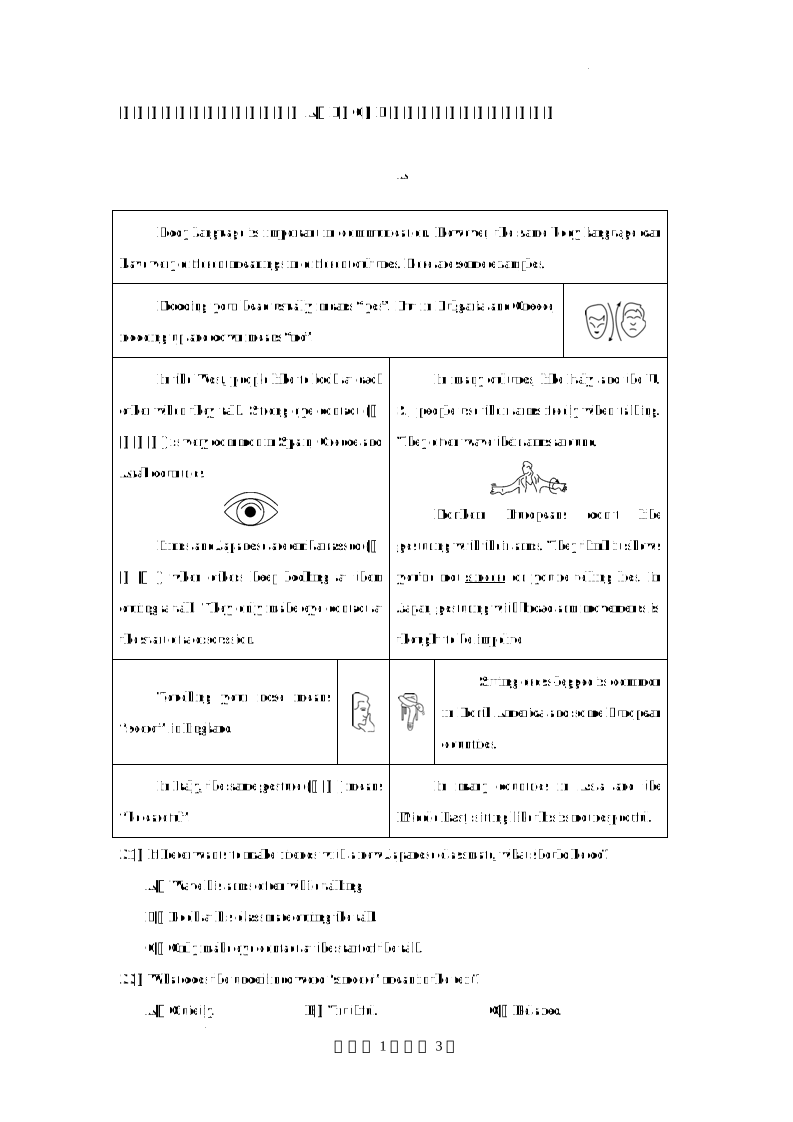
Body language is important in communication. However, the same body language can have very different meanings in different cultures. Here are some examples.
Nodding your head usually means “yes”. But in Bulgaria and Greece, nodding up and down means “no”.
In the West, people like to look at each other when they talk. Strong eye contact (眼神交流) is very common in Spain, Greece and Arab countries.
Finns and Japanese are embarrassed (尴尬的) when others keep looking at them during a talk. They only make eye contact at the start of a discussion.
In many cultures, like Italy and the U. S., people use their arms freely when talking. They often wave their arms around.
Northern Europeans don’t like gesturing with their arms. They think it shows you’re not sincere or you’re telling lies. In Japan, gesturing with broad arm movements is thought to be impolite.
Touching your nose means “secret” in England.
Sitting cross-legged is common in North America and some European countries.
In Italy, the same gesture (姿势) means “be careful”.
In many countries in Asia and the Middle East, sitting like this is not respectful.
21.If Peter wants to make friends with a new Japanese classmate, what should he do?
A.Wave his arms often while talking.
B.Look at his classmate during the talk.
C.Only make eye contact at the start of the talk.
22.What does the underlined word “sincere” mean in the text?
A.Quietly. B.Truthful. C.Relaxed.
23.What does it mean when an Italian touches his nose in a conversation?
A.I agree with you. B.You are lying. C.Be more careful.
24.What is the writer’s main purpose in writing this text?
A.To tell readers what body language is.
B.To ask readers to use more body language.
C.To help readers understand other cultures better.
25.Where is the text probably taken from?
A.A health magazine. B.A culture magazine. C.A science magazine.
【答案】21.C 22.B 23.C 24.C 25.B
【导语】本文是一篇说明文。主要介绍了点头、眼神交流、摸鼻子、坐姿等常见肢体动作在不同文化中的不同含义。
【详解】21.根据“Finns and Japanese are embarrassed when others keep looking at them during a talk. They only make eye contact at the start of a discussion”,可知与日本同学交流时只应在讨论开始时进行眼神接触。
22.“sincere”所在的句子讨论肢体语言的含义,结合跨文化语境,此处指“真诚的”,与“Truthful”相符。
23.文中指出“In Italy, the same gesture(摸鼻子)means ‘be careful’”,故意大利人摸鼻子意为“小心”。
24.全文围绕同一肢体动作在不同文化中含义不同展开,旨在帮助读者更好地理解其他文化。
25.文本主题为跨文化交际中的肢体语言差异,属于文化类内容,故最可能选自文化类杂志。
B
Pets like dogs and cats are usually popular with people. If you keep a dog or a cat, do you always turn on the radio or TV when you’re not in just because you don’t want your pet to be lonely (孤独的)? A study shows that some of the British people with dogs would like to turn on the radio or turn on the television. But do pets really like this?
Sometimes dogs respond (作出反应) to music. A study shows that when there is light music playing, many dogs seem to be silent. When it comes to rock music, those dogs seem to be very excited. They make little response to popular music.
For cats, they hardly respond to music because their hearing spectrum (频谱) is different from humans’ (人类的), so what they hear when they listen to music is different from what we hear. Some studies show that cats respond to the sounds within their own hearing spectrum. Scientists once tried to see what would happen if they played “cat music” for the cats. They asked a professor (教授) to make special music for cats. And it showed that when they were playing it to 47 cats, some cats did respond to it.
So, you’d better play different music for your pets. Good news for cat lovers is that you can buy such special “cat music” online. The professor once took part in the cat study and he wrote “cat music” for sale online.
26.Why do some people leave the radio or TV on for their pets?
A.To do a study on pets. B.To stop them being noisy.
C.To make them less lonely. D.To make them love music.
27.The meaning of the underlined word “silent” is close to “______”.
A.quiet B.sick C.hungry D.afraid
28.What does the second paragraph mainly talk about?
A.Why dogs respond to some music. B.How to make dogs respond to music.
C.How dogs respond to different music. D.What sounds dogs would like to hear.
29.Which of the following is true?
A.Pets like to listen to the same music. B.Cats have little interest in music.
C.The professor didn’t sell things online. D.The “cat music” can make people excited.
30.What’s the best title for the passage?
A.How can we look after pets? B.What kind of music do dogs love?
C.Where can we buy special “cat music”? D.Do dogs and cats like music?
【答案】26.C 27.A 28.C 29.B 30.D
【导语】本文是一篇说明文,介绍了宠物狗和猫是否喜欢音乐、它们对不同音乐的反应,以及专门为猫咪创作的音乐等相关内容。
【详解】26.根据第一段中的“If you keep a dog or a cat, do you always turn on the radio or TV when you’re not in just because you don’t want your pet to be lonely (孤独的)?”可知,人们离开时开着收音机或电视是为了不让宠物感到孤单。
27.根据第二段中的“Sometimes dogs respond (作出反应) to music. A study shows that when there is light music playing, many dogs seem to be silent. When it comes to rock music, those dogs seem to be very excited.”可知,狗会对音乐作出反应,这里用轻音乐和摇滚音乐做对比,excited“兴奋的”的反义状态是安静的,所以silent和quiet“安静的”意思相近。
28.根据第二段中的“Sometimes dogs respond (作出反应) to music. A study shows that when there is light music playing, many dogs seem to be silent. When it comes to rock music, those dogs seem to be very excited.”可知,第二段先讲狗对轻音乐的反应,再讲狗对摇滚音乐的反应,整体是说明狗对不同音乐的不同反应。
29.根据第三段中的“For cats, they hardly respond to music because their hearing spectrum (频谱) is different from humans’ (人类的)...”可知,猫对音乐几乎没有反应,也就是说猫对音乐几乎没有兴趣。
30.文章围绕“猫狗是否喜欢音乐、对音乐的反应”展开,从狗对不同音乐的反应,到猫对普通音乐和“猫音乐”的反应,都在讨论宠物和音乐的关系,因此D选项“Do dogs and cats like music?”最适合作为标题。
C
Li Na is a primary school teacher in a small mountain village. She is not famous, but she is a hero to her students and neighbors.
Ten years ago, Li Na left her job in a big city and returned to her hometown. She wanted to help the children there get a better education. However, the school was very old. There were not enough desks, chairs, or books. Most parents worked far away and could not help.
Li Na did not give up. She talked to the villagers and said, “Let’s work together to change our school.” At first, only a few people joined her. But Li Na did not lose hope. She and her small team cleaned the classrooms and painted the walls with their own hands.
Then, Li Na asked parents in the city for help. Many of them sent books and schoolbags. Some even came on weekends to repair the broken desks. Little by little, more and more people joined.
Last year, the school got a new library. It was built with the help of the whole village. “One person cannot do much, but a team can make great things happen,” Li Na said with a smile.
Now, the school has over 200 students. Many of them dream of becoming teachers like Li Na. And they all know that teamwork makes dreams come true.
31.Where did Li Na work before she returned to her hometown?
A.In a small village. B.In a big city.
C.In a mountain school. D.In a foreign country.
32.What problems did the school have at first?
① No teachers. ② Not enough desks and chairs.
③ Few books. ④ No playground.
A.①② B.②③ C.①④ D.②④
33.How did Li Na get help from parents in the city?
A.She asked them to give money. B.She visited them one by one.
C.She asked them for help. D.She wrote a letter to the government.
34.What does the underlined word “It” in Paragraph 5 refer to?
A.The classroom. B.The library. C.The desk. D.The village.
35.What can we learn from Li Na’s story?
A.A teacher should work alone.
B.It is easy to build a new school.
C.City life is better than village life.
D.Teamwork can make great things happen.
【答案】31.B 32.B 33.C 34.B 35.D
【导语】本文讲述了乡村教师李娜放弃城市工作,回到家乡带领大家改善乡村学校条件,传递了团队合作成就梦想的道理。
【详解】31.第二段提到“Ten years ago, Li Na left her job in a big city and returned to her hometown.”,李娜回家乡前在大城市工作。
32.第二段提到“However, the school was very old. There were not enough desks, chairs, or books.”,学校初期的问题是桌椅不足、书籍稀少,对应②和③。
33.第四段提到“Then, Li Na asked parents in the city for help.”,李娜向城市里的家长寻求帮助。
34.第五段提到“Last year, the school got a new library. It was built with the help of the whole village.”,去年,在全村帮助下学校有了一个新图书馆,划线单词“It”指代的是前一句提到的“a new library”。
35.根据第五段李娜说的话“One person cannot do much, but a team can make great things happen,”以及文章最后一段“teamwork makes dreams come true”可知,文章主要告诉我们团队合作能成就大事。
D
A Dragon Boat Race
The dragon boat race is a traditional Chinese sport with a long history. It is held every year during the Dragon Boat Festival. Teamwork is the key to winning the race.
Last June, our school team took part in a dragon boat race in the city park. There were 12 members in our team, including 10 rowers, 1 drummer, and 1 steerer (掌舵人). The drummer beats the drum to keep the rhythm (节奏), and the steerer controls the direction of the boat.
At the beginning of the race, we were behind the other teams. Everyone felt nervous. But our drummer, Li Wei, beat the drum faster and shouted, “Pull together!” The rowers started rowing in the same rhythm. Slowly, we caught up.
In the last 100 meters, we gave our best effort. We passed two teams and finally finished in second place. Although we did not win first place, we learned a valuable lesson: when a team works together, nothing is impossible.
第一步:先略读下面短文,完成下面小题
36.What is the main idea of this passage?
A.How to become a good drummer.
B.How to win a race by rowing faster.
C.The history of the Dragon Boat Festival.
D.The importance of teamwork in a dragon boat race.
37.What did the team learn from the race?
A.Winning is everything. B.The drummer should not shout.
C.Rowing fast is the most important. D.Teamwork makes the impossible possible.
第二步:再扫读短文,回答第3—5题
38.How many members are there in the school dragon boat team?
A.10. B.11. C.12. D.13.
39.What did Li Wei do when the team was behind?
A.He stopped rowing. B.He jumped into the water.
C.He shouted and beat the drum faster. D.He asked for help from other teams.
40.What place did the team finally get?
A.First place. B.Second place. C.Third place. D.Fourth place.
【答案】36.D 37.D 38.C 39.C 40.B
【导语】本文主要介绍了去年六月作者学校校队参加的龙舟比赛,强调了团队合作的重要性。
【详解】36.本文主要介绍了去年六月作者学校校队参加的龙舟比赛。第一段“Teamwork is the key to winning the race.”指出,团队合作是获胜的关键;最后一段“when a team works together, nothing is impossible”总结,当团队合作时,没有什么是不可能的。全文贯穿的主题是龙舟赛中团队合作的重要性。
37.根据最后一段“Although we did not win first place, we learned a valuable lesson: when a team works together, nothing is impossible.”可知,队伍从比赛中学到的是团队合作能让不可能成为可能。
38.根据第二段“There were 12 members in our team, including 10 rowers, 1 drummer, and 1 steerer (掌舵人).”可知,学校龙舟队共有12人。
39.根据第三段“But our drummer, Li Wei, beat the drum faster and shouted, ‘Pull together!’”可知,当团队落后时,李伟加快击鼓并大喊鼓舞士气。
40.根据最后一段“We passed two teams and finally finished in second place.”可知,团队最终获得了第二名。
第二节 阅读七选五(共5个小题:每小题2分,满分10分)
More and more people like to have dogs at home. 41 And for others, dogs are like their best friends or even part of the family. Do you know why? Dogs are really smart. They can even learn numbers!
If you want to get a dog, you have to think about how big your house is. 42 If you have a big house or a lot of space, then a big dog would be okay.
Dogs eat all kinds of foods. They love meat, fruit and lots of other things. 43 If it eats too much, it will get sick. Also, always give your dog clean water. In summer, when it’s really hot, your dog needs even more water.
44 They look so cute when they sleep. But at night, they are very watchful. Don’t forget to take your dog out for exercise. 45 Your dog needs your love, and you’ll get a lot of love back from it too. So, why not have a pet dog? It’s so much fun!
A.A lot of people are afraid of dogs.
B.But don’t give your dog too much food.
C.For some people, dogs are just cute pets.
D.I think you should try to get a big dog.
E.You should take it for a walk every day.
F.Dogs usually sleep for more than ten hours a day.
G.If your house is small, it will be better to get a little dog.
【答案】41.C 42.G 43.B 44.F 45.E
【导语】本文是一篇说明文,介绍了养狗需要注意的几个方面,包括人们对狗的不同看法、根据房子大小选择狗、狗的饮食、睡眠和运动需求等。
【详解】41.根据上文“More and more people like to have dogs at home.”以及下文“And for others, dogs are like their best friends or even part of the family.”可知,此处应介绍另一种人对狗的看法。选项C“对一些人来说,狗只是可爱的宠物”符合语境。
42.根据上文“you have to think about how big your house is”以及下文“If you have a big house...then a big dog would be okay.”可知,此处应说明房子小的情况适合养小狗。选项G“如果你的房子小,养一只小狗会更好”符合逻辑。
43.根据上文“They love meat, fruit and lots of other things.”以及下文“If it eats too much, it will get sick.”可知,此处应提醒不要喂太多食物。选项B“但不要给你的狗太多食物” 引出饮食注意事项。
44.根据下文“They look so cute when they sleep. But at night, they are very watchful.”可知,此处介绍狗的睡眠情况。选项F“狗通常每天睡十多个小时”契合睡眠相关话题。
45.根据上文“Don’t forget to take your dog out for exercise.”以及下文“Your dog needs your love...”可知,此处建议每天遛狗。选项E“你应该每天带它去散步”符合语境。
第三部分 语言运用(共三节,满分35分)
第一节 补全对话(共5个小题:每小题1分,满分5分)
Peter: Hey, Teng Fei!
Teng Fei: Hey, Peter!
Peter: It’s amazing. What about you?
Teng Fei: It’s fine, I’m so upset that we don’t have ping-pong class this term.
Peter: But we will have ping-pong, swimming, and kung fu next term.
Teng Fei: Really? That’s great! I will take ping-pong.
Peter: That’s cool! Hope you enjoy it.
Teng Fei: Thanks.
Peter: Emm ... I have not decided yet. Kung fu is so cool. And I always wanted to be a kung fu star. But I started playing football when I was five. It’s really hard to drop it.
Teng Fei: You know what? Kung fu is one of the most famous examples of traditional Chinese culture. If you take it, you will understand China better.
Peter: Thanks. I think I’m going to take it and go to the football club after school.
46.A.How do you like our football class? B.What do you like about our football class?
C.How often do you play football? D.Why do you like our football class?
47.A.but I know nothing about football . B.but I like football better.
C.but I don’t like ping-pong . D.but I like ping-pong better.
48.A.How exciting! B.What a pity! C.No way! D.My pleasure!
49.A.Are you interested in Kung fu? B.Is it hard to learn Kung fu?
C.Do you want to try something new? D.Would you like to join us?
50.A.I’ve no idea. B.Of course. C.It’s a shame. D.Sounds great.
【答案】46.A 47.D 48.B 49.C 50.D
【导语】本文是一段对话,二人围绕足球课程感受、本学期无乒乓球课的遗憾、下学期特色课程选择以及功夫文化展开交流。
【详解】46.Peter回答它太棒了,这是对某种事物的评价。A项“How do you like our football class?”是询问对方对某事看法的常用句型,能自然引出Peter的评价,符合语境。
47.Teng Fei先说还行,紧接着表达我很沮丧这学期没有乒乓球课。D项“but I like ping-pong better.”通过转折连词“but”连接前后句意,解释了为什么没乒乓球课会让他沮丧,逻辑通顺。
48.Teng Fei表达了对没有乒乓球课的遗憾,Peter对此应表示同情或遗憾。B项“What a pity!”是对他人不幸遭遇的恰当回应,随后Peter用“But”转折告知下学期的好消息,衔接自然。
49.Peter回答我不知道,后来提到了功夫太酷了以及自己一直在纠结是否放弃足球去学功夫。这表明Teng Fei的问题是关于有没有其他感兴趣的。C项“Do you want to try something new?”符合上下文逻辑。
50.Teng Fei建议Peter如果学功夫能更好地了解中国文化,Peter最后决定我想我要选它……。这说明Peter接受了建议并感到满意。D项“Sounds great.”是对他人建议的积极反馈,且后文紧跟“Thanks”,语意连贯。
第二节 完形填空(共15个小题:每小题1分,满分15分)
My good friend Daniel is an exchange (交换) student. He is 51 the USA.He is the only American 52 in our school. He is my classmate. He is a friendly boy 53 all the students in our class like to make friends with him. He says he enjoys living and 54 in China.
Daniel says he likes sport. He 55 tall and strong. He is about 1.70 meters tall. He 56 us he is a good tennis 57 . He often played tennis 58 coming to China. But now in our school, he can’t find any good 59 to play tennis. There isn’t a tennis court in our school. I tell him that he can be a good player in our basketball 60 . So he joins us and practices 61 us twice (两次) a week. We 62 he is a good player. He 63 shooting (投篮). He often scores (得分) for our 64 . Now, Daniel is very happy. He 65 to like playing basketball.
51.A.of B.at C.from D.with
52.A.teacher B.student C.girl D.farmer
53.A.because B.and C.but D.if
54.A.working B.studying C.writing D.reading
55.A.sees B.looks C.watches D.looks at
56.A.talks B.speaks C.says D.tells
57.A.people B.dancer C.player D.boy
58.A.after B.before C.when D.without
59.A.time B.food C.money D.places
60.A.class B.colour C.team D.classroom
61.A.by B.for C.with D.on
62.A.show B.look at C.look for D.find
63.A.is good at B.is weak at C.is easy at D.is interested at
64.A.school B.class C.team D.club
65.A.begins B.beginning C.start D.starting
【答案】
51.C 52.B 53.B 54.B 55.B 56.D 57.C 58.B 59.D 60.C 61.C 62.D 63.A 64.C 65.A
【导语】本文介绍了交换生Daniel的国籍、外貌及爱好,讲述他加入学校篮球队的经历和感受。
【详解】51.句意:他来自美国。
根据“the USA”可知,他来自美国,固定搭配be from表示“来自”。
52.句意:他是我们学校唯一的美国学生。
根据前文“exchange student”和代词“He”可知,Daniel的身份是学生,且性别为男,student“学生”符合逻辑。
53.句意:他是一个友好的男孩,并且全班学生都喜欢和他做朋友。
根据“He is a friendly boy...all the students in our class like to make friends with him.”可知,前后句为并列关系,用连词and“并且”。
54.句意:他说他喜欢在中国生活和学习。
根据前文“exchange student”可知,Daniel的身份是学生,在中国主要是学习,studying“学习”符合语境。
55.句意:他看起来又高又壮。
根据“He...tall and strong.”可知,此处需要补充系动词,构成主系表结构,looks“看起来”是系动词,符合语法结构要求。sees“看见”强调看的结果;watches“观看”强调持续地看;looks at“看”强调看的动作,均为实义动词。
56.句意:他告诉我们他是一位优秀的网球运动员。
空后“us he is a good tennis...”是双宾语结构,tells“告诉”可接双宾语。talks“交谈”强调双方交互;speaks讲某种语言,强调说的动作;says“说”强调说的内容,均不能接双宾语结构。
57.句意:他告诉我们他是一位优秀的网球运动员。
根据后文“He often played tennis”可知,他是一位网球运动员,player“运动员”符合语境。
58.句意:来中国之前他常打网球。
根据后文“But now in our school, he can’t find any good...to play tennis.”可知,他经常打网球是来中国之前的事,before“在……之前”符合逻辑。
59.句意:但是现在我们学校里,他找不到任何打网球的好地方。
根据后文“There isn’t a tennis court in our school.”可知,此处指打网球的地方,places“地方”符合语境。
60.句意:我告诉他,他可以成为我们篮球队的一名好球员。
根据上文“a good player”和后文“So he joins us”可知,他可以成为篮球队的一员,team“队”符合语境。
61.句意:所以他加入我们,每周和我们一起练习两次。
根据“practices...us”可知,他和我们一起练习,with“和”符合语义。
62.句意:我们发现他是个好选手。
根据语境可知,此处表示经过练习后发现的结果,find“发现”符合语境。
63.句意:他擅长投篮。
根据上文“he is a good player”和后文“He often scores”可知,他擅长投篮,is good at“擅长”符合逻辑。is weak at“不擅长”;is easy at表达错误;is interested at表达错误,均不符合上下文逻辑或表达错误。
64.句意:他经常为我们队得分。
根据上文可知,Daniel加入了篮球队,因此是为篮球队得分,team“队”符合语境。
65.句意:他开始喜欢打篮球。
主语“He”是第三人称单数,谓语动词应用三单形式,begins“开始”符合主谓一致要求。beginning是现在分词;start开始,动词原形;starting是现在分词,均不符合句子的语法要求。
第三节 阅读填空(共10个小题:每小题1.5分,满分15分)
Sports are fun and good for us, and everyone should get a 66 (chance) to play. They are 67 (fair) easy to join in, and they 68 (shape) our bodies in healthy ways.
Before playing, don’t let your stomach stay 69 (empty)—eat a small snack first. Warm up 70 (carefully) than usual. You are less likely 71 (get) hurt if you prepare well. When playing with classmates, it’s 72 (polite) to cheat (欺骗). We should take rules 73 (serious) and play fair.
Team sports teach us to help each other. We need to finish games 74 (within) time and support our teammates. Our PE teacher always 75 (pay) attention to our safety and shows us how to play right. Sports make us strong and help us learn useful skills.
【答案】
66.chance 67.fairly 68.shape 69.empty 70.more carefully 71.to get 72.impolite 73.seriously 74.within 75.pays
【导语】本文是一篇说明文,主要介绍了运动的好处、运动前后的注意事项以及团队运动的意义。
【详解】66.句意:运动很有趣,对我们也有好处,每个人都应该有机会参与其中。设空前有不定冠词a,后接可数名词单数。chance“机会”本身为名词原形,符合a+可数名词单数的用法。
67.句意:它们相当容易参与,并且以健康的方式塑造我们的身体。设空后为形容词easy,需用副词修饰形容词。fair“公平的”的副词形式是fairly,意为“相当;公平地”。
68.句意:它们相当容易参与,并且以健康的方式塑造我们的身体。句子主语是they(复数),时态为一般现在时,谓语动词用原形。
69.句意:运动前,不要让你的胃空着——先吃点小零食。设空在系动词stay后,需用形容词作表语。
70.句意:比平时更认真地热身。设空后有比较级标志词than,需用副词的比较级形式修饰动词短语warm up。carefully“认真地”的比较级为more carefully。
71.句意:如果你准备充分,受伤的可能性就更小。固定搭配be likely to do sth.表示“可能做某事”,因此设空处需用动词不定式形式。get“变得;受到”的不定式为to get。
72.句意:和同学一起玩时,作弊是不礼貌的。根据语境“作弊”是不礼貌的行为,需用polite“礼貌的”的反义词impolite“不礼貌的”。固定句型It’s+形容词+to do sth.中用形容词作表语。
73.句意:我们应该认真对待规则,公平竞争。固定搭配take sth. seriously表示“认真对待某事”,需用副词seriously“认真地”修饰动词take。
74.句意:我们需要在规定时间内完成比赛并支持我们的队友。设空后为名词time,需用介词构成介词短语作状语。within“在……之内”本身为介词,within time表示“在规定时间内”,符合语境。
75.句意:我们的体育老师总是注意我们的安全,并教我们如何正确运动。句子主语Our PE teacher是第三人称单数,时态为一般现在时,谓语动词需用第三人称单数形式。pay“注意”的第三人称单数形式为pays。
第四部分 写作(共两节,满分35分)
第一节情境运用(共5小题;每小题2分,满分10分)
根据所给的图片, 用一个完整的句子提问或应答。
76.A: Is this your bag, Lily?
B: ____________________________.
77.A: What does Mary often do?
B: ____________________________.
78. A: What rules do we follow at school?
B: ____________________________.
79.A: ____________________________ ?
B: Because they are kind of cute.
80.A: ____________________________, Mike?
B: His favourite sport is swimming.
【答案】76.No, it isn’t. It’s Lucy’s 77.She often plays ping-pong/plays table tennis 78.We can’t/mustn’t use mobile phones at school/Don’t use mobile phones at school 79.Why do you like pandas 80.What is his favourite sport
【详解】76.问句意为“这是你的书包吗,莉莉?”,属于一般疑问句。观察图片,书包旁边明确写着“Lucy’s”,说明书包不是莉莉的。因此需要先作否定回答No, it isn’t.,再补充说明它是露西的It’s Lucy’s.。
77.问句意为“玛丽经常做什么?”。观察图片,图中的人物正在打乒乓球play ping-pong/play table tennis。因为主语是Mary是第三人称单数,且问句中有often,时态为一般现在时,所以动词play需要加-s,变为plays,故填She often plays ping-pong/plays table tennis。
78.问句意为“我们在学校要遵守什么规则?”。观察图片,是一个手机上画着红色斜杠的标志,代表“禁止使用手机”。可以用情态动词can’t/mustn’t表示禁止,答语完整表达为We can’t/mustn’t use mobile phones at school,也可以直接用祈使句的否定形式,Don’t use mobile phones at school.
79.答语意为“因为它们有点可爱。”,由“Because”开头可知,问句必然是“Why”引导的询问原因的特殊疑问句。观察图片是一只熊猫,且答语中用了复数代词“they”,说明问句是在问Why do you like pandas?。
80.答语意为“他最喜欢的运动是游泳。”。根据答语的内容可以直接倒推问句,答语的主语是“His favourite sport”,所以问句应该用“What”来提问,“他最喜欢的运动是什么”,即“What is his favourite sport”。
第二节作文(满分25分)
81.假如你是李媛,星期六下午正和家人一起在公园游玩。为了练习英语,你想用英语在朋友圈发一条动态。请你根据以下提示,写一篇英语短文。
提示:
1. Where are you now?
2. What are you doing?
3. How is the weather?
4. How do you feel?
要求:
(1)短文必须回答所有提示问题,可适当拓展内容;
(2)词数 80–120 词,开头已给出,不计入总词数。
开头:Hello from the park this Saturday afternoon!
________________________________________________________________________________________________________________________________________________________________________________________________________________________________________________________________________________________________________________________________________________________________________________
【答案】
例文:
Hello from the park this Saturday afternoon! I am here with my parents. We are enjoying the beautiful sunshine. The weather is sunny and warm, perfect for outdoor activities.
Look! My father is flying a kite near the lake, while my mother is taking photos of the flowers. I am walking along the path and breathing the fresh air. Everything looks so green and lively.
I feel very relaxed and happy because I spend quality time with my family. It is a wonderful day to get close to nature. I hope you can also enjoy your weekend!
【详解】写作步骤
[第一步:审题立意]
确定文体:记叙文,以现在进行时为主
明确要点:地点;天气;正在做的事;感受
确定人称:第一人称(I/my)
注意事项:必须回答所有提示问题;词数80-120词
[第二步:构思布局]
三段式结构:
开头段:描述所在的地方和天气状况
主体段:描述正在做的事
结尾段:描述感受和结尾祝福
[第三步:要点展开]
要点一:地点
地点:in the park/at the lake/by the river/in the forest/on the grass/under the big tree/near the lake...
要点二:天气
天气:sunny and warm/perfect for outdoor activities/cloudy and cool/a gentle breeze blowing/clear blue sky/bright sunshine/pleasant temperature...
要点三:正在做的事
正在做的事:flying a kite/taking photos/walking along the path/having a picnic on the grass/reading a book under the tree/playing badminton/feeding the ducks/watching children flying kites...
要点四:感受
感受:relaxed and happy/a wonderful day to get close to nature/feel peaceful and joyful/grateful for this family time/this makes me forget all my worries/feel lucky to have such a perfect day...
试卷第1页,共3页
试卷第1页,共3页
学科网(北京)股份有限公司
$
(山东济南专用)期末提分卷-- 2025-2026学年
七年级下学期 人教版
英语
(考试时间:120分钟 试卷满分:150分)
注意事项:
1.答卷前,考生务必将自己的姓名、准考证号、座号等填写在答题卡和试卷指定位置上。
2.回答选择题时,选出每小题答案后,用2B铅笔把答题卡上对应题目的答案标号涂黑。如需改动,用橡皮擦干净后,再选涂其他答案标号。回答非选择题时,用0.5mm黑色签字笔将答案写在答题卡上。写在本试卷上无效。
3.考试结束后,将本试卷和答题卡一并交回。
第一部分 听力(共四节,满分30分)
第一节(共5个小题:每小题1.5分,满分7.5分)
1. A.Huge. B.Africa. C.Bamboo.
2.A.No problem. B.I like swimming. C.Very cold today.
3.A.They are healthy. B.I like potatoes. C.I don’t like potatoes.
4.A.5 kilos. B.15 years old. C.25 dollars.
5.A.On the bed. B.Size M. C.100 yuan.
第二节(共5个小题:每小题1.5分,满分7.5分)
6.What’s Jerry’s hometown famous for?
A.Flowers. B.Tea. C.Vegetables.
7.What house does Helen live in?
A.A tall building. B.A town house. C.A mobile home.
8.What colour is Jack’s coat?
A.Grey. B.Blue. C.Black.
9.Who is watering flowers?
A.Ben. B.Ben’s father. C.Ben’s mother.
10.How long can a pine (松树) live?
A.For 100 years. B.For 500 years. C.For 1,000 years.
第三节(共5个小题:每小题1.5分,满分7.5分)
录音中有一段对话,听对话两遍后,从每小题A、B、C中选出能回答所给问题的正确答案。(录音播放前有30秒钟的读题时间)
11.How many people are there in Ella’s family?
A.Five. B.Seven. C.Eight.
12.What color is Ella’s cap in the photo?
A.Blue. B.Pink. C.Orange.
13.What does Ella say about her grandparents?
A.They are clever.
B.They are funny.
C.They are kind.
14.Where is Ella’s dad now?
A.In Sydney. B.In Beijing. C.In London.
15.What does Joe like doing?
A.Reading. B.Hiking. C.Fishing.
第四节(共5个小题:每小题1.5分,满分7.5分)
你将听到一篇短文,请根据短文内容,选出最佳答案。短文读两遍。
16.What time is it?
A.7:00 in the evening. B.7:30 in the evening. C.7:30 in the morning.
17.Where is Mrs. Black?
A.In the study (书房). B.In the living room. C.In the bedroom.
18.What is Mr. Black doing?
A.He is watching TV. B.He is reading a book. C.He is reading a newspaper.
19.Who is Mike?
A.Tom’s brother. B.Tom’s friend. C.Tom’s cousin.
20.What are Kate and Jane doing?
A.They’re listening to a CD.
B.They’re playing computer games.
C.They’re reading books.
第二部分 阅读(共两节,满分50分)
第一节 阅读理解(共20个小题:每小题2分,满分40分)
阅读下列短文,从每题所给的A、B、C、D四个选项中选出最佳选项。
A
Body language is important in communication. However, the same body language can have very different meanings in different cultures. Here are some examples.
Nodding your head usually means “yes”. But in Bulgaria and Greece, nodding up and down means “no”.
In the West, people like to look at each other when they talk. Strong eye contact (眼神交流) is very common in Spain, Greece and Arab countries.
Finns and Japanese are embarrassed (尴尬的) when others keep looking at them during a talk. They only make eye contact at the start of a discussion.
In many cultures, like Italy and the U. S., people use their arms freely when talking. They often wave their arms around.
Northern Europeans don’t like gesturing with their arms. They think it shows you’re not sincere or you’re telling lies. In Japan, gesturing with broad arm movements is thought to be impolite.
Touching your nose means “secret” in England.
Sitting cross-legged is common in North America and some European countries.
In Italy, the same gesture (姿势) means “be careful”.
In many countries in Asia and the Middle East, sitting like this is not respectful.
21.If Peter wants to make friends with a new Japanese classmate, what should he do?
A.Wave his arms often while talking.
B.Look at his classmate during the talk.
C.Only make eye contact at the start of the talk.
22.What does the underlined word “sincere” mean in the text?
A.Quietly. B.Truthful. C.Relaxed.
23.What does it mean when an Italian touches his nose in a conversation?
A.I agree with you. B.You are lying. C.Be more careful.
24.What is the writer’s main purpose in writing this text?
A.To tell readers what body language is.
B.To ask readers to use more body language.
C.To help readers understand other cultures better.
25.Where is the text probably taken from?
A.A health magazine. B.A culture magazine. C.A science magazine.
B
Pets like dogs and cats are usually popular with people. If you keep a dog or a cat, do you always turn on the radio or TV when you’re not in just because you don’t want your pet to be lonely (孤独的)? A study shows that some of the British people with dogs would like to turn on the radio or turn on the television. But do pets really like this?
Sometimes dogs respond (作出反应) to music. A study shows that when there is light music playing, many dogs seem to be silent. When it comes to rock music, those dogs seem to be very excited. They make little response to popular music.
For cats, they hardly respond to music because their hearing spectrum (频谱) is different from humans’ (人类的), so what they hear when they listen to music is different from what we hear. Some studies show that cats respond to the sounds within their own hearing spectrum. Scientists once tried to see what would happen if they played “cat music” for the cats. They asked a professor (教授) to make special music for cats. And it showed that when they were playing it to 47 cats, some cats did respond to it.
So, you’d better play different music for your pets. Good news for cat lovers is that you can buy such special “cat music” online. The professor once took part in the cat study and he wrote “cat music” for sale online.
26.Why do some people leave the radio or TV on for their pets?
A.To do a study on pets. B.To stop them being noisy.
C.To make them less lonely. D.To make them love music.
27.The meaning of the underlined word “silent” is close to “______”.
A.quiet B.sick C.hungry D.afraid
28.What does the second paragraph mainly talk about?
A.Why dogs respond to some music. B.How to make dogs respond to music.
C.How dogs respond to different music. D.What sounds dogs would like to hear.
29.Which of the following is true?
A.Pets like to listen to the same music. B.Cats have little interest in music.
C.The professor didn’t sell things online. D.The “cat music” can make people excited.
30.What’s the best title for the passage?
A.How can we look after pets? B.What kind of music do dogs love?
C.Where can we buy special “cat music”? D.Do dogs and cats like music?
C
Li Na is a primary school teacher in a small mountain village. She is not famous, but she is a hero to her students and neighbors.
Ten years ago, Li Na left her job in a big city and returned to her hometown. She wanted to help the children there get a better education. However, the school was very old. There were not enough desks, chairs, or books. Most parents worked far away and could not help.
Li Na did not give up. She talked to the villagers and said, “Let’s work together to change our school.” At first, only a few people joined her. But Li Na did not lose hope. She and her small team cleaned the classrooms and painted the walls with their own hands.
Then, Li Na asked parents in the city for help. Many of them sent books and schoolbags. Some even came on weekends to repair the broken desks. Little by little, more and more people joined.
Last year, the school got a new library. It was built with the help of the whole village. “One person cannot do much, but a team can make great things happen,” Li Na said with a smile.
Now, the school has over 200 students. Many of them dream of becoming teachers like Li Na. And they all know that teamwork makes dreams come true.
31.Where did Li Na work before she returned to her hometown?
A.In a small village. B.In a big city.
C.In a mountain school. D.In a foreign country.
32.What problems did the school have at first?
① No teachers. ② Not enough desks and chairs.
③ Few books. ④ No playground.
A.①② B.②③ C.①④ D.②④
33.How did Li Na get help from parents in the city?
A.She asked them to give money. B.She visited them one by one.
C.She asked them for help. D.She wrote a letter to the government.
34.What does the underlined word “It” in Paragraph 5 refer to?
A.The classroom. B.The library. C.The desk. D.The village.
35.What can we learn from Li Na’s story?
A.A teacher should work alone.
B.It is easy to build a new school.
C.City life is better than village life.
D.Teamwork can make great things happen.
D
A Dragon Boat Race
The dragon boat race is a traditional Chinese sport with a long history. It is held every year during the Dragon Boat Festival. Teamwork is the key to winning the race.
Last June, our school team took part in a dragon boat race in the city park. There were 12 members in our team, including 10 rowers, 1 drummer, and 1 steerer (掌舵人). The drummer beats the drum to keep the rhythm (节奏), and the steerer controls the direction of the boat.
At the beginning of the race, we were behind the other teams. Everyone felt nervous. But our drummer, Li Wei, beat the drum faster and shouted, “Pull together!” The rowers started rowing in the same rhythm. Slowly, we caught up.
In the last 100 meters, we gave our best effort. We passed two teams and finally finished in second place. Although we did not win first place, we learned a valuable lesson: when a team works together, nothing is impossible.
第一步:先略读下面短文,完成下面小题
36.What is the main idea of this passage?
A.How to become a good drummer.
B.How to win a race by rowing faster.
C.The history of the Dragon Boat Festival.
D.The importance of teamwork in a dragon boat race.
37.What did the team learn from the race?
A.Winning is everything. B.The drummer should not shout.
C.Rowing fast is the most important. D.Teamwork makes the impossible possible.
第二步:再扫读短文,回答第3—5题
38.How many members are there in the school dragon boat team?
A.10. B.11. C.12. D.13.
39.What did Li Wei do when the team was behind?
A.He stopped rowing. B.He jumped into the water.
C.He shouted and beat the drum faster. D.He asked for help from other teams.
40.What place did the team finally get?
A.First place. B.Second place. C.Third place. D.Fourth place.
第二节 阅读七选五(共5个小题:每小题2分,满分10分)
More and more people like to have dogs at home. 41 And for others, dogs are like their best friends or even part of the family. Do you know why? Dogs are really smart. They can even learn numbers!
If you want to get a dog, you have to think about how big your house is. 42 If you have a big house or a lot of space, then a big dog would be okay.
Dogs eat all kinds of foods. They love meat, fruit and lots of other things. 43 If it eats too much, it will get sick. Also, always give your dog clean water. In summer, when it’s really hot, your dog needs even more water.
44 They look so cute when they sleep. But at night, they are very watchful. Don’t forget to take your dog out for exercise. 45 Your dog needs your love, and you’ll get a lot of love back from it too. So, why not have a pet dog? It’s so much fun!
A.A lot of people are afraid of dogs.
B.But don’t give your dog too much food.
C.For some people, dogs are just cute pets.
D.I think you should try to get a big dog.
E.You should take it for a walk every day.
F.Dogs usually sleep for more than ten hours a day.
G.If your house is small, it will be better to get a little dog.
第三部分 语言运用(共三节,满分35分)
第一节 补全对话(共5个小题:每小题1分,满分5分)
Peter: Hey, Teng Fei!
Teng Fei: Hey, Peter!
Peter: It’s amazing. What about you?
Teng Fei: It’s fine, I’m so upset that we don’t have ping-pong class this term.
Peter: But we will have ping-pong, swimming, and kung fu next term.
Teng Fei: Really? That’s great! I will take ping-pong.
Peter: That’s cool! Hope you enjoy it.
Teng Fei: Thanks.
Peter: Emm ... I have not decided yet. Kung fu is so cool. And I always wanted to be a kung fu star. But I started playing football when I was five. It’s really hard to drop it.
Teng Fei: You know what? Kung fu is one of the most famous examples of traditional Chinese culture. If you take it, you will understand China better.
Peter: Thanks. I think I’m going to take it and go to the football club after school.
46.A.How do you like our football class? B.What do you like about our football class?
C.How often do you play football? D.Why do you like our football class?
47.A.but I know nothing about football . B.but I like football better.
C.but I don’t like ping-pong . D.but I like ping-pong better.
48.A.How exciting! B.What a pity! C.No way! D.My pleasure!
49.A.Are you interested in Kung fu? B.Is it hard to learn Kung fu?
C.Do you want to try something new? D.Would you like to join us?
50.A.I’ve no idea. B.Of course. C.It’s a shame. D.Sounds great.
第二节 完形填空(共15个小题:每小题1分,满分15分)
My good friend Daniel is an exchange (交换) student. He is 51 the USA.He is the only American 52 in our school. He is my classmate. He is a friendly boy 53 all the students in our class like to make friends with him. He says he enjoys living and 54 in China.
Daniel says he likes sport. He 55 tall and strong. He is about 1.70 meters tall. He 56 us he is a good tennis 57 . He often played tennis 58 coming to China. But now in our school, he can’t find any good 59 to play tennis. There isn’t a tennis court in our school. I tell him that he can be a good player in our basketball 60 . So he joins us and practices 61 us twice (两次) a week. We 62 he is a good player. He 63 shooting (投篮). He often scores (得分) for our 64 . Now, Daniel is very happy. He 65 to like playing basketball.
51.A.of B.at C.from D.with
52.A.teacher B.student C.girl D.farmer
53.A.because B.and C.but D.if
54.A.working B.studying C.writing D.reading
55.A.sees B.looks C.watches D.looks at
56.A.talks B.speaks C.says D.tells
57.A.people B.dancer C.player D.boy
58.A.after B.before C.when D.without
59.A.time B.food C.money D.places
60.A.class B.colour C.team D.classroom
61.A.by B.for C.with D.on
62.A.show B.look at C.look for D.find
63.A.is good at B.is weak at C.is easy at D.is interested at
64.A.school B.class C.team D.club
65.A.begins B.beginning C.start D.starting
第三节 阅读填空(共10个小题:每小题1.5分,满分15分)
Sports are fun and good for us, and everyone should get a 66 (chance) to play. They are 67 (fair) easy to join in, and they 68 (shape) our bodies in healthy ways.
Before playing, don’t let your stomach stay 69 (empty)—eat a small snack first. Warm up 70 (carefully) than usual. You are less likely 71 (get) hurt if you prepare well. When playing with classmates, it’s 72 (polite) to cheat (欺骗). We should take rules 73 (serious) and play fair.
Team sports teach us to help each other. We need to finish games 74 (within) time and support our teammates. Our PE teacher always 75 (pay) attention to our safety and shows us how to play right. Sports make us strong and help us learn useful skills.
第四部分 写作(共两节,满分35分)
第一节情境运用(共5小题;每小题2分,满分10分)
根据所给的图片, 用一个完整的句子提问或应答。
76.A: Is this your bag, Lily?
B: ____________________________.
77.A: What does Mary often do?
B: ____________________________.
78. A: What rules do we follow at school?
B: ____________________________.
79.A: ____________________________ ?
B: Because they are kind of cute.
80.A: ____________________________, Mike?
B: His favourite sport is swimming.
第二节作文(满分25分)
81.假如你是李媛,星期六下午正和家人一起在公园游玩。为了练习英语,你想用英语在朋友圈发一条动态。请你根据以下提示,写一篇英语短文。
提示:
1. Where are you now?
2. What are you doing?
3. How is the weather?
4. How do you feel?
要求:
(1)短文必须回答所有提示问题,可适当拓展内容;
(2)词数 80–120 词,开头已给出,不计入总词数。
开头:Hello from the park this Saturday afternoon!
________________________________________________________________________________________________________________________________________________________________________________________________________________________________________________________________________________________________________________________________________________________________________________
试卷第1页,共3页
试卷第1页,共3页
学科网(北京)股份有限公司
$听力考试正式开始。Where do the giraffe come from? Listen to the next . question. Can I call you back later? Can I call you back later? Listen to the next question. Do you like potatoes or tomata oes? Do you like potatoes or tomata oes? Listen to the next question. How many kilos of fruit would you like to buy? How many . kilos of fruit would . you like to buy? Listen to the next question. Where is her pink jacket? Where is her pink jacket? Listen to the next . question. Hi Jerry. Where are you from? I'm from fugen. My hometown is famous for its tea. Listen to the next question. What type of house do you live in? Helen. I live in a town house in the west of london. What type of house do you live in? Helen, I live in a town house in the west of london. Listen to the next question. Mary, do you know which code is tim? The gray one is his. The blue one is jack. Mary, do you know which code . is tims? The great one is his, the blue one is jack. Listen to the next . question. Are your parents at home ban? Yes, my mother is cooking. My father is watering flowers. As for me, I am watching T, V. Are your parents . at home? Bin, yes, my mother is cooking. My father is watering flowers. As for me, I am watching T, V. Listen to the next question. how long can a pine live? mr. r. gal. Pines are always Green, and many of them can live for one thousand years. How long can a pine live? Mister gal pines are . always Green, and many of them can live for one thousand years. Listen to the next question. how many people are there in your family? Ala. there are um one, two, three, seven. Oh. you have a big family. Look. this is a photo of . my family. Well, your pink hat looks nice. That's not me. That's my twin sister, Sally. I'm the one with a blue cap. Oh, I see your grandparents look kind. Yes, they are very kind. They love high gain. They go hiking every month. Is this . your dad? Yes, he is in london. Now what about him? He is my brother joe. He is clever. He likes reading. How many people are there in your . family? Ela, there are one, two, three, seven. Oh, you have a big family. Look, this is a photo of . my family. Well, your pink hat looks nice. That's not me. That's my twin sister, Sally. I'm the one with a blue cap. Oh, I see your grandparents look kind. Yes, they are very kind. They love high gang. They go hiking every month. Is this . your dad? Yes, he is in london. Now what about him? He is my brother joe. He is clever. He likes reading. Listen to the next question. IT is seven thirty in the evening. The blacks are at home. mrs. Black is in the study. SHE is drawing a picture. mr. Black is in the living room. He is sitting in a chair and reading a newspaper. Tom is friend. Mike are in tomb's room. They are playing computer games. Kate and her friend jane are in cate's bedroom. They are listening to AC. D. All of them are having a good time. IT is seven thirty in the evening. The black are at home. mrs. Black is in the study. SHE is drawing a picture. mr. Black is in the living room. He is sitting in a chair and reading a newspaper. Tom and his friend mike are in tom's room. They are playing computer games. Kate and her friend jane are in cate's bedroom. They're listening to AC, D. All of them are having a good time. 听力部分到此结束。
资源预览图
1

2
3
相关资源
由于学科网是一个信息分享及获取的平台,不确保部分用户上传资料的 来源及知识产权归属。如您发现相关资料侵犯您的合法权益,请联系学科网,我们核实后将及时进行处理。