广西柳州市柳南区2026年5月九年级教学实验研究质量监测试卷 英语
 切换试卷
切换试卷
2026-05-30
|
11页
|
100人阅读
|
3人下载
资源信息
| 学段 | 初中 |
|---|---|
| 学科 | 英语 |
| 教材版本 | - |
| 年级 | 九年级 |
| 章节 | - |
| 类型 | 试卷 |
| 知识点 | - |
| 使用场景 | 中考复习-二模 |
| 学年 | 2026-2027 |
| 地区(省份) | 广西壮族自治区 |
| 地区(市) | 柳州市 |
| 地区(区县) | 柳南区 |
| 文件格式 | DOCX |
| 文件大小 | 262 KB |
| 发布时间 | 2026-05-30 |
| 更新时间 | 2026-05-30 |
| 作者 | 匿名 |
| 品牌系列 | - |
| 审核时间 | 2026-05-30 |
| 下载链接 | https://m.zxxk.com/soft/58124014.html |
| 价格 | 1.00储值(1储值=1元) |
| 来源 | 学科网 |
内容正文:
2026年5月九年级教学实验研究质量监测试卷
英语
(全卷满分120分,考试时间120分钟)
注意事项:
1.答题前,考生务必将考号、姓名、班级填写在试卷和答题卡上。
2.考生作答时,请在答题卡上作答(答题注意事项见答题卡),在本试卷、草稿纸上作答无效。
3.考试结束后,将本试卷和答题卡一并交回。
一、听力(共30小题,每小题1分,共30分)
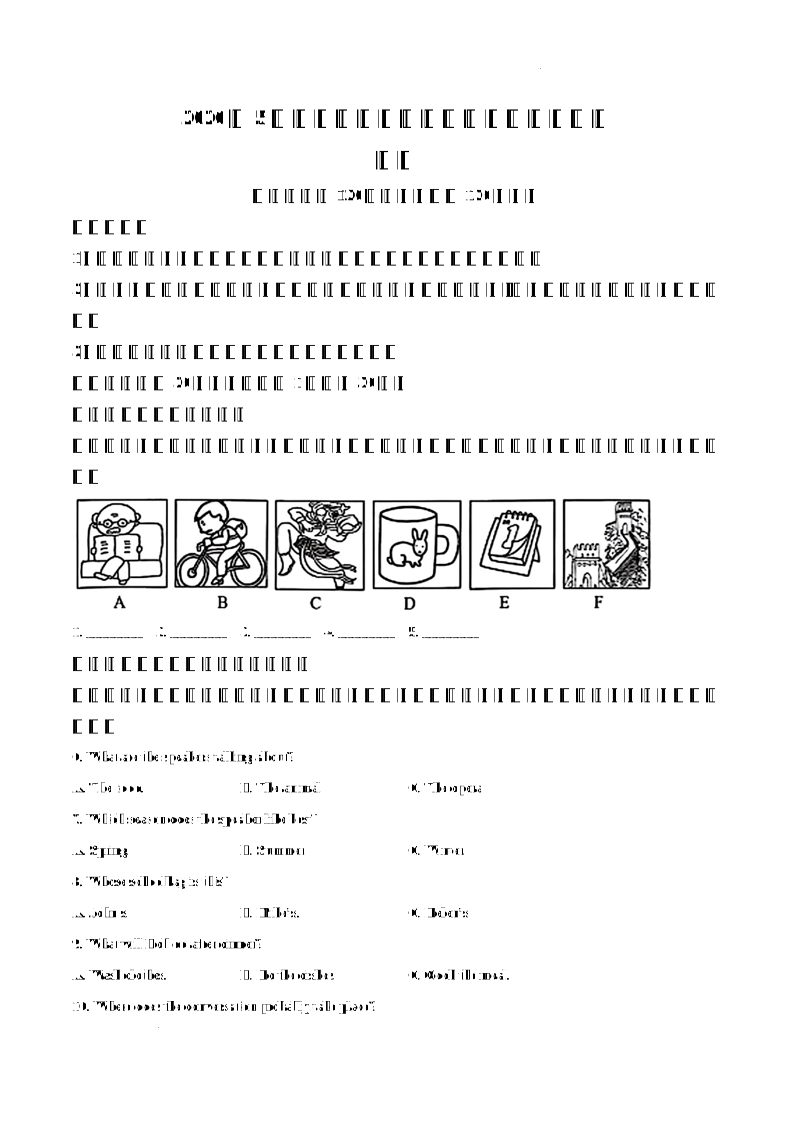
(一)听句子,选图片。
你将听到五个句子,请选出与所听句子内容相符的图片,有一幅图是多余的。每个句子读两遍。
1. ________ 2. ________ 3. ________ 4. ________ 5. ________
(二)听短对话,选择最佳答案。
你将听到五段对话,每段对话后有一个小题,请根据对话内容,选出最佳答案。每段对话读两遍。
6. What are the speakers talking about?
A. The food. B. The animal. C. The opera.
7. Which season does the speaker like best?
A. Spring. B. Summer. C. Winter.
8. Whose schoolbag is this?
A. John’s. B. Mike’s. C. Helen’s.
9. What will Bob do after dinner?
A. Wash clothes. B. Do the dishes. C. Cook the meal.
10. Where does the conversation probably take place?
A. At the airport. B. At the train station. C. At the supermarket.
(三)听长对话,选择最佳答案。
你将听到三段对话,请根据对话内容,选出每个问题的最佳答案。每段对话读两遍。
请听第一段对话,回答第11至13小题。
11. What kind of clothes does his son prefer?
A. Simple clothes. B. Colorful clothes. C. Fashionable clothes.
12. What size is the white T-shirt?
A. Small. B. Medium. C. Large.
13. What is the T-shirt made of?
A. Wool. B. Silk. C. Cotton.
请听第二段对话,回答第14至16小题。
14. Why is Jack full of energy?
A. He sleeps a lot. B. He exercises every day. C. He keeps normal weight.
15. How often does Jack swim?
A. Hardly ever. B. As long as there’s time. C. Three times a week.
16. What might the woman do next?
A. Go to exercise. B. Go to sleep. C. Go to work.
请听第三段对话,回答第17至20小题。
17. Where is Bill’s college?
A. In France. B. In England. C. In America.
18. What does Bill think of his college life?
A. Relaxing. B. Difficult. C. Interesting.
19. How long does Bill take exercise every morning?
A. For twenty minutes. B. For thirty minutes. C. For forty minutes.
20. What does Bill usually do on weekends?
A. He only studies.
B. He goes to parties and sleeps late.
C. He washes and cleans, sees friends and studies.
(四)听短文,选择最佳答案。
你将听到一篇短文,请根据短文内容,选出每个问题的最佳答案。短文读两遍。
21. How old is Lucy’s grandfather?
A. 63. B. 65. C. 68.
22. What did Lucy’s family prepare for Grandfather?
A. A cake. B. A trip. C. A book.
23. How did Lucy’s family ask Grandfather’s friends to help?
A. By sending letters. B. By making calls. C. By paying visits.
24. When did Grandfather receive the gift?
A. In the morning. B. At noon. C. In the evening.
25. How did Grandfather feel when seeing the gift in the study?
A. Disappointed. B. Moved. C. Sad.
(五)听短文,填信息。
你将听到一篇短文,请根据短文内容,将所缺信息填入答题卡对应的横线上,每空一词。短文读三遍。
World Animal Day
Time
on 26 4th every year
Reasons
to remember the important role that animals have 27
to remind us to protect animals and their homes
History
In 1925, over 5000 people took part in the first activity.
In 1931, a meeting was held in Italy, and then the day became 28 .
In 1948, some Australians finally made the day in autumn after stopping people from 29 animals.
Methods
join groups to fight against treating animals badly
share the care for animals on social 30
二、补全对话(共5小题,每小题2分,共10分)
根据对话内容,从下面方框中选出恰当的句子补全对话,有一个选项是多余的。
A: Good afternoon, Linda.
B: 31 I heard that your class organized a special activity.
A: Yes. We made paper cuttings through math knowledge.
B: 32
A: So it is. It’s full of fun. I become more interested in math.
B: 33
A: I made one like a flower.
B: 34
A: Certainly! Let’s prepare some paper and a pair of scissors first.
B: Wow! 35
A. Can I join you?
B. Good afternoon.
C. I can’t wait to try.
D. It’s so great.
E. What did you make?
F. We should learn from each other.
三、完形填空(共10小题,每小题1.5分,共15分)
阅读下面语篇,从各小题所给的A、B、C三个选项中,选出最佳选项。
As a British exchange student in China, I really like Chinese culture. I took a calligraphy (书法) course to learn more about this traditional Chinese 36 .
The calligraphy room is a quiet and 37 place. It is filled with the pleasant smell of ink (墨) and the soft sound of brushes touching paper. Our calligraphy teacher, Mr Li, is known for his skills and patience.
On the first day, Mr Li showed us the art of calligraphy. I watched 38 as he moved the brush with grace (优雅) and care. And the characters he created looked like beautiful paintings.
Then, Mr Li introduced the 39 of calligraphy: the brush, ink, paper, and ink stone. He taught us how to hold the brush and 40 our hands to create smooth flowing (流动) lines.
When it was my turn to try, I found it was 41 than I imagined. My first characters were far from perfect and I felt sad, but Mr Li 42 me patiently and gave me support.
From then on, I 43 learning calligraphy. Slowly, I noticed 44 skills improving. I learned not only how to write the characters but also how to understand the meanings behind them: every character holds the wisdom and history of Chinese culture, like a small story in itself.
I really love calligraphy, 45 it is a way to express myself and connect with Chinese culture.
36. A. art B. food C. sport
37. A. busy B. peaceful C. crowded
38. A. angrily B. happily C. carefully
39. A. tools B. objects C. things
40. A. wave B. move C. raise
41. A. easier B. harder C. stronger
42. A. pointed B. replied C. encouraged
43. A. gave up B. put off C. kept on
44. A. my B. his C. its
45. A. so B. because C. but
四、阅读理解(共20小题,每小题2分,共40分)
A
Notice About Study Trip
Dear parents,
In order to help students learn more about the local history and traditional culture of our city, we are going to organize a study trip to City Museum. If your children want to join us, please complete the permission slip (同意书) at the bottom of this notice and give it back by May 31st, 2026.
Study Trip Plan
Place
City Museum
Date
June 8th, 2026
Time
8:30 am — 11:30 am
Transportation
School buses
Things to bring
Food, drinks, notebooks, pens, umbrellas
No.1 Middle School
May 25th, 2026
Cut here
Permission Slip
I give permission for my child ____________ (name) to take part in the study trip. If any emergency happens, please call me at ____________ (telephone number).
Parent: ____________ (name)
Date: ____________
根据语篇内容,选择最佳选项。
46. What’s the purpose of the study trip?
A. Enjoy the scenery. B. Make friends. C. Learn about the history and the culture.
47. How long will the trip last?
A. For three hours. B. For two and a half hours. C. For two hours.
48. How will the students go there?
A. On foot. B. By bus. C. By bike.
49. Which is TRUE according to the passage?
A. The student needn’t take anything.
B. The permission slip should be handed on May 31st, 2026.
C. The parent must write his or her phone number on the permission slip.
50. Who is the passage written for?
A. Parents. B. Teachers. C. Students.
B
“Lydia is almost 80 years old,” you may be thinking. “How can she be writing about hope?”
It’s true that at my age, if there is no hope, everything will be lost. Like all people who live long enough, I have been through many dark periods and seen so many sad things.
It was a cold early spring day when our old house was burnt down in a fire. Just as the whole family was standing on the ruins (废墟) in silence, my little daughter shouted loudly, “Mom, look at that tree!” Looking in the direction she was pointing, we saw the pear tree that my husband had planted in the early spring. It had been burnt badly with only one living branch (树枝) reaching toward the sky.
It was not easy to save the badly burnt tree, but nature always finds a way when given a chance. Finally, the tree made it. Once it was strong enough, it was moved to our new house. In the spring, its branches are bright with white flowers. It is a symbol of the power of nature and hope for new beginnings, even in the darkest moments.
Fifty years have passed. My children have all gone to other places and have their own families. That pear tree is still there and bears sweet fruit every year. The tree, saved from near death, not only regrows its leaves but also brings hope to us. Now do you understand how I dare (敢) write about hope?
根据语篇内容,选择最佳选项。
51. What does Lydia probably do?
A. A writer. B. A teacher. C. A gardener.
52. What happened to Lydia’s family 50 years ago?
A. They moved to a new country.
B. A big fire burnt their old house.
C. A little tree was planted in their garden.
53. How was the weather when the pear tree was burnt badly?
A. warm B. cold C. hot
54. What can be inferred (推断) from the underlined sentence in Paragraph 4?
A. The pear tree was dead.
B. The pear tree came back to life.
C. The pear tree became a family symbol.
55. What’s the main idea of the passage?
A. Lydia’s family went through a fire.
B. A pear tree was saved after a fire.
C. Lydia shared her hope through the story of a pear tree.
C
On February 12, 2025, the China Manned Space Agency (机构) told everyone the official names of the spacesuit and lunar rover (月球车). They are named “Wangyu” and “Tansuo”. And they are used for China’s moon landing plan.
“Wangyu” means “gazing (凝望) at the universe and exploring the unknown”. It is connected to the “Feitian” spacesuit which was used for space station tasks. “Wangyu” shows that China’s plan is to change from working in space to landing on the moon. It also shows that China’s making efforts to build a better future for humans.
The lunar rover is named “Tansuo”, which means “exploration”. Its job is to help Chinese people explore the moon. It can carry two astronauts and move quickly over rocky ground. It can also help with direction, safety, communication, and carrying things. It will support astronauts in doing scientific research and tests on the moon.
The names were chosen from more than 9,000 entries in a public competition. They are full of Chinese culture and modern spirit. From “Chang’e” and “Yutu” to “Tianwen” and “Zhurong”, and now “Wangyu” and “Tansuo”, the names of China’s spacecraft (航天器) always connect traditional culture with modern technology.
Right now, the “Wangyu” spacesuit and the “Tansuo” lunar rover are in the early stages of development. China plans to send people to the moon before 2030. The task will test key technologies like traveling between the Earth and the moon and working together with robots. The astronauts will do many tasks like landing, exploring, collecting samples (样本), researching, and bringing things back to the Earth.
The names “Wangyu” and “Tansuo” mark a new step in China’s space exploration. They are not only the results of China’s space technology but also symbols of the Chinese people’s spirit of exploration and innovation (创新).
根据语篇内容,选择最佳选项。
56. Why does the writer mention “Feitian”?
A. To explain the use of spacesuits in space station tasks.
B. To explain the change of China’s plan from space to the moon.
C. To explain the improvement of spacesuits used for space exploration.
57. Which of the following can be true about the lunar rover?
A. It is named “Wangyu”.
B. It can carry three astronauts.
C. It helps Chinese people explore the moon.
58. What does the underlined word “entries” mean in Paragraph 4?
A. Works. B. Medals. C. Characters.
59. What won’t astronauts do during the lunar exploration task?
A. Land and explore.
B. Collect samples and do research.
C. Build a home to live on the moon.
60. Which can be the best title for the passage?
A. The inventions of China’s spacecraft.
B. The History of China’s Space Exploration.
C. The Names and Meanings of Spacesuits and Lunar Rovers.
D
The history of traffic lights dates back to the early 19th century in Britain. London was a busy city with horse-drawn carriages (马车). They often rushed into people, causing many accidents. At the same time, there was a fashion rule in London-women in red showed that they were married and green for unmarried. This gave people the idea for using red and green as traffic signs later.
On December 10th, 1868, British mechanic (机械师) De Hart designed the world’s first traffic light with only red and green. A policeman had to pull a belt to change the lights: red meant “stop”, and green meant “go”. At first, it worked well and reduced accidents. However, this traffic light exploded (爆炸) after 23 days. The light was turned off, but the idea stayed alive.
In 1914, electric traffic lights were first used in America. Red and green still did their jobs, and they were safer and easier to see.
In 1927, a Chinese student named Hu Ruding was studying in the US. He noticed drivers sometimes rushed when the light changed. “What if there’s a middle color to slow people down?” he thought. That’s how the yellow light was born, meaning “get ready to stop”. Around the same time, an American policeman named William Potts created the first three-color traffic lights for all directions. They made crossroads much safer.
These colors were not chosen by chance. Red is easy to see, like a fire alarm, so it means “Danger-stop!”. Yellow is a warning, like a sign that says “Be careful-slow down!”. Green, like a forest, tells us “Safe to go!”. Together, they form a common language that keeps safe every day.
Great ideas come from everyday things. Whether traffic lights or something else, noticing and thinking “what if” can change the world!
根据语篇内容回答问题,每空单词数不限,将答案填写在答题卡对应的横线上。
61. When did the world’s first traffic light with only red and green appear?
____________________________________________________________________________________________
62. In which country were electric traffic lights first used?
____________________________________________________________________________________________
63. Who suggested adding a yellow light to traffic signs?
____________________________________________________________________________________________
64. What does the underlined word “they” refer to in Paragraph 5?
____________________________________________________________________________________________
65. If you can add a new color or use other things like sounds and shapes to make traffic safer, what will you choose and why?(不超过15词)
____________________________________________________________________________________________
五、选词填空(共10小题,每小题1分,共10分)
根据语篇内容,从方框中选择恰当的单词,并用其正确形式填空。将单词填写在答题卡对应的横线上。每个单词只能用一次。
if they ability best saying pay consider easy useful goals
Many people think successful people are often talkative and outgoing (外向的), while quiet people are much less confident or less intelligent (聪颖的). When parents find their children talking less than other children, they may become worried and try their 66 to make their children outgoing.
Actually, it’s unnecessary to try to make kids outgoing. Just let them be 67 . It’s more possible for quiet people to become successful because of their own advantages.
Quiet people listen more than they talk, so they learn a lot. They don’t like to show their own ideas. Instead, they usually say something 68 when they need to speak.
Quiet people can win trust 69 . Because of their fewer talks, they are 70 as honest people who can keep secrets in social situations.
They can prepare things well. As a(n) 71 goes, “Preparedness ensures (确保) success and unpreparedness spells failure.” Careful planning is necessary 72 a person wants to get satisfying results. When it comes to making plans, quiet people often take it very seriously. They think about what they need to do and how to make it better to achieve their 73 .
Quiet people are less possible to be distracted (分神). They can 74 attention to a task and finish it faster. What’s more, quiet people also have the 75 to keep doing something for longer. They seldom lose interest in what they’re doing.
六、书面表达(15分)
假设你是李华,你校举办了“校园读书日”(School Reading Day)主题活动。请你给英国笔友David写一封邮件,分享你的读书收获,并向他推荐一本书。内容包括:
1.你在读书活动中的收获;
2.你想推荐给他的一本书;
3.你推荐这本书的理由。
注意:
1.词数为80左右(开头和结尾已给出,不计入总词数);
2.可适当增加细节,以使行文连贯;
3.文中不能出现真实姓名及学校名称。
参考词汇:broaden one’s horizons (开阔视野) recommend (v. 推荐) meaningful (adj. 有意义的)
Dear David,
How is everything going? Our school held a School Reading Day activity. ____________________________
____________________________________________________________________________________________
____________________________________________________________________________________________
I’m looking forward to hearing from you.
Yours,
Li Hua
学科网(北京)股份有限公司
$
资源预览图
1
2
3
相关资源
由于学科网是一个信息分享及获取的平台,不确保部分用户上传资料的 来源及知识产权归属。如您发现相关资料侵犯您的合法权益,请联系学科网,我们核实后将及时进行处理。