北京市平谷区2026年初中学业水平考试统一练习(二) 英语试卷
 切换试卷
切换试卷
2026-05-30
|
13页
|
121人阅读
|
6人下载
资源信息
| 学段 | 初中 |
|---|---|
| 学科 | 英语 |
| 教材版本 | - |
| 年级 | 九年级 |
| 章节 | - |
| 类型 | 试卷 |
| 知识点 | - |
| 使用场景 | 中考复习-二模 |
| 学年 | 2026-2027 |
| 地区(省份) | 北京市 |
| 地区(市) | 北京市 |
| 地区(区县) | 平谷区 |
| 文件格式 | ZIP |
| 文件大小 | 1.36 MB |
| 发布时间 | 2026-05-30 |
| 更新时间 | 2026-05-30 |
| 作者 | 匿名 |
| 品牌系列 | - |
| 审核时间 | 2026-05-30 |
| 下载链接 | https://m.zxxk.com/soft/58123899.html |
| 价格 | 1.00储值(1储值=1元) |
| 来源 | 学科网 |
内容正文:
北京市平谷区2026年初中学业水平考试统一练习(二)
英语试卷
2026.5
注意事项
1.本试卷共10页,包括两部分,共38题,满分60分,考试时间90分钟。
2.在答题卡上准确填写学校名称、班级和姓名。
3.试题答案一律填涂或书写在答题卡上,在试卷上作答无效。
4.在答题卡上,选择题用2B铅笔作答,其他试题用黑色字迹签字笔作答。
5.考试结束,将本试卷和答题卡一并交回。
第一部分
本部分共33题,共40分。在每题列出的四个选项中,选出最符合题目要求的一项。
一、单项填空。(每题0.5分,共6分)
从下面各题所给的A、B、C、D四个选项中,选择可以填入空白处的最佳选项。
1. Tom likes Chinese painting and ______ favourite subject is art.
A. his B. her C. your D. their
2. We held a basketball match _________ our school gym last Friday afternoon.
A. on B. to C. in D. with
3. — _________ I pick some fresh peaches from your garden?
— Sure, welcome. These peach trees over there are open for picking.
A. May B. Should C. Need D. Must
4. Now traveling in the countryside is becoming one of _________ activities during holidays.
A. popular B. more popular C. most popular D. the most popular
5. — Linda, _________ did you buy this storybook?
— Oh, I bought it in the bookshop near our school.
A. what B. where C. when D. how
6. Beijing is trying to build a greener city, ________ more parks and wetlands are appearing everywhere.
A. or B. but C. so D. if
7. — Were you at home at 9:00 last night?
— Yes, I ______ a movie at that time.
A. watch B. watched C. am watching D. was watching
8. Look! The students _________ an English play in the classroom.
A. put on B. puts on C. are putting on D. will put on
9. — What did you do last Sunday?
— I _________ as a volunteer in the community kitchen.
A. work B. worked C. will work D. has worked
10. His English is very excellent. He _________ English for over ten years.
A. learns B. learned C. has learned D. is leaning
11. Many special vegetables and fruits _________ on the Doctor’s Farm every year.
A. grow B. grows C. are grown D. were grown
12. — Do you know _________ for her mother on Mother’s Day?
— She is going to buy some flowers.
A. what Kate is going to buy B. what did Kate buy
C. what is Kate going to buy D. what Kate bought
二、完形填空。(每题1分,共8分)
阅读下面的短文,掌握其大意,然后从短文后各题所给的A、B、C、D四个选项中,选择最佳选项。
As a boy, Marco tried everything to win his father’s love. He got good marks, behaved well, and chose good friends. Sadly, his parents separated when he was only eight. He was sent to a boarding (寄宿制) school. He was shy, short and younger than his classmates, so he had 13 confidence.
At fourteen, he and his sister lived with their dad and stepmother. His father was busy and hardly talked to Marco. The only words from him were orders or criticism (批评). Marco felt nobody 14 him. He was always lonely and often silent at home. He began to avoid coming home every day.
One day, Marco left his bike in the yard, and his father fell over it. As he got up, his face turned red with 15 . He shouted at Marco, “Can’t you put anything in the right place? You’re always making trouble!” Marco stood frozen and felt hurt and confused. It seemed that no matter how hard he tried, he could never do anything right. In deep sadness, Marco ran to his room and 16 the door. He cried for hours and refused to talk to anyone. For two days, Marco stayed in his room and felt hopeless.
Two days later, his Aunt Ginette 17 unexpectedly. She usually only called him once a year, on his birthday. She advised him to join a public speaking competition and strongly believed he could do it. Though Marco was shy, he agreed because of her trust. All winter, he kept 18 , although his father didn’t like it. His sister helped him with housework so he could prepare for the competition.
Four months later, the big day came! Marco took part in the competition. Though nervous at first, he performed 19 on stage and won first prize. His aunt and sister were very proud of him. He felt happy and alive. His name appeared in the papers. This experience changed Marco completely. He started to believe in himself, and his confidence grew. He realized he should live happily and be respected.
Today, Marco is a famous speaker. His story inspires people around the world. He learned that even in the darkest moments, a little 20 from someone can awaken a lifetime of courage.
13. A. full B. low C. excited D. strong
14. A. valued B. hated C. helped D. saw
15. A. shyness B. sadness C. surprise D. anger
16. A. opened B. broke C. locked D. painted
17. A. came B. called C. visited D. wrote
18. A. practicing B. running C. watching D. hoping
19. A. luckily B. quietly C. perfectly D. carefully
20. A. money B. protection C. education D. trust
三、阅读理解。(每题2分,共26分)
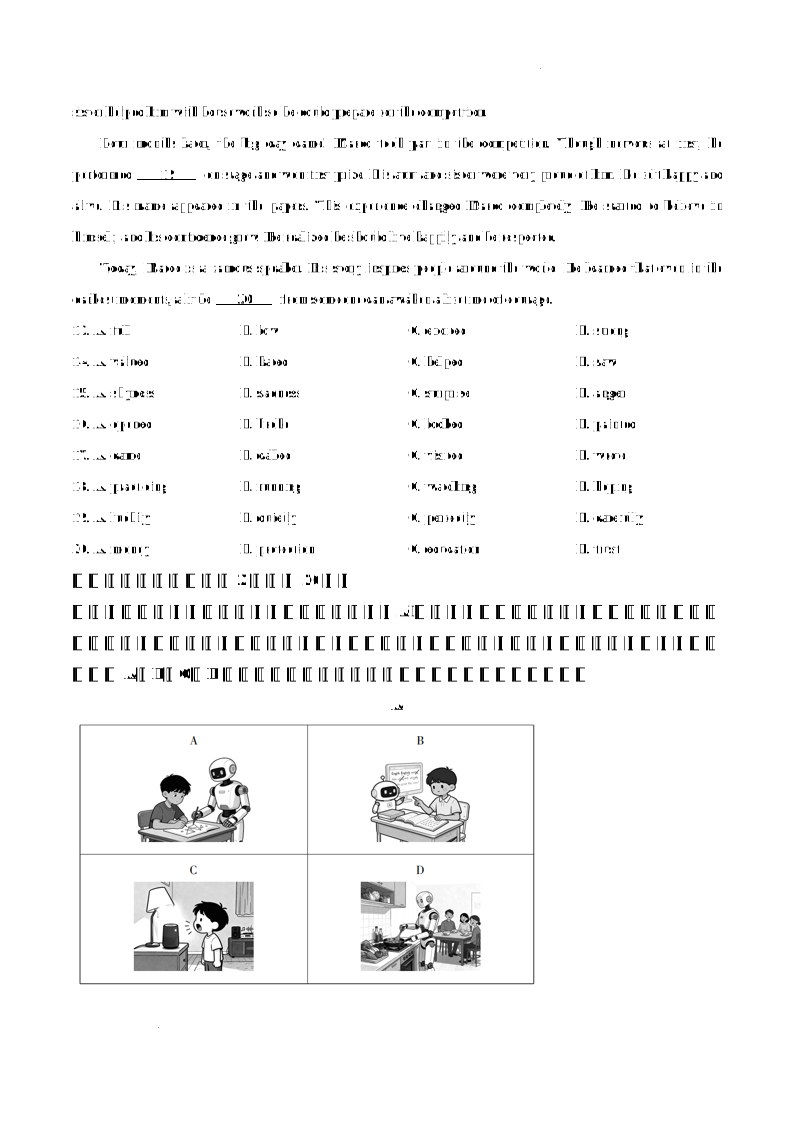
(一)英语课上,老师让学生讨论人工智能(AI)给我们的生活和学习带来的便捷。下面的每张图片代表一个谈论内容的场景。请根据人物讲述的内容,匹配最合适的图片,并将图片对应的A、B、C、D选项填在相应的位置上。选项中有一项为多余选项。
A
21. ___________
I think AI makes our daily life easier. For example, I use a smart speaker to control the lights and play music simply with my voice.
22. ___________
That’s true. For studying, AI helps me a lot too. AI can help us practice spoken English, and I also use it to check my writing and correct grammar mistakes, which saves me a lot of time.
23. ___________
Yes! When I don’t understand a math problem, I can take a photo and the AI app shows me the steps to solve it. I think although AI can do a lot, we should use it wisely.
(二)阅读下列短文,根据短文内容,从短文后各题所给的A、B、C、D四个选项中,选择最佳选项。
B
Priya used to hate Mondays. Not because of math tests, but because of library period. That was when Mrs. Tandon asked students to read aloud.
Every Sunday night, Priya’s stomach would hurt. “I feel sick,” she told her mother. Every Monday morning, she pressed her hands against her belly and walked to the nurse’s office. Her face looked pale, but her heart beat fast with fear. She was not really ill. She was just afraid.
Priya had trouble with words. When she looked at a page, the letters seemed to dance. The other children read smoothly, but her voice shook. Last month, a boy laughed when she said “dog” instead of “god.” She wanted to disappear.
This went on for four Mondays. Then one Tuesday, Mrs. Tandon found Priya under the old tree in the school garden.
“Priya,” she said gently, “may I sit with you?” Priya nodded, but she did not look up.
“Reading is like climbing a mountain,” Mrs. Tandon said. “Nobody runs to the top alone.” Her voice was warm. Tears filled Priya’s eyes. “I just want friends,” Priya whispered. “Not pity.”
Mrs. Tandon smiled. “Then let us try something new.” The next week, she started a “Reading Buddy” plan. She put Priya together with Aarav, a small boy from Grade 1. He loved stories but needed help with big words. “You look at the pictures, and I will read the words,” Priya told him. Her voice was soft, but Aarav listened carefully. He did not laugh. He just smiled and pointed at the next picture.
Week by week, something changed. Priya’s voice grew steady. The letters stopped dancing. And Aarav listened carefully to every word she read. “Again!” he said when they finished a book. Priya began to arrive early on Mondays, carrying picture books for her little partner.
By the end of the term, Priya no longer walked to the nurse’s office. She walked to the library instead. She finally understood: everyone carries his own problems. The bravest thing is not to hide them, but to let someone walk beside you until you find your own strength.
24. How did Priya feel when she looked at a page during library period?
A. She felt excited. B. She felt confused. C. She felt proud. D. She felt relaxed.
25. What happened to Priya after she joined the “Reading Buddy” plan?
A. She stopped going to school on Mondays.
B. She became more confident in reading aloud.
C. She decided to teach Mrs. Tandon how to read.
D. She asked her mother to call the nurse every week.
26. What can we learn from Priya’s experience?
A. It is better to hide our problems from others.
B. Facing difficulties alone shows true courage.
C. Accepting help from others can help us grow.
D. Working hard is the best way to succeed.
C
Imagine a tool you could use to help you improve the performance of your mind and body. Well, it is your lungs! By simply changing how fast or slow you breathe, you can get many benefits. Here are two main breathing methods: slow breathing and fast breathing.
Slow breathing means breathing at a very slow speed — about six breaths a minute. That is half the normal rate (速率) or even less. This type of breathing helps you control stress, feel more relaxed, and think more clearly, especially in difficult situations, like before a test.
Fast breathing means breathing at a much faster speed — about 25 to 60 breaths a minute. That is much faster than normal. This type of breathing helps you feel awake and full of energy. It gets you ready for challenging physical tasks, like a 100-meter race or lifting weights.
When you breathe in, your heart rate speeds up, and when you breathe out, it slows down. This is normal and shows your heart is healthy. Have you ever been told to take a deep breath when you felt nervous? By doing that, you were slowing down your heart rate without knowing it, which helped you feel calmer.
These changes are controlled by your nervous system. This system works by itself and has two parts. The “fight or flight” part makes you more active and awake. The “rest and digest” part makes you more relaxed. Your breathing can turn on different parts of this system.
Slow breathing turns on the “rest and digest” part. It slows down your heartbeat and helps you feel calm. It also helps your brain work better, especially when you need to make decisions or control your feelings.
Fast breathing turns on the “fight or flight” part. It speeds up your heartbeat and gets your body ready for action. More oxygen (O2) goes to your muscles, and you get more energy to meet challenges. For example, fast breathing is useful before a short race or lifting heavy things.
Research has clearly shown that breathing methods are important for performance and well-being. When used correctly, they can have many positive effects. Think about how you can use your breath to change the way you think, feel, and act when you need to be your best. Remember — breathing is a superpower!
27. According to the passage, which breathing method should you use before a math competition?
A. Slow breathing. B. Fast breathing. C. Normal breathing. D. Light breathing.
28. What can we learn from the passage?
A. People should use fast breathing when they feel nervous.
B. Slow breathing works better than fast breathing in daily life.
C. Breathing faster than 60 breaths a minute brings the most energy.
D. Breathing methods affect the body by working on the nervous system.
29. Which of the following would be the best title for the passage?
A. The Speed of Breathing B. The Power of Breathing
C. The Ways to Change Your Mind D. The Ways to Control Your Feelings
D
Why Athletes Should Wear Light-Colored Clothing in Hot Weather
Have you ever noticed that many athletes prefer light-colored clothes in hot summer? Most people think it is just a matter of fashion or personal habit. However, studies show that clothing color actually has a surprising influence on athletes’ performance in hot weather.
Some people might think that the color of a T-shirt does not really matter. They may say, “It is just a color. How can it affect your performance?” But a recent study has proved this idea wrong. In fact, research has shown that wearing a black T-shirt in hot weather can hurt an athlete’s performance — not physically, but mentally.
Scientists did a research on young tennis players in 32℃ weather. They divided the players into two groups: one in white T-shirts and the other in black ones. Surprisingly, Although both groups had the same body temperature and drank about the same amount of water, the players in black T-shirts felt very different. Players in black felt much more tired and uncomfortable. They even thought they were making greater efforts than they actually did.
Why does this happen? The answer may lie in a common belief. Most people think that black clothing absorbs (吸收) more heat and makes you hotter. This belief is so strong that it can actually change how you feel during exercise. Even if players say they never pay attention to their T-shirt color, the belief still affects them. This shows that our minds can play tricks on us. Therefore, doing something as simple as choosing a white T-shirt over a black one can help athletes feel better and perform better in the heat.
So, what should athletes do? The answer is clear and simple. First, always wear light-colored clothing when training outdoors on hot days. White, light gray, or light blue are good choices. Second, change your T-shirt if it gets too wet with sweat. Third, drink cool water regularly and take breaks in cool shade. These steps are easy to follow, but they can make a real difference.
Some still doubt that such a small choice is not worth caring about. Some might argue that training harder is what really matters. Proper training is important, but we should never ignore (忽视) easy and useful ways to improve performance. Winning in sports often comes from small advantages. If wearing a white T-shirt can help you feel less tired and more comfortable, why would you not do it?
All in all, light-colored clothes help athletes feel more comfortable and less tired in hot weather. Never let a simple choice of clothing color influence your state. Smart choices always support better performance. Choose white, feel better, and play your best.
30. According to the study on young tennis players, what’s the difference between the two groups?
A. Players in black T-shirts drank more water to reduce heat.
B. Players in white T-shirts made greater efforts in the training.
C. Players in white T-shirts had lower body temperature than those in black.
D. Players in black T-shirts felt more tired though their physical state was the same.
31. The underlined phrase “play tricks on” in Paragraph 4 probably means ______.
A. cheat B. protect C. challenge D. encourage
32. What does the writer think of the idea that “training harder is what really matters” in Paragraph 6?
A. He doesn’t care about the idea and focuses on the study results.
B. He completely agrees with it and thinks clothing color is unimportant.
C. He disagrees with it and thinks training needs proper clothing to work.
D. He thinks training is important, but small choices like clothing color also matter.
33. What is the main purpose of the passage?
A. To introduce a new study on athletes’ clothing color.
B. To explain why black clothing makes people feel hotter.
C. To advise athletes to wear light-colored clothing in hot weather.
D. To argue that training is more important than clothing color.
第二部分
本部分共5题,共20分。根据题目要求,完成相应任务。
四、阅读表达。(34-36题每题2分,37题4分,共10分)
阅读短文,根据短文内容回答问题。
Chinese Calligraphy
Chinese calligraphy is one of the greatest art forms in Chinese culture. In 2009, UNESCO officially recognized it as an Intangible Cultural Heritage of Humanity (人类非物质文化遗产). It has a history of more than 3,000 years. The earliest examples come from the Shang Dynasty (商朝), when people carved characters onto bones and shells.
Over the centuries, calligraphy developed through different styles. In the Qin Dynasty, Prime Minister Li Si created the small seal script to meet the growing need for records. However, it was too slow to write, which led to the official script — faster and with straighter lines. Later, the regular script developed, which has clear corners and straight strokes (笔画) of different thicknesses.
The Tang Dynasty is seen as the golden age of calligraphy. Masters like Wang Xizhi and Yan Zhenqing set standards for later generations. During this time, calligraphy skill became very important. Anyone who wanted a government job had to write well in regular script. The Chinese still use this script today in print and daily life. Two other styles, running script and cursive script, also became popular. Running script is faster and more flowing, while cursive script is even more free and artistic.
Calligraphy is more than beautiful writing. In ancient China, good handwriting was a sign of education and moral character (品德). Many great poets and thinkers were also famous calligraphers. Their works remain national treasures, and calligraphy continues to attract interest worldwide as a symbol of Chinese civilization (文明).
For students, learning calligraphy offers valuable lessons. It requires careful attention to every stroke, helping build patience and focus. In today’s digital world, calligraphy provides a chance to slow down. The slow, repeated brush movements create a sense of calm, helping students manage stress.
Moreover, calligraphy connects students with their cultural roots (根源). By studying ancient masters, they learn core Chinese values (核心价值观) — harmony (和谐), discipline (自律), and respect for hard work. In an age of computers, calligraphy offers a rare link to the past. It builds character, preserves culture, and brings inner peace. Tradition can still bring meaning to modern life.
34. How long is the history of Chinese calligraphy?
35. In ancient China, what was good handwriting a sign of?
36. Which style of Chinese calligraphy is more free and artistic, running script or cursive script?
37. Do you think calligraphy is still important for students today? Why or why not? (Please give two reasons.)
五、文段表达。(共10分)
38.从下面两个题目中任选一题,根据中文和英文提示,完成一篇不少于50词的英语文段写作。文中已给出内容不计入总词数。所给提示词语仅供选用。请不要写出你的校名和姓名。
题目①
为丰富校园文化生活,你校英语社团即将举办“English Dubbing Competition (英语配音大赛)”。假设你是英语社团团长李华,为此你对本社团40名同学进行了调查统计,下表是部分统计结果。请你根据表格中的学生意向调查结果,给英语老师写一篇报告,简要说明图表内容,并谈谈你的看法。
Types of dubbing materials
(配音类型)
Cartoons
Movies
School sitcoms
(校园剧)
Documentaries
(纪录片)
Number of Students
16
12
8
4
Competition forms
(配音形式)
individual dubbing
(单独)
Pair dubbing
Group dubbing
Number of Students
4
20
16
提示词语:most, be interested in, prefer, choose, perform, practice, show, benefit
提示问题:·What can you learn from the results?
·What is your opinion of the dubbing competition?
Dear students,
Our school will hold an English dubbing competition. Here is the result of our survey about students choices._
________________________________________________________________________________________________________________________________________________________________________________________________________________________________________________________________________________________________________________________________________________________________________________________________________________________________________________________________________________________________________________________________________________________________________
题目②
初中生活转瞬即逝,回望三年校园时光,总有一些温暖的瞬间令人铭记于心。某学校英文网站现举办毕业留言征文活动,请你以“A Moment That Touched Me”为题,写一篇英语短文。简述令你感动的瞬间发生的经过;谈谈你的内心感受;表达你的感恩之情。
提示词语:unforgettable, upset, encourage, support, thankful, cherish
提示问题:·What happened in the moving moment?
·How did it make you feel and what have you learned from the experience?
How time flies! Many warm moments come back to my mind._______________________________________
____________________________________________________________________________________________________________________________________________________________________________________________________________________________________________________________________________________________________________________________________________________________________________________________________________________________________________________________________________
学科网(北京)股份有限公司
$北京市平谷区2026年初中学业水平考试统一练习(二)
英语试卷答案
一单项填空6分(0.5X12)
1-5 ACADB 6-10CDCBC
11-12CA
二完形填空8分(1X8)
13B14A15D16C17B18A19C20D
三阅读理解26分
(2X13)
A 21C
22B
23A
B 24B
25B
26C
C 27A
28D
29B
D 30D
31A
32D
33C
四阅读表达(34-36题每题2分,37题4分共10分)
34 More than 3,000 years.About 3,000 years.
35 Education and moral character.
36 Cursive script.
37 Yes,because it helps build patience and it connects us to our culture.
No,because typing is more convenient today and students are very busy with
different things.)
评分标准:
34一36题,内容(关键信息点)正确2分。
37题第一问内容1分,第二问内容2分;整体语言质量1分。
理由需与观点自洽。
观点一:Yes,I think calligraphy is still important.
Reason 1:It helps students build patience and focus,because the practice requires
careful attention to every stroke.
Reason 2:It connects students with their cultural roots and helps them learn core
Chinese values like harmony and discipline.
(共约35词)
观点二:No,I don't think it is necessary for all students.
Reason 1:Students today are already very busy with many subjects and exams,and
calligraphy takes a lot of time to practice.
Reason 2:In the digital age,typing is more convenient for daily communication,so
not everyone needs to learn calligraphy.
五文段表达10分(略)
文段表达评分标准:先根据文章整体内容和语言表达确定档次,然后在该档次内评
出分数,共10分。
具体评分标准如下:
第一档:(9一10分)完全符合题目要求,观点正确,要点齐全。
句式多样,词汇丰富。语言准确,语意连贯,表达清楚,具有逻辑性。
说明:满足以上要求且书写工整,个别不影响理解的2处以内小失误可以给满分
10分。书写较差可适当减一分。
第二档:(6一8分)基本符合题目要求,观点正确,要点齐全。
语法结构和词汇基本满足文章需要。语言基本通顺,语意基本连贯,表达基本清
楚。虽然有少量语言错误,但不影响整体理解。
说明:最低要求为三个问题都有涉及,属要点齐全给6分。
第三档:(35分)部分内容符合题目要求,要点不齐全。
语法结构和词汇错误较多,语言不通顺,表达不够清楚,影响整体理解。
说明:根据内容多少和书写情况给出适当分数。
第四档:(0一2分)
与题目有关内容不多,只是简单拼凑词语,所写内容难以理解。
抄无关内容0分。
资源预览图
1
2
3
相关资源
由于学科网是一个信息分享及获取的平台,不确保部分用户上传资料的 来源及知识产权归属。如您发现相关资料侵犯您的合法权益,请联系学科网,我们核实后将及时进行处理。