湖北武汉市江汉区2026年九年级英语二模试题
 切换试卷
切换试卷
2026-05-29
|
8页
|
70人阅读
|
15人下载
资源信息
| 学段 | 初中 |
|---|---|
| 学科 | 英语 |
| 教材版本 | - |
| 年级 | 九年级 |
| 章节 | - |
| 类型 | 试卷 |
| 知识点 | - |
| 使用场景 | 中考复习-二模 |
| 学年 | 2026-2027 |
| 地区(省份) | 湖北省 |
| 地区(市) | 武汉市 |
| 地区(区县) | 江汉区 |
| 文件格式 | |
| 文件大小 | 5.73 MB |
| 发布时间 | 2026-05-29 |
| 更新时间 | 2026-05-29 |
| 作者 | 匿名 |
| 品牌系列 | - |
| 审核时间 | 2026-05-29 |
| 下载链接 | https://m.zxxk.com/soft/58120171.html |
| 价格 | 0.00储值(1储值=1元) |
| 来源 | 学科网 |
内容正文:
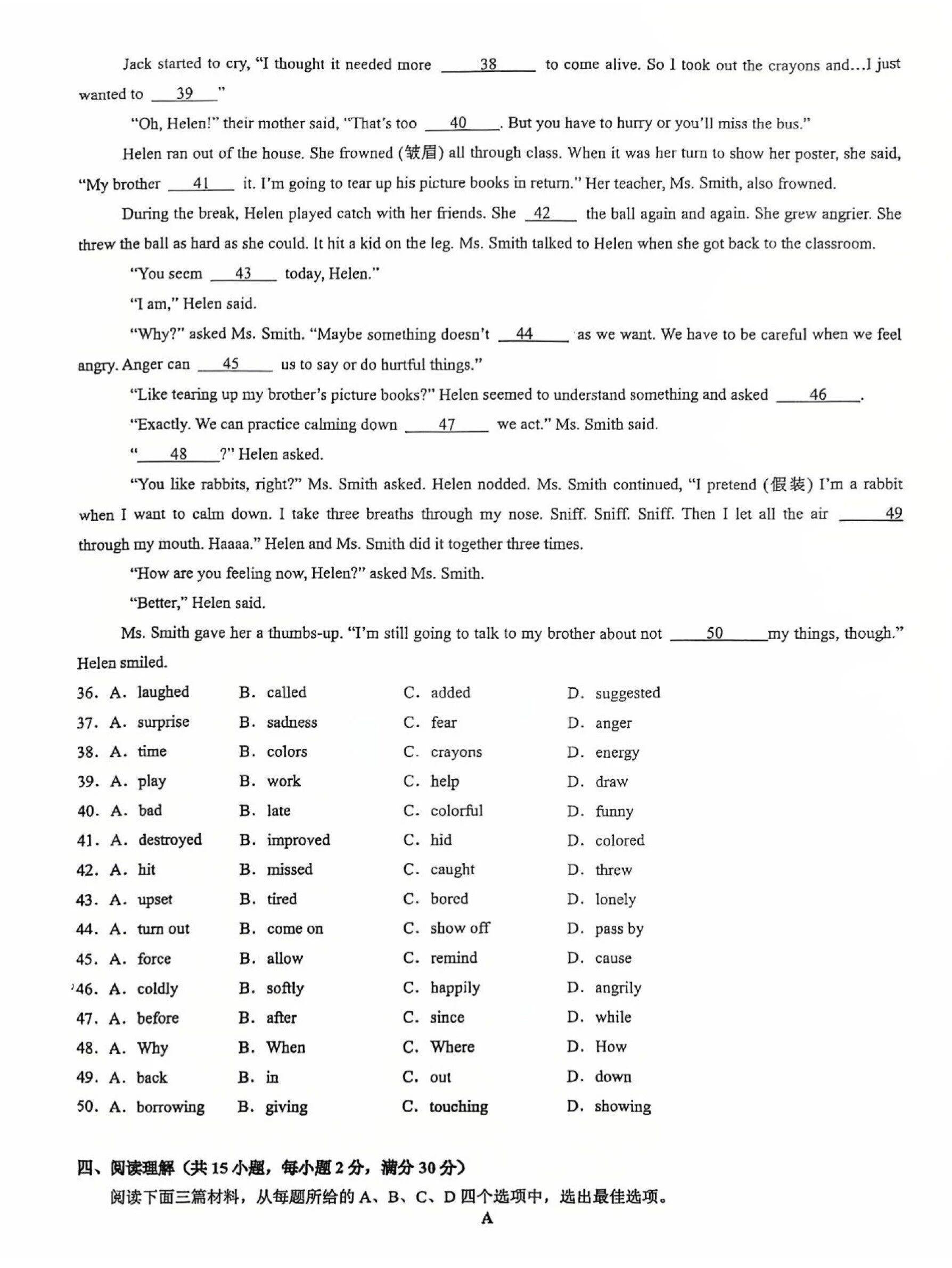
九年级英语 第1卷(选择题共80分) 第一部分听力部分 一、听力测试(共三节) 第一节(共5小题,每小题1分,满分5分) 听下面5个问题。每个问题后有三个答语,从题中所给的A、B、C三个选项中选出最佳选项。听完每个问题 后,你都有5秒钟的时间来作答和阅读下一小题。每个问题仅读一遍。 1.A.Great. B.A map C.At home. 2.A.Funny. B Linda C.Strict. 3.A.Ateacher. B On the bed. C.For a week. 4.&.50yuan. B.Red. C.In the morning. 5.A.At 8 o'clock. B.OK. C.Swimming. 第二节(共7小题,每小题1分,满分7分) 听下面7段对话。每段对话后有一个小题,从题中所给的A、B、C三个选项中选出最佳选项。听完每段对话 后,你都有10秒钟的时间来作答有关小题和阅读下一小题。每段对话仅读一遍。 6.What is in Jason's bag? A.football. B A basketball. C.A baseball. 7.What will the weather be like tomorrow? A.Rainy. B.Sunny. C.Windy. 6.What does the woman suggest? A.Talking to classmates. B.Asking for help. C.Learning from teachers. o.Why is Tom wanted for the job? A.He is hardworking. B.He is famous. C.He is experienced. 10.What does Dad mean? A.The girl will win. B.The girl should practice more. C.The girl is far behind. 11.What are the speakers doing? A.Getting ready for cooking. B.Holding a meeting. C.Setting the table for a meal. 12.Where does this conversation probably take place? A. B 第三节(共13小题,每小题1分,满分13分) 听下面4段对话或独白。每段对话或独白后有几个小题,从题中所给的A、B、C三个选项中选出最佳选项。 听每段对话或独白前,你将有时间阅读各个小题,每小愿5秒钟:听完后,各小题将给出5秒钟的作答时间。每段 对话或独白读两遍。 听下面-一段对话,回答13至15三个小题。 13 What is wrong with the watch? A.It is broken into pieces. B.It shuts down by itself. C.It can't be fixed. 14.What does the woman tell the man to do at first? A.Waiting some time. B.Getting a new one. C.Making more calls. 5.When will the man go to the store? A.After supper. B.Before lunch. C.Next morning. 听下面一段对话,回答16至18三个小题。 16.What is the conversation mainly about? A.School trips. B.Vacation plans. C.Dream jobs 17.What is the man going to do this summer? A.Learn to cook. B.Travel to Beijing C.Take a part-time job. 18.Why does the man want to do that? A.To make new friends. B.To help his family. C.To get work experience. 听下面一段对话,回答19至21四个小题。 19.What is the relationship between the two speakers? A.Teacher and student. B.Mother and son. C.Husband and wife. 20.What advice does Tom get? A.Buying a new video game. B.Communicating with Mike first. C.Saying sorry to his friend. 21.How does the boy probably feel at the end? A.Angry. B.Worried. C.Hopeful. 听下面一段独白,回答22至25三个小题。 22.What does the passage mainly focus on? A.Traditional art. B.Famous performers. C.Big drums. 23.What does the artist do during the performance? A.Dances to the beats. B.Sings and beats the drum C.Beats the drum with bamboo boards. 24.What do we know about Hubei Dagu? A.The drum is usually big B.The lyrics are often funny. I. C.The beat is always gentle. 25.What does the speaker think of it? A.It's out of date. B.It's easy to leam. C.It's worth protecting. 第二部分笔试部分 二、远择填空(共10小题,每小题1分,满分10分) 从题中所给的A、B、C、D四个选项中,选出一个最佳答案。 20.-How did you find life in the countryside? -Quite good.It's quiet and,every now and then,a bird's song would break the of the village. A.alarm B.match C.pressure D.silence 27.-Now we use different learning tools like online dictionaries and AI to study.We can also watch online lessons. -Yeah. of these ways help us study better. A.Either B.All C.Neither D.None 28.-Our cat really likes to play at night. -That's true.Cats are naturally and active after dark. A.clean B.independent C.awake D.sleepy 29.-The old bridge looks weak.Can it the weight of the truck? -Don't worry.It's stronger than it seems. A.hold B.lose C.raise D.add 30.-What did you do before you started using this new machine? 一I all the parts to make sure everything was in order. A.fixed B.checked C.compared D.pressed 31.-Why do many young people return to build their hometown now? -Because creates more jobs and a better life. A.natural environment B.local development C.cultural tradition D.personal improvement 32.-Tina and her cousin fought yesterday. -They should learn to each other instead of arguing. A.look down on B.get on with C.keep away from D.make fun of 33.-Jack,don't let this opportunity ,or you will regret. -OK,Ms.Lee.I will try my best to take this chance. A.drop by B.stand by C.pass by D.come by 4 -He could hardly this amount of work in such a short time. -Maybe we should send some workers to help him. A.get through B.get into C.get down D.get off 35.-I just got a new smart watch,but I don't know -Don't worry.Let me show you.First,press this button. A.how much it costs B.where was it made C.how I can use it D.why is it so popular 三、完形填空(共15小题,每小题1分,满分15分) 阅读下面短文,从短文后各题所给的A、B、C、D四个选项中,选出可以填入空白处的最佳选项。 Helen searched everywhere."Where's my poster?"she said.She had made one about rabbits. "Here it is!"Her little brother Jack 36,holding up the poster.He drew all over it with crayons."No!" Helen shouted in 37."Mom,just see what Jack did!" Jack started to cry,"I thought it needed more38 to come alive.So I took out the crayons and...I just wanted to39 "Oh,Helen!"their mother said,"That's too 40.But you have to hurry or you'll miss the bus." Helen ran out of the house.She frowned (all through class.When it was her turn to show her poster,she said, "My brother 41 it.I'm going to tear up his picture books in return."Her teacher,Ms.Smith,also frowned. During the break,Helen played catch with her friends.She 42 the ball again and again.She grew angrier.She threw the ball as hard as she could.It hit a kid on the leg.Ms.Smith talked to Helen when she got back to the classroom. "You secm 43 today,Helen." "I am,"Helen said. "Why?"asked Ms.Smith."Maybe something doesn't44as we want.We have to be careful when we feel angry.Anger can 45 us to say or do hurtful things." "Like tearing up my brother's picture books?"Helen seemed to understand something and asked 46. "Exactly.We can practice calming down 47 we act."Ms.Smith said. “48?"Helen asked. “You like rabbits,,ight?”Ms.Smith asked.Helen nodded.Ms.Smith continued,“I pretend(假装)I'm a rabbit when I want to calm down.I take three breaths through my nose.Sniff.Sniff.Sniff.Then I let all the air49 through my mouth.Haaaa."Helen and Ms.Smith did it together three times. "How are you feeling now,Helen?"asked Ms.Smith. “Better,”Helen said. Ms.Smith gave her a thumbs-up."I'm still going to talk to my brother about not 50 my things,though." Helen smiled. 36.A.laughed B.called C.added D.suggested 37.A.surprise B.sadness C.fear D.anger 38.A.time B.colors C.crayons D.energy 39.A.play B.work C.help D.draw 40.A.bad B.late C.colorful D.funny 41.A.destroyed B.improved C.hid D.colored 42.A.hit B.missed C.caught D.threw 43.A.upset B.tired C.bored D.lonely 44.A.turn out B.come on C.show off D.pass by 45.A.force B.allow C.remind D. cause 46.A.coldly B.softly C.happily D.angrily 47.A.before B.after C.since D.while 48.A.Why B.When C.Where D.How 49.A.back B.in C.out D.down 50.A.borrowing B.giving C.touching D.showing 四、阅读理解(共15小题,每小题2分,满分30分) 阅读下面三篇材料,从每题所给的A、B、C、D四个选项中,选出最佳选项。 A Come and share your favorite Chinese idioms(成语)! Repair the sheepfold()after losing the sheep A man lost some shecp because of a hole in the wall.His neighbor told him to fix it,but he said,"They are already gone,why trouble myself?"Later,he lost even more sheep.Then he finally repaired the wall and never lost another sheep. Origin:Strategies of the Warring States (Western Han Dynasty) What I learned:It's never too late to fix a problem.Even if you have already suffered a loss,taking action now can prevent bigger losses in the future. Pulling up seedlings(幼苗)to help them grow A man worried that his rice scedlings grew too slowly.So he pulled all the seedlings higher by hand in one night.Finally,all the seedlings dricd up and died. He was thirsty for quick success but destroyed everything. Origin:Mencius (Warring States Period) What I learned:Everything has its own growth rule.We can't be anxious for quick results.Especially in study,we need to make down-to-earth efforts day by day. A farmer saw a rabbit run into a tree stump(),break its neck,and die.He picked it up and took it home for dinner.The next day,he stopped farming and sat by the stump waiting for another rabbit to come.He waited and waited,but no rabbit came again. Origin:Han Feizi(Warring States Period) What I leamed:You can't expect the same lucky accident to happen again.It's a warning against trusting chance and giving up hard work. 51.In which part of the online newspaper can we read the material? A.World News. B.Science Lab. C.Culture Share. D.Animal Stories. 52.Which writing skill is used in Part 1? A.Comparing two different idioms B.Raising a question and answering it C.Drawing a life lesson from the story D.Listing historical facts in time order 53.According to Part 2,why did the seedlings die? A.The man forgot to water them. B.The man pulled them higher by hand. C.The man planted them in the wrong season. D.The man waited too long to harvest them. 54.Which idiom is being explained in Part 3? A.Killing two birds with one stone B.The fox borrows the tiger's power C.Waiting for gains without pains D.Adding flowers to a piece of cloth 55.Which of the following best describes the idiom"Pulling up seedlings to help them grow"? A.Tim tries to memorize 200 words in one day,but forgets most of them the next day. B.Lisa breaks her phone and buys a new one immediately without trying to fix it. C.Tom sees his friend win the lottery(),so he spends all his money on lottery tickets. D.Mary fixes a hole in her back yard door after her dog runs away for the second time. B Have you ever taken a moment to watch a cloud/If not,you could be missing something truly wonderful! A pop-science blogger with sumame Zheng,known as the "Cloud Collector"on Xiaohongshu,started her account in 2022 to share cloud photos.She finds joy in recording the daily beauty and hopes to share these-lovely moments with more people."Clouds have always been a great comfort to me!"she says. One of Zheng's most unforgettable cloud-watching experiences happened on a flight.It was then that she first saw "glory",a natural phenomenon()formed by tiny water drops in the air."It looked like a bright point in the center of a circular rainbow halo(光环),”she recalls. As more online users showed interest and asked qucstions,Zheng decided to share more scientific knowledge about clouds.She began reading books on metcorology()to enrich her own knowledge and often asked-field experts for help. So far,Zheng has posted nearly 200 pieces of popular science content,covering how to tell different clouds apart,how clouds form,diffcrent cloud types and their relations to weather.Her account now has over 210,000 followers.There are also five group chats where thousands of members share their daily cloud-watching experiences. In the future,Zheng plans to hold photo exhibitions.She is also collecting more cloud photos and the stories behind them.She hopes to encourage more people to slow down and enjoy the beauty of those "gentle white giants"in the sky. 56 How does the writer lead into the topic? A.By giving an example. B.By asking a question. C.By telling a story. D.By describing a scene. 57.Why did Zheng open her account on Xiaohongshu? A.To show her amazing photography skills. B.To follow the growing fashion of cloud watching. C.To educate people about the science behind cloud formation. D.To share cloud photos and encourage others to appreciate nature. 58.What helped Zheng deepen her knowledge of clouds most? A.Chatting with a growing number of followers about cloud watching. B.Experimenting with the latest cloud recognition techniques. C.Studying specialized books and turning to experts in the field. D.Collecting special cloud photos and their stories. 59.Which words can best describe Zheng? A.Patient and far-sighted B.Curious and life-loving. C.Careful and knowledgeable. D.Considerate and hard-working: 60.What would be the best title for the passage? A.A'Cloud Collector'Sharing Sky Wonders B.The Most Unforgettable Cloud-watching Experience C.The Art of Cloud Photography D Science in the Sky:A Social Media Success C In some top universities,there is a situation known as“Stanford Duck Syndrome(综合征)”.Just like ducks swimming on a lake,students appear to move calmly.But under the surface,they are kicking hard to keep up. Experts from Stanford's Health Services found a troubling trend().During the day,many students spend time in cafes.They look relaxed and don't seem to need to study.But at night,they study-sometimes all night long.They do this to keep up the image of succeeding without effort.This comes at a high cost.Many students feel tired and worried.What's more,it leads to a common misunderstanding:people think that truly smart people succeed easily,and those who work hard are less talented. To fight this wrong belief,researchers designed an experiment.Participants()watched colors while scientists recorded their brain activity.The experiment hud two parts.In the first part,the colors were easy to tell apart.In the second part,the colors were very similar.so it took more effort.As the task became harder,brain activity clearly increased, especially in areas related to memory and abstract(抽象的)thinking. The study shows that when tasks need more effort,more brain areas become acuve.Growth comes from working hard again and again,not from talent alone. Our brain works like a muscle()Without effort,even our natural talents will disappear over time. This makes us think again about the culture that may cause this problem.Instead of praising natural talents too highly, we should pay more attention to the learning process.By creating a culture that values effort,we can help students understand that intelligence is not fixed and can be changed.It can grow through hard work.Such a change would lower the pressures of"Stanford Duck Syndrome"and influence personal development and the future of education. 61.What situation does the "Stanford Duck Syndrome"probably describe? A.Caring more about effort than health. B.Lowering stress by spending time with friends. C.Showing a calm image to impress others. D.Working hard in secret to look naturally talented. 62.What is the author's main worry about "Stanford Duck Syndrome"? A.It cares more about the learning process than results. B.It stops students from seeing their own talents. C.It leads to stress and wrong beliefs about success. D.It makes students put hanging out with friends before studying. 63.According to Paragraph 3 and 4,which of the following is TRUE about the picture? A.Student A's brain is more colorful than Student B's. B.Student B shows more active brain activity. C.Both students show the same brain activity. D.Student A is more talented than Student B. 64.What can we know about the participants in the experiment? doaling with dealing with a simple task a hard task A.They were students from a top university. B.They could easily tell similar colors apart. C.Their learning process was not valued by the researchers. D.They needed more effort when facing closer color differences. 65.Which of the following might the author agree with? A.Hard work is the pen that draws a great picture. B.Lucky people are those who know what they want. C.Keep moving forward even when no one sees it. D.Work in silence and let success make the noise. 第 卷(非选择题共40分) 五、词与短语填空(共5小题,每小趣2分,满分10分) 阅读下面短文,然后用下面方框中所给的单词或短语填空,使短文在结构、语意和逻辑上正确。(提示:方框 中有两个单词或短语是多余的。) look after/friends/unden tand spirit /groups common smart Scientists found that African starlings help each other.These birds live together in (66) They watch over nests and(67) baby birds. Scientists watched the birds for 20-years.They saw birds helping each other again and again.This kind of team (68) is spccial in animals.Beforc,people thought animals only helped their family.But these starlings show animals can help friends too.This makes us (69) sortething interesting-Like human friends,the birds help cach other for many years and work in(70) ways. 六、综合填空(共10小题,每小题1分,满分10分) 阅读下面短文,根据上下文或括号内单词等提示,在空白处填入适当的单词或括号内单词的适当形式。, Have you ever dreamed of becoming an adventurer?Meet Xu Xiake (1587~1641),one of China's 71 (great)travellers during the Ming Dynasty!Unlike most students who studied for exams,Xu 72 (choose)to travel across China.What's his secret?Curiosity and strong3(walk)legs! Xu visited 16 provinces,from icy mountains to tropical(forests- tmost)on foot!He once lost all his things on the way kept going with help from kind locals.Do you know his duty?To study nature,he measured(测量)rivers,drew mountain shapes,.and even went into over270 dark karst cavest(岩溶 穴)to record their secrets.He mapped China with his 76(toot). Xu corrected big mistakes in old books.For example,people thought the Min River was the beginning the Yangtze River for 2,000 years.Xu proved it was actually Jinsha River!He also discovered how plants grow differently in different weather conditions and even found ancient volcanic remains in Yunnan. After his _(the),Xu's travel notes became The Travels of Xu Yiake-a 400,000-word "adventure book" mixing science and stories.It shows that true knowledge 80 (come)from exploring,not just reading! 七、书面表达(共1大题,满分20分) 本学期,你所在的班级开展了“健康生活习惯养成”活动,活动形式丰富多样,如保证优质睡眠(getting quality sleep)、保持均衡饮食(having a balanced diet).、合理使用电子设备(limiting screen time)等。请你根据以下提示 写一篇英语短文,参加英语课前分享活动。 提示: What healthy habit did you develop? How has it changed your life? Can you give some advice to other students? Please write more about it. 注意:文中不得透露个人真实信息,词数100词左右(开头和结尾已给出的词不计入总词数)。 Hello everyone!This term,our class held an activity called"Healthy Habit Development". Thank you!
资源预览图

1

2

3
4
相关资源
由于学科网是一个信息分享及获取的平台,不确保部分用户上传资料的 来源及知识产权归属。如您发现相关资料侵犯您的合法权益,请联系学科网,我们核实后将及时进行处理。