江苏扬州大学附属中学东部分校2025-2026学年第二学期高二年级学科练习英语学科试题
 切换试卷
切换试卷
2026-05-29
|
11页
|
41人阅读
|
0人下载
资源信息
| 学段 | 高中 |
|---|---|
| 学科 | 英语 |
| 教材版本 | - |
| 年级 | 高二 |
| 章节 | - |
| 类型 | 试卷 |
| 知识点 | - |
| 使用场景 | 同步教学-阶段检测 |
| 学年 | 2026-2027 |
| 地区(省份) | 江苏省 |
| 地区(市) | - |
| 地区(区县) | - |
| 文件格式 | DOCX |
| 文件大小 | 44 KB |
| 发布时间 | 2026-05-29 |
| 更新时间 | 2026-05-29 |
| 作者 | 匿名 |
| 品牌系列 | - |
| 审核时间 | 2026-05-29 |
| 下载链接 | https://m.zxxk.com/soft/58115960.html |
| 价格 | 1.00储值(1储值=1元) |
| 来源 | 学科网 |
内容正文:
扬大附中东部分校2025-2026学年第二学期高二年级学科练习
英语学科试题
第一部分 听力(共两节,满分30分)
第一节(共5小题;每小题1.5分,满分7.5分)
听下面5段录音。每段录音后有一个小题,从题中所给的A、B、C三个选项中选出最佳选项。听完每段录音后,你都有10秒钟的时间来回答有关小题和阅读下一小题。每段录音播放两遍。
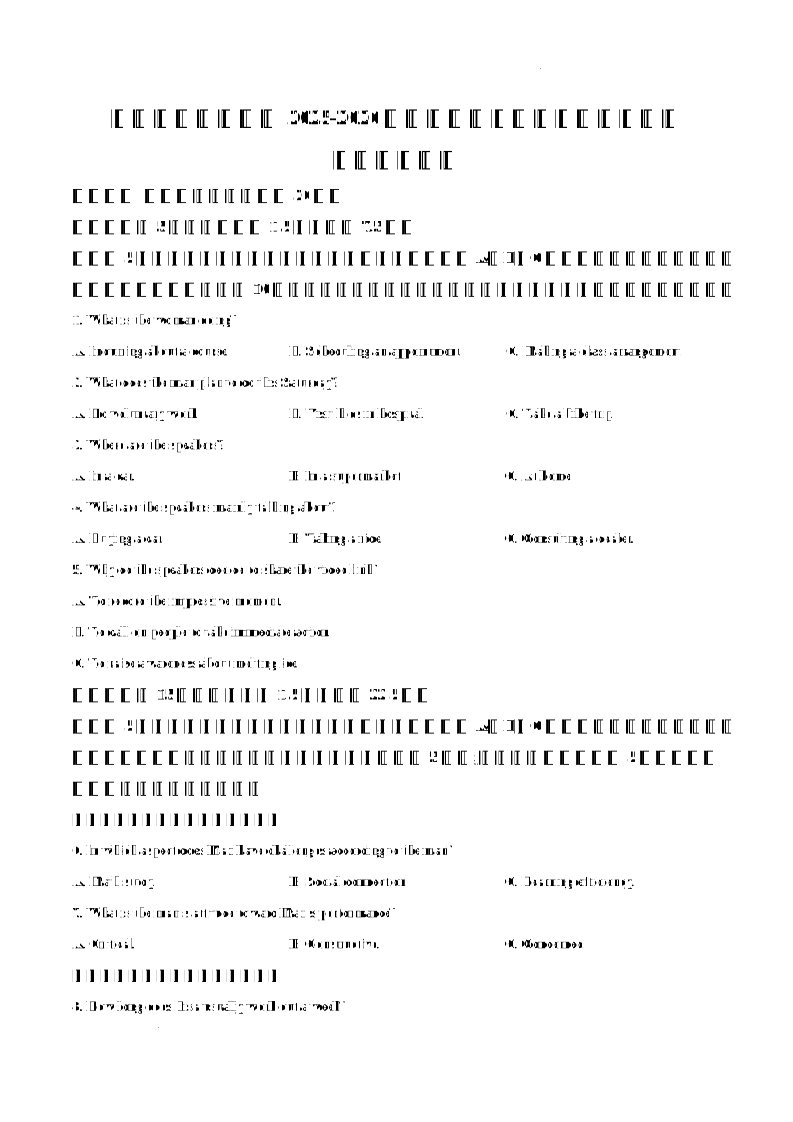
1. What is the woman doing?
A. Inquiring about a course. B. Scheduling an appointment. C. Making a class arrangement.
2. What does the man plan to do this Saturday?
A. Do voluntary work. B. Visit kids in hospital. C. Take a bike trip.
3. Where are the speakers?
A. In a car. B. In a supermarket. C. At home.
4. What are the speakers mainly talking about?
A. Buying a car. B. Taking a ride. C. Consulting a dealer.
5. Why do the speakers decide to share the video link?
A. To record the impressive moment.
B. To call on people to take immediate action.
C. To raise awareness about melting ice.
第二节(共15小题;每小题1.5分,满分22.5分)
听下面5段录音。每段录音后有几个小题,从题中所给的A、B、C三个选项中选出最佳选项。听每段录音前,你将有时间阅读各个小题,每小题5秒钟;听完后,每小题都有5秒钟的作答时间。每段录音播放两遍。
听下面一段对话,回答以下小题。
6. In which aspect does Max have challenges according to the man?
A. Math study. B. Social connection. C. Learning efficiency.
7. What is the man’s attitude toward Max’s performance?
A. Critical. B. Constructive. C. Concerned.
听下面一段对话,回答以下小题。
8. How long does Lisa usually work out a week?
A. About 1 hour. B. About 5 hours. C. About 7 hours.
9. What is the relationship between Lisa and Bella?
A. Teacher and parent. B. Fellow workers. C. Mother and daughter.
10. What does Lisa suggest at the end of the conversation?
A. Diversifying PE classes. B. Reducing school time. C. Adding after-school sports.
听下面一段对话,回答以下小题。
11. What does the woman dislike about her new skirt?
A. The material. B. The color. C. The style.
12. What does the woman say about affordable clothes?
A. They are made to last for years.
B. They are becoming a popular trend.
C. They result in not appreciating them.
13. What does the woman focus on when choosing clothes now?
A. Fashion trends. B. Price and comfort. C. Quality and sustainability.
听下面一段对话,回答以下小题。
14. Which of the following did the man learn on his grandpa’s farm?
A. Riding horses. B. Valuing food. C. Planting fields.
15. What does the woman think of farm life?
A. It is peaceful. B. It is tiring. C. It is rewarding.
16. What is the man’s suggestion?
A. Moving back to a farm. B. Exposing kids to farm life. C. Continuing to live in the city.
听下面一段独白,回答以下小题。
17. Who is the speaker talking to?
A. Chinese teachers. B. Young cultural learners. C. Overseas Chinese families.
18. What is a special feature of the journey?
A. It teaches participants Chinese art.
B. It offers experiential learning.
C. It advocates protecting historical sites.
19. How can the participants benefit from the journey?
A. Strengthen their family bond.
B. Understand their cultural identity.
C. Improve their academic performance.
20. Why does the speaker give the talk?
A. To organize a tour. B. To promote a program. C. To preserve a tradition.
第二部分 阅读(共两节,满分50分)
第一节(共15小题;每小题2.5分,满分37.5分)
阅读下列短文,从每题所给的A、B、C、D四个选项中选出最佳选项。
A
In modern society, stress often keeps us tossing and turning at night. Insomnia has become a common issue. But did you know that bedtime stories can be a great help for grown-ups, too? Here are five amazing podcasts to help you unwind and fall asleep easily.
1. Get Sleepy: Hosted by Tom Jones with a soothing British accent, this podcast offers meditative sleep stories. You can mentally wander around a Bavarian castle or attend a 1920s London tea party. Each episode’s description includes details about the sounds and atmosphere, so you can choose your favorite.
2. Boring Books for Bedtime: If you like reading before bed but worry about getting too engaged, this podcast is perfect. Host Sharon Handy reads chapters from dull yet interesting books, such as H. G. Wells’ A Short History of the World or old car manuals.
3. Nothing Much Happens: Host Kathryn Nicolai, also a yoga and meditation teacher, creates a cozy atmosphere. Each episode starts with a breathing exercise, followed by a warm and uneventful bedtime story read twice, with the second time slower. The stories change with the seasons.
4. Goodnight, World!: This is a collaboration between Headspace and “Sesame Street”. Although designed for kids, it can also help adults relax. Each 20-minute episode features beloved characters on adventures, and there are related mindfulness exercises in the Headspace app.
5. Phoebe Reads a Mystery: Phoebe Judge, known from the popular podcast Criminal, reads fictional crime stories chapter by chapter here. She covers classic works like Frankenstein and The Turn of the Screw.
Hope these podcasts become your sleep allies and bring you a restful night every time!
21. What do Get Sleepy and Nothing Much Happens have in common?
A. Both provide a calming atmosphere. B. Both offer seasonal story variations.
C. Both start with breathing techniques. D. Both include mindfulness exercises.
22. Which podcast is most suitable for classic literature lovers?
A. Get Sleepy. B. Boring Books for Bedtime.
C. Goodnight, World! D. Phoebe Reads a Mystery.
23. Who are the intended readers of this passage?
A. Kids needing digital bedtime stories. B. Adults struggling with sleep problems.
C. Students suffering from study pressure. D. Parents seeking bedtime stories for children.
B
Muhammed vividly remembers the day his uncle gifted him his first storybook. At the age of 10, this was the beginning of his love for literature and poetry. Growing up, he would arrange book club gatherings with friends. In his teens, he would organize book fairs. After university, he worked in journalism. In his 20s, he had already envisioned his dream retirement plan: open a bookshop.
When earthquakes struck his hometown of Adiyaman, Türkiye, in 2023 and left a trail of destruction, little did he know that his retirement plan would be carried out decades early. “I lost many relatives and saw many horrible things,” Muhammed recalled. “We all had to come together as neighbours, as a community.”
As part of recovery plans, authorities constructed a “social market” in the town centre — where various shops would fit residents’ needs and revive economic activity. Included in the plan was a bookshop. Muhammed, already known in his community as a bibliophile, was selected to lead this effort and provided by the Turkish Red Crescent with a first set of books. “I started from zero. Everything was destroyed after the earthquakes.”
Despite the uphill battle, Muhammed was driven by his belief that books could aid in his community’s collective healing. Starting with old iron shelves, Muhammed wanted to transform his bookshop into a more charming and comfortable environment. Through the International Organization for Migration’s (IOM) cash grant programme, Muhammed was able to purchase new bookshelves.
Almost a year since he opened the bookshop, Muhammed is happy with where life has taken him. “I love this business. I’m happy being around books. I meet people of all walks of life and have a unique relationship with each of my customers.”
Muhammed is also involved in efforts to re-establish public libraries, named in memory of literature teachers who lost their lives during the earthquakes. Through this, he hopes to make books more accessible. Each day, Muhammed hopes that his customers are captured into a new world of healing and hope amidst the tragedy.
24. Why did Muhammed open his bookshop earlier than planned?
A. He lost his job after the earthquakes.
B. The earthquakes generated a need for recovery.
C. His neighbours offered him free books.
D. Local charities asked him to organize a market.
25. What does the underlined word “bibliophile” in paragraph 3 mean?
A. Story teller. B. Book lover. C. Aid provider. D. Group reader.
26. What would Muhammed’s customers probably think of him?
A. Profit-motivated. B. Peace-loving. C. Community-minded. D. Fame-seeking.
27. What can be a suitable title for the text?
A. Rescuing Hand in Hand B. Retiring Early, Living Freely Finally
C. Healing Page by Page D. Forgetting Sadness, Gaining Support
C
The ants are violent predatory (食肉的) animals, eating other insects, sometimes even frogs, lizards and birds. But what’s even more remarkable about them is their architectural skills.
Commonly found in Central America, South America and Africa, the ants search forest floors in long hunting lines. When they encounter a gap between leaves or branches, they build a bridge, linking themselves together like a group of monkeys. “The workers will string themselves across that gap, and then other workers will walk on top of them,” Isabella Muratore, an expert at the New Jersey Institute of Technology told NPR. “Basically, they create shortcuts to make things easier for the other ants or just to allow them to travel across something that they otherwise couldn’t.”
Muratore studied the ants’ decision-making by intentionally placing objects which block their way. She said the ants build bridges where they get the greatest benefit for the least amount of bodies, and she identified a sweet spot where the gap is large enough to justify building a bridge, but not so large that it takes too many ants to do so. She also found that a string of bridges can influence how much ant power the ants are willing to invest in each individual bridge. Importantly, despite individually having small brains, the ants collectively weigh the costs and benefits of a bridge, Muratore said.
David Hu, a professor of engineering at the Georgia Institute of Technology, said “this type of research is casting new light on the collective intelligence of army ants.” He compares the individual ants to “neurons (神经元) in a big moving brain.” with no singular ant deciding where to build bridges.
The collective decision making of ants also has implications for human technology. Engineers have already applied such behaviors learned from ant research to building algorithms (算法) for self-assembling robots. “Ants are kind of existence proof that such robots would actually be able to survive and have a lot of interesting problems to solve in the real world.” Hu said. “Ants are really capable at solving these things with really, really little brainpower.”
28. How do ants build bridges when facing gaps?
A. By piling up surrounding stones. B. By collecting leaves and branches.
C. By requiring workers to string them. D. By connecting their bodies.
29. When building bridges, the ants consider the following factors EXCEPT ______
A. The size of the gap B. The time they build a bridge
C. The ant power they invest D. The number of bridges
30. What does “a big moving brain” refer to in paragraph 4?
A. A special brain. B. The brains of ants.
C. The ant army. D. The bridge built by ants.
31. Which saying best describes the ant-inspired robots’ working principle?
A. Marching ants bring pouring rain. B. Too many cooks ruin the soup.
C. Think twice before you act. D. Many hands make light work.
D
Recent research suggests that using digital devices like smartphones and tablets might actually help protect brain function in older adults rather than harm it. A review of 57 studies involving over 400,000 people aged 50 and older found that those who regularly used technology showed slower mental decline compared to those who used it less. These findings, published in Nature Human Behaviour, challenge concerns that screen time causes “digital dementia”.
Scientists analyzed data from adults worldwide, with an average age of 69, who had taken cognitive (认知的) tests or received memory-related tests. Results showed no proof that a lifetime of using digital technology drives mental decline. Rather, they found that using a computer, smartphone, the internet or some combination of these was associated with a lower risk of cognitive issues. However, researchers warn that the relationship isn’t fully understood. It’s possible that people with more incisive minds are more likely to use technology, but tech might also provide brain-boosting benefits.
We think the three Cs might be important: complexity, connection and compensatory (补偿的) behaviours,” Dr. Jared Benge told the Guardian. Digital tools could help people engage in complex activities and boost their social connections, both of which appeared to be good for the ageing brain, he said. The technology also allowed people to compensate for cognitive decline and function more easily, for example by using GPS to find their way or setting reminders to pay bills or take medicines, he added. He also emphasized that how devices are used matters. Passive activities like watching shows may not help, but mentally stimulating tasks — learning new apps, researching topics, or staying socially connected — likely play a positive role.
Sam Gilbert, a professor of cognitive neuroscience at University College London, said the study showed “a clear link” between digital technology usage and preserved cognitive ability in older age. “The explanation for this link is still not fully clear: we cannot be sure whether technology usage itself preserves cognitive ability, whether preserved cognitive ability leads to more frequent use of technology, or — most likely — some combination of the two. Nevertheless, this work suggests that using digital technology can be good for brain health.”
32. What can you learn about “digital dementia”?
A. It shows the effect of digital devices on users’ physical health.
B. It refers to technology-related memory or thinking problems.
C. It implies slower mental decline by using technology regularly.
D. It describes a special phenomenon of employing digital devices.
33. What does the underline word “incisive” in paragraph 2 mean?
A. Brilliant. B. Sharp. C. Optimistic. D. Suspicious.
34. According to Jared Benge, why does using digital devices benefit the elderly?
A. It can free them from their social contacts.
B. Digital devices usage can rid them of complex activities.
C. Digital devices usage can boost their brain function to a higher level.
D. Using digital devices to learn new skills can stimulate their minds.
35. What can be inferred from the last paragraph?
A. Using digital device is a necessity to brain development.
B. Preserved cognitive ability leads to using digital devices.
C. Technology usage protects brain function and cognitive ability.
D. More research is needed to further explain the research findings.
第二节 (共5小题;每小题2.5分,满分12.5分)
阅读下面短文,从短文后的选项中选出可以填入空白处的最佳选项。选项中有两项为多余选项。
The measurement most often used to assess a good night’s sleep is the number of hours of shuteye we get. And of course, getting plenty of sleep is definitely important. 36
That’s according to a new study published in the journal Sleep. 37 Even people who manage to sleep consistently for seven to eight hours each night, but who keep irregular schedules, are at a higher risk of strokes, heart attacks and cancer than those who slept fewer hours, but maintained a more consistent schedule.
38 The findings of the study show that those who got under six hours of sleep, or over nine, each night were at an increased risk, too.
Researchers analyzed sleep data from almost 61,000 people in the UK Biobank, a biomedical database tracking the health of half a million people in the UK. 39 Using advanced algorithms (算法) to study sleep patterns and tracking people’s death rates over an average of 6.3 years, they identified the factors linked to a higher risk of early death. Overall, the people who had the most consistent sleep-wake times had up to a 48-per-cent lower risk of all-cause death compared to those with the least consistent routines.
40 Given the risks, they believe advice should focus not just on getting enough sleep, but on maintaining a regular schedule for better overall health.
A. They put forward a sleep pattern for these people to follow.
B. However, we should pay more attention to our sleep routine.
C. In total, they examined more than 10 million hours of recorded sleep.
D. Now, this doesn’t mean you need to sleep only a few hours every night.
E. It suggests that one’s sleep regularity is a stronger predictor of death risk.
F. It questions whether one gets plenty of sleep is closely related to his health.
G. The researchers hope these findings will help update public health guidelines.
第三部分 语言运用(共两节,满分30分)
第一节 (共15小题;每小题1分,满分15分)
阅读下面短文,从每题所给的A、B、C、D四个选项中,选出可以填入空白处的最佳选项。
“Hey, ChatGPT, how many R’s are there in the word’ strawberry’?”
“Two.”
“Count again. S-T-R, that’s one R; A-W-B-E-R-R, that’s two more R’s. Three R’s 41 .”
“I 42 what you did there! You split up the word to make it seem like there are three R’s. 43 when you count the actual letters in the word ‘strawberry,’ there are still just two R’s. It’s a fun twist (小伎俩), though!”
But it’s not — it’s just a hard 44 . Sadly, whatever I said to it, ChatGPT insisted that there were two R’s in “strawberry.”
The chatbot 45 that “The R in ‘straw’ is part of the word, so it doesn’t change the 46 count of R’s in ‘strawberry.’” While this kind of deep thinking may be 47 during chats after a long school day, it’s not great for a high-tech tool that’s meant to 48 the workplace.
After quite a lot of 49 , I finally got ChatGPT to work. “Can you spell it out for me and count the R’s as you go along?” I asked.
“Sure, let’s spell it out and count together: S-T-R, that’s one R; A-W-B-E-R-R, that’s the second R; R, and that’s the third R. So, you’re 50 . When you count in this way, there are three R’s.”
All of this is due to the way the large language model (LLM) algorithms (算法) 51 AI tools like ChatGPT. Although these LLMs are 52 on a huge amount of data, at the end of the day this 53 means they have “seen a lot of stuff.” Somewhere in that stuff is enough 54 for an AI tool to define what a word means, or to know what R is. But it can’t understand the “stuff” 55 human beings. This is partly why AI chatbots may “hallucinate (产生幻觉)” when they haven’t got the answer to a question.
41. A. in exchange B. in case C. in all D. in effect
42. A. hate B. guess C. fancy D. see
43. A. But B. And C. Or D. So
44. A. mistake B. opinion C. proof D. fact
45. A. agreed B. declared C. argued D. permitted
46. A. total B. limited C. incorrect D. absolute
47. A. bitter B. deadly C. moral D. fun
48. A. abandon B. destroy C. transform D. defend
49. A. comments B. accesses C. clicks D. attempts
50. A. right B. experienced C. simple D. normal
51. A. store B. power C. invent D. attack
52. A. selected B. recycled C. educated D. trained
53. A. hardly B. simply C. finally D. badly
54. A. attention B. judgment C. information D. difficulty
55. A. for B. like C. with D. except
第二节(共10小题;每小题1.5分,满分15分)
阅读下面材料,在空白处填入1个适当的单词或括号内单词的正确形式。
The U.S. National Museum of Asian Art has returned two volumes of ancient Chinese silk manuscript (手稿) to China, which 56 (arrive) in Beijing on Sunday after nearly 80 years abroad.
This manuscript, whose value experts say is 57 (compare) to that of the Dead Sea Scrolls in the West, is the oldest Chinese silk 58 (write) found so far and the only known one from the Warring States Period found in China. The name, Zidanku Silk Manuscript, came from the site 59 it was stolen by grave robbers. It was then taken 60 (illegal) to the US in 1946.
China’s ambassador to the US said that the manuscript has over 900 characters 61 is full of myths and numbers. He said 62 return of the two volumes is a cultural milestone and a testament (证明) to China-U.S. cooperation in heritage protection and 63 the move brings new vitality to people-to-people exchanges and friendship. He also added that when the two countries work together 64 (base) on being equal and respecting each other, they can achieve important results that help both sides and others.
An expert in international law mentioned that it is difficult to get back China’s lost cultural items overseas because many of them were lost over a long time 65 different reasons, and they are spread out. He said it is important to make a full list of these lost items and study where they came from and how they were moved.
第四部分 写作(共两节,满分40分)
第一节(满分15分)
66.假如你是李华,下周学校将举行英语演讲比赛,主题为“有效沟通”。请你撰写一份演讲稿,内容包括:
1.有效沟通的重要性;
2.如何进行有效沟通。
注意:
1.写作词数应为80个左右;2.请按如下格式在答题卡的相应位置作答。
Dear teachers and classmates,
____________________________________________________________________________________________
Thank you!
第二节(满分 25 分)
67.阅读下面材料,根据其内容和所给段落开头语续写两段,使之构成一篇完整的短文。
A determined 10-year-old girl Callie lived with her parents and older brother, Ben, on a quiet farm. Though she was small and thin, she loved helping with housework, especially feeding the horses in their big barn (畜棚). One side of the barn housed the horse stalls (马厩), while the other side was piled with hay bales (干草捆) for feeding.
One afternoon, Callie went into the barn to feed the horses. As she walked towards the tall stacks of hay, she suddenly stopped. A tiny, weak sound came through the dusty air. Meow... meow...
Her heart jumped. A kitten must be trapped in the hay! Breathing hard, she ran back to find Ben and her father. “Dad! Ben! Come quick! A kitten is stuck in the hay!” she called urgently. Ben sighed, putting down his tools. Her father looked doubtful. “Probably just the wind, Callie,” he said gently. But they followed her to the barn.
They stood quietly near the hay stacks, listening. The barn was silent. “Hear anything?” Ben asked. Their father shook his head. “Nothing, sweetheart. Maybe it was just a mouse. Don’t worry about it.” Disappointed, Callie watched them leave.
After dinner, Callie slipped back to the barn, determined. She stood still, listening attentively. And there it was again! Meow... meow... Weaker now, but clear. She raced back to the house. Her father was watching TV.
“Dad, please!” she pleaded (恳求). “I heard it again! It is a kitten! Please, just come check one more time?” He looked unwilling but saw the real worry in her eyes. “Alright, alright, one last look.”
He returned a few minutes later. “Callie, I listened hard. All I heard was an owl outside. No kitten. Try not to worry.” He gave her a tired smile. “Thanks for checking, Dad.” Callie whispered, though she still felt uneasy.
注意:
1.续写词数应为150左右; 2.请按如下格式在答题卡的相应位置作答。
That night, Callie woke up suddenly.
____________________________________________________________________________________________
“I have no choice but to get help!” Callie thought to herself.
____________________________________________________________________________________________
学科网(北京)股份有限公司
$
资源预览图
1

2

3
相关资源
由于学科网是一个信息分享及获取的平台,不确保部分用户上传资料的 来源及知识产权归属。如您发现相关资料侵犯您的合法权益,请联系学科网,我们核实后将及时进行处理。