Unit 7 A Good Read 单元话题(文学阅读)阅读理解进阶练15篇-2025-2026学年八年级英语下册重难点讲练全攻略(人教版)
2026-05-29
|
2份
|
48页
|
202人阅读
|
4人下载

资源信息
| 学段 | 初中 |
|---|---|
| 学科 | 英语 |
| 教材版本 | 初中英语人教版八年级下册 |
| 年级 | 八年级 |
| 章节 | Unit 7 A Good Read |
| 类型 | 题集-专项训练 |
| 知识点 | - |
| 使用场景 | 同步教学-期末 |
| 学年 | 2026-2027 |
| 地区(省份) | 全国 |
| 地区(市) | - |
| 地区(区县) | - |
| 文件格式 | ZIP |
| 文件大小 | 669 KB |
| 发布时间 | 2026-05-29 |
| 更新时间 | 2026-05-29 |
| 作者 | 初高中原创精品库 |
| 品牌系列 | - |
| 审核时间 | 2026-05-29 |
| 下载链接 | https://m.zxxk.com/soft/58104175.html |
| 价格 | 3.00储值(1储值=1元) |
| 来源 | 学科网 |
摘要:
**基本信息**
本专项以文学阅读为核心,分基础、进阶、综合三层次系统训练,通过15篇多元文本提升阅读理解能力,融合语言能力与文化意识培养。
**专项设计**
|模块|题量/典例|题型特征|知识逻辑|
|----|-----------|----------|----------|
|基础入门训练|5篇(如《八十天环游地球》书评)|以细节理解、词义指代为主,文本简洁|从简单文学信息提取过渡,建立阅读基本逻辑|
|进阶拓展训练|5篇(如《金银岛》选段)|增加推理判断、人物分析,文本情节复杂|深化文学语境理解,衔接基础与综合能力|
|能力综合实践|5篇(如《黑骏马》选段、AI主题书评)|涵盖主旨归纳、跨文本关联,文本体裁多元|整合文学与现实主题,提升高阶思维品质|
内容正文:
2025-2026学年一线教师制作新教材英语同步精品系列资料,名师遴选!
2025-2026学年一线教师制作新教材英语同步精品系列资料,名师遴选!
学校:___________姓名:___________班级:___________考号:___________
Unit 7 A Good Read 单元话题(文学阅读)
阅读理解进阶练15篇
说明:此专题分三个难度层次,基础入门训练<进阶拓展训练< 能力综合实践,老师根据学生实际情况进行针对性难度训练。
基础入门训练5篇
Amy’s Note
The Name of the Book: Around the World in Eighty Days
Writer: Jules Verne
Type of book: Adventure (冒险)
The Main Character: Phileas Fogg
Main Subject: The book is all about Phileas Fogg’s trip. Phileas Fogg travels around the world in 80 days. He takes the train, takes the ship, and so on. He meets different people and faces new problems. From his story, we can learn that if we plan well and keep trying, we can do some difficult things.
Favorite Parts: My favorite part is when Phileas rides an elephant to cross a forest. It’s so cool! Another part I love is when he almost misses the last ship but runs fast to catch it. I feel happy for him!
Feelings:This book makes me want to travel too! It teaches me “never stop trying”—that’s a great lesson. You should read it if you like fun adventures!
1.Who is the main character of the book?
A.Amy. B.Jules Verne. C.Phileas Fogg. D.An elephant keeper.
2.How long does it take the main character to travel around the world?
A.60 days. B.80 days. C.100 days. D.120 days.
3.What does the underlined word “it” refer to?
A.The last ship. B.The last book. C.The last forest. D.The last elephant.
4.What is Amy’s purpose in writing this text?
A.To encourage readers to travel around the world.
B.To introduce a book and advise readers to read it.
C.To teach readers how to take the train for travel.
D.To share her own trip experience with family and friends.
5.What is the text?
A.A story. B.A poem. C.An email. D.A book report.
【答案】1.C 2.B 3.A 4.B 5.D
【导语】本文是Amy的读书笔记,她介绍了《八十天环游地球》的作者、主角、故事梗概,分享了自己最喜欢的片段与阅读感受,并推荐读者阅读这本书。
1.原文表格明确标注“The Main Character: Phileas Fogg”,可知主角是Phileas Fogg。
2.原文“The Main Subject”部分提到“Phileas Fogg travels around the world in 80 days”,可知主角环游世界花了80天。
3.原句“Another part I love is when he almost misses the last ship but runs fast to catch it” 中,“catch”的对象是前面提到的“the last ship”,可知“it”指代the last ship。
4.全文从书名、作者、内容、个人感受等方面介绍《八十天环游地球》,结尾还直接推荐“You should read it if you like fun adventures”,可知Amy的目的是介绍书籍并推荐阅读。
5.文章结构包含书籍信息、内容梗概、个人感受、推荐语,是典型的阅读报告。
The Boy Who Made Everyone Laugh
By Helen Rutter
Eleven-year-old Billy Plimpton loves jokes. He dreams of growing up to become a famous comedian (喜剧演员) like Johnson Lee, but there’s a problem—Billy has a stammer. How can he become a fast-talking, funny performer who delivers perfect performance when he can’t get the words out? Now he’s starting secondary school. Billy has made up his mind to overcome his stammer once and for all. He plans to become the most popular boy in his class and win the talent show in his school. His best friend knew he would never give up on the way to this goal. However, it’s not going to be easy, even with his kind teacher Mr Osho on hand to help. This is a warm-hearted and funny story with lots of Billy’s favorite jokes.
WIN! We’re giving away five copies of The Boy Who Made Everyone Laugh!
For a chance to win a copy, just send your name and address to competitions@theweekjunior.co.uk and put LAUGH in the subject line.
Closing date: midnight on Friday 19 February. See theweekjunior.co.uk/ terms for rules.
1.Who is the writer of the book The Boy Who Made Everyone Laugh?
A.Jacqueline Wilson. B.Helen Rutter. C.Billy Plimpton. D.Johnson Lee.
2.What does the underlined word “stammer” mean?
A.The ability to make others happy.
B.The interest in telling stories.
C.The problem of speaking out words fluently.
D.The spirit of never giving up.
3.Who helps Billy to prepare for the talent show?
A.His beloved parents. B.His kind teacher Mr Osho.
C.His friendly classmates. D.His best friend.
4.Who may win the free copy of the book The Boy Who Made Everyone Laugh?
A.Alice who wrote a book review of the book.
B.Molly who visited the website theweekjunior.co.uk/terms.
C.Lucy who bought five copies of the book.
D.Jack who sent an e-mail and put LAUGH in the subject line.
5.Which section might you find the article in a newspaper?
A.Advertisement. B.Music. C.Sports. D.Art.
【答案】1.B 2.C 3.B 4.D 5.A
【导语】本文是一篇书籍介绍及赠书活动说明,主要介绍了《让所有人笑的男孩》这本书的故事梗概以及参与赢取免费赠书的方式。
1.文章标题下方“By Helen Rutter”指出,该书的作者是Helen Rutter。
2.本书作者下面的段落里,句子“How can he become a fast-talking, funny performer who delivers perfect performance when he can’t get the words out?”指出,Billy无法流畅地说出词语,因此stammer意为“口吃,说话不流利”。
3.本书作者下面的段落里,倒数第二句“...although even with his kind teacher Mr Osho on hand to help.”指出,帮助Billy准备才艺表演的是他的老师Mr Osho。
4.方框里的句子“just send your name and address to competitions@theweekjunior.co.uk and put LAUGH in the subject line”指出,发送电子邮件并在主题行填写LAUGH的人有机会赢取免费赠书。
5.本文主要内容为一本书的介绍以及有奖赠书活动,属于广告宣传类信息,因此最可能出现在报纸的广告版面。
When the children arrived at the tunnel, they looked up and saw something strange. The trees on the hill were moving down the hill! It was a landslide.
The children knew the trees would fall on the railway line. If the train hit the trees, there would be a big accident. They had to stop the next train. The next train was arriving at 11:29, only five minutes away, and it was just 15 kilometers from them.
“We can run towards the train and wave to the driver,” Phyllis said.
“He won’t think there is anything wrong,” Roberta said. “We always wave to him.”
“We need something red to wave,” Peter said. “Red is for danger.”
“My skirt is red,” Phyllis said. “I’ll tear pieces off.”
Phyllis tore strips (条) from the bottom of her skirt.
“We need sticks to tie the strip to,” Peter said.
The children ran to a nearby tree. With his knife, Peter cut off three thin branches (树枝). He tied each of the strips of red skirt to one of the branches.
“Now we have red flags,” he said. “When we wave these, the engine driver will know something is wrong. He will stop the train and ask us what the matter is.”
The children ran through the tunnel and waited at the other side for the train to come. When the train arrived, the children waved their flags. Roberta was so excited that she fainted (晕). The engine driver saw the red flags and stopped the train at once. All the passengers cheered for the children.
— Adapted from The Railway Children
1.How did the children realize the train was in danger?
A.The train driver waved to them first.
B.Roberta fainted and they knew something was wrong.
C.They heard a warning sound from the railway station.
D.They saw the trees moving down the hill in a landslide.
2.Why did the children choose something red to stop the train?
A.Because red meant danger.
B.Because red was their favorite color.
C.Because Phyllis’s skirt was red.
D.Because red was a traditional railway color.
3.What did the children use to stop the train?
A.Self-made flags. B.Loud shouts.
C.Big branches. D.Colorful strips.
4.Which is the right order of the events?
① The children waited for the train to come. ② Phyllis tore strips from her skirt.
③ The children prevented an awful accident. ④ The children saw trees moving down.
A.④①②③ B.②④①③ C.④②①③ D.①③②④
5.Which is the best title for this passage?
A.How to Make Red Flags B.A Day at the Railway Station
C.Roberta’s Dangerous Adventure D.Three Brave Children Save a Train
【答案】1.D 2.A 3.A 4.C 5.D
【导语】本文是一篇记叙文,节选自《铁路边的孩子们》。文章讲述了三个孩子(Phyllis, Roberta, Peter)在隧道口目睹山体滑坡,预见到火车即将面临的危险。他们急中生智,用Phyllis的红裙子和树枝制作成红色旗帜,成功拦停了火车,避免了一场重大事故,展现了孩子们的勇敢与智慧。
1.根据文章第一段“When the children arrived at the tunnel, they looked up and saw something strange. The trees on the hill were moving down the hill! It was a landslide.”以及第二段“The children knew the trees would fall on the railway line. If the train hit the trees, there would be a big accident.”可知,孩子们是通过看到山体滑坡,意识到火车处于危险之中的。
2.根据文章第五段Peter所说“We need something red to wave,” Peter said. “Red is for danger.”可知,孩子们选择红色的东西来拦停火车是因为红色代表危险。
3.从文章第六段“Phyllis tore strips (条) from the bottom of her skirt.”、第八段“The children ran to a nearby tree. With his knife, Peter cut off three thin branches (树枝). He tied each of the strips of red skirt to one of the branches.”以及第九段“‘Now we have red flags,’ he said.”可知,孩子们用的是自制的旗帜来拦停火车。
4.事件的正确顺序为:④孩子们看到树木移动(第一段);②Phyllis从她的裙子上撕下布条(第六段);①孩子们等待火车到来(倒数第二段);③孩子们阻止了一场可怕的事故(倒数第二段火车司机看到红旗停车)。所以顺序是④②①③。
5.全文讲述了三个孩子发现山体滑坡后,用自制红旗成功拦停火车、避免事故的故事。
Sun Jing loved learning. To stop him from falling asleep, he tied his hair to the roof beam (横梁). When he felt sleepy and nodded off, the rope would pull his hair to wake him up. Then he would continue studying.
Another learner, Su Qin, used an awl (锥子) to prick (刺) his own leg when he wanted to sleep. In this way, he could go on studying.
Kuang Heng was born in a poor family but he wanted to study. He had to work hard to support his family during the day. At night, he wanted to study but his family couldn’t afford lamp (灯) oil. So he made a hole in the wall to let in the light from his neighbor’s house. The weak light helped him read.
When Li Bai was young, he didn’t want to study. One day, on his way out, he saw an old woman grinding (摩擦) an iron (铁的) stick. He asked what she was doing, and she said, “I am making it into a needle (针).” Li Bai was surprised at her patience and learned keeping doing something was the key to success. So he returned to his studies again and worked very hard from then on.
根据材料内容选择最佳答案。
1.What were Sun Jing’s and Su Qin’s ways used for?
A.Sleeping well. B.Studying happily.
C.Continuing their studies. D.Avoiding playing.
2.Why did Kuang Heng make the hole?
A.To pass things easily. B.To do more housework.
C.To make his neighbor angry. D.To let in the light.
3.What would the iron stick be made into by the old woman?
A.A knife. B.A needle.
C.A bowl. D.A small stick.
4.Which of the following is TRUE according to the text?
A.Sun Jing pricked his leg when feeling sleepy.
B.Su Qin always wanted to sleep when he was studying.
C.Kuang Heng’s parents didn’t care about him at all.
D.The old woman’s patience influenced Li Bai a lot.
5.What did the four learners have in common?
A.They were poor. B.They studied very hard.
C.They often slept in class. D.They didn’t want to study.
【答案】1.C 2.D 3.B 4.D 5.B
【导语】本文通过“头悬梁、锥刺股、凿壁偷光、铁杵成针”四个中国古代勤学故事,展现了古人刻苦学习的精神。
1.表格第一栏提到“Sun Jing loved learning. To stop him from falling asleep…”和“Another learner, Su Qin… In this way, he could go on studying.”,说明孙敬与苏秦的方法都是为了克服困倦,继续学习。
2.表格第二栏提到“At night, he wanted to study… So he made a hole in the wall to let in the light from his neighbor’s house.”,说明匡衡凿墙洞的目的是引入邻居家的光线,借此读书。
3.表格第三栏中老妇人说:“I am making it into a needle.”,可知她要把铁棍磨成针。
4.表格第三栏提到“Li Bai was surprised at her patience… and worked very hard from then on.”,说明李白被老妇人的耐心打动,明白了坚持的重要性,从此努力学习,因此“老妇人的耐心深深影响了李白”这一表述正确。
5.四个故事的核心都是讲述古人克服困难、坚持刻苦学习的经历,因此他们的共同点是“学习都非常刻苦”。
Foxes with nine tails, animals with human faces and fish bodies, turtles with bird heads and snake tails, these magical animals are from Shan Hai Jing (The Classic of Mountains and Seas). This old book played an important role in the world and inspired (给予灵感) today’s works. Let’s learn more about it!
Shan Hai Jing took shape before the Qin Dynasty (221-206 BC). Like an encyclopedia (百科全书), it writes about the world in the eyes of people at that time. The 30,000-word book records about 40 states, 550 mountains, 300 rivers, more than 100 people in history and 400 interesting animals.
Shan Hai Jing had a deep influence (影响) on the culture of mythology (神话学) in the world. It was taken to Japan during the Sui (581-618) and Tang (618-907) dynasties, or much earlier. In Japan, it was popular. People there once saw it as a guidebook for traveling in China. The book’s monsters (怪兽) were also popular.
Shan Hai Jing has inspired many works. Liu Siliang is a teacher at Shanghai Jiao Tong University. He said the book inspired the writing of Journey to the West and Strange Tales from a Chinese Studio《聊斋志异》. Pop culture works also borrow ideas from the book. Some of the animals in the book even go into movies, such as Zouwu, the star monster in Shan Hai Jing. It has a tiger-body with stripes of five colors. Its tail is longer than its body. It can travel 1,600 kilometers in a day. We can see it in the popular movie Fantastic Beasts II in 2021.
1.Why did the writer talk about the strange animals in Paragraph 1?
A.To answer some questions.
B.To give some examples.
C.To interest the readers.
D.To make a conclusion.
2.What does the underlined word “it” refer to in Paragraph 2?
A.The encyclopedia. B.The mythology.
C.Shan Hai Jing. D.The monsters.
3.Which of the following can you find in Shan Hai Jing?
4. states 2. mountains 3. rivers 4. plants 5. art
A.1234 B.123 C.234 D.345
4.What happened when Shan Hai Jing arrived in Japan?
A.People liked the book except for the monsters.
B.People were afraid of the monsters in the book.
C.It was too difficult for people to understand.
D.People liked both the book and the monsters.
5.What is the main idea of the passage?
A.Shan Hai Jing has inspired works across the world.
B.Shan Hai Jing includes many special monsters.
C.Shan Hai Jing sells very well across the world.
D.All people like the monsters from Shan Hai Jing.
【答案】1.C 2.C 3.B 4.D 5.A
【导语】本文是一篇说明文,主要介绍了《山海经》这部古老书籍,讲述了其成书时间、内容,对世界神话文化的影响,对众多作品的启发以及在日本的情况等。
1.第一段提到“Foxes with nine tails, animals with human faces and fish bodies, turtles with bird heads and snake tails, these magical animals are from Shan Hai Jing (The Classic of Mountains and Seas).”作者列举了《山海经》中各种奇特的动物,目的是引起读者的兴趣。
2.第二段“Shan Hai Jing took shape before the Qin Dynasty (221-206BC). Like an encyclopedia (百科全书), it writes about the world in the eyes of people at that time”中,前文提到了《山海经》,后面说像百科全书一样记录当时人们眼中的世界,所以“it”指代的是“Shan Hai Jing”。
3.第二段提到“The 30,000-word book records about 40 states, 550 mountains, 300 rivers, more than 100 people in history and 400 interesting animals.”可知在《山海经》中能找到州、山、河,没有提到植物和艺术。所以能找到1、2、3。
4.第三段提到“In Japan, it was popular. People there once saw it as a guidebook for traveling in China. The book’s monsters (怪兽) were also popular.”说明《山海经》到了日本后,书和书中的怪兽都很受欢迎。
5.文章最后一段提到“Shan Hai Jing has inspired many works.”以及前文对《山海经》对世界文化、作品等方面影响的阐述,可知文章主要讲的是《山海经》启发了世界各地的作品。
进阶拓展训练5篇
Jim Hawkins hid behind a big barrel. His heart was beating fast when listening to the dangerous pirates (海盗) talking.
“Listen, my friends,” Long John Silver said quietly “Tomorrow morning, when we reach the island, we will take the treasure and kill anyone who tries to stop us.”
“But what about the boy and the other gentlemen on this ship?” asked one of the pirates nervously.
“Ha!” Silver said angrily. “They don’t know our real plans. Once we find where the treasure is, they will be useless to us.”
Jim felt very scared because he knew how dangerous they were. These men, in fact, were bad sailors and were planning to kill them.
“What if they find out our plan too early?” another pirate asked worriedly.
“Then we will have to act quickly,” Silver answered coldly. “I have killed many people. A young boy and a few gentlemen are no real danger to skilled pirates like us.”
“Yes, Captain Silver,” the men said together excitedly.
Jim knew he must tell his friends about it right away. Quietly, he began to move away from his hiding place, but suddenly his foot hit a wooden board and made a loud noise.
“What was that?” Silver asked sharply, looking around the dark places.
“Maybe just the ship moving,” one pirate said.
“Maybe,” Silver said, “but be careful. We cannot have any problems at this important time.”
Jim held his breath, hoping they would not find him. Everyone’s safety depended on his ability to get away from it and tell his friends about the danger.
(Adapted from Treasure Island by Robert Louis Stevenson)
1.When did the scene of the story happen?
A.In the morning. B.At night. C.In the afternoon. D.At noon.
2.What was Long John Silver’s real plan?
A.To help Jim find the treasure safely.
B.To sail to a different island for food.
C.To take the treasure and kill the stoppers.
D.To give the treasure back to the gentlemen.
3.How is this passage mainly told?
A.Through detailed descriptions of the ship and island.
B.Through conversations between people and Jim’s thoughts.
C.Through historical information about pirates.
D.Through comparing different characters.
4.Which is the correct order of the following events?
a. Jim heard the pirates’ secret plan. b. Jim tried to move away quietly.
c. Jim hid behind the barrel. d. Jim’s foot hit a board and made noise.
e. Silver and his men became doubtful.
A.c-a-b-d-e B.a-c-b-d-e C.c-b-a-d-e D.a-b-c-e-d
5.What can we learn about Jim from the passage?
A.Silly and careless. B.Strict and serious.
C.Lazy and shy. D.Brave and thoughtful.
【答案】1.B 2.C 3.B 4.A 5.D
【导语】本文改编自《金银岛》,讲述了吉姆躲在桶后偷听到海盗阴谋,并试图逃脱去警告朋友的故事。
1.根据文中第二段Long John Silver说的话“Tomorrow morning, when we reach the island...”以及后文Silver看向“dark places”可知,对话发生时还没到第二天早上,且环境黑暗,因此故事场景发生在晚上。
2.根据文中第二段Long John Silver说的话“Tomorrow morning... we will take the treasure and kill anyone who tries to stop us.”可知,他们的真实计划是夺取宝藏并杀害阻止者。
3.通读全文可知,文章大部分篇幅是海盗之间的对话以及吉姆的心理活动和感受,如“Jim felt very scared...”, “Jim knew he must...”。文章主要通过人物对话和吉姆的想法来叙述故事。
4.根据故事发展顺序:首先文章第一句提到“Jim Hawkins hid behind a big barrel.”(c.吉姆躲在桶后);接着他“listening to the dangerous pirates talking”听到了计划(a.吉姆听到海盗的秘密计划);然后“Quietly, he began to move away”(b.吉姆试图悄悄离开);随后“his foot hit a wooden board and made a loud noise”(d.吉姆的脚撞到木板发出噪音);最后Silver问“What was that?”表示怀疑(e.Silver和他的手下变得怀疑)。正确顺序为c-a-b-d-e。
5.根据文中描述,吉姆虽然害怕,但他知道必须告诉朋友,并且试图悄悄离开去报信,这体现了他的勇敢(Brave)和为他人着想的周全(thoughtful)。他并不愚蠢、懒惰或严肃。
After returning home, Roberta wanted to know if the old gentleman could help the Russian find his family. So the children wrote to the old gentleman. The children took the letter to the station master and asked him to give it to the old gentleman.
The next day, they went to the station. When the train came, the old gentleman got off, the children ran up to him.
“Thank you for coming to talk to us,” Roberta said.
“I’m happy to,” the old gentleman said. “Let’s go into the waiting room.” They all went into the waiting room. The children told the old gentleman about the Russian.
“He wrote a book,” Peter said, “and it made the government so angry that they put him in prison (监狱).”
“What’s his name?” the old gentleman asked.
“I can’t pronounce it,” Peter said, “but I can spell it.”
He wrote down the Russian’s name on a piece of paper. It was Mr. Szczepansky.
“I know that name,” the old gentleman said. “I’ve read his book. I know many Russians in London, and they will know this man. But now, tell me all about yourselves. You’re such good children, and your mother is so kind to help a poor refugee (避难者). I want to know everything about you.”
The children began to talk about their mother and their father. Phyllis left the waiting room for a short time and then came back carrying a pot of tea and some bread and butter.
“Perks, the porter, gave this to me,” she said. The children had a delightful tea party with the old man. Then, he got on the train at 9:00 on his way to London.
Ten days later, the children were sitting above the station when the 5:15 train came in. They saw the old gentleman get off. The children ran down to the station. The old gentleman was waiting for them.
“I have good news for you,” he said. “I have found the Russian’s wife and child. May I come with you to your cottage and tell him the good news?”
The children led the old gentleman to their cottage.
1.Why did the children write to the old gentleman?
A.To write a book about the Russian. B.To help the Russian find his family.
C.To invite him to their cottage. D.To thank him for his kindness.
2.How did the old gentleman know about Mr. Szczepansky?
A.The old gentleman was also from Russia.
B.He worked in London with Mr. Szczepansky.
C.He read a book that Mr. Szczepansky wrote.
D.Mr. Szczepansky worked on the railway.
3.What does the underlined word “delightful” mostly mean?
A.Cheerful. B.Careful. C.Helpful. D.Useful.
4.Which of the following is the correct order of the events in the story?
①The Russian wrote a book. ②The Russian’s family were found.
③The children wrote to the old gentleman. ④The children talked about themselves.
A.③①②④ B.①④③② C.③②①④ D.①③④②
5.What is the best title for the passage?
A.Family Search. B.A Tea Party.
C.A Station Adventure. D.An Unexpected Visit.
【答案】1.B 2.C 3.A 4.D 5.A
【导语】本文是一篇记叙文,讲述了孩子们为了帮助一位俄国避难者寻找家人,写信给一位老绅士,最终在老绅士的帮助下成功找到其家人的故事。
1.第一段提到:“Roberta wanted to know if the old gentleman could help the Russian find his family. So the children wrote to the old gentleman.” 说明孩子们写信的目的是帮助那位俄国人找到家人。
2.根据文中老绅士的话:“I know that name. I’ve read his book.” 可知,他是因为读过Mr. Szczepansky写的书而知道这个人。
3.结合上下文,孩子们与老绅士一起喝茶、吃面包黄油,氛围愉快,因此“delightful”应意为“愉快的”,与cheerful意思相近。
4.正确顺序为:①俄国人写了一本书 → ③孩子们写信给老绅士 → ④孩子们向老绅士介绍自己 → ②俄国人的家人被找到。因此答案为①③④②。
5.故事围绕孩子们帮助俄国人寻找家人展开,最终成功找到,因此“Family Search”(寻找家人)是最佳标题。
At times, everything goes south on you. Maybe you can try your best to solve that. Maybe you have to accept that. You’re going to say, “This is it.” “This is how I end.”
Let’s read two stories about the superheroes from different countries. What did they do for their goals?
Jingwei Tries to Fill up the Sea Once upon a time, the youngest daughter of Emperor Yan went boating on the Eastern Sea. While she was enjoying herself, a strong wind rose on the sea, and her boat sank to the sea. Her spirit turned into a beautiful bird after she died. She cried sadly in the sound “Jingwei, Jingwei”. That was why people called her “Jingwei”.
The bird lived on a mountain near the sea. She was so sad that she decided to fill up the sea. Every day, she flew between the mountain and the sea, carrying stones or branches from the mountain and dropping them into the sea.
One day, the sea said to Jingwei, “Poor little bird, stop doing that meaningless thing. You’ll never fill me up.” Jingwei replied, “I’ll fill you up without doubt. I will, even if it will take me thousands of years. I’ll fight on without taking a rest.”
Robinson Crusoe
Robinson Crusoe is a main character from a novel named Robinson Crusoe.
When Robinson first arrived on the island, he had nothing. But he found the ship and made a small boat. He brought back many things he could use—food and drinks, tools, knives and guns. Although he lost everything, he didn’t lose his life. He kept working and waiting for another ship. He used the knife to cut down trees and built a house. He went with his gun almost every day to kill animals and birds for food. He learned to grow fruit and vegetables. He lived on the island for many years and he was saved finally.
1.Who are the superheroes in the two stories?
A.Animals and birds. B.Jingwei and Robinson.
C.Emperor Yan and the Eastern Sea. D.Emperor Yan and Robinson.
2.Why did people call the beautiful bird “Jingwei”?
A.Because she cried sadly in the sound “Jingwei”.
B.Because her father gave her the name “Jingwei”.
C.Because the name of the mountain where she lived was “Jingwei”.
D.Because she liked the name.
3.What did Robinson do with his knife according to the passage?
A.He grew fruit and vegetables. B.He killed animals and birds for food.
C.He cut down trees to build a house. D.He cut fish for food.
4.Which of the following statements is TRUE?
A.The sea thought Jingwei did the meaningful thing.
B.Jingwei decided to fill up the sea with stones and branches.
C.Robinson had some food and tools when he first arrived on the island.
D.Robinson bought fruit and vegetables from other places.
5.The two stories show that people should ________ to reach their goals.
A.never give up B.ask for help C.keep away from difficulties D.help the weak
【答案】1.B 2.A 3.C 4.B 5.A
【导语】本文是一篇记叙文,主要讲述了两个来自不同国家的“超级英雄”的故事:精卫填海和鲁滨逊漂流记,展示了他们为实现目标所展现的坚持不懈的精神。
1.根据文章内容,两个故事的主角分别是精卫(Jingwei)和鲁滨逊(Robinson Crusoe),他们都为各自的目标努力奋斗,是文中所说的“超级英雄”。
2.根据精卫填海部分“She cried sadly in the sound ‘Jingwei, Jingwei’. That was why people called her ‘Jingwei’.”可知,人们叫她精卫是因为她悲伤地叫着“精卫,精卫”的声音。
3.根据鲁滨逊漂流记部分“He used the knife to cut down trees and built a house.”可知,他用刀砍树来建造房子。
4.根据精卫填海部分“she decided to fill up the sea... carrying stones or branches from the mountain”可知,精卫决定用石头和树枝填海,B正确。
5.两个故事都展现了主人公面对巨大困难永不放弃的精神:精卫即使要花上千年也要填海,鲁滨逊在荒岛上坚持多年最终获救。因此两个故事告诉人们应该永不放弃来实现目标。
It was late when Matthew Cuthbert arrived home. His sister Marilla was waiting for him. However, she was very surprised when her eyes fell on the strange little figure beside him. Instead of the boy she was expecting, there stood a girl in a stiff, ugly dress, with red hair and bright eyes.
“Matthew Cuthbert, who’s that?” she asked. “Where is the boy?”
“There wasn’t any boy at the station,” said Matthew. “There was only her.”
“No boy?” Marilla insisted (坚持说). “But we sent word to Mrs. Spencer to bring a boy!”
The little girl was silent at first, but then she understood what they were saying. “You don’t want me because I’m not a boy!” she cried, and she began to cry stormily.
“Well, there’s no need to cry,” Marilla said, a little more softly. “We are not going to send you outside tonight. What’s your name?”
“Will you please call me Cordelia?” the girl said eagerly. But after Marilla’s questioning, she admitted unwillingly that her real name was Anne Shirley, which she felt was unromantic. “Cordelia is such a perfectly elegant name. I’ve always imagined that my name was Cordelia!”
“Nonsense,” said Marilla. “Anne is a really good plain name.” She then explained, “We need a boy to help Matthew on the farm. A girl is no use to us.”
At supper, Anne was too sad to eat. She said she was in “the depths of despair (绝望).”
Later, when Anne was sent to bed, Marilla and Matthew discussed the situation. Marilla was determined that the girl must be sent back. Matthew, however, spoke up unexpectedly. “She’s a real interesting little thing,” he insisted. “We might be some good to her.” As Matthew went to bed, Marilla frowned, and upstairs, the lonely child cried herself to sleep.
——Adapted from Anne of Green Gables
1.Why was Marilla shocked when Matthew came home?
A.Because Matthew was late.
B.Because the girl was poorly dressed.
C.Because Matthew didn’t wait for her.
D.Because Matthew brought a girl rather than a boy.
2.What can you infer about Anne from the conversation?
A.She is shy and speaks very little.
B.She is satisfied with her situation.
C.She is calm and does not have strong emotions.
D.She is imaginative and has a desire for romance.
3.Why didn’t Marilla want Anne?
A.Because Anne was lost deeply in sadness.
B.Because Anne was crying loudly all the time.
C.Because Anne wasn’t much help with the farm work.
D.Because Anne had an ordinary and unimaginative name.
4.How did Matthew feel about sending Anne back?
A.He didn’t want to argue with Marilla.
B.He thought Marilla’s ideas were important.
C.He felt sorry for Anne and advised keeping her.
D.He thought Anne’s leaving might be good to them.
5.What is the main idea of the passage?
A.A big fight between the Cuthberts.
B.A strange girl disliked her plain name.
C.A girl had a terrible night at the Cuthberts’.
D.An unwanted girl was brought to the Cuthberts’.
【答案】1.D 2.D 3.C 4.C 5.D
【导语】本文节选讲述兄妹二人本打算领养男孩帮忙务农,却意外接回女孩安妮,二人对此产生分歧,安妮满心失落难过。
1.第一段“However, she was very surprised when her eyes fell on the strange little figure beside him. Instead of the boy she was expecting, there stood a girl...”,Marilla惊讶是因为“Matthew带回来的是一个女孩,而不是他们原本预期的男孩”。
2.倒数第四段“Will you please call me Cordelia?...‘Cordelia is such a perfectly elegant name. I’ve always imagined that my name was Cordelia!’”,Anne不喜欢自己平凡的名字,幻想自己有一个优雅的名字,这体现了她“富有想象力且渴望浪漫”的特质。
3.倒数第三段“...said Marilla...‘We need a boy to help Matthew on the farm. A girl is no use to us.’”,Marilla不想要Anne是因为他们需要一个男孩在农场帮忙,而“女孩对他们没有用处”。
4.倒数第一段“Matthew, however, spoke up unexpectedly. ‘She’s a real interesting little thing,’ he insisted. ‘We might be some good to her.’,Matthew认为Anne很有趣,他们也许能对安妮有好处,即“他们可以帮助她”,这表明“他同情Anne并建议留下她”,而不是送她走。
5.通读全文可知,文章主要讲述Matthew意外带回了一个女孩Anne,而Cuthbert兄妹原本想要一个男孩来帮忙农活,导致Anne最初是不被需要的(unwanted),随后描述了双方对此事的反应。D项“一个不被想要的女孩被带到了Cuthberts的家”最能概括文章的主要内容。
Matilda’s parents owned quite a nice house with three bedrooms upstairs, while on the ground floor there was a dining room and a living room and a kitchen. Her father was a dealer in second-hand cars and it seemed he did pretty well at it.
“Sawdust,” he would say proudly, “is one of the great secrets of my success. And it costs me nothing. I get it free from the sawmill (锯木厂).”
“What do you use it for?” Matilda asked him.
“Ha!” the father said. “Wouldn’t you like to know.”
“I don’t see how it can help you to sell second-hand cars, Daddy.”
“That’s because you’re an ignorant little twit,” the father said. His speech was never very delicate but Matilda was used to it. She also knew that he liked to boast and she would egg him on shamelessly.
“You must be very clever to find a use for something that costs nothing,” she said. “I wish I could do it.”
“You couldn’t,” the father said. “You’re too stupid. But I don’t mind telling young Mike here about it seeing he’ll be joining me in the business one day.” Ignoring Matilda, he turned to his son and said, “I’m always glad to buy a car when some fool has been crashing the gears (齿轮) so badly. They’re all worn out and rattle like mad. I get it cheap. Then all I do is mix a lot of sawdust with the oil in the gear-box and it runs as sweet as a nut.”
“How long will it run like that before it starts rattling again?” Matilda asked him.
“Long enough for the buyer to get a good distance away,” the father said, grinning. “About hundred miles.”
“But that’s dishonest, Daddy,” Matilda said. “It’s cheating.”
“No one ever got rich being honest,” the father said. “Customers are there to be diddled (骗取).”
——Adapted from Matilda
1.The underlined word “it” refers to “________”.
A.a second-hand car B.the sawmill C.sawdust D.the father’s success
2.Matilda’s father thought her ________.
A.lazy B.stupid C.hard-working D.dishonest
3.Who was Mike?
A.He was Matilda’s brother. B.He was Matilda’s teacher.
C.He was Matilda’s uncle. D.He was Matilda’s cousin.
4.What did the father do to make a car run smoothly?
A.By fixing it properly. B.By mixing sawdust with the oil.
C.By showing the driver how to drive properly. D.By changing the engine.
5.What did the father mean at the end of the passage?
A.He could get rich by cheating others. B.Matilda should keep the secret.
C.Mike was good at doing business. D.He disliked cheating customers.
【答案】1.C 2.B 3.A 4.B 5.A
【导语】本文是一篇记叙文,节选自《Matilda》,讲述了 Matilda 的父亲作为二手车商,用锯末掺进机油里掩盖齿轮故障来欺骗顾客的故事,展现了他不诚实的经商方式。
1.由第二段“‘Sawdust,’ he would say proudly, ‘is one of the great secrets of my success. And it costs me nothing’”可知,父亲骄傲地说锯末是他成功的秘诀之一,且“它”不需要花钱,“it”指代的是前文提到的“sawdust”。
2.由第八段“You’re too stupid.”可知,父亲认为玛蒂尔达很愚蠢。
3.由第八段“young Mike here... he’ll be joining me in the business one day”以及“he turned to his son”可知,迈克是玛蒂尔达父亲的儿子,即玛蒂尔达的兄弟。
4.由第八段“mix a lot of sawdust with the oil in the gear-box and it runs as sweet as a nut”可知,父亲通过将锯末混入机油来让汽车暂时平稳运行。
5.由最后一段“No one ever got rich being honest... Customers are there to be diddled”可知,父亲认为诚实无法致富,顾客就是用来欺骗的,因此他靠欺骗别人来致富。
能力综合实践5篇
When it is possible that AI may be able to change our lives, we need to take action to deal with our AI-powered future. The book AI by Design: A Plan for Living with Artificial Intelligence comes out just in time.
In general, written by Catriona Campbell, the book explains how AI will change our lives and what we can do to prepare for the coming AI revolution (变革). In the wrong hands, such a book could be very difficult to understand. But thankfully, with over 20 years of professional experience, Campbell writes in simple terms, not like a teacher but like someone who wants to share useful knowledge. By the end, you’ll feel much smarter about AI.
According to Campbell, AI is already very smart and will keep improving. Right now, we have “Narrow AI,” which does specific (具体的) tasks. Soon, we may have “General AI,” which thinks more like humans. Later, “Dominant (主导的) AI” could become even more powerful. Campbell warns that we must raise our awareness of AI now—before it’s too late. If we don’t, AI could make decisions without us, leading to serious problems.
Campbell’s goal is to wake up those who are responsible for AI — the tech companies and world leaders. They must work with experts to guide AI’s growth. She says we are at a key moment in history. If we act now, we can shape a safe and bright future. But if we wait, AI could become a threat. To avoid disasters, we need clear rules and careful planning.
AI will affect us all, and if you only read one book on the subject, this is it.
1.What does the phrase “In the wrong hands” in paragraph 2 probably mean?
A.If it is read by someone with poor education.
B.If it is written by someone with weaker ability.
C.If it is reviewed by someone with mean thoughts.
D.If it is translated by someone with less knowledge.
2.What is a feature of AI by Design according to the passage?
A.It is written for AI experts. B.It is difficult to understand.
C.It provides detailed instructions. D.It uses a down-to-earth writing style.
3.What does Campbell ask people to do on AI development?
A.Wait for its further development.
B.Rethink experts’ opinions about it.
C.Learn from past experience to slow it down.
D.Make efforts together to keep it under control.
4.What is the author’s purpose in writing the passage?
A.To predict the future of AI. B.To recommend a book on AI.
C.To praise an outstanding AI expert. D.To give a brief introduction to Al history.
5.What’s the structure of the passage?
A. B. C. D.
【答案】1.A 2.D 3.D 4.B 5.C
【导语】本文主要介绍了Catriona Campbell所著的《AI by Design: A Plan for Living with Artificial Intelligence》一书,书中探讨了人工智能将如何改变我们的生活,并提出了应对AI革命的建议。
1.词句猜测题。根据“In the wrong hands, such a book could be very difficult to understand.”可知,如果落在不适合的人手中,这样一本书可能会很难理解。既已成一本书,此处应是指“读者”,结合选项,这句话意为“如果这本书被教育水平较低的人阅读,可能会难以理解”。故选A。
2.细节理解题。根据“But thankfully, with over 20 years of professional experience, Campbell writes in simple terms, not like a teacher but like someone who wants to share useful knowledge.”可知,《AI by Design》的特点是使用了平易近人的写作风格。故选D。
3.细节理解题。根据“Campbell’s goal is to wake up those who are responsible for AI—the tech companies and world leaders. They must work with experts to guide AI’s growth.”可知,Campbell呼吁人们共同努力来控制AI的发展。故选D。
4.主旨大意题。根据“AI will affect us all, and if you only read one book on the subject, this is it.”可知,作者写这篇文章的目的是推荐一本关于AI的书籍。故选B。
5.篇章结构题。文章第一段引入书籍《AI by Design》,指出其及时出版的意义;第二、第三以及第四段分别介绍书的内容、坎贝尔的呼吁和建议;最后一段强调书籍的必要性,呼吁阅读。选项C与之相符。故选C。
Scene I
(On a cold night, Buck, the half-dog and half-wolf, sits with his kind master John. They are having a heart-to-heart talk by the fire.)
Buck: John, do you remember the day we met and you saved me from that cruel man? You gave me a chance to live again.
John: Of course, Buck. I could see the power in your eyes, even though you were hurt.
Buck: You’re my family now. I’d do anything for you.
John: (Touching Buck’s head) So would I. And you also saved me after we lived together, remember?
You once jumped into the river to pull me out. You didn’t hesitate (犹豫) at all.
Buck: I love you, John. But something calling me. It’s like a voice deep inside, telling me to run free in the wild.
John: I understand, Buck. You’re not just any dog. You have the heart of a wolf. The wild is part of who you are.
Buck: I’ll always remember you. But I think one day, I’ll have to answer that call.
Scene 2
(Buck and his kind master John continued talking.)
Buck: (Thinking) The wild is calling me. I can feel it in my blood. But what about John? He saved me, cared for me...
John: (Softly) You’re a strong one, Buck. The strongest dog I’ve ever known. But I see it in your eyes—the wild is pulling you away.
Buck: You know I love you, John. But the forest, the wolves ... they’re part of me too.
John: (Sighing) (叹气) I understand, boy. You don’t belong to me or anyone. You belong to the wild.
(Later, Buck hears the howl (嚎叫声) of a wolf pack (狼群) outside. He looks back at John, crying.)
Buck: I don’t want to leave you, John. But the call ... it’s too strong.
John: (Smiling sadly) Go, Buck. Follow your heart. You’ll always be my family, no matter where you are.
(Buck hesitates, and then takes a step toward the forest. He looks back one last time before running into the wilderness, answering the call.)
1.What’s the relationship between Buck and John?
A.Enemy. B.Relatives. C.Strangers. D.Family.
2.What is the correct order of the events in the two scenes?
①Buck felt a call from the wild. ②Buck pulled John out of the river.
③John saved Buck from a cruel man. ④Buck left to answer the call of the wild.
A.①③④② B.②③④① C.③②①④ D.④①②③
3.What does the underlined word “it” refer to?
A.John’s love for Buck. B.The wolf in the forest.
C.The call of the wild. D.Buck’s hesitation to leave John.
4.Which of the following might describe the tone (气氛) of the two scenes?
A.Sad but moving. B.Relaxing and happy.
C.Cold but encouraging. D.Friendly and humorous.
5.According to the passage, what will most probably happen next?
A.Buck tries to get used to the new life.
B.Buck becomes a house pet for someone else.
C.Buck forgets John and live happily in the wild.
D.Buck and the wolf pack live with John together.
【答案】1.D 2.C 3.C 4.A 5.A
【导语】本文是一篇记叙文,文章节选自《野性的呼唤》的两个场景对话,主要讲述了Buck和John之间的情感以及Buck受到野性召唤的故事。
1.细节理解题。根据Buck所说“You’re my family now.”以及John的回应“You’ll always be my family, no matter where you are.”可知,Buck和John是“家人”关系。故选D。
2.细节理解题。根据“John, do you remember the day we met and you saved me from that cruel man?”可知,John把Buck从那个残忍的人手中解救了出来,③“John从残忍的人手中救下了Buck。”排第一;又根据“You once jumped into the river to pull me out.”可知,Buck曾经跳进河里把John救了出来,②“Buck把John从河里拉了上来。”排第二;根据“I love you, John. But something calling me.”可知,有一种力量在召唤着Buck,①“Buck感受到野性的召唤。”排第三;再根据“He looks back one last time before running into the wilderness, answering the call.”可知,在冲入荒野、响应召唤之前,Buck最后回头望了一眼,④“Buck离开去回应野性的呼唤了。”排第四;因此,顺序为③②①④。故选 C。
3.词义猜测题。根据“The wild is calling me. I can feel it in my blood.”可知,荒野在呼唤Buck,Buck能从血液中感受到;据此可以推断,划线单词“it”指代前一句中提到的“the call of the wild (野性的呼唤)”。故选C。
4.推理判断题。Buck与John的离别充满不舍 (“crying”、“smiling sadly”),John叹气、Buck犹豫,体现了悲伤气氛;又根据“I’d do anything for you.”、“Follow your heart.”以及“You’ll always be my family, no matter where you are.”可知,两人相互救赎的情感,令人感动。故选A。
5.推理判断题。根据“But the forest, the wolves ... they’re part of me too.”可知,Buck已强调野性是自我认同的一部分,所以Buck奔向荒野后,最合理的发展是尝试适应新生活。故选A。
One night, John came into the stable (马厩), calling, “Wake up, Beauty!”
He put my saddle (马鞍) and bridle (缰绳) on and rode up to the front door of the house. The Squire was there.
“John,” he said, “Mrs Gordon is very ill. Ride to the doctor’s and give him this note.”
“Now, Beauty, do your best,” said John.
I went as fast as possible.
When we arrived at Dr White’s house, John told him, “Mrs Gordon is very ill. Squire Gordon thinks she is going to die. Please go to see her immediately (立刻).” “Yes,” said the doctor, “but my son has my horse. Can I have yours?” he asked.
The doctor was heavier than John, and not such a good rider. But I did my best and went as fast as possible. When we got to Birtwick Park, Squire Gordon was at the door. The doctor went into the house with him, and Joe led me to the stable. I was glad to be home.
My legs were shaking, and I was very wet. Joe was young and he forgot to put a warm blanket on me. Then he gave me cold water to drink. Soon all my body began to shake, and I felt very cold.
A long time later, John came back. He covered me with two or three warm blankets, and ran to the house for some hot water. He gave me some warm food, and then I think I went to sleep.
Over and over again, John said to himself, “Stupid (愚蠢的) boy! Stupid boy!”
I was now very sick, and John was nursing me night and day.
The Squire came to see me. “Poor Beauty,” he said one day. “You saved Mrs Gordon’s life.”
John said, “Black Beauty went so fast. He seemed to know what was wrong.”
—Taken from Black Beauty
1.Whose life did Black Beauty save?
A.The Squire’s. B.Mrs Gordon’s.
C.John’s. D.Dr White’s.
2.What’s the correct order of the story?
a. Joe gave me cold water to drink. b. John woke me up.
c. I was very wet. d. Dr White rode me to Birtwick Park.
e. Joe didn’t put a warm blanket on me. f. John and I arrived at Dr White’s house.
A.f—b—a—c—d—e B.b—f—a—e—d—c
C.b—f—d—c—e—a D.b—f—c—d—e—a
3.What’s the meaning of the underlined word “nursing”?
A.taking care of B.looking at
C.shouting at D.worrying about
4.John said to himself, “Stupid boy! Stupid boy!” because he thought ________.
A.he was very stupid B.Joe didn’t look after Black Beauty well
C.he made a stupid mistake D.Black Beauty went so fast
5.What can we learn from the passage?
A.Dr White was not good at riding a horse at all.
B.Black Beauty was strong and seldom got ill.
C.Black Beauty knew what was wrong with Mrs Gordon.
D.John was a good man and he was nice to Black Beauty.
【答案】1.B 2.C 3.A 4.B 5.D
【导语】本文是一篇记叙文。节选自《黑骏马》,主要以马的视角讲述了Black Beauty拯救了Mrs Gordon生命但是自己病倒的故事。
1.细节理解题。根据倒数第二段“The Squire came to see me. ‘Poor Beauty,’ he said one day. ‘You saved Mrs Gordon’s life.’”可知,Black Beauty救了Mrs. Gordon的命。故选B。
2.细节理解题。根据“John came into the stable (马厩), calling, ‘Wake up, Beauty!’”可知,John叫醒Black Beauty,对应b;根据“When we arrived at Dr White’s house”可知,John和Black Beauty到达Dr White,对应f;根据“The doctor was heavier than John, and not such a good rider. But I did my best and went as fast as possible. When we got to Birtwick Park”可知,Dr White骑Black Beauty去 Birtwick Park,对应d;根据“My legs were shaking, and I was very wet.”可知,Black Beauty浑身湿透,对应c;根据“Joe was young and he forgot to put a warm blanket on me.”可知,Joe没有给它盖毯子,对应e;根据“Then he gave me cold water to drink.”可知,Joe给它喝冷水,对应a。正确顺序为 b—f—d—c—e—a。故选C。
3.词句猜测题。根据“I was now very sick, and John was nursing me night and day.John was nursing me night and day.”可知,“我”病得很重,John日夜照料我。“nursing”意为“照顾”。故选A。
4.推理判断题。根据“Joe was young and he forgot to put a warm blanket on me. Then he gave me cold water to drink.”可知,Joe没有给Black Beauty盖毯子,且喝的是冷水;根据“He covered...went to sleep.”可知,John回来后用两三条暖和的毯子盖住Black Beauty,然后跑进屋里去取热水,给Black Beauty一些热乎乎的食物。可推知,John骂的是Joe没有照顾好Black Beauty。故选B。
5.推理判断题。根据He covered me with two or three warm blankets, and ran to the house for some hot water. He gave me some warm food, and then I think I went to sleep.”可知,John回来后用两三条暖和的毯子盖住Black Beauty,然后跑进屋里去取热水,给Black Beauty一些热乎乎的食物。由此可知,John 是个好人,对Black Beauty很好。故选D。
Bertie was sad for weeks, months after the lion died. There was nothing I could do to cheer him up. He would sit for hours in his room, or go off on long walks all on his own. He seemed to be all alone in his own world, so far away. Try as I did, I could not reach him.
Then one day, I was in the kitchen here, when I saw Bertie hurrying down the hill, waving his stick and shouting for me. “I’ve got an idea,” he cried, as he came in, “I finally thought of it.” He showed me the end of his stick. It was white. “See this, Millie? It’s white chalk (白垩)!”
“So?” I said.
“You know the famous White Horse on the hill at Uffington, the one they carved out (雕刻) of the chalk a thousand years ago? It seems that the horse never dies. Well, that’s what we’re going to do, so he will never be forgotten! We’ll carve him out on the hill—he’ll be there forever.”
“It’ll take a long time, won’t it?” I said.
“We’ve got plenty, haven’t we?” he replied, with the same smile he had when he was a ten-year-old boy.
It took us twenty years to do it. Every spare moment we had, we were on the hill, digging with shovels and using buckets to carry away the dirt. It was hard, back-breaking work, but it was a labour of love. We made the paws, tail, body, and mane until he was perfect in every detail.
It was just after we’d finished that the butterflies first came. In summer, when the sun comes out after the rain, these butterflies would drink on the chalk face. Then the “White Lion” becomes a butterfly lion, and it comes back to life again. So now you know how Bertie’s white lion became our special butterfly lion.
(Adapted from The Butterfly Lion)
1.What did the writer mean by saying “I could not reach him” in paragraph 1?
A.The writer was physically far away from Bertie. B.The writer could not understand Bertie’s language.
C.The writer was unable to get Bertie out of his sadness. D.The writer did not know where Bertie was staying.
2.The underlined word “he” in paragraph 4 refers to ________.
A.Bertie B.the butterfly C.the White Horse D.the lion
3.Why was Bertie excited about the White Horse on the hill at Uffington?
A.It was very beautiful and he admired it.
B.It was a symbol of something that could live on forever.
C.It was made of the same white chalk as on his stick.
D.He had visited it before and had good memories there.
4.What does the scene with butterflies landing on the White Lion symbolize (象征)?
A.The lion becomes colorful. B.Nature changes the lion.
C.The lion turns into a real one. D.The lion seems to come alive.
5.The main idea of the passage is about ________.
A.how to turn a lion into butterflies B.the friendship between Bertie and Millie
C.how Bertie and Millie remembered the dead lion D.the story of the famous White Horse
【答案】1.C 2.D 3.B 4.D 5.C
【导语】本文是一篇记叙文,主要讲述了Bertie在狮子去世后长时间沉浸在悲伤中,后来通过雕刻白垩狮子雕像并吸引蝴蝶停留的方式,让狮子以另一种形式“重生”的故事。
1.词句猜测题。根据“He seemed to be all alone in his own world, so far away. Try as I did, I could not reach him”可知,Bertie似乎独自一人在自己的世界里,那么遥远,尽管作者努力了,还是无法触及他。由此可知,Bertie独自一人沉浸在悲伤中,作者无法让他走出悲伤。故选C。
2.词句猜测题。根据“You know the famous White Horse on the hill at Uffington, the one they carved out (雕刻) of the chalk a thousand years ago? It seems that the horse never dies. Well, that’s what we’re going to do, so he will never be forgotten!”可知,一千年前人们用白垩雕刻出来的马似乎是不死的,所以Bertie也要这样做,要雕刻狮子,这样狮子就永远不会被遗忘。he指的是前文提及的“狮子”。故选D。
3.推理判断题。 根据“You know the famous White Horse on the hill at Uffington... It seems that the horse never dies. Well, that’s what we’re going to do, so he will never be forgotten!”可知,Bertie受白马雕像“永恒存在”的启发,想通过雕刻让狮子永远被铭记。由此可知,乌芬顿山上的白马象征着某种东西可以永远存在。故选B。
4.推理判断题。根据“the ‘White Lion’ becomes a butterfly lion, and it comes back to life again”可知,蝴蝶停留在雕像上时,狮子仿佛“复活”了。故选D。
5.主旨大意题。全文围绕Bertie和Millie如何通过雕刻白垩狮子纪念逝去的狮子展开,最终蝴蝶的降临赋予雕像生命意义。故选C。
At seventeen minutes past four in the afternoon, while the passengers were in the main saloon taking their lunch, a slight blow was felt on the hull of the Scotia, on the quarter a little behind the port wheel.
The Scotia had not run into something: something had run into it, a cutting or a sharp object rather than a blunt one. The blow seemed so slight that nobody on board would have worried but for the shout of the hold workers who rushed up on to the deck shouting:
“We’re sinking (下沉)! We’re sinking!”
At first the passengers were quite scared—but Captain Anderson quickly reassured them. Actually the danger could not be imminent (迫近的). The Scotia, divided into seven parts by its watertight bulkheads, was guaranteed to resist any leak safely.
Captain Anderson headed immediately for the hold. He observed that the fifth part had flooded; and the speed of the flooding proved that the hole was a considerable one. Very fortunately, the boilers were not in this compartment, for the fires would have gone out immediately.
Captain Anderson had the engines stopped at once, while one of the sailors dived to assess the damage. Shortly afterwards, the existence of a two-metre hole in the hull was confirmed. Such damage could not be repaired and the Scotia, its wheels half underwater, had to continue its journey in the same state. It was 300 miles from Cape Clear, and was three days late when it sailed into the company docks, having greatly worried Liverpool.
The engineers then carried out an inspection (检查) of the Scotia, which was in dry dock.
They couldn’t believe their eyes. Two and a half metres below the water-line appeared a neat hole in the form of an isosceles triangle (等腰三角形). The break in the plate was perfectly clean, and could not have been cut with greater precision.
1.What does the underlined word “reassured” in the fourth paragraph mean?
A.责备 B.宽慰 C.观察 D.相信
2.Where did the story take place?
A.In the ocean. B.In a house. C.In the classroom. D.In a garden.
3.The________ part of the boat was flooded according to the story.
A.first B.third C.fifth D.seventh
4.Which of the following is the correct order according to the story?
a. The Captain stopped the engines. b. The boat was hit by something sharp.
c. The engineers checked the Scotia for damage. d. People realized that the Scotia was sinking.
A.a-b-d-c B.c-d-a-b C.b-d-a-c D.d-a-b-c
5.Which of the following is TRUE according to the passage?
A.The story took place in the morning. B.Captain Anderson was very worried in the story.
C.The damage was not very serious. D.In the beginning of the story, most people were not aware of the damage.
【答案】1.B 2.A 3.C 4.C 5.D
【导语】本文是名著《海底两万里》节选,讲述了斯科舍号船在海上遇险的故事。
1.词句猜测题。根据第四段“At first the passengers were quite scared…”以及“Actually the danger could not be imminent… was guaranteed to resist any leak safely.”可知,起初乘客们很担心,但是船长告诉他们,船体被水密隔板分隔为七个独立舱室,即使发生渗漏也能确保安然无恙。因此可推知船长是在“宽慰”他们。故选B。
2.推理判断题。根据第一段“on the hull of the Scotia”以及全文对轮船航行的描述可知,故事发生在海洋上。故选A。
3.细节理解题。根据第五段“He observed that the fifth part had flooded”可知,船的第五部分进水了。故选C。
4.细节理解题。根据文章第二段“The Scotia had not run into something… rather than a blunt one”可知,首先是船被尖锐物体撞了,对应b;根据文章第三段“We’re sinking! We’re sinking!”及第四段“At first the passengers were quite scared.”可知,接着是人们意识到船在下沉,对应d;根据文章第六段“Captain Anderson had the engines stopped at once…”可知,然后是船长下令停引擎,对应a;根据文章第七段“The engineers then carried out an inspection of the Scotia, which was in dry dock”可知,最后是工程师检查船的损坏情况,对应c;故正确顺序为b-d-a-c。故选C。
5.细节理解题。根据第二段“The blow seemed so slight that nobody on board would have worried but for the shout of the hold workers.”可知,起初大多数人并未意识到船的损坏。故选D。
26
同步新教材,周周有练习,月月有重点!
27
同步新教材,周周有练习,月月有重点!
学科网(北京)股份有限公司
$
2025-2026学年一线教师制作新教材英语同步精品系列资料,名师遴选!
2025-2026学年一线教师制作新教材英语同步精品系列资料,名师遴选!
学校:___________姓名:___________班级:___________考号:___________
Unit 7 A Good Read 单元话题(文学阅读)
阅读理解进阶练15篇
说明:此专题分三个难度层次,基础入门训练<进阶拓展训练< 能力综合实践,老师根据学生实际情况进行针对性难度训练。
基础入门训练5篇
Amy’s Note
The Name of the Book: Around the World in Eighty Days
Writer: Jules Verne
Type of book: Adventure (冒险)
The Main Character: Phileas Fogg
Main Subject: The book is all about Phileas Fogg’s trip. Phileas Fogg travels around the world in 80 days. He takes the train, takes the ship, and so on. He meets different people and faces new problems. From his story, we can learn that if we plan well and keep trying, we can do some difficult things.
Favorite Parts: My favorite part is when Phileas rides an elephant to cross a forest. It’s so cool! Another part I love is when he almost misses the last ship but runs fast to catch it. I feel happy for him!
Feelings:This book makes me want to travel too! It teaches me “never stop trying”—that’s a great lesson. You should read it if you like fun adventures!
1.Who is the main character of the book?
A.Amy. B.Jules Verne. C.Phileas Fogg. D.An elephant keeper.
2.How long does it take the main character to travel around the world?
A.60 days. B.80 days. C.100 days. D.120 days.
3.What does the underlined word “it” refer to?
A.The last ship. B.The last book. C.The last forest. D.The last elephant.
4.What is Amy’s purpose in writing this text?
A.To encourage readers to travel around the world.
B.To introduce a book and advise readers to read it.
C.To teach readers how to take the train for travel.
D.To share her own trip experience with family and friends.
5.What is the text?
A.A story. B.A poem. C.An email. D.A book report.
The Boy Who Made Everyone Laugh
By Helen Rutter
Eleven-year-old Billy Plimpton loves jokes. He dreams of growing up to become a famous comedian (喜剧演员) like Johnson Lee, but there’s a problem—Billy has a stammer. How can he become a fast-talking, funny performer who delivers perfect performance when he can’t get the words out? Now he’s starting secondary school. Billy has made up his mind to overcome his stammer once and for all. He plans to become the most popular boy in his class and win the talent show in his school. His best friend knew he would never give up on the way to this goal. However, it’s not going to be easy, even with his kind teacher Mr Osho on hand to help. This is a warm-hearted and funny story with lots of Billy’s favorite jokes.
WIN! We’re giving away five copies of The Boy Who Made Everyone Laugh!
For a chance to win a copy, just send your name and address to competitions@theweekjunior.co.uk and put LAUGH in the subject line.
Closing date: midnight on Friday 19 February. See theweekjunior.co.uk/ terms for rules.
1.Who is the writer of the book The Boy Who Made Everyone Laugh?
A.Jacqueline Wilson. B.Helen Rutter. C.Billy Plimpton. D.Johnson Lee.
2.What does the underlined word “stammer” mean?
A.The ability to make others happy.
B.The interest in telling stories.
C.The problem of speaking out words fluently.
D.The spirit of never giving up.
3.Who helps Billy to prepare for the talent show?
A.His beloved parents. B.His kind teacher Mr Osho.
C.His friendly classmates. D.His best friend.
4.Who may win the free copy of the book The Boy Who Made Everyone Laugh?
A.Alice who wrote a book review of the book.
B.Molly who visited the website theweekjunior.co.uk/terms.
C.Lucy who bought five copies of the book.
D.Jack who sent an e-mail and put LAUGH in the subject line.
5.Which section might you find the article in a newspaper?
A.Advertisement. B.Music. C.Sports. D.Art.
When the children arrived at the tunnel, they looked up and saw something strange. The trees on the hill were moving down the hill! It was a landslide.
The children knew the trees would fall on the railway line. If the train hit the trees, there would be a big accident. They had to stop the next train. The next train was arriving at 11:29, only five minutes away, and it was just 15 kilometers from them.
“We can run towards the train and wave to the driver,” Phyllis said.
“He won’t think there is anything wrong,” Roberta said. “We always wave to him.”
“We need something red to wave,” Peter said. “Red is for danger.”
“My skirt is red,” Phyllis said. “I’ll tear pieces off.”
Phyllis tore strips (条) from the bottom of her skirt.
“We need sticks to tie the strip to,” Peter said.
The children ran to a nearby tree. With his knife, Peter cut off three thin branches (树枝). He tied each of the strips of red skirt to one of the branches.
“Now we have red flags,” he said. “When we wave these, the engine driver will know something is wrong. He will stop the train and ask us what the matter is.”
The children ran through the tunnel and waited at the other side for the train to come. When the train arrived, the children waved their flags. Roberta was so excited that she fainted (晕). The engine driver saw the red flags and stopped the train at once. All the passengers cheered for the children.
— Adapted from The Railway Children
1.How did the children realize the train was in danger?
A.The train driver waved to them first.
B.Roberta fainted and they knew something was wrong.
C.They heard a warning sound from the railway station.
D.They saw the trees moving down the hill in a landslide.
2.Why did the children choose something red to stop the train?
A.Because red meant danger.
B.Because red was their favorite color.
C.Because Phyllis’s skirt was red.
D.Because red was a traditional railway color.
3.What did the children use to stop the train?
A.Self-made flags. B.Loud shouts.
C.Big branches. D.Colorful strips.
4.Which is the right order of the events?
① The children waited for the train to come. ② Phyllis tore strips from her skirt.
③ The children prevented an awful accident. ④ The children saw trees moving down.
A.④①②③ B.②④①③ C.④②①③ D.①③②④
5.Which is the best title for this passage?
A.How to Make Red Flags B.A Day at the Railway Station
C.Roberta’s Dangerous Adventure D.Three Brave Children Save a Train
Sun Jing loved learning. To stop him from falling asleep, he tied his hair to the roof beam (横梁). When he felt sleepy and nodded off, the rope would pull his hair to wake him up. Then he would continue studying.
Another learner, Su Qin, used an awl (锥子) to prick (刺) his own leg when he wanted to sleep. In this way, he could go on studying.
Kuang Heng was born in a poor family but he wanted to study. He had to work hard to support his family during the day. At night, he wanted to study but his family couldn’t afford lamp (灯) oil. So he made a hole in the wall to let in the light from his neighbor’s house. The weak light helped him read.
When Li Bai was young, he didn’t want to study. One day, on his way out, he saw an old woman grinding (摩擦) an iron (铁的) stick. He asked what she was doing, and she said, “I am making it into a needle (针).” Li Bai was surprised at her patience and learned keeping doing something was the key to success. So he returned to his studies again and worked very hard from then on.
根据材料内容选择最佳答案。
1.What were Sun Jing’s and Su Qin’s ways used for?
A.Sleeping well. B.Studying happily.
C.Continuing their studies. D.Avoiding playing.
2.Why did Kuang Heng make the hole?
A.To pass things easily. B.To do more housework.
C.To make his neighbor angry. D.To let in the light.
3.What would the iron stick be made into by the old woman?
A.A knife. B.A needle.
C.A bowl. D.A small stick.
4.Which of the following is TRUE according to the text?
A.Sun Jing pricked his leg when feeling sleepy.
B.Su Qin always wanted to sleep when he was studying.
C.Kuang Heng’s parents didn’t care about him at all.
D.The old woman’s patience influenced Li Bai a lot.
5.What did the four learners have in common?
A.They were poor. B.They studied very hard.
C.They often slept in class. D.They didn’t want to study.
Foxes with nine tails, animals with human faces and fish bodies, turtles with bird heads and snake tails, these magical animals are from Shan Hai Jing (The Classic of Mountains and Seas). This old book played an important role in the world and inspired (给予灵感) today’s works. Let’s learn more about it!
Shan Hai Jing took shape before the Qin Dynasty (221-206 BC). Like an encyclopedia (百科全书), it writes about the world in the eyes of people at that time. The 30,000-word book records about 40 states, 550 mountains, 300 rivers, more than 100 people in history and 400 interesting animals.
Shan Hai Jing had a deep influence (影响) on the culture of mythology (神话学) in the world. It was taken to Japan during the Sui (581-618) and Tang (618-907) dynasties, or much earlier. In Japan, it was popular. People there once saw it as a guidebook for traveling in China. The book’s monsters (怪兽) were also popular.
Shan Hai Jing has inspired many works. Liu Siliang is a teacher at Shanghai Jiao Tong University. He said the book inspired the writing of Journey to the West and Strange Tales from a Chinese Studio《聊斋志异》. Pop culture works also borrow ideas from the book. Some of the animals in the book even go into movies, such as Zouwu, the star monster in Shan Hai Jing. It has a tiger-body with stripes of five colors. Its tail is longer than its body. It can travel 1,600 kilometers in a day. We can see it in the popular movie Fantastic Beasts II in 2021.
1.Why did the writer talk about the strange animals in Paragraph 1?
A.To answer some questions.
B.To give some examples.
C.To interest the readers.
D.To make a conclusion.
2.What does the underlined word “it” refer to in Paragraph 2?
A.The encyclopedia. B.The mythology.
C.Shan Hai Jing. D.The monsters.
3.Which of the following can you find in Shan Hai Jing?
4. states 2. mountains 3. rivers 4. plants 5. art
A.1234 B.123 C.234 D.345
4.What happened when Shan Hai Jing arrived in Japan?
A.People liked the book except for the monsters.
B.People were afraid of the monsters in the book.
C.It was too difficult for people to understand.
D.People liked both the book and the monsters.
5.What is the main idea of the passage?
A.Shan Hai Jing has inspired works across the world.
B.Shan Hai Jing includes many special monsters.
C.Shan Hai Jing sells very well across the world.
D.All people like the monsters from Shan Hai Jing.
进阶拓展训练5篇
Jim Hawkins hid behind a big barrel. His heart was beating fast when listening to the dangerous pirates (海盗) talking.
“Listen, my friends,” Long John Silver said quietly “Tomorrow morning, when we reach the island, we will take the treasure and kill anyone who tries to stop us.”
“But what about the boy and the other gentlemen on this ship?” asked one of the pirates nervously.
“Ha!” Silver said angrily. “They don’t know our real plans. Once we find where the treasure is, they will be useless to us.”
Jim felt very scared because he knew how dangerous they were. These men, in fact, were bad sailors and were planning to kill them.
“What if they find out our plan too early?” another pirate asked worriedly.
“Then we will have to act quickly,” Silver answered coldly. “I have killed many people. A young boy and a few gentlemen are no real danger to skilled pirates like us.”
“Yes, Captain Silver,” the men said together excitedly.
Jim knew he must tell his friends about it right away. Quietly, he began to move away from his hiding place, but suddenly his foot hit a wooden board and made a loud noise.
“What was that?” Silver asked sharply, looking around the dark places.
“Maybe just the ship moving,” one pirate said.
“Maybe,” Silver said, “but be careful. We cannot have any problems at this important time.”
Jim held his breath, hoping they would not find him. Everyone’s safety depended on his ability to get away from it and tell his friends about the danger.
(Adapted from Treasure Island by Robert Louis Stevenson)
1.When did the scene of the story happen?
A.In the morning. B.At night. C.In the afternoon. D.At noon.
2.What was Long John Silver’s real plan?
A.To help Jim find the treasure safely.
B.To sail to a different island for food.
C.To take the treasure and kill the stoppers.
D.To give the treasure back to the gentlemen.
3.How is this passage mainly told?
A.Through detailed descriptions of the ship and island.
B.Through conversations between people and Jim’s thoughts.
C.Through historical information about pirates.
D.Through comparing different characters.
4.Which is the correct order of the following events?
a. Jim heard the pirates’ secret plan. b. Jim tried to move away quietly.
c. Jim hid behind the barrel. d. Jim’s foot hit a board and made noise.
e. Silver and his men became doubtful.
A.c-a-b-d-e B.a-c-b-d-e C.c-b-a-d-e D.a-b-c-e-d
5.What can we learn about Jim from the passage?
A.Silly and careless. B.Strict and serious.
C.Lazy and shy. D.Brave and thoughtful.
After returning home, Roberta wanted to know if the old gentleman could help the Russian find his family. So the children wrote to the old gentleman. The children took the letter to the station master and asked him to give it to the old gentleman.
The next day, they went to the station. When the train came, the old gentleman got off, the children ran up to him.
“Thank you for coming to talk to us,” Roberta said.
“I’m happy to,” the old gentleman said. “Let’s go into the waiting room.” They all went into the waiting room. The children told the old gentleman about the Russian.
“He wrote a book,” Peter said, “and it made the government so angry that they put him in prison (监狱).”
“What’s his name?” the old gentleman asked.
“I can’t pronounce it,” Peter said, “but I can spell it.”
He wrote down the Russian’s name on a piece of paper. It was Mr. Szczepansky.
“I know that name,” the old gentleman said. “I’ve read his book. I know many Russians in London, and they will know this man. But now, tell me all about yourselves. You’re such good children, and your mother is so kind to help a poor refugee (避难者). I want to know everything about you.”
The children began to talk about their mother and their father. Phyllis left the waiting room for a short time and then came back carrying a pot of tea and some bread and butter.
“Perks, the porter, gave this to me,” she said. The children had a delightful tea party with the old man. Then, he got on the train at 9:00 on his way to London.
Ten days later, the children were sitting above the station when the 5:15 train came in. They saw the old gentleman get off. The children ran down to the station. The old gentleman was waiting for them.
“I have good news for you,” he said. “I have found the Russian’s wife and child. May I come with you to your cottage and tell him the good news?”
The children led the old gentleman to their cottage.
1.Why did the children write to the old gentleman?
A.To write a book about the Russian. B.To help the Russian find his family.
C.To invite him to their cottage. D.To thank him for his kindness.
2.How did the old gentleman know about Mr. Szczepansky?
A.The old gentleman was also from Russia.
B.He worked in London with Mr. Szczepansky.
C.He read a book that Mr. Szczepansky wrote.
D.Mr. Szczepansky worked on the railway.
3.What does the underlined word “delightful” mostly mean?
A.Cheerful. B.Careful. C.Helpful. D.Useful.
4.Which of the following is the correct order of the events in the story?
①The Russian wrote a book. ②The Russian’s family were found.
③The children wrote to the old gentleman. ④The children talked about themselves.
A.③①②④ B.①④③② C.③②①④ D.①③④②
5.What is the best title for the passage?
A.Family Search. B.A Tea Party.
C.A Station Adventure. D.An Unexpected Visit.
At times, everything goes south on you. Maybe you can try your best to solve that. Maybe you have to accept that. You’re going to say, “This is it.” “This is how I end.”
Let’s read two stories about the superheroes from different countries. What did they do for their goals?
Jingwei Tries to Fill up the Sea Once upon a time, the youngest daughter of Emperor Yan went boating on the Eastern Sea. While she was enjoying herself, a strong wind rose on the sea, and her boat sank to the sea. Her spirit turned into a beautiful bird after she died. She cried sadly in the sound “Jingwei, Jingwei”. That was why people called her “Jingwei”.
The bird lived on a mountain near the sea. She was so sad that she decided to fill up the sea. Every day, she flew between the mountain and the sea, carrying stones or branches from the mountain and dropping them into the sea.
One day, the sea said to Jingwei, “Poor little bird, stop doing that meaningless thing. You’ll never fill me up.” Jingwei replied, “I’ll fill you up without doubt. I will, even if it will take me thousands of years. I’ll fight on without taking a rest.”
Robinson Crusoe
Robinson Crusoe is a main character from a novel named Robinson Crusoe.
When Robinson first arrived on the island, he had nothing. But he found the ship and made a small boat. He brought back many things he could use—food and drinks, tools, knives and guns. Although he lost everything, he didn’t lose his life. He kept working and waiting for another ship. He used the knife to cut down trees and built a house. He went with his gun almost every day to kill animals and birds for food. He learned to grow fruit and vegetables. He lived on the island for many years and he was saved finally.
1.Who are the superheroes in the two stories?
A.Animals and birds. B.Jingwei and Robinson.
C.Emperor Yan and the Eastern Sea. D.Emperor Yan and Robinson.
2.Why did people call the beautiful bird “Jingwei”?
A.Because she cried sadly in the sound “Jingwei”.
B.Because her father gave her the name “Jingwei”.
C.Because the name of the mountain where she lived was “Jingwei”.
D.Because she liked the name.
3.What did Robinson do with his knife according to the passage?
A.He grew fruit and vegetables. B.He killed animals and birds for food.
C.He cut down trees to build a house. D.He cut fish for food.
4.Which of the following statements is TRUE?
A.The sea thought Jingwei did the meaningful thing.
B.Jingwei decided to fill up the sea with stones and branches.
C.Robinson had some food and tools when he first arrived on the island.
D.Robinson bought fruit and vegetables from other places.
5.The two stories show that people should ________ to reach their goals.
A.never give up B.ask for help C.keep away from difficulties D.help the weak
It was late when Matthew Cuthbert arrived home. His sister Marilla was waiting for him. However, she was very surprised when her eyes fell on the strange little figure beside him. Instead of the boy she was expecting, there stood a girl in a stiff, ugly dress, with red hair and bright eyes.
“Matthew Cuthbert, who’s that?” she asked. “Where is the boy?”
“There wasn’t any boy at the station,” said Matthew. “There was only her.”
“No boy?” Marilla insisted (坚持说). “But we sent word to Mrs. Spencer to bring a boy!”
The little girl was silent at first, but then she understood what they were saying. “You don’t want me because I’m not a boy!” she cried, and she began to cry stormily.
“Well, there’s no need to cry,” Marilla said, a little more softly. “We are not going to send you outside tonight. What’s your name?”
“Will you please call me Cordelia?” the girl said eagerly. But after Marilla’s questioning, she admitted unwillingly that her real name was Anne Shirley, which she felt was unromantic. “Cordelia is such a perfectly elegant name. I’ve always imagined that my name was Cordelia!”
“Nonsense,” said Marilla. “Anne is a really good plain name.” She then explained, “We need a boy to help Matthew on the farm. A girl is no use to us.”
At supper, Anne was too sad to eat. She said she was in “the depths of despair (绝望).”
Later, when Anne was sent to bed, Marilla and Matthew discussed the situation. Marilla was determined that the girl must be sent back. Matthew, however, spoke up unexpectedly. “She’s a real interesting little thing,” he insisted. “We might be some good to her.” As Matthew went to bed, Marilla frowned, and upstairs, the lonely child cried herself to sleep.
——Adapted from Anne of Green Gables
1.Why was Marilla shocked when Matthew came home?
A.Because Matthew was late.
B.Because the girl was poorly dressed.
C.Because Matthew didn’t wait for her.
D.Because Matthew brought a girl rather than a boy.
2.What can you infer about Anne from the conversation?
A.She is shy and speaks very little.
B.She is satisfied with her situation.
C.She is calm and does not have strong emotions.
D.She is imaginative and has a desire for romance.
3.Why didn’t Marilla want Anne?
A.Because Anne was lost deeply in sadness.
B.Because Anne was crying loudly all the time.
C.Because Anne wasn’t much help with the farm work.
D.Because Anne had an ordinary and unimaginative name.
4.How did Matthew feel about sending Anne back?
A.He didn’t want to argue with Marilla.
B.He thought Marilla’s ideas were important.
C.He felt sorry for Anne and advised keeping her.
D.He thought Anne’s leaving might be good to them.
5.What is the main idea of the passage?
A.A big fight between the Cuthberts.
B.A strange girl disliked her plain name.
C.A girl had a terrible night at the Cuthberts’.
D.An unwanted girl was brought to the Cuthberts’.
Matilda’s parents owned quite a nice house with three bedrooms upstairs, while on the ground floor there was a dining room and a living room and a kitchen. Her father was a dealer in second-hand cars and it seemed he did pretty well at it.
“Sawdust,” he would say proudly, “is one of the great secrets of my success. And it costs me nothing. I get it free from the sawmill (锯木厂).”
“What do you use it for?” Matilda asked him.
“Ha!” the father said. “Wouldn’t you like to know.”
“I don’t see how it can help you to sell second-hand cars, Daddy.”
“That’s because you’re an ignorant little twit,” the father said. His speech was never very delicate but Matilda was used to it. She also knew that he liked to boast and she would egg him on shamelessly.
“You must be very clever to find a use for something that costs nothing,” she said. “I wish I could do it.”
“You couldn’t,” the father said. “You’re too stupid. But I don’t mind telling young Mike here about it seeing he’ll be joining me in the business one day.” Ignoring Matilda, he turned to his son and said, “I’m always glad to buy a car when some fool has been crashing the gears (齿轮) so badly. They’re all worn out and rattle like mad. I get it cheap. Then all I do is mix a lot of sawdust with the oil in the gear-box and it runs as sweet as a nut.”
“How long will it run like that before it starts rattling again?” Matilda asked him.
“Long enough for the buyer to get a good distance away,” the father said, grinning. “About hundred miles.”
“But that’s dishonest, Daddy,” Matilda said. “It’s cheating.”
“No one ever got rich being honest,” the father said. “Customers are there to be diddled (骗取).”
——Adapted from Matilda
1.The underlined word “it” refers to “________”.
A.a second-hand car B.the sawmill C.sawdust D.the father’s success
2.Matilda’s father thought her ________.
A.lazy B.stupid C.hard-working D.dishonest
3.Who was Mike?
A.He was Matilda’s brother. B.He was Matilda’s teacher.
C.He was Matilda’s uncle. D.He was Matilda’s cousin.
4.What did the father do to make a car run smoothly?
A.By fixing it properly. B.By mixing sawdust with the oil.
C.By showing the driver how to drive properly. D.By changing the engine.
5.What did the father mean at the end of the passage?
A.He could get rich by cheating others. B.Matilda should keep the secret.
C.Mike was good at doing business. D.He disliked cheating customers.
能力综合实践5篇
When it is possible that AI may be able to change our lives, we need to take action to deal with our AI-powered future. The book AI by Design: A Plan for Living with Artificial Intelligence comes out just in time.
In general, written by Catriona Campbell, the book explains how AI will change our lives and what we can do to prepare for the coming AI revolution (变革). In the wrong hands, such a book could be very difficult to understand. But thankfully, with over 20 years of professional experience, Campbell writes in simple terms, not like a teacher but like someone who wants to share useful knowledge. By the end, you’ll feel much smarter about AI.
According to Campbell, AI is already very smart and will keep improving. Right now, we have “Narrow AI,” which does specific (具体的) tasks. Soon, we may have “General AI,” which thinks more like humans. Later, “Dominant (主导的) AI” could become even more powerful. Campbell warns that we must raise our awareness of AI now—before it’s too late. If we don’t, AI could make decisions without us, leading to serious problems.
Campbell’s goal is to wake up those who are responsible for AI — the tech companies and world leaders. They must work with experts to guide AI’s growth. She says we are at a key moment in history. If we act now, we can shape a safe and bright future. But if we wait, AI could become a threat. To avoid disasters, we need clear rules and careful planning.
AI will affect us all, and if you only read one book on the subject, this is it.
1.What does the phrase “In the wrong hands” in paragraph 2 probably mean?
A.If it is read by someone with poor education.
B.If it is written by someone with weaker ability.
C.If it is reviewed by someone with mean thoughts.
D.If it is translated by someone with less knowledge.
2.What is a feature of AI by Design according to the passage?
A.It is written for AI experts. B.It is difficult to understand.
C.It provides detailed instructions. D.It uses a down-to-earth writing style.
3.What does Campbell ask people to do on AI development?
A.Wait for its further development.
B.Rethink experts’ opinions about it.
C.Learn from past experience to slow it down.
D.Make efforts together to keep it under control.
4.What is the author’s purpose in writing the passage?
A.To predict the future of AI. B.To recommend a book on AI.
C.To praise an outstanding AI expert. D.To give a brief introduction to Al history.
5.What’s the structure of the passage?
A. B. C. D.
Scene I
(On a cold night, Buck, the half-dog and half-wolf, sits with his kind master John. They are having a heart-to-heart talk by the fire.)
Buck: John, do you remember the day we met and you saved me from that cruel man? You gave me a chance to live again.
John: Of course, Buck. I could see the power in your eyes, even though you were hurt.
Buck: You’re my family now. I’d do anything for you.
John: (Touching Buck’s head) So would I. And you also saved me after we lived together, remember?
You once jumped into the river to pull me out. You didn’t hesitate (犹豫) at all.
Buck: I love you, John. But something calling me. It’s like a voice deep inside, telling me to run free in the wild.
John: I understand, Buck. You’re not just any dog. You have the heart of a wolf. The wild is part of who you are.
Buck: I’ll always remember you. But I think one day, I’ll have to answer that call.
Scene 2
(Buck and his kind master John continued talking.)
Buck: (Thinking) The wild is calling me. I can feel it in my blood. But what about John? He saved me, cared for me...
John: (Softly) You’re a strong one, Buck. The strongest dog I’ve ever known. But I see it in your eyes—the wild is pulling you away.
Buck: You know I love you, John. But the forest, the wolves ... they’re part of me too.
John: (Sighing) (叹气) I understand, boy. You don’t belong to me or anyone. You belong to the wild.
(Later, Buck hears the howl (嚎叫声) of a wolf pack (狼群) outside. He looks back at John, crying.)
Buck: I don’t want to leave you, John. But the call ... it’s too strong.
John: (Smiling sadly) Go, Buck. Follow your heart. You’ll always be my family, no matter where you are.
(Buck hesitates, and then takes a step toward the forest. He looks back one last time before running into the wilderness, answering the call.)
1.What’s the relationship between Buck and John?
A.Enemy. B.Relatives. C.Strangers. D.Family.
2.What is the correct order of the events in the two scenes?
①Buck felt a call from the wild. ②Buck pulled John out of the river.
③John saved Buck from a cruel man. ④Buck left to answer the call of the wild.
A.①③④② B.②③④① C.③②①④ D.④①②③
3.What does the underlined word “it” refer to?
A.John’s love for Buck. B.The wolf in the forest.
C.The call of the wild. D.Buck’s hesitation to leave John.
4.Which of the following might describe the tone (气氛) of the two scenes?
A.Sad but moving. B.Relaxing and happy.
C.Cold but encouraging. D.Friendly and humorous.
5.According to the passage, what will most probably happen next?
A.Buck tries to get used to the new life.
B.Buck becomes a house pet for someone else.
C.Buck forgets John and live happily in the wild.
D.Buck and the wolf pack live with John together.
One night, John came into the stable (马厩), calling, “Wake up, Beauty!”
He put my saddle (马鞍) and bridle (缰绳) on and rode up to the front door of the house. The Squire was there.
“John,” he said, “Mrs Gordon is very ill. Ride to the doctor’s and give him this note.”
“Now, Beauty, do your best,” said John.
I went as fast as possible.
When we arrived at Dr White’s house, John told him, “Mrs Gordon is very ill. Squire Gordon thinks she is going to die. Please go to see her immediately (立刻).” “Yes,” said the doctor, “but my son has my horse. Can I have yours?” he asked.
The doctor was heavier than John, and not such a good rider. But I did my best and went as fast as possible. When we got to Birtwick Park, Squire Gordon was at the door. The doctor went into the house with him, and Joe led me to the stable. I was glad to be home.
My legs were shaking, and I was very wet. Joe was young and he forgot to put a warm blanket on me. Then he gave me cold water to drink. Soon all my body began to shake, and I felt very cold.
A long time later, John came back. He covered me with two or three warm blankets, and ran to the house for some hot water. He gave me some warm food, and then I think I went to sleep.
Over and over again, John said to himself, “Stupid (愚蠢的) boy! Stupid boy!”
I was now very sick, and John was nursing me night and day.
The Squire came to see me. “Poor Beauty,” he said one day. “You saved Mrs Gordon’s life.”
John said, “Black Beauty went so fast. He seemed to know what was wrong.”
—Taken from Black Beauty
1.Whose life did Black Beauty save?
A.The Squire’s. B.Mrs Gordon’s.
C.John’s. D.Dr White’s.
2.What’s the correct order of the story?
a. Joe gave me cold water to drink. b. John woke me up.
c. I was very wet. d. Dr White rode me to Birtwick Park.
e. Joe didn’t put a warm blanket on me. f. John and I arrived at Dr White’s house.
A.f—b—a—c—d—e B.b—f—a—e—d—c
C.b—f—d—c—e—a D.b—f—c—d—e—a
3.What’s the meaning of the underlined word “nursing”?
A.taking care of B.looking at
C.shouting at D.worrying about
4.John said to himself, “Stupid boy! Stupid boy!” because he thought ________.
A.he was very stupid B.Joe didn’t look after Black Beauty well
C.he made a stupid mistake D.Black Beauty went so fast
5.What can we learn from the passage?
A.Dr White was not good at riding a horse at all.
B.Black Beauty was strong and seldom got ill.
C.Black Beauty knew what was wrong with Mrs Gordon.
D.John was a good man and he was nice to Black Beauty.
Bertie was sad for weeks, months after the lion died. There was nothing I could do to cheer him up. He would sit for hours in his room, or go off on long walks all on his own. He seemed to be all alone in his own world, so far away. Try as I did, I could not reach him.
Then one day, I was in the kitchen here, when I saw Bertie hurrying down the hill, waving his stick and shouting for me. “I’ve got an idea,” he cried, as he came in, “I finally thought of it.” He showed me the end of his stick. It was white. “See this, Millie? It’s white chalk (白垩)!”
“So?” I said.
“You know the famous White Horse on the hill at Uffington, the one they carved out (雕刻) of the chalk a thousand years ago? It seems that the horse never dies. Well, that’s what we’re going to do, so he will never be forgotten! We’ll carve him out on the hill—he’ll be there forever.”
“It’ll take a long time, won’t it?” I said.
“We’ve got plenty, haven’t we?” he replied, with the same smile he had when he was a ten-year-old boy.
It took us twenty years to do it. Every spare moment we had, we were on the hill, digging with shovels and using buckets to carry away the dirt. It was hard, back-breaking work, but it was a labour of love. We made the paws, tail, body, and mane until he was perfect in every detail.
It was just after we’d finished that the butterflies first came. In summer, when the sun comes out after the rain, these butterflies would drink on the chalk face. Then the “White Lion” becomes a butterfly lion, and it comes back to life again. So now you know how Bertie’s white lion became our special butterfly lion.
(Adapted from The Butterfly Lion)
1.What did the writer mean by saying “I could not reach him” in paragraph 1?
A.The writer was physically far away from Bertie. B.The writer could not understand Bertie’s language.
C.The writer was unable to get Bertie out of his sadness. D.The writer did not know where Bertie was staying.
2.The underlined word “he” in paragraph 4 refers to ________.
A.Bertie B.the butterfly C.the White Horse D.the lion
3.Why was Bertie excited about the White Horse on the hill at Uffington?
A.It was very beautiful and he admired it.
B.It was a symbol of something that could live on forever.
C.It was made of the same white chalk as on his stick.
D.He had visited it before and had good memories there.
4.What does the scene with butterflies landing on the White Lion symbolize (象征)?
A.The lion becomes colorful. B.Nature changes the lion.
C.The lion turns into a real one. D.The lion seems to come alive.
5.The main idea of the passage is about ________.
A.how to turn a lion into butterflies B.the friendship between Bertie and Millie
C.how Bertie and Millie remembered the dead lion D.the story of the famous White Horse
At seventeen minutes past four in the afternoon, while the passengers were in the main saloon taking their lunch, a slight blow was felt on the hull of the Scotia, on the quarter a little behind the port wheel.
The Scotia had not run into something: something had run into it, a cutting or a sharp object rather than a blunt one. The blow seemed so slight that nobody on board would have worried but for the shout of the hold workers who rushed up on to the deck shouting:
“We’re sinking (下沉)! We’re sinking!”
At first the passengers were quite scared—but Captain Anderson quickly reassured them. Actually the danger could not be imminent (迫近的). The Scotia, divided into seven parts by its watertight bulkheads, was guaranteed to resist any leak safely.
Captain Anderson headed immediately for the hold. He observed that the fifth part had flooded; and the speed of the flooding proved that the hole was a considerable one. Very fortunately, the boilers were not in this compartment, for the fires would have gone out immediately.
Captain Anderson had the engines stopped at once, while one of the sailors dived to assess the damage. Shortly afterwards, the existence of a two-metre hole in the hull was confirmed. Such damage could not be repaired and the Scotia, its wheels half underwater, had to continue its journey in the same state. It was 300 miles from Cape Clear, and was three days late when it sailed into the company docks, having greatly worried Liverpool.
The engineers then carried out an inspection (检查) of the Scotia, which was in dry dock.
They couldn’t believe their eyes. Two and a half metres below the water-line appeared a neat hole in the form of an isosceles triangle (等腰三角形). The break in the plate was perfectly clean, and could not have been cut with greater precision.
1.What does the underlined word “reassured” in the fourth paragraph mean?
A.责备 B.宽慰 C.观察 D.相信
2.Where did the story take place?
A.In the ocean. B.In a house. C.In the classroom. D.In a garden.
3.The________ part of the boat was flooded according to the story.
A.first B.third C.fifth D.seventh
4.Which of the following is the correct order according to the story?
a. The Captain stopped the engines. b. The boat was hit by something sharp.
c. The engineers checked the Scotia for damage. d. People realized that the Scotia was sinking.
A.a-b-d-c B.c-d-a-b C.b-d-a-c D.d-a-b-c
5.Which of the following is TRUE according to the passage?
A.The story took place in the morning. B.Captain Anderson was very worried in the story.
C.The damage was not very serious. D.In the beginning of the story, most people were not aware of the damage.
2
同步新教材,周周有练习,月月有重点!
1
同步新教材,周周有练习,月月有重点!
学科网(北京)股份有限公司
$
资源预览图
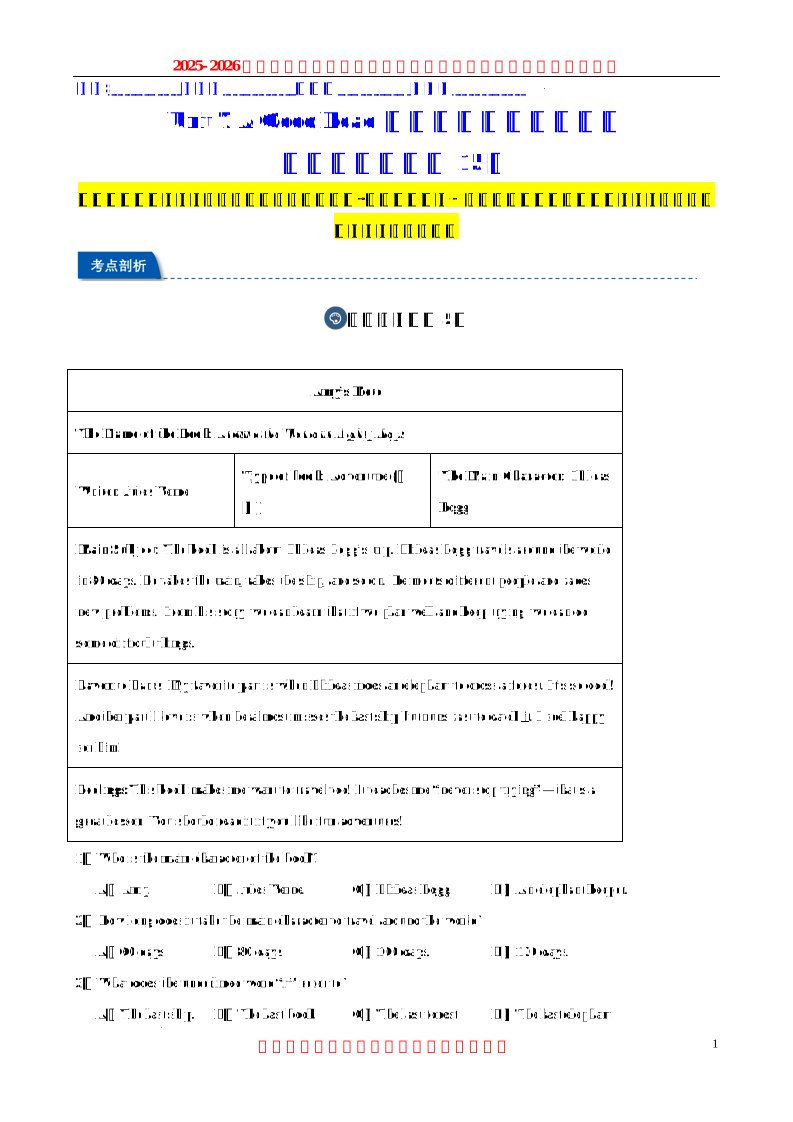
1

2

3
相关资源
由于学科网是一个信息分享及获取的平台,不确保部分用户上传资料的 来源及知识产权归属。如您发现相关资料侵犯您的合法权益,请联系学科网,我们核实后将及时进行处理。