江西九江六校2025-2026学年高一下学期期中联考英语试卷
 切换试卷
切换试卷
2026-05-28
|
11页
|
72人阅读
|
0人下载
资源信息
| 学段 | 高中 |
|---|---|
| 学科 | 英语 |
| 教材版本 | - |
| 年级 | 高一 |
| 章节 | - |
| 类型 | 试卷 |
| 知识点 | - |
| 使用场景 | 同步教学-期中 |
| 学年 | 2026-2027 |
| 地区(省份) | 江西省 |
| 地区(市) | 九江市 |
| 地区(区县) | - |
| 文件格式 | DOCX |
| 文件大小 | 45 KB |
| 发布时间 | 2026-05-28 |
| 更新时间 | 2026-05-28 |
| 作者 | 匿名 |
| 品牌系列 | - |
| 审核时间 | 2026-05-28 |
| 下载链接 | https://m.zxxk.com/soft/58101876.html |
| 价格 | 1.00储值(1储值=1元) |
| 来源 | 学科网 |
内容正文:
高一英语
考生注意:
1.本试卷分选择题和非选择题两部分。满分150分,考试时间120分钟。
2.答题前,考生务必用直径0.5毫米黑色墨水签字笔将密封线内项目填写清楚。
3.考生作答时,请将答案答在答题卡上。选择题每小题选出答案后,用2B铅笔把答题卡上对应题目的答案标号涂黑;非选择题请用直径0.5毫米黑色墨水签字笔在答题卡上各题的答题区域内作答,超出答题区域书写的答案无效,在试题卷、草稿纸上作答无效。
4.本卷命题范围:人教版必修第一册至必修第三册Unit 1。
第一部分 听力(共两节,满分30分)
第一节(共5小题;每小题1.5分,满分7.5分)
听下面5段录音。每段录音后有一个小题,从题中所给的A、B、C三个选项中选出最佳选项。听完每段录音后,你都有10秒钟的时间来回答有关小题和阅读下一小题。每段录音播放两遍。
1. When is the man advised to leave?
A. At 1:00 pm. B. At 2:00 pm. C. At 3:00 pm.
2. How will the speakers probably go to the restaurant?
A. By bus. B. By car. C. On foot.
3. What will the woman do this afternoon?
A. Attend a French class. B. Study math with the man. C. Help the man with his homework.
4. What will the man do next?
A. Turn on the TV. B. Buy some snacks. C. Turn off the light.
5. Where are the speakers?
A. In a restaurant. B. In a street. C. At home.
第二节(共15小题;每小题1.5分,满分22.5分)
听下面5段录音。每段录音后有几个小题,从题中所给的A、B、C三个选项中选出最佳选项。听每段录音前,你将有时间阅读各个小题,每小题5秒钟;听完后,每小题都有5秒钟的作答时间。每段录音播放两遍。
听第6段录音,回答第6、7题。
6. How does the woman probably feel?
A. Relieved. B. Worried. C. Annoyed.
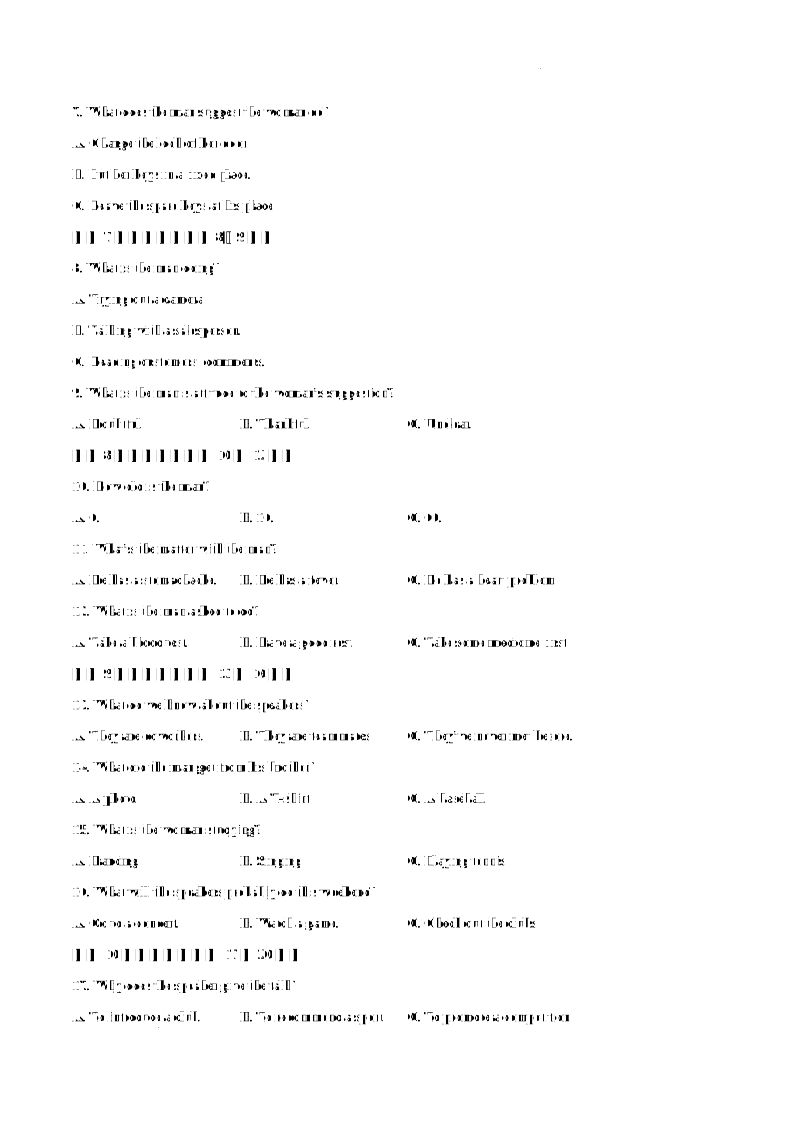
7. What does the man suggest the woman do?
A. Change the lock of her door.
B. Put her keys in a fixed place.
C. Leave the spare keys at his place.
听第7段录音,回答第8、9题。
8. What is the man doing?
A. Trying out a camera.
B. Talking with a salesperson.
C. Reading customers’ comments.
9. What is the man’s attitude to the woman’s suggestion?
A. Doubtful. B. Thankful. C. Unclear.
听第8段录音,回答第10至12题。
10. How old is the man?
A. 6. B. 16. C. 60.
11. What’s the matter with the man?
A. He has a stomachache. B. He has a fever. C. He has a heart problem.
12. What is the man asked to do?
A. Take a blood test. B. Have a good rest. C. Take some medicine first.
听第9段录音,回答第13至16题。
13. What do we know about the speakers?
A. They are coworkers. B. They are teammates. C. They’ve never met before.
14. What did the man get from his brother?
A. A photo. B. A T-shirt. C. A baseball.
15. What is the woman studying?
A. Dancing. B. Singing. C. Playing tennis.
16. What will the speakers probably do this weekend?
A. Go to a concert. B. Watch a game. C. Check out the clubs.
听第10段录音,回答第17至20题。
17. Why does the speaker give the talk?
A. To introduce a club. B. To recommend a sport. C. To promote a competition.
18. Where did the speaker start her straining?
A. At her uncle’s pool. B. At school. C. At a leisure centre.
19. What can we learn about Anna?
A. She was a former Olympic winner.
B. She was very strict with her students.
C. She often took her students to competitions.
20. How often did the speaker train when she was in the advanced class?
A. Twice a week. B. Three times a week. C. Every day after school.
第二部分 阅读(共两节,满分50分)
第一节(共15小题;每小题2.5分,满分37.5分)
阅读下列短文,从每题所给的A、B、C、D四个选项中选出最佳选项。
A
Here’s a guide to the best places to catch a live blues show in Austin, Texas, “the live music capital of the world”.
The Continental Club
Known as “the granddaddy of all local Austin music clubs,” the Continental Club never sees a slow night. Tourists and locals alike can’t resist its charm, which has remained close to its blue origins since it opened in 1955. In addition to its location in the heart of the city, this landmark is proud to offer live blue music shows every single night of the week.
Antone’s Nightclub
You can’t have a discussion about Austin’s blues scene without mentioning Antone’s. Opened by Clifford Antone in 1975, this world-famous nightclub has lived up to its fame as “Austin’s home of the blues” for decades. Its walls are covered with the stories of past blues greats like BB King, Stevie Ray Vaughan, and ZZ Top, all of whom often performed on the nightclub’s stage in the blues’ best time of the 1970s and 1980s. While shows in the other clubs have grown more eclectic (兼收并蓄) over the years, Antone’s still holds to the blues tradition.
C-Boy’s Heart & Soul
If the downtown places are not your dish, wander down to C-Boy’s Heart & Soul. Opened in 2013 and hidden deep in the historic South Austin, it is a small and quiet place that delivers an endless supply of good mix of blues, soul, and R&B seven days a week. If you need a little break during the shows, be sure to wander out to the spacious game room for some of the latest games. C-Boy’s has its own parking lot, an unusual advantage over any music club in Austin.
21. When was the “granddaddy” born?
A. In 1955. B. In 1975. C. In 1980. D. In 2013.
22. What can be learned about BB King?
A. He was one of the pioneers in blues. B. He helped some of the greatest musicians.
C. He was the co-founder of a nightclub. D. He often performed at Antone’s Nightclub.
23. What is unique about C-Boy’s Heart & Soul?
A. It offers various types of music. B. It is best-known for traditional blues.
C. It is open every day of the week. D. It has easy access to shopping centers.
B
When computer network came into existence, it was extremely difficult to use. To read an online story, for example, you would need to know which network-equipped computer had the story you wanted and then connect your machine to the computer directly.
But on April 30, 1993, that all changed thanks to the invention of the World Wide Web. Since then, users just need to type in an address. More importantly, anyone can build their own “website”.
The World Wide Web was the brainchild of Tim Berners-Lee, a 37-year-old researcher at CERN, a physics lab in Switzerland. But Berners-Lee thought that keeping the technology as open as possible to the public would help it grow.
The decision led to a rapid growth of internet users. By the end of 1995, more than 24 million people in the US and Canada alone spent an average of 5 hours per week on the internet.
It’s hard not to wonder what life would look like today if Berners-Lee hadn’t decided to give away the invention. In a 1999 interview, Berners-Lee was asked why he never cashed in.
“Your question suggests that you just measure people’s value by their net worth,” he responded. “People are what they’ve done and what they stand for, rather than what they happen to have in the bank.”
Since the World Wide Web went public, it’s totally changed how we communicate, gather, work and learn. However, it’s also expanded the reach of disinformation. Berners-Lee even predicted (预见) this problem decades ago.
“I don’t mind there being false information out there,” he said in the same interview. “The important thing is that users should know that the webpages they see are written by people. In a way, the internet is a reflection of the real world. Users should learn to know whether they’re looking at disinformation or not.”
24. Why did Berners-Lee give away his invention?
A. He didn’t know it was valuable. B. He had too much money in the bank.
C. He was under pressure to do so. D. He probably wanted to popularize it.
25. What is paragraph 4 mainly about?
A. The side effects of the internet. B. The protest from the public.
C. The significance of the decision. D. The advantages of the internet.
26. What did Berners-Lee suggest about the online disinformation?
A. It was unavoidable. B. It was totally unacceptable.
C. It should be stopped. D. It could be easily recognized.
27. Which of the following best describes Berners-Lee?
A. Ungrateful. B. Generous. C. Humorous. D. Irresponsible.
C
Since Born to Run, a book about long-distance barefoot runners in Mexico, was published in 2009, walking barefoot has gained popularity around the world, again. Over the years, a growing number of studies continues to show that going barefoot can increase foot strength, improve balance and reduce risk of falls.
A recent study, which focuses on improving the design of modern footwear, has even found that our shoes have affected our movements and even changed the structure of our feet. “For example, most shoes have a quite narrow toe box,” it writes. “It means our toes are pressed together and we can’t use our feet naturally. This may contribute to poor balance and even arch collapse (扁平足) over time.”
While those studies about the barefoot movement are promising, don’t throw out all of the shoes just yet, warn other researchers. They argue that switching (切换) to barefoot walking too quickly can be a recipe for injuries since our feet have adapted to them and have lost some of their strength. Plus, our feet are now very sensitive to anything but smooth, soft ground.
“That’s like having your arm in a cast (石膏) for years, ”says John Mercer, professor at the University of Nevada. “Then take it off, and the first thing you do is go out and play a game of tennis.”
Instead, Mercer recommends starting slow. “First, try walking around the house and outside on a soft surface. Then, go for a short walk around the block. Add a bit more distance each week,” he suggests. “Your feet will tell you when you’ve had enough. If you experience any sharp pain, stop.”
28. What does the new study most probably aim to do?
A. Show the benefits of barefoot walking. B. Warn the risk of walking without shoes.
C. Provide guidelines for barefoot walkers. D. Study the problems of modern footwear.
29. Which of the following can replace the underlined words “be a recipe for” in paragraph 3?
A. Lead to. B. Keep track of. C. Take advantage of. D. Get through.
30. What does John Mercer mean?
A. We can protect our feet with a cast. B. We must toughen up our feet gradually.
C. We should go for other exercises first. D. We have to do warm-up exercises each time.
31. In which section of a newspaper will this text most probably appear?
A. Literature. B. Technology. C. Sports. D. Environment.
D
Though Chicago has been well-known for marking St. Patrick’s Day by dyeing green the waterway flowing through the city since 1962, the tradition did not begin as an act of celebration. Instead, it was a part of the city’s effort to clean up the Chicago River, which had become so dirty and smelly that Upton Sinclair mentioned it in his famous novel The Jungle.
When Richard Daley took office in 1955, he was determined to develop the riverfront area and allowed city workers to use a special kind of green dye to find out where the waste water came from. In 1962, he was persuaded by his friend Stephen Bailey to dye the whole river to kick-start the official celebration of St. Patrick’s Day. Later, other cities, including San Antonio, Tampa, and Indianapolis, were inspired to adopt similar celebrations.
What you may not know, however, is that one year earlier, another city tried, unsuccessfully, to dye its river green for the Irish holiday. That city was Savannah. The greening effort failed because of the quickly moving tides. So the city dyed several of its fountains(喷泉) green, including the famous Forsyth Fountain.
“In the past, we accepted the practice in Chicago because there were larger problems facing the river. But as the health of the rivers has improved, perhaps it’s time to start considering new ideas,” said Margaret Frisbie, the manger of an environmental group.
Despite protests from environmental groups, the dyeing of rivers doesn’t seem to be going anywhere. Millions of people around the country braved the cold last weekend to celebrate and witness the annual tradition.
32. Why was the Chicago River dyed green during the 1950s?
A. To celebrate the St. Patrick’s Day. B. To experiment with a new dye.
C. To identify the source of the waste water. D. To cover up the dirty waste water.
33. Which was the first city to mark St. Patrick’s Day by dyeing the river green?
A. Savannah. B. Chicago. C. San Antonio. D. Tampa.
34. How does Margaret Frisbie feel about the new tradition in the US?
A. Excited. B. Worried. C. Unclear. D. Unconcerned.
35. What is the best title for the text?
A. When Did Americans Start Dyeing Rivers Green on St. Patrick’s Day?
B. Why Did Americans Dye the Chicago River Green on St. Patrick’s Day?
C. What Is Environmental Groups’ Response to the St. Patrick’s Day Traditions?
D. How Does Dyeing Rivers Green Become a St. Patrick’s Day Tradition in the US?
第二节(共5小题;每小题2.5分,满分12.5分)
阅读下面短文,从短文后的选项中选出可以填入空白处的最佳选项。选项中有两项为多余选项。
Most of you may agree that to become a conversational or fluent speaker in Chinese, you must immerse(沉浸) yourself in a Chinese-speaking environment in China. 36 . Luckily, there are plenty of ways to do so in your home country.
37
A formal Chinese course gives you an environment where you can cut yourself off from your native language and immerse yourself in Chinese, though you still have to try your best to speak as much Chinese as possible when communicating with your classmates and teachers.
Create an immersive environment
Try putting sticky notes on all your household objects in Chinese characters and pinyin so that you are reminded of them throughout your day. As an additional step, switch your mobile phone and computer’s default (默认的) language to Chinese. 38 .
Find a language partner
In addition, you need to find yourself a language partner to further increase your opportunities for speaking Chinese. Of course, it is better to have a native speaker as a language partner. 39 . Remember the goal here is creating an environment for you to use the language.
40 ?
If you are a university student, check out programs offered by your school’s Asian Studies or International Education departments. They usually host frequent international coffee hours or plenty of events in Chinese. It is very likely that you can find some suitable language partners there.
A. Sign up for a Chinese class
B. What kind of partners are suitable for you
C. Then how can you find yourself a language partner
D. Consume Chinese social media and entertainment
E. Such strategies may help you make your environment more Chinese
F. Yet many of you lack the time, money, or desire to spend a significant time in China
G. But even someone that is learning Chinese alongside you is also suitable for practice
第三部分 语言运用(共两节,满分30分)
第一节(共15小题;每小题1分,满分15分)
阅读下面短文,从每题所给的A、B、C、D四个选项中选出可以填入空白处的最佳选项。
In terms of social behavior, wild orangutans are very different not only from human beings but also from their cousins like monkeys, gorillas and chimpanzees. These animals are 41 as social animals. But the wild orangutans are lonely souls: Adult male orangutans usually stay 42 and adult females are accompanied only by their dependent children.
One morning, I went out to 43 wild orangutans. When I was rounding a turn, I saw a huge orangutan heading straight toward me. He was 44 very slowly, with his head down. Obviously, he was not aware of my 45 . Then he stopped less than twelve feet away. For a few seconds, he stared (瞪着) at me. But, 46 , I felt no fear. I was simply 47 by his beautiful orange coat in the sunlight. Suddenly, he turned around and 48 . There was nothing but the 49 of his feet padding (轻步走) off along the path. My 50 seemed to run contrary (相反) to the traditional belief that wild orangutans were 51 .
Back at camp, though, my workman, told me of a relative in Kumai who had 52 half of his hand and part of one foot to an adult male orangutan he had met. However, I 53 later that the relative had been running after the animal with his dogs. Other similar 54 always led to the same conclusion: Humans who were attacked had usually 55 the creature.
41. A. trained B. characterized C. saved D. used
42. A. alone B. outdoors C. quietly D. awake
43. A. care for B. play with C. concentrate on D. search for
44. A. dancing B. breathing C. walking D. reading
45. A. presence B. gift C. fear D. love
46. A. typically B. strangely C. embarrassingly D. naturally
47. A. angered B. frightened C. amazed D. confused
48. A. died B. rolled C. clicked D. escaped
49. A. weight B. shape C. sound D. print
50. A. experience B. faith C. view D. romance
51. A. rude B. smart C. short D. violent
52. A. cut B. lost C. eaten D. given
53. A. learned B. wished C. felt D. believed
54. A. animals B. images C. opinions D. accidents
55. A. documented B. appreciated C. threatened D. identified
第二节(共10小题;每小题1.5分,满分15分)
阅读下面短文,在空白处填入1个适当的单词或括号内单词的正确形式。
Born in 551 BC and 56 (raise) in a poor family, Confucius has made a greater 57 (contribute) to Chinese culture than anyone else in history. He developed his thoughts into a system of philosophy known as Confucianism 58 emphasized harmonious relationships with each other and respect for the elderly. It also stressed that friends should be honest to each other 59 that rulers should make an effort to provide a happy life for the people.
Confucius traveled around 60 (promote) his thoughts to the rulers but failed. He refused to give up and started to educate the ordinary people, many of 61 became famous scholars and 62 (power) government officials.
Since then, Confucius 63 (respect) as the greatest teacher as well as one of the greatest spiritual 64 (leader) in China. For over 2,500 years, his philosophy has continued to influence China and has been spread to the rest of the world. Nowadays, he is regarded 65 a symbol of Chinese culture.
第四部分 写作(共两节,满分40分)
第一节(满分15分)
假定你是李华。上周末,你参加了一次奇特的比赛:在森林里睡大觉。请给你的笔友Peter写一封电子邮件,内容包括:
1.比赛的规则;
2.分享你的感受。
注意:1.写作词数应为80个左右;
2.请按如下格式在答题卡的相应位置作答。
Dear Peter,
____________________________________________________________________________________________________________________________________________________________________________________________________________________________________________________________________________________
Best wishes,
Yours,
Li Hua
第二节(满分25分)
阅读下面材料,根据其内容和所给段落开头语续写两段,使之构成一篇完整的短文。
Holly boarded a plane at JFK Airport in New York City. She was excited to spend a year studying in France. Yet one thought bothered her throughout the flight: “Can they understand me?”
Her fears proved justified. Within days of arriving in France, Holly felt completely lost. Simple tasks, like ordering coffee or asking for directions, became exhausting battles. She felt very lonely and missed home terribly.
The only comfort came in a package from her mother. It was filled with Holly’s favorite treat: Skippy peanut butter, which was impossible to be found in France. She rushed to the post office to get the package. On the way, she even imagined herself opening the package and eating the comfort food right there!
But at the counter, the attendant couldn’t speak any English at all. Holly switched to her awkward French. However, the attendant just shook her head. The more she repeated herself, the more frustrated — and hopeless — she felt. Obviously, she couldn’t understand Holly’s French, either. Just as Holly was about to break down in tears — not just over the peanut butter, but over everything: the loneliness, the endless struggle to be understood — a gentle voice came from behind, “Can I help you?” Holly turned to see a French woman about her mother’s age, with kind eyes and a warm smile. Her name was Jouve.
After Holly explained her situation in English, Jouve placed a reassuring hand on Holly’s arm and spoke to the attendant in rapid, fluent French. Within two minutes, the package was handed over. Holly held it like a treasure.
On their way to the parking lot, Holly poured out her heart — the language barrier, the isolation, the homesickness. Jouve listened quietly, her eyes full of sympathy. Before they parted, she asked, “Why not join my family for dinner this Sunday?”
注意:1.续写词数应为150个左右;
2.请按如下格式在答题卡的相应位置作答。
That meal changed everything. _______________________________________________________________
____________________________________________________________________________________________________________________________________________________________________________________________________________________________________________________________________________________
Holly decided to pass on Jouve’s kindness to other international students. _____________________________
____________________________________________________________________________________________________________________________________________________________________________________________________________________________________________________________________________________
学科网(北京)股份有限公司
$
资源预览图

1
2

3
相关资源
由于学科网是一个信息分享及获取的平台,不确保部分用户上传资料的 来源及知识产权归属。如您发现相关资料侵犯您的合法权益,请联系学科网,我们核实后将及时进行处理。