江苏苏州市立达中学校2025-2026学年第二学期初三教学情况调研(二)英语
 切换试卷
切换试卷
2026-05-27
|
9页
|
5人阅读
|
0人下载
资源信息
| 学段 | 初中 |
|---|---|
| 学科 | 英语 |
| 教材版本 | - |
| 年级 | 九年级 |
| 章节 | - |
| 类型 | 试卷 |
| 知识点 | - |
| 使用场景 | 中考复习-二模 |
| 学年 | 2026-2027 |
| 地区(省份) | 江苏省 |
| 地区(市) | 苏州市 |
| 地区(区县) | - |
| 文件格式 | DOCX |
| 文件大小 | 149 KB |
| 发布时间 | 2026-05-27 |
| 更新时间 | 2026-05-27 |
| 作者 | 匿名 |
| 品牌系列 | - |
| 审核时间 | 2026-05-27 |
| 下载链接 | https://m.zxxk.com/soft/58082788.html |
| 价格 | 1.00储值(1储值=1元) |
| 来源 | 学科网 |
内容正文:
2025~2026 学年第二学期初三教学情况调研(二)
英 语
第一部分 完形填空(共 10 小题;每小题 1 分,满分 10 分)
请认真阅读下面短文,从短文后各题所给的 A、B、C、D 四个选项中,选出最佳选项,并在答题卡上将该项涂黑。
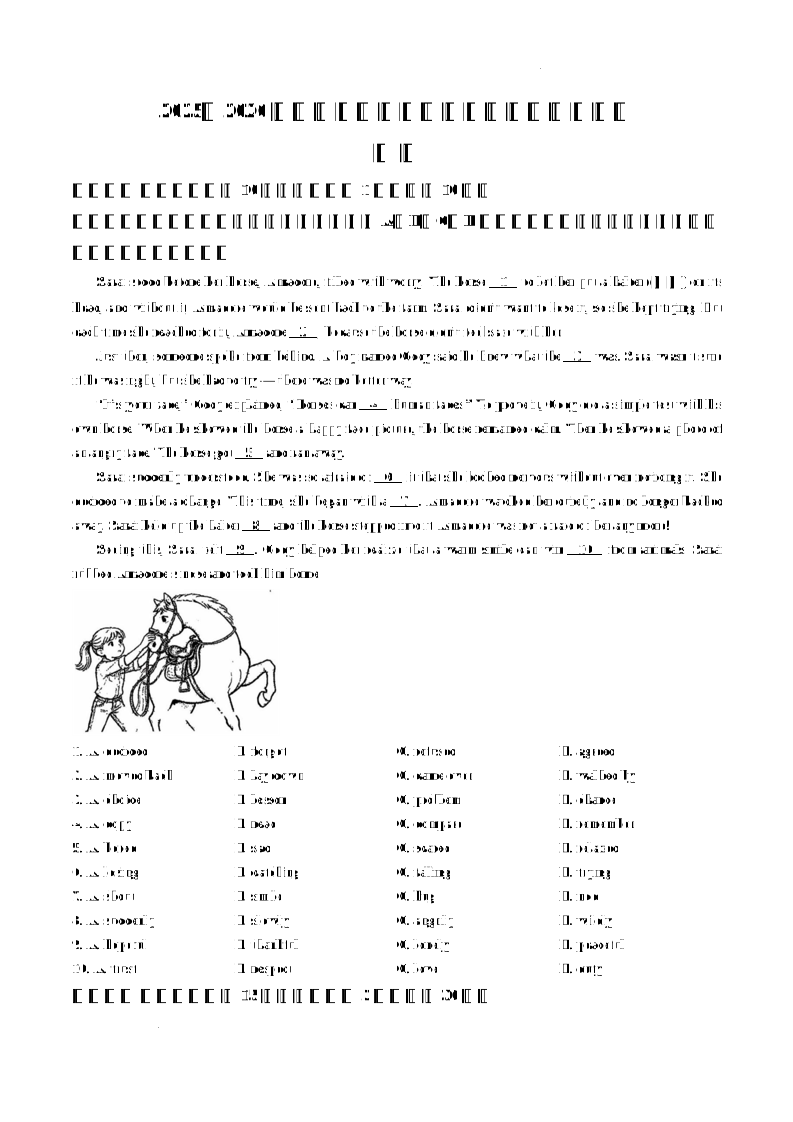
Sarai stood before her horse, Amadore, filled with worry. The horse 1 to let her put a halter (笼头) on its head, and without it, Amadore would be sent back to the farm. Sarai didn’t want to lose it, so she kept trying. But each time she reached for it, Amadore 2 , because the horse didn’t feel safe with her.
Just then, someone spoke from behind. A boy named Cody said he knew what the 3 was. Sarai wasn’t sure if he was right, but she had to try — there was no better way.
“It’s your face,” Cody explained, “Horses can 4 human faces.” To prove it, Cody did a simple test with his own horse. When he showed the horse a happy face picture, the horse remained calm. Then he showed a photo of an angry face. The horse got 5 and ran away.
Sarai suddenly understood. She was so afraid of 6 it that she looked nervous without even noticing it. She decided to make a change. This time, she began with a 7 . Amadore watched her quietly and no longer backed away. Sarai held up the halter 8 and the horse stepped into it. Amadore was not afraid of her any more!
Seeing this, Sarai felt 9 . Cody helped her realize that a warm smile can win 10 from animals. Sarai rubbed Amadore’s nose and took him home.
1. A. decided B. forgot C. refused D. agreed
2. A. moved back B. lay down C. came over D. walked by
3. A. choice B. lesson C. problem D. chance
4. A. copy B. read C. compare D. remember
5. A. bored B. sad C. scared D. relaxed
6. A. losing B. catching C. falling D. trying
7. A. shout B. smile C. hug D. nod
8. A. suddenly B. slowly C. angrily D. wildly
9. A. hopeful B. thankful C. lonely D. peaceful
10. A. trust B. respect C. love D. duty
第二部分 阅读理解(共 15 小题,每小题 2 分,满分 30 分)
请认真阅读下面短文,从短文后各题所给的 A、B、C、D 四个选项中,选出最佳选项,并在答题卡上将该项涂黑。
A
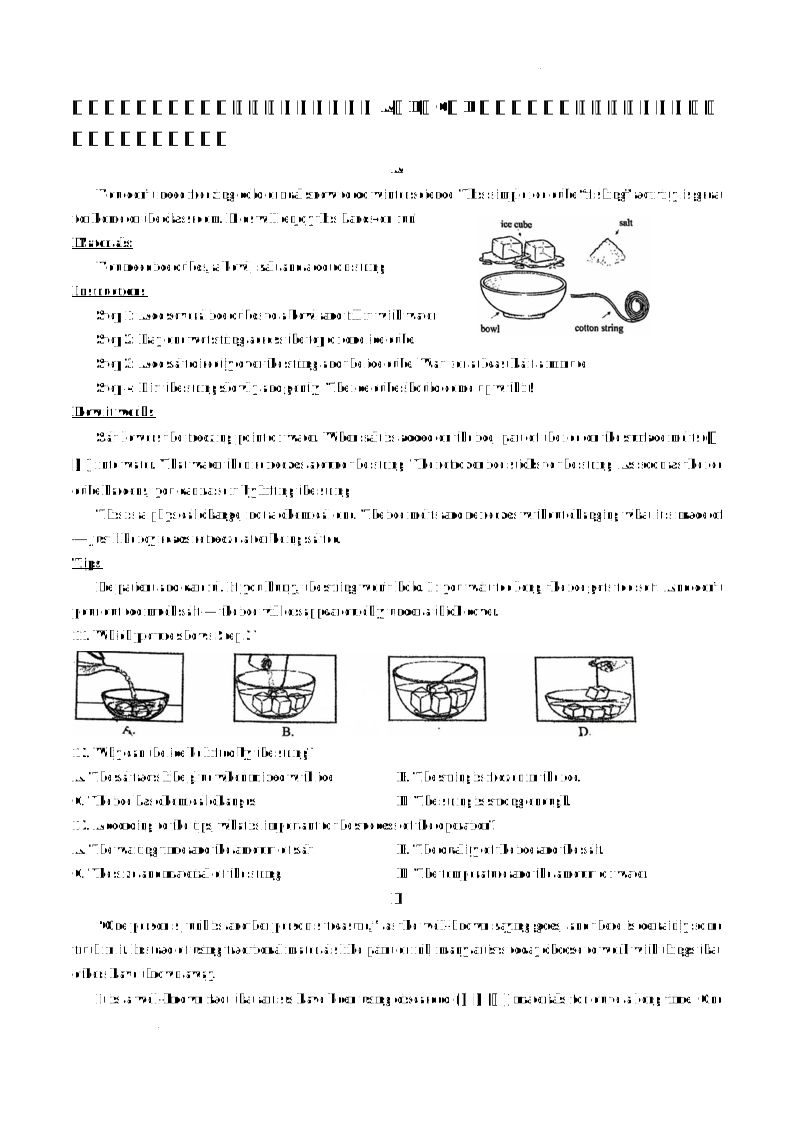
You don’t need freezing cold or real snow to do winter science. This simple ice cube “fishing” activity is great for home or the classroom. Kids will enjoy this hands-on fun!
Materials:
You need ice cubes, a bowl, salt and a cotton string.
Instructions:
Step 1: Add several ice cubes to a bowl and fill it with water.
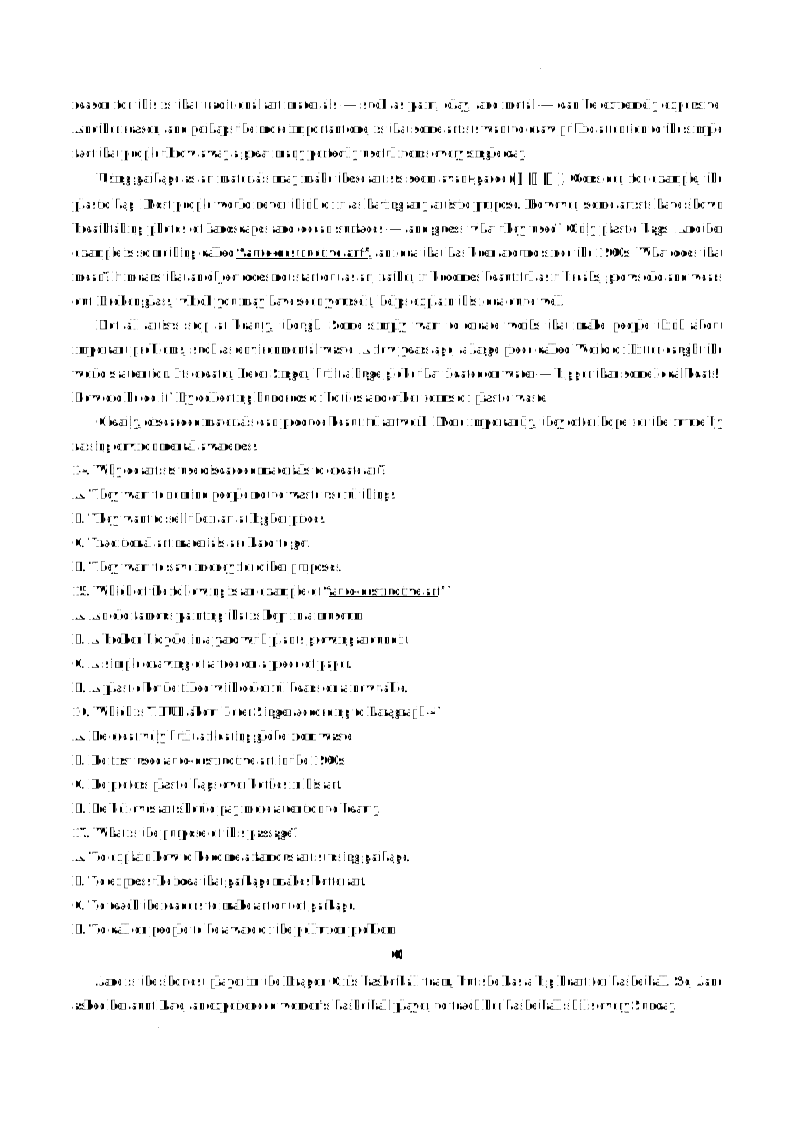
Step 2: Lay one wet string across the top of one ice cube.
Step 3: Add salt directly over the string and the ice cube. Wait for at least half a minute.
Step 4: Lift the string slowly and gently. The ice cube should come up with it!
How it works:
Salt lowers the freezing point of water. When salt is added on the ice, part of the ice on the surface melts (融化) into water. That water then refreezes around the string. The refrozen ice sticks to the string. As soon as the ice cube hardens, you can raise it by lifting the string.
This is a physical change, not a chemical one. The ice melts and refreezes without changing what it’s made of — just like icy roads refreeze after being salted.
Tips:
Be patient and careful. If you hurry, the string won’t hold. If you wait too long, the ice gets too soft. And don’t pour out too much salt — the ice will disappear quickly under a thick cover.
11. Which picture shows Step 2?
12. Why can the ice be lifted by the string?
A. The salt acts like glue when mixed with ice. B. The string is frozen in the ice.
C. The ice has chemical changes. D. The string is strong enough.
13. According to the tips, what is important to the success of the operation?
A. The waiting time and the amount of salt. B. The quality of the ice and the salt.
C. The size and material of the string. D. The temperature and the amount of water.
B
“One person’s junk is another person’s treasure,” as the well-known saying goes, and there is certainly some truth in it. Instead of using traditional materials like paint or ink, many artists today choose to work with things that others have thrown away.
It is a well-known fact that artists have been using discarded (废弃的) materials for quite a long time. One reason for this is that traditional art materials — such as paint, clay, and metal — can be extremely expensive. Another reason, and perhaps the more important one, is that some artists want to draw public attention to the simple fact that people throw away a great many perfectly useful items every single day.
Using garbage as art materials may make these artists seem avant-garde (前卫的). Consider, for example, the plastic bag. Most people would never think of it as having any artistic purpose. However, some artists have shown breathtaking photos of landscapes and ocean surfaces — and guess what they used? Only plastic bags. Another example is something called “auto-destructive art”, an idea that has been around since the 1960s. What does that mean? It means that an object does not start out as art; rather, it becomes beautiful as it breaks, grows old and wears out. Broken glass, which you may have seen yourself, helps explain this idea quite well.
Not all artists stop at beauty, though. Some simply want to create works that make people think about important problems, such as environmental waste. A few years ago, a large piece called World of Litter caught the world’s attention. Its creator, Peter Singer, built a huge globe that floated on water — bigger than some local boats! How did he do it? By collecting hundreds of bottles and other forms of plastic waste.
Clearly, discarded materials can produce beautiful artwork. More importantly, they offer hope for the future by raising environmental awareness.
14. Why do artists use discarded materials to create art?
A. They want to remind people not to waste useful things.
B. They want to sell their art at higher prices.
C. Traditional art materials are hard to get.
D. They want to save money for other purposes.
15. Which of the following is an example of “auto-destructive art”?
A. An old famous painting that is kept in a museum.
B. A broken bicycle in a yard with plants growing around it.
C. A simple drawing of a tree on a piece of paper.
D. A plastic bottle filled with colorful beans on a new table.
16. Which is TRUE about Peter Singer according to Paragraph 4?
A. He creatively built a floating globe from waste.
B. He first used auto-destructive art in the 1960s.
C. He prefers plastic bags over bottles in his art.
D. He believes art should pay more attention to beauty.
17. What is the purpose of this passage?
A. To explain how to become a famous artist using garbage.
B. To express the idea that garbage makes better art.
C. To teach the readers to make art out of garbage.
D. To call on people to be aware of the pollution problem.
C
Jane is the shortest player in the Dragon Girls basketball team, but she has a big heart for basketball. So, Jane asked her aunt Kate, an experienced women’s basketball player, to teach her basketball skills every Sunday.
The Dragon Girls lost their first three games of the season, leading Jane to ask her aunt Kate for some extra help. Kate spent hours training the players, focusing on their advantages. Mary was the best player in their team. Jane believed helping Mary improve was really important. As for herself, she just wanted to prove that she could play with the team. However, Kate told them “The biggest thing about basketball is to play together. It’s a team sport. “______”
The fourth game of the season was against the Tiger Girls. The Tiger Girls led 25-12 at halftime. But in the second half, the Dragon Girls played with better guarding plans and started to work well as a team. As the Tiger Girls began to make mistakes, Mary stole the ball! Jane raced to the other end of court and smoothly caught the long pass. The shortest Dragon girl shot a three-pointer from the corner.
The Dragon Girls fought back strongly. With just 10 seconds left, the Tiger Girls’ lead was down to one point. Jane ran towards the basket but was knocked down as the final bell sounded, just as Mary’s last shot failed to go through the net.
Final score: Tigers 41, Dragons 40. The Tiger Girls cheered loudly.
Kate appeared at the court where Jane was trying to hold back her tears.
“Congratulations,” Kate said to Jane loudly, for all players to hear.
“What? Why?” Jane voice shook. “We lost... again.”
“You did. But in that second half, you were really thinking and playing together. Today, I saw a team, and that team almost won.”
Jane dried her tears and smiled. “Thanks, Kate. And next time, we will win!”
18. Jane turned to Kate for further help mainly because ______.
A. she failed to get along with her teammates B. she wanted to become the top player
C. her team suffered three continuous losses D. Kate was free to train them all the time
19. What would be the best sentence in the “______”?
A. Playing to your own strengths leads to victory. B. Each member matters to make your team succeed.
C. Helping the best player makes the team stronger. D. Improving your personal skills helps win games.
20. What happened in the second half of the fourth game?
A. The Dragons Girls played worse than in the first half.
B. The Tigers Girls managed to shoot all the three-pointers.
C. The Dragons Girls got closer in scores to the Tigers.
D. The Tigers Girls played with better guarding and teamwork.
21. What can we infer about Jane from the whole story?
A. She cares more about teamwork than personal performance.
B. She feels upset and wants to give up after this failure.
C. She only aims to score three-pointers to win matches.
D. She thinks tall players are more important in basketball.
D
Have you ever felt your heart beat fast and thought, “I’m so angry!”? Why does this happen? In 1962, two scientists, Stanley Schachter and Jerome Singer, gave us an answer. They said our feelings come in two steps. First, our body has a physical reaction, like a fast heartbeat or sweating (流汗). Then, our brain looks at the situation and decides what emotion (情绪) we are feeling. So, the same fast heartbeat could be called fear, excitement, or anger, and our mind decides which one it is.
For a long time, many people believed that to stop feeling angry, you should get it out of your system. They might shout loudly or hit something like a desk — all ways of venting anger. The idea was that by letting the emotion out, it would go away. But is this true? In 2024, two researchers, Sophie Kjaervik and Brad Bushman, decided to test this popular belief. They did not just do one small test. Instead, they carefully looked at the results of 154 different studies from around the world. In total, these studies asked 10,189 people of all ages about their anger. This big, careful way of studying makes their findings very strong and trustworthy.
Their research showed that the common idea of “letting out “anger is often wrong. Activities like running fast or boxing, which make your body more active and your heartbeat even faster, are not very helpful. In fact, they can sometimes make you feel angrier. Why? Because these activities increase the alarm signs (like a racing heart) that is part of the anger feeling. If you add more, the feeling can grow.
So, what does work? The study points to a much calmer path. Since emotions are a mix of body and mind, calming the body is key. The best ways to reduce anger are activities that calm your body down. This includes deep breathing, yoga, clearing your mind, or a quiet walk. These activities slow your heartbeat and help your body relax. Once your body is calm, your mind can also calm down and see the situation more clearly. Interestingly, some fun group activities, like playing a ball game, can also help. The fun and play help push away the anger.
The lesson is clear: next time you feel anger building, don’t feed the fire with more excitement. Try to cool the fire down, first in your body, and then in your mind.
22. According to Schachter and Singer’s theory, what happens first if you see a snake?
A. You get the feeling of fear. B. You decide whether it is dangerous.
C. Your heart starts beating fast. D. You run away from the snake at once.
23. What does the underlined word “venting” probably mean in Paragraph 2?
A. Expressing. B. Hiding. C. Avoiding. D. Imagining.
24. What is the main finding of the new study?
A. Letting out anger through high-energy activities is helpful.
B. Making your heartbeat faster is key to dealing with anger.
C. Fast-running and boxing are the best ways to manage anger.
D. To reduce anger, it is better to calm the body than to excite it.
25. What is the writer’s suggestion for dealing with anger?
A. Let the anger out quickly. B. Try to calm your body down.
C. Think about the situation clearly. D. Find a group of friends to play with.
第三部分 信息还原(共5小题;每小题1分,满分5分)
请认真阅读下面短文,从短文后的选项中选出能填入空白处的最佳选项,并在答题卡上将该项涂黑。选项中有两项为多余选项。
Have you ever seen a robot doing kung fu? At the 2026 Spring Festival Gala, Chinese humanoid robots put on a special kung fu show called Wu-BOT, together with young kung fu students. 27 Moves like these were once thought impossible for machines. At one fantastic moment, one of the robots suddenly fell flat on his back. Just as the audience began to wonder what was happening, he rose smoothly to his feet. 2
This wasn’t the first time that robots appeared at the Spring Festival Gala. In 2025, some robots could perform a traditional dance called yangge. 28 It needs higher requirements. For example, the robots had to calculate (计算) their movements 2,000 times per second to stay balanced! From YangBot to Wu-Bot, it’s unbelievable that the robotics technology progressed so rapidly in just the past year.
Foreign newspapers and media quickly wrote about the robot performance. Many of them were amazed by how well the robots moved and worked together. 29 Others praised how robots perfectly mixed traditional culture with modern technology.
30 As Director Yu Lei said, “We hope to spread the power of science and technology, and let it grow well along with our own culture.”
A. But kung fu is much harder than dancing.
B. They did rapid running with formation changes, Drunken Boxing, and even Carp Jump.
C. In the future, robots may work in places like hospitals and disaster zones.
D. It turned out to be a trick — a classic Drunken Boxing move.
E. Some said it showed China’s leading role in robotics technology.
F. Videos of this year’s show have received lots of likes online.
G. The mix of AI technology and traditional arts shows the world the beauty of kung fu.
第四部分 词汇运用(共13小题;每小题1分,满分13分)
第一节 根据下列句子所给汉语注释或首字母,在答题卡标有题号的横线上,写出空缺处各单词的正确形式。每空限填一词。
31. It is said that Biluochun was named by Emperor Kangxi d______ his third southern tour.
32. The tea has a special sweet smell of flowers and fruits because of its special geographical ______ (条件).
33. A daily cup of this tea works well for people’s health. E______ in summer, Biluochun brings coolness and calm.
34. However, Biluochun should not be d______ on an empty stomach. The strong tea may make people feel uncomfortable.
35. In the past, farmers only ______ (依靠) on old experience to grow tea trees. They had to work hard day and night.
36. Modern technology has made a great d______ to tea making.
37. They use AI to help check tea trees every day and find ______ (隐藏的) dangers early.
38. Some young people even sell Biluochun online, ______ (分享) tea culture with the world.
第二节 请认真阅读下面短文,从方框中选择适当的单词或短语,在答题卡标有题号的横线上,填入其正确形式。每个单词或短语仅用一次。
because of peaceful move carry out true
The film Dear You is rather touching. It 39 plenty of people across the whole nation so far. Many years ago, a young man left his hometown to work far away.
40 a serious sudden illness, he passed away and failed to return home as he had promised. One kind-hearted local person made up her mind 41 his unfinished promise and kept writing letters in his name.
The elderly grandma stayed strong and faced loneliness bravely. She spent her long waiting days in 42 Every audience can 43 feel the great power behind her lifelong waiting and praise the grandma’s brave and firm spirit.
第五部分 短文填空(共10小题;每小题1分,满分10分)
请认真阅读下面短文,在答题卡标有题号的横线上,填入一个适当的单词或括号内单词的正确形式。
Spider silk is one of the strongest 44 (material) in nature. It is stronger than steel and even tougher than Kevlar, a super strong man-made fiber. However, spider silk is much 45 (light) and softer.
Spiders produce this amazing material from 46 (they) bodies to build webs. The web acts as a trap to catch insects. When an insect flies into the web, the silk pulls instead of breaking. This allows the web 47 (hold) the struggling insect firmly.
Scientists are very interested in learning 48 spiders make this silk. If it 49 (produce) in labs, we will be able to use it to make lightweight clothes for soldiers or strong ropes for climbers. 50 challenge is that the cost is too high to produce large amounts of it cheaply.
Unlike silkworms, spiders are 51 (friend) and will attack each other. Therefore, it is impossible to raise thousands of spiders together. Now, researchers are trying to put the spider genes (基因) 52 other animals like goats. The goats then produce the silk protein (蛋白) in milk. It is amazing to think that we might get spider silk from a goat one day!
By 53 (study) nature, we can find ways to solve many of our engineering problems. In the future, this technology might even help us create medical dressings that heal wounds faster.
第六部分 阅读表达(共3小题,54题2分,55题2分,56题3分,满分7分)
请认真阅读下面短文,用英语回答短文后的问题,并将答案写在答题卡标有题号的横线上。
More and more places in China have started to have spring and autumn school breaks. Local governments want to reduce students’ study pressure, help people travel more easily and let families spend more time together. Up to now, 13 provinces have used this holiday system, and more cities are joining in.
Unlike the long summer and winter vacations, spring and autumn breaks are short. They come in each term and usually last 2 to 4 days, with a total of 6 days at most in a year. They often come with public holidays like Qingming Festival or National Day, so people can have a longer rest. This helps families avoid busy travel times and enjoy better parent-child time. For example, Chengdu in Sichuan Province said each break will be 3 days, connected with weekends or public holidays.
The national government supports this holiday system. It encourages more cities to try it and make it work with paid holidays. Since March this year, at least seven provinces, such as Yunnan, Zhejiang and Shaanxi, have taken steps to let parents have more flexible (灵活的) rest time, so they can stay with their children over the breaks.
This policy has brought many good effects. Over 40% of people chose to travel before the May Day holiday this year, which helps the tourism, food and hotel industries develop. Besides, students can get close to nature, do practical activities and relax from study, which is good for their all-round development.
54. How many days can students have at most for spring and autumn breaks in a year?
_______________________________________________________________________________________
55. How does the national government support the holiday system?
_______________________________________________________________________________________
56. What would you like to spend most of your time on over the breaks? Why?
_______________________________________________________________________________________
_______________________________________________________________________________________
第七部分 书面表达(共1题;满分25分)
57.请根据以下图片内容及提示,结合你自身的经历,以 “Attitude Matters” 为题写一篇英语短文。
内容包括:
(1) 简要描述图片内容,并说出图片所表达的深层含义;
(2) 结合你的一次亲身经历,谈谈你的做法和得到的启示;
要求:
(1) 词数100词左右;
(2) 文中不得出现真实的姓名、校名等信息;
(3) 语言通顺,意思连贯,条理清楚,书写规范;
(3) 文章的开头已为你写好,不计入总词数。
参考词汇: attitude 态度 positive 积极的
Attitude Matters
Recently, I saw an interesting picture online. It shows___________________________________
_________________________________________________________________________________________________________________________________________________________________________________________________________________________________________________________________________________________________________________________________________________________________________________________________________________________________________________________________________________________________________________________________________________________________________________________________________________________________________________________________________________________________________________________________________________________
学科网(北京)股份有限公司
$
资源预览图
1
2
3
相关资源
由于学科网是一个信息分享及获取的平台,不确保部分用户上传资料的 来源及知识产权归属。如您发现相关资料侵犯您的合法权益,请联系学科网,我们核实后将及时进行处理。