江苏常州市钟楼区2026年九年级教学质量调研英语试题
 切换试卷
切换试卷
2026-05-27
|
9页
|
76人阅读
|
0人下载
资源信息
| 学段 | 初中 |
|---|---|
| 学科 | 英语 |
| 教材版本 | - |
| 年级 | 九年级 |
| 章节 | - |
| 类型 | 试卷 |
| 知识点 | - |
| 使用场景 | 中考复习-二模 |
| 学年 | 2026-2027 |
| 地区(省份) | 江苏省 |
| 地区(市) | 常州市 |
| 地区(区县) | 钟楼区 |
| 文件格式 | DOCX |
| 文件大小 | 216 KB |
| 发布时间 | 2026-05-27 |
| 更新时间 | 2026-05-27 |
| 作者 | 匿名 |
| 品牌系列 | - |
| 审核时间 | 2026-05-27 |
| 下载链接 | https://m.zxxk.com/soft/58080554.html |
| 价格 | 1.00储值(1储值=1元) |
| 来源 | 学科网 |
内容正文:
2026 年九年级教学质量调研 2026.05
英语试题
学校 ______________ 班级 ______ 姓名 ____________
注意事项:
1. 本试卷满分为 90 分,考试时间为 100 分钟。
2.请将答案全部填写在答题卡上,在本试卷上答题无效。
一、积累与运用(共 20 分)
一、单项选择(共 10 小题;每小题 1 分,满分 10 分)
1. Taking part in the school art festival is my favorite. ____▲____ is more fantastic than it
A. Something B. Anything C. Nothing D. Everything
2. — Must we always be honest with our friends?
— No, you ____▲____. You can keep some personal secrets.
A. mustn’t B. needn’t C. can’t D. shouldn’t
3. Zhang Xue met countless failures on his road to the championship. ____▲____, he still chose to keep going forward firmly and his strong spirit finally led him to the final victory.
A. Moreover B. Therefore C. Otherwise D. Anyway
4. Many people think protecting the environment is difficult and needs big actions. In fact, creating a green world is often ____▲____ a matter of small good habits in our daily life.
A. simply B. nearly C. hardly D. mostly
5. ____▲____ poor eyesight has become a common problem among teenagers, schools should cut down unnecessary screen-based homework.
A. Although B. Since C. Unless D. Unless
6. Many students feel at a loss when unexpected troubles ____▲____ in their study and daily life.
A. break into B. break down C. break out D. break up
7. Every spring, Hongmei Park in Changzhou becomes a lively ____▲____ where flowers, ancient architecture, and happy laughter come together.
A. sight B. memory C. experience D. scene
8. Could you please tell me ____▲____ and whether he needs any help over these days?
A. what has happened to the new student
B. where he had arrived in the city
C. how long he has joined our school football team
D. when did the new student arrive here
9. — I’m always left out by my classmates and feel bad about myself.
— Cheer up! ____▲____. Everyone will have his shining moment.
A. Every dog has its day B. Practice makes perfect
C. Rome was not built in a day D. Actions speak louder than words
10. —How would you like your coffee, Sir?
— ▲ .
A. That’s all right. B. Pretty good.
C. With some sugar, please. D. No, thanks.
二、完形填空(共12小题;每小题1分,满分12分)
阅读下面短文,从短文后各题所给的A、B、C、D四个选项中,选出最佳选项。
I once worked in the remote but beautiful countryside. In my experience, all farm work can train a person to develop a Spartan spirit (斯巴达精神)
From the age of eight, I had to contribute my share of labour (劳动力) along with my parents and two elder brothers. On the hottest summer days when the air 11 flowed, I knelt in a paddy field (稻田) with my knees deep in mud (泥土). The bugs and worms in the water 12 into my skin, and the sun 13 upon my back. Sweat (汗) 14 down; if a drop ran into the eyes, it would 15 tears. So I always kept my face as low as possible.
I told myself, “Be 16 !” If my parents and brothers could go on taking it, so could I. Slowly I pulled myself together and dragged (拖;拽) myself 17 . I learned not to be afraid of difficulties and the meaning of “you will harvest what you plant.”
“Judge a man not by his face, but by his 18 ” my mother used to say. The land is dependable as long as you are willing to work on it. When the wind blew and the rice plants moved like 19 in the sea, breathtakingly beautiful, a deep sense of 20 appeared in my heart.
Although later I went into academic (学术的) research, I shall always remember 21 working in the paddy fields taught me: plant your feet firmly on the ground, never give up and you will be 22 .
11. A. gently B. hardly C. loudly D. usually
12. A. climbed B. fell C. cut D. bit
13. A. burned B. shone C. lit D. spread
14. A. turned B. calmed C. streamed D. laid
15. A. hold B. produce C. drop D. replace
16. A. quick B. proud C. quiet D. patient
17. A. toward B. forward C. upward D. downward
18. A. fields B. books C. clothes D. appearance
19. A. boats B. water C. fishes D. waves
20. A. confidence B. excitement C. pride D. direction
21. A. what B. how C. why D. when
22. A. encouraged B. educated C. rewarded D. comforted
三、阅读理解(共 14 小题;每小题 2 分,满分 28 分)
阅读下列短文,从短文后各题所给的 A、B、C、D 四个选项中,选出最佳选项。
A
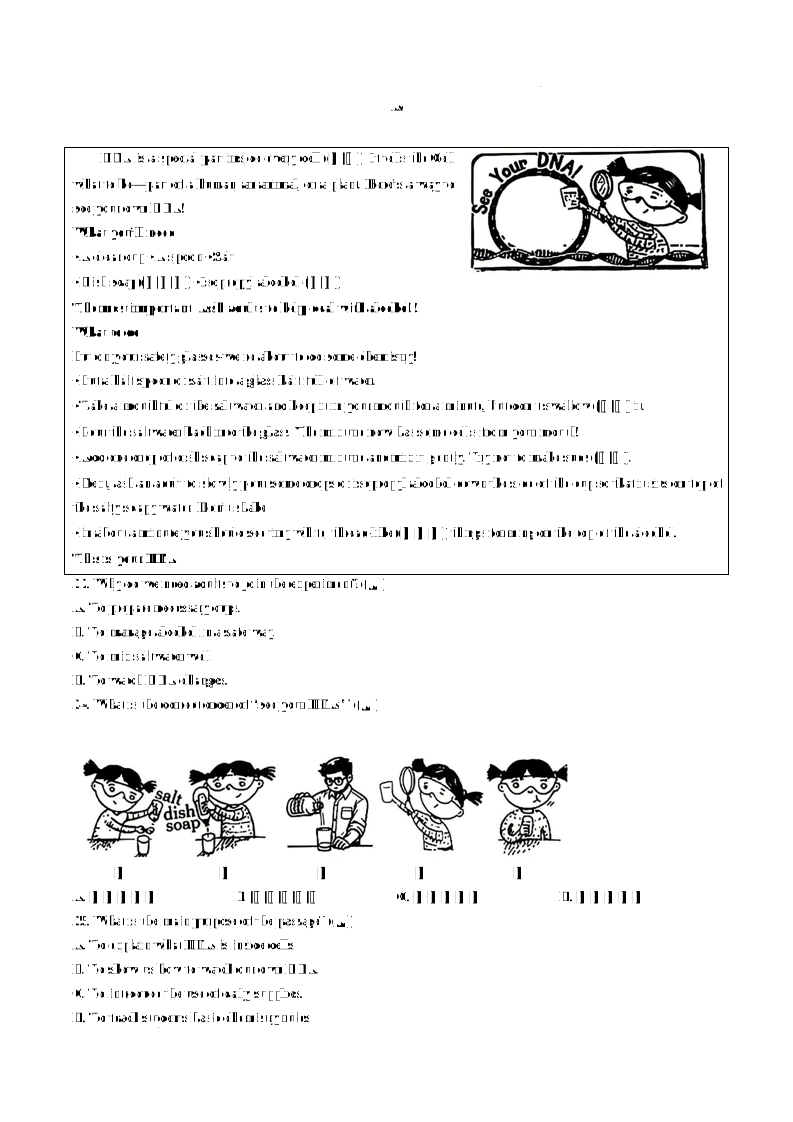
DNA is a special part inside every cell (细胞). It tells the Cell what to be—part of a human, an animal, or a plant. Here’s a way to see your own DNA!
What you’ll need
♦A clear cup ♦A spoon ♦Salt
♦Dish soap (洗洁精) ♦Isopropyl alcohol (酒精)
The most important! Ask adults to help deal with alcohol!!!
What to do
Put on your safety glasses-we’re about to do some chemistry!
♦Put a half spoon of salt into a glass half full of water.
♦Take a mouthful of the saltwater and keep it in your mouth for a minute, but don’t swallow (吞咽) it.
♦Pour the saltwater back into the glass. The mixture now has some cells from your mouth!
♦Add one drop of dish soap to the saltwater mixture and mix it gently. Try not to make suds (泡沫).
♦Next, ask an adult to slowly pour some drops of isopropyl alcohol down the side of the cup so that it sits on top of the salty soapy water. Don’t shake.
♦In about a minute you should see tiny white, thread-like (线形的) things forming on the top of the alcohol.
This is your DNA!
23. Why do we need adults to join the experiment? (▲)
A. To prepare necessary cups.
B. To manage alcohol in a safe way.
C. To mix saltwater well.
D. To watch DNA changes.
24. What is the correct order of “see your DNA”? (▲)
① ② ③ ④ ⑤
A. ①⑤②③④ B. ①②③⑤④ C. ①②④⑤③ D. ②④①③⑤
25. What is the main purpose of the passage? (▲)
A. To explain what DNA is inside cells.
B. To show us how to watch our own DNA.
C. To introduce the use of daily supplies.
D. To teach students basic chemistry rules.
B
This summer I came face-to - face with three deep-rooted fears: heights, bears, and aging.
Two friends joined me on a four-day wilderness getaway, and since we were all in our seventies, we decided we’d better go while we still could. Our adventure began with a scary drive up a winding mountain road.
On one hike, I found myself hanging onto a wire on a bridge made of two partly rotten (腐烂的) logs, suspended high above rushing rapids. I would never have attempted (尝试) it without our guide ahead, mouthing encouraging words. Fixing my eyes on her boots, I inched along the shaky logs. Somehow, I made it across, flooded with a rush of intense excitement and huge relief.
Later, after spotting bear tracks, we were told to make loud noises, which soon became a game once the tension faded.
Until suddenly, time stood still.
We had just crossed a stream when the guide whispered, “There’s a bear.” I looked up in disbelief and saw not one, but two, about ten meters above us — the brown mother in front, her cub behind.
Though scared speechless, I couldn’t help noticing how beautiful they looked in their natural setting. I wondered if it would be my last memory. As they started towards us, we recovered enough to shout and wave our hiking poles. Taken aback, they stopped, and then slowly turned away. Another fear was overcome!
On our final morning, after a quiet, thoughtful walk through the forest, we were asked to bring back a “meaningful” stick, rock, and leaf to share what would “stick” with us, what “rocked, ” and what we would “leaf” behind. The bond of friendship would stick with me. Women supporting one another truly rocked. And I hoped to leave some fears behind.
Our guide ended by expressing her admiration, praising not only our fitness but also our positive attitude, and saying she hoped to be like us in another thirty or forty years. Those unexpected words warmed my heart and eased my fear of being “over the hill.” Being valued for what we had accomplished felt like winning an Olympic medal — even if just for participation.
26. How did the author cross the bridge? (▲)
A. By taking careful steps.
B. By rushing across it bravely.
C. By using her sense of direction.
D. By having the guide drag her over.
27. Why did the bears leave? (▲)
A. They were attracted by the natural setting.
B. They were afraid of the noise of the rapids.
C. They were surprised at the group’s actions.
D. They were threatened by the guide’s rocks.
28. What is the best title for the passage? (▲)
A. How to Stay Positive in Daily Life B. Unforgettable Moments with Animal Friends
C. A Meaningful Journey in Old Age D. Facing Fears on a Wilderness Trip
C
We are currently living in a digital era where short videos, instant news and fragmented (碎片化的) information fill every aspect of our daily lives. An increasing number of people have got used to effortless and rapid reading, giving up the habit of reading physical books. In April 2026, China started a national deep reading campaign, which quickly caused widespread concern and heated discussions among students, parents and teachers.
Deep reading is completely different from the shallow reading we often do nowadays. It refers to the careful and in-depth reading of complete books, classic essays and great works. It requires us to read with patience, think systematically (系统地) and understand the core ideas thoroughly. Besides, it enables us to deeply share the strong feelings and wise thoughts passed on by great writers.
However, fragmented reading brings a lot of problems. Short-video apps and information platforms tend to make people read in a lazy and passive way, making it difficult for them to keep their attention
for a long time. As a result, their abilities in logical (碎逻辑上) thinking and in-depth understanding are gradually becoming weaker. A large number of teenagers find it hard to finish reading a single full book within a month, and they get a one-sided or even wrong understanding of the world through the fragmented information online.
It is worth noting that the national deep reading campaign does not refuse digital reading completely; instead, it is against shallow, fragmented and utilitarian reading styles. To promote deep reading, public libraries have extended their opening hours and set up special reading areas. Schools have made practical reading plans and stopped meaningless exam-oriented training that only focuses on answering questions. Communities also hold reading sharing meetings to encourage people’s enthusiasm for reading.
Educational experts strongly support this campaign. They point out that deep reading is not just a way to get knowledge; it also plays an important role in shaping people’s good personalities, developing critical thinking skills and passing on traditional culture. In an era full of fast-consuming information, sticking to deep reading can help people get rid of information anxiety, form independent judgment and avoid being easily led astray by wrong online public opinions.
In fact, although deep reading needs time and effort, it brings great benefits. It makes our thinking sharper, enriches our spiritual world and makes our lives more meaningful.
29. What is the characteristic of deep reading? (▲)
A. It means quickly going through online news and short passages.
B. It requires reading whole books carefully, thinking deeply and systematically.
C. It focuses on getting the main ideas of classic works in a short time.
D. It helps readers understand only the strong feelings of the writers.
30. Why does the author talk about “short-video apps and information platforms” in Paragraph 3? (▲)
A. To praise how easy and fast they are for today’s readers.
B. To tell why teenagers cannot finish a book in a month.
C. To show how fragmented reading makes logical thinking and attention worse.
D. To suggest that we should replace all digital reading with physical books.
31. What does the word “utilitarian” probably mean in paragraph 4? (▲)
A. useful and helpful B. related to real situations
C. easy to carry out D. caring only about quick gains or usefulness
32. What is the writer’s attitude toward the campaign? (▲)
A. Doubtful B. Worried C. Uninterested D. Positive
D
When people get old, they retire, and the same rule applies to power batteries in new energy cars, which play a crucial role in ensuring the normal operation of the vehicles. But unlike human retirement, these “retired” batteries still have great value and can be recycled through professional technologies. Recently, China has issued 22 national standards for the recycling of power batteries, which is an important measure to promote the green development of the new energy industry and protect the ecological environment.
As batteries are used for a long time, their performance will gradually decline, and when their capacity (容量) drops to 75 percent, they are basically no longer suitable for use in new energy cars.
What’s more, some harmful metals contained in these dying batteries not only pose a serious threat to human health but also may lead to fire explosions (爆炸), if they are not properly handled, according to a report released by the Australian Electric Vehicle Council.
Recycling these retired power batteries is of great significance to both the country and the environment. For example, China, which is a major consumer of lithium resources, imported about 5.25 million tons of lithium concentrate (锂精矿) in 2024 to meet the growing demand for new energy batteries. As reported by Xinhua News Agency, recycling lithium from used batteries can not only reduce the country’s dependence on imported lithium but also save a lot of resources and reduce the cost of battery production.
When it comes to recycling, hydrometallurgical recycling (湿法冶金回收) is a main way. It separates the battery’s electrodes (电极) from thin sheets of materials (材料薄板). Chemicals are used to break down the glue or burn it off. The remaining powder (粉末) is then mixed into a special liquid (液体). Useful metals are taken out through a method that puts two liquids that do not mix well together, like oil and water. This makes it easy to separate and collect the metals, said the Union of Concerned Scientists.
However, this recycling process may produce waste water and harmful gases, which will cause certain pollution to the environment if not properly treated. Fortunately, many enterprises are actively taking measures to solve this problem; for instance, BYD, a famous new energy car maker, burns the electrolytes (电解液) in the batteries at 1, 100 °C, turning them into harmless carbon dioxide and oxygen, and the remaining harmful gases will be completely removed after a second burn and rapid cooling.
33. Why are retired power batteries not allowed to be thrown away at will (任意)? (▲)
A. They still have 75% capacity for use.
B. They are hard to collect and transport.
C. They may bring harm to people and the environment.
D. They can be sold at a high price to recycling companies.
34. What’s the main advantage of recycling used power batteries? (▲)
A. It can help cut down China’s lithium imports.
B. It can make more new energy cars be produced.
C. It can reduce the number of fire explosions.
D. It can help companies make more money.
35. What does the underlined word “this” in Paragraph 4 probably refer to? (▲)
A. Breaking down the glue with chemicals.
B. Separating electrodes from material thin sheets.
C. Mixing the powder into a special liquid.
D. Using two immiscible liquids to take out metals.
36. What is the best title for the passage? (▲)
A. The Hidden Dangers of Retired Power Batteries
B. National Standards for Green Battery Development
C. Recycling: A Win-Win Choice for Batteries
D. The Development of New Energy Car Batteries
四、还原信息(共4小题;每小题1.5分,满分6分)
阅读下面短文,从短文后所给的六个选项中选出四个可以填入空白处的最佳选项。
Qian Xuesen was a world-famous great scientist. (37) ▲ . He is also widely known as “the King of the Rocket.” Thanks to his long-term hard research, China’s space technology has made rapid progress.
Qian was born in Shanghai on December 11th, 1911. At the age of 24, he went to America to study advanced space science. After finishing his study, he worked in top research centers there for years. In the early 1950s, he learned that New China had been founded. The good news made him decide to give up comfortable working conditions abroad. Although the American government tried to stop him from returning, he finally came back to China in 1955.
(38) ▲ . Then it became the leading center for China’s rocket and space travel research. At that time, Chinese research conditions were really poor. There was little money and few modern machines for space development. (39) ▲ . They kept working day and night to solve all kinds of problems. Finally, on April 24, 1970, China’s first man-made satellite “Dongfanghong I” was successfully sent into space.
Zhu Yilin, one of Qian Xuesen’s students, spoke highly of him. “I not only learned professional knowledge and strict working spirit from Mr. Qian. When our country was in great need of scientists, he gave up everything abroad and returned to serve the motherland. (40) ▲ .”
A. His selfless devotion to our country will always inspire us.
B. Qian Xuesen spent much time on art in his free time.
C. But Qian and his team bravely overcame all kinds of difficulties.
D. He is known as “the Father of China’s Space Program.”
E. In 1956, Qian Xuesen suggested setting up a special research organization.
F. Qian Xuesen refused to do space research in foreign countries.
五、阅读回答(第1, 2, 3题每题为2分,第4题为3分,满分9分)
阅读下面短文,回答短文后的问题(前3题每题答案不超过10个词)
Do you feel bored on your way to school or the park? Why not turn it into a treasure hunt? Now many people enjoy a new activity — the color walk.
The idea is simple: Pick one color and find things in that color.
I first started this last year. Some colors, like green, are easy. You can find it in traffic lights, grass and other things. Other colors, like gold, are hard to find. But I have enjoyed every color walk I’ve tried. When you look for a color, you start to notice things you wouldn’t normally have paid attention to.
Recently, I looked for the color blue while on a walk in the Beijing Olympic Forest Park. I found myself really taking the time to look at things, like the decorations on trees, the details on signs and even the color of people’s clothes as they walked by. In the end, I was amazed by how many blue things I could find, and I felt a real sense of satisfaction.
Xu Gaoyang, a therapist from Beijing, said that color walk fixes your attention on something outside and sets up a small, manageable goal. This keeps you present in the moment (专注当下), making you feel calm and relaxed.
Next time you go for a walk, give the color walk a try. You’ll realize how colorful our world truly is.
41. What’s the simple idea of the color walk ?
_______________________________ ▲ _
42. When did the writer start taking color walk?
_______________________________ ▲ _
43. What happened after the writer’s walk in the Beijing Olympic Forest Park?
_______________________________ ▲ _
44. Would you like to try the color walk? Why or why not?
_______________________________ ▲ _
六、综合填空(共 10 小题;每小题 1 分,满分 10 分)
阅读下面短文,在空白处填入一个适当的单词或括号内单词的正确形式。
Grain Buds 45. ▲ (call) Xiao Man in Chinese, and it is the 46. ▲ (eight) solar term of the year. It falls between May 20th and 22nd, a period when grains are growing full but not yet ripe. In northern China, the name suggests the “fullness” of crops, such as wheat and barley, which are gradually plumping up. While in the south it indicates an abundance of rain, providing sufficient water for rice planting and promoting the healthy growth of various crops.
During this time, temperatures rise 47. ▲ (wide) across the country, and the temperature difference between the north and the south becomes 48. ▲ (small) than before. However, a dry hot wind often appears in some northern areas, which can harm crops and affect their final yield. As a famous saying goes, “A heavy rainfall makes the river full.” So far, many traditional farming practices 49. ▲ (spread) from older generations to younger ones. The 50. ▲ (farm) wisdom, such as timely irrigation and pest control, is highly valued and still used today.
After Xiao Man, the weather changes greatly, 51. ▲ people should be careful to avoid catching a cold. The sudden temperature drop, especially after rain, makes it necessary 52. ▲ (keep) warm. The diet should be based 53. ▲ fresh and light vegetarian dishes, such as seasonal vegetables and porridge, which help people adapt to the changing weather. It is believed that a person 54. ▲ remains modest can achieve true growth, just like the grains at this solar term—growing steadily without being in a hurry.
七、书面表达(共 1 题,满分 15 分)
55.假如你校英文报正在举办以“Colorful Life”为主题的征文活动,请你结合自身经历,写一篇短文投稿。
提示:
1. What makes your life colorful?
2. What activities do you usually do to have a colorful life?
3. How do these activities make your life more colorful?
注意:
1.文中不得出现你的真实姓名和学校名称;
2.词数 100 左右;文章的开头已为你写好,不计入总词数。
I really think a colorful life makes everyone happier and better. ▲ ▲ ▲ ▲ ▲ ▲
学科网(北京)股份有限公司
$
资源预览图
1
2
3
相关资源
由于学科网是一个信息分享及获取的平台,不确保部分用户上传资料的 来源及知识产权归属。如您发现相关资料侵犯您的合法权益,请联系学科网,我们核实后将及时进行处理。